Backfire Step 3: REFRAME –Fraudulent Concealment of Fabricated Forensic test correction, False Statements Under Color of Law : Need to hold accountable

Screen Shot 2014-11-06 at 11.17.32 PMimgres-8

Laboratory developed tests (LDTs) have no FDA or CLIA oversight.  Avoiding regulatory oversight is just one of the ways those involved in the use of these tests avoid accountability.  Without answerability to third parties they have essentially removed themselves from consequences.

College of American Pathologists (CAP) accreditation is the sole avenue for complaint.  CAP does not sanction.  They only have the ability to educate lab to come under compliance with CAP standards under threat of loss of accreditation and it is under this threat that they can force a laboratory to correct both unintentional and intentional errors.  This is what was done in my case.

I filed a complaint with CAP in January of 2012.  The “Litigation packet ” showing forensic fraud was sent to CAP and I was informed that the investigation could take many months.    In October of 2012 I was suddenly reported to the Board of Registration in Medicine for  “noncompliance” with AA meetings (that were the sole and direct result of this test) and action was taken against my medical license which resulted in my suspension.

In December of 2012,  the Chief Investigator for CAP, Amy Daniels  called me to see how I was doing in light of the “amended” test.  She told me that the test had been invalidated on October 4, 2012.   I told her this was news to me as I was in the process of being suspended for “noncompliance” and called the Director of Operations at Physician Health Services (PHS) Linda Bresnahan who predictably told me she was unaware of any revision to the test.

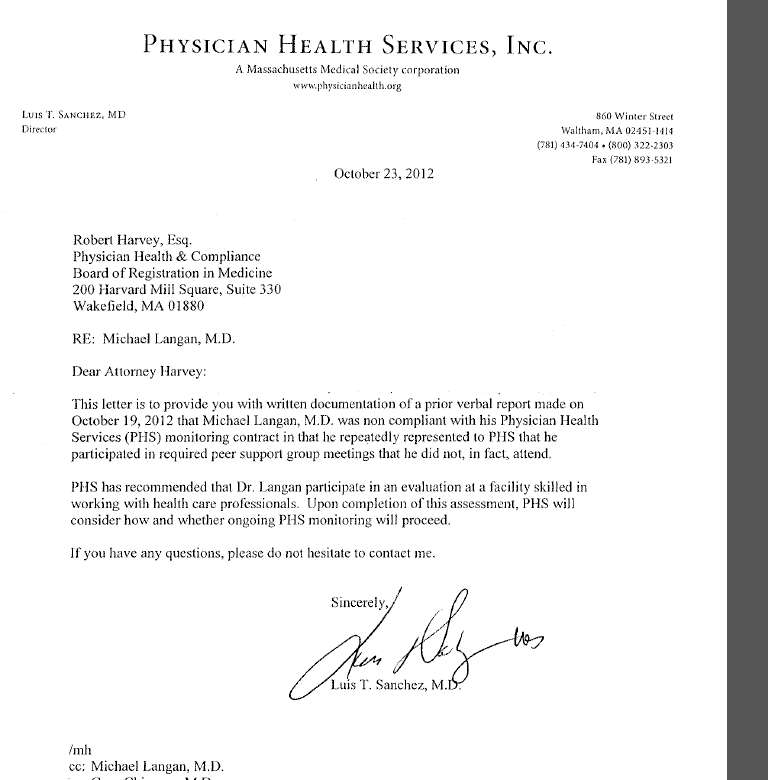
But the very next day a letter was  sent out  signed by PHS Medical Director Dr. Luis Sanchez, M.D. stating that they had just  found out about the amended test on December 10. 2012, the day before when I called them.  Interestingly the letter acknowledged the invalidity of the test but  stated PHS and the BORM would  “continue to disregard” it.  Sanchez also made it a point in the letter to state they were  were not aware of any consequences resulting from it.  They denied any knowledge of an October 4, 2012 revision which would have been 67-days earlier than this acknowledgment and dismissal of the test.

In response to 93-A demand letters from my attorney for fraud, PHS, Quest and USDTL all refused to consider any damages by blaming my suspension on me.   They claimed my suspension was due to my “noncompliance” with attending AA meetings that was officially reported to the Board October 18, 2012.     The claimed the test that was used as a stepping-stone for all subsequent adverse events was completely irrelevant and had nothing to do with anything.    This is what is known as “moving the goalpost.”   What they did not know was that I would eventually be able to get the document proving they knew what they knew and when they knew it.

The response letters revealed important information that was previously only speculative with no way to prove.  Both labs, in defense, claimed that  the test was sent as “clinical” specimen at the request of PHS (an ultra vires out of scope act as they are a 503(B) charity. PHS is not a healthcare provider and is not authorized to practice medicine.

PHS and the labs were apparently unaware of the new HIPAA Privacy rule that requires labs to provide patients with their lab tests without approval from the agency ordering the test.  PHS had previously refused to provide labs by hiding under confidentiality and medical records regulations.

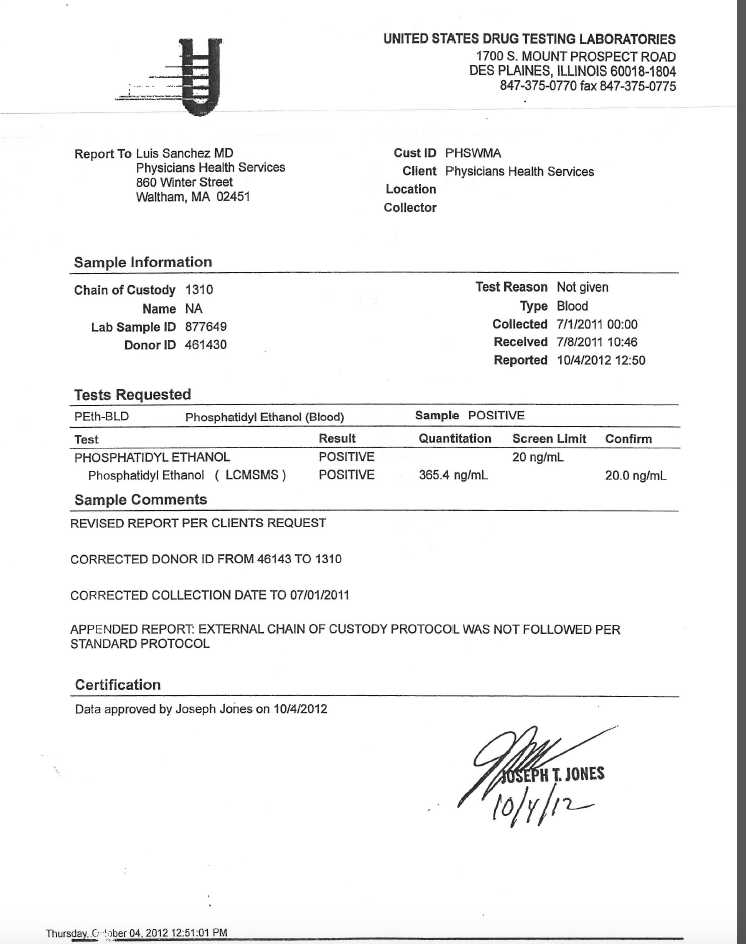
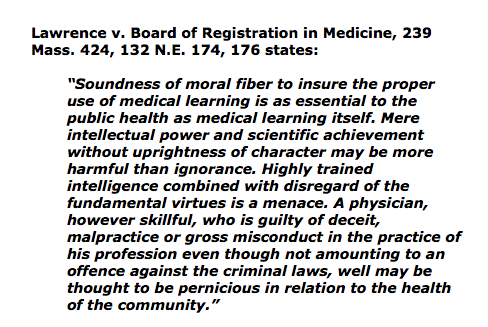
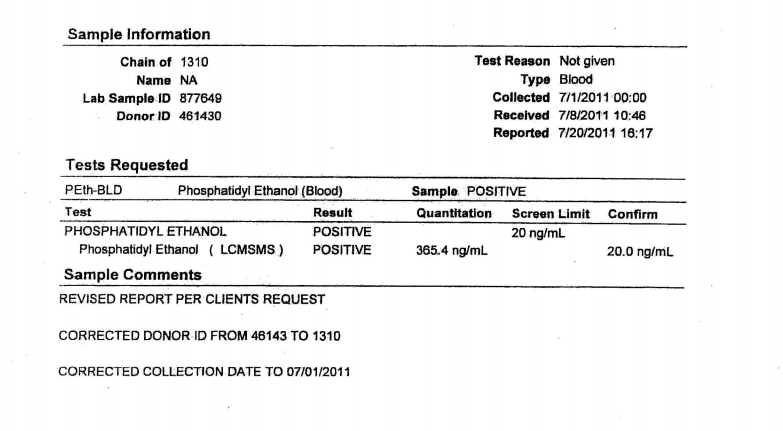
At first they refused but CAP and the DOJ -civil rights division forced USDTL to provide the document below dated October 4, 2012 informing Dr. Luis Sanchez of the amended test he reported in a signed letter to a state agency that he had just found out about December 10, 2012.  The letter undeniably shows Sanchez lied to a state agency in a written letter.  This is also a prima facie crime.  It is just one of many crimes that Board Attorney Deb Stoller has facilitated for PHS as her job is to ignore, suppress, minimize and deflect any criminal acts committed by PHS and protect them.  And this needs to be made public.  PHS needs to be held accountable.  So too do the actions of Ms. Stoller whose job as an agent of the state makes her involvement even more egregious than the perpetrators.

The documents below show a clear violation of M.G.L. 256 (B) Section 69 done under Color of Law.

Screen Shot 2014-11-10 at 1.34.48 PM

Title 18, U.S.C., Section 242
Deprivation of Rights Under Color of Law

This statute makes it a crime for any person acting under color of law, statute, ordinance, regulation, or custom to willfully deprive or cause to be deprived from any person those rights, privileges, or immunities secured or protected by the Constitution and laws of the U.S.

This law further prohibits a person acting under color of law, statute, ordinance, regulation or custom to willfully subject or cause to be subjected any person to different punishments, pains, or penalties, than those prescribed for punishment of citizens on account of such person being an alien or by reason of his/her color or race.

Screen Shot 2015-01-08 at 10.04.47 PM


Screen Shot 2015-04-07 at 4.52.21 AM

Screen Shot 2015-04-07 at 5.00.04 AM

Screen Shot 2015-04-07 at 5.00.40 AM

Screen Shot 2015-04-07 at 4.50.05 AM

Screen Shot 2014-11-10 at 1.34.48 PM

Screen Shot 2014-11-10 at 1.25.03 PM

False Statements Relating to Health Care Matters (18 U.S.C. § 1035) It is a crime to knowingly and willfully falsify or conceal a material fact, make any materially false statement, or use any materially false, fictitious, or fraudulent writing or document in connection with the delivery of or payment for health care benefits, items, or services. 11 Chapter 2 ~ Summary of Fraud and Abuse Laws


Mail and Wire Fraud (18 U.S.C. §§1341 and 1343)  Statutes, which prohibit the use of the mails or the wires to further “schemes” to defraud


Perjury and False Statements

PERJURY BY WRITTEN INSTRUMENT. 

FALSE STATEMENTS (18 U.S.C. § 1001)

This statute prohibits the making of any false, fictitious, or fraudulent statement to the United States or a government agency. This statute is exceedingly broad: It covers any statement or representation made to the government or any of its agents. A statement can be made either orally or in writing, and it can be sworn or unsworn.


Screen Shot 2014-11-10 at 1.36.13 PM

BTwgkTwCMAABmSA

Supression of Dissent: Basic Information

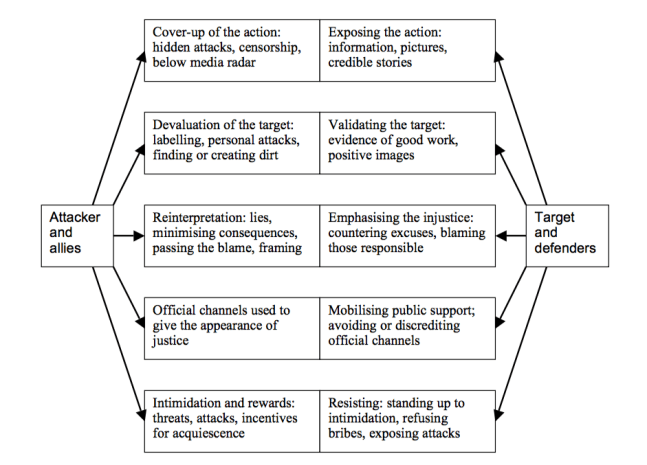
2. The keys to backfire

• “Reveal: expose the injustice, challenge cover-up

• Redeem: validate the target, challenge devaluation

• Reframe: emphasize the injustice, counter reinterpretation

• Redirect: mobilize support, be wary of official channels• Resist: stand up to intimidation and bribery”

via Helpful resources for those abused and afraid — via http://www.bmartin.cc .

Without Dr. William Morgan the 2004 Red Sox World Series win would not exist–a true Boston Hero

OLYMPUS DIGITAL CAMERAsox1

The essay below found on 123HelpMe.com called The “Doctor Who Saved Boston.” is about Dr. William J. Morgan, the brilliant hand surgeon who helped the Red Sox win the World Series for the first time in 86 years.  Morgan performed  surgery on Curt Schilling’s severely damaged ankle that allowed him to pitch in game 6 of the ALCS against the Yankees when we were down three games to two.
No known medical or surgical options existed to allow Schilling the functionality to pitch.  But just as things were looking bleak Dr. Morgan miraculously performed an unprecedented procedure he invented that allowed Schilling to pitch seven innings winning the game 4-2.   He created a wall of stitches to hold Schillling’s torn tendon sheath in place before game 6’s win and again before game 2 of the World Series that we also won.
And October 27. 2004 is a magical date for red sox fan.  Watching it unfold with my wife and daughters and the joy and excitement that followed is a vivid memory for me that I will never forget and it should be noted that without Dr. Morgan that night would never have happened.  Without Dr. Morgan the curse would not have been reversed.  He is a true Boston hero.   But, as with all of us, he is not perfect.  In November of 2003 he was arrested for driving under the influence and, as a Massachusetts doctor, he was mandated to Physician Health services (PHS) under a monitoring contract.  According to news sources from February of 2010 Dr. Morgan was forced to give up his right to practice medicine in Massachusetts as a result of “unspecified allegations” and reading these reports the assumption that he must have done something very wrong is assumed–a logical and rational conclusion based on how we assume the world works.
I was reminded of doctor Morgan because today is opening day for the Red Sox.  Over the past couple weeks I have been contacted on average four time a day by doctors who are currently suffering under their state physician health programs or by those who wanted to tell me of the circumstances surrounding the suicides of doctors they loved.  The stories  I have been hearing are heartbreaking and unreal but the patterns are the same. One of the most bothersome facts is that I have yet to hear from anyone who was truly an addict or alcoholic.  Like Dr. Morgan, some life event bought them a one-way ticket into a PHP and from that point on their lives and locus of control was placed in the hands of others.  Most of the doctors I have spoken to are good and kind doctors who were referred for situational factors and one-offs–mistakes or circumstances that were transient.  Many were given positive tests using the non-FDA approved laboratory developed tests (LDTs) and pulled out of practice resulting in suicide.
The “unspecified allegation” leading to Dr. Morgans 2010 loss of license was that he had a positive Phosphatidyl-ethanol (Peth) test ordered by Dr. Luis Sanchez and reported as positive by USDTL. And as seen here, these two cannot be trusted.   Intentional fraud perpetrated in this manner requires zero tolerance. It also brings into question the validity of all testing done by PHS and performed by USDTL.   It is extremely concerning that criminal acts done under color of law is not being addressed by the state medical society and the Department of Health (DPH).

The sociologist Stanley Cohen’s States of Denial: Knowing about Atrocities and Suffering (Polity Press, 2001) systematically analyzes processes of denial by both individuals and governments and describes five methods of denial:

1. Deny responsibility: “I don’t know a thing about it.”

2. Deny injury: “It didn’t really cause any harm.”

3. Deny the victim: “They had it coming to them.”

4. Condemn the condemner: “They’re corrupt hypocrites.”

5. Appeal to higher loyalties: “I owe it to my mates.”… 

None of these apply here.   I happen to know that the positive test  given to Dr. Morgan was not the result of anything he did.   Sanchez and Jones claim professionalism and high ethical standards but the undeniable evidence shows they are unethical individuals engaging in criminal acts.    These need to be exposed and those involved need to be held accountable.
Schadenfreude is a word taken from German and literally means “harm-joy.”   Along with psychopathy and narcissism. schadenfreude seems to be a common characteristic of those involved in PHPs.   Deriving pleasure in the misfortunes of others and particularly if that person is someone who represents what they could never be.   I understand they took particular pleasure in bringing down Dr. Morgan and he deserves to be restored to his status as a true Boston hero. The city of Boston and Red Sox fans everywhere have the responsibility to make sure they be charged criminally by law enforcement.   We owe it to Dr. Morgan and any others who have been victimized by the Massachusetts PHP.
curt-schilling-bloody-sock-2

The Doctor Who Saved Boston

The memories of the Red Sox run to the 2004 World Series championship this year will remain in the minds of Sox fans forever.   It is about Dr. William J. Morgan, a brilliant hand surgeon who performed a risky

Whether it is David Ortiz’s walk off performances against the Angels and Yankees, Manny Ramirez’s tape measure home runs, or Derek Lowe winning the clinching games of all three playoff series, Red Sox nation will not soon forget the memories that the “bunch of idiots,” as centerfielder Johnny Damon dubbed this year’s Sox club,provided them, nor will they forget the Sox all out assault on baseball and Boston sports history.

But of all the images the fans retain, of all the feelings they experienced, of all the heroes Sox nation put on an altar and worshipped – the most memorable has to be Curt Schilling pitching three games on an inured ankle, blood from broken sutures seeping through his sock and a look of obvious discomfort on his face, winning two, and capturing the heart’s of every member of Red Sox nation. images-37

But to understand the elation of the Nation and the reason that it has turned Curt Schilling into a God in the church that Cy Young, Ted Williams, and Carl Yaztremski built, we have to take a step back and remember the predicament that the Red Sox were in just over two months ago.

It was October 12, and the Yankees had beaten the Red Sox in Game one of the ALCS. It was only one game, but that familiar feeling was back. That familiar feeling that Red sox fans have of doom and gloom lingering just over the horizon returned.

Curt Schilling, the hired gun, the man who Sox management had brought in to beat the Yankees in just this situation, had not only lost the game, but looked utterly ineffective in doing so, allowing six runs in just three innings of work and the media was reporting that Schilling may not pitch again.

On June 10, reports came out on ESPN and in the Boston papers that Schilling had a minor injury to his ankle but that he would pitch through it and make his start that night and would not have to go on the disabled list.What came out later on in the papers was that Schilling had made the majority of his starts in the 2004 season only after undergoing shots of marcaine, which sportsinjuries.com describes as a long lasting local anesthesia that is used for pain management and works by blocking nerve sensations.The attitude that the Red Sox seemed to take toward Schilling’s injury was no harm, no foul, and after June little was heard about Schilling’s ankle, that is until October 5.October 5 was the beginning, and almost the end, of the Red Sox 2004 playoff run. It was a glorious, and infamous, day in Red Sox history. Curt Schilling pitched 6 and 2/3 strong innings at Anaheim, allowing just two runs and scattering nine hits as the Red Sox cruised to a 9-3 victory.

But late in the sixth inning, Schilling pulled up lame after fielding a slow roller down the first base line and throwing the ball over first baseman Kevin Millar’s head. He was favoring that same right ankle that had been hurting him all year.

Back to October 12, and the feelings of anxiety that every Sox fan from Maine to Rhode Island no doubt had in the pit of their stomachs. Questions were swirling around Boston. Just how serious was Schillings injury? Could he pitch again? Would he pitch again? Is there a God?

Jamie Musler, an assistant clinical specialist at Northeastern, put the injury into perspective.

Musler said that Schilling tore the tissue that covers his peroneal tendon, which sits in a small groove in the fibula and is partly responsible for moving and planting the foot. Musler said that this type of injury is caused by a traumatic event to the foot or ankle, like a significant ankle sprain, and when Schilling was moving his foot, the tendon was slipping out and causing an uncomfortable, but not necessarily painful, snapping sensation because the tendon was snapping across the fibula. This, Musler said, would directly affect foot mechanics and cause a huge problem in Schilling’s delivery.

And it would present a huge road block in Boston’s attempt to win a World Series title.

Schilling meant more to the 2004 Red Sox club than any other player. He was the tone setter and the ace, and without him the Sox would have no chance against the hated Yankees.

The Red Sox needed Schilling, because number two starter Pedro Martinez is not the fire balling Dominican dandy he used to be. And the Yankees, it seemed, had his number of late after he lost two late season starts to them, prompting Pedro to say in a press conference after one of those losses that he could “just tip my hat and call the Yankees my daddy.”

After Pedro, things got even bleaker, with inconsistent and fragile Derek Lowe, aging and unpredictable knuckleballer Tim Wakefield, and young, playoff inexperienced Bronson Arroyo filling out the rotation. These four hurlers are serviceable and talented major league pitchers, but they were not the automatic win that Schilling had proved himself to be in postseason’s past, especially in 2001, when he garnered co-MVP honors after defeating the Yankees in the World Series.

So in comes the man from behind the scenes. The man who would help the Red Sox end 86 years of playoff futility, Red Sox team doctor Bill Morgan, who talked about the injury and treatment in “Faith Rewarded,” the DVD that the New England Sports Network (NESN) recently released.

“It was a very unique situation. Either we did this or (Schilling) didn’t pitch,” Morgan said. “And he was determined that he was going to pitch, no matter what it took.” But what could Morgan do?

What followed was possibly the most publicized treatment of a sports injury in history. One could not turn on a New England news program or open up a New England paper without the top story being about Curt Schilling’s right ankle.

First, according to boston.com, the Red Sox front office brought in Dr. George H. Theodore, chief of foot and ankle service at Massachusetts General Hospital, to help Dr. Morgan try to create a brace to immobilize Schilling’s ankle while he pitched. The idea was that by eliminating movement of the ankle he would eliminate movement of the tendon and eliminate the sensation. But the problem, Schilling insisted, was that the sensation was altering his delivery, and that became apparent after his struggles in Game one of the ALCS. File that idea in the circular cabinet.

Next on the block, according to boston.com, was pair of customized cleats. Morgan had Reebok play around with different styles of cleats, from high tops to low tops, raised bottoms to lowered bottoms, in an attempt to find Schilling a comfortable medium. No dice. Schilling still could not get comfortable.

According to the Massachusetts Medical Board’s website, Dr. William Morgan is an orthopedic surgeon who specializes in hand surgery. He has his own private practice in Brighton, but his primary work setting is in hospitals. Morgan works out of several area hospitals and rehabilitation centers, including St. Elizabeth’s Medical Center of Boston and New England Baptist Hospital, New England Rehabilitation Services of Central Massachusetts, Worcester Medical Center, and University of Massachusetts Memorial Medical Center. Morgan also works out of the Massachusetts Hospital School.

Morgan got his degree from the Texas Medical College and Hospital in Galveston, Texas. He received post graduate training at the University of Massachusetts Medical Center. He continued his post grad training in hand and upper extremity surgery at the Roosevelt Hospital in New York, Brigham and Women’s Hospital, New England Baptist Hospital, and the Kantonspittal in Basle, Switzerland.

Morgan performed successful wrist surgery on one former Boston Red Sox superstar shortstop Nomar Garciaparra, allowing him to come back from what could have been a career altering injury as the All Star he was before he was injured.

The point is that Morgan is not some shaky med student on his first hospital residency. He has been around the block a few times and he knows his orthopedic surgery.

Musler said that with any injury, a doctor has to analyze it by thinking “what is the injury? What can we do to keep the tendon in place? If the feeling is throwing (Schilling) off, how do we help that?”

Morgan, it would seem, did just that, and came up with a new treatment, which he based off of the usual treatment for Schilling’s injury. Musler said that the usual treatment for the injury is to go in and deepen the groove that the peroneal tendon sits in. Musler showed me a video of the procedure in which surgeons cut away the tissue surrounding the tendon and the tendon sheath and then used a surgical drill and chisel to physically deepen the groove in the fibula that the tendon sits in. The surgeons then sutured the sheath back in place and closed the opening.
But Morgan and the Sox didn’t have that much time. They had four days. They went in, did the procedure, gave Schilling another marcaine shot, and, as they say, the rest is history.

Schilling came back and won game six against the Yankees. After the game, Morgan took out the sutures, Musler said, to avoid infection.

Morgan did the procedure again before Game two of the World Series, and Schilling would later say that had the series gone past four games he and Morgan had decided not to do the procedure again and that Schilling would shut it down for the rest of the series.

This time, Schilling was pitching on what is the biggest stage in sports, the World Series, against the best hitting team in baseball, the St. Louis Cardinals, whose line up featured Albert Pujols, the best young hitter in baseball and an MVP candidate, Scott Rolen, the RBI leader in the NL during the regular season, hard hitting and speedy shortstop Edgar Renteria, and two probable Hall of Famers in outfielders Larry Walker and Jim Edmonds.

Schilling was dominant. He made the heralded and hyped Cardinal offense look like a team of Little Leaguers as he pitched six strong innings allowing no earned runs and only four hits.
The rest, as they say, is history. The Sox would go on to sweep the Cardinals in four games, ending their 86 year dry spell of World Series titles and sending New England into a euphoria that it has still not recovered from.

But one has to wonder if there will be any lingering effects from the injury. Will Schilling be alright to pitch next year as the Sox try to repeat as champs?

Mary J. Hickey, an Assistant Clinical Specialist in the Northeastern department of Physical therapy, thinks so.

“Curt made an informed choice about his ankle. I don’t think there will be any long lasting damage,” Hickey said.

But Schilling is not out of the woods yet. Hickey said that Schilling faces at least four to six weeks in a cast, during which he will be seen often by Morgan and the Red Sox medical staff, and Musler said that Schilling faces five to six months of rehab to get back his range of motion, endurance, strength, and sports’ skill. Musler said that this could risk further injury if Schilling is not properly prepared for next season and presses when he is not ready.

Regardless of rehab and healing time, Curt Schilling and Red Sox fans are on cloud nine. The Red Sox are World Series champions for the first time in 86 years, and Sox fans have a new hero and new memories.

The memory of Curt Schilling, of him pitching hurt, grimacing in the dugout, bloody sock and all, will remain with everyone who saw it, even Yankees fans, forever. Schilling billed himself as the hired gun, a man who said in an interview with the Boston Herald before the ALCS that “he was not sure of any scenario more enjoyable than making 55,000 people from New York shut up.” But in the end he was so much more than just a hired gun, he was a hero in real red socks. And he made more than 55,000 people from Boston stand up and applaud as he became the newest Red Sox player to be canonized in the church of Red Sox nation, alongside Yaz, the Kid, Pudge and Cy.

And not to be forgotten is the man behind the scenes, the quiet and unassuming surgeon who made it all possible, Dr. William Morgan, whose name will be forever linked to Curt Schilling, the Red Sox and the 2004 World Series. He may not have thrown a pitch or swung a bat, but William Morgan saved the 2004 Boston Red Sox from being another team that just missed. And he saved Red Sox fans from finally having to utter those awful words – “wait ‘til next year.” But because of Bill Morgan and the entire Red Sox medical staff, next year is this year.

Backfire Step 1: Expose the Injustice–Forensic Fraud being committed by PHPs in Collusion with Corrupt Labs


Screen Shot 2015-03-12 at 10.45.17 PM

I will be putting up a survey shortly and want to hear your stories.  One of the recurrent themes I keep hearing from those victimized by PHPs is falsified drug and alcohol tests.   Attached is an example of what they are capable of.

Screen Shot 2015-03-19 at 9.09.39 PM

Quote by Dr. Greg Skipper, MD, FASAM, FSPHP

Remember, this group has essentially removed themselves from accountability in drug and alcohol testing via the use of Laboratory Developed Tests (LDTs), a loophole which avoids FDA approval and oversight.   Whereas most drug testing is transparent and held accountable, the PHPs use testing that is opaque, unregulated and accountable to no one.  Accountability demands both the provision of information and justification for ones actions. PHPs block both.  While most drug-testing requires the immediate provision of information if the test is questioned (as it should be), PHPs have put forth the logical fallacy that doctors have some sort of inherent expertise in toxicology and pharmacology and can “figure out” how to circumvent the testing process if they were to get copies of their lab results.  They block this provision of information.  And even if this information is ultimately provided, as seen below,  no outside organizations exist to hold them to account.  They do not have to justify their actions to anyone.  No safeguards exist to assure integrity and honesty of the sample.   No safeguards exist to assure the integrity and honesty of those ordering the sample either.

The documents below show forensic fraud.  This is undeniable and indefensible. It does not take a toxicologist or Medical Review Officer to understand what “chain-of-custody” is and that “updating” one constitutes misconduct, fraud and (as seen here) criminal activity.   These documents were obtained 5 months after a falsified test was ordered by Linda Bresnahan, Director of Operations at Physician Health Services, Inc. (PHS, inc.) the Massachusetts PHP via fax no less.  The blood test was drawn on July 1, 2011.  On July 19th, 2011 Ms Bresnahan requests (through the PHP secretary Mary Howard) that an already positive test for the alcohol biomarker phosphatidylethanol be “updated” with  ID # 1310 and a “chain-of-custody. (which is an oxymoron-a “chain-of-custody” by definition cannot be “updated.”  Unveleivably the lab does it without hesitation or any apparent compunction.   The documents speak for themselves.  ID # 1310 just happens to be my ID number.  When I complained that no one ever accused me of ever having an alcohol problem she replied:

“You have an Irish last name-good luck finding anyone who will believe you!” 

For a more detailed analysis see here, here and here.  And where was the Medical Review Officer during all of this?  Good question and one he will not answer!  And no one else is holding him to account.   This needs to change.


Screen Shot 2014-11-06 at 11.17.32 PM


IMG_8756 2


IMG_8758 2


IMG_8757 2


Screen Shot 2014-11-04 at 11.38.57 PM


Screen Shot 2015-03-12 at 10.40.47 PM


Screen Shot 2015-03-12 at 11.16.11 PMScreen Shot 2015-03-12 at 10.42.01 PM

Screen Shot 2015-03-12 at 11.09.28 PMScreen Shot 2015-03-12 at 10.51.09 PMBTwgkTwCMAABmSA


A

Screen Shot 2014-07-28 at 12.40.13 PM

B

Screen Shot 2014-07-28 at 12.41.01 PM

C

Screen Shot 2014-07-28 at 12.41.18 PM


Screen Shot 2015-02-02 at 12.22.44 AM


Screen Shot 2014-11-10 at 1.34.48 PM


Screen Shot 2014-12-03 at 12.53.49 AM


Screen Shot 2014-11-10 at 1.25.03 PM


Screen Shot 2014-11-10 at 1.23.23 PM


Screen Shot 2014-12-05 at 2.02.29 AM

1. Supression of Dissent: Basic Information

2. The keys to backfire

• “Reveal: expose the injustice, challenge cover-up

• Redeem: validate the target, challenge devaluation

• Reframe: emphasize the injustice, counter reinterpretation

• Redirect: mobilize support, be wary of official channels• Resist: stand up to intimidation and bribery”

via Helpful resources for those abused and afraid — via www.bmartin.cc .

American Doctors Are Killing Themselves and No One Is Talking About It–By Gabrielle Glaser via the Daily Beast

Screen Shot 2015-03-23 at 7.31.40 PMVia the Daily Beast:   http://www.thedailybeast.com/articles/2015/03/23/american-doctors-are-killing-themselves-and-no-one-is-talking-about-it.html

Screen Shot 2015-03-23 at 7.32.01 PM

Excerpt:

“Doctors who acknowledge problems with substances or mental health are typically referred to a physicians health program, or PHP. These organizations evaluate, monitor, and treat physicians. Established initially in the 1970s, PHPs, which exist in almost every state, were intended to divert physicians suffering from alcohol or drug problems from censure from their state medical boards. PHPs are incorporated as nonprofits and have autonomy from the boards. But some PHPs breach confidentiality if they fear a doctor is a danger to the public. And some state medical boards also fund their PHPs. Since the boards hold the keys to licensure, many say this is a conflict of interest.

There are growing concerns about whether PHPs have the right approach to the job. They typically send doctors to rehab programs rooted in the faith-and-abstinence principles of Alcoholics Anonymous. While AA’s 12 steps might work for some with alcohol-use disorders, critics say most PHP recommendations are ill suited for patients with mental health problems.

J. Wesley Boyd, a Harvard psychiatrist who left his post as assistant director of the Massachusetts PHP over a disagreement about practices there, says PHPs routinely intimidate their clients. In an article he co-wrote for the Journal of Addictions Medicine in 2012, Boyd noted that many doctors who seek or are referred by colleagues for treatment are mandated to attend pre-selected rehabilitation facilities for 60 to 90 days. Afterward, they must agree to monitoring and drug testing, typically at their own cost. When doctors resist PHP recommendations, they risk losing their livelihood and their licenses.”

For full article see:  http://www.thedailybeast.com/articles/2015/03/23/american-doctors-are-killing-themselves-and-no-one-is-talking-about-it.html

EtG–The Rosie Ruiz of Bent Science and Bad Medicine

The Displacement of the idea that facts and evidence matter, by the idea that everything boils down to subjective interests and perspectives is — second only to American political campaigns — the most prominent and pernicious manifestation of anti-intellectualism in our time. — Larry Laudan, Science and Relativism (1990)Screen Shot 2015-03-19 at 11.55.08 PMOn April 21, 1980 Rosie Ruiz appeared to win the 84th Boston Marathon’s female category with a time of 2:31:56.  Her time would have been the fastest female time in Boston Marathon history and and the third-fastest female time ever recorded in any marathon.
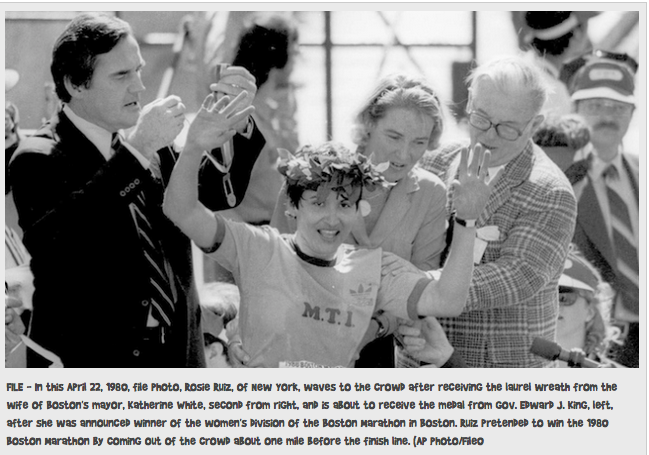
“Miss Ruiz, an administrative assistant for Metal Trading Inc. in Manhattan, received the traditional laurel wreath, a medal and a silver bowl for her victory,” According to the New York Times

Ruiz was unknown in the running world and her victory raised suspicions.  After studying marathon photographs she didn’t appear in any of them until the very end and conducting interviews.

The problem was that, according to Runners World: “Ruiz had dropped out of the race, hopped on the subway, got off about a mile from the finish line, and ran in from there.”   It is believed Ruiz intended to jump in in the middle of the pack but miscalculated when she joined so close to the end not realizing she was ahead of the other 448 female runners.Screen-Shot-2014-12-29-at-10.16.38-AM

Marathon officials stripped Ruiz of her title on April 29, 1980, and named Jacqueline Gareau of Canada the women’s division champion with a time of 2:34:28.  It was later discovered that she had also taken the subway during part of the New York City Marathon which qualified her for the Boston Marathon.  In 1982 she was caught stealing money from her employer and was subsequently caught selling drugs to an undercover officer in Florida.

Screen Shot 2015-03-19 at 9.02.57 PM

In the early 1950’s it was discovered that a small fraction of ingested alcohol in rabbits gets metabolized by conjugation with glucuronic acid to form Ethyl Glucuronide (EtG)..1,2 The potential of EtG as a marker for alcohol consumption was recognized in the 1990s and analytical methods for its determination were developed in urine, blood and hair.3-5

It’s use as a marker of alcohol consumption in forensic settings was subsequently suggested by Dr. Friedrich Wurst based on studies showing that urine EtG could be detected after complete elimination of alcohol from the body (up to 80 hours), and he suggested the alcohol biomarker be utilized in forensic monitoring to improve public health.   6,7

Wurst et al note that a “marker of high sensitivity and specificity capable of monitoring patients in treatment for alcohol or other drug abuse” could “improve therapy outcome and quality of life in patients, increase safety at work places and in traffic, avoid harm to the unborn during pregnancy (fetal alcohol syndrome) and reduce costs by making therapy more effective and reducing productivity loss.”7
Screen Shot 2015-03-19 at 8.52.29 PM

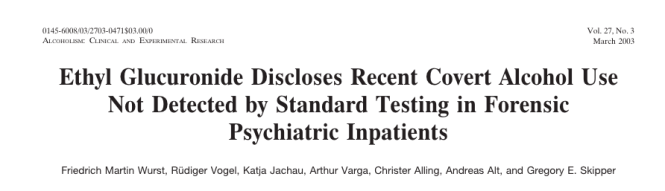
A literature search from 1952 to 2002 yields one conclusion and once conclusion only; EtG measurements increase with alcohol ingestion. There are no studies considering what other factors might increase EtG measurements.

The false logic takes the following form:

  • Premise: Event A occurred after (or with) event B.
  • Conclusion: Therefore, event A caused event B.

But in 2003 Wurst and Gregory Skipper, M.D., FASAM, Medical Director of the Alabama Physician Health Program reported at an international meeting of the American Medical Society that EtG provided proof of alcohol consumption as much as 5 days after drinking an alcoholic beverage and that there are now a substantial number of studies in the world literature that support the clinical importance and reliability of EtG as a marker of recent alcohol consumption.8

“In the future it will be negligent not to test for EtG when monitoring recovering alcoholics,” reported Dr. Skipper.8

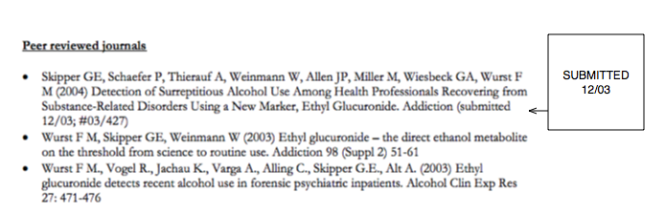
Also, in 2003, Skipper pitched the test to National Medical Services, Inc. (NMS labs) who then developed it as a Laboratory Developed Test (LDT).9
Screen Shot 2015-03-19 at 11.49.56 PM

Because of its high sensitivity the newly marketed test was suggested as a tool to monitor health care professionals by Skipper in 2004.10   Skipper then approached the Federation of State Medical Boards and pitched the test to them proposing it be used in the assessment and monitoring of doctors by state Physician Health Programs.   In a stunning example of policy entrepreneurship a market was created and filled simultaneously.
images-4

“Detection of Alcohol Use in Monitored Aftercare Programs: A National Survey of State Physician Health Programs11 published in the Journal of Medical Licensure and Discipline in 2004 found that “surreptitious alcohol use was a significant concern” for state Physician Health Programs (PHPs) yet no “best methods for detecting alcohol use.” The 36-question phone interview was conducted with directors of PHPs in 46 states regarding current methods of drug testing and notes:Screen Shot 2015-03-20 at 4.06.32 AM
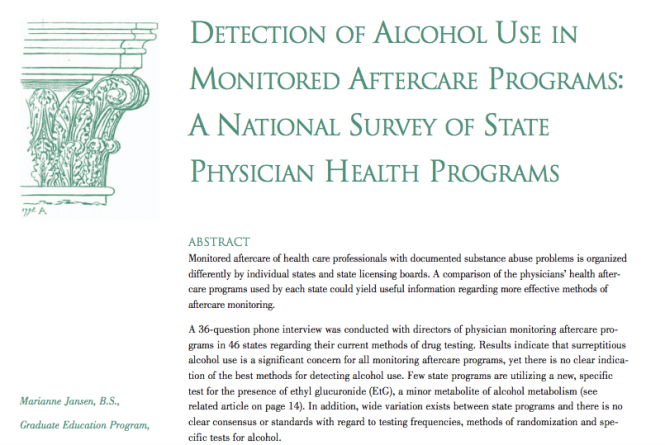
“Because alcohol is the most frequently abused substance adequate monitoring for alcohol is a major concern. During rehabilitation and recovery, the potential for alcohol abuse may increase due to the lack of efficient screening tests. The ingestion of alcohol while in aftercare is a violation of the contractual agreement made with the monitoring program and may lead to relapse and/or abuse of other psychoactive substances, thus rendering the practitioner unsafe to practice their profession. Therefore, alcohol detection remains an important component of contract compliance and sobriety.”
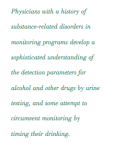
Screen Shot 2015-03-19 at 9.09.39 PMThey conclude that: “EtG can be detected in urine as long as 18 hours after blood alcohol levels reach zero and demonstrates exceptional specificity (100 percent) and sensitivity because even small amounts of alcohol (7 g, or less than one alcoholic beverage) can be detected.”

This very same issue of the Journal of Medical Licensure and Discipline contains an article written by Skipper concerning new marker to detect alcohol use in “recovering physicians” that “has recently been introduced in the United States and an assay for EtG is now commercially available.”12

Screen Shot 2015-03-19 at 9.08.30 PM

Skipper states that “EtG is not detectable unless alcohol has been consumed” and notes the “usefulness of the test was affirmed in one study involving psychiatric inpatients”Screen Shot 2015-03-19 at 9.09.15 PM
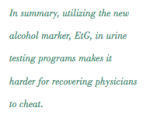
An EtG above 500 renders it “extremely unlikely” that alcohol was not ingested and adds “ In any event, if testing is positive” in monitored doctors it is advisable to refer them for further in-depth evaluation by clinicians or programs skilled and adept at evaluating physicians.”

In Bending Science: How Special Interests Corrupt Public Health Research13, Thomas McGarity and Wendy Wagner describe how special interest groups scheme to advance their own economic or ideological goals by using distorted or “bent” science to influence legal, regulatory and public health policy.

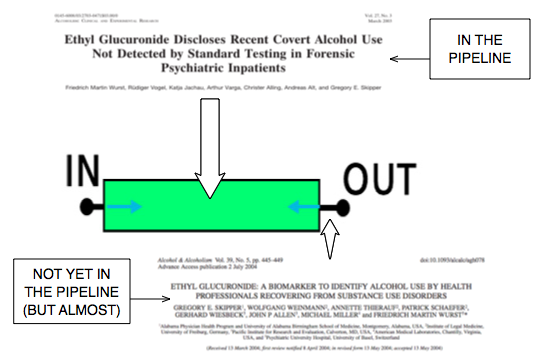
The authors describe a “separatist view” of the world that assumes scientific research is sufficiently reliable for public policy deliberations and legal proceedings once it flows out of the realm of science through a pipeline in which the scientific community has ensured through rigorous peer-review and professional oversight that the final product that exits the pipeline is unbiased and produced in accordance with the norms and procedures of science.

Screen Shot 2015-02-05 at 10.49.27 AM

This view does not consider the possibility that the scientific work exiting the pipeline could be distorted and contaminated by biasing influences.

If we look at this through the lens of “bent science” several issues arise including a failure to adhere to the norms and standards of toxicology and forensic drug and alcohol testing, an absence of evidence base and glaring conflicts of interests.

Norms and Standards of Toxicology and Forensic Drug Testing

On September 15, 1986 President Ronald Reagan signed Executive Order 12,564 requiring that the urine of federal employees in “sensitive” jobs be sampled randomly for illegal drugs. In 1988 Congress followed with the Drug-Free Workplace Act and drug testing became common organizational practice by the mid 1990s. Most followed the federal norms and procedures in their testing.

The Department of Health and Human Services (DHHS) had established specific cutoff levels that define a positive result.   These values were developed to help eliminate false-positive results.14 The cutoff levels were originally established at a drug concentration that produced an analytic signal some multiplicative factor above the noise level (the signal obtained from drug free urine).

“The concept of cutoff for major urine screening programs has two basic applications: the lower limit of reliable testing based on the techniques involved in the testing and the lower limit of reliable testing based on the possibility of interference from medications, foodstuffs, environmental exposure, or endogenous processes.”15

“Urine Drug Testing in Clinical Practice: Dispelling the myths & Designing Strategies cautions about “caveats to interpretation.” “As with any unexplained test result, it is important to clarify the interpretation with someone knowledgeable in clinical toxicology.”16

Evidence Base

What was in the pipeline when the EtG was proposed as a forensic monitoring tool can be illustrated below:

Screen Shot 2015-03-19 at 9.02.57 PM

Taking Advantage of a Loophole

The EtG was developed by NMS labs as a “Laboratory—Developed Test” or LDT. The LDT pathway does not even require proof of validity, that the test is actually testing for what it claims to be testing, and with no FDA oversight a lab can claim any validity it wants in its marketing and sales, and they did.   Proponents for regulation of LDTs argue this lack of oversight is a direct threat to patient care and safety. An viewpoint piece in JAMA states that a   “patient’s life or death could hinge on whether a single, unregulated diagnostic test result is meaningful.” 17

In the case of EtG Skipper arbitrarily chose a value of 100 as a cut-off for EtG. The rationale behind this value is not cited. Interference with foods, medications and environmental exposures had not been worked out. The results were predictable.

Aftermath was Predictable and Therefore Avoidable

The case of EtG is exemplifies ‘policy entrepreneurship” and “bent science” at its worst. It shows how junk-science can be introduced into the market without any real difficulties or meaningful opposition and how self-interest is promoted in defiance of science in an effort to manipulate public policy. This is nothing more than opportunist exploitation of the regulatory framework and the FSMB eagerly complied.   Without this “regulatory sanctification” none of these tests would have ever made it to market.

EtG was subsequently found to be so sensitive that it could measure incidental exposure to alcohol in foods, over the counter cold medications, mouthwash18,19, hand sanitizer gel20, nonalcoholic beer21, and nonalcoholic wine.22

“Exposure to ethanol-containing medications, of which there are many, is another potential source of “false” positives.

Forbidding patients/subjects access to such medications may be unrealistic, and even unwise.”23

The United States Substance Abuse and Mental Health Services Administration warned against using a positive EtG as primary or sole evidence of drinking for disciplinary or legal action.24 The advisory states:

“Although positive biomarker results should be taken seriously, use of certain biomarkers, such as EtG, is now warranted as stand-alone confirmation of relapse because research has not yet established an acceptable standard to distinguish possible exposure to alcohol in various commercial products from consumption of alcoholic beverages.”

The Wall Street Journal in 2006 reported the problems with the EtG to the general public.25

The authors of a 2011 study demonstrating that hand sanitizer alone could result in EtG concentrations of 1998 concluded that:

“in patients being monitored for ethanol use by urinary EtG concentrations, currently accepted EtG cutoffs do not distinguish between ethanol consumption and incidental exposures, particularly when urine specimens are obtained shortly after sustained use of ethanol containing hand sanitizer.”26

images-5Sauerkraut and bananas have even recently been shown to cause positive EtG levels.27

A 2010 study found that consumption of baker’s yeast with sugar and water28 led to the formation of elevated EtG above the standard cutoff.images-6

EtG can originate from post-collection synthesis if bacteria is present in the urine.29 Collection and handling routines can result in false-positive samples.30

EtG varies among individuals.31 Factors that may underlie this variability include gender, age, ethnic group, and genetic polymorphisms.

images-9

The Cochrane Collaboration does systematic reviews of the literature using conscientious, explicit, and judicious criteria to in order to produce and disseminate only high quality and evidenced based health care, exclude bias, and enhance transparency.

The Cochrane database is internationally recognized as the standard in evidence based health care.   It records just 5 controlled trials under the topic ethyl glucuronide.22,31-33

These 5 studies represent the only high-quality evidence regarding EtG to date. Information provided by the five studies suggests the following, and only the following:

  1. EtG measurements increase with alcohol ingestion.
  2. The window of detection is shorter than what is commonly proposed (80 hours).
  3. Individual values are variable both within and between subjects.
  4. Non-alcoholic wine can cause positive levels.

During this time period any rational authority would have admitted error and removed the test from the market. Skipper’s approach was to keep raising the cutoff level from 100 to 250 to 500 to 1000. With EtG paving the way for other laboratory developed tests he then added “confirmatory” LDTs such as EtS and PEth. The EtS was found to have the same problems and PEth inevitably will but this is now a billion dollar market and they plan on using these tests on almost everyone including kids.

There has been no academic, public policy or conflict of interest analysis of all of this. As probably the worst case of bent-science in history there needs to be.

  1. Kamil A, Smith JN, Williams RT. A New Aspect of Ethanol Metabolism: Isolation of ethylglucuronide. Biochemical Journal. 1952;51:32-33.
  2. Kamil IA, Smith JN, Williams RT. Studies in detoxication. L. The isolation of methyl and ethyl glucuronides from the urine of rabbits receiving methanol and ethanol. The Biochemical journal. Jun 1953;54(3):390-392.
  3. Schmitt G, Aderjan R, Keller T, Wu M. Ethyl glucuronide: an unusual ethanol metabolite in humans. Synthesis, analytical data, and determination in serum and urine. Journal of analytical toxicology. Mar-Apr 1995;19(2):91-94.
  4. Schmitt G, Droenner P, Skopp G, Aderjan R. Ethyl glucuronide concentration in serum of human volunteers, teetotalers, and suspected drinking drivers. Journal of forensic sciences. Nov 1997;42(6):1099-1102.
  5. Aderjan RE. Ethyl glucuronide. A non-volatile ethanol metabolite in hair. 1995.
  6. Wurst FM, Seidl S, Alt A, Metzger J. [Direct ethanol metabolite ethyl glucuronide. Its value as alcohol intake and recurrence marker, methods of detection and prospects]. Psychiatrische Praxis. Nov 2000;27(8):367-371.
  7. Wurst FM, Seidl S, Ladewig D, Muller-Spahn F, Alt A. Ethyl glucuronide: on the time course of excretion in urine during detoxification. Addiction biology. Oct 2002;7(4):427-434.
  8. Martin DM, G.E. S, Costantino A. Alcohol Use Can Now be Detected for Days Rather than Hours Using a New Test, Ethyl Glucuronide. 2003; http://www3.firstlab.com/media/16032/EtGFirstLabReport.pdf.
  9. Skipper G. “Urine Luck” Overview of New Drug Testing Technologies and Conundrums. http://gregskippermd.weebly.com/uploads/7/4/7/5/74751/skipper.urine_luck_2014_aaap_meeting.pdf. Accessed March 17, 2015.
  1. Skipper GE, Weinmann W, Thierauf A, et al. Ethyl glucuronide: a biomarker to identify alcohol use by health professionals recovering from substance use disorders. Alcohol Alcohol. Sep-Oct 2004;39(5):445-449.
  2. Jansen M, Bell LB, Sucher MA, Stoehr JD. Detection of Alcohol Use in Monitored Aftercare Programs: A National Survey of State Physician Health Programs. Journal of Medical Licensure and Discipline. 2004;90(2):8-13
  1. Skipper G, Weinmann W, Wurst F. Ethylglucuronide (EtG): A New Marker to Detect Alcohol Use in Recovering Physicians. Journal of Medical Licensure and Discipline. 2004;90(2):14-17.
  2. McGarity TO, Wagner WE. Bending Science: How Special Interests Corrupt Public Health Research. Cambridge, MA: Harvard University Press; 2008.
  3. US Department of Health and Human Services. Mandatory guidelines and proposed revisions to mandatory guidelines for federal workplace drug testing programs: notices. Federal Register. April 13, 2004;69(71):19659-19660.
  4. Clark HW. The role of physicians as medical review officers in workplace drug testing programs. In pursuit of the last nanogram. West J Med. May 1990;152(5):514-524.
  5. Resnick RB, Volavka J, Freedman AM, Thomas M. Studies of EN-1639A (naltrexone): a new narcotic antagonist. Am J Psychiatry. Jun 1974;131(6):646-650.
  6. Sharfstein J. FDA Regulation of Laboratory-Developed Diagnostic Tests: Protect the Public, Advance the Science. JAMA : the journal of the American Medical Association. Jan 5 2015.
  7. Costantino A, Digregorio EJ, Korn W, Spayd S, Rieders F. The effect of the use of mouthwash on ethylglucuronide concentrations in urine. Journal of analytical toxicology. Nov-Dec 2006;30(9):659-662.
  8. Reisfield GM, Goldberger BA, Pesce AJ, et al. Ethyl glucuronide, ethyl sulfate, and ethanol in urine after intensive exposure to high ethanol content mouthwash. Journal of analytical toxicology. Jun 2011;35(5):264-268.
  9. Rosano TG, Lin J. Ethyl glucuronide excretion in humans following oral administration of and dermal exposure to ethanol. Journal of analytical toxicology. Oct 2008;32(8):594-600.
  10. Thierauf A, Gnann H, Wohlfarth A, et al. Urine tested positive for ethyl glucuronide and ethyl sulphate after the consumption of “non-alcoholic” beer. Forensic Sci Int. Oct 10 2010;202(1-3):82-85.
  11. Hoiseth G, Yttredal B, Karinen R, Gjerde H, Christophersen A. Levels of ethyl glucuronide and ethyl sulfate in oral fluid, blood, and urine after use of mouthwash and ingestion of nonalcoholic wine. J Anal Toxicol. Mar 2010;34(2):84-88.
  12. Jatlow P, O’Malley SS. Clinical (nonforensic) application of ethyl glucuronide measurement: are we ready? Alcohol Clin Exp Res. Jun 2010;34(6):968-975.
  13. Administration SAaMHS. The role of biomarkers in the treatment of alcohol use disorders. In: Advisory SAT, ed2006:1-7.
  14. Helliker K. A test for alcohol–and its flaws. The Wall Street Journal2006.
  15. Reisfield GM, Goldberger BA, Crews BO, et al. Ethyl glucuronide, ethyl sulfate, and ethanol in urine after sustained exposure to an ethanol-based hand sanitizer. Journal of analytical toxicology. Mar 2011;35(2):85-91.
  16. Musshoff F, Albermann E, Madea B. Ethyl glucuronide and ethyl sulfate in urine after consumption of various beverages and foods–misleading results? Int J Legal Med. Nov 2010;124(6):623-630.
  17. Thierauf A, Wohlfarth A, Auwarter V, Perdekamp MG, Wurst FM, Weinmann W. Urine tested positive for ethyl glucuronide and ethyl sulfate after the consumption of yeast and sugar. Forensic Sci Int. Oct 10 2010;202(1-3):e45-47.
  18. Helander A, Olsson I, Dahl H. Postcollection synthesis of ethyl glucuronide by bacteria in urine may cause false identification of alcohol consumption. Clinical chemistry. Oct 2007;53(10):1855-1857.
  19. Helander A, Hagelberg CA, Beck O, Petrini B. Unreliable alcohol testing in a shipping safety programme. Forensic science international. Aug 10 2009;189(1-3):e45-47.
  20. Sarkola T, Dahl H, Eriksson CJ, Helander A. Urinary ethyl glucuronide and 5-hydroxytryptophol levels during repeated ethanol ingestion in healthy human subjects. Alcohol and alcoholism. Jul-Aug 2003;38(4):347-351.
  21. Hoiseth G, Bernard JP, Stephanson N, et al. Comparison between the urinary alcohol markers EtG, EtS, and GTOL/5-HIAA in a controlled drinking experiment. Alcohol and alcoholism. Mar-Apr 2008;43(2):187-191.
  22. Wojcik MH, Hawthorne JS. Sensitivity of commercial ethyl glucuronide (ETG) testing in screening for alcohol abstinence. Alcohol and alcoholism. Jul-Aug 2007;42(4):317-320.

Screen Shot 2013-10-28 at 10.24.14 PM


Helpful resources for those abused and afraid — via www.bmartin.cc 

www-bmartin-cc-pubs-bf-bfbasics-pdf-51. Supression of Dissent: Basic Information

2. The keys to backfire

• “Reveal: expose the injustice, challenge cover-up

• Redeem: validate the target, challenge devaluation

• Reframe: emphasize the injustice, counter reinterpretation

• Redirect: mobilize support, be wary of official channels• Resist: stand up to intimidation and bribery”

via Helpful resources for those abused and afraid — via www.bmartin.cc .

Screen Shot 2015-01-09 at 1.59.40 AM

FullSizeRender 2

Monopolies, Self-Referral and Shell Games: The Need for Antitrust Investigation of Physician Health Programs and their “PHP-Approved” Assessment and Treatment Centers

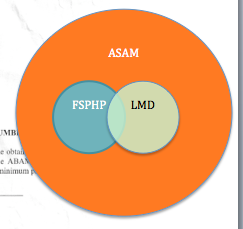
Screen Shot 2015-03-06 at 4.38.05 AMThree shells and a pea–ASAM, FSPHP, and LMD.

“PHP-Approved” Assessment and Treatment Centers

On the above list  can be found the Medical Directors of a number of drug and alcohol rehabilitation facilities.

Talbott, Marworth, Hazelden, Promises, and another two-dozen or so “PHP-approved”  assessment and treatment centers are represented on this list.    State Physician Health Programs (PHPs) refer doctors to these facilities for evaluations.  PHPs are non-profit tax-exempt organizations.  They do not evaluate or treat patients.   If a physician is referred to a PHP for a suspected problem the assessment must be done at an outside facility which will invariably be linked to a name on the list of Like-Minded Docs.

What most people do not know, however, is that this is an exclusive arrangement.    Evaluations are constrained to one of these facilities.   It is mandated.   No bargaining.  No compromises. No choice.  In other words it is a coercion.

“What’s wrong with that?” one might ask.   These facilities are all recognized as top-drawer and first-class.  Perhaps they were hand-picked on objective criteria and the PHPs are just making sure that doctors get the best assessments money can buy– decision making by experts based on knowledge and experience–picking a winner so you don’t have to.

Screen Shot 2014-07-27 at 7.55.16 PM copy


No documented Policy for Selecting Treatment Centers.  Criteria for “PHP-Approval” Unknown by those “Approving”

What objective criteria are used in selecting “PHP-approved” assessment and treatment centers?    According to a  Performance Audit of the North Carolina Physicians Health Program done by State Auditor Beth A. Wood that’s a good question.

The North Carolina State  Audit specifically noted the predominant use of out-of-state treatment centers.   In addition to “creating an undue burden on” those being evaluated the audit states that:

 “Program procedures did not ensure that physicians received quality evaluations and treatment because the Program had no documented criteria for selecting treatment centers and did not adequately monitor them”

In fact the audit found no documented policy for selecting treatment centers.  The very organizations demanding documentation of policy for approval and charged with approving the treatment centers could not even give a comprehensible, plausible or even simple explanation for what any of  these things even mean.    

Screen Shot 2014-05-07 at 5.38.23 PMThe auditor also noted this lack of concrete criteria goes against both The Federation of State Physician Health Programs (FSPHP) and the Federation of State Medical Boards (FSMB) requirements that physician health programs use established guidelines to select evaluation providers and treatment centers.

In its “Physician Health Program Guidelines,” the FSPHP established: • “Characteristics of Evaluation Providers Appropriate for PHP referrals,” and • “Characteristics of Treatment Programs which are appropriate for PHP referrals.”  And in its “Policy on Physician Impairment,” the FSMB states : • “PHPs should employ FSPHP Guidelines in selecting the providers/facilities to provide treatment of physicians with addictive and/or psychiatric illness.”

When the NC PHP was asked to define these characteristics they explained that they learned  of “new treatment centers through professional networks and other informal sources” and used the “treatment centers’ reputation as a basis for establishing a referral relationship.”      Staff credentials, quality of care, treatment methods and modalities, patient choice, follow-up data, outcomes and other objective information apparently took a back-seat to what appears to be ill-defined and subjective word-on-the-street.   Screen Shot 2014-03-15 at 7.33.14 PM

This  “failure to use FSPHP  recommended criteria to select treatment centers,” the Audit concluded “could cause the Program to enter into referral arrangements with service providers that do not meet quality standards”

Ironically the  NC PHP failed to follow guidelines they themselves introduced and demanded be followed.  They could produce no documentary evidence these criteria even exist or even provide plausible criteria.   “Professional networks”, “reputation” and other informal sources are fine for some choices.  That’s how I picked out my first skateboard.

Resources such as these can play in important role in choosing a shirt, buying new sneakers or even purchasing a car but they do not constitute selection criteria for an assessment in which the consequences and recommendations made for the person being assessed are significant, potentially life-altering and possibly permanent!

And to top it all off the  Medical Director of the North Carolina PHP,  Dr. Warren Pendergast,  was the  President of the national organization for state PHPs, the Federation of State Physician Health Programs (FSPHP) at the time of the audit!

PHPs are not clinical providers but monitoring agencies.  They meet with, assess and refer doctors for evaluations and then monitor doctors through drug and alcohol testing and periodic reports of supervisors, co-workers and others.        As such the PHP is tasked with just two jobs-referring doctors for evaluation and then monitoring them after they have been evaluated in a contractual agreement.  The fact that the state PHP 0r FSPHP could not produce the facts and reasoning  behind the mechanics and mentality of the very reason for which they exist is incomprehensible.  It is, in fact, ludicrous beyond belief.    The President of the FSPHP being unable to define the selection criteria for approved and mandated facilities is like Anthony Bourdain being unable to explain the ingredients of an omelette.

To summarize, doctors in North Carolina were being forced by the PHP  to have evaluations at “PHP-approved” assessment and treatment centers but the PHP was unable to explain anything substantive in defining any of it.  Why?  Because no qualitative objective selection criteria exist.

“Reputation” obfuscates and confuses.  It does nothing to support or justify.    It is like answering “numbers” to the question “what is 9 x 9?”

And this is especially concerning when it is realized that these evaluations are limited to facilities and people  tied financially and ideologically to the groups and individuals who are mandating the referral.

Screen Shot 2014-02-18 at 11.06.35 PM

All of the “PHP-approved” assessment centers are represented by medical directors who belong to “Like-minded docs”-an admittedly  12-step steeped conservative fundamentalist faction of the American Society of Addiction Medicine (ASAM).   And all of these facilities are private-pay rehabilitation centers that recommend doctors be treated three-times longer than the rest of the population–another medical “urban legend” that should have been debunked from the get-go.

Limiting assessment and recommendations to this close-knit  group of evaluators is a monopoly of force.  It is unethical if not criminal. And the fact that these are all heavily indoctrinated 12-step facilities also makes it a violation of the Establishment Clause of the 1st Amendment.  Moreover,  many of the medical directors at these facilities are also graduates of the same program in “recovery.”

And if it is looked at from this vantage point it is a system of  self-referral.  Self-referral harms patients and society as a whole.

It is a shell game that removes all choice and removes freedom, objectivity, fundamental fairness, autonomy and choice.


Antitrust law

American antitrust law was “designed to be a comprehensive charter of economic liberty aimed at preserving  free and unfettered competition as the mule of trade. It rests on the premise that the unrestrained interaction of competitive forces will yield the best allocation of our economic resources, the lowest prices, the highest quality and the greatest material progress, while at the same time providing an environment conducive to the preservation of our democratic political and social institutions” (29, p 4).

In this case it is a safe assumption that all doctors desire the “best possible” care and this requires objective and unbiased assessment and treatment when requested by Physician Health Programs.

Congress and the Supreme Court have made clear is that the “best” services are selected by  consumers when their choice is made in an open market free of restraints. Eventually the marketplace will determine the best medical care, not judges, juries, or even doctors (30, p 904).

PHPs are clearly bypassing patient choice.  In 2011 the American Society of Addiction Medicine (ASAM) issued a Public Policy Statement on coordination between PHPs, regulatory agencies, and treatment providers recommending  that  only “PHP approved” treatment centers be used in the assessment and treatment of doctors.  The state Medical Boards have accepted and adopted this policy and denying doctors requests for assessments at non “PHP-approved” facilities. Many have been sanctioned for resisting, protesting or even questioning this unlawful monopoly.  It is prohibition of patient choice.

The N.C. PHP is representative of most PHPs. This is not an exception but a rule.      PHPs are mandating assessments only at facilities they approve but cannot define or explain how these facilities are “approved”  Yet The ideological and financial conflicts of interest between the PHPs and their referral centers are self-evident.  Connect the dots.  

State medical boards are enforcing this mandate under threat of loss of licensure.   Your money or your life.

Federal Trade Commission

For these reasons an investigation by the Federal Trade Commission and Office of the Inspector General of the DHHS is necessary.  For those who have been abused by this unholy alliance I urge you to look at this list to see if the medical director of the facility at which you were evaluated is represented.

If so note it here.   My guess is almost everyone will find this correlation and representation in numbers would necessitate both state and Federal investigation.  If this were done it  could quickly transform a system of institutional injustice into one that allows choice.

Applying Antitrust law to the linkage of  PHPs  and “PHP approved” assessment and treatment centers is consistent with free-market law and theory.   Demanding accountability would provide a powerful deterrent to this type of unfettered abuse.

1. Northern Pacific Railway v U.S., 356 US I (1958).

.2.  Koefoot v American College of Surgeons. 652 F Supp 882 (ND Ill 1986).

← Back

Thank you for your response. ✨

Inquisition_10_Pushing_Off_Bridge

IMG_8301

The “Impaired Physician”–Increasing the grand scale of the hunt

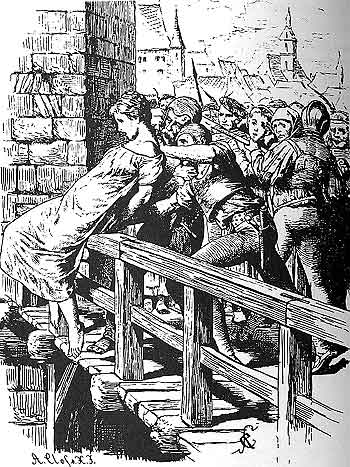
“Wretched creatures are compelled by the severity of the torture to confess things they have never done and so by cruel butchery innocent lives are taken; and by new alchemy, gold and silver are coined from human blood.”  Father Cornelius Loos  ( 1592 )


Screen Shot 2015-02-28 at 8.15.35 AM

How Impaired Physicians Can be Helped–Medscape Business of Medicine Article Published February 24, 2015. Click on image to access


How can impaired Physicians be helped?

1.   Impairment among physicians is growing:  Why?  

Answer:  It is not.   State Physician Health Programs (PHPs) are “diagnosing” impairment when there is no impairment.  They are pathologizing the normal and expanding in scope to increase the grand scale of the hunt.

2.  What’s the Prognosis for Impaired Physicians?

Answer:  Not Good.   Those who need help (the truly impaired)  are afraid to get help for fear of being monitored by their state PHP while many of those ensnared by PHPs are not impaired.   There is absolutely no oversight, regulation or accountability.  This needs to be evaluated in the context of physician suicide.    The system is one of institutional injustice and abuse of power. 

3.  Is your knowledge of physician impairment up-to-date?  

Answer:   No.  This will only occur after an evidence-based Cochrane type review separates information from misinformation; An objective non-biased investigation by outside actors identifying any conflicts-of-interest, misconduct or lack of evidence-base in the current system and separating the art and science of the medical profession from the politicalization and exploitation of the medical profession.

The list of doctors on Like-Minded Docs  solves the final piece of a  puzzle. It explains why so many doctors across the country are claiming fabrication and manipulation of personality and cognitive tests to support nonexistent diagnoses at these “PHP-approved” assessment centers.    The relationship between the state PHP’s and the “PHP-approved” assessment centers is the same as it is between the state PHPs and the corrupt labs.

As Drs. John Knight and J. Wesley Boyd note in Ethical and Managerial Considerations Regarding State Physician Health Programs, published in the Journal of the American Society of Addiction Medicine,  this is what is known as “tailoring a diagnosis”–a euphemism for the political abuse of psychiatry.  According to the Global Initiative on Psychiatry “Political abuse of psychiatry refers to the misuse of psychiatric diagnosis, treatment and detention for the purposes of obstructing the fundamental human rights of certain individuals and groups in a given society.”   The shoe fits here.  In fact it fits very well.

Screen Shot 2015-01-09 at 1.59.40 AM

The Global Initiative on Psychiatry opposes the Political_Abuse_of_Psychiatry  wherever  it may occur and “supports those psychiatrists and psychiatric organizations that pressure the offending states to discontinue the practice and lobby vigorously those organizations which are wavering. The main way for individuals and organizations to work is through diplomatic channels. It is necessary to expose the practice and to embarrass countries that are at fault by expelling them from organizations such as the World Psychiatric Association. This can only be ensured by properly organized open investigation of psychiatric practice and interviews with the alleged victims”

Political abuse of psychiatry in the profession of medicine needs to be treated in the same way.

An evidence based Cochrane type assessment of their “research” and an Institute of Medicine Conflict of Interest review are long overdue.

In evaluating a physician for “impairment” or being “disruptive” the Physician Health Programs (PHPs)  under the Federation of State Physician Health Programs (FSPHP)  are not gathering data to form a hypothesis.  They are making data fit a hypothesis that arrived at the out-of-state “PHP-approved” assessment center well before the alleged miscreant doctor.

With guilt assumed from the start, no due process, no appeal, and no way out physicians are being bullied, demoralized, and dehumanized  to the point of hopelessness, helplessness and despair.

This needs to end now.

Medicine is predicated on competence, good-faith, and integrity. 

Medical ethics necessitates beneficence, respect, and autonomy. 

The scaffold erected here is designed for coercion and control. 

Exposure, transparency, and accountability are urgent. 

The emperor has no clothes.

Sunshine is the best disinfectant.

https://artbylisabelle.wordpress.com/2015/03/01/three-shells-and-a-pea-asam-fsphp-and-lmd/

Edit (in 5 minutes)

The Elephant in the Room: Physician Suicide and Physician Health Programs

IMG_1009

Physician Suicide and the Elephant in the Room

Michael Langan, M.D.

Although no reliable statistics exist, anecdotal reports suggest an alarming upsurge in physician suicide. This necessitates a reappraisal of known predisposing risk factors such as substance abuse and depression but also requires a critical examination of what external forces or vulnerabilities might be unique to doctors and how they might be involved in the descent from suicidal ideation to suicidal planning to completed suicide.

Depression and Substance Abuse Comparable to General Population

Depression and substance abuse are the two biggest risk factors for suicide. The prevalence of depression in physicians is close to that of the general population 1,2 and, if one looks critically at the evidence based literature, substance abuse in medical professionals approximates that of the general population.  Controlled studies using DSM diagnostic criteria suggest that physicians have the same rates (8-14%) of substance abuse and dependence as the rest of the population 3 and slightly lower rates compared to other occupations.4,5 Epidemiological surveys reveal the same. Hughes, et al.6 found a lifetime prevalence of drug or alcohol abuse or dependence in physicians of 7.9%, markedly less than the 14.6% prevalence reported in the general population by Kessler.7

State Physician Health Programs

Perhaps it is how physicians are treated differently when they develop a substance abuse or mental health problem.

Physician Health Programs (PHP) can be considered an equivalent to Employee Assistance Programs (EAPs) for other occupations. PHPs meet with, assess and monitor doctors who have been referred to them for substance use or other mental or behavioral health problems. Originally developed as “impaired physician” programs, the PHPs were created to help doctors who developed problems with substance abuse or addiction an alternative to disciplinary action by State Medical Boards. These programs existed in almost every state by 1980. Often staffed by volunteer physicians and funded State Medical Societies, these programs served the dual purpose of helping sick colleagues and protecting the public. Preferring rehabilitation to probation or license revocation so long as the public was protected from imminent danger, most medical boards accepted the concept with support and referrals. Most EAPs were developed with the collaboration of workers unions or some other group supporting the rights and interests of the workers.  As there is no such organization representing doctors, PHPs developed in the absence of regulation or oversight.    As a consequence there is no meaningful accountability.   

In Ethical and Managerial Considerations Regarding State Physician Health Programs published in the Journal of Addiction Medicine in 2012, John Knight, M.D. and J. Wesley Boyd, M.D., PhD who collectively have more than 20 years experience with the Massachusetts PHP state that:

“Because PHP practices are unknown to most physicians before becoming a client of the PHP, many PHPs operate out- side the scrutiny of the medical community at large. Physicians referred to PHPs are often compromised to some degree, have very little power, and are, therefore, not in a position to voice what might be legitimate objections to a PHP’s practices.”8

Noting that “for most physicians, participation in a PHP evaluation is coercive, and once a PHP recommends monitoring, physicians have little choice but to cooperate with any and all recommendations if they wish to continue practicing medicine,” Knight and Boyd raise serious ethical and managerial questions about current PHP policies and practice including conflicts of interest in referrals for evaluation and treatment, lack of adherence to standards of care for forensic testing of substances of abuse, violations of ethical guidelines in PHP research, and conflicts of interest with state licensing boards.

Knight and Boyd recommend “that the broader medical community begin to reassess PHP’s as a whole” and that “consideration be given toward the implementation of independent ethical oversight and establish and appeals process for PHP clients who feel they are being treated unfairly.” 8 They also recommend the relationship of PHP’s between the evaluation and treatment centers and licensing boards be transparent and that national organizations review PHP practices and recommend national standards “that can be debated by all physicians, not just those who work within PHPs.”8 Unfortunately this has not happened. Most physicians have no idea that the state physician health programs have been taken over by the “impaired physicians movement.”

In his Psychology Today blog,  Boyd again recommends oversight and regulation of PHPs.   He cites the North Carolina Physicians Health Program Audit released in April of 2014 that reported the below key findings:

Screen Shot 2015-02-25 at 11.52.29 PM

As with Knight and Boyd’s paper outlining the ethical and managerial problems in PHPs, the NC PHP audit finding that abuse could occur and not be detected generated little interest from either the medical community or the media.

Although state PHPs present themselves as confidential caring programs of benevolence they are essentially monitoring programs for physicians who can be referred to them for issues such as being behind on chart notes. If the PHP feels a doctor is in need of PHP “services” they must then abide by any and all demands of the PHP or be reported to their medical board under threat of loss of licensure.

State PHP programs require strict adherence to 12-step doctrine9 yet many of the physicians monitored by them are neither addicts nor alcoholics. Some do not even have substance abuse issues and there are reports of “disruptive” physicians being diagnosed with “character defects” at the “PHP-approved” facilities that do these assessments.   PHPs require abstinence from drugs and alcohol yet use  non-FDA approved Laboratory Developed Tests in their monitoring programs. Many of these tests were introduced to commercial labs and promoted by ASAM/FSPHP physicians.10-12

LDTs bypass the FDA approval process and have no meaningful regulatory oversight.   The LDT pathway was not designed for “forensic” tests but clinical tests with low risk.   Some are arguing for regulation and oversight of LDTs due to questionable validity and risk of patient harm.13

These same physicians are claiming a high success rate for PH programs9 and suggesting that they be used for random testing of all physicians.14

As with LDTs, the state PHPs are unregulated, and without oversight. State medical societies and departments of health have no control over state PHPs.

Their opacity is bolstered by peer-review immunity, HIPPA, HCQIA, and confidentiality agreements. The monitored physician is forced to abide by any and all demands of the PHP no matter how unreasonable-all under the coloration of medical utility and without any evidentiary standard or right to appeal.

The ASAM has a certification process for physicians and claim to be “addiction” specialists. This “board certification” is not recognized by the American Board of Medical Specialties and is not a recognized medical specialty. The goal of the ASAM is to be recognized as the experts in addiction medicine with the consensus expert opinion based on the 12-step prohibitionist brain disease model. The ASAM has aligned itself with a number of inpatient drug treatment centers  (Hazelden, Talbott, Marworth, Bradford,etc) and are heavily funded by the drug testing industry.   It is in fact a “rigged game.”

State PHPs are non-profit non-governmental organizations and have been granted quasi-governmental immunity by most State legislatures from legal liability.

By infiltrating “impaired physician” programs they have established themselves in almost every state by joining, gaining power, and removing dissenters. Groupthink and 12-step indoctrination are the goals. By advertising as advocates for doctors who are “caring,” “confidential resources,” “giving help,” and advocating for “colleagues in need” the outward appearance is one of benevolence.

The biggest obstacle is that this system allows them to throw the normal rules of conduct under the imperative of a higher goal assumed to trump all other consideration. Those outside of programs either defend or ignore the reports of ethical and criminal violations, complacent in their trust of these “experts” claiming they are just helping sick doctors and protecting the public.

With no oversight or regulatory body involved this is all done with impunity, immunity, and undercover. They use the accusation of substance abuse as an indication to disregard the claims of the accused. The physician is left without rights, depersonalized, and dehumanized. The imposition of confinement, stigmatization, lack of oversight of the organizations, peer-review protected confidentiality, and lack of procedural protection is a one-way train to hopelessness and despair.

By establishing a system that of coercion, control, secrecy, and misinformation, the FSPHP is claiming an “80% success rate” 15and deeming the “PHP-blueprint” as “the new paradigm in addiction medicine treatment.

The ASAM/FSPHP had a major influence on the DSM-V where drug abuse and dependence are no longer separate entities. They are also working behind the scenes to get legislation to randomly drug test all physicians.

They are now after the “disruptive physician” and the evidentiary criteria are fairly low and red flags include “deviating from workplace norm in dress or conduct” and being tardy for meetings.

They have identified “the aging physician” as a potential problem because “as the population of physicians ages,””cognitive functioning” becomes “a more common threat to the quality of medical care.”

The majority of physicians are unaware that the Federation of State Medical Boards House of Delegates adopted an updated Policy on Physician Impairment in 2011 that uses addiction as an example of a “potentially impairing illness.”  According to the Federation of State Physician Health Programs …”physician illness and impairment exist on a continuum with illness typically predating impairment, often by many years. This is a critically important distinction. Illness is the existence of a disease. Impairment is a functional classification and implies the inability of the person affected by disease to perform specific activities.”

“Process addiction” was added as a potentially impairing illness including compulsive gambling, compulsive spending, compulsive video gaming, and “workaholism.” According to the FSPHP “the presence of a process addiction can be problematic or even impairing in itself, and it can contribute to relapse of a physician in recovery. As such, process addictions should be identified and treated.” They define three levels of relapse including the novel “relapse without use.”

Screen Shot 2014-07-01 at 3.38.23 AM

Bullying, Helplessness, Hopelessness and Despair

Perceived helplessness is significantly associated with suicide.16 So too is hopelessness, and the feeling that no matter what you do there is simply no way out17,18 Bullying is known to be a predominant trigger for adolescent suicide19-21 One study found that adolescents in custody who were bullied were 9.22 times more likely to attempt suicide than those were not bullied.22

Heightened perceptions of defeat and entrapment are known to be powerful contributors to suicide.23,24 The “Cry of Pain” model 25,26 specifies that people are particularly prone to suicide when life experiences are interpreted as signaling defeat which is defined as a sense of “failed struggle” or loss of social position and resources.. The person is unable to identify an escape from or resolution to a defeating situation, a sense of entrapment proliferates with the perception of no way out, and this provides the central impetus for ending ones life.

There is also evidence that rescue factors such as social supports may play a role in preventing suicide. These rescue factors act buffers to protect against suicide in the face of varying degrees of life stress.27,28 The study of female physicians revealed meetings to discuss stressful work experiences as a potential protective factor, 29 and support at work when difficulties arose appeared to be a protective factor for the male physicians.30   Research involving Finnish physicians found that control over one’s work and organizational justice were the most important determinants of work-related wellbeing.31,32 Organizational justice is related to fairness and refers to an individuals perception of an organizations behaviors, decisions, and actions and how these influence one’s own attitudes and behaviors and has been identified as a psychosocial predictor of health and wellbeing33 34 Low organizational justice has been identified as a notable risk factor for psychological distress and depression.35,36

A recent report indicates that job stress, coupled with inadequate treatment for mental illness may play a role in physician suicide..

Using data from the National Violent Death Reporting System the investigators compared 203 physicians who had committed suicide to more than 31,000 non-physicians and found that having a known mental health disorder or a job problem that contributed to the suicide significantly predicted being a physician.1

Physicians were 3.12 times more likely to have a job problem as a contributing factor. In addition, toxicology testing showed low rates of medication treatment.  The authors concluded that inadequate treatment and increased problems related to job stress are potentially modifiable risk factors to reduce suicidal death among physicians.

They also warned that the database used likely underestimated physician suicides because of “underreporting and even deliberate miscoding because of the stigma attached.”

I can think of nothing more institutionally unjust than an unregulated zero-tolerance monitoring program with no oversight using unregulated drug and alcohol testing of unknown validity.

We have heard of numerous suicides due to these institutionally unjust programs.   Three doctors died by suicide in Oklahoma in a one month period alone (August 2014).   All three were being monitored by the Oklahoma PHP.   I went to an all boys high-school of less than 350 students yet a classmate a couple years ahead of me died by suicide a few months ago. He was being monitored by the Washington PHP. His crime?  A DUI in 2009–a one-off situational mistake that in all likelihood would never have recurred.  But as is often the case with those ensnared by state PHPs he was forced to have a “re-assessment” as his five-year monitoring contract was coming to an end.  These re-assessments are often precipitated by a positive Laboratory Developed Test (LDT) and state medical boards mandate these assessments can only be done at an out-of-state “PHP-approved” facility.    Told he could no longer operate and was unsafe to practice medicine by the PHP and assessment center he then hanged himself.  And at the conclusion of Dr. Pamela Wible’s haunting video below are listed just the known suicides of  doctors; many were being monitored by their state PHPs–including the first name on the list– Dr. Gregory Miday.

None of these deaths were investigated. None were covered in the mainstream media.   These are red flags that need to be acknowledged and addressed!    This anecdotal evidence suggests the oft-used estimate of 400 suicides per year (an entire medical school class) is a vast underestimation of reality—extrapolating just the five deaths above to the entire population of US doctors suggests we are losing at least an entire medical school per year.

As physicians we need to demand transparency, oversight, regulation and auditing by outside groups. This is a public health emergency.

To wit:

They first came after the substance abusers and I did not speak out because I was not a substance abuser.

They then came for those with psychiatric diagnoses and I did not speak out because I was not diagnosed with a psychiatric disorder.

They then came after the “disruptive physician” and I did not speak out because I was not disruptive.

They then came after the aging physician and I did not speak out because I was young.

They then came after me and there was no one else to speak out for me.

  1. Ford DE, Mead LA, Chang PP, Cooper-Patrick L, Wang NY, Klag MJ. Depression is a risk factor for coronary artery disease in men: the precursors study. Archives of internal medicine. Jul 13 1998;158(13):1422-1426.
  2. Frank E, Dingle AD. Self-reported depression and suicide attempts among U.S. women physicians. The American journal of psychiatry. Dec 1999;156(12):1887-1894.
  3. Brewster JM. Prevalence of alcohol and other drug problems among physicians. JAMA : the journal of the American Medical Association. Apr 11 1986;255(14):1913-1920.
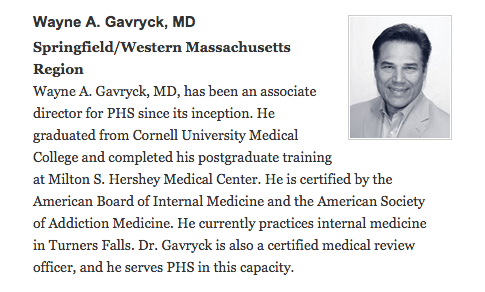
  4. Anthony J, Eaton W, Mandell W, al. e. Psychoactive Drug Dependence and abuse: More Common in Some Occupations than in Others? Journal of Employee Assistance Res. 1992;1:148-186.
  5. Stinson F, DeBakely S, Steffens R. Prevalence of DSM-III-R Alcohol abuse and/or dependence among selected occupations. Alchohol Health Research World. 1992;16:165-172.
  6. Hughes PH, Brandenburg N, Baldwin DC, Jr., et al. Prevalence of substance use among US physicians. JAMA : the journal of the American Medical Association. May 6 1992;267(17):2333-2339.
  7. Kessler RC, Berglund P, Demler O, Jin R, Merikangas KR, Walters EE. Lifetime prevalence and age-of-onset distributions of DSM-IV disorders in the National Comorbidity Survey Replication. Archives of general psychiatry. Jun 2005;62(6):593-602.
  8. Boyd JW, Knight JR. Ethical and managerial considerations regarding state physician health programs. Journal of addiction medicine. Dec 2012;6(4):243-246.
  9. DuPont RL, McLellan AT, White WL, Merlo LJ, Gold MS. Setting the standard for recovery: Physicians’ Health Programs. Journal of Medical Regulation. Mar 2010;95(4):10-25.
  10. Skipper GE, Weinmann W, Thierauf A, et al. Ethyl glucuronide: a biomarker to identify alcohol use by health professionals recovering from substance use disorders. Alcohol and alcoholism. Sep-Oct 2004;39(5):445-449.
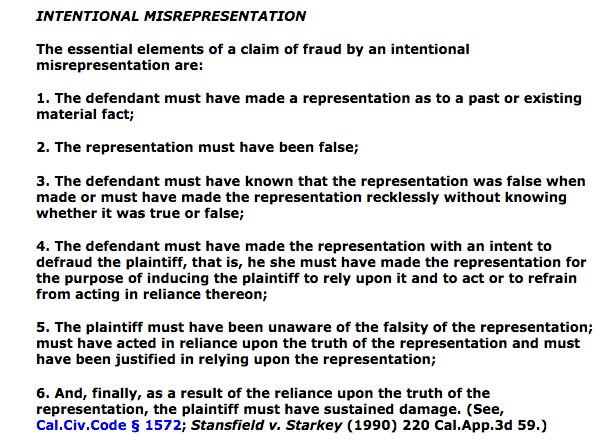
  11. Skipper GE, Thon N, Dupont RL, Baxter L, Wurst FM. Phosphatidylethanol: the potential role in further evaluating low positive urinary ethyl glucuronide and ethyl sulfate results. Alcoholism, clinical and experimental research. Sep 2013;37(9):1582-1586.
  12. Skipper GE, Thon N, DuPont RL, Campbell MD, Weinmann W, Wurst FM. Cellular photo digital breathalyzer for monitoring alcohol use: a pilot study. European addiction research. 2014;20(3):137-142.
  13. Sharfstein J. FDA Regulation of Laboratory-Developed Diagnostic Tests: Protect the Public, Advance the Science. JAMA : the journal of the American Medical Association. Jan 5 2015.
  14. Pham JC, Pronovost PJ, Skipper GE. Identification of physician impairment. JAMA : the journal of the American Medical Association. May 22 2013;309(20):2101-2102.
  15. McLellan AT, Skipper GS, Campbell M, DuPont RL. Five year outcomes in a cohort study of physicians treated for substance use disorders in the United States. Bmj. 2008;337:a2038.
  16. Rivers I, Noret N. Potential suicide ideation and its association with observing bullying at school. The Journal of adolescent health : official publication of the Society for Adolescent Medicine. Jul 2013;53(1 Suppl):S32-36.
  17. Lester D, Walker RL. Hopelessness, helplessness, and haplessness as predictors of suicidal ideation. Omega. 2007;55(4):321-324.
  18. Beck AT. Hopelessness as a predictor of eventual suicide. Annals of the New York Academy of Sciences. 1986;487:90-96.
  19. Hinduja S, Patchin JW. Bullying, cyberbullying, and suicide. Archives of suicide research : official journal of the International Academy for Suicide Research. 2010;14(3):206-221.
  20. Hertz MF, Donato I, Wright J. Bullying and suicide: a public health approach. The Journal of adolescent health : official publication of the Society for Adolescent Medicine. Jul 2013;53(1 Suppl):S1-3.
  21. Kim YS, Leventhal B. Bullying and suicide. A review. International journal of adolescent medicine and health. Apr-Jun 2008;20(2):133-154.
  22. Kiriakidis SP. Bullying and suicide attempts among adolescents kept in custody. Crisis. 2008;29(4):216-218.
  23. Taylor PJ, Gooding P, Wood AM, Tarrier N. The role of defeat and entrapment in depression, anxiety, and suicide. Psychological bulletin. May 2011;137(3):391-420.
  24. Lester D. Defeat and entrapment as predictors of depression and suicidal ideation versus hopelessness and helplessness. Psychological reports. Oct 2012;111(2):498-501.
  25. Williams JMG. Cry of Pain. Harmondsworth: Penguin; 1997.
  26. Williams JMG, Crane C, Barnhofer T, Duggan DS. Psychology and suicidal behavior: elaborating the entrapment model. In: Hawton K, ed. Prevention and treatment of suicidal behavior: from science to practice. Oxford: Oxford University Press; 2005:71-89.
  27. Borowsky IW, Ireland M, Resnick MD. Adolescent suicide attempts: Risks and protectors. Pediatrics. 2001;107(485).
  28. Clum GA, Febbraro GAR. Stress, social support and problem-solving appraisal/skill: Prediction of suicide severity within a college sample. Journal of Psychopathology and Behavioral Assessment. 1994;16:37-46.
  29. Fridner A, Belkic K, Marini M, Minucci D, Pavan L, Schenck-Gustafsson K. Survey on recent suicidal ideation among female university hospital physicians in Sweden and Italy (the HOUPE study): cross-sectional associations with work stressors. Gender medicine. Apr 2009;6(1):314-328.
  30. Fridner A, Belkic K, Minucci D, et al. Work environment and recent suicidal thoughts among male university hospital physicians in Sweden and Italy: the health and organization among university hospital physicians in Europe (HOUPE) study. Gender medicine. Aug 2011;8(4):269-279.
  31. Lindfors PM, Meretoja OA, Toyry SM, Luukkonen RA, Elovainio MJ, Leino TJ. Job satisfaction, work ability and life satisfaction among Finnish anaesthesiologists. Acta anaesthesiologica Scandinavica. Aug 2007;51(7):815-822.
  32. Heponiemi T, Kuusio H, Sinervo T, Elovainio M. Job attitudes and well-being among public vs. private physicians: organizational justice and job control as mediators. European journal of public health. Aug 2011;21(4):520-525.
  33. Elovainio M, Kivimaki M, Vahtera J. Organizational justice: evidence of a new psychosocial predictor of health. Am J Public Health. Jan 2002;92(1):105-108.
  34. Lawson KJ, Noblet AJ, Rodwell JJ. Promoting employee wellbeing: the relevance of work characteristics and organizational justice. Health promotion international. Sep 2009;24(3):223-233.
  35. Hayashi T, Odagiri Y, Ohya Y, Tanaka K, Shimomitsu T. Organizational justice, willingness to work, and psychological distress: results from a private Japanese company. Journal of occupational and environmental medicine / American College of Occupational and Environmental Medicine. Feb 2011;53(2):174-181.
  36. Lang J, Bliese PD, Lang JW, Adler AB. Work gets unfair for the depressed: cross-lagged relations between organizational justice perceptions and depressive symptoms. The Journal of applied psychology. May 2011;96(3):602-618.

Screen Shot 2014-12-02 at 3.17.56 AM


Rantings from the Bully Pulpit


Screen Shot 2015-02-20 at 11.02.24 PM

The three e-mails below were received within a twenty-four hour period from a physician supporting (and in all likelihood involved in) drug courts and physician health programs (PHPs).  E-mails such as this are invariably anonymous and I usually drag them right to the trash where they belong  but the trio below provides valuable insight into the mentality of those involved.  And for that reason I am posting them as they were received.

Under the nom de plume of “TT Wilson” the author presents non-sequitur and fallacious logic to promote drug courts, PHPs and the sanctification of an illegitimate  and irrational medical specialty.

He presents either/or logical fallacy and  false dichotomy.  You are either with us or against us!  He appeals to professionalism yet his words show he has no  inkling of the true definition, resorts to simple-minded cliches and meaningless platitudes and then sinks into ad hominem attacks on my blog and then me.

Ironically he accuses me me of ranting in a rant!

He is a prototypical example of the sham-artist physicians typically involved in these programs–an authoritarian paternalistic know-it-all who can only rant under the shield of gang-stalking power or a shroud of absolute anonymity.

As I have said time-and-time again if any factual errors exist in my blog I will not only remove them but remove my blog.

So I am going to make this offer to “TT Wilson”–if you wish to provide a rebuttal of any of the documentary evidence I provide in my blog herein then do so now.  If you can I will delete the whole kit and kaboodle.  Simple as that.

You Sir are an incompetent and a coward.  If not then prove me wrong. I challenge you to reveal your true identity. Let’s level the playing field a tad on this.  It is easy to present an opinion while cowardly hiding behind a veil of anonymity.  Let’s see if you have the courage to debate this publicly.

I won’t be holding my breath on this one.


February 7, 2015 7:45 PM

Comment:  It looks like it is too late already.  The ABAM is closer than ever to becoming a member of the ABMS, there is a big push from the Obama administration to fund addiction treatment and to greatly widen access.  As communities see how well run addiction programs save lives and force crime away from their homes the trend will be very hard to stop.  I agree, PHPs are draconian when they work with physicians thought to have SUDs, but I would rather have them too tough than too lax.  And a sober physician should be OK with that.

February 7, 2015  3:00 PM

Comment: Actually well run drug courts help patients who would have otherwise kept using substances of abuse.  Drug courts are quite dictatorial by design and clearly a defiant patient will defeat even the most caring and competent efforts to help them.  Of course we prefer that the patients be in a stage of change that leaves them open to treatment, but more than a few we’ve helped were not about to change without pressure from the court.

And I stipulated well run drug courts.  There are many incredibly poorly run drug courts.  When a judge doesn’t get it things are just as bad or worse than when the medical team doesn’t get it.  And the studies done are typically dismal.  Very short, small sample size, no standardization.  

As far as impaired physicians are concerned, it is not enough to just stop using and declare innocence.  If a cardinal event has attracted the attention of the medial (sic) board and that board requires participation in treatment to maintain licensure, well that goes with the license.  You can certainly choose not to participate, and the board can then choose to not let you practice.  They do the same thing with physicians with psychiatric issues.  And they encounter a huge amount of denial in this population, I would say more so than the lay population.  At least the denial is louder.

Dictatorial — sure.  Fair — well, no.  But life is not fair.  

As doctors we owe it to our patients to be held to a higher standard.  If someone of authority says I need to be screened, they are most welcome to any fluid or hair sample they require.  Is that fair?  Surely not.  Does that make it bad?  Not at all.

Do you have a better approach?  So far you haven’t demonstrated it in your myriad postings.

As far as ABAM is concerned, have you cried out about the ER boards, Pain Medicine boards, and all of the other boards that have been added to the charter members of the ABMS over the years?  Heck, back in the day a buddy of mine was grandfathered into the board of Plastic Surgery without even taking a test.  He sent them $500 and he was board certified.  Got a really nice certificate too, but it didn’t come with a frame.  Years later they started requiring fellowship training and actually taking a test.

I enjoy your site — clearly there are problems with the way care is being delivered by some individuals in some cases.  Of course that is true of every aspect of medicine.  No one is advocating that we shut down every other aspect of medicine.  Well some are, but that is for another discussion.  

My concern is that your ranting will deter some people away from meaningful treatment, very much like those who seethe against vaccinations lead the unknowing to not treat their children.  If I was cynical I could invoke Darwin here.  Thinning the herd.  

And you might want to get some help with wordpress.  This endless scrolling is distracting.  I was missing a good third of your content.

Screen Shot 2015-02-20 at 11.19.24 PM

February 7. 2015  9:45 PM

Comment: Finally made it to your last entry.  Please learn how to conduct a wordpress blog — your technique is very distracting.

You protesteth too much good sir.  Put aside your denial and get some treatment.  I am sure Harvard was glad to be rid of you.  They are very lucky you are out of there.

There might be some legitimate content in there somewhere, but by the time I reached the bottom of the page I was ready to hand you a mood disorder questionaire.  Not that we really need you to fill one out to make a diagnosis.

Screen Shot 2015-02-20 at 11.19.50 PM

image

← Back

Thank you for your response. ✨

johnnyLawrence

image9

image1