The Plan to introduce non-FDA approved drug and alcohol tests into the Healthcare system and require doctors drug-test ALL PATIENTs including students and kids!

1285610338-quack-doctor1

The Plan to introduce non-FDA approved Laboratory Developed Tests (LDTs) into the Healthcare system and require doctors drug-test ALL PATIENTs including students and kids!

The ASAM plans to introduce non-FDA approved “forensic”  Laboratory Developed Tests (LDTs) into mainstream healthcare via a loophole.    This same group introduced most of these tests through a loophole and now they want to drug-and alcohol TEST EVERYBODY including STUDENTS AND KIDS through another loophole!   These tests are of unknown reliability and accuracy.  The LDT pathway does not even require proof that the test is even valid  (i.e. that the test is actually testing for the substance it claims to be testing) but with no FDA oversight or regulation the labs can claim anything they want in marketing it and they do.

If a doctor collects a test on a “patient”  the test is rendered “clinical” rather than “forensic” and by deeming this drug-testing  “clinical” rather than “forensic”  they can then call the consequences of a positive test “treatment” rather than “punishment.  ” It is via this loophole they plan to introduce and unleash the panoply of junk-science tests currently being used on other groups who have no say in the matter (probationers, parolees, private professional monitoring groups, etc. ) onto the general population at large.    A boon for the Drug and Alcohol Testing Industry Association and the assessment and treatment industry but a bane to the rest of society.    And to prevent this from happening more people need to be talking about this.

Lapses into piety

James J. Conway's avatarStrange Flowers

For whosoever shall call upon the name of the Lord shall be saved.

– Romans 10:13

Harry Crosby, American poet and publisher, didn’t die on this day in 1917. Big deal, right? Well it was to Crosby, who was then serving at Verdun as an ambulance driver and survived a shell attack which, by rights, should have blown him to kingdom come.

Earlier the same day he had chanced upon the above passage in the Bible, and for a while afterwards attributed his miraculous survival to You-Know-Who. His friends teased him about his subsequent “lapses into piety”, during which he promised to forego his wayward ways in thanks for his deliverance.

Impatient to test himself in the theatre of war, Crosby had sailed in high summer from New York to Bordeaux on the French ship Espagne. Also on board was Cole Porter; like Crosby, born to fortune. But…

View original post 418 more words

Mandating Drug-Testing of Unknown Validity while removing the procedural safeguards of forensic drug testing: The plan to Introduce Laboratory Developed Tests into Mainstream Healthcare

Screen Shot 2013-09-04 at 6.14.30 PM

Chain-of-Custody refers to the document or paper trail showing the collection, control, transfer, analysis and disposition of laboratory tests.  It is the written documentation of a specimen from the moment of collection to the final destination to the review and reporting of the final results.   The multi-part chain-of-custody form or “custody and control” form is part and parcel of this process. It contains stickers to sign and seal the specimen so that it cannot be tampered with and the form itself is signed by the appropriate parties as the test specimen travels from place to place. Information is added to the form as it travels from person to person.  It has been given the status of a legal document as it has the ability to invalidate a specimen with incomplete information.  Once the sample is analyzed it is reviewed by a Medical Review Officer (MRO) for final review. In the case of a positive test it is the responsibility of the MRO to ascertain an intact  chain-of-custody, determine whether an alternative explanation exists for the positive test such as a prescribed medication, and then and only then report the test as a “true positive.”

The MRO looks for what are called “fatal flaws” and,  should one be present, invalidates the test.  A fatal flaw requires the test be rejected as it were never drawn.  It invalidates it and it cannot be used. screen-shot-2013-12-19-at-12-20-46-pmAny and all drug testing requires strict  chain-of-custody procedures. It documents not only the whereabouts of the specimen at any given time but the management and storage of the specimen. This is important because time and temperature can influence the results of certain tests.  One such test is alcohol.

Specimen integrity is critical in forensic drug testing, but so too is the integrity of the people involved.


Forensic Versus Clinical Drug Testing

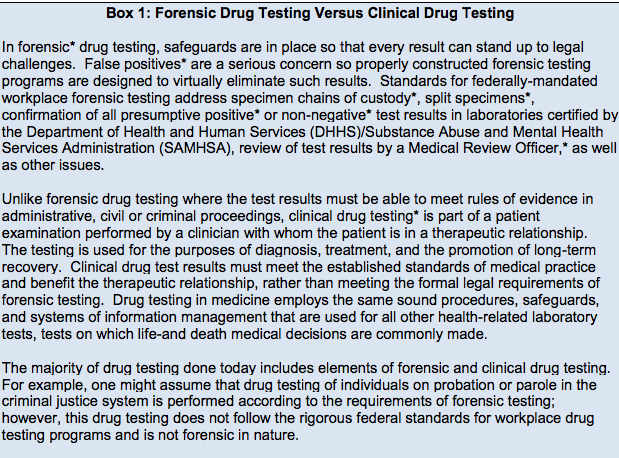
According to the ASAM White Paper on Drug Testing, clinical drug-testing “employs the same sound procedures, safeguard, and systems of information management that are used for all other health-related laboratory tests, tests on which life-and-death medical decisions are commonly made.”  In the box below they describe the multiple safeguards in place and requirements demanded of “forensic” drug testing but do not mention the reason these uncompromising and multiple specifications exist is to protect the donor from a false accusation of drug or alcohol use.  They proceed to define “clinical drug testing” as “part of a patient examination performed for the purposes of diagnosis, treatment, and the promotion of long term recovery” noting that clinical testing “must meet the established standards of medical practice and benefit the therapeutic relationship, rather than meeting the formal legal requirements of forensic testing.”  The authors then state that the “majority of drug testing done today” includes both forensic and clinical elements using individuals on parole and probation as examples.

Screen Shot 2015-01-14 at 12.32.11 AM

From the ASAM White Paper on Drug Testing

The logical fallacy here is striking.  It is comparing apples and oranges.  After detailing the specific quality assurance safeguards designed to prevent the donor of a drug or alcohol test from being falsely accused of illicit use, the authors give a general  definition and purpose of  “clinical” testing  then state that when testing for drugs the systems in place are up to snuff as they are already being used to make  “life-and-death medical decisions.”  The take-home message is that “forensic” testing is unnecessary hyperbole designed for legal challenges. The clinical lab  systems in place are used for critically  important testing and can therefore be used for drug-testing–after all, parolees and probationers don’t require it.

Forensic guidelines were developed in collaboration with occupational and environmental medicine specialists, clinical and forensic toxicologists, pathologists and others and the recommended  requirements agreed upon by this consortium exists solely to  assure validity and accuracy in the testing process.  These requirements exist to protect the donor and If the “clinical” testing context fit the bill then “forensic” testing would not have evolved.

Labs ordered clinically in the course of patient care are interpreted within the context of multiple other pieces of data.  Lab errors occur all the time and are interpreted in that context. Oftentimes a lab will not fit with the clinical picture and, when that happens, a repeat lab is ordered for verification.  Specimens get collected in the wrong tube and specimens get lost but in the clinical setting they simply get reordered and there are no consequences to patient care.   In contrast drug testing is an all-or-none one-shot test and the results have consequences. It is for that reason they must be valid.  Chain-of-custody and MRO review are critical and that is why most drug-testing programs follow the forensic protocol.  And the example of non-forensic drug-testing  parolees and probationers is misleading.   Any Employee Assistance Program that has a union or some other group looking out for their best interests uses strict “forensic” guidelines.   Parolees and probationers have no power  and have no choice.  Besides, the  National Association of Drug Court Professionals uses the Laboratory Developed Tests these same people introduced to test  individuals on probation or parole in the criminal justice system just as they do in the PHPs.

The  ASAM White Paper:

 “Encourages wider and “smarter” use of drug testing within the practice of medicine and, beyond that, broadly within American society. Smarter drug testing means increased use of random testing* rather than the more common scheduled testing,* and it means testing not only urine but also other matrices such as blood, oral fluid (saliva), hair, nails, sweatand breath when those matrices match the intended assessment process. In addition, smarter testing means testing based upon clinical indication for a broad and rotating panel of drugs”

As a physician-patient relationship renders drug testing “clinical” rather than “forensic” the consequences become “treatment” rather than “discipline.”  And that is the real reason behind all of this.    A positive “forensic” test in most employee random drug screening programs today will result in an “assessment” for substance abuse.  Most EAPs allow a choice in where that assessment takes place.  The model this system is based on, Physician Health Programs. do not allow choice as evaluations are mandated to “PHP-approved” assessment centers; a rigged game.

A positive “clinical” test will result in the same thing under the ASAM White Paper proposal.  But the assessment will be at an ASAM facility and if a Substance Use Disorder (SUD) is confirmed it will result in mandated abstinence of all substances (including alcohol) and lifelong spirituality involving 12-step recovery   And by using the healthcare system as a loophole and calling this testing “clinical” rather than “forensic” the ASAM will have successfully introduced widespread testing of a variety of Laboratory Developed Tests (LDTs) of unknown validity while removing  the safeguards provided by forensic testing including chain-of-custody and MRO review.


Screen Shot 2014-02-25 at 1.06.55 PM

← Back

Thank you for your response. ✨

Screen Shot 2014-02-25 at 1.04.35 PM

Junk Science and the Need for Regulatory Oversight of Forensic Laboratory Developed Tests

Screen Shot 2015-01-12 at 10.43.08 PM

Screen Shot 2014-02-21 at 11.38.29 AM


Laboratory Developed Tests

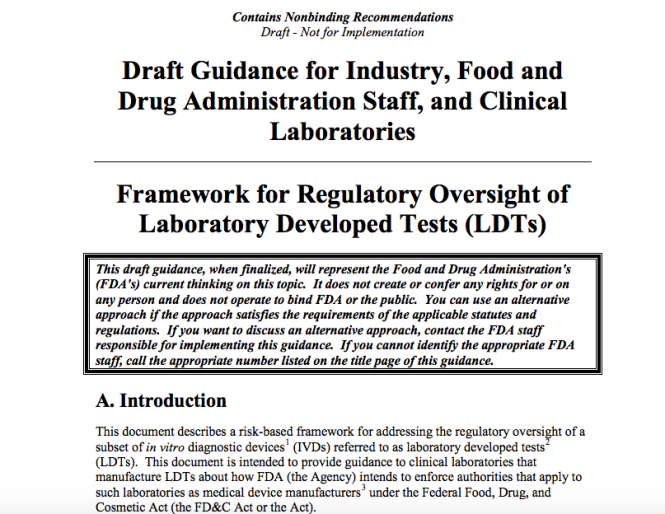
Questions about the accuracy and marketing of Laboratory Developed Tests (LDTs) have led to the current debate whether the U.S. Food and Drug Administration (FDA) should regulate a subset of diagnostic tests currently exempted from oversight. Designed to bring clinical tests to market that the costly FDA process would otherwise preclude, such as those for rare diseases, the LDT pathway bypasses Federal regulation and accountability.  Questions about the validity of these tests have raised concerns over patient safety and a call for oversight.  Among those asking for regulation are Massachusetts Senators Edward J. Markey and Elizabeth Warren.

Opponents of regulation argue the LDT  pathway enables new and pioneering tests to be developed quickly and improve patient care.  A recent viewpoint piece published in JAMA opposing regulation noted such advances have occurred “in large part because of the nimbleness of relatively small clinical and academic laboratories that can quickly respond to new medical findings and patient needs by rapidly and safely developing and improving laboratory-developed tests.”

But the LDT pathway does not require proof of test validity, that the test is actually testing for what it claims to be testing, and with no FDA oversight a lab can claim any validity it wants in marketing the test.  There is no accountability.    Proponents of  regulation argue that this lack of oversight is a direct threat to patient safety and, as an opposing viewpoint piece in JAMA notes, a “patient’s life or death could hinge on whether a single, unregulated diagnostic test result is meaningful.”

The debate has focused on the reliability and validity of a number of clinical tests currently marketed with unverified claims of accuracy such as those used for prenatal screening and Lyme disease.  Notably absent from the discussions are the vast number of  Laboratory Developed Tests tests being used for “forensic” drug and alcohol testing with the current FDA draft guidance stating simply:

  • At this time, FDA will continue to defer oversight of the use of these tests in the forensics (law enforcement) setting to the existing system of legal controls, such as the rules of evidence in judicial proceedings and other protections afforded through the judicial process.”


The Birth of EtG:  The Introduction and Marketing of Laboratory Developed Tests for “Forensic” Drug Testing  Via a Lucrative Loophole

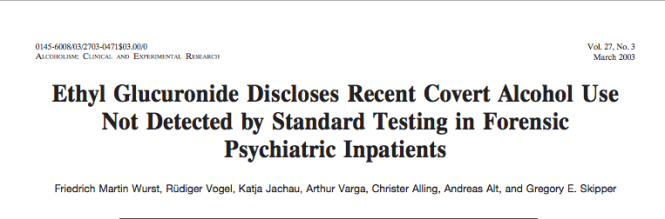
Numerous “forensic” tests of unknown validity using urine, blood, hair, fingernails breath and saliva have been developed and brought to market as LDTs since the first one was introduced in 2003 when ASAM physician Dr. Gregory Skipper,  then Medical Director of the Alabama Physicians Health Program,  “convinced the initial lab in the USA, NMS near Philadelphia to start performing EtG testing.”1   With essentially no evidence base Skipper then claimed the alcohol biomarker “appeared to be 100 percent specific” in detecting covert use of alcohol for several days after ingestion based on a study he coauthored that involved a mere 35 forensic psychiatric inpatients in Germany, all male2  
Screen Shot 2014-02-24 at 10.08.19 PMUsing an arbitrary cutoff level of 100 ug/L the EtG was marketed as a valid and reliable test and blindly tested on those being monitored by programs not beholden to the strict protocol and procedure dictated by the Mandatory Guidelines for Federal Workplace Drug Testing that most Employee Assistance Programs (EAPs) adopted.  In other words, the test was used on those who possessed little power or had their power removed.

The test was  subsequently found to be so sensitive that it could measure incidental exposure to alcohol in foods, over the counter cold medications, mouthwash3,4, hand sanitizer gel5, and nonalcoholic wine.6 Sauerkraut and bananas have even been shown to cause positive levels.7

Slide25

Shortly after the EtG debuted, complaints began to accumulate from individuals testing positive who adamantly proclaimed they did not drink.  Steadfast in their trust of expert opinion and the claimed accuracy of  EtG, the complaints of the accused were largely disregarded by those doing the monitoring.   People lost their licenses, jobs, careers, and reputations. Others lost their freedom or had their children taken away. It is unknown how many died by suicide.

There have been multiple  lawsuits filed since the introduction of the EtG including a class-action suit, but these were inevitably met with a well-funded and deep legal defense and their “experts.” The labs have taken a  “stand your ground” position yielding either dismissals or in favor of the defense.   As a new to the market  lab with no prior evidence-based research in forensic testing prior to its implementation and use for forensic testing, the proponents of EtG testing had no meaningful opposition in terms of a scientific body of facts and evidence and no credible voice to present it.  With the only “experts”  in EtG validity being those  who introduced and promoted its use there were no counter-forces.  Those suffering the consequences of a false-positive test had no recourse.  But as the toll of mayhem increased  it eventually reached a tipping-point where others began to take notice.

Page from the Talbott Recovery Center  list of products containing alcohol that doctors are required to avoid due to interference with EtG testing

Page from the Talbott Recovery Center list of products containing alcohol that doctors are required to avoid due to interference with EtG testing

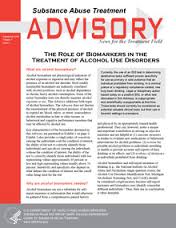
In 2006 the Wall Street Journal reported the problems with the EtG to the general public,8 and SAMHSA issued an advisory stating that “legal or disciplinary action based solely on a positive EtG…. is inappropriate and scientifically unsupportable at this time. These tests should currently be considered as potential valuable clinical tools, but their use in forensic settings is premature.”9

Since that time Skipper has served as expert witness in close to 46 administrative hearings 22 criminal  14 custody and 1 Federal class action suit.
Unknown-20

But this did not stop the Federation of State Physician Health Programs  from using the EtG on physicians being monitored. Instead they instructed doctors to avoid anything potentially containing alcohol including hand sanitizer which a 2011 study found could result in EtG concentrations of almost 2000 ug/L. 10 To continue to justify the use of EtG they added other LDTs as confirmation tests of LDTs such as EtS and PEth– Junk Science to confirm  junk science. Nonsensical smoke-and-mirrors antithetical to science and evidence-based medicine.

Since the birth of the EtG a variety of tests have been introduced and marketed as LDTs utilizing nails, blood, hair, breath and urine—all with unknown validity but marketed without constraint.  No regulation, oversight or accountability exists.

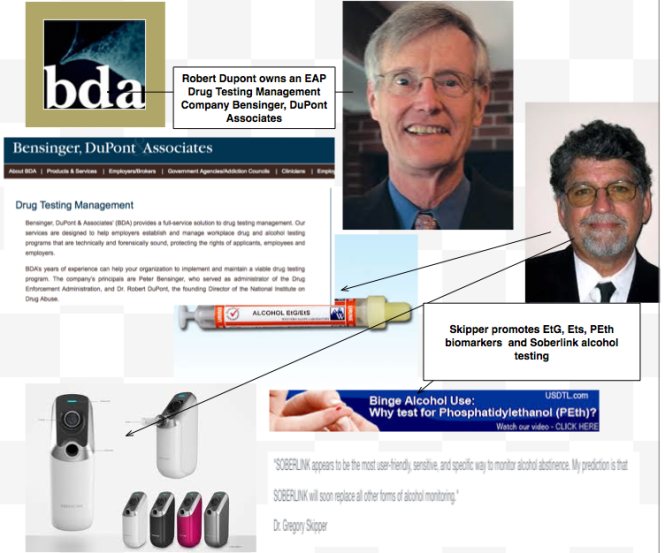
The newest gadget they are using on doctors is the Cellular Digital Photo Breathalyze which he is promoting in the same manner as the EtG after a study he co-authored with Robert Dupont on just 12 subjects.


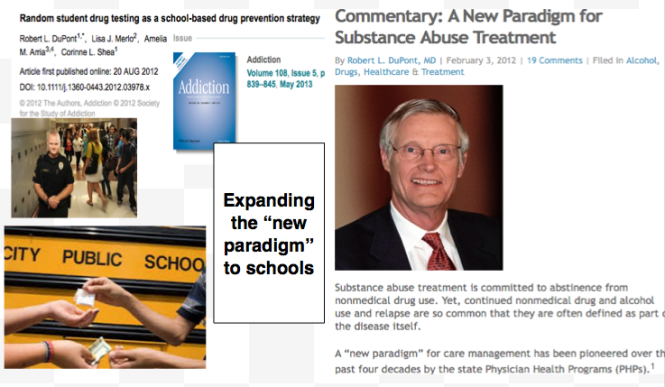
Expanding Laboratory Developed Tests to Test Everyone:   The ASAM White Paper on Drug-Testing and the  “New Paradigm” 

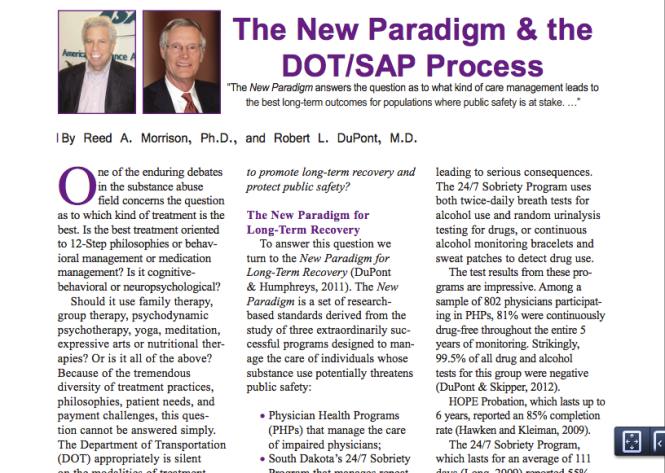
Although the current use of these tests is limited to the criminal justice system and professional monitoring programs this may soon change as the American Society of Addiction Medicine is proposing a “new paradigm” of zero-tolerance random widespread drug and alcohol testing. This is outlined  in the ASAM White Paper on Drug Testing and described by Robert Dupont in his keynote speech  before the Drug and Alcohol Testing Industry Association (DATIA) annual conference in 2012.

The ASAM White paper states drug testing is “vastly underutilized” throughout healthcare and describes the use of drug testing “within the practice of medicine and, beyond that, broadly within American Society.”

As the consequences of a single unregulated “forensic” test result can be grave, far-reaching and even permanent it is critical that these tests be included in the debate on regulation of LDTs.

Evidence based medicine is not restricted to randomized trials and meta-analyses. It involves tracking down the best external evidence with which to answer our clinical questions.11

Expert opinion is the lowest level of evidence available in the EBM paradigm.12,13   Fortunately, the scientific method and Cochrane type critical analysis of the available evidence is  a tool to help people progress toward the truth despite their susceptibilities to unconscious confirmatory bias or conscious confirmatory distortion .14  Unfortunately, no one has used these tools address they panoply of tests of unknown validity that have already entered the market ; poised to be used on virtually everyone.

  1. Skipper G. Exploring the Reliability, Frequency, and Methods of Drug Testing: What is Enough to Ensure Compliance?:   Alcohol Markers and Devices. 2013; http://www.fsphp.org/Skipper, Exploring the Reliability Frequency and Methods 2 Presentation.pdf.
  2. Wurst FM, Vogel R, Jachau K, et al. Ethyl glucuronide discloses recent covert alcohol use not detected by standard testing in forensic psychiatric inpatients. Alcohol Clin Exp Res. Mar 2003;27(3):471-476.
  3. Costantino A, Digregorio EJ, Korn W, Spayd S, Rieders F. The effect of the use of mouthwash on ethylglucuronide concentrations in urine. Journal of analytical toxicology. Nov-Dec 2006;30(9):659-662.
  4. Reisfield GM, Goldberger BA, Pesce AJ, et al. Ethyl glucuronide, ethyl sulfate, and ethanol in urine after intensive exposure to high ethanol content mouthwash. Journal of analytical toxicology. Jun 2011;35(5):264-268.
  5. Rosano TG, Lin J. Ethyl glucuronide excretion in humans following oral administration of and dermal exposure to ethanol. Journal of analytical toxicology. Oct 2008;32(8):594-600.
  6. Hoiseth G, Yttredal B, Karinen R, Gjerde H, Christophersen A. Levels of ethyl glucuronide and ethyl sulfate in oral fluid, blood, and urine after use of mouthwash and ingestion of nonalcoholic wine. J Anal Toxicol. Mar 2010;34(2):84-88.
  7. Musshoff F, Albermann E, Madea B. Ethyl glucuronide and ethyl sulfate in urine after consumption of various beverages and foods–misleading results? Int J Legal Med. Nov 2010;124(6):623-630.
  8. Helliker K. A test for alcohol–and its flaws. The Wall Street Journal2006.
  9. Administration SAaMHS. The role of biomarkers in the treatment of alcohol use disorders. In: Advisory SAT, ed2006:1-7.
  10. Reisfield GM, Goldberger BA, Crews BO, et al. Ethyl glucuronide, ethyl sulfate, and ethanol in urine after sustained exposure to an ethanol-based hand sanitizer. Journal of analytical toxicology. Mar 2011;35(2):85-91.
  11. Sackett DL, Rosenberg WM, Gray JA, Haynes RB, Richardson WS. Evidence based medicine: what it is and what it isn’t. BMJ. Jan 13 1996;312(7023):71-72.
  12. Shaneyfelt TM, Centor RM. Reassessment of clinical practice guidelines: go gently into that good night. JAMA. Feb 25 2009;301(8):868-869.
  13. Straus SE, Green ML, Bell DS, et al. Evaluating the teaching of evidence based medicine: conceptual framework. BMJ. Oct 30 2004;329(7473):1029-1032.
  14. Haack S. Defending Science–Within Reason: Between Scientism and Cynicism. Amherst, N.Y.: Prometheus Books; 2003.
Screen Shot 2014-02-15 at 4.39.03 PM

IMG_0701

quote-a-liar-sees-lies-said-taleswapper-even-when-they-aren-t-there-just-as-a-hypocrite-sees-orson-scott-card-216626

Accountability Needed for Criminal Fraud Committed by Physician Health Programs

Screen Shot 2015-01-09 at 1.59.40 AM

If we’re looking for the source of our troubles we shouldn’t test people for drugs, we should test them for stupidity, ignorance, greed and love of power.” –P.J. O’ Rourke

Fraud is distinguished from negligence, ignorance, and error by virtue of the fact that it is Intentional; involving some level of calculation.1 Negligence is: “the failure to use such care as a reasonably prudent and careful person would use under similar circumstances,”  and characterized chiefly by “inadvertence, thoughtlessness, inattention, and the like.”2.  Fraud, in contrast, is not accidental in nature, nor is it unplanned.2-4 Those who commit fraud know what they are doing and are deliberate in their efforts. They are also aware that it is unethical, illegal, or otherwise improper.

Fraudulent intent  can be established by examining the documentation of decisions and behaviors associated with those involved. As explained in Coenen: “Manipulation of documents and evidence is often indicative of such intent. Innocent parties don’t normally alter documents and conceal or destroy evidence.”5

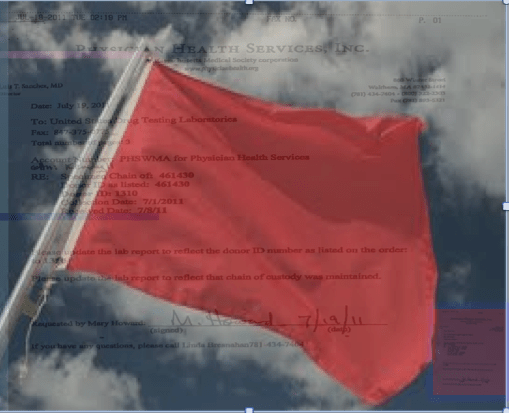
A chain of custody is generated in real time. It cannot be done retroactively. To do so constitutes fraud.   What is remarkable is with what apparent ease this was done.  There is no compunction, concern or inquiry from top to bottom at either of these agencies and documents a Machiavellian egocentricity. The acts are those of morally disengaged bullies who lack compassion and integrity.

One would assume that the state of Massachusetts would have a low tolerance for forensic fraud in the wake of the Annie Dookhan lab scandal,  especially when the perpetrators are contractors with the Department of Public Health (DPH) and work within the walls of the Massachusetts Medical Society (MMS).

The problem is Physician Health Programs (PHPs) have set up procedural barriers designed to bloc, ignore, marginalize and bury.  Truth is misrepresented, censored and suppressed.  The DPH and MMS have no oversight or regulation over Physician Health Services (PHS) and PHPs have convinced law enforcement that doctors police themselves.

Accountability needs to be rooted in organizational purpose and public trust.  When an organization operating within or contracting with an institution is committing  serious misconduct and fraud, then it becomes the institutions responsibility to investigate and correct it.  How low must the moral compass go before the MMS and DPH recognize what is self-evident to everyone else?   This would not have happened 20 years ago. What is happening to the profession of medicine when the institutions that are supposed to represent physicians and the public health allow individuals who are obviously and inexcusably engaging  in behavior antithetical to their own expressed ideals and purpose?

Corrupt individuals cannot be hired or retained by an employer without some level of institutional negligence, apathy or even encouragement.

Rationalization involves either self-delusion regarding the acceptability of fraud related to behavior under “special circumstances” or a disregard for the law as unjust or somehow inapplicable.5 Coenen explains that rationalization is the process by which someone   “determines that the fraudulent behavior is “okay” in her or his mind. For those with deficient moral codes the process of rationalization is easy. For those with higher moral standards it may not be quite so easy; they may have to convince themselves that a fraud is okay by creating “excuses” in their minds.

There is a diffusion of responsibility when verification is required and repercussions warranted.  This system of institutional injustice and forensic fraud between state Physician Health Programs and these corrupt labs is occurring across the country. I have spoken to the spouses and parents of multiple doctors who have killed themselves because this same thing was done to them.  Their deaths are being caused by people just like this and accountability is needed.


  1. Albrecht WS, Albrecht CO. Fraud Examination and Prevention. Mason, Ohio: South-Western Educational Publishing; 2003.
  2. Black HC. Black’s Law Dictionary. 6th ed. St. Paul, Minnesota: West Group; 1990.
  3. Albrecht WS, Albrecht CO, Albrecht CC, Zimbelman MF. Fraud Examination. 4th ed. Mason, Ohio: South Western Cengage Learning; 2011.

  4. O’ Lord A. The Prevalence of Fraud . What should we as academics be doing to address the problem? Accounting and Management Information Systems. 2010;9(1):4-21.
  5. Coenen T. Essentials of Corporate Fraud. Hoboken, NJ: John Wiley & Sons, Inc.; 2008.


← Back

Thank you for your response. ✨

33e7f-0905opedparini-master180-v3

capture

mllangan1's avatarDisrupted Physician


IMG_9516
“A body of men holding themselves accountable to nobody ought not to be trusted by anybody.”

― Thomas Paine 

USDTL drug testing laboratory claims to advance the”Gold Standard in Forensic Toxicology.”  “Integrity: Results that you can trust, based on solid science” is listed as a corporate value. “Unlike other laboratories, our drug and alcohol testing begins and ends with strict chain of custody.” “When people’s lives are on the line, we don’t skip steps.”  Joseph Jones, Vice President of Laboratory Operations explains the importance of chain-of-custody in this USDLT video presentation.

Dr. Luis Sanchez, M.D. recently published an article entitled Disruptive Behaviors Among Physicians in the Journal of the American Medical Association discussing the importance of  of a “medical culture of safety” with “clear expectations and standards.”  Stressing the importance of values and codes-of-conduct in the practice of medicine, he calls on physician leaders  “commit to professional behavior.”

Sanchez is Past President of…

View original post 4,712 more words

Psychopathy and the Medical Profession

mllangan1's avatarDisrupted Physician

IMG_9598Psychopathy is present in all professions. In The Wisdom of Psychopaths: What Saints, Spies, and Serial Killers Can Teach Us About Success, Kevin Dutton provides a side-by-side list of professions with the highest (CEO tops the list) and lowest (care-aid) percentage of psychopaths.   Interestingly surgeons come in at #5 among the professions with the highest percentage of psychopathy while doctors  (in general) are listed among the lowest.

Although by no means a scientific study, Psycopaths, by their very nature, seek power and it would make sense that a psychopath among us might pick surgery over pediatrics or pathology as they are drawn to power, prestige, and control. Be this as it may the incidence of psycopathy or psychopathic traits in doctors of any specialty is low. Statistics indicate that no more than 1% of men in general exhibit psychopathic traits. In Women these characteristics are far less.

Due to irresponsible…

View original post 673 more words

Happy New Year from DisruptedPhysician.Com

ark--38305-g4r49qgw-is-1

Please don’t forget to sign petition to request Massachusetts State Auditor Suzanne Bump investigate the  Massachusetts Board of Registration in Medicine Physician Health and Compliance Unit under the direction of Attorney Deb Stoller  and their unholy alliance with Physician Health Services, Inc. (PHS).

Accountability requires both the provision of information and consequences.  Those who are able to hold PHS accountable have been provided with information that unquestionably shows PHS is engaging in unethical and criminal activity including forensic fraud and collusion with third parties to commit fraud.  It is necessary that these agencies do their job, provide due diligence, investigate and provide the appropriate consequences to those who engage in misconduct and break the law. Anything less is indicative of complicity.

Happy New Year to you and yours.  Let’s end this type of corruption in healthcare in 2015.

← Back

Thank you for your response. ✨

5be84913767be62dd5ac5ec9d424416c


Please Sign Petition and Call (617-727-6200) MA State Auditor Suzanne Bump to Demand Audit of Corrupt Physician Health Services and the MA BORM Physician Health and Compliance Unit

Please Sign Petition and Call (617-727-6200) MA State Auditor Suzanne Bump to Demand Audit of Corrupt Physician Health Services and the MA BORM Physician Health and Compliance UnitThe Petition can be found here.  Or better yet, sign the petition and call her.  The evidence that Physician Health Services, Inc. (PHS) is committing crimes has been free-floating for the past two years.   It has been posted on Reddit, Twitter, Facebook, Linkedin, blogged, faxed, and phoned.  The response?  Absolute silence.

The procedural, ethical and criminal violations are clear and many.     The incontrovertible evidence has been directly delivered to individuals who should address this but for some reason do not.  This is not a matter of opinion folks but a matter of fact.    Time and time again we hear of  egregious misconduct hidden for decades because of  cognitive dissonance and blinkered apathy.

What evidentiary standard is required for action?   Over the past three years and under a lot of duress I have obtained indefensible documentary prima facie  proof of  crimes committed by individuals that should elicit immediate action but produced nothing but silence.

The crimes are many and they are of significance.  Accountability necessitates both the provision of information and justification for one’s actions.   This group has effectively blocked both of these. With much effort and under threat I have obtained proof of criminal activity with the expectation that the provision of this information would  result in those who should and could do something about it would.   They have not.

The documentary evidence of crimes is self-evident.  It is indefensible.    It is inexcusable that criminal activity is taking place within the walls of the Massachusetts Medical Society.   The fact that PHS is unregulated and without any meaningful accountability is irrelevant.  They are engaging in criminal activity within the walls of an institution whose very foundation is the antithesis of this groups actions and it must be addressed. Either support what the documents show or do something about it.

So please sign this petition and call  Massachusetts State Auditor Suzanne Bump at 617-727-6200

Institutional injustice just like that being committed by Luis Sanchez, Linda Bresnahan and the corrupt MRO Wayne Gavryck is killing doctors across the country.  They need to be held accountable.  Help me hold them accountable.

You do not need to be from Massachusetts to sign this petition. It is to raise public awareness–hopefully enough to elicit more exposure of this problem to prompt audits not only in Massachusetts but in other states as was recently done in North Carolina. The N.C. state auditor conducted an investigation and found poor oversight of the state PHP by both the state Medical Society and the state Medical Board, a lack of due process for physician’s who disputed the PHP’s evaluations and requirements, and multiple instances of potential conflicts-of-interest.

Dr. J. Wesley Boyd, who was previously an Associate Director at Physician Health Services, inc., the Massachusetts PHP is recommending that state government agencies audit their PHPs as well to “ensure that their vast power is wielded judiciously and with oversight.”  He adds that “doctors who are unsafe to practice medicine ought to be prevented from doing so. But every doctor who enters any kind of treatment or monitoring program should be treated respectfully and fairly, monitored appropriately, and have legitimate avenues of appealing decisions about their care.”

The Massachusetts PHP is engaging in unconscionable conduct including forensic fraud and self-evident criminal activity that is indefensible from within the walls of the Massachusetts Medical Society. Most are not aware of this. They need to be. This rigged game is a national problem and how the racket works in Massachusetts can be seen here.

 Please help me expose this and put a stop to it!

← Back

Thank you for your response. ✨

IMG_8564

Screen Shot 2014-11-26 at 6.52.55 PM

Disrupted Physician 101.2: “Addiction Medicine” is a Self-Designated Practice Specialty Unrecognized by the American Board of Medical Specialties–(An AMA Census Term Indicating Neither Training nor Competence)

Disrupted Physician 101.2: “Addiction Medicine” is a Self-Designated Practice Specialty Unrecognized by the American Board of Medical Specialties–(An AMA Census Term Indicating Neither Training nor Competence)B1A19yWIMAAQf7EThe fraudulent Addiction Medicine drug-testing, assessment and treatment complex is a  charade of prohibitionists and profiteers.  It is time that this be identified and addressed. Addiction Medicine has evolved in a Lord-of-the-Flies manner without regulatory scrutiny or oversight and an absence of the need to guard. They are the Robber barons of Science and Medicine who have bought and boondoggled their way into the Medical Profession and Society  and are poised to ruin both. It is time to take aim at these unsupervised pundits of authoritative opinion with facts, evidence base, and the scientific method. The immense and unconscionable conflicts of interest  must also be addressed. And the blinkered apathy of the masses and willful ignorance of organized medicine needs to end now!   If not the ASAM White Paper on Drug Testing  will come to pass and we will be  faced with a future Police State run by unqualified, illegitimate and irrational zealots and profiteers.

← Back

Thank you for your response. ✨

johnnyLawrence

10271616_1417366195200940_5101328752156758607_n

British Medical Journal 17 December 2014: Drug Policy: We Need Brave Politicians and Open Minds

Screen Shot 2014-12-30 at 3.38.59 PM

http://www.bmj.com/content/349/bmj.g7603/rr

← Back

Thank you for your response. ✨


Screen Shot 2013-10-23 at 2.56.31 PM