Drug Companies and Doctors: A Story of Corruption

Drug Companies and Doctors: A Story of Corruption.

What we need is a Marcia Angell to take on the multi-billion dollar drug and alcohol testing, assessment and treatment industry.

Screen Shot 2015-06-01 at 7.22.25 PMWhile all eyes were focused on the drug companies these multi-billion dollar industries erected a scaffold of immunity and profit by removing (and blocking) themselves from essentially all aspects of accountability; answerability, justification for actions and the ability to be punished by outside actors.    The 2009 quote in reference to “big pharma”  is just as applicable to the drug and alcohol testing industry,”  the inpatient assessment and treatment centers and the “authorities” pushing public policy and swaying public opinion to accept irrational and illegitimate authoritative opinion as truth.

And unlike the pharmaceutical industries carefully constructed “bent science” which requires a keen eye and critical analysis , the evidence-base supporting the testing, assessment and treatment industry rests on a foundation that can be aptly characterized as illusions and lies.  The “science” is not just “junk-science” but junk-science of the lowest order–examples of confirmatory distortion and data-dredging to make the data fit the hypothesis abound.   The conflicts-of-interest are not potential but incestual with many of the key players putting their hands in every slice of the pie!

The bad science, bad medicine, bad policy and  bad actors are easy to identify. It would be like shooting fish in a barrel.

So what are the barriers?

Why has this not been done?

The answer to that is complex but  involves a confluence of factors including psychological, political and cultural.  “Feel good fallacy,”  “political correctness, and moral and policy entrepreneurship have effectively swayed the targets intended.  The well-funded misinformation and propaganda was cast with a large net using the same techniques others have successfully used throughout history to accomplish the same.  Moral panics, moral crusades, and a plethora of logical fallacy have been used and used with considerable resources and skill.

So what can we do about it?

The first “step into the breach” is to identify the problem with the first one being the Emperor has no clothes.  Once this is acknowledged it would not take long to address directly the specific problems and erroneous assumptions of this paradigm through the lenses of science, critical reasoning, ethics and common sense.  If this were to be done the entire Potemkin village would fall like a house of cards.

But the very first and simplest step is to use your voice to question this authority. Make it be known.

Screen Shot 2015-05-31 at 5.24.44 PM

Screen Shot 2015-05-31 at 5.23.51 PM


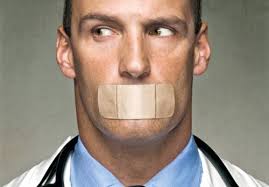
History teaches us that silence and secrecy are often the most effective tools of power.   It hides things including very bad things.  It is time to shine a light on this dank dark corner of the medical profession.


It is simply no longer possible to believe much of the clinical research that is published, or to rely on the judgment of trusted physicians or authoritative medical guidelines. I take no pleasure in this conclusion, which I reached slowly and reluctantly over my two decades as an editor of The New England Journal of Medicine” – Marcia Angell 

leonardo

“At times to be silent is to lie. You will win because you have enough brute force. But you will not convince. For to convince you need to persuade. And in order to persuade you would need what you lack: Reason and Right”
― Miguel de Unamuno

“I have always found it odd that people who think passive aggressively ignoring a person is making a point to them. The only point it makes to anyone is your inability to articulate your point of view because deep down you know you can’t win. It’s better to assert yourself and tell the person you are moving on without them and why, rather than leave a lasting impression of cowardness on your part in a person’s mind by avoiding them.”
― Shannon L. Alder

Staying silent is like a slow growing cancer to the soul and a trait of a true coward. There is nothing intelligent about not standing up for yourself. You may not win every battle. However, everyone will at least know what you stood for—YOU.”
― Shannon L. Alder


IMG_8021Screen Shot 2015-06-01 at 8.17.00 PM

How False Constructs Come to Be Regarded As Irrefutable Truth: The “Disruptive Physician”, Addiction Medicine Specialists and the 21st Century Inquisition of Doctors–Let’s See if She Floats!

According to the FSPHP, physician illness and impairment exist on a continuum with illness typically predating impairment, often by many years.” The policy extends PHP authority to cover physical illnesses affecting cognitive, motor, or perceptive skills, disruptive physician behavior, and “process addiction” (compulsive gambling, compulsive spending, video gaming, and “workaholism”). It also defines “relapse without use” as “behavior without chemical use that is suggestive of impending relapse.”

mllangan1's avatarDisrupted Physician

Screen Shot 2014-02-24 at 9.19.46 AM“This physician may be clinically competent; indeed, he may be technically superior. However, no one wants to refer patients to him. No one wants to assist him in surgery. He is the one who screams at nurses, belittles medical students and makes criticisms that go beyond the bounds of fair professional comment. However, he is not always loud. He can be the passive physician who will not answer the pager while on call, who does not show up at meetings and will not help find solutions to departmental problems. Indeed, this physician is not always male, but more often than not that seems to be the case.”

So begins “The Dreaded Task of Confronting Disruptive Physicians,” 1 a call to arms by Dr. Graeme M. Cunningham, M.D. (Fellow of the American Society of Addiction Medicine) published in the Journal of Medical Licensure and Discipline in 2004  (The official…

View original post 1,977 more words

How False Constructs Come to Be Regarded As Irrefutable Truth: The Malleus Maleficarum, Demonologists and Witch-Prickers–Let’s See if She Floats!

hanging_witch_01

From the mid 1980s until present day a confederacy of “authorities” calling themselves “addiction medicine” specialists assisted in identifying disruptive physicians. Shaping clinical and legal orthodoxy they set the standards that cooperating regulatory authorities could follow in criminalizing, persecuting and punishing heretics.imgres

Behavioral manifestations included not answering pages on time, untimely or illegible chart notes, being late for meetings and questioning hospital authority. Disruptive physicians were blamed for everything—patient morbidity and mortality, increasing malpractice costs and decreased hospital revenue.

Using the nebulous “disruptive physician” label, anyone with a grudge or suspicious could accuse anyone of misbehavior, malice and mayhem.

Propaganda, threats, misinformation, guild assumed from the start, PHP oversight of disruptive physician persecution was standard.

mllangan1's avatarDisrupted Physician

cropped-images-4.jpeg

“The belief that there are such things as witches is so essential a part of the faith that obstinately to maintain the opposite opinion manifestly savors of heresy.”  

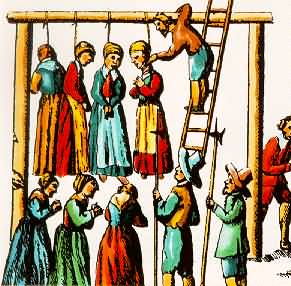
So begins Malleus Maleficarum , a witch hunters manual published in 1486 that  launched a new paradigm for all those concerned with the identification and extirpation of witches.  Used as a judicial case-book the Malleus set forth definitions of witchcraft, rules of evidence, and the canonical procedures by which suspected witches were tortured and put to death.   Written by Inquisitors for Inquisitor, the Malleus construct came to be regarded as irrefutable truth and contributed to the identification and execution of as many as 60,000 “witches”, predominantly women.  The 29th and last edition was published in 1669.

images-16

Although there was a general belief in witches at the time theas published they were not regarded as evil or life threatening.  Society did not…

View original post 682 more words

Silence and Secrecy are often the most effective tools of Power

Screen Shot 2015-05-31 at 5.23.51 PM

Screen Shot 2015-05-31 at 5.24.44 PM

History teaches us that silence and secrecy are often the most effective tools of power.   It hides things.

“At times to be silent is to lie. You will win because you have enough brute force. But you will not convince. For to convince you need to persuade. And in order to persuade you would need what you lack: Reason and Right”
― Miguel de Unamuno

“I have always found it odd that people who think passive aggressively ignoring a person is making a point to them. The only point it makes to anyone is your inability to articulate your point of view because deep down you know you can’t win. It’s better to assert yourself and tell the person you are moving on without them and why, rather than leave a lasting impression of cowardness on your part in a person’s mind by avoiding them.”
― Shannon L. Alder

Staying silent is like a slow growing cancer to the soul and a trait of a true coward. There is nothing intelligent about not standing up for yourself. You may not win every battle. However, everyone will at least know what you stood for—YOU.”
― Shannon L. Alder

Request that Massachusetts Medical Society acknowledge or refute professional, ethical and criminal misconduct by Physician Health Services (PHS, Inc.)

Screen Shot 2014-11-26 at 7.10.56 PMAphorisms

Kim Sawyer

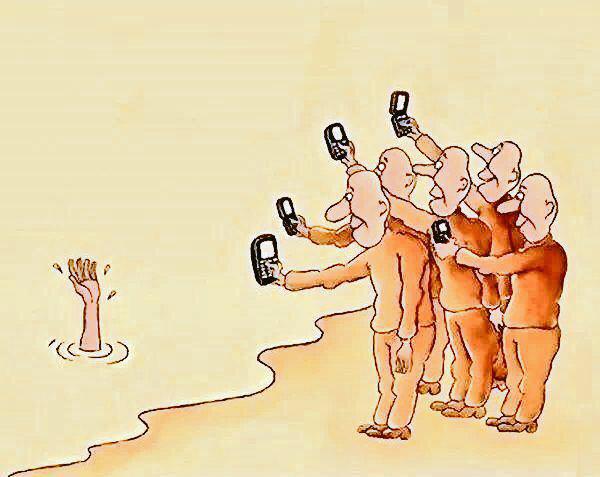
The bystander
The silence of one bystander is agag
powerful voice.
Their silence is more powerful than
the silence of none.
The silence of two bystanders more
powerful than one.Featured Image -- 48380
The silence of three bystanders
more powerful than two.
The silence of four bystanders
more powerful than three.
And in the limit, the silence of the
bystanders converges to
the voice of the wrongdoer.


mllangan1's avatarDisrupted Physician

Oliver Wendell Holmes, the Massachusetts Medical Society, Tinsel Erudition and Pretended Science Redux

images-10As the oldest medical society in the United States the Massachusetts Medical Society can count some of the greatest minds in the history of American medicine as members.  My how far we have fallen.  This same author has previously unintelligibly compared the field of medicine to Barbra Streisand’s face and shamelessly and opportunistically blamed the Boston Marathon bombing on “marijuana withdrawal.” 
The sophomoric mnemonics are neither clever nor illuminating.  Unworthy of  Readers Digest circa 1957, this dumbing down of doctors needs to end.  The very soul and practice  of medicine is being castrated and lobotomized by the same dull and very very blunt instrument. 
How does one reconcile the fact that the very same medical society that publishes the New England Journal of Medicine is allowing this type of tripe and rabble to get past editorial review?  In…

View original post 1,846 more words

“No matter what people tell you,words and ideas can change the world.”-Robin Williams.

“No matter what people tell you,words and ideas can change the world.”-Robin Williams..

“I stand upon my desk to remind myself that we must constantly look at things in a different way.”

-John Keating (Robin Williams)

Dead Poets Society

The ASAM plan to exploit the doctor-patient relationship to drug test everyone they can using non-FDA approved tests they introduced: And you and your doctor won’t have a choice in the matter.

Screen Shot 2015-05-30 at 3.41.27 PM


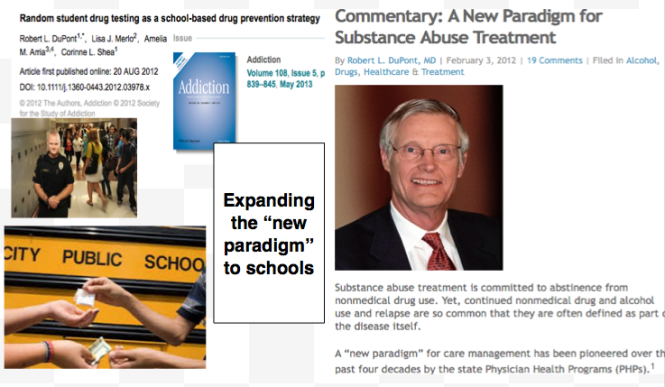
Before the  2012 Drug and Alcohol Testing Industry Association (DATIA)  annual conference, former Nixon Drug Czar Dr. Robert Dupont delivered a speech entitled “Drug Testing and the Future of American Drug Policy.”   Dupont describes a “New Paradigm” for substance abuse treatment that enforces “zero tolerance for alcohol and drug use”  enforced by monitoring with frequent random drug and alcohol tests in which positive tests are “met with swift, certain, but not draconian, consequences.” The paradigm is based on the current Physician Health Programs blueprint.  Dupont states:

“…physician health programs , have set the standard for effective use of drug testing. These pioneering state programs provide services to health care professionals with substance use disorders. The programs are run by physicians, some of whom in recovery themselves. PHPs feature relatively brief but highly focused treatment followed by active lifelong participation in the 12-step fellowships of Alcoholics Anonymous and Narcotics Anonymous. The key to the success of the PHP system of care management is the enforcement of the standard of zero tolerance for any alcohol or other drug use by intensive long-term random testing for both alcohol and drugs with swift and certain consequences for even a single use of alcohol or any other drugs of abuse. PHPs use drug panels of 20 or more drugs. The PHPs commonly use EtG and EtS tests to detect recent alcohol use. Similar comprehensive programs have been developed for commercial pilots and attorneys. These innovative programs of care management produce unprecedented long-term, outcomes.”

Physician Health Programs (PHPs) use a doctor’s medical license as “leverage” in what they call “contingency management.”  The doctor must comply with any and all demands made under threat of being reported to their medical board for “non-compliance.”  The national organization representing PHPs, the Federation of State Physician Health Programs (FSPHP) has convinced the national organization representing state medical boards, the Federation of State Medical Boards (FSMB) that “second-guessing” PHP authority “undermines a culture of professionalism.”   As with every other ware the FSPHP has pitched the FSMB they accepted this notion in blind faith and without critical analysis. If they did look a little deeper they would find the “PHPs-blueprint” more resembles a paradigm of “racketeering” then it does “rehabilitation” or “recovery” and the terms they use are euphemisms.  Taking a medical license “hostage” and holding it for “ransom”  while putting coins in your pocket by “extortion” doesn’t fit in with a “culture of professionalism” though.  They are very good at impression management–have to give them that.

Declaring the PHP model the “gold standard” of substance abuse treatment they now want to spread the wealth to others, including kids.    But instead of a medical license it will be your student loan, right to participate in school sports, teaching license, hairdressing license, commercial truck driving license, gun license, and even license to drive they will be after.  If you got it and it is in any way tied to state or federal government benefits or rights they will threaten you with removing it.  And as is being seen in doctors there will not be a damned thing you will be able to do about it.

This is all outlined in the 2013 American Society of Addiction Medicine White Paper on Drug Testing.   If you have not read it yet you need to.   If you read one thing this year make it this as it is under the radar and no one is talking about it.

A Modest Proposal

I implore you to do two things:

1.  Read the ASAM White Paper on Drug Testing in its entirety.  It can be found here and here.

2.  If you like what you see do nothing.  If this is the predominant response then it will surely come to fruition as has every other public policy recommendation the ASAM has pushed.  ( See policy entrepreneurship, bent science,  moral crusades).

3. If you don’t like what you see then stand up!  Make your voice known.  Make your voice known in every venue you can.  Write and call your local and state politicians,  comment in the news media, tweet, Instagram, post to FaceBook, send links to your connections on Linkedin. Do everything you can because we do not have long.  The ASAM is slated to become recognized by the American Board of Medical Specialties in 2016 and that will be the beginning of the end.  What is described in the ASAM White Paper will be ushered in and, as we have seen with what has happened to doctors, there will not be a thing you will be able to do about it.

The ASAM is not a medical “specialty” but a “special interest group representing the billion dollar drug and alcohol testing, assessment and treatment industry.   Although they say they exist to help addicts and benefit the public their plans as outlined below suggest they do neither.   Moreover, many of the architects of this future drug-testing dystopia can be found right here on this list.

In order to prevent this we need voices now!  Please take the ASAM White Paper on Drug Testing Challenge.  Read it, form an opinion and state, yell and shout  your opinion everywhere and anywhere you can.


The 2013 American Society of Addiction Medicine White Paper on Drug Testing describes the organizational structure of the “New Paradigm” which includes utilization of the medical profession as a urine collection agency for their drug and alcohol testing. When a doctor-patient relationship exists the testing is rendered “clinical” rather than “forensic.” Thus the consequences of a positive test can be deemed “treatment” rather than punishment. This bypasses the strict chain-of-custody and Medical Review Officer requirements designed to ensure accuracy and minimize false-positives.  Forensic drug testing is tightly regulated because the results a positive test can be grave and far reaching.  Erroneous results are unacceptable.

And then he proposed expansion of this paradigm to other populations including workplace, healthcare, and schools.

Screen Shot 2013-09-04 at 6.14.30 PM

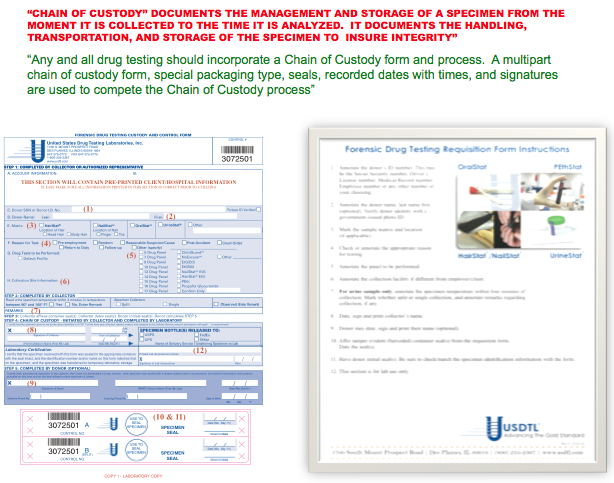
Chain-of-Custody refers to the document or paper trail showing the collection, control, transfer, analysis and disposition of laboratory tests.  It is the written documentation of a specimen from the moment of collection to the final destination to the review and reporting of the final results.   The multi-part chain-of-custody form or “custody and control” form is part and parcel of this process. It contains stickers to sign and seal the specimen so that it cannot be tampered with and the form itself is signed by the appropriate parties as the test specimen travels from place to place. Information is added to the form as it travels from person to person.  It has been given the status of a legal document as it has the ability to invalidate a specimen with incomplete information.  Once the sample is analyzed it is reviewed by a Medical Review Officer (MRO) for final review. In the case of a positive test it is the responsibility of the MRO to ascertain an intact  chain-of-custody, determine whether an alternative explanation exists for the positive test such as a prescribed medication, and then and only then report the test as a “true positive.”

The MRO looks for what are called “fatal flaws” and,  should one be present, invalidates the test.  A fatal flaw requires the test be rejected as it were never drawn.  It invalidates it and it cannot be used. screen-shot-2013-12-19-at-12-20-46-pmAny and all drug testing requires strict  chain-of-custody procedures. It documents not only the whereabouts of the specimen at any given time but the management and storage of the specimen. This is important because time and temperature can influence the results of certain tests.  One such test is alcohol.
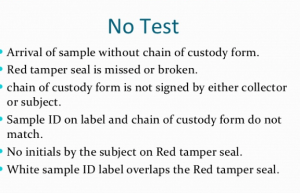
Specimen integrity is critical in forensic drug testing, but so too is the integrity of the people involved.


Forensic Versus Clinical Drug Testing

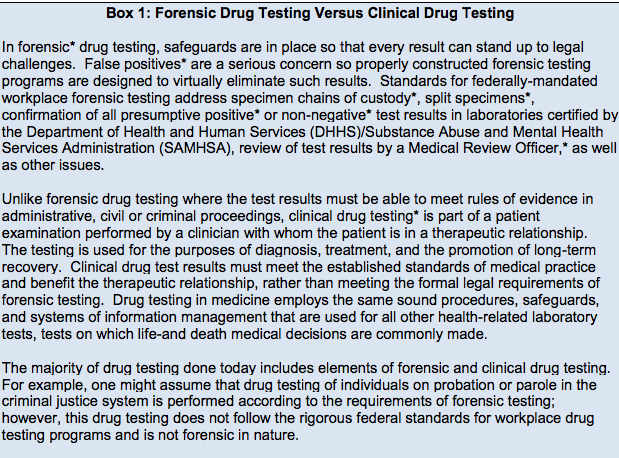
According to the ASAM White Paper on Drug Testing, clinical drug-testing “employs the same sound procedures, safeguard, and systems of information management that are used for all other health-related laboratory tests, tests on which life-and-death medical decisions are commonly made.”  In the box below they describe the multiple safeguards in place and requirements demanded of “forensic” drug testing but do not mention the reason these uncompromising and multiple specifications exist is to protect the donor from a false accusation of drug or alcohol use.  They proceed to define “clinical drug testing” as “part of a patient examination performed for the purposes of diagnosis, treatment, and the promotion of long term recovery” noting that clinical testing “must meet the established standards of medical practice and benefit the therapeutic relationship, rather than meeting the formal legal requirements of forensic testing.”  The authors then state that the “majority of drug testing done today” includes both forensic and clinical elements using individuals on parole and probation as examples.
Screen Shot 2015-01-14 at 12.32.11 AM

From the ASAM White Paper on Drug Testing

The logical fallacy here is striking.  It is comparing apples and oranges.  After detailing the specific quality assurance safeguards designed to prevent the donor of a drug or alcohol test from being falsely accused of illicit use, the authors give a general  definition and purpose of  “clinical” testing  then state that when testing for drugs the systems in place are up to snuff as it is already being used to make  life-and-death medical decisions.  The take-home message is that “forensic” testing is unnecessary hyperbole designed for legal challenges. The clinical lab  systems in place are used for critically  important testing so it can be used for drug-testing.   After all, parolees and probationers don’t require it.

Forensic guidelines were developed in collaboration with occupational and environmental medicine specialists, clinical and forensic toxicologists, pathologists and others and the recommended  requirements agreed upon by this consortium exists solely to  assure validity and accuracy in the testing process.  These requirements exist to protect the donor and If the “clinical” testing context fit the bill then “forensic” testing would not have evolved.

Labs ordered clinically in the course of patient care are interpreted within the context of multiple other pieces of data.  Lab errors occur all the time and are interpreted in that context. Oftentimes a lab will not fit with the clinical picture and, when that happens, a repeat lab is ordered for verification.  Specimens get collected in the wrong tube and specimens get lost but in the clinical setting they simply get reordered and there are no consequences to patient care.   In contrast drug testing is an all-or-none one-shot test and the results have consequences. It is for that reason they must be valid.  Chain-of-custody and MRO review are critical and that is why most drug-testing programs follow the forensic protocol.  And the example of non-forensic drug-testing  parolees and probationers is misleading.   Any Employee Assistance Program that has a union or some other group looking out for their best interests uses strict “forensic” guidelines.   Parolees and probationers have no power  and have no choice.  Besides, the  National Association of Drug Court Professionals uses the Laboratory Developed Tests these same people introduced to test  individuals on probation or parole in the criminal justice system just as they do in the PHPs.

The  ASAM White Paper:

 “Encourages wider and “smarter” use of drug testing within the practice of medicine and, beyond that, broadly within American society. Smarter drug testing means increased use of random testing* rather than the more common scheduled testing,* and it means testing not only urine but also other matrices such as blood, oral fluid (saliva), hair, nails, sweatand breath when those matrices match the intended assessment process. In addition, smarter testing means testing based upon clinical indication for a broad and rotating panel of drugs”

As a physician-patient relationship renders drug testing “clinical” rather than “forensic” the consequences become “treatment” rather than “discipline.”  And that is the real reason behind all of this.    A positive “forensic” test in most employee random drug screening programs today will result in an “assessment” for substance abuse.  Most EAPs allow a choice in where that assessment takes place.  The model this system is based on, Physician Health Programs. does not allow choice as evaluations are mandated to “PHP-approved” assessment centers; a rigged game.

A positive “clinical” test will result in the same thing under the ASAM White Paper proposal.  But the assessment will be at an ASAM facility and if a Substance Use Disorder (SUD) is confirmed it will result in mandated abstinence of all substances (including alcohol) and lifelong spirituality involving 12-step recovery   And by using the healthcare system as a loophole and calling this testing “clinical” rather than “forensic” the ASAM will have successfully introduced widespread testing of a variety of Laboratory Developed Tests (LDTs) of unknown validity while removing  the safeguards provided by forensic testing including chain-of-custody and MRO review.
Screen Shot 2014-02-25 at 1.06.55 PM

Screen Shot 2014-02-25 at 1.04.35 PM17855_1257443328661_5061955_n

Snakes in Smocks: Unrecognized Corporate Psychopathy in the Medical Profession

Screen Shot 2015-05-30 at 12.47.51 AM

A 2010 study, Corporate Psychopathy: Talking the Walk, found that 3 to 6 percent of corporate employees may be responsible for the majority of ethical breaches in corporations, with corporate psychopathy tending to be concentrated at the higher levels of organizations.

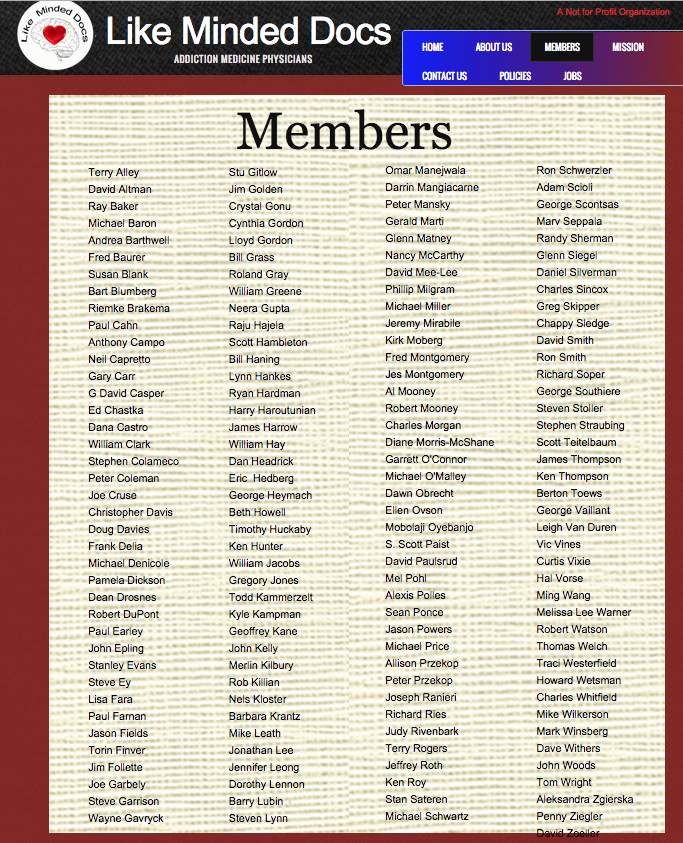
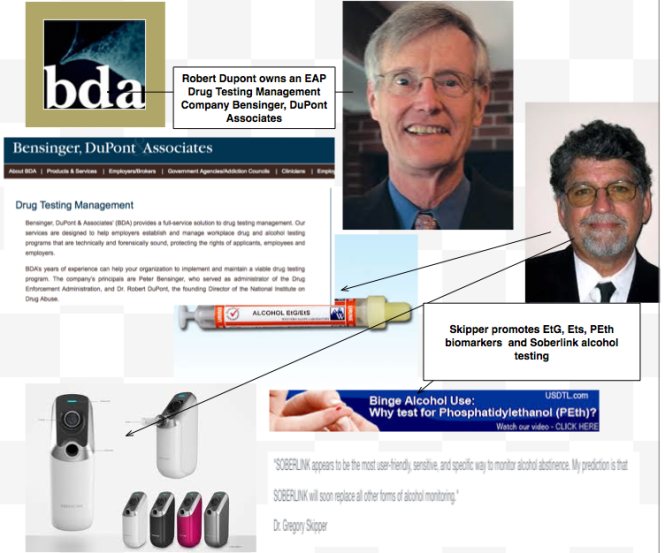
This group here, Like-minded Docs,  is largely responsible for what happens to any doctor referred to a state PHP because all of the medical directors of  the “PHP-approved” assessment and treatment centers can be found right here.

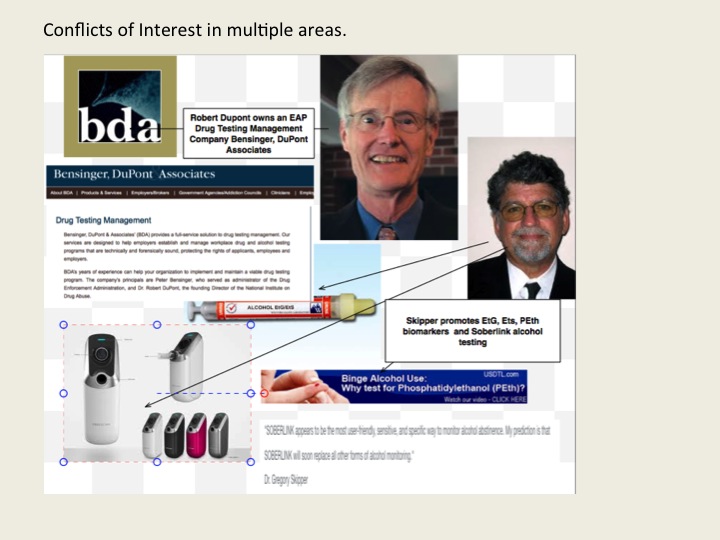
So too can Bob Dupont and Greg Skipper who have introduced the non-FDA approved drug and alcohol LDTs.  Stuart Gitlow, President of ASAM is also on the list.

This group is essentially in control of doctors and determines their fates and the percentage of psychopathy here is much much more than the  3-6% found at Enron.

Some of these doctors have done horrible things that most doctors would never do under any circumstances (steal IV pain relieving drugs from dying cancer patients I.V. bags, selling the ‘date-rape” drug to DEA agents).

On this list are multiple felons and a fair number of double felons who got their licenses back by saying they were not responsible for what they did.  They were helpless over drugs or alcohol and have now been saved by the good graces of 12-step spirituality.

And with that the medical boards gave them power without accountability.  There is no regulation, oversight, answerability or need to justify their actions.  It is a free for all and this list is a gold-mine for anyone studying organized psychopathy.

Physician Health Programs are a funnel for the sociopath and without restraint they are only growing.

This is what John Nash described would happen without counter-forces to keep their numbers low.


Psychopathy

Psychopathy is present in all professions. In The Wisdom of Psychopaths: What Saints, Spies, and Serial Killers Can Teach Us About Success, Kevin Dutton provides a side-by-side list of professions with the highest (CEO tops the list) and lowest (care-aid) percentage of psychopaths.   Interestingly surgeons come in at #5 among the professions with the highest percentage of psychopathy while doctors  (in general) are listed among the lowest.

Although by no means a scientific study, Psycopaths, by their very nature, seek power and it would make sense that a psychopath among us might pick surgery over pediatrics or pathology as they are drawn to power, prestige, and control. Be this as it may the incidence of psycopathy or psychopathic traits in doctors of any specialty is low. Statistics indicate that no more than 1% of men in general exhibit psychopathic traits. In Women these characteristics are far less.

Due to irresponsible behavior and a tendency to ignore or violate social conventions and rules,  psychopaths frequently find themselves engaged in conduct involving the criminal justice system or involved in other disciplinary action. Juvenile delinquency, arrests, school suspensions and misconduct related issues are barriers that preclude professional careers for many and, with around 15% of the prison population estimated to be psychopathic, incarceration and recidivism are common final pathways. Because of this tendency it would be highly unlikely for most sociopaths to follow a standard professional career pathway involving academic rigor and normal professional and societal expectations,  because impulsive irresponsible actions commonly blocks it. This would predict a probably much lower prevalence of psycopathy in physicians compared to the general population.

That being said, such self imposed removal from a potential  career is the sole product of getting caught for misconduct and being held accountable for it.   Psychopaths possess several traits that make this difficult.    With a talent for “reading people” and identifying their weak spots and vulnerabilities they are able to get people to see what they want them to see.  Psychopaths often exude charm, confidence and charisma.  They can lie effortlessly and are very convincing..

The natural history of psychopathy involves risky behavior and the ability to get away with it or out of it. The consequences of this depend on if and when it occurs. It is entirely conceivable that some may live their entire lives undetected. With a need for stimulation and a proneness to boredom the psychopath is particularly prone to drug abuse and addiction and twice as likely as the general population to be diagnosed.

 Psycopathy involves a path of risky behavior as well as the potential for being held accountable for it. At any age the behavior that brings they psychopath to the attention of the criminal justice system is often drug or alcohol related. The natural history of the average psychopath reveals an overrepresentation in prison with a 15x greater risk in general. Any statistics on psycopathy in a population is based on psychometric evaluations retrospectively in specific populations. Being arrested or getting caught for something does not reveal the pathology or the correlation. You have to look for it.

And nothing is known of subpopulations of psychopaths and the impact of intelligence, education, profession and other factors and how they relate to outcomes and consequences over time. Egocentricity and a sense of entitlement drives they do not adapt to the environment but try to make the environment adapt to them. Without empathy and lacking remorse the goal is always self-serving and a question of what they can get out of it.

 Many judges, as an alternative to incarceration, have been requiring people arrested for drug and alcohol related offenses to attend AA meetings and provide proof of participation. As misguided as this is on other levels it is also dangerous. Given a choice between incarceration and attending AA the majority of any population, including those with psychopathic traits, would choose the latter. And as in any situation they would use it to see what they could get out of it. Masters of manipulation and impression management in a room full of potential victims. The reports of rape and theft coming out is no surprise. It is in all likelihood much worse.

And in reality psychopaths exist in every profession, including medicine.

What is the natural history and final common pathway of M.D. psychopaths?  Where do these shape-shifters end up?

Screen Shot 2014-11-08 at 11.10.42 PM

In his book Without Conscience, Dr. Robert Hare notes “If we can’t spot them, we are doomed to be their victims, both as individuals and as a society. ” Dr. Clive Boddy in Corporate Psychopaths observes that unethical leaders create unethical followers, which in turn create unethical companies and society suffers as a result.” And if you look at the FSPHP branch of the ASAM that is exactly what you will find.  less than 1/% of the population are psychopaths but they represent more that 10% of those in prisons.  What is the natural history of the physician psychopath? You do the math.

images-4

http://psychopathyinfo.wordpress.com/2012/03/22/characteristics-of-corporate-psychopaths-and-their-corporations/


Teitelbaum1

Teitelbaum2

Skipper

In Mechanics and Mentality the Physician Health Program “Blueprint” is Essentially Straight, Inc. for Doctors.
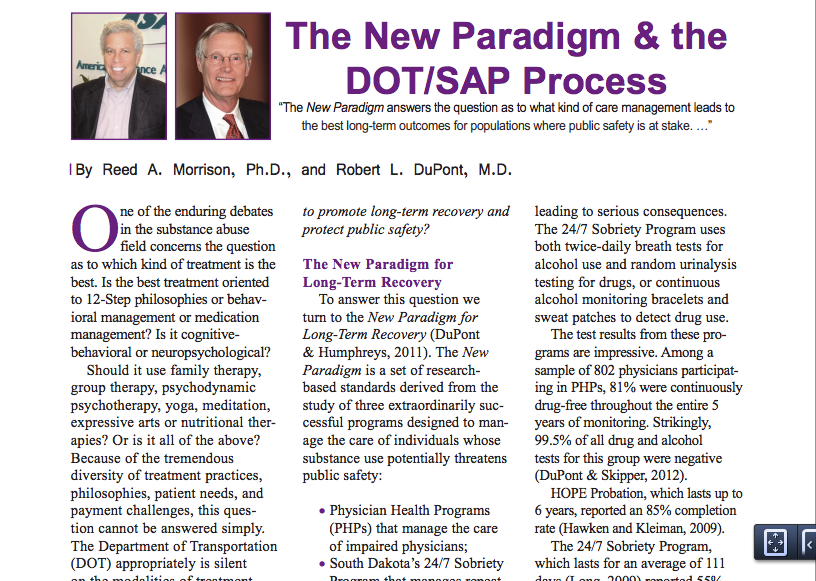
Screen Shot 2014-02-07 at 8.38.55 AMIn 2012 former Nixon Drug Czar Robert Dupont, MD delivered the keynote speech at the Drug and Alcohol Testing Industry Association (DATIA) annual conference and described a “new paradigm” for addiction and substance abuse treatment. He advocated zero tolerance for alcohol and drug use enforced by monitoring with frequent random drug and alcohol tests. Detection of any substances is met with “swift and certain consequences.”

And then he proposed expansion of this paradigm to other populations including workplace, healthcare, and schools.

Screen Shot 2014-12-02 at 1.18.54 AMRobert Dupont was a key figure in launching the “war on drugs” — now widely viewed as the failed policy that has turned the US into the largest jailer in the world.

In the 1970s, Dupont administered the experimental drug rehab program called “The Seed” – that was later deemed by congress to use methods similar to those used on American POW’s in North Korea. He would later go on to consult for “Straight, Inc”, a rehab program that treated troubled teens as “addicts”, often for minor infractions or normal teenage behavior.

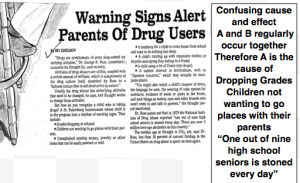
Screen Shot 2014-12-02 at 10.27.30 PMDeemed the “family oriented treatment program,” Dupont encouraged organization and expansion. Targeting the children of wealthy white families parents fears were used to refer their kids to the programs. Signs of hidden drug use such as use of Visine, altered sleep patterns, and changes in clothing style were used as indications for referral. Any child who arrived would be considered an addict in need of their services. Coercion, confrontation, command and control were the guiding principles. Submit or face the consequences. We know what’s right. The idea was to strip the child of all self-esteem and then build him back up again in the straight image.

Abused, dehumanized, delegitimized and stigmatized-the imposition of guilt, shame, and helplessness was used for ego deflation to facilitate canned and condensed 12-step as a preparatory step on the path of lifelong spiritual recovery.

Children were coaxed or terrorized into signing confessions, berated, and told they were in “denial.” Inaccurate and false diagnoses were given to wield greater control. Reports and witness accounts now indicate that many of the kids did not even have drug problems but by creating a “moral panic” about teenage drug use they exploited parents fears for profit. Straight, Inc. became the biggest juvenile rehabilitation center in the world for rehabilitation and treatment of addiction.

Screen Shot 2014-11-25 at 7.10.47 PMA 12 year old girl was admitted to inpatient addiction rehabilitation for sniffing a “magic marker”–Once!

A Deficiency Correction Order was issued by the Executive Office of Human Services, Office of Children, Commonwealth of Massachusetts Services to Straight, Boston in 1990 that read in part:

“Although Straight’s statement of services states that Straight serves chemically dependent adolescents, a review of records and interviews with staff demonstrate that Straight admits children who are not chemically dependent. For example, one twelve-year-old girl was admitted to the program although the only information in the file regarding use of chemicals was her admission that she had sniffed a magic marker.”

Screen Shot 2014-02-15 at 4.39.03 PM
Straight was always making outlandish claims of success but there was no scientific evidence based data to support it. In September 1986 USA TODAY ran an article headlined: DRUGS: Teen abusers start by age 12 which opened with: “Almost half of the USA’s teen drug abusers got involved before age 12…”The article was based on a study conducted by Straight, Inc.

Many former patients of Straight were so devastated by the abuse that they took their own lives. Since then, Dupont has been a key figure in the proliferation of workplace drug testing programs, and once advocated for drug testing anyone in the workplace under the age of 40.Slide39

crop0002_3_3

mllangan1's avatarDisrupted Physician

Screen Shot 2015-03-30 at 8.44.59 PM

In 2012 former Nixon Drug Czar Robert Dupont, MD delivered the keynote speech at the Drug and Alcohol Testing Industry Association (DATIA) annual conference and described a “new paradigm” for addiction and substance abuse treatment. He advocated zero tolerance for alcohol and drug use enforced by monitoring with frequent random drug and alcohol tests. Detection of any substances is met with “swift and certain consequences.”

And then he proposed expansion of this paradigm to other populations including workplace, healthcare, and schools.

Robert Dupont was a key figure in launching the “war on drugs” — now widely viewed as the failed policy that has turned the US into the largest jailer in the world.

Screen Shot 2014-02-23 at 8.06.56 PMIn the 1970s, Dupont administered the experimental drug rehab program called “The Seed” – that was later deemed by congress to use methods similar to those used on American POW’s in North Korea. He would later…

View original post 2,611 more words