Bent Science and Bad Medicine: The Medical Profession, Moral Entrepreneurship and Social Control

IMG_9005The Medical Profession, Moral Entrepreneurship, and Social Control

Sociologist Stanley Cohen  used the term “”moral panic” to characterize the amplification of deviance by the media, the public, and agents of social control.1  Labeled as being outside the central core values of consensual society, the deviants in the designated group are perceived as posing a threat to both the values of society and society itself.   Belief in the seriousness of the situation justifies intolerance and unfair treatment of the accused.   The evidentiary standard is lowered.

Howard Becker describes the role of “moral entrepreneurs,” who crusade for making and enforcing rules that benefit their own interests by bringing them to the attention of the public and those in positions of power and authority under the guise of righting a society evil. 2

And according to cultural theorist Stuart Hall, the media obtain their information from the primary definers of social reality in authoritative positions and amplify the perceived threat to the existing social order. The authorities then act to eliminate the threat.3  The dominant ideas or ideologies are reproduced by relying on the opinions of the defining authority and then spread through the media. The communal good has been assailed.

As a society governed by organizations, associations,  institutions and regulatory bodies, the medical profession is not immune to “moral panics.”  A threat to patient care or the values of the profession can be identified and amplified.   A buildup of public concern fueled by media attention ensues creating a need for governing bodies to act. Medical Professionalism and the Public Health has been assailed.

Unbeknownst to the general public and most members of the medical profession at large, certain groups have gained tremendous sway within medical society. Through  moral entrepreneurship they have gained authority and become  the primary definers of the governance of the medical profession and the social control of  doctors.  To benefit their own interests they have fostered and fueled “moral panics” and “moral crusades. ” Exhorting authorities to fight these  threats by any means necessary  they have successfully made and enforced rules and  regulations and introduced new definitions and tools with no meaningful resistance or opposition.

The Inquisition did not have to convince  individual citizens or the general public of their beliefs to advance an agenda; just Ecclesiastical and Political Authority.  Similarly, the  “impaired physicians movement” did not have to convince individual doctors or the medical profession of their beliefs  to further a self-serving agenda; just  regulatory and administrative authority.

Addiction Medicine Monopoly, False Authority and Conflicts of Interest

The “impaired physicians movement” can be defined as a group of physicians with alcohol and substance abuse problems who, having found sobriety through 12-step spirituality, banded together to promote the ideology behind their personal  “recovery”  to other doctors and the medical community at large. In the 1980s the movement gained momentum and as their numbers grew  began calling themselves  specialists in “addiction medicine.”  The American Society of Addiction Medicine (ASAM)  is not a true specialty, but a Self-Designated-Practice-Specialty, which simply means that is what they are calling themselves.  It reflects neither knowledge nor expertise..  “Board certification” by the American Board of Addiction Medicine (ABAM) is not recognized by the American Board of Medical Specialties (ABMS).

ABAM certification requires only a medical degree, a valid license to practice medicine, and completion of residency training in ANY specialty.  Addiction Psychiatry, a subspecialty of psychiatry under the American Board of Neurology and Psychiatry  is the only  specialty recognized by the ABMS. and their specialty society is the American Academy of Addiction Psychiatry.

The ASAM is schooled in just one one uncompromising model of addiction with the majority attributing their very own sobriety to that model–the chronic relapsing “brain disease” with lifelong abstinence and 12-step spiritual recovery model.   As the “voice of addiction medicine,” the ASAM has nevertheless defined the dominant treatment paradigm in the United States.   ASAM doctors outnumber addiction psychiatrists by 4:1 and the movement is well funded.   Because addiction is defined as a “disease”, addicts must be “treated” (more often coercive than voluntary), and “cured” (defined as abstinent).  The billion dollar  assessment and treatment industry and the drug and alcohol testing industry  lucratively profits from this model which has grown to monopolize addiction treatment  in the United States.

The goal of the ABAM Foundation is to “gain recognition of Addiction Medicine as a medical specialty by the American Board of Medical Specialties (ABMS).”   A monopoly defined by self-appointed experts without recognized  specialty training will soon likely Robber baron their way to being accepted as  a true specialty.Screen Shot 2015-02-28 at 8.15.35 AM

Physician Health Programs, Regulatory Agencies, and Treatment Centers

Physician Health Programs (PHPs) meet with, assess, and monitor doctors who have been referred to them for substance use or other mental or behavioral health problems. Unless being monitored by one, PHP practices are unknown to most physicians and operate outside the scrutiny of the medical community.  Initially funded by State Medical Societies and staffed by volunteer physicians,  PHPs  served the dual function of helping sick doctors and protecting the public.

As the populations of ASAM physicians proliferated  in the 1980s, many  joined their state Physician Health Programs. PHP doctors who did not agree with the ASAM groupthink were gradually removed  and they  organized under the Federation of State Physician Health Programs (FSPHP).  Other ASAM physicians found employment at treatment centers as staff physicians and medical directors.

The FSPHP cultivated a relationship with the  Federation of State Medical Boards (FSMB) and the state PHPs formed alliances with their  state medical boards. Promoting themselves as offering “treatment” rather than”punishment” they offered an alternative to disciplinary action.  They then began promoting their successful outcomes  in rehabilitating “impaired physicians”,  and this history can be seen by examining the archives of the Journal of Medical Regulation and similar  publications.  In 1995 the   Washington  PHP claimed a success rate of  95.4%,   Tennessee  claimed 93% and Alabama 90%.

Part of this success was attributed  to the specialized  treatment centers for doctors directed by their ASAM colleagues such as  Ridgeview Institute in Atlanta created by G. Douglas Talbott.  Talbott, who helped organize and serve as past president of the ASAM claimed a 92.3 percent recovery rate. He also put forth a Medical Urban Legend–the proposition that doctors were a different species, separate from the rest of society, who needed special treatment three times longer than anyone else.  Amazingly, this dicto simpliciter argument that can, in fact, be refuted simply by pointing it out  was allowed to enter regulatory medicine unopposed.  Simply because, sadly, no one ever pointed out the logical fallacy. It is now entrenched.    Three months or more of treatment is  standard of care for our profession. They did this by getting medical boards and the FSMB to accept fantasy as fact by relying on board members tendency to accept expert evidence at face value.

Physicians are unique only insofar as the unique elements required of the profession to become and be a physician such as going to medical school and completing the required board examinations.  That’s it.    I implore anyone to put forth any sound argument based on science and evidence that justifies a thrice lengthy stay in medical professionals.  Not gonna happen.   Thought stopping memes and logical fallacy is the best they have to offer.  And, unfortunately this type of  rabbling gibberish cuts the mustard in the regulatory medicine venue.   A “low-bar” evidentiary standard is not the problem.  If you look at the documentary evidence from a medico-historical perspective there never was a bar.  The FSMB has essentially given the impaired physicians movement carte blanche authority and unrestrained managerial prerogative.  A bar never even existed.  It’s a laissez-faire Lord of the Flies free-for-all.    The logical fallacy of appeal to authority–illegitimate and irrational authority.  Bamboozled by smoke and mirrors.

A 1995 issue of the FSMB publication  The Federal Bulletin: The Journal of Medical Licensure and Discipline contains reports on eight  separate state  PHPs.   The “almost 90% success rate” was  applauded by the editor, who added  “cooperation and communication between the medical boards and the physician health programs must occur in an effort to protect the public while assisting impaired physicians in their recovery.”   And more recent reports suggest PHPs   reduce malpractice claims. They are now being promoted as a replicable model  to be used in other populations.

The problem is no one bothered to examine the methodology to discern the validity of these claims.  There has been no critical analysis or Cochrane type review of any of these studies which are invariably small, methodologically flawed, and biased.

The FSMB has accepted them as  expert authority and  their authoritative opinion as fact.  It  is this acceptance of faith without objective assessment that has allowed the ASAM and FSPH to advance their agenda. By  confusing ideological opinion  with professional knowledge, the FSMB and state Medical Boards have acted as willing gulls each step of the way. No counter-forces existed.  And they still don’t.   Junk science and unvalidated neuropsychological testing is used by these groups unconstrained and willfully.  There is no regulation, oversight, or accountability.  They are using polygraph testing (despite the AMA’s previous public policy statement deeming it junk) to both condemn “disruptive” surgeons and deem convicted pedophiles fit to return to work.  They have introduced junk-science in drug and alcohol testing and unvalidated “neuropsychological” testing to detect “character-defects” by getting regulatory agencies to accept the validity of these tests not by the Scientific Method or Evidence Based Research but by (to coin a term) “Regulatory Sanctification”

To paraphrase one FSPHP member,   “Who needs evidence-based medicine when the boards have already accepted these tests as valid?”  Who indeed?

The ideological bias and financial conflicts of interest between PHPs and the  treatment centers was also not recognized. It still isn’t.  The  spotlights are apparently all  on Big Pharma  in this regard.    Some sunlight needs to be exposed in the direction of the billion dollar drug and alcohol testing and assessment industry as well.

Doctors  were held at Ridgeview three times longer than the rest of the population (and at three times the cost)  under threat of loss of licensure.   Although there is no evidence base or plausible explanation why an entire profession would have a three-times  longer length of stay than the rest of the population this continues to be the reality. There is no choice.

in 2011 The ASAM issued a Public Policy Statement on coordination between PHPs, regulatory agencies, and treatment providers recommending  that  only “PHP approved” treatment centers be used in the assessment and treatment of doctors.  It specifically excludes non “PHP -recognized” facilities.  And what defines a “PHP approved” treatment center?    In addition to finding essentially no oversight by the state medical society and medical board, a recent audit of the  North Carolina PHP found financial conflicts of interest and no  documented criteria for selecting the out of state treatment centers they used.  The common denominator the audit missed was that the 19  “PHP-approved” centers were all ASAM facilities just like Ridgeview whose medical directors can be seen on this list.

The appeal to authority logical fallacy has enabled the FSPHP to become the expert authority on physician impairment through the eyes of the medical boards.  It has also allowed them to increase their scope.

The FSMB House of Delegates adopted an updated Policy on Physician Impairment at their 2011 annual meeting distinguishing “impairment” and “illness”  stating that:

“Regulatory Agencies should recognize the PHP as their expert in all matters relating to licensed professionals with ‘potentially impairing illness.'”

According to the FSPHP, physician illness and impairment exist on a continuum with illness typically predating impairment, often by many years.”

The policy extends PHP authority to cover physical illnesses affecting cognitive, motor, or perceptive skills, disruptive physician behavior, and “process addiction” (compulsive gambling, compulsive spending, video gaming, and “workaholism”). It also defines “relapse without use” as “behavior without chemical use that is suggestive of impending relapse.”

G. Douglas Talbott defines  “relapse without use”  as  “emotional behavioral abnormalities” that often precede relapse or “in A A language –stinking thinking.”  AA language has entered the Medical Profession and no one even blinked.  It will get worse.

The ASAM has  monopolized addiction treatment in the United States.   It has imposed  it on doctors through the FSPHP.  The FSPHP political apparatus exerts a monopoly of force. It selects who will be monitored and dictates every aspect of what that entails.  It is a, in fact, a  rigged game.

Inherent in this model is the importance of external control.  It gives them power to exert control over the individual regardless of whether they need to be treated.

By bamboozling regulatory medicine this was accomplished.    And the maintenance of this relationship is necessary as this  presentation  by an FSPHP physician  warns, “guard this relationship jealously.”

Screen Shot 2015-03-04 at 7.27.11 PM

Moral Panics and Moral Crusades

By introducing and fueling moral panics the ASAM/FSPHP political apparatus has been able to expand in both scope and power.

The Medscape article “Drug Abuse Among Doctors:  Easy, Tempting, and Not Uncommon” published in the “Business of Medicine” section in January 2014 is characteristic example of the authoritative opinion, propaganda, and misinformation spun to maintain a pervasive climate of fear. Proof by anecdote.  Physicians are “5 times as likely as the general public to misuse prescription drugs” according to Lisa Merlo, PhD.  “Given the epidemic of prescription addiction sweeping the nation, that’s a grim statistic.”

Described as a “researcher at the University of Florida’s Center for Addiction Research and Education,” Merlo’s research involving 55 doctors being monitored by their state Physician Health Program published in the Journal of Addiction Medicine in October 2013 found “most physicians who abuse prescription drugs” do so to “relieve stress and physical or emotional pain.”  Nowhere is it mentioned on Medscape that Merlo is the Director of Research for the Florida state PHP Professionals Research Network.   Physician access to medications through prescriptions,  “networks of professional contacts, and proximity to hospital and clinic supplies” gives them “rare access to powerful, highly sought-after drugs” says Marvin D. Seppala, chief medical officer at Hazelden.  This access “sets them apart” and “not only foment a problem” but”perpetuate it” says Seppala.  “Access “becomes an addict’s top priority” and they “will do everything in their power to ensure it continues.”  

“They’re often described as the best workers in the hospital,” he says. “They’ll overwork to compensate for other ways in which they may be falling short, and to protect their supply. They’ll sign up for extra call and show up for rounds they don’t have to do.”-Dr. Marvin D. Seppala

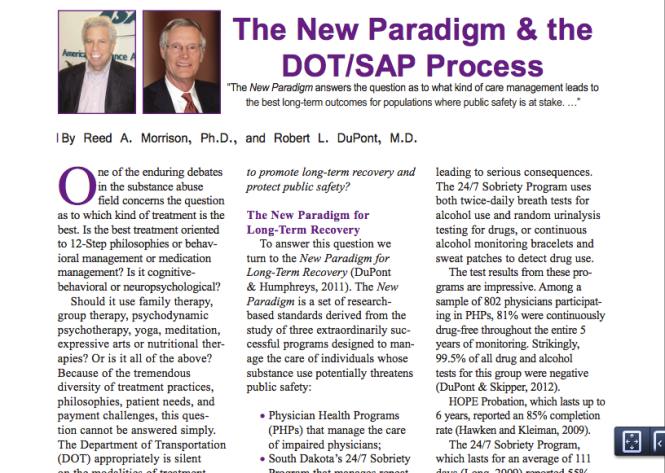
Physicians are intelligent and skilled at hiding their addictions, he says. Few, no matter how desperate, seek help of their own accord.”  In reality this is absurd.  And if you look at any of the current “moral panics” that are being used to suggest random suspicion-less drug testing of all doctors or promoting the Physician Health Programs as the “New Paradigm” you will inevitably find a doctor, just like Marv Seppala who is on this list as  an author or interviewee.  It is a given.

The terms  “impaired physician” and  the “disruptive physician”  are used as labels of deviancy.  As deviants who allegedly threaten the very core of medicine (patient care) and  the business of medicine (profit)  they must be stopped at all costs.   Belief in the seriousness of the situation justifies intolerance and unfair treatment.  The evidentiary standard is lowered.  Aided by a  “conspiracy of silence” among doctors in which impaired colleagues are not reported  necessitates identification of them by any means necessary.   Increase the grand scale of the hunt.

In this way these front-groups have successfully acted as moral entrepreneurs to make and enforce rules and put forth new definitions and mandates that serve their own interests.     A retrospective non -blinded non-randomized cohort study with serious underlying methodological errors involving 904 physicians being monitored by PHPs is now being used to “set the standard for recovery.”

IMG_8365

Across the Country doctors are going to the media,  law enforcement, the AGO, and the ACLU only to be turned a deaf ear.   Many consider this a “parochial” issue best handled by the medical community. Doctors reporting crimes are turned back over to the very perpetrators of the crimes.   The Medical Societies and professional organizations contribute to the problem by willful ignorance.   Accusations are used to disregard the claims of the accused.   It is a system of institutional injustice that is driving many doctors to suicide.  Hopeless, helpless, and feeling entrapped many are taking this route.  And no one is talking about it.   This cannot be avoided any longer.

The next target is the “aging physician.”   And as they have done with the “impaired” and “disruptive” physician” the FSPHP and their affiliates are setting the stage for another “moral crusade.”

  1. Cohen S. Folk Devils and Moral Panics: The Creatio of the Mods and Rockers (New Edition). Oxford, U.K.: Martin Robertson; 1980.
  2. Becker H. Outsiders: Studies in the Sociology of Deviance. New York: Free Press; 1963.
  3. Hall SC, Critcher C, Jefferson T, Clark J, Roberts B. Policing the Crisis: Mugging, the State, and Law and Order. London: Macmillan; 1978.

images-4

← Back

Thank you for your response. ✨

Junk-Science in the Medical Profession: The Resurgence of Polygraph “Lie-Detection” in an age of Evidence-Based Medicine

mllangan1's avatarDisrupted Physician

33755_1527129670651_5081648_n Circa 1995

The article below was published in the now defunct magazine Gray Areas almost twenty years ago. (Vol. 4, No. 1, Spring 1995 pp. 75-77).   Antipolygraph.og founder George Maschke noted in 2008 that article “makes a good introduction to the pseudoscience of polygraphy” and “the criticisms of polygraphy remain valid today.”  They remain valid in 2014.

images-3

The Art of Deception: Polygraph Lie Detection

By Michael Lawrence Langan, M.D.

I’d swear to it on my very soul, If I lie, may I fall down cold.”

– Rubin and Cherise
(Hunter/Garcia)

The accuracy of polygraphic lie detection is slightly above chance. Nevertheless, State and local police departments and law enforcement agencies across the United States are devoted proponents of this unscientific and specious device. In addition, the American public seems to lend an implicit credence to the “lie detector” as evinced by its ubiquitous use on television crime shows and…

View original post 2,617 more words

How We Know What to Rely Upon

what-is-reality


← Back

Thank you for your response. ✨

Screen Shot 2014-03-15 at 7.33.14 PM

IMG_8540

Integrity and Accountability—Going on two months and no winners stepping forward. Defend the MRO Procedurally, Ethically or Legally and you win all the prizes

As the Medical Review Officer (MRO)  for the Massachusetts state Physician Health Program (PHP), Physician Health Services, Inc. (PHS, inc.), Dr. Wayne Gavryck’s responsibility is simple.  He is supposed to verify that the chain-of-custody  in any and all drug and alcohol testing is intact before reporting a test as positive.

Screen Shot 2014-12-03 at 12.53.49 AM

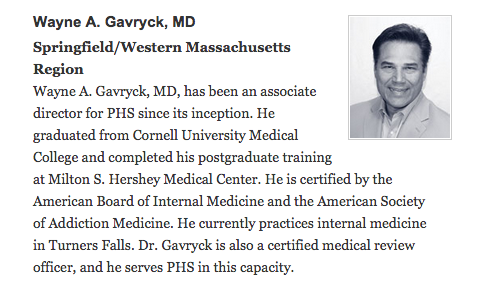
Note Dr Gavryck is: 1. Certified by ASAM; 2. A .Certified Medical Review Officer (MRO) who “serves PHS in this capacity.” Although Dr. Gavryck serves PHS I would beg to differ on the MRO function. Accessed from PHS Website 1/15/2015 http://www.massmed.org/Physician_Health_Services/About/PHS_Associate_Directors/#.VM1dZlXF-hY


Dr. Gavryck evidently did not do that here.  In fact for more than a year he helped cover up an alcohol test that was intentionally fabricated at the behest of PHS Director of Operations Linda Bresnahan (who told me when I confronted her with the fact that I have never had or ever even been suspected of having an alcohol problem “you have an Irish last name–good luck finding anyone who will believe you!”

It took a formal complaint with the College of American Pathologists to get the truth out.  The whole fiasco can be seen here and here.

What Gavryck and his co-conspirators did is egregious and ethically reprehensible.  It shows a complete lack of moral compass and personal integrity.  What was done from collection to report to coverup  and everything in-between is indefensible on all levels (procedurally, ethically, and legally).

The documentary evidence shows with clarity that this was not accident or oversight.  It was intentional and purposeful misconduct.  I think everyone would agree that there should be zero-tolerance for forensic fraud in positions of power.    Any person of honor and civility would agree.

Transparency, regulation, and accountability are necessary for these groups.   It is an issue that needs to be acknowledged and addressed not ignored and covered up.

If Dr. Gavryck can give a procedural, ethical, or legal explanation of what was done then I stand corrected. Just one will suffice.  I’ll erase my blog and vanish into the woodwork.  But If he cannot then this needs to be addressed openly and publicly.   And whether he was involved in the original fraud or not is irrelevant. As the MRO for PHS it is his responsibility to correct it–however late the hour may be.

Perhaps Dr. Gavryck needs to see some of the damage he has caused in order to take this responsibility. Known as a “bag man” who simply rubber stamps positive tests at the request of Sanchez and Bresnahan (much like Annie Dookhan)  he does not see the damage that is caused. Forensic fraud has grave and far reaching effects and in this case has severely impacted many people and include patient deaths.

Perhaps Dr. Gavryck needs to take a “moral inventory” and see that this this type of behavior causes real damage to real people and put a face on it.

It is people just like this who are killing physicians across the country.   The body count is vast and multiple.  And those who are caught doing dirty deeds such as this need to be held accountable.

Please help me get this exposed, corrected, and rectified.  The doctors of Massachusetts and the doctors of this entire country deserve better than this.

via Integrity and Accountability—Defend the MRO Procedurally, Ethically or Legally and win 100 Volumes of the Classics in Medicine Library and Salk and Sabin Autographs!.


← Back

Thank you for your response. ✨

Screen Shot 2014-11-26 at 7.10.56 PM

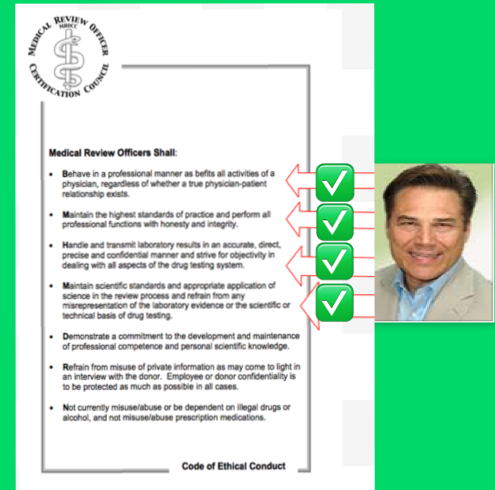
The MRO Code of Ethics--Seems like Dr. Gavryck's breaking them in sequential order!

The MRO Code of Ethics–Seems like Dr. Gavryck’s breaking them in sequential order!


Physician Suicide, the “Impaired Physician Movement” and ASAM: The Dead Doctors at Ridgeview Institute under G. Douglas Talbott

Physician Suicide, the “Impaired Physician Movement” and ASAM: The Dead Doctors at Ridgeview Institute under G. Douglas Talbott.

In May 1999 G. Douglas Talbott stepped down as president of the American Society of Addiction Medicine (ASAM) as a jury awarded Dr. Leonard Masters a judgment of $1.3 million in actual damages and an undisclosed sum in punitive damages for fraud, malpractice, and the novel claim of false imprisonment.

The fraud finding required a finding that errors in the diagnosis were intentional. Masters, who was accused of overprescribing narcotics to his patients was told by the director of the Florida Physician Health Program (PHP) that he could either surrender his medical license until the allegations were disproved or submit to a four-day evaluation.

Thinking he would have an objective and fair evaluation, Masters agreed to the latter.  He was instead diagnosed as “alcohol dependent” and coerced into “treatment under threat of loss of his medical license. Staff would routinely threaten to report any doctor who questioned any aspect of their diagnosis or treatment to their state medical boards “as being an impaired physician, leaving necessary treatment against medical advice,”  the equivalent of professional suicide.

Masters, however, was not an alcoholic. Not even remotely so.

According to his attorney, Eric. S. Block,  “No one ever accused him of having a problem with alcohol. Not his friends, not his wife, not his seven children, not his fellow doctors, not his employees, not his employers, No one.”

He was released 4 months later and forced to sign a five-year “continuing care” contract with the Florida PHP, also under continued threat of his medical license.

12 years earlier the Atlanta Constitution did a series of reports after five inpatients died by suicide at one of Talbott’s rehabilitation facilities called Ridgeview.  At least 20 more killed themselves after leaving Ridgeview.

A jury awarded $1.3 million to the widow of one of the deceased physicians against Ridgeview  and other lawsuits initiated on behalf of suicides were settled out of court.

The Constitution reported that doctors entered the program under threats of loss of licensure “even when they would prefer treatment that is cheaper and closer to home.” The paper also noted that Ridgeview “enjoys unparalleled connections with many local and state medical societies that work with troubled doctors,” “licensing boards often seek recommendations from such groups in devising an approved treatment plan,” and those in charge are often “physicians who themselves have successfully completed Ridgeview’s program.”

In 1997 William L. White interviewed Dr. LeClair Bissell, M.D., one of the pioneers in the treatment of impaired professionals. The interview was not published until after her death in 2008 per her request.   White asked her when those in the field of treatment for substance abuse and addictions began to see physicians (and other professional) as a special treatment population.   She replied

“When they started making money in alcoholism. As soon as insurance started covering treatment, suddenly you heard that residential treatment was necessary for almost everybody. And since alcoholic docs had tons of money compared to the rest of the public, they not only needed residential treatment, they needed residential treatment in a special treatment facility for many months as opposed to the shorter periods of time that other people needed.” -Dr. LeClair Bissel

Talbott claimed a “92.3 percent recovery rate according to information compiled from a five-year follow-up survey based on complete abstinence and other treatment.”   A 1995 issue of The Federal Bulletin: The Journal of Medical Licensure and Discipline, published by the Federation of State Medical Boards, contains articles outlining impaired physician programs in 8 separate states. Although these articles were methodologically flawed opinion pieces written by program directors of State PHPs and  included no described study-design or methodology the FSMB bought their purported 90% success rates hook line and sinker it is at this point an alliance was formed between the FSPHP and FSMB.

Talbott faced no professional repercussions for the multiple suicides at Ridgeview or the fraud.  And absolutely no changes in their treatment philosophy were made. They still haven’t.  They have simply tightened the noose and taken steps to remove accountability.

Up until his recent death, Talbott continued to present himself and ASAM as the most qualified advocates for the assessment and treatment of medical professionals for substance abuse and addiction.

The ASAM, FSPHP and Like-Minded Docs still do.

In most states today any physician referred for an assessment for substance abuse will be mandated to do so in a facility just like Ridgeview.

There is no choice.   In mechanics and mentality, this same system of coercion, control, and indoctrination has metastasized to almost every state only more powerful and opaque in a system that is essentially unregulated, protected from public scrutiny, and accountable to no one.   For what they have done is taken the Ridgeview model and replicated it state by state in the the Physician Health Programs under the scaffold of the Federation of State Physician Health Programs (FSPHP). The organizations alliance with the FSMB has only gone stronger.

And this directly correlates with the marked rise in physician suicide we are now seeing in the United States.

For full post see:   Physician Suicide, the “Impaired Physician Movement” and ASAM: The Dead Doctors at Ridgeview Institute under G. Douglas Talbott.

imgres


← Back

Thank you for your response. ✨


cropped-puritanstocks.jpg10271616_1417366195200940_5101328752156758607_n


Hubris

images-9

Three shells and a pea–ASAM, FSPHP, and LMD.

Hubris (/ˈhjuːbrɪs/, also hybris, from ancient Greek ὕβρις) means extreme pride or self-confidence. When it offends the gods of ancient Greece, it is usually punished. The adjectival form of the noun hubris is “hubristic”.

Hubris is usually perceived as a characteristic of an individual rather than a group, although the group the offender belongs to may suffer consequences from the wrongful act. Hubris often indicates a loss of contact with reality and an overestimation of one’s own competence, accomplishments or capabilities, especially when the person exhibiting it is in a position of power.

Junk Science and the Need for Regulatory Oversight of Forensic Laboratory Developed Tests

Screen Shot 2015-01-12 at 10.43.08 PM

Screen Shot 2014-02-21 at 11.38.29 AM


Laboratory Developed Tests

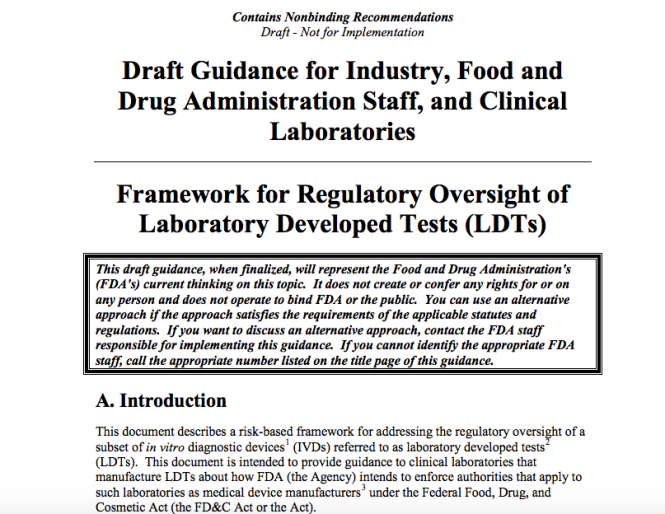
Questions about the accuracy and marketing of Laboratory Developed Tests (LDTs) have led to the current debate whether the U.S. Food and Drug Administration (FDA) should regulate a subset of diagnostic tests currently exempted from oversight. Designed to bring clinical tests to market that the costly FDA process would otherwise preclude, such as those for rare diseases, the LDT pathway bypasses Federal regulation and accountability.  Questions about the validity of these tests have raised concerns over patient safety and a call for oversight.  Among those asking for regulation are Massachusetts Senators Edward J. Markey and Elizabeth Warren.

Opponents of regulation argue the LDT  pathway enables new and pioneering tests to be developed quickly and improve patient care.  A recent viewpoint piece published in JAMA opposing regulation noted such advances have occurred “in large part because of the nimbleness of relatively small clinical and academic laboratories that can quickly respond to new medical findings and patient needs by rapidly and safely developing and improving laboratory-developed tests.”

But the LDT pathway does not require proof of test validity, that the test is actually testing for what it claims to be testing, and with no FDA oversight a lab can claim any validity it wants in marketing the test.  There is no accountability.    Proponents of  regulation argue that this lack of oversight is a direct threat to patient safety and, as an opposing viewpoint piece in JAMA notes, a “patient’s life or death could hinge on whether a single, unregulated diagnostic test result is meaningful.”

The debate has focused on the reliability and validity of a number of clinical tests currently marketed with unverified claims of accuracy such as those used for prenatal screening and Lyme disease.  Notably absent from the discussions are the vast number of  Laboratory Developed Tests tests being used for “forensic” drug and alcohol testing with the current FDA draft guidance stating simply:

  • At this time, FDA will continue to defer oversight of the use of these tests in the forensics (law enforcement) setting to the existing system of legal controls, such as the rules of evidence in judicial proceedings and other protections afforded through the judicial process.”


The Birth of EtG:  The Introduction and Marketing of Laboratory Developed Tests for “Forensic” Drug Testing  Via a Lucrative Loophole

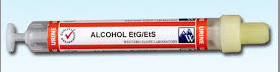
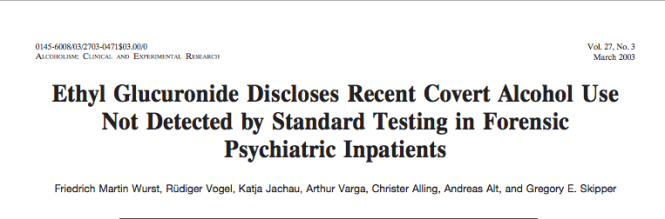
Numerous “forensic” tests of unknown validity using urine, blood, hair, fingernails breath and saliva have been developed and brought to market as LDTs since the first one was introduced in 2003 when ASAM physician Dr. Gregory Skipper,  then Medical Director of the Alabama Physicians Health Program,  “convinced the initial lab in the USA, NMS near Philadelphia to start performing EtG testing.”1   With essentially no evidence base Skipper then claimed the alcohol biomarker “appeared to be 100 percent specific” in detecting covert use of alcohol for several days after ingestion based on a study he coauthored that involved a mere 35 forensic psychiatric inpatients in Germany, all male2  

Screen Shot 2014-02-24 at 10.08.19 PMUsing an arbitrary cutoff level of 100 ug/L the EtG was marketed as a valid and reliable test and blindly tested on those being monitored by programs not beholden to the strict protocol and procedure dictated by the Mandatory Guidelines for Federal Workplace Drug Testing that most Employee Assistance Programs (EAPs) adopted.  In other words, the test was used on those who possessed little power or had their power removed.

The test was  subsequently found to be so sensitive that it could measure incidental exposure to alcohol in foods, over the counter cold medications, mouthwash3,4, hand sanitizer gel5, and nonalcoholic wine.6 Sauerkraut and bananas have even been shown to cause positive levels.7

Slide25

Shortly after the EtG debuted, complaints began to accumulate from individuals testing positive who adamantly proclaimed they did not drink.  Steadfast in their trust of expert opinion and the claimed accuracy of  EtG, the complaints of the accused were largely disregarded by those doing the monitoring.   People lost their licenses, jobs, careers, and reputations. Others lost their freedom or had their children taken away. It is unknown how many died by suicide.

There have been multiple  lawsuits filed since the introduction of the EtG including a class-action suit, but these were inevitably met with a well-funded and deep legal defense and their “experts.” The labs have taken a  “stand your ground” position yielding either dismissals or in favor of the defense.   As a new to the market  lab with no prior evidence-based research in forensic testing prior to its implementation and use for forensic testing, the proponents of EtG testing had no meaningful opposition in terms of a scientific body of facts and evidence and no credible voice to present it.  With the only “experts”  in EtG validity being those  who introduced and promoted its use there were no counter-forces.  Those suffering the consequences of a false-positive test had no recourse.  But as the toll of mayhem increased  it eventually reached a tipping-point where others began to take notice.

Page from the Talbott Recovery Center  list of products containing alcohol that doctors are required to avoid due to interference with EtG testing

Page from the Talbott Recovery Center list of products containing alcohol that doctors are required to avoid due to interference with EtG testing

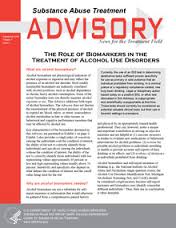
In 2006 the Wall Street Journal reported the problems with the EtG to the general public,8 and SAMHSA issued an advisory stating that “legal or disciplinary action based solely on a positive EtG…. is inappropriate and scientifically unsupportable at this time. These tests should currently be considered as potential valuable clinical tools, but their use in forensic settings is premature.”9

Since that time Skipper has served as expert witness in close to 46 administrative hearings 22 criminal  14 custody and 1 Federal class action suit.

Unknown-20

But this did not stop the Federation of State Physician Health Programs  from using the EtG on physicians being monitored. Instead they instructed doctors to avoid anything potentially containing alcohol including hand sanitizer which a 2011 study found could result in EtG concentrations of almost 2000 ug/L. 10 To continue to justify the use of EtG they added other LDTs as confirmation tests of LDTs such as EtS and PEth– Junk Science to confirm  junk science. Nonsensical smoke-and-mirrors antithetical to science and evidence-based medicine.

Since the birth of the EtG a variety of tests have been introduced and marketed as LDTs utilizing nails, blood, hair, breath and urine—all with unknown validity but marketed without constraint.  No regulation, oversight or accountability exists.

The newest gadget they are using on doctors is the Cellular Digital Photo Breathalyze which he is promoting in the same manner as the EtG after a study he co-authored with Robert Dupont on just 12 subjects.


Expanding Laboratory Developed Tests to Test Everyone:   The ASAM White Paper on Drug-Testing and the  “New Paradigm” 

Although the current use of these tests is limited to the criminal justice system and professional monitoring programs this may soon change as the American Society of Addiction Medicine is proposing a “new paradigm” of zero-tolerance random widespread drug and alcohol testing. This is outlined  in the ASAM White Paper on Drug Testing and described by Robert Dupont in his keynote speech  before the Drug and Alcohol Testing Industry Association (DATIA) annual conference in 2012.

The ASAM White paper states drug testing is “vastly underutilized” throughout healthcare and describes the use of drug testing “within the practice of medicine and, beyond that, broadly within American Society.”

As the consequences of a single unregulated “forensic” test result can be grave, far-reaching and even permanent it is critical that these tests be included in the debate on regulation of LDTs.

Evidence based medicine is not restricted to randomized trials and meta-analyses. It involves tracking down the best external evidence with which to answer our clinical questions.11

Expert opinion is the lowest level of evidence available in the EBM paradigm.12,13   Fortunately, the scientific method and Cochrane type critical analysis of the available evidence is  a tool to help people progress toward the truth despite their susceptibilities to unconscious confirmatory bias or conscious confirmatory distortion .14  Unfortunately, no one has used these tools address they panoply of tests of unknown validity that have already entered the market ; poised to be used on virtually everyone.

  1. Skipper G. Exploring the Reliability, Frequency, and Methods of Drug Testing: What is Enough to Ensure Compliance?:   Alcohol Markers and Devices. 2013; http://www.fsphp.org/Skipper, Exploring the Reliability Frequency and Methods 2 Presentation.pdf.
  2. Wurst FM, Vogel R, Jachau K, et al. Ethyl glucuronide discloses recent covert alcohol use not detected by standard testing in forensic psychiatric inpatients. Alcohol Clin Exp Res. Mar 2003;27(3):471-476.
  3. Costantino A, Digregorio EJ, Korn W, Spayd S, Rieders F. The effect of the use of mouthwash on ethylglucuronide concentrations in urine. Journal of analytical toxicology. Nov-Dec 2006;30(9):659-662.
  4. Reisfield GM, Goldberger BA, Pesce AJ, et al. Ethyl glucuronide, ethyl sulfate, and ethanol in urine after intensive exposure to high ethanol content mouthwash. Journal of analytical toxicology. Jun 2011;35(5):264-268.
  5. Rosano TG, Lin J. Ethyl glucuronide excretion in humans following oral administration of and dermal exposure to ethanol. Journal of analytical toxicology. Oct 2008;32(8):594-600.
  6. Hoiseth G, Yttredal B, Karinen R, Gjerde H, Christophersen A. Levels of ethyl glucuronide and ethyl sulfate in oral fluid, blood, and urine after use of mouthwash and ingestion of nonalcoholic wine. J Anal Toxicol. Mar 2010;34(2):84-88.
  7. Musshoff F, Albermann E, Madea B. Ethyl glucuronide and ethyl sulfate in urine after consumption of various beverages and foods–misleading results? Int J Legal Med. Nov 2010;124(6):623-630.
  8. Helliker K. A test for alcohol–and its flaws. The Wall Street Journal2006.
  9. Administration SAaMHS. The role of biomarkers in the treatment of alcohol use disorders. In: Advisory SAT, ed2006:1-7.
  10. Reisfield GM, Goldberger BA, Crews BO, et al. Ethyl glucuronide, ethyl sulfate, and ethanol in urine after sustained exposure to an ethanol-based hand sanitizer. Journal of analytical toxicology. Mar 2011;35(2):85-91.
  11. Sackett DL, Rosenberg WM, Gray JA, Haynes RB, Richardson WS. Evidence based medicine: what it is and what it isn’t. BMJ. Jan 13 1996;312(7023):71-72.
  12. Shaneyfelt TM, Centor RM. Reassessment of clinical practice guidelines: go gently into that good night. JAMA. Feb 25 2009;301(8):868-869.
  13. Straus SE, Green ML, Bell DS, et al. Evaluating the teaching of evidence based medicine: conceptual framework. BMJ. Oct 30 2004;329(7473):1029-1032.
  14. Haack S. Defending Science–Within Reason: Between Scientism and Cynicism. Amherst, N.Y.: Prometheus Books; 2003.

Screen Shot 2014-02-15 at 4.39.03 PM

IMG_0701

quote-a-liar-sees-lies-said-taleswapper-even-when-they-aren-t-there-just-as-a-hypocrite-sees-orson-scott-card-216626

Accountability Needed for Criminal Fraud Committed by Physician Health Programs

Screen Shot 2015-01-09 at 1.59.40 AM

If we’re looking for the source of our troubles we shouldn’t test people for drugs, we should test them for stupidity, ignorance, greed and love of power.” –P.J. O’ Rourke

Fraud is distinguished from negligence, ignorance, and error by virtue of the fact that it is Intentional; involving some level of calculation.1 Negligence is: “the failure to use such care as a reasonably prudent and careful person would use under similar circumstances,”  and characterized chiefly by “inadvertence, thoughtlessness, inattention, and the like.”2.  Fraud, in contrast, is not accidental in nature, nor is it unplanned.2-4 Those who commit fraud know what they are doing and are deliberate in their efforts. They are also aware that it is unethical, illegal, or otherwise improper.

Fraudulent intent  can be established by examining the documentation of decisions and behaviors associated with those involved. As explained in Coenen: “Manipulation of documents and evidence is often indicative of such intent. Innocent parties don’t normally alter documents and conceal or destroy evidence.”5

A chain of custody is generated in real time. It cannot be done retroactively. To do so constitutes fraud.   What is remarkable is with what apparent ease this was done.  There is no compunction, concern or inquiry from top to bottom at either of these agencies and documents a Machiavellian egocentricity. The acts are those of morally disengaged bullies who lack compassion and integrity.

One would assume that the state of Massachusetts would have a low tolerance for forensic fraud in the wake of the Annie Dookhan lab scandal,  especially when the perpetrators are contractors with the Department of Public Health (DPH) and work within the walls of the Massachusetts Medical Society (MMS).

The problem is Physician Health Programs (PHPs) have set up procedural barriers designed to bloc, ignore, marginalize and bury.  Truth is misrepresented, censored and suppressed.  The DPH and MMS have no oversight or regulation over Physician Health Services (PHS) and PHPs have convinced law enforcement that doctors police themselves.

Accountability needs to be rooted in organizational purpose and public trust.  When an organization operating within or contracting with an institution is committing  serious misconduct and fraud, then it becomes the institutions responsibility to investigate and correct it.  How low must the moral compass go before the MMS and DPH recognize what is self-evident to everyone else?   This would not have happened 20 years ago. What is happening to the profession of medicine when the institutions that are supposed to represent physicians and the public health allow individuals who are obviously and inexcusably engaging  in behavior antithetical to their own expressed ideals and purpose?

Corrupt individuals cannot be hired or retained by an employer without some level of institutional negligence, apathy or even encouragement.

Rationalization involves either self-delusion regarding the acceptability of fraud related to behavior under “special circumstances” or a disregard for the law as unjust or somehow inapplicable.5 Coenen explains that rationalization is the process by which someone   “determines that the fraudulent behavior is “okay” in her or his mind. For those with deficient moral codes the process of rationalization is easy. For those with higher moral standards it may not be quite so easy; they may have to convince themselves that a fraud is okay by creating “excuses” in their minds.

There is a diffusion of responsibility when verification is required and repercussions warranted.  This system of institutional injustice and forensic fraud between state Physician Health Programs and these corrupt labs is occurring across the country. I have spoken to the spouses and parents of multiple doctors who have killed themselves because this same thing was done to them.  Their deaths are being caused by people just like this and accountability is needed.


  1. Albrecht WS, Albrecht CO. Fraud Examination and Prevention. Mason, Ohio: South-Western Educational Publishing; 2003.
  2. Black HC. Black’s Law Dictionary. 6th ed. St. Paul, Minnesota: West Group; 1990.
  3. Albrecht WS, Albrecht CO, Albrecht CC, Zimbelman MF. Fraud Examination. 4th ed. Mason, Ohio: South Western Cengage Learning; 2011.
  4. O’ Lord A. The Prevalence of Fraud . What should we as academics be doing to address the problem? Accounting and Management Information Systems. 2010;9(1):4-21.
  5. Coenen T. Essentials of Corporate Fraud. Hoboken, NJ: John Wiley & Sons, Inc.; 2008.


← Back

Thank you for your response. ✨

33e7f-0905opedparini-master180-v3

capture

mllangan1's avatarDisrupted Physician


IMG_9516
“A body of men holding themselves accountable to nobody ought not to be trusted by anybody.”

― Thomas Paine 

USDTL drug testing laboratory claims to advance the”Gold Standard in Forensic Toxicology.”  “Integrity: Results that you can trust, based on solid science” is listed as a corporate value. “Unlike other laboratories, our drug and alcohol testing begins and ends with strict chain of custody.” “When people’s lives are on the line, we don’t skip steps.”  Joseph Jones, Vice President of Laboratory Operations explains the importance of chain-of-custody in this USDLT video presentation.

Dr. Luis Sanchez, M.D. recently published an article entitled Disruptive Behaviors Among Physicians in the Journal of the American Medical Association discussing the importance of  of a “medical culture of safety” with “clear expectations and standards.”  Stressing the importance of values and codes-of-conduct in the practice of medicine, he calls on physician leaders  “commit to professional behavior.”

Sanchez is Past President of…

View original post 4,712 more words

Disrupted Physician 101.2: “Addiction Medicine” is a Self-Designated Practice Specialty Unrecognized by the American Board of Medical Specialties–(An AMA Census Term Indicating Neither Training nor Competence)

Disrupted Physician 101.2: “Addiction Medicine” is a Self-Designated Practice Specialty Unrecognized by the American Board of Medical Specialties–(An AMA Census Term Indicating Neither Training nor Competence)B1A19yWIMAAQf7EThe fraudulent Addiction Medicine drug-testing, assessment and treatment complex is a  charade of prohibitionists and profiteers.  It is time that this be identified and addressed. Addiction Medicine has evolved in a Lord-of-the-Flies manner without regulatory scrutiny or oversight and an absence of the need to guard. They are the Robber barons of Science and Medicine who have bought and boondoggled their way into the Medical Profession and Society  and are poised to ruin both. It is time to take aim at these unsupervised pundits of authoritative opinion with facts, evidence base, and the scientific method. The immense and unconscionable conflicts of interest  must also be addressed. And the blinkered apathy of the masses and willful ignorance of organized medicine needs to end now!   If not the ASAM White Paper on Drug Testing  will come to pass and we will be  faced with a future Police State run by unqualified, illegitimate and irrational zealots and profiteers.

← Back

Thank you for your response. ✨

johnnyLawrence

10271616_1417366195200940_5101328752156758607_n

Please Sign Petition and Call (617-727-6200) MA State Auditor Suzanne Bump to Demand Audit of Corrupt Physician Health Services and the MA BORM Physician Health and Compliance Unit

Please Sign Petition and Call (617-727-6200) MA State Auditor Suzanne Bump to Demand Audit of Corrupt Physician Health Services and the MA BORM Physician Health and Compliance Unit.

The evidence that Physician Health Services, Inc. (PHS) is committing crimes has been free-floating for the past two years.   It has been posted on Reddit, Twitter, Facebook, Linkedin, blogged, faxed, and phoned.  The response?  Absolute silence.

The procedural, ethical and criminal violations are clear and many.     The incontrovertible evidence has been directly delivered to individuals who should address this but for some reason do not.  This is not a matter of opinion folks but a matter of fact.    Time and time again we hear of  egregious misconduct hidden for decades because of  cognitive dissonance and blinkered apathy.

They are engaging in criminal activity within the walls of an institution whose foundation is the antithesis of this groups actions and it must be addressed. Either support what the documents show or do something about it.

So please sign this petition and call  Massachusetts State Auditor Suzanne Bump at 617-727-6200

Institutional injustice just like that being committed by Luis Sanchez, Linda Bresnahan and the corrupt MRO Wayne Gavryck is killing doctors across the country.  They need to be held accountable.  Help me hold them accountable.