Why are we tolerating the use of junk science against those in the medical profession? A direct question that begs for a direct answer.

 “That everyone shall exert himself in that state of life in which he is placed, to practice true humanity towards his fellow men, on that depends the future of mankind.” – Albert Schweitzer 
“By and by never comes” –St Augustine

photo 1

“A day’s impact is better than a month of dead pull”-Justice Oliver Wendell Holmes, Jr.

 I am looking for a few honest and credible statisticians, biostatisticians or epidemiologists who want to make a difference in the spirit  of service and helping others.  I can’t pay you but you would be combating injustice, corruption and dishonesty.   You would be doing your part in helping the Medical Profession, honest and decent doctors, our country and  perhaps our future.  

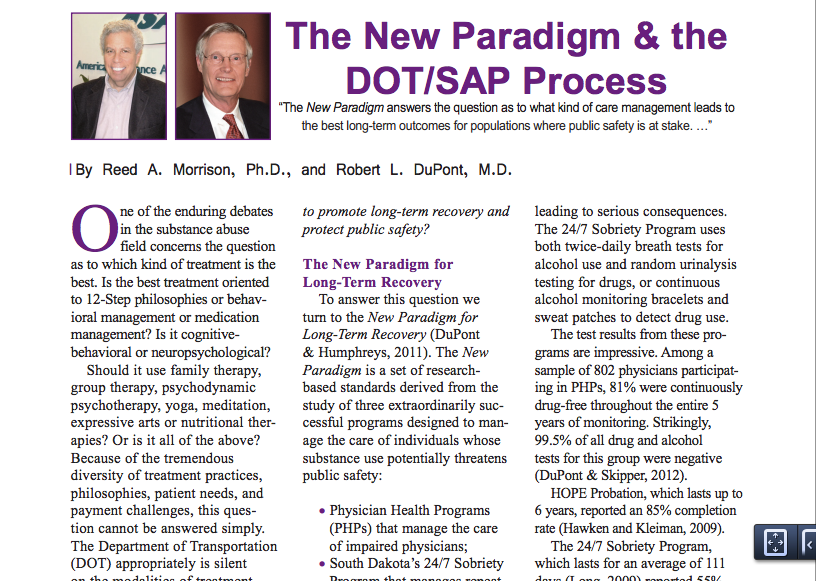
It is only a few public policy steps and minor changes in state regulatory statutes before what is described in the ASAM White Paper on Drug Testing comes to fruition.  Before we know it the Drug and Alcohol Testing Industries “New Paradigm” as described here by Robert Dupont will be ushered in as it did with doctors; not with a bang but a whimper.  From the ASAM white Paper:

“THIS WHITE PAPER ENCOURAGES WIDER AND “SMARTER” USE OF DRUG TESTING WITHIN THE PRACTICE OF MEDICINE AND, BEYOND THAT,BROADLY WITHIN AMERICAN SOCIETY. SMARTER DRUG TESTING MEANS INCREASED USE OF RANDOM TESTING* RATHER THAN THE MORE COMMON SCHEDULED TESTING,* AND IT MEANS TESTING NOT ONLY URINE BUT ALSO OTHER MATRICES SUCH AS BLOOD, ORAL FLUID (SALIVA), HAIR, NAILS, SWEAT AND BREATH WHEN THOSE MATRICES MATCH THE INTENDED ASSESSMENT PROCESS. IN ADDITION, SMARTER TESTING MEANS TESTING BASED UPON CLINICAL INDICATION FOR A BROAD AND ROTATING PANEL OF DRUGS RATHER THAN ONLY TESTING FOR THE TRADITIONAL FIVE-DRUG PANEL.”

To prevent this future drug testing dystopia, that includes testing schoolchildren, we need to take a step back and analyze the reliability and credibility of the “evidence-base” behind these multiple non-FDA approved forensic drug and alcohol tests and testing devices the ASAM proposes be used on the population at large utilizing the Medical Profession as a urine collection agency and bypassing forensic drug testing protocol by calling this “evaluation” and treatment rather than “monitoring” and punishment. New definitions, loopholes, secrecy and subterfuge are the bread and butter of these prohibitionist profiteers.

Amazingly, there has been no Academic review of these tests, let alone a Cochrane type critical analysis.  It is essentially untapped territory.  In addition there has been no Institute of Medicine type Conflict of Interest Analysis.  And that is why I am asking for help from statisticians, biostatisticians and epidemiologists.  The task would entail a review of the literature prior to the introduction of these tests for evidence base of forensic applicability (there essentially is none) and a review of the literature peri-and post marketing of these devices to assess the reliability and credibility of the underlying methodology and ascertain the evidence-base.  The goal would be publication in both academic journals and presentation to the general public through media publication with the assistance of investigative journalists and other writers. The goal is to get the truth out about these tests and allow both the medial profession and public at large to awaken to the menace this presents to medicine, our society and our future.

 Lack of Evidence-Base, Bias and Conflicts of Interest:  Making the Data Fit the Hypothesis

I am no epidemiologist or statistician but as with pornography I know junk-science when I see it.  Almost all of these tests were introduced with little or no evidence-base and, as with most of their endeavors, they did it below board via loopholes and cutting corners.

The overwhelming majority of papers are small, methodologically flawed, non-randomized, non-blinded  retrospective studies in that appear to make the data fit the hypothesis.   The authors can invariably be linked to those profiting from the tests of the testing process ( the patent holder, doctors associated with the drug testing labs, ASAM or FSPHP, Robert Dupont, Greg Skipper, etc.)


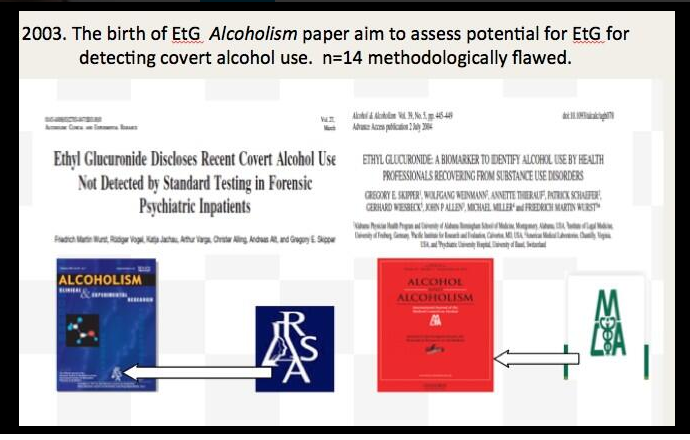
Ethyl Glucuronide (EtG) was introduced in 1999 as a biomarker for alcohol consumption,1 and was subsequently suggested as a tool to monitor health professionals by Dr. Gregory Skipper because of its high sensitivity to ethanol ingestion.2   
Screen Shot 2014-12-30 at 8.45.09 PM

Described as the  “innovator of EtG as an alcohol biomarker,” Skipper and  Friedrich Wurst,  “convinced” NMS labs in Pennsylvania “to start performing EtG testing in 2002.

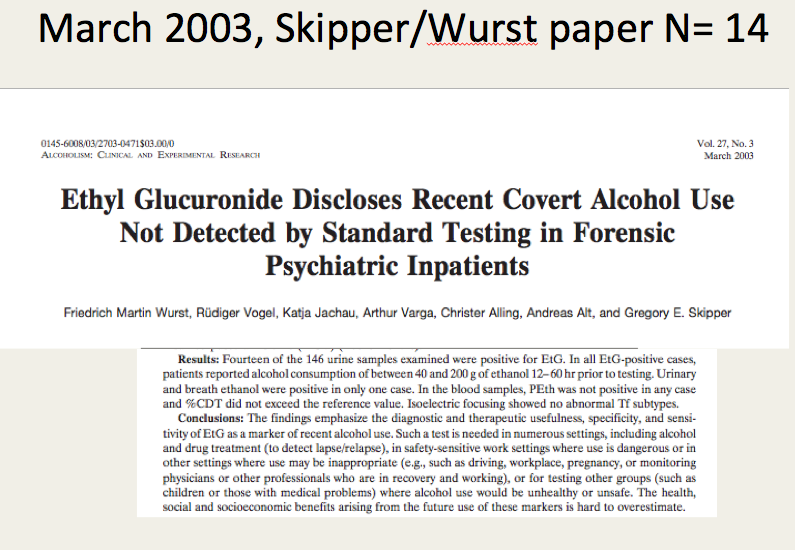
The study most often cited as 100% proof that there is 100% accuracy in EtG testing proving alcohol consumption involved a mere 35 forensic psychiatric inpatients in Germany that was published in 2003.3  

Shortly thereafter the Physician Health Programs began using it in monitoring doctors and other professional monitoring programs soon followed.
Screen Shot 2014-11-25 at 7.11.18 PM

Screen Shot 2014-11-29 at 5.16.18 PMLaboratory Developed Tests -A Loophole to Avoid FDA Approval and Accountability

Up until the birth of the EtG tests used for forensic drug and alcohol monitoring had to go through the arduous, expensive and necessary FDA approval process.   The LDT pathway was designed to develop simple tests with little risk that have  low market potential (i;e. the cost of the normal FDA approval process would prohibit them from coming to market).  The LDT pathway was designed to improve patient care and help improve diagnosis and treatment. It was not designed for forensic tests.  LDT approval does not require in vivo testing.  It is essentially an honor system and to develop an LDT it is not even necessary to prove that the test is actually testing what it is purportedly testing for (validity).

So with little to no evidence base they introduced the EtG, had it developed and marketed as a LDT in collusion with unscrupulous labs, and then began using it on physicians being monitored by State PHPs. This then spread to other monitoring organizations in which there was a large power-differential between those ordering the tests and those being tested (criminal-justice, other professional monitoring programs).  These biomarkers have never been used in Federal Drug Testing, SAMHSA approved, DOT, and other organizations where unions or other organizations are present and looking out for the best interests of those being tested.

Another example of how this group removes accountability.  There has been essentially no oversight or regulation of LDTs.  Although there was a recent push for regulation of these tests the Drug and Alcohol Testing Industry Association lobby made sure that forensic tests would be exempt.

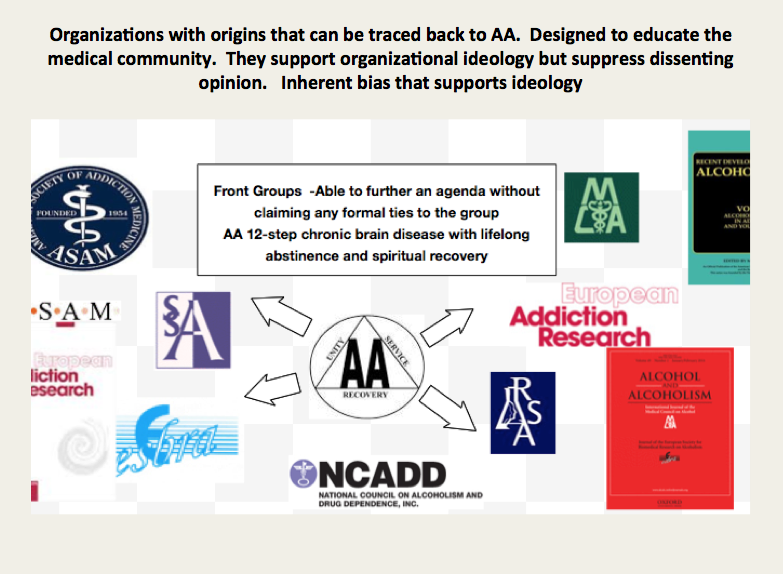
They then began publishing “research” on the EtG using the physicians being monitored as subjects. Many of the studies promoting the EtG and other biomarkers can be found  in  Journals that are linked to organizations that are linked to AA and were organized to educate the medical community.
Screen Shot 2014-11-29 at 5.16.39 PM
 
Screen Shot 2014-11-29 at 5.14.23 PM
These small, methodologically flawed studies amount to little more than opinion pieces but   This “evidence-base” is predominantly in biased journals published by biased medical “societies.  
The EtG was subsequently found to be so sensitive that it could measure incidental exposure to alcohol in foods, over the counter cold medications, mouthwash4,5, hand sanitizer gel6, nonalcoholic beer7, and nonalcoholic wine.8  Sauerkraut and bananas have even been shown to cause positive EtG levels.9
The United States Substance Abuse and Mental Health Services Administration warned against using a positive EtG as primary or sole evidence of drinking for disciplinary or legal action.10  The Wall Street Journal in 2006 reported the problems with the EtG to the general public.11   
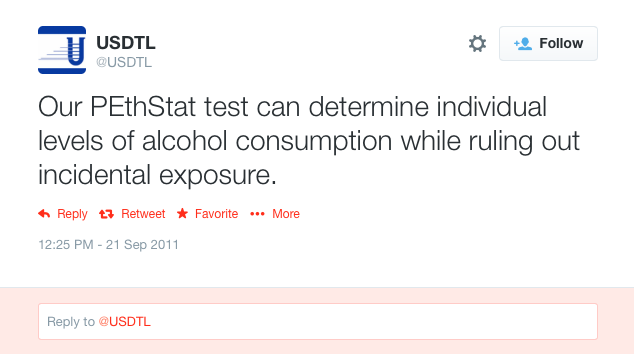
Screen Shot 2014-03-23 at 10.45.36 PMAs any rational authority would do, the majority of monitoring agencies abandoned the EtG after these flaws were revealed. The PHPs did not.  They continued to use the EtG on doctors uninterruptedly by telling them to avoid any products that could potentially contain alcohol; a ubiquitous substance in the environment. Since that time they have justified and rationalized (EtG)2,12 13  use by sequentially raising cutoff levels from 100 to 250 to 500 to 1000 to 2000 to now unknown and adding other LDTs as “confirmation tests such as Ethyl Sulfate (EtS)14,15 Phosphatidyl-Ethanol ( Peth)16 17 and other devices such as the Subcutaneous Remote Alcohol Monitoring Bracelet (SCRAM) and, their newest device the Cellular Photo Digital Breathalyzer (CPDB) that has recently been launched, just like the EtG Screen Shot 2014-02-23 at 10.00.22 PMwith little to no evidence base other than a pilot study done by Greg Skipper and Robert Dupont.18 
A  2013 article published in an ASAM incubated journal Alcoholism: Clinical and Experimental Research promotes the Phosphatidyl-ethanol (PEth ) test to confirm drinking.16  The study was done on physicians being monitored by the Alabama Physician Health Program who tested positive for EtG/EtS alcohol biomarkers. It is co-authored by Robert Dupont, Greg Skipper, and Friedrich Wurst and involved 18 subjects who tested positive for EtG/EtS of whom 7 claimed they did not drink.  After finding that 5 of the 7 tested negative for PEth they concluded that “positive PEth testing following positive EtG/EtS results confirms recent drinking.  Hard to wrap your head around the science in that one.Screen Shot 2014-04-30 at 1.06.53 PMSkipper is also using both Scram ankle bracelets and the CPDB monitoring in pilots in the Human Interventional Motivational Study (HIMS) Program that was developed in 2009 to “identify, treat and, eventually, re-certify airline pilots with substance abuse problems. 
 
IMG_0275

The Cochrane Collaboration does systematic reviews of the literature using conscientious, explicit, and judicious criteria to in order to produce and disseminate only high quality and evidenced based health care, exclude bias, and enhance transparency. The Cochrane database is a current and evolving database that includes the accuracy of diagnostic tests and is internationally recognized as the standard in evidence based health care.  This benchmark for evidence based health care and systematic reviews, records just 5 controlled trials under the topic ethyl glucuronide.8,19-21 These 5 studies represent the only high-quality evidence regarding EtG applying to EtG. Information provided by the five studies suggests the following, and only the following:

  1. EtG and EtS measurements increase with alcohol ingestion.
  2. The window of detection is shorter than what is commonly proposed (80 hours).
  3. Individual values are variable both within and between subjects.
  4. Non alcoholic wine can cause positive levels.

Notably, there are no studies that fit Cochrane Criteria, other than non-alcoholic wine, that look at the pharmacokinetics of EtG or EtS in terms of dose-response curves, cut-off levels, specificity drug and food interactions, or modes of ingestion.

SAMHSA notes that there is little research on PEth and that EtG, EtS, and PEth “do not have a strong research base,” and that “it is not known at this time how the test results might be affected by the presence of physical diseases, ethnicity, gender, time, or the use of other drugs. Until considerable more research has occurred, use of these markers should be considered experimental.”

Phosphatidylethanol (PEth), SCRAM, and the  yields no data as a test in the Cochrane library.

SAMHSA notes that there is little research on PEth and that EtG, EtS, and PEth “do not have a strong research base,” and that “it is not known at this time how the test results might be affected by the presence of physical diseases, ethnicity, gender, time, or the use of other drugs. Until considerable more research has occurred, use of these markers should be considered experimental.”

Evidence based medicine (EBM) can be defined as the conscientious, explicit, and judicious use of current best evidence in making decisions about the care of individual patients.22

Medical progress and scientific advancement is occurring so fast that the volume of medical literature is expanding at a rate of greater than 7% per year.23

Evidence based medicine is not restricted to randomized trials and meta-analyses. It involves tracking down the best external evidence with which to answer our clinical questions.22  

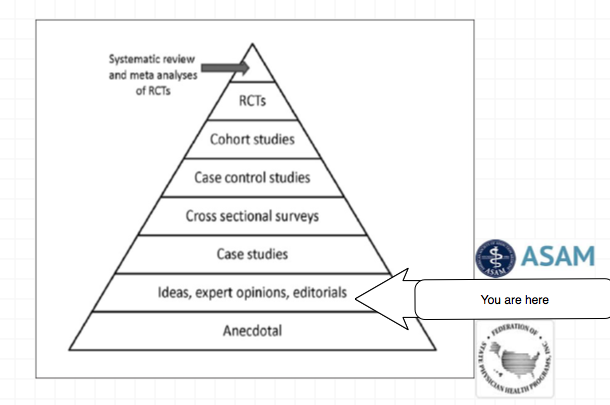
Expert opinion is the lowest level of evidence available in the EBM paradigm.24,25

Fortunately, the scientific method is a tool to help people progress toward the truth despite their susceptibilities to confirmation bias and other errors.26

Unfortunately, due to a confluence of factors (including political) this has not been done.  But, unless we want a  future as envisioned by Robert Dupont and explained in the the ASAM White Paper on Drug Testing we need to act now.  This is not a “New Paradigm” but a “New Inquisition.”

Screen Shot 2014-11-25 at 7.10.47 PM

Screen Shot 2014-02-15 at 4.39.03 PM

  1. Wurst FM, Kempter C, Seidl S, Alt A. Ethyl glucuronide–a marker of alcohol consumption and a relapse marker with clinical and forensic implications. Alcohol Alcohol. Jan-Feb 1999;34(1):71-77.
  2. Skipper GE, Weinmann W, Thierauf A, et al. Ethyl glucuronide: a biomarker to identify alcohol use by health professionals recovering from substance use disorders. Alcohol Alcohol. Sep-Oct 2004;39(5):445-449.
  3. Wurst FM, Vogel R, Jachau K, et al. Ethyl glucuronide discloses recent covert alcohol use not detected by standard testing in forensic psychiatric inpatients. Alcohol Clin Exp Res. Mar 2003;27(3):471-476.
  4. Costantino A, Digregorio EJ, Korn W, Spayd S, Rieders F. The effect of the use of mouthwash on ethylglucuronide concentrations in urine. J Anal Toxicol. Nov-Dec 2006;30(9):659-662.
  5. Reisfield GM, Goldberger BA, Pesce AJ, et al. Ethyl glucuronide, ethyl sulfate, and ethanol in urine after intensive exposure to high ethanol content mouthwash. J Anal Toxicol. Jun 2011;35(5):264-268.
  6. Rosano TG, Lin J. Ethyl glucuronide excretion in humans following oral administration of and dermal exposure to ethanol. J Anal Toxicol. Oct 2008;32(8):594-600.
  7. Thierauf A, Gnann H, Wohlfarth A, et al. Urine tested positive for ethyl glucuronide and ethyl sulphate after the consumption of “non-alcoholic” beer. Forensic Sci Int. Oct 10 2010;202(1-3):82-85.
  8. Hoiseth G, Yttredal B, Karinen R, Gjerde H, Christophersen A. Levels of ethyl glucuronide and ethyl sulfate in oral fluid, blood, and urine after use of mouthwash and ingestion of nonalcoholic wine. J Anal Toxicol. Mar 2010;34(2):84-88.
  9. Musshoff F, Albermann E, Madea B. Ethyl glucuronide and ethyl sulfate in urine after consumption of various beverages and foods–misleading results? Int J Legal Med. Nov 2010;124(6):623-630.
  10. Administration SAaMHS. The role of biomarkers in the treatment of alcohol use disorders. In: Advisory SAT, ed2006:1-7.
  11. Helliker K. A test for alcohol–and its flaws. The Wall Street Journal2006.
  12. Wurst FM, Skipper GE, Weinmann W. Ethyl glucuronide–the direct ethanol metabolite on the threshold from science to routine use. Addiction. Dec 2003;98 Suppl 2:51-61.
  13. Wurst FM, Alling C, Aradottir S, et al. Emerging biomarkers: new directions and clinical applications. Alcoholism, clinical and experimental research. Mar 2005;29(3):465-473.
  14. Anton RF. Commentary on: ethyl glucuronide and ethyl sulfate assays in clinical trials, interpretation, and limitations: results of a dose ranging alcohol challenge study and 2 clinical trials. Alcoholism, clinical and experimental research. Jul 2014;38(7):1826-1828.
  15. Hernandez Redondo A, Schroeck A, Kneubuehl B, Weinmann W. Determination of ethyl glucuronide and ethyl sulfate from dried blood spots. International journal of legal medicine. Jul 2013;127(4):769-775.
  16. Skipper GE, Thon N, Dupont RL, Baxter L, Wurst FM. Phosphatidylethanol: the potential role in further evaluating low positive urinary ethyl glucuronide and ethyl sulfate results. Alcoholism, clinical and experimental research. Sep 2013;37(9):1582-1586.
  17. Hahn JA, Dobkin LM, Mayanja B, et al. Phosphatidylethanol (PEth) as a biomarker of alcohol consumption in HIV-positive patients in sub-Saharan Africa. Alcoholism, clinical and experimental research. May 2012;36(5):854-862.
  18. Skipper GE, Thon N, DuPont RL, Campbell MD, Weinmann W, Wurst FM. Cellular photo digital breathalyzer for monitoring alcohol use: a pilot study. European addiction research. 2014;20(3):137-142.
  19. Hoiseth G, Bernard JP, Stephanson N, et al. Comparison between the urinary alcohol markers EtG, EtS, and GTOL/5-HIAA in a controlled drinking experiment. Alcohol Alcohol. Mar-Apr 2008;43(2):187-191.
  20. Wojcik MH, Hawthorne JS. Sensitivity of commercial ethyl glucuronide (ETG) testing in screening for alcohol abstinence. Alcohol Alcohol. Jul-Aug 2007;42(4):317-320.
  21. Sarkola T, Dahl H, Eriksson CJ, Helander A. Urinary ethyl glucuronide and 5-hydroxytryptophol levels during repeated ethanol ingestion in healthy human subjects. Alcohol Alcohol. Jul-Aug 2003;38(4):347-351.
  22. Sackett DL, Rosenberg WM, Gray JA, Haynes RB, Richardson WS. Evidence based medicine: what it is and what it isn’t. BMJ. Jan 13 1996;312(7023):71-72.
  23. Norwitz ER, Greenberg JA. Promoting evidence-based medicine. Rev Obstet Gynecol. Summer 2008;1(3):93-94.
  24. Shaneyfelt TM, Centor RM. Reassessment of clinical practice guidelines: go gently into that good night. JAMA. Feb 25 2009;301(8):868-869.
  25. Straus SE, Green ML, Bell DS, et al. Evaluating the teaching of evidence based medicine: conceptual framework. BMJ. Oct 30 2004;329(7473):1029-1032.

Screen Shot 2016-01-11 at 12.51.47 AMScreen Shot 2015-10-05 at 4.57.26 AM


The “Impaired Physician”–Increasing the Grand Scale of the Hunt

Screen Shot 2015-01-09 at 1.59.40 AM

“Wretched creatures are compelled by the severity of the torture to confess things they have never done and so by cruel butchery innocent lives are taken; and by new alchemy, gold and silver are coined from human blood.”  Father Cornelius Loos  ( 1592 )


Screen Shot 2015-02-28 at 8.15.35 AM

How Impaired Physicians Can be Helped–Medscape Business of Medicine Article Published February 24, 2015. Click on image to access

How can impaired Physicians be helped?

1.   Impairment among physicians is growing:  Why?  

Answer:  It is not.   State Physician Health Programs (PHPs) are “diagnosing” impairment when there is no impairment.  They are pathologizing the normal and expanding in scope to increase the grand scale of the hunt.

2.  What’s the Prognosis for Impaired Physicians?

Answer:  Not Good.   Those who need help (the truly impaired)  are afraid to get help for fear of being monitored by their state PHP while many of those ensnared by PHPs are not impaired.   There is absolutely no oversight, regulation or accountability.  This needs to be evaluated in the context of physician suicide.    The system is one of institutional injustice and abuse of power. 

3.  Is your knowledge of physician impairment up-to-date?  

Answer:   No.  This will only occur after an evidence-based Cochrane type review separates information from misinformation; An objective non-biased investigation by outside actors identifying any conflicts-of-interest, misconduct or lack of evidence-base in the current system and separating the art and science of the medical profession from the politicalization and exploitation of the medical profession.

The list of doctors on Like-Minded Docs  solves the final piece of a  puzzle. It explains why so many doctors across the country are claiming fabrication and manipulation of personality and cognitive tests to support nonexistent diagnoses at these “PHP-approved” assessment centers.    The relationship between the state PHP’s and the “PHP-approved” assessment centers is the same as it is between the state PHPs and the corrupt labs.

As Drs. John Knight and J. Wesley Boyd note in Ethical and Managerial Considerations Regarding State Physician Health Programs, published in the Journal of the American Society of Addiction Medicine,  this is what is known as “tailoring a diagnosis”–a euphemism for the political abuse of psychiatry.  According to the Global Initiative on Psychiatry “Political abuse of psychiatry refers to the misuse of psychiatric diagnosis, treatment and detention for the purposes of obstructing the fundamental human rights of certain individuals and groups in a given society.”   The shoe fits here.  In fact it fits very well.

images-18

The Global Initiative on Psychiatry opposes the Political_Abuse_of_Psychiatry  wherever  it may occur and “supports those psychiatrists and psychiatric organizations that pressure the offending states to discontinue the practice and lobby vigorously those organizations which are wavering. The main way for individuals and organizations to work is through diplomatic channels. It is necessary to expose the practice and to embarrass countries that are at fault by expelling them from organizations such as the World Psychiatric Association. This can only be ensured by properly organized open investigation of psychiatric practice and interviews with the alleged victims”

Political abuse of psychiatry in the profession of medicine needs to be treated in the same way.

An evidence based Cochrane type assessment of their “research” and an Institute of Medicine Conflict of Interest review are long overdue.

In evaluating a physician for “impairment” or being “disruptive” the Physician Health Programs (PHPs)  under the Federation of State Physician Health Programs (FSPHP)  are not gathering data to form a hypothesis.  They are making data fit a hypothesis that arrived at the out-of-state “PHP-approved” assessment center well before the alleged miscreant doctor.

With guilt assumed from the start, no due process, no appeal, and no way out physicians are being bullied, demoralized, and dehumanized  to the point of hopelessness, helplessness and despair.

This needs to end now.

Medicine is predicated on competence, good-faith, and integrity. 

Medical ethics necessitates beneficence, respect, and autonomy. 

The scaffold erected here is designed for coercion and control. 

Exposure, transparency, and accountability are urgent. 

The emperor has no clothes.

Sunshine is the best disinfectant.

https://artbylisabelle.wordpress.com/2015/03/01/three-shells-and-a-pea-asam-fsphp-and-lmd/

Screen Shot 2015-08-30 at 8.39.06 PM


Medical Regulation and Junk-Science: The “Medical Sanctification” of Lie-Detectors byMedical Boards and State Physician Health Programs

Junk-Science in the Medical Profession: The Resurgence of Polygraph “Lie-Detection” in an age of Evidence-Based Medicine.

33755_1527129670651_5081648_n

Circa 1995

The article below was published in the now defunct magazine Gray Areas almost twenty years ago. (Vol. 4, No. 1, Spring 1995 pp. 75-77).  It is not a research article but a critique of the use of polygraphy written for a general audience.

Antipolygraph.org founder George Maschke noted in 2008 that the article “makes a good introduction to the pseudoscience of polygraphy” and “the criticisms of polygraphy remain valid today.”  The basic assumption of any good test is that is has construct validity; that it is actually measuring what it is purported to measure.   Polygraphy is purported to detect lies but the specificity and sensitivity are about the same as a toss of a coin and has the potential to cause a great deal of harm to those who are judged dishonest by its results.  Heads I win, tails you lose.

In the article I suggest that state laws regarding polygraph use must change and call upon the medical and scientific communities to educate lawmakers and policy makers about the absence of construct validity in this pseudoscientific instrument and “put the greater than 3000 anachronistic polygraph examiners in the United States out of business.” The Employee Polygraph Protection Act of 1988 (EPPA) generally prevents employers from using polygraphs for pre-employment screening or during the course of employment,  A 2003 report by the  National Academy of Sciences found that the majority of polygraph research was “unreliable, unscientific and biased.” In 2004 the American Psychological Association (APA) issued a position paper finding little evidence to support polygraphy in detecting deception concurring with the 1986 American Medical Association’s (AMA’s) Council on Scientific Affairs conclusions that there is little evidence base for this test and it is unscientifically supportable.

Alas, in  2016 the polygraph examiners are still in business and there are now approximately 5000 of them.  The American Polygraph Association is still claiming 90% accuracy and the test is used extensively by prosecutors, defense attorneys, and law enforcement agencies.  In U.S. courts judges have expanded the instances in which polygraph testing is mandated or admitted as evidence.

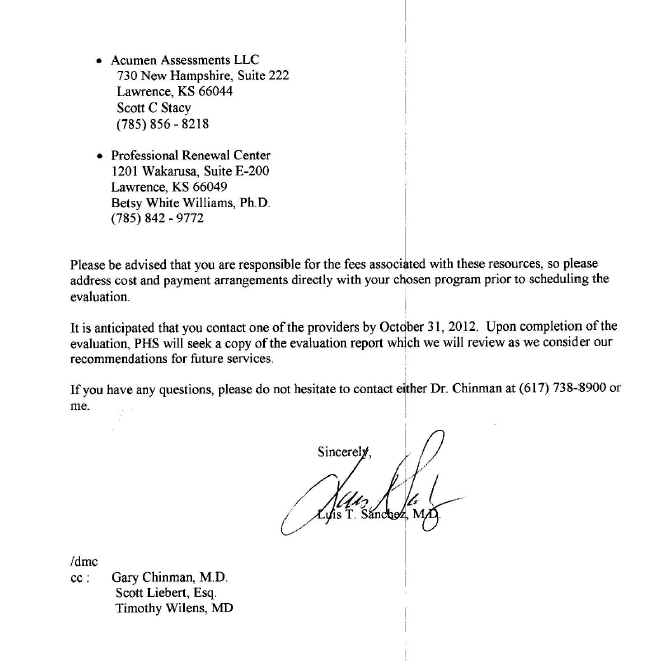
The Employee Polygraph Protection Act of 1988 (EPPA) applies only to private industry, not the government and, ironically, state medical boards and their national organization,, the Federation of State Medical Boards condone their use on medical doctors despite the fact that the American Medical Association likened their accuracy to a coin-toss and recommended against their use in the 1980s.   This is due to the influence of the Federation of State Physician Health Programs (FSPHP).  The alliance between the FSMB and FSPHP has resulted in bad policy and decision making as physician health programs have bamboozled medical boards into complete deference to their perceived authority and expertise in evaluating physicians for just about anything. This has resulted in the acceptance of non-FDA approved drug and alcohol testing, non-validated psychological instruments and lie-detectors.   Polygraphs serve an important purpose for those involved in the PHP and rehab racket.   They are used in disruptive physician evaluations to “confirm” (i.e. “tailor”) diagnoses in physicians referred to gulags such as Acumen, the Professional Renewal Center and Vanderbilt.  Polygraphs and adherence to 12-step doctrine is also being used as leverage to regain medical licenses and apparently the medical boards agree with this methodology.

Take for instance, Dr. James Peak, M.D., a child psychiatrist who was sent to prison on a federal child pornography conviction and taken under the wing of the Montana PHP.  Michael J. Ramirez, clinical coordinator for the Montana Professional Assistance Program, says “Peak’s remorse for his crimes is genuine.”  Peak, who primarily saw adolescent boys in his practice  maintains he only looked at child pornography of young boys but never physically abused any and a polygraph confirmed that he was only a “looker”  but never a “toucher.” He spent just 10 months in Federal prison for a crime that could get up to ten years and thanks to the PHP his  license was reinstated lickety-split.

Peak’s treatment includes going to one AA meeting and one 12-step sex addict meeting per week.

Legitimate policy must be based on recognized institutions and experts.  The science must be reliable and unbiased. Regulatory changes demand methodologically sound science and evidence-based facts arrived at through rigorous peer review and professional.  Decision are currently being made by illegitimate carney hucksters and irrational clowns.

images-3

The Art of Deception: Polygraph Lie Detection

By Michael Lawrence Langan, M.D.

I’d swear to it on my very soul, If I lie, may I fall down cold.”

– Rubin and Cherise
(Hunter/Garcia)

The accuracy of polygraphic lie detection is slightly above chance. Nevertheless, State and local police departments and law enforcement agencies across the United States are devoted proponents of this unscientific and specious device. In addition, the American public seems to lend an implicit credence to the “lie detector” as evinced by its ubiquitous use on television crime shows and in “whodunit” literature. It is given overt attributions of credibility on tabloid type talk shows and news shows. For example, in the highly publicized case of Tonya Harding a reporter stated, not with removed objectivity but with sardonic grin and mocking emphasis, that the accused had failed two polygraph tests. The implied assumption is that if the person has failed the polygraph test, then therefore he or she is guilty regardless of other evidence. Bottom line. Culpa ex machina. End of story.

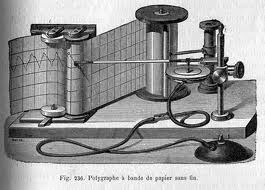
Lie detection by the polygraph is based on the premise that the act of telling a lie causes specific, universal, and reproducible physiological responses as manifested by the autonomic nervous system. (Saxe, 1991) These physiological responses, which are largely outside the influence of voluntary control, are then measured by the polygraph instrument. The polygraph itself is simplistic in design. It consists of several devices which are attached to the subject to record blood pressure, pulse, respiration, and galvanic skin response (which is related to perspiration). The results are then recorded on a moving paper by a “kymograph.” Hence any change of one of the autonomic nervous system variables will be recorded on the paper as a change from baseline. The polygraph examiner then interprets the tracing. A characteristic change from baseline on a relevant question is interpreted as a lie.

images-5

In fact, the polygraph test does measure autonomic nervous system activity. The role of the autonomic nervous system with its sympathetic and parasympathetic branches is well defined within the field of medicine, and was well described by the French physician Claude Bernard over a century ago. The primary role of the autonomic nervous system is to maintain bodily homeostasis to allow the individual to exist in a changing environment.

Simplistically described, the autonomic nervous system is a part of the peripheral nervous system which consists of a variety of outgoing nerve pathways that regulate important physiological functions generally outside of voluntary and conscious control. Thus, respiration, body temperature, heart rate, digestion, sweating, and blood pressure are all, partly or entirely, regulated by the autonomic nervous system. It is divided into sympathetic and parasympathetic branches which have contrasting functions in terms of effect. The sympathetic branch increases heart rate, respiratory rate, blood pressure, and perspiration. It is active at all times but varies with the constantly changing environment, and is especially active during rage or fright and prepares the body for the so called “fight or flight” phenomenon. Many of these reactions are caused by the release of epinephrine. The parasympathetic nervous system, on the other hand, is primarily involved with conservation and restoration. It is the sympathetic branch of the autonomic nervous system that the polygraph measures in terms of its activity. Thus, from a medical perspective it is entirely valid that the polygraph will accurately measure sympathetic nervous system activity with its instrumentation.

The false assumption of the polygraph test is that dishonesty is the sole cause of sympathetic arousal during a polygraph examination. Deception is a cognitive phenomenon that cannot be measured. Indeed, throughout the entire history of medicine there has not been a single scientific study that demonstrated evidence that a cognitive phenomenon (such as love, hatred, truth, altruism, jealousy) could be measured. Since, in the complex realm of truth and deception, there is no known physiological response that correlates with lying, then there is no validity to the test. Although the act of lying can elicit fear and anxiety via the sympathetic nervous system, so can multiple other confounding and complex emotional factors including stress, embarrassment, anger, and fear. “Deception itself cannot be measured directly.” (Steinbrook, 1992) In addition, each individual differs in autonomic lability. Some people stay calm with a gun at their head. While others get autonomically excited, with heart thumping and palms sweating at simply shaking someone’s hand.

In reality, the examination itself is inherently designed to elicit fear and anxiety. It is an interrogation. If this fear and anxiety are recorded on a relevant question, then you have failed that question according to the polygraph “experts.”

The polygraph technique begins with a pre-test. After a sixth-grade level lecture on the nervous system and a proclamation of the test’s infallibility, the examiner will go over all of the questions that have been formulated.

These questions consist of control questions, relevant questions, and irrelevant questions. The subject will then be attached to the polygraph equipment and the formal testing begins.

The most crucial questions on the polygraph examination, or “Control Question Test,” are the control questions and relevant questions. The control questions are garnered from the suspect by asking him an innocuous question which could not be truthfully denied. For example, “Have you ever thought of hurting someone?” or “Have you ever lied to anyone?” The responses to the control questions will elicit some degree of autonomic activity which can then serve as a baseline for which to compare subsequent questions. The relevant questions pertain to the actual investigation at hand. The magnitude of responses to relevant questions and control questions as compared with the irrelevant questions is then interpreted, in a non-blinded manner, by the examiner. The assumption is, that if you are prevaricating, the relevant questions will cause a greater response than the control questions. So if the question “Have you ever been late for an appointment?” (control question) elicits less of an emotive response on the polygraph equipment than “Did you murder and rape your girlfriend?” (relevant question) you have failed the test. And, according to the American Polygraph Association (APA) you are lying. Assuming the subject is innocent, it is fairly obvious that he would respond with more emotional autonomic activity to a question regarding a recently deceased loved one than he would an inquiry about punctuality. Obvious to everyone, that is, but the APA.

The APA is a professional organization for polygraph examiners who have complete faith in the accuracy of the test. They have their own trade journal Polygraph in which they report scientifically worthless studies and brandish anecdotes of the wonders of their trade. The majority of these members can pride themselves on completing a 6 week to 6 month post- high school training course in the art of polygraphy. They have no formal training in medicine, psychology, physiology, or behavior; the very disciplines on which the testing is based. The majority of them cater to the legal system wherein their economic livelihood depends.

Since they are primarily paid to identify guilty suspects, motivational factors may play a part in their eagerness to find the guilty suspect. (Kleinmuntz, 1987)

The accuracy of any test is determined by that test’s sensitivity (ability to find a positive) and specificity (ability to find a negative). A polygraph examiner will ardently tell you that the exam has somewhere in the neighborhood of a 95% sensitivity rate. This means that if 100 guilty suspects are given a polygraph exam, 95 of them will be detected through the test. Only five of the 100 will be a false negative and not be detected by this miraculous method. Likewise they will claim a similar specificity rate, and state that if you are telling the truth then you have almost a 100% chance of being cleared by the test. John Reid, the inventor of the Control Question Test claimed 99% accuracy. (Reid and Inbau, 1977)

This is clearly not accurate. The polygraph was not subjected to much critical and scientific investigation until the last two decades. (Saxe, et al., 1983) Since this time there have been a number of studies of sound scientific design and methodology which clearly refute the high specificity and sensitivity that polygraph advocates claim. These studies have appeared in reputable peer-reviewed journals and not trade publications. Horvath, for example, reported a sensitivity of 76 percent and a specificity of 52 percent. (Horvath, 1977) This means that out of 100 liars 76 of them will be detected by the polygraph. What is astonishing though is the specificity of 52 percent. This means that out of 100 people who are not lying, 52 will be identified as telling the truth while 48 of the honest individuals will be branded as liars. The odds are similar to that of a coin toss which would have a specificity of 50 percent. Barland and Raskin’s study actually demonstrated a specificity of 45%. Worse than a coin toss. (Barland and Raskin, 1976) Multiple other studies have shown similar results. (Brett, et al., 1986, Kleinmuntz and Szucko, 1984, Lykken, 1984).

The polygraph examiner likens his “skill” to that of the radiologist reading a chest X-Ray or a cardiologist interpreting an EKG. (Barefoot, 1974) This analogy is not only ridiculous but, in fact, if a medical test had a similar sensitivity and specificity to that of the polygraph examination it would simply not be used in the field of medicine. They will cite the fact that the polygraph has been used in the United States for greater than 70 years as if longevity is directly related to validity. They will state that they have personally administered hundreds or thousands of these tests, and have almost never been wrong, as if total number of tests given constitutes accuracy.

They are so convinced of the accuracy of the polygraph that they regard opponents of polygraphy as communists and do-nothing professors. (Arther, 1986) It doesn’t occur to them that someone with a Ph.D. and years of research experience, in the very subjects they ignorantly dabble in, may know something more than they do.

It is astounding that the criminal justice system has institutionalized and perpetuated a so called “technology” that lacks scientific evidence and is in fact rejected by the scientific community. It is as ludicrous as procuring the so called “love meter” machine from the amusement park which measures galvanic skin response and placing it in the courtroom. But in a backward legal system which has been known to use psychics to help with unsolved murders and has allowed the mentally retarded to serve as jurors, it is not entirely surprising.

The tool is useful to them, however, in that 25 to 50 percent of examinees will, under the tense psychological pressure of the exam, confess to the misdeed at hand. (Lykken, 1981, Lykken, 1991) Persuaded that they have been proven dishonest by “scientific” means they give up hope. It is usual for the polygraph examiner to interrogate the subject who has failed the test. They will state that there is no way now to deny the objective guilt demonstrated by this impartial and unbiased scientific device, and that the only available option is to confess.

The assessment by the polygrapher is genuinely convincing because, sadly, he believes it himself. Thus the instrument is clearly useful as a confession inducing device. One wonders, over the past 70 years, how many false confessions have been obtained in this way from innocent persons.

In summary, the polygraph is a ludicrous implementation of pseudo-science at its worst. The members of the APA are non-scientists practicing science, and the consequences are often dire. Lykken reports the cases of three men who were convicted of murder largely due to the polygraph examiner’s testimony that in their “expert opinion” they had failed the test. All three were subsequently found to be innocent. (Lykken, 1991) Polygraph examiners ignore such cases or rationalize that they are due to the rare incompetence of some examiners.

The continued use of polygraphic lie detection has the potential to cause much harm to those who are judged dishonest by its results. The specificity and sensitivity are not dissimilar to that of a coin toss. Innocent suspects have about a 50/50 chance. One failure is all it takes to ruin your life. Since the 1923 Federal Court decision of Frye vs United States (293 F 1013 [DC Cir 1923]), polygraph evidence has not been admissible in federal court cases because there was deemed a lack of scientific validity to the test. This travesty however is still used widely by the state court system. Furedy characterizes the continued use of polygraphy as a serious “social disease.” (Furedy, 1987) State laws regarding abuse of the polygraph must change, and it is time for the medical and scientific communities to educate lawmakers and policy makers about the true validity of this perversion of science. It must be forever banished to the same realm of parapsychology as the Ouija Board, phrenology, and palmistry. The relatively conservative American Medical Association’s Council on Scientific Affairs recommended that the polygraph not be used in pre-employment screening and security clearance. (Council on Scientific Affairs, 1986) It is time to extend this recommendation across the board, and put the greater than 3000 anachronistic polygraph examiners in the United States out of business.

Meanwhile, if you are asked to take a polygraph test–don’t do it. Those involved in the criminal justice system, including lawyers, are largely uneducated in the realm of scientific scrutiny and experimental methodology.

They may not separate science and pseudo-science, and erroneously believe that the polygraph is an accurate scientific instrument. Their interactions are with polygraph examiners who proselytize its use, and they have little or no interaction with scientists, psychologists, and physicians who refute its use. Refuse to take the test and educate them. Cite the Frye doctrine, go to the medical library, copy the scientific articles which belie its validity, and present them to whomever requested you to take the test. State that the principles and assumptions underlying polygraphy are not supported by our understanding of psychology, neurology, and physiology. Then put the burden of proof on their heads. Tell them to present you with scientific evidence that corroborates the validity of the test. There is simply no rational basis for a machine to detect liars.

References

Arther RO. 1986. The polygraph’s enemies: An update. Journal of Polygraph Science. 20: 133-136.

Barefoot J. 1974. The Polygraph Story. Cluett Peabody and Co., New York.

Barland, G, Raskin D. 1976. Validity and reliability of polygraph examinations of criminal suspects (Report 76-1, Contract 75 NI-99-0001).

Brett AS, Phillips M, Beary JF. 1986. Predictive power of the polygraph: Can the “lie detector” really detect liars? The Lancet. 1: 544-547.

Council on Scientific Affairs. 1986. Polygraph. Journal of the American Medical Association. 256: 1172-1175.

Furedy JJ. 1987. Evaluating polygraphy from a psychophysiological perspective: a specific-effects analysis. Pavlovian Journal of Biological Sciences.22: 145-151.

Horvath F. 1977. The effect of selected variables on interpretation of polygraph records. Journal of Applied Psychology. 62: 127-136.

Kleinmuntz B. 1987. The predictive power of the polygraph: The lies lie detectors tell. Journal of the American Medical Association. 257: 189-190.

Kleinmuntz B, Szucko J. 1984. A field study of the fallibility of polygraphic lie detection. Nature. 308: 449-450.

Lykken D. 1984. Polygraph Interrogation. Nature. 307: 681-684.

Lykken DT. 1981. A tremor in the blood: Uses and abuses of the lie detector. McGraw-Hill, New York.

Lykken DT. 1991. Why (some) Americans believe in the lie detector while others believe in the guilty knowledge test. Integrative Physiological and Behavioral Science. 26: 214-222.

Reid JE, Inbau FE. 1977. Truth and deception: The polygraph (“lie detector”) technique. Williams & Wilkins, Baltimore.

Saxe L. 1991. Science and the CQT polygraph: A theoretical critique. Integrative Physiological and Behavioral Science. 26: 223-231.

Saxe L, Dougherty D, Crosse T. 1983. Scientific validity of polygraph testing: a research review and evaluation. Conference: OTA-TM. U.S. Congress Office of Technology Assessment.

Steinbrook R. 1992. The polygraph test – A flawed diagnostic method. The New England Journal of Medicine. 327: 122-123.

png-1


Go back

Your message has been sent

Warning
Warning
Warning
Warning

Warning.


Transcription and HTML by AntiPolygraph.org

Published in Gray Areas, Vol. 4, No. 1 (spring 1995), pp. 75-77. This article may also be downloaded as a 1 mb scanned PDF file.https://antipolygraph.org/articles/article-053.pdf


AntiPolygraph.org Home Page > Reading Room

graycvr7

Class Action Lawsuit Hits Michigan Professional Health Program

Class Action Lawsuit Hits Michigan Professional Health Program

State Physician Health Programs Scurry to Avoid Legal Action, Doctors Outraged

A  lawsuit was filed in Federal Court in March against the organization that monitors impaired professionals for the Michigan State Board of Medicine, alleging constitutional violations, financial conflicts, lack of oversight, and due process.  Three mid-level providers are claiming damages as a result of actions taken by the Health Professional Recovery Program (HPRP), originally established to provide health professionals with a confidential and non-disciplinary approach  to dealing with substance abuse disorders and mental health issues.

The HPRP, administered by a private contractor, was initially designed to monitor treatment of health professionals referred to them by providers.  But plaintiffs claim the program’s administrators are overruling treatment decisions by board-certified and licensed physicians in favor of coercion of individuals into a small group of selected treatment facilities that are also charged with providing an initial evaluation of the need for treatment. Treatment facilities are expensive, and in most cases, insurance companies don’t consider these admissions to be medically necessary.

In one case cited in the court filing, the plaintiff was told she would have to stop taking pain medication prescribed by her treating physician for a period of two years. This decision was made after a short evaluation during which the evaluator did not contact the treating provider, and when the plaintiff refused to agree, her nursing license was summarily suspended. Her suspension was later dissolved in court. This is one small example, but it’s telling, Last time I checked, doctors had the right to choose a healthcare provider. It is surprising that the Michigan Medical Board would support a policy that essentially declares many of their own licensees inadequate to provide a treatment plan.

Unfortunately, this is not the only professional health program faced with backlash for financial double dealing and coercion. North Carolina physicians’ complaints promoted the North Carolina State Auditor to investigate oversight by the medical board in that state, and she found evidence of lack of oversight and the appearance of conflict of interest. Money flowed directly from the “impaired physician program” to their “approved providers” in the form of scholarships for the doctors they referred.

A common pattern has emerged in the treatment of doctors for mental illness or substance abuse. Agencies that were originally installed as volunteer boards aimed at helping doctors return to practice safely have been populated with a new group of professionals – doctors who are closely tied to treatment facilities or drug testing companies who frequently have their own history of substance abuse issues.

A recent string of posts on SERMO, the world’s largest physician-only social network, received a lot of attention. It is clear there have been a lot of abuses, sharing of confidential information, and lack of due process for participants. Many object to the religious overtones of every program that is “approved” for doctors by the Federation of State Physician Health Committees, the parent organization that has formed to keep all state committees notified of talking points. Physicians are currently subjected to polygraph tests, a practice most Americans would never accept. The term “disruptive physician” is an easy way to target those who speak out against a system that has become adversarial.

There are 400 suicide deaths annually among US physicians. Many of these doctors suicide when under investigation or contract with the committees originally designed to help them return to health. Other doctors are afraid to speak out, for fear of reprisal, particularly when in a contract with their PHP.

Have you heard of a colleague who has self-reported or has been reported for mental health or substance issues? Perhaps you have experienced a period of mental health crisis in your own life. How did you handle reporting requirements? What rights should doctors enjoy?

Deciding Whether To Refer a Colleague to a Physician Health Program, Oct 15 – AMA Journal of Ethics -J. Wesley Boyd, M.D., PhD

Screen Shot 2015-10-01 at 11.01.33 AM


Deciding Whether To Refer a Colleague to a Physician Health Program

J. Wesley Boyd, MD, PhD

Physicians should exercise caution in referring a possibly impaired colleague to a physician health program (PHP), given that PHPs work closely with their state medical societies or licensing boards but often receive little oversight. The AMA Journal of Ethics is a monthly bioethics journal published by the American Medical Association.

Source: Deciding Whether To Refer a Colleague to a Physician Health Program, Oct 15 – AMA Journal of Ethics (formerly Virtual Mentor)

Gay Doctor coerced by Physician Health Program (PHP) into mandated 12-step treatment and monitoring for sex addiction: The slippery slope begins

gay-friendly-doctor

State Physician Health Programs -coercion, control and abuse.

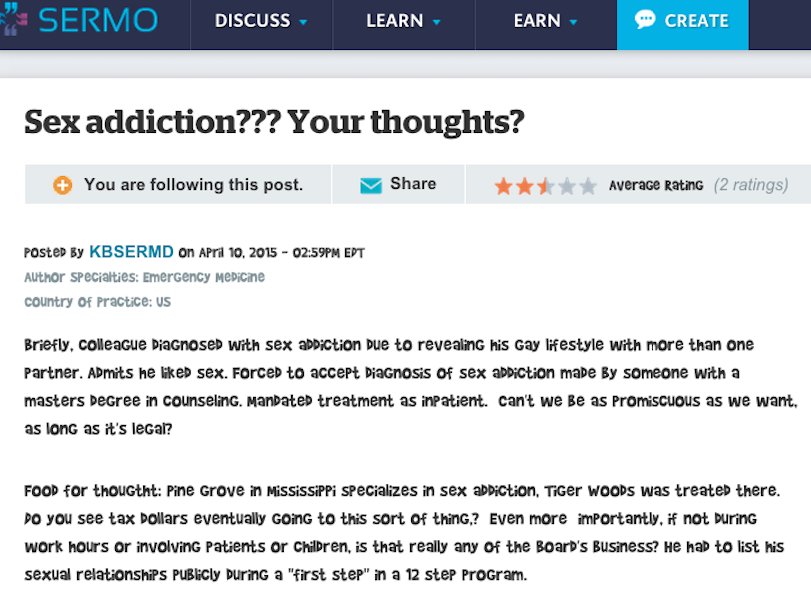
This anecdote concerning  a gay doctor’s revelation he liked his non monogamous lifestyle leading  to a forced acceptance of a “sex addiction”  diagnosis, mandatory inpatient treatment and indoctrination into 12-step recovery was just posted on the physician social network SERMO.    If the pattern looks familiar it is.

Screen Shot 2015-04-10 at 11.56.04 PM

Physician Health Programs (PHPs) are non-profit NGOs that exist in every state ostensibly to help impaired doctors and protect the public from harm.  PHPs have no regulation or oversight and have essentially removed all accountability. Under the ruse of protecting a doctors anonymity and providing confidentiality they have built barriers of opacity.  Most doctors are unaware how they work unless they become involved with them and they are not on the radar of the public at large–they need to be.

Organized under the Federation of State Physician Health Programs, (FSPHP),  state medical boards have abdicated their responsibility and consider them expert authority on all things related to physician health–a logical fallacy that has placed illegitimate and irrational authority in professional control of medicine once again proving that knowledge isn’t power and ignorance often reigns.

PHPs encourage confidential referrals for “warning signs” such as those on the list below from the Massachusetts PHP, PHS, Inc. and guarantee  the reporters anonymity.  All semblance of due process has been removed.  Medical boards have given state PHPS complete and absolute managerial control over  assessment,  treatment and monitoring.  PHPs are not healthcare providers but monitoring agencies.  If a PHP recommends an “assessment” of a reported doctor there is no choice in the matter.   No allowances for a second opinion,  outside support or appeal exist.Screen Shot 2015-03-06 at 7.33.17 AM

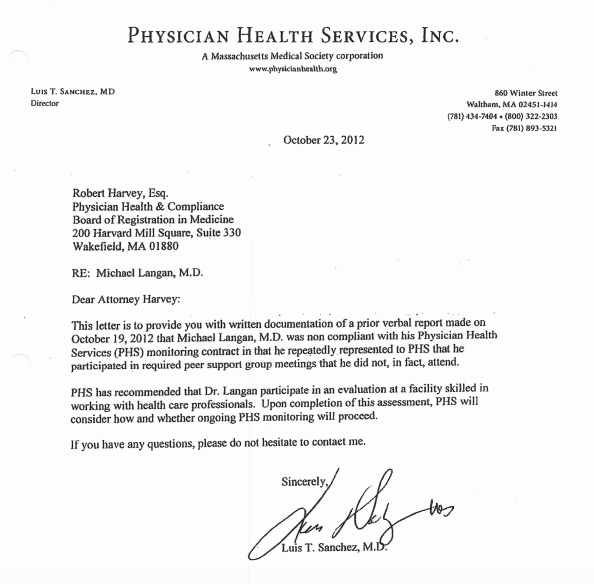
This doctor was apparently reported to his state PHP because a patient thought she smelled alcohol on his breath.  As it turned out, the accusation was bogus but by being honest and forthcoming about his sexual orientation in the interview the PHP mandated an “assessment.” for unrelated issues.  A not uncommon scenario as reports of behavioral issues often end up with hair tests for alcohol and other substances resulting in mandated assessments for “substance use disorder” followed by a five-year monitoring contract with the PHP and weekly urine tests.

The PHP provides  a list  of three or four facilities drawn from the same pool of “PHP-approved” assessment and treatment centers. However, an audit of the N.C. PHP found no written objective criteria or quantitative measurements existed on how these assessment and treatment centers are “approved” by the PHP.  The common denominator seems to be that these facilities are  (1) 12-step ASAM directed, and (2) willing to “tailor” an assessment to support a predetermined diagnosis. It is, in fact, a rigged game.  Unfortunately the medical boards have been duped into mandating assessments at these centers under threat of loss of medical license and specifically exclude non “PHP-approved” assessments.

This scaffold  is also the unspoken and hushed major contributor to physician suicide—It is the elephant in the room no one speaks of out of fear of being targeted.    Doctors who really need help for mental health, substance abuse or other issues are afraid to get it for fear of being reported to the PHP.  Those already monitored are subject to all sorts of psychological, financial and emotional abuse.

The Federation of State Physician Health Programs (FSPHP)  has a relationship with Pine Grove.  It is one of the “PHP-approved” facilities and two of their staff, Phillip Hemphill, PhD and James C. “Jes” Montgomery, MD are are listed as Program Faculty at the FSPHP annual educational conference and business meeting on April 24-27, 2015 in Fort Worth Texas.

26well-gaydoctor-tmagArticle

Political Abuse of Psychiatry

Political abuse of psychiatry is the “misuse of psychiatric diagnosis, detention and treatment for the purposes of obstructing the fundamental human rights of certain groups and individuals in a society.  The coercive use of psychiatry represents a violation of basic human rights in all Cultures.Screen shot 2013-05-13 at 1.29.38 PM

What has occurred in the medical profession is no different from China or the Soviet Union under totalitarian rule where dissent is disapproved, often punished, and those perceived as threats to the existing system can be effectively “neutralized with trumped up psychiatric illness” and by this stigmatization reputations were ruined, power was diminished, and voices were hushed.

Screen Shot 2015-03-12 at 11.17.53 PM

Political abuse of psychiatry involves the deliberate action of diagnosing someone with a mental condition they do not have as a means of repression or control and if you do not believe it is occurring right here today then take a look here and here to see how they are colluding with commercial drug testing companies to engage in forensic fraud and the assessment and the treatment centers to fabricate data to support non-existent diagnoses.

“Sex Addiction” used as a tool to Discriminate

There has been a lot of “chatter” in PHP circles concerning “sex addiction” and I knew they had been aligning themselves and setting up specialized programs at certain facilities.  It seemed unusual as many of the key players who erected and run this scaffold have themselves been involved in sexual misconduct.   Screen Shot 2015-01-09 at 5.22.34 PM

009935_3_thumb

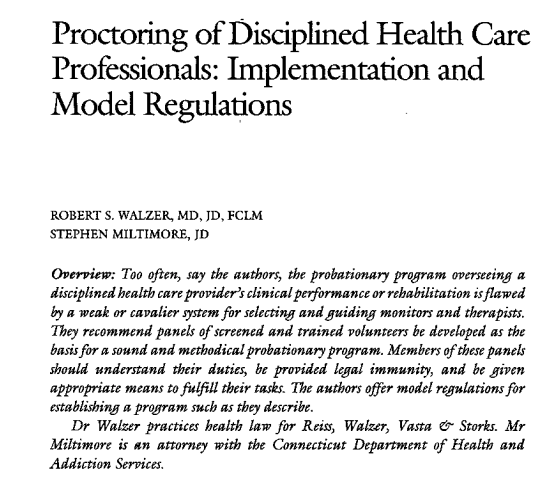
One of the architects of the current system, Dr. Robert Walzer, M.D., J.D. who was instrumental in tinkering with administrative and medical practice laws to remove the due process and appeal rights of doctors surrendered his license in 2001 due to inappropriate sexual relationships with patients.  He was the co-author of the current physician health program paradigm.

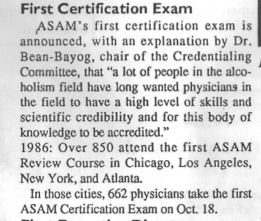
  Dr. Margaret bean-Byog, M.D, Chairman of the credentialing 7109298-Mcommittee for the first certification exam and ASAM president surrendered her medical license after being accused  of sexually abusing one of her patients, a Harvard medical student who subsequently died by suicide.
Somehow, I don't think this is quite what they had in mind!And the FSPHP seems to treat doctors involved in sexually related misconduct in a favorable light.  Take for instance, Dr. James Peak, M.D., a child psychiatrist who was sent to prison on a federal child pornography conviction taken under the wing of the Montana PHP.  After “proving” he only ‘”looked” at pornography of young boys but never abused any using a polygraph “lie-detector” test his license was reinstated in no time at all.  His treatment includes going to one AA meeting and one 12-step sex addict meeting per week.  My guess is they need more staff at the PHP or one of the assessment centers.

Screen Shot 2015-04-11 at 2.25.11 AM

I had been wondering what the motivation was behind this focus on “sex addiction” and my suspicions seem to be correct.

  I have since heard of a second case of a gay doctor being forced into his state Physician Health Program (PHP) in Alabama.

Once under the control of the PHP most doctors are afraid to come forward because of the “swift and certain” consequences imposed on them.  All they have to do is say the doctor was “noncompliant” to the medical board and it is over.  They lose their license and there is not a thing they can do about. it.  I have heard from doctors in multiple states going to law enforcement,  the Attorney General,  the media and the ACLU only to have the door slammed in their faces. Myself included.    .

 The coercion, control, ethics, and civil and human rights violations remain hidden.  The crimes remain hidden. So too will this.

It appears the FSPHP is following the same pattern they have with the “impaired” and “disruptive” physicians–to discriminate.    The targeting of gay, lesbian or transgender doctors for what they do in their private lives is predictable.  It is an inevitable part of this well oiled slope of coercion, control, obedience and abuse.

The import of this can not be overestimated.


References:

Position Statement on Political Abuse of Psychiatry. Paper presented at: Global Initiative on Psychiatry2005.Birley JL.

Political abuse of psychiatry. Acta psychiatrica Scandinavica. Supplementum. 2000;399:13-15.

4-stage-plan1week-4-human-rights-8-638

Do physician health programs increase physician suicides? —Pamela Wible, MD (Over 950 Comments Overwhelmingly Suggest they do!)

Source: Do physician health programs increase physician suicides? —Pamela Wible, MD

“Do Physician Health Programs Increase Physician Suicides?” 

“Do Physician Health Programs Increase Physician Suicides?” by Dr. Pamela Wible was published on Medscape August 28, 2015 and was subsequently posted on KevinMD on September 7 where it quickly became the #1 most popular article of the week and the #3 most popular article of the past six months. 323 comments have been left on Medscape thus far and 258 on KevinMD where comments are now closed.

Physician Health Programs: More harm Than Good?”  

Pauline Anderson’s article Physician Health Programs: More harm Than Good?” published August 19, 2015 on Medscape currently has 200 comments and the response from the President of their national organization the Federation of State Physician Health Programs (FSPHP) Doris Gunderson “FSPHP Response to ‘Physician Health Programs: More Harm than Good? published September 8 on Medscape has generated 172 comments.  

Conclusions based on comments = Increased suicide and harm by a landslide

What is the consensus so far regarding the questions raised by Anderson and Wible?    Judging by the comments thus far the overwhelming consensus is that Physician Health Programs are not only causing harm but large-scale, serious, far-reaching and grave harm and this is by a landslide.   Of the over 950 collective comments all but a handful have been extremely negative and critical.   These comments raise specific and serious questions that are not being answered by the FSPHP or their sympathizers and apologists.  

FSPHPs attempt at rebuttal with logical fallacy and authoritative opinion ineffective

Gunderson’s response to Anderson’s article deserves a point-by-point analysis at a later point, but to summarize, her rebuttal attempts to summarily dismiss the serious criticisms raised in Anderson’s article while completely avoiding the specific criticisms and dismissing key facts.  She does this by questioning the integrity and quality of the both the report itself and the sources used for the report.  

Calling it a “biased and unbalanced view of Physician Health Programs (PHPs)” Gunderson implies the piece falls short of the “journalistic excellence” expected of Medscape and that almost all of the information relies on “hearsay, including information from anonymous sources, allegations rather than facts, and a handful of anecdotes.”  She contrasts this to the “six pages of factual information and references to several peer-reviewed articles” that were summarily ignored by Medscape.  

 Quality of that information aside, Anderson’s article is investigative journalism not research.  It is designed to raise questions not compare outcomes.  It essentially expresses the concerns of tangential dissident voices that have previously been unheard  (or silenced) by the perceived authority in question and in doing so fulfills its purpose. Anderson’s paper is not a research based comparison of the literature but the exposure of criticisms involving an organization of alleged absolute power over doctors who have been stripped of due process and appeal; an organization allegedly bereft of accountability and oversight; a purported secretive unregulated system of coercion, disempowerment and control.

Most victims of this system lack the resources to even mount effective challenges, much less undertake their own counter research. Not sure what she was expecting but in situation like this allegations and anecdotes are the only ammunition available and articles such as this are the proper, and sole, means available to voice dissenting opinion and raise awareness and concern.

Gunderson predictably  goes on to present the usual appeals to authority, special knowledge and consequences and inevitably brandishes the “overwhelming success” of PHPs. She also references her own study concluding that PHPs reduce malpractice. She states:

“…research demonstrates that physicians who participate in PHP monitoring for any health issue have a lower malpractice risk compared to the physician population at large, underscoring the relationship between physician health and effective patient care.”

“Overwhelming success” is of course based on Setting the Standard for Recovery: Physicians’ Health Programs, a  poorly designed non-randomized non-blinded retrospective analysis of a single data set with multiple flaws in both reasoning (type I and type II errors) and statistical analysis that render its conclusions invalid. In addition the impact of undeclared but substantial financial conflicts-of-interest (including funding by drug testing and addiction treatment industries) and personal ideological biases (including personal 12-step recovery from addictions) in the authors make it nothing more than authoritative opinion.   Adding the alleged misdiagnosis and over-diagnosis of addiction in physicians by this group incentivized by lucrative self-referral dollars for expensive 90-day treatment programs renders it less than authoritative opinion.

As with the “PHP-blueprint” the claims of lower malpractice risk are based on a single retrospective cohort study (with Gunderson being one of the authors ) comparing malpractice risk prior to and after being enrolled in a state PHP that revealed a reduction in malpractice rates in those who participated in the PHP.    The 20% reduction they speculate:   

“…could be that participants learned skills during their treatment and recovery — skills to communicate better with colleagues, staff, and patients. It may be that experience with the PHP led participants to make use of other professional supports — that is, maybe to seek consultation earlier in their work. Or maybe they were more motivated to practice conservatively and adhere to standards of practice, given what they learned in the PHP program.”

This sounds great until you consider what impact being monitored by a PHP might have on the number of patient encounters a doctor might have before and after being enrolled in a PHP.  I speculate otherwise.

How many had practice restrictions, reduced hours, retired or were working in non-clinical positions after being enrolled in the PHP.  Being subject to PHP monitoring is not comparable to taking a daily dose of vitamin-D.  It has a very serious impact on one’s day to day activities and for a study looking at malpractice risk I would venture to guess that matching the NUMBER OF HOURS SEEING PATIENTS AND NUMBER OF PATIENT ENCOUNTERS  would be an essential part of the study design that should be explicitly and accurately matched especially in a group in which the average age enrolled was 50.   

This is akin to a pre-school claiming that participation in their program leads to a 20% reduction in wet diapers for children because of the skills those little fellers learned at their school.

Unfortunately this combination of logical fallacy and misrepresentation of seriously flawed studies usually sways the target.  Criticisms are dismissed and everyone walks away complacent in the belief these are just good people helping doctors and protecting the public, but that is not what is happening here.

Serious questions raised and silence of FSPHP deafening.

   The comments left here and on the other 3 articles have made it abundantly clear that not only is there a  problem with PHPs but a very serious problem. Allegations included fabricated diagnoses, “diagnosis rigging”, “treatment rigging,” total denial of due process, lab fraud and many other serious concerns.  Faced with these specific and serious criticisms and critical reasoning  the FSPHP has become tongue-tied as the individual horror stories mount.

Now  silence from authority is an acceptable stance when the criticisms are unreasoned and unfounded ad hominem attacks and generalizations based on bias and prejudice but that is not the case here.   The testimonials and criticisms are articulate, specific and remarkably similar.

Need for further exposure, awareness and investigation through mainstream media and others

Patterns are appearing that involve abuse of power and control of information in a system that manages all aspects of testing, assessment and treatment without oversight or regulation; an opaque and rigged game that dismisses all outside opinion with no transparency or apparent accountability (including the provision of information and justification for actions).  Due process has been removed and the  coercion, control and abuse of power are seen in these comments that are not only believable but plausible.  This is crystal clear.

These comments can be seen here:  FSPHP Response to ‘Physician Health Programs_ More Harm Than Good_’ and I urge others to read them, form their own opinions. investigate this area and help expose these issues.  If PHPs are causing this degree of harm and contributing to the suicide epidemic in doctors it needs to be exposed with dispatch and allies are urgently needed.

Do physician health programs increase physician suicides? —Pamela Wible, MD

Do physician health programs increase physician suicides?

How do we care for the people who care for us? As doctors, we’re immersed in pain and suffering — as a career. We cry when our patients die. We feel grief anxiety, depression — even suicidal — all occupational hazards of our profession.

A recent Medscape article on physician health programs suggests the people who are here to help us may actually be doing more harm than good. And they may even be increasing physician suicides.

 Both doctors I dated during medical school died by suicide. Eight physicians killed themselves in my town alone. I’ve become a specialist in physician suicide. My cell phone has turned into a suicide hotline. And I have a stack of physician suicide notes that I keep at home.

Here’s one of them:

141-640x565

Dear Some, My family, I love you. To others who have been good friends, I love you too. This is just the end of the line for my particular train. Earth wasn’t a great place for me. We’ll see what else is out there. Will miss you all. I’m sorry for what it’s worth. Love Greg.

On June 22, 2012. Dr. Greg Miday killed himself — 12 hours after being told not to follow his psychiatrist’s safety plan by the physician health program that controlled his medical license.  Sober for years, he relapsed just before his death. A brilliant clinician, never impaired at work, Greg drank to cope with anxiety.

Afterwards, two interns jumped to their deaths from New York hospitals the same week (within three days of each other, I believe). Greg’s mother, a psychiatrist, sent this letter to the editor of the New York Times:

An unacknowledged predicament for physicians who identify their struggle with substance abuse and/or depression is that they are often placed under the supervision of their state medical board’s physician health program. My son, Greg, was being monitored by such a program. He took his own life at age 29, one week before he was to enter an esteemed oncology fellowship. His final phone calls were to the physician health program notifying them of his use of alcohol while on vacation, a disclosure he had previously described as a ‘career killer.’ These programs, which often offer no psychiatric oversight, serve as both treating and policing agencies, a serious conflict of interest. Threatened loss of licensure deters vulnerable physicians from seeking help and may even trigger a suicidal crisis. Medical Boards have the duty to safeguard the public, but the assumption that mental illness equals medical incompetence is an archaic notion. Medical Boards must stop participating in the stigmatization of mental illness. We cannot afford to lose another physician to shame.

13-640x477

Greg Miday and his mother, Karen Miday

The facts: Our medical schools, hospitals, and clinics actually cause or exacerbate mental health conditions in physicians, then they blame us and force us to release our confidential medical records. And in the end, they take our license ..

Maybe that’s why my friend, an excellent psychiatrist, drives 200 miles out of town, pays cash, and uses a fake name to get mental health care.

And another physician friend who was deemed “too slow” (seeing patients) by her residency director, was sent to a psychiatrist who diagnosed her with mild OCD. (Don’t we all have some OCD if we are thorough physicians?) Well, she was actually then sent to medical board who referred her to a physician health program that mandated an AA-style substance abuse program — which makes no sense at all since she does not do substances, She doesn’t drink or smoke.

So who the hell is protecting us from being misdiagnosed, mistreated, and abused?

There are many who prey upon physicians. So who cares for doctors?

And how in the world can we give patients the care we’ve never received?

Pamela Wible pioneered the community-designed ideal medical clinic and blogs at Ideal Medical Care. She is the author of Pet Goats and Pap Smears. Watch her TEDx talk, How to Get Naked with Your Doctor. She hosts the physician retreat, Live Your Dream, to help her colleagues heal from grief and reclaim their lives and careers.


“Do Physician Health Programs Increase Physician Suicides?” by Dr. Pamela Wible was published on Medscape August 28, 2015 and was subsequently posted on KevinMD on September 7, 2015 where it quickly became the #1 most popular article of the week and the #3 most popular article of the past six months. 323 comments have been left on Medscape thus far and 258 on KevinMD where comments are now closed.

Pauline Anderson’s article Physician Health Programs: More harm Than Good?” published August 19, 2015 on Medscape currently has 200 comments and the response from the President of their national organization the Federation of State Physician Health Programs (FSPHP) Doris Gunderson “FSPHP Response to ‘Physician Health Programs: More Harm than Good? published September 8, 2015 on Medscape has generated 172 comments.  

What is the consensus so far regarding the questions raised by Anderson and Wible?    Judging by the comments the consensus is that Physician Health Programs are not only causing harm but serious, far-reaching and grave harm on a large scale.  This is by a landslide.   Of the over 950 collective comments all but a few have been extremely negative toward PHPs. They raise specific and serious questions that are not being answered by the FSPHP, their sympathizers or apologists.  Gunderson’s response to Anderson’s article deserves a point-by-point analysis which will be done at a later date.  To summarize, her rebuttal attempts to summarily dismiss the serious criticisms raised in Anderson’s article by questioning the integrity and quality of the both the report itself and the sources used for the report.     Calling it a “biased and unbalanced view of Physician Health Programs (PHPs)” Gunderson implies the piece falls short of the “journalistic excellence” expected of Medscape and that almost all of the information relied primarily on “hearsay, including information from anonymous sources, allegations rather than facts, and a handful of anecdotes.”  This is in contrast to the “six pages of factual information and references to several peer-reviewed articles” that were ignored by Medscape.    Quality of that information aside, the point of Anderson’s article is to express the concerns of tangential dissident voices that often go unheard (or are silenced) by perceived authority not a research based comparison of the literature. The criticisms involve  lack of due process, accountability and oversight in a secretive and unregulated system of coercion, disempowerment and control.   Most victims of this system lack resources to mount effective challenges, much less undertake their own counter research.   She goes on to present the usual appeals to authority, special knowledge and consequences and brandishes the “overwhelming success” of PHPs and references her own study showing that PHPs reduce malpractice stating: 

“…research demonstrates that physicians who participate in PHP monitoring for any health issue have a lower malpractice risk compared to the physician population at large, underscoring the relationship between physician health and effective patient care.”

The “overwhelming success” is of course based on Setting the Standard for Recovery: Physicians’ Health Programs, a  poorly designed non-randomized non-blinded retrospective analysis of a single data set with multiple flaws in both reasoning (type I and type II errors) and statistical analysis that render its conclusions invalid. In addition the impact of undeclared but substantial financial conflicts-of-interest (including funding by drug testing and addiction treatment industries) and personal ideological biases (including personal 12-step recovery from addictions) in the authors make it nothing more than authoritative opinion.   Adding the alleged misdiagnosis and over-diagnosis of addiction in physicians by this group incentivized by lucrative self-referral dollars for expensive 90-day treatment programs renders it less than authoritative opinion.  As with the “PHP-blueprint” the claims of lower malpractice risk are based on a single retrospective cohort study (with Gunderson being one of the authors ) that compares malpractice risk prior to and after being enrolled in the Colorado PHP and showed a reduction in malpractice in those who participated in the PHP program.  The 20% reduction they speculate:   

“It could be that participants learned skills during their treatment and recovery — skills to communicate better with colleagues, staff, and patients. It may be that experience with the PHP led participants to make use of other professional supports — that is, maybe to seek consultation earlier in their work. Or maybe they were more motivated to practice conservatively and adhere to standards of practice, given what they learned in the PHP program.”

This sounds great until you consider what impact being monitored by a PHP might have on the number of patient encounters a doctor might have before and after being enrolled in a PHP.

How many had practice restrictions, reduced hours, retired or were working in non-clinical positions. For a study looking at malpractice risk I would venture to guess that matching the NUMBER OF HOURS SEEING PATIENTS AND NUMBER OF PATIENT ENCOUNTERS  would be an essential part of the study design.    In addition the average age enrolled in the PHP was 50 and the chances of reducing hours obviously increases with time as we age.   

This is like a pre-school claiming that participation in their program leads to a 20% reduction in wet diapers for children because of the skills those little fellers learned at the school.

Unfortunately this combination of logical fallacy and misrepresentation of seriously flawed studies usually sways the audience.  Criticisms are dismissed with everyone complacent in the belief that these are just good people helping doctors and protecting the public.  But that is not what has happened here.    The comments have made it abundantly clear that not only is there a  problem but a very serious problem and  allegations included fabricated diagnoses, “diagnosis rigging”, “treatment rigging,” total denial of due process, lab fraud and many other serious concerns.  Faced with these specific and serious criticisms and critical reason the FSPHP has become tongue-tied as the individual horror stories mount.

Now  silence from authority is an acceptable stance when the criticisms are unreasoned and unfounded ad hominem attacks and generalizations based on bias and prejudice but that is not the case here.   The testimonials and criticisms are articulate, specific and remarkably similar.

Patterns are appearing that involve abuse of power and control of information in a system that manages all aspects of testing, assessment and treatment without oversight or regulation; an opaque and rigged game that dismisses all outside opinion with no transparency or apparent accountability (including the provision of information and justification for actions).  Due process has been removed and the  coercion, control and abuse of power are seen in these comments that are not only believable but plausible.  This is crystal clear.

These comments can be seen here:  FSPHP Response to ‘Physician Health Programs_ More Harm Than Good_’ and I urge others to read them, form their own opinions. investigate this area and help expose these issues.

Comments (258)

  • Avatar

    Thanks, Pam.

    Now in my fourth decade, I can tell you that if I had mental illness, chemical dependency, or practically anything that could threaten my medical practice I would not tell anyone, including my one good physician friend who is my primary care doc. I don’t have any of those conditions mentioned, but I am very sensitive to those who do. In my mind, the most untrustworthy physicians are the ones on the state medical boards. They seem to have one and only one goal… protect the public at all costs and toss physicians who show any weakness. I never get any communications from them when they want me to shell out my yearly fee or remind me that I need to have a certain amount of CME hours.

    Our privacy is invaded by them even before we have a chance to declare it. Why is it that everyone in the world can know most everything about us as physicians from where we live to, but patient’s information is rabidly protected with the HIPPA maul?

    Thanks for your caring. Perhaps it is because a physician’s story would be safe with you? Ours is truly one of the lonliest professions. I don’t think we can trust anyone much, and am extremely careful about sharing myself as a person with anyone even though I have no mental illness or substance abuse issues.

    Now I’m in my 33rd year…my goal is maybe 45 years and I’m done.

    Warmest regards,

    Ron

    • Avatar

      I don’t tell m doctor that I’m a doctor or even in healthcare. I make a point of going further out of town to get any major treatment. The only time my doctor knew who I was is when I had to have some orhto surgery.

      I don’t trust any of them. Actually I don’t trust most doctors when it comes to these type of things. They will sell you out. They sell their own out for less.

      • Avatar

        Doctors have gone into hiding, Cruel “health care” system.

      • Avatar

        That is just so overwhelmingly sad — a doctor not being able to trust most other doctors. As a patient, I continue to struggle to try to understand why the same people who become doctors to help people can be so heartless and untrustworthy to each other. And yet, at the same time, a lot of doctors marry other doctors.

        • Avatar

          We are beaten up. We came into this profession with compassion and a desire to serve. Instead we have been bullied, hazed, victimized, and if we ask for mental health help . . . (just read the stories here to see what happens then). I couldn’t make this stuff up. Truth is stranger than fiction.

           1
    • Avatar

      This is terrible. We need to bring more public awareness to these issues!

      • Avatar

        You’re absolutely right. Many very talented and compassionate physicians’ and nurses’ and PA’s careers are being destroyed by these self-righteous state-protected psychopaths. And this malignancy is soon to move to broader professional horizons – lawyers, counselors, teachers … just about anybody who needs a license to practice. All done under the virtuous banner of “protecting the public,” all the while depriving the professional of due process and operating without any oversight or accountability! And … all the while, these programs turn a handy profit by using their state-sanctioned authority to refer to their friends running “preferred programs.

        • Avatar

          Is there a way to protect due process by contract as well as by law? Web sites such as this can offer model contracts for doctors

          • Avatar

            Due process is in the NC law, and in the contract that NCPHP had with the NC Medical Board.
            It made no difference, as they just did not respect the law and offered no due process.

            Avatar

            We are held to an inhuman standard and we have no safe accessible mental health care. It’s insane. No wonder we have such high rates of suicide. Again, I will ask, who is helping us?

            • Avatar

              Pamela,

              No one is helping us. No one will. We are the overpaid evil doctors who are just in it for the money. Didn’t you know that?

              The guy selling vitamins makes millions and he is a good businessman.

              The lawyer makes millions on BS lawsuits and he is a brilliant attorney.

              The doctor makes millions serving patients, doing a good job and saving lives or improving peoples live and he must be a crook or doing something wrong.

              • Avatar

                You must be referring to the specialist. No primary care docs making millions (that I know of).

                The media has certainly portrayed us poorly. And doctor bashing stories somehow get much more traction than others.

                Avatar

                People don’t know or care about the difference. To them we are all the rich doctor. And so what if we make a good living.

                • Avatar

                  I’m a patient and part of the public and I don’t think doctors are all just rich and overpaid. I think you’re seriously underestimating how many of us patients do sincerely care about our doctors. You need to stop obsessing about the patients who do hate doctors and start building a coalition with those of us patients who do care about our docs. Just like in a political election, forget about trying to change the minds of people who will never vote for you and concentrate on engaging with and activating the patients who are on your side. I’ve said this many times here but I’ll say it again — We really need to start building a strong doctor-patient coalition.

                • Avatar

                  Divide and conquer. Us vs. them mentality. Really keeps us locked down in the status quo. Patients and docs should be on the same team. Weren’t we once?

              • Avatar

                Doctors don’t feel that way about other docs, do they? I don’t either, for what it’s worth. But even if that is the dominant image that the public has of doctors (and I’m not agreeing that it is), how does that explain how ruthless docs can be toward other docs?

                • Avatar

                  The PHP system is a funnel for psychopathy. Many of these doctors had a history of manipulating the system, got caught and had their licenses revoked. By claiming the salvation card, blaming their bad behavior on drugs and alcohol, and claiming they were redeemed through 12-step they got their licenses back. Unlike the doctors telling their stories here, many of these doctors were criminals who got caught doing something very bad. Many of these doctors joined their state PHPs and others found work in the drug and alcohol assessment, treatment and testing industry. It is these doctors who are involved in the culture of harm you see here. In my opinion what we are seeing is the result of corporate psychopathy and this system makes Enron look like a preschool picnic.

                  The final common pathway for many sociopaths is jail. This depends on them getting caught. The final common pathway for a sociopathic doctor who gets caught would likely be a PHP. And what do you think might happen when a group of these doctors find each other? Some of these individuals should never have had their licenses returned. Giving them power without any oversight or accountability probably wasn’t such a bright idea.

                  One of the common themes reported is the complete lack of empathy these people exhibit.

                  • Avatar

                    The PHP system is the physician’s rabbit hole into the twilight zone. Don’t go near one. Voluntarily or otherwise.

                    • Avatar

                      If a doc with a substance abuse and/or mental health problem opts to seek help from a direct pay private practice psychiatrist or other doc with no insurance records, are the helping docs required to report the docs with problems to anyone (medical board, doc’s employer, etc). Or are they both protected by doctor/patient confidentiality?

                        
                        • Avatar

                          Speaking of MB position statements in re: reporting impairment, it is also important to note that MBs also have position statements re: reporting of unethical behavior. A number of physicians have reported the profoundly unethical behavior of the PHP clinician to the MB as unprofessional (and illegal) behavior (e.g. the violation of due process; coercive referral to preferred programs etc.). The MB has repeatedly declined to even consider the complaint. Appears they get to choose what is “unethical.” And apparently anything involving the illegal and abusive behavior of MBs and PHPs is immune from being considered “unethical.” Seems like they like a rigged game.

                          • Avatar

                            Have most of the docs who have filed complaints with the MB about unethical behavior by the PHP been docs who were treated — or mistreated — at the PHP? I’m guessing that the MBs find it easy to blow off the opinions of docs who have a substance abuse problem as disgruntled resistant participants. Have any docs with no personal substance abuse problem and no need for a PHP filed any complaints about PHPs? Or are they reluctant to get involved with that can of snakes?

                            • Avatar

                              MGH tried to remove me from PHS and the MGH attorneys, my Chief and his Chief had a conference with them to attempt this. When things got confrontational with one of the Chiefs they asked him how much he drank in a not so thinly veiled threat. The Boards have agreed not to second guess the PHPs and they are free to do what they want. Boards do not investigate PHP members–at least here in Massachusetts.

                              • Avatar

                                Wow! to the way they threatened the Chief who tried to support you. I imagine there’s a certain amount of CYA going on here by everyone in case a patient gets hurt badly by a doctor down the line. Nobody wants to share the blame if that happens.. But, at heart, it sounds like PHPs are far too lucrative and that money train is what they’re protecting at all costs. Aren’t they supposed to be nonprofit organizations with the dual mission of protecting patients and helping doctors? How easy would it be to follow and document the money being made by PHPs and those who run them? Expose how lucrative they really are and you expose the motive. I’m really sorry that you’re having to go through this but I love how you’re fighting back!

                          • Avatar

                            Wow.

                            Avatar

                            However, that said, it is also important to note that some / most states’ medicals boards have “position statements” that say that you must report an impaired colleague. My guess is that this pertains when you a) know an impairment exists; and b) have tried other means of intervention such as you or another colleague talking with the doc. Otherwise, this “duty to report” turns colleagues into undercover secret Stasi and creates distrust and further isolates and disrupts the necessary existence of a collegial community.
                            Now, if a physician with a run-of-the-mill illness like anxiety or depression or excessive use of alcohol or similar is in treatment with a private doc, my personal belief is that the private treating clinician’s 1st duty is to one’s patient. If there is a question about potential impact of that patient’s illness on others (e.g. their own patients) then I think it’s incumbent on the treating clinician to seek wise and confidential consultation with knowledgeable (non-PHP) colleagues.

                      • Avatar

                        There is no duty to report anyone (i.e. mandated reporter) unless there is child abuse, elder abuse or intended harm. There is no duty to hospitalize unless the patient is a danger to oneself or others or incapable of self care. I would argue that if a therapist reported confidential information to anyone without explicit consent of the patient, they have violated their professional ethics and should a) be reported to their board and b) should be put on a “do not use” list.

                      • Avatar

                        I’d like to know the answer to that too! Anyone know? Michael?

                • Avatar

                  As with most groups of people 95 + percent of doctors are honest and sincere individuals with moral compass and kind heart. They inherently “do the right thing.” The doctors who have erected this scaffold predominantly come from the same pool of like-minded addiction specialists.

                  In the 1980s some of these physicians realized they could make money by holding a doctors medical license hostage. The first step was the specialized facilities for doctors. It makes no sense on any level for doctors to spend 3-4 months in rehab. There is no difference between doctors and anyone else other than the specific education, training and experience they have. To claim doctors are “unique” and require different treatment is ludicrous. It is a dicto simpliciter argument that can be refuted just by pointing it out. It is an urban legend that exists to this day and one of many that must be addressed with critical reasoning, common sense and evidence-base.

                  And believe it or not it is this same group that has created the moral panics that has tarnished the image of doctors.

                  http://disruptedphysician.com/…

                  • Avatar

                    Wow. This whole discussion about state PHPs has been a real eye opener to me, especially, assuming it’s true, that many of the people who run PHPs are doctors who lost their licenses for criminal reasons. it sounds like, to justify their jobs and maybe to retaliate for what happened to them, they go after other docs.

                    Even if 95% of docs are good people, I can see how the fact that any doc could be one of the 5% who might turn on you creates an atmosphere of threat and mistrust among doctors. This truly dark side of the healing profession is extremely disheartening. As a patient, I want there to be a way to keep dangerous doctors from practicing but there has to be a better way.

                    • Avatar

                      Exactly why we are conversing publicly. There must be a better way. Curious what reform you would suggest?

                      • Avatar

                        One more thought: Are there any countries that are handling the issue of treating doctors’ mental illness and substance abuse better? Or is this a worldwide issue for docs? If there are places that are handling it in a better, more fair/humane, less corrupt way, how are they doing it?

                        • Avatar

                          Other Countries have PHPs but this model originated here and is also in Canada and has been put in place in the UK and some other countries facilitated by the countries equivalent of ASAM. Other countries PHPs are the same as the EAPs used by the rest of society. After all that’s how it should be. Specialized programs for doctors is not needed and there is no evidence for 3 months of treatment . This same group just made it up as a way to make money and bamboozled others into believing the lie. And they are still at it.

                        • Avatar

                          What a great question! Just off the phone with a female doc in Canada with similar horror stories.

                      • Avatar

                        Heh. I’ll let you know if/when I come up with any replacement ideas. To be honest, your OP and the comments here and on Medscape are making me aware of and educating me for the first time about PHPs. I knew nothing about them before this. But what I’m reading now is outrageous. You need to make more patients like me aware of this.

                        Clearly, replacing the current system is not going to happen overnight. But I would start with exposing the corruption of individual doctors in positions of power in these things. Systematically start to discredit the whole system, thereby creating a need for something new.. Find the docs who weren’t broken by the PHPs but instead emerged stronger, even if they are no longer practicing medicine. They are some of your potential leaders. I sure don’t have any instant solution. Just thinking out loud here. Brainstorming strategy was part of my former work.

                    • Avatar

                      It is indeed the “dark side.” It’s eerily akin to “Shutter Island.” Once you go there, you’ll never escape. An if you try to visit just to investigate, whoa boy – they just don’t like snoops crashing their game.

                      • Avatar

                        I didn’t think of Lehane’s (or Scorceses’s) Shutter Island while reading this thread. But now that you mention it. I did think of Kesey’s One Flew Over the Cukoo’s Nest while reading through this thread.

                • Avatar

                  It doesn’t. competition does. the threat of losing your practice or license due to a malpractice suit because some other as hole doctor said negative things about you does. Happens all the time.

                  • Avatar

                    Fear really cause some strange behavior in humans.

                    • Avatar

                      I agree.

                    • Avatar

                      I agree. Living in a constant state of fear is a horrible way to live. I’ve lived that way a few times briefly but couldn’t take it so I had to just say “FU fear”, shake it off and refuse to live in fear of things that may never happen or that I have no way of stopping them if they do. I did this living in NYC after 9/11 as the smoke from the WTC blew by my apartment windows. I did this after my ovarian cancer dx. I did this after I had to be my own lawyer in housing court to keep a roof over my head. I still do this on a daily basis, living paycheck to paycheck when there is a paycheck, not being able to afford food everyday and still pay my bills. Maybe it’s easier for me than it is for docs to choose not to live in fear because I don’t have much to lose anymore except for my life. But still, docs should try to remember that they can’t use fear as a tactic against you if you refuse to live in fear.

                      • Avatar

                        As an independent doc. let me tell you my fears.

                        malpractice
                        board certification
                        constant state of am I going to have enough cases and patient to keep clinic going and for how much longer
                        Can I do this for the rest of my career
                        I’m so stressed today and don’t know if I can continue this any longer
                        How am I going to pay the bills
                        Is there going to be some doc. my competition that is going to bad mouth me today. They have before.
                        The list is longer but I’ll spare you.

                        I know it’s like the refugees but it a different kind of fear.

                        • Avatar

                          I’m truly sorry that you’re living with all of that. I certainly didn’t mean to minimize your fears. I really don’t believe in competitive pain or fear (as in whose is worse). I do think life is stressful for most of us, each in our own ways, and that we can’t really avoid stress in this world, only manage it. For me, swimming and laughing regularly are two of my best stress busters. I hope you find a way to manage yours and be happy. I guess there really is a kind of freedom in nothin’ left to lose. But let me tell you, even though I lost everything material and financial, in the past two years I did fight hard in deep uncharted waters (like our healthcare system) to live since my cancer dx. And now that I’m alive and kicking, I get to start over in my late fifties. I probably should be terrified. But I’m just happy to still be here.

                    • Avatar

                      And doctors are human.

                • Avatar

                  People who are injured and afraid may act as irrational as an injured raccoon or squirrel. Have you ever tried to help an injured animal? They’ll bite you. Furthermore, a cycle of abuse perpetuates itself. Those who have been abused often become the abusers.

                  • Avatar

                    Yes, I actually have helped and been bitten and clawed by injured animals. And I certainly understand, from the perspective of families with domestic violence and abuse, how some of the abused become abusers themselves. I also know several guys who I know were abused by their fathers as boys and who broke that cycle and, instead of becoming abusers themselves, grew into the least violent men I know — basically, they became the opposite of their fathers instead of becoming their fathers. This abusive dark side of medical culture is truly disturbing. Doctors are supposed to be healing and nurturing (as are families), not viscous and vindictive and sadistic.

                    Any time we try to change anything bad in this world, the first step is always awareness, shedding light on the darkness and spreading that awareness. Because of the nature of the problem, clearly, docs can’t fix this on their own. You’ll need to get others to work with you to change this. But you also need good activist leaders like you, Dr Wible. Keep kicking those doors down and shedding that light.

    • Avatar

      See whether any articles at www.aapsonline.org are useful.

    • Avatar

      Sad, as mental illnesses are biological as much as “physical” ones…actually, the term should be brain illnesses, but we are not to that point in our civilization yet to consider the brain (mind) an organ…though that makes no sense, logically.

    • Avatar

      Please don’t go. We need you to help bring our professional back to life. What are your plans for retirement? Don’t just hang out on the golf course Ron. Help heal our profession. I’m begging you.

      • Avatar

        Hi, Pam.

        Just recently I’ve dropped to three full days a week from four. Its nice in one way, but I think I get the hardest patients. Because I answer email, I get a fair amount of that, but the practice only fields about 6 or 7 phone calls a month and we see around 9 to 10 thousand patients visits a year. I have four nurse practitioners who work for me and we are a good team and the office has a very good community reputation.

        But I find myself getting tired more. I’m just 57 but I’ve been at this a long time and the intensity level is at the maximum throughout the day. My forty minute drive to and from work is relaxing because I don’t have to talk to anyone.

        After 200,000 to 250,000 patients visits in my career, I still find myself thinking mostly about my staff who need the work, my patients who need a graying doctor, and my grandchildren who remind me of all the other grandchildren. If I keep up this pace I could see another 40,000 visits or more. I get physicially tired.

        My wife Stacy and I have been married 38 years and we are stuck together for sure. But I can’t remember the last real good friend since undergrad in premed. I’m sure other docs feel isolated as well.

        I wish I could make a different with all these issues, but I don’t think the powers that be can listen because of their powers that are. I’ve never struggled with depression or addictions or any medical conditions, but there are a few doctors that I know who have. I don’t think they are bad people, but one strike in this game and you’re out according to those in power.

        I’ll keep going as long as I can.

        Warmest regards,

        Ron Smith, MD

        see more

        • Avatar

          Ron, You’re a real trooper and I bet it’d be a gift to have you as my doc. Hope you’ll stay involved with this PHP issue.

        • Avatar

          Medicine is all encompassing. It can be isolating for sure. So you never answered my question about your post-retirement activities. Have you given any thought to that?

          • Avatar

            Well, I haven’t gotten that far. We’ve just got our small, 115 yo farmhouse paid off, and I’ve talked to Stacy about maybe hiring a Pediatrician at the office and keeping it going so that my staff will continue to have jobs, and my patients/parents have the care they are used to. I thought too about doing some clinical teaching maybe at Mercer or one of the other schools in their resident’s clinic, since I like teaching.

            I don’t play golf, but I’ve got two grandsons and two granddaughters ages 2 to 6 that I want to spend as much time with as possible.

            I don’t know what to do about the PHP mess. Maybe if we physicians could spearhead a non-profit to compete with current PHPs where we could set the rules, more or less, and keep the physician’s confidences. Maybe it could be a membership thing…maybe there is already something like that.

            I have no confidence in state medical boards. They have a conflict of interest between their public image of patient protectors and what appears only at face value to be a friend to physicians. Maybe a physician advocate organization could wield some muscle in our behalf?

            Heck, that’s a steep climb…the public at large doesn’t have much sympathy I don’t think, even when they say their doctor is the best. Everybody else is questionably in their minds I think.

            I think I’m living out the end of medicines best years. No one starts solo much. That was really fun. I really liked the cutting edge of making critical primary care decisions…still do and I get my share of “I’ve never that before” patients.

            Ron Smith, MD

            • Avatar

              Solo docs are coming back! http://www.idealmedicalcare.or…

              • Avatar

                Looked at that link and its encouraging. But what I want to see it solo practice have at least an equal footing with freshly certified Pediatricians coming out of residency. Heck, I never ever considered working for a corporation or even a group when I started. Now, residents shy away from solo like it was the plague. I would really like to teach the business of solo practice to residents…they are missing out on the best that medicine has to offer I think.

                Ron Smith, MD

                • Avatar

                  Yes. You should teach because many students do not find suitable mentors during training. Need more inspired community docs teaching in med schools:

                  Is medical school an anti-mentorship program?

                  http://www.idealmedicalcare.or…

                  • Avatar

                    The problem in the era of ACO’s is Indy’s can’t survive. Insurance company’s pay them peanuts compared with large university and private systems with their market share and army of administrators to feed. Frankly, I have found most university systems being “anti-mentor ship”, if those mentors are outside of the university system. Dr Sieberts thread about us being “whiners” is exactly what is wrong with an academic medicine today. There is a complete disconnect from those who are part time clinicians and the rest of us.

  • Avatar

    Pam in your own state the PHP program has been contracted out to a private company who have very little knowledge or caring about the job of physicians. It is 12 step based and frighteningly incompetent, but gee whiz, they got the contract. They treat physicians like street people and make demands on their time that are unrealistic. The medical board argued with me that care by a licensed board certified addictionologist was inappropriate so they sent a physician patient to Rush Medical Center. The result? Gee whiz, I actually knew what I was doing! I had been threatened qwith losing my own license for treating a fellow physician for his addiction. A system run by “Investigators” who again in your state are former police with no training in medicine.

  • Avatar

    Physician Health Programs are not the problem. The problem is the Frankenstein PHP’s have become over time. With no oversigjht, regulation or accountability the usual checks and balances that self-govern any group of individuals are not in place and Power without restraint follows an inevitable course. That is what we are seeing here. The historical precedents are many and we still fail to learn. Groupthink has poisoned the well and a Lord of the Flies free-for-all has evolved. Original intentions are lost. Those of decency and conscience are removed. Evidence-based science and critical reasoning are replaced with ideology and dogma. Empathy and moral compass give way to intolerance, injustice and fear to increase the grand scale of the hunt under the banner of “protecting the public'”

    Be it the “impaired,” “disruptive” or “aging” physician these witches are real, these witches are dangerous and we know how to find them.

    Wha remains in many state PHPs is a mix of self-appointed experts with personality disorders ((narcissism, sociopathy), bullies collectively mobbing ( previously insecure doctors of low to mediocre reputations fueled by first time Power who derive pleasure at wielding it – this ranges from bystander indifference to outright cruelty), and lastly 12-step recovery zealots blinkered by black and white thinking who believe their ability to make authoritative pronouncements over others is a divine grant bestowed on their own “recovery” and consider any use of substances “addiction” in need of lifelong abstinence and fundamentalist devotion to their creed. From the point of view of these “like minded docs” drinking a beer is a spiritual malady commensurate with an IV heroin addiction. Any resistance to AA is deemed “relapse without use” or in AA parlance “Stinkin thinkin,”. As with standards of care, professional ethics and the law, the Establishment Clause of the 1st Amendment does not apply to them.

    The biggest problem here is that the PHPs are diagnosing doctors with problems they do not have and mandating unneeded treatment and monitoring. This is taking place because no one oversees them. They have been given carte Blanche authority and power and when the animals are running the zoo that’s a big problem.

    • Avatar

      Some of these self-appointed experts need to be profiled — their medical careers previous to working at a PHP, their personalities, their lavish lifestyles, their connections, their intimidation tactics, their conflicts of interest. Every bit of dirt you can dig up on them and document and expose. Heh. Is my background in investigative research showing? But seriously. Find the worst offenders and expose them. But of course document everything to CYA before going public with it.

      • Avatar

        Let’s take a look at a typical scenario.

        In 2000 when this doctor who had a revoked license requested it be reinstated two board members were opposed due to his long term history of manipulating the system.

        http://www.ct.gov/dph/lib/dph/…

        These include the following statements: “The twice weekly random, observed urine screens imposed upon petitioner by the 1992 and 1994 Consent Agreements were insufficient to detect his then on-going substance abuse. Petitioner WAS QUITE ADEPT AT MANIPULATING The SYSTEM TO AVOID DETECTION.” (my emphasis).

        How did he get it back?

        Advocacy of his state PHP of course.

        Many in the current abusive PHP system got their licenses back using the 12-step salvation card and reinvented themselves as specialists in “addiction medicine.” They are given a “clean slate.”

        This doctor is now running the entire Health Professionals Program in Florida–nurses, doctors, and any licensed medical practitioners from acupuncturists to veterinarians are referred to this program.

        Brilliant! Let’s not just give him his license back but how about we put him in a leadership position with no transparency, regulation or accountability and put all the medical professionals careers and lives in his hands. You can read some of the reviews on the vitals.com website for examples. They are very similar to what are being reported here. Of course the majority of the comments are probably true but in this sick system are considered the bellyaching of sick doctors and ignored.

        Here is a recent comment that tells it all:

        “Every single available website has years of overwhelmingly negative reviews, accompanied by similar stories of abuse, coercion, and damage, all for this physician. Enough. Please join us in our promotion of public awareness and help end the injustice at stopscottteitelbaum.com.”

        Even with a petition out no one is listening as they consider the whole chorus of doctors condemned here for trivial issues a bunch of bellyaching dangers to the public.

        It is this same route that felons, double-felons, Doctors who stole IV pain medication and replaced it with saline from dying cancer patients, pedophiles, and a guy who got caught selling industrial quantities of the date-rape drug to undercover cops are now practicing medicine while those who got a single DUI, borrowed their husbands ativan to help them sleep, had a little too much at the christmas party or sometimes nothing at all are losing their licenses and some are dying.

        Label the accused as deviant to disregard the claims of the accused. It is hard to wrap ones head around the thinking here.

        How about we just apply Occam’s razor or a little bit of common sense? It’s time to WTFU.

        see more

    • Avatar

      I agree completely

    • Avatar

      you have elucidated the problems very well, very succinctly. Yes, those drawn to positions of authority in PHP programs probably come from those backgrounds along with some naïve doctors who are chronic do-gooders (except in this case, they harm and kill).

      • Avatar

        If you want to march in front of your PHP, I will join you…that is what I want to do here in Tx.
        PHYSICIAN’S LIVES MATTER.
        PHPs=DEAD DOCs
        etc.

        • Avatar

          Gail, I really like the “Physicians Lives Matter” slogan.

        • Avatar

          I’m not a doctor but I am a veteran of political and social justice campaigns, including building coalitions. I am also a patient who is on your side on this issue. But with all due respect, if you want to start reaching out to the public for support on this, I really think it’s a bad idea at this point in time to try to co-opt the phrase “Black Lives Matter” into “Physicians Lives Matter”. Honestly, that’s bound to push some buttons and alienate some who would be on your side. Docs need their own slogan. Surely we can think of something else. If it annoys me, I can only imagine how the black community might take it as docs equating their issues with young black men who get shot in the back or strangled by police officers.

          • Avatar

            Ok well, I never thought of it that way. I was thinking of it very concretely. I think the black population had a great idea in bringing forth that slogan, and it is effective, to the point. Of course I borrowed it, because it was so great! I believed I was honoring the black population which has been decimated in the same way, by authorities run amuck without oversight. I completely support blacks in their marches and believe we should march, too. Want to join me?

            • Avatar

              but I see your point in believing I was usurping this motto, though I wasn’t sensitive to that idea…ok will not use it…will think up another. Thanks for your constructive voice.

              • Avatar

                It’s just my humble opinion. You’re, of course, free to use any slogan you want to use. My background is not in medicine but I have friends and familiy who work in healthcare. My professional background is decades of experience in strategic research, analysis, campaigning and coalition building. And I sincerely think that the public would not react well to the Physicians Lives Matter slogan and it’s seeming to equate racist violence with what addicted doctors go through. It’s not that I’m not sympathetic to what PHPs do to docs. I am.

                But I think this slogan might backfire on you. I wouldn’t march with you under it and I’m already with you on this issue. As for marching in the streets, I’ve been doing that for years for numerous social justice issues. I live in Brooklyn a few miles from where Eric Garner was killed by police on Staten Island.

                Please don’t take any of what I’ve said as hostile to your cause. We’re on the same side here.

                • Avatar

                  No, I don’t! I saw it as cautionary and something I didn’t think of. You are right about this! I would rather you tell me I have spinach between my teeth than let it keep hanging there!
                  As one who enjoys smiling…
                  I will come up with something else. Thanks.

                  • Avatar

                    Something else I thought of to share is that I learned that we aren’t necessarily speaking of addicted physicians, though a program harming one suffering already from that illness is bad enough, but we are reading here and on other websites about any physician getting involved with PHPs for any reason, including being “reported” to them anonymously having no recourses to the draconian measures dealt to them by PHPs under the guise of providing for their “health”.

          • Avatar

            I agree with you Kit. I think an original slogan is better 🙂

  • Avatar

    “At times to be silent is to lie. You will win because you have enough brute force. But you will not convince. For to convince you need to persuade. And in order to persuade you would need what you lack: Reason and Right”
    ― Miguel de Unamuno

    The first “step into the breach” is to question and challenge authoritative opinion and that is being done here and on Medscape. The FSPHP is used to making authoritative pronouncements without opposition or scrutiny. When challenged directly with specific questions and facts they simply do not answer the questions.

    It is clear there is a big problem with PHPs as currently being managed by the FSPHP. What is being described is abuse of power not unlike the political abuse of psychiatry seen in the Soviet Union. Doctors are being diagnosed with illnesses they don’t have while those who do need help are getting improper treatment in a rigged system of friends referring to friends. Others are afraid to get help for fear of being ensnared by the PHP. How many good doctors are we losing every year unnecessarily? How many suicides?

    Although the comments here are alarming it is just the tip of the iceberg. Even under guaranteed anonymity and not having to provide any identifying information the majority of doctors I talked to who are being monitored by the MA PHP would not call the state auditor to tell their stories. They were too afraid of the PHP finding out. A 3-month stay in an out-of-state “PHP-approved” facility for “relapse prevention” keeps most doctors silent. The PHPs use the accusation of substance abuse or behavioral problems as a means to delegitimize doctors and remove their power and this is a hole hard to crawl out of when an outside facility confirms a problem. It is a rigged system and the ideological and financial conflicts-of-interest are significant. The FSPHP is both illegitimate and irrational authority.

    An evidence-based scrutiny of the literature would reveal their research to be invalid and of little probative value.

    A public policy analysis would reveal the logical fallacies involved in trumpeting their positions including exaggerated rhetoric and fear monitoring strategies designed to inspire moral panics and exploit fears to further an underlying political agenda

    A critical analysis of authoritative opinion would reveal cherry picking. proof by anecdote, deceptive propaganda, double talk, contradictory, illogical and incomprehensible jabber, unprovable and un-disprovable statements and a panoply of logical fallacy.

    These groups misrepresent, censor and suppress. They nit pick and split hairs. The concept of denial is not just used to force people into treatment and justify abuse during treatment but to suppress specific questions and deliberately avoid key facts.

    The next step needs to be exposing the Emperor has no clothes. Once this is acknowledged it would not take long to address directly the specific problems and erroneous assumptions of this paradigm through the lenses of science, critical reasoning, ethics and common sense. If this were to be done the entire Potemkin village would fall like a house of cards.

    see more

  • Avatar

    I’m an early career doctor. I got mixed up with a PHP due to an error. PHP tried their best to label be dependent on alcohol. It didn’t work because I don’t drink and I had strong supporters and testimonies.

    The PHP director gave me a choice: spend all my money or ruin my career. I have no reason to be involved with the PHP. I have wonderful documentation of everything. I would love to see a few PHP directors in jail.

    I had committed lawyers, great documentation, and powerful supporters, and I am lucky to be out of PHP’s reach now. I can get back to my patients now. I can easily see how another doctor in my position could be murdered by coercion from the PHP.

    • Avatar

      This is unusual as the PHPs have taken a Machiavellian and “stand your ground” approach to their decisions. They usually do not negotiate or back down unless they have their backs to the door. As I am sure they did not reconsider the facts or have a change of heart. Something must have threatened them. Could you tell us what it was that caused them to retreat?

    • Avatar

      Sad. So how did you prevail when others do not?

    • Avatar

      Orwellian Napoleonic law with no due process. Do you think lawyers would put up with this for one second?

      WWJDD?

      • Avatar

        No.

        • Avatar

          And what is the fundamental difference in character between lawyers and doctors?

          Lawyers FIGHT, they are not only willing to do so, some REALLY DIG IT. Doctors consider is “unprofessional” to fight. Even though lawyers are professionals too.

          Doctors are like British generals who sent columns into machine gun fire at the Battle of the Somme in WWII cause that was the honorable thing to do in the Boer War or whatever. The honor strategy is obsolete and it is getting our troops killed.

          I don’t expect this to change anytime soon. Moses waited forty years in the desert so that the servant mentality would disappear. I’m just appealing to the minority of doctors who get it or who are starting to come around.

          • Avatar

            Disagree. Lawyers may fight when their own ass is on the line (and they generally don’t have malignant Bars or Legal Assistance Programs), but in terms of defense of docs, most have been pretty lazy and even deferential to the Boards. After all, a lot of them are chums. Why disrupt the gravy train? I can’t get over the fact that no lawyer has ever challenged forced out of state evaluation, inappropriate extended in-pt treatment, the shaky corporate and legal basis of PHPs, the medical liability of PHPs, the use of polygraph experts, use of explicitly contraindicated lab tests, violation of confidentiality under both HIPAA and 42 CFR Part 2, violation of HCQIA …. As bad as the PHP scourge has been, the performance of legal representation has been abysmal. One can only conclude 3 causes: incompetence / laziness of counsel; deferential bias (pre-existing relationship with Boards legal staff); or “law-for-profit only,” i.e. run out of money, you done run out of justice.

    • Avatar

      Congratulations to you and your lawyers! Amazing what it takes to extract oneself! Care to say what strategy your lawyers used to make the predators back away? And over what period of time and at what $$ cost?

    • Avatar

      I am glad you escaped! I didn’t think escape possible.

  • Avatar

    State Physician Health Programs (PHPs) were originally developed by competent and caring physicians to both protect the public and help sick colleagues who developed problems with addiction or substance abuse. The current system does neither. These programs have been taken over by a group that does not represent the best interests of doctors or the patient public. Physician health programs are not the problem. We need PHPs. What needs to be addressed is the current management of them under the FSPHP. This group has created a culture of impunity and harm.while effectively removing due process from doctors while removing answerability and accountability from themselves. There is no oversight, regulation or accountability. They are a power unto themselves with carte blanche managerial control. The horror stories are real and mounting. They are also consistent. Egregious ethical violations, forensic-fraud, diagnosis rigging, and other crimes are being reported. It is a system of institutional injustice and organizational sham-peer review. They have also convinced medical boards to give them complete autonomy when it comes to physician assessments. There is absolutely no oversight.

    • Avatar

      So PHPs were well run until recently? When did the “current management” and institutional injustice begin? Do you have a timeline?

      • Avatar

        In 1973 the AMA Council on Mental Health published The Sick Physician: Impairment by Psychiatric Disorders, Including Alcoholism and Drug Dependence in JAMA. recommending that physicians do a better job of helping colleagues impaired by mental illness, alcoholism or drug dependence. The AMA defined an “impaired physician” as “a physician who is unable to practice medicine with reasonable skill and safety to patients because of mental illness or excessive use or abuse of drugs, including alcohol.” This led to the development of state “impaired physicians programs” Often staffed by volunteer physicians and funded by State Medical Societies, these programs served the dual purpose of helping sick colleagues and protecting the public. PHPs are the equivalent of Employee Assistance Programs (EAPs) for other occupations. PHPs meet with, assess, and monitor doctors who have been referred to them for substance use or other mental or behavioral health problems.

        Most EAPs, however, were developed with the collaboration of workers unions or some other group supporting the rights and best interests of the employees. PHPs were created and evolved without any oversight or regulation.

        At this same time specialized treatment centers for doctors were being developed by members of the “impaired physician movement” such as G. Douglas Talbot who claimed physicians are unique because of what he called the “four MDs.” “M-Deity”, “Massive Denial” “Militant Defensiveness” and “More Drugs.” This was used to justify the thrice lengthy stay of doctors compared to the rest of the population.

        Doctors admitted to these programs complained of false diagnoses, coercion and abuse all under threat of loss of their licenses and in 1987 the Atlanta Journal constitution did a series of reports after five inpatients died by suicide during a four-year period at one of Talbott’s facilities (Ridgeview) and at least 20 more did so after being discharged.

        Critics of these boot-camp like programs included ASAM President LeClair Bissell and former Assistant Surgeon General John C. Duffy.

        But in 1995 The Federal Bulletin: The Journal of Medical Licensure and Discipline, published by the Federation of State Medical Boards published articles reporting the 90% success rates of PHP programs directed by ASAM physicians in 8 separate states. This formed an alliance between the FSPHP and the FSMB. This is when they gained a seat at the table of power and the FSMB accepted their offer of “rehabilitation” as an alternative to “discipline.” Since that time the FSPHP has duped the FSMB (as well as others) into accepting public policy and changing medical practice law to gain power and immunity. They also pushed for changes that removed due process and rights of doctors. To see how far this has gone one only has to look at the 2011 FSMB Public Policy Statement on Physician Impairment. The FSMB accepted “potentially impairing illness: and “relapse without use” as definitions and agreed not to second guess the PHPs. Medial Boards have agreed not to question their decisions. They have also introduced non-FDA approved drug and alcohol testing (LDTs) and these are being used by the PHPs. The conflicts-of-interest are immense both financially and ideologically.

        see more

        • Avatar

          You are a walking encyclopedia on this topic. Amazing.

          • Avatar

            Thanks. If I can clarify anything for anyone I am happy to do so. And unlike the group we are talking about I can reference sources, facts and documentary evidence.

            • Avatar

              Just curious Michael. How long have been at this? When did you first start researching PHPs?

              • Avatar

                Since July 1, 2011 when I was minding my own business and the Massachusetts PHP asked me to submit a blood test for alcohol and requested I have an evaluation at a “PHP-approved” assessment center. Since that time I have obtained documentary proof that the MA PHP is colluding with both the drug testing and assessment centers to fabricate false positive tests and the assessment and treatment centers to intentionally report normal tests as abnormal to support unneeded treatment. This will eventually be recognized as political abuse of psychiatry against the medical profession and those behind it are affiliated with the drug and alcohol testing, assessment and treatment industries.

        • Avatar

          I agree completely.

        • Avatar

          EAPs especially need to be cautious about signing a contract with these “specialized programs.” They will have not only sold their souls to the devil, they will have contributed to the derailment of good physicians’ careers. It is VITAL that they understand the malignancy and profit motive of these predators.

          • Avatar

            I actually don’t trust EAPs. And I was represented by a union for 18 years before my layoff and was an active member, serving on the negotiating committee for our contract. Nope. I don’t trust EAPs.

          • Avatar

            The “PHP-blueprint” iis merely a template for the “Nrw Paradigm” and that is the plan that has been in place all along as envisioned by Robert DuPont. In fact Gunderson alludes to it in her response to Pamela’s paper. If you do an Internet search with “new paradigm” “PHP blueprint” and DuPont you will find a lot of information relating to this and see how they are laying the foundation for exanding this to as many people as he can.

            The FSPHP do not represent the best interests of doctors but serving the interests of a business plan.

            Doctors are afraid to speak out of fear and intimidation because iit serves a purpose. The “recovery racket” ASAM and FSPHP are singing the praises of PHPs with no opposition. To sell this model to other EAPs as the next best thing you can’t have a bunch of doctors telling the truth about them. Who would want them? But by creating a culture of fear and intimidation and keeping doctors silent they can continue to claim “gold standard”

            • Avatar

              Well, they’ve laid the groundwork pretty effectively. “Preferred programs,” “preferred labs;” “PHPs really don’t do evaluations;” state sanction authority; complete immunity; no malpractice worries; denial of due process; no pesky oversight; complete control over career if non-compliant – and even if compliant; shaming of the victim and reporting to their employer. And now, the masterpiece – congressional endorsement and guaranteed insurance parity for extended hospitalization for oh-so-necessary treatment at the facilities we’ve set up especially designed for professionals.
              Wow! Sort of like insider trading, though that, even in great magnitude, doesn’t hurt people so directly.
              Wonder how many “in-the-know” docs who are members of the medical societies which proudly proclaim ownership of these PHPs have hopped on the bandwagon to own a piece of this action!
              It’s easy! It’s franchisable!
              All you gotta do is open a shabby facility, hire questionably-recovered drunks and druggies with a high school education and with a penchant for bullying and a delusional zeal about their being God’s angel here to rescue you from your illness to do the counseling; make friends with the right people at FSPHP (a little donation can’t hurt); and get yourself designated as a “preferred program.”
              And you’re guaranteed an endless stream of high-paying referrals who dare not balk because you now are powerful like the PHP you’re in bed with and you too can take away their license – just label them as “disruptive” and “non-compliant.” What a rush!
              And who’s going to believe THEM anyway – they’re just disturbed docs, officially stamped with the PHP imprimatur of infallibility. Docs now with zero credibility. And now no money to hire a lawyer! What a dream! What a golden goose investment opportunity for economically squeezed docs and morally depraved lawyers looking for a good income stream. It’s a virtual annuity! Do you realize how much you could make on mandatory testing alone?! 5 years of guaranteed monitoring! Even if they’re not diagnosed with alcohol or drub abuse issues! Wowzer!
              Before he blueprint goes public, you really want to get in on this!

              see more

            • Avatar

              It sounds like a big chunk of the problem is that PHPs have apparently been allowed to become, first and foremost, a lucrative, profit-driven business when they should be nonprofit organizations with the central mission of helping and healing docs, not making as much money as possible. Frankly though, this doesn’t surprise me since I think our entire healthcare system has been allowed to become a profit-driven big business in which making money is the main goal. In the profit-driven business of healthcare in the US, why would PHPs be any different? The people who are deeply vested in, at all costs, keeping it this way are the ones who are making the money. It’s hard to attack PHPs for making tons of money off of some doctos’ misery when our entire healthcare system is making tons of money off of patients’ misery. That kind of money and corruption come hand-in-hand.

          • Avatar

            The grand plan of these criminals is expanding the PHP model to the rest of the population. What is happening to doctors

    • Avatar

      It would seem that a system that has no oversight would also have no enforceability. If the source of their power is the legislature, then we need to reverse that legislation. I recognize that’s a long-term solution (and to necessarily even accomplishable). Then next step it would seem is to make it clear that certain states are to be avoided at all costs. Effectively, a physician embargo.

    • Avatar

      I am in total agreement.

  • Avatar

    I would like to hear from supporters of PHPs please. Recent articles on Medscape are filled with tragedies from those who have been injured by PHPs: http://www.medscape.com/viewar… and http://www.medscape.com/viewar…

    It is my objective to hear from both sides. If you are a doctor, please comment if PHPs have helped you with your mental health. As a physician who is extremely concerned about all these physician suicides (just off the phone with another doc who lost her colleague) and I need to know what we are doing (or not doing) as a profession to help or harm our vulnerable colleagues.

  • Avatar

    This is sad, and not limited to the healing professions. Aspiring lawyers must go through a bar admission process that in many jurisdictions still requires disclosure of any past mental health issues. I’ve known cautious law students who have discontinued seeing psychiatrists and stopped taking medication so that they could honestly answer “No” to these types of invasive inquiries. Regulators might say that this is an unwarranted over-reaction, but try explaining that to risk-averse-by-nature law students who are spending more than $100,000 for a professional education that will be useless in the absence of a license to practice. These types of mental health inquiries by licensing boards (which have no particular expertise or competence in these areas) are useless and counter-productive, and should be prohibited by law, in my opinion.

  • Avatar

    The following is a quote from an article on physician suicide by W. Clay Jackson, MD featured on the PsychCongress Network this morning:

    “Clinicians’ risks for suicide mirror those of general society in many ways, but differ in one critical area: the
    intense sense of personal identity tied to the professional role,” said Dr. Jackson. “When that identity is threatened, physicians are at high risk of depression and self-harm.”

    Need I say more?

  • Avatar

    Hello all. I am so grateful for this posting. This is SUCH an important issue. I certainly felt more despairing when, due to a history of depression alone (no other significant illness, no substance abuse, no malpractice, excellent reviews by supervisors and colleagues during residency etc.) I was required to enroll in a 2-year PHP contract in order to get my license to practice following residency. The program required monthly visits with a case manager who asked me the same questions each time: had I abused substances, had I gotten in trouble with the law, had I complied with my psychiatrist’s suggestions, etc. – even though none of these had been the issue to begin with. They were asking the wrong questions. It also required reports every 3 months from a “workplace monitor” (a colleague), my therapist, my family members, and my psychiatrist, on my “behavior.” I was being treated as though I had committed a crime, when all I had done was voluntarily disclose on my licence application that I suffered from depression and had VOLUNTARILY chosen to take medical leave twice for a few months during residency, for more intensive treatment. I had an impeccable professional record and still do. This was extremely humiliating and the restrictions I had on my license (the fact that I had to comply with this monitoring program) have followed me every time I have had to apply for hospital privileges, or a license in a new place. Certainly the demoralization of this process exacerbates/exacerbated my depression, and exhaustion. I think we certainly do need programs specifically designed for physician mental health, but that these programs need to be there for the purpose of helping physicians – NOT for the purpose of policing them. I realize some physicians with mental health issues can at times be a risk to patients, but most are not. PHP’s need to match the services they provide to each individual physician based on individual issues/risks/needs.

    • Avatar

      Given your experience, what program would you wish that you had available to you? What would you suggest that we offer to support (rather than punish or police) med students and docs. Thanks.

  • Avatar

    I find it interesting that the FSPHP continues to compare doctors to pilots. Also interesting that, on the whole, it is likely that both pilots and doctors routinely perform their tasks with a serious lack of sleep. No cause for concern here? Frankly, I would rather have my surgeon or pilot drink a beer before work than reporting for work after only 2 or 3 hours sleep. Interesting that the house of medicine, at least during training years, has actually been designed to keep doctors awake all night and all day and then expect them to perform well. This is institutionalized impairment. What about protecting the public from this? Where’s the outcry?

    • Avatar

      They often use the nuclear power, airline and railway industry as examples of “safety sensitive” occupations that use drug testing in their push to randomly test all physicians. The big difference is that these three agencies follow strict Federal Workplace Drug Testing Guidelines and use only certified labs and FDA approved tests. These industries follow strict procedure and protocol using strict chain-of-custody procedures and MRO review. There is accountability and oversight. In addition, these industries have unions or other groups looking out for the best interests of their employees. Doctors do not. This is how non-FDA approved laboratory testing with no FDA oversight has been introduced into these programs. There are no safeguards. While government drug testing uses only certified labs the PHP system uses commercial labs using these “Laboratory Developed Tests” (LDTs) that they themselves pitched to the labs. The conflicts-of-interest are unimaginable and it is unconscionable that the medical profession has allowed their own to be tested with what is essentially junk-science. Just look at the history of the EtG introduced by Greg Skipper who was director of the Alabama PHP at the time. He claimed 100% specificity at an arbitrary cutoff level of 100, then raised it to 250, 500, 1000, 2000 to unknown as the test was shown to be unreliable and with no evidence base. Any rational authority would have taken it off the market but the PHPs just kept raising the cutoff leaving a wake of ruined lives behind them as they arbitrarily changed the cutoff and claimed it to be valid. This is not science but snake-oil carney hucksterism.

      • Avatar

        The Airline Pilots Association has been complicit in all of this. They are not a union, but an association, that frequently, if not always, works against the interest of the pilots they purport to serve. ALPA is a paper tiger; a political behemoth, if you will.

  • Avatar

    “Greg’s mother, a psychiatrist”

    This does not surprise me one bit. And while this article is about “physician health programs” doing more harm than good, I would also argue that psychiatrists are also guilty. Partly by self-selection and partly by virtue of psychiatry training, they have this desire to “fix” people. They pick up on verbal and non-verbal queues to figure out what people are “really thinking”, and they know how to influence people and change behaviors. One can not stop being a psychiatrist when they go home, it’s part of who they are. This weighs on people and may cause irreversible harm to those who spend a significant amount of time around psychiatrists. Anecdotally, out of all of my friends who I grew up with, only 1 has ever had a significant physiological problem, this actually required hospitalization during high school. Not surprisingly, one of his parents is a psychiatrist.

    On the other hand, short 15 min appointments every few months are beneficial for many people with mental health problems, I will always refer these patients to the experts if needed.

  • Avatar

    Please post directly to Doris Gundersen, FSPHP response, Medscape. She needs to hear from all of you.

    • Avatar

      One gets the sense that she and her affiliates don’t particularly want to hear critical feedback. Interrupts their firmly held notion that anyone who objected was just in denial or a defiant troublemaker who hadn’t done their 12 steps of submission. It’s very difficult for people like this who live in an insular world of magical thinking to accept information that challenges their fundamental assumptions. It literally blows their mind.
      It’s best they adapt quickly, because what truly is going to blow their mind and their pocketbook are the suits for intentional misdiagnosis, operating without a medical license, involuntary detention, denial of due process, deprivation of civil liberties, physician patient endangerment, and patient endangerment (patients of victim physicians of these gulags). Every state that has let these programs run under state authority and immunity will face incomprehensibly huge punitive damages.

      • Avatar

        Let’s get started! Please advise what is best to do right now…Gail

        • Avatar

          Assuming Dr Langan wants it, doctors could start massively supporting him in his case to highlight what the MA PHP is doing and make an example of MA as just the tip of the iceberg of what many state PHPs are doing. Get tens of thousands of docs to sign a petition in support of Dr Langan. Buttons, t-shirts, bumper stickers asking “Where is Dr Langan?” or “Free Dr Langan” or “Who is Dr Langan?” or “What have they done to Dr Langan?”. He could become the Karen Silkwood of the reform PHPs movement.

          • Avatar

            I’m willing to do whatever it takes to expose this. I have documentary evidence of how they are colluding with both the laboratories and the “PHP-approved” facilities. Both of these are verified by outside groups and they were forced to correct the intentionally fraudulent interpretation. In addition I have proof of the Establishment Clause violations confirmed by outside groups.

            http://americanhumanist.org/ne…

            Not sure if you are aware of the Like-minded docs and their involvement in all of this.

            Both the 2011 ASAM Policy on Coordination Between PHPs, Treatment Centers and Regulatory Agencies and the updated FSMB Policy on Physician Impairment state that assessment and treatment must be at a “PHP-approved” facility. It is assumed that FSMB “approval” is based on some sort of objective qualitative criteria and quantitative measurements but this is not the case.

            The NC PHP Audit found that no objective criteria exists in choosing the out-of-state treatment centers they used. Warren Pendergast, FSPHP President at the time could not provide the State Auditor with what criteria went into selecting the places he sent doctors to for evaluation. His best response was “reputation” and “word of mouth.”

            This would be akin to the FDA being asked what criteria went into the FDA approval process and replying “word on the street” but no one has awakened to the significance of this disparity between rhetoric and reality. The “PHP-approved” facilities have a single selection criteria–ideological. All of the medical directors of these facilities are not only all ASAM “addiction medicine” doctors but members of a conservative fundamentalist group of doctors called “Like-minded docs.”

            The list can be seen here: http://www.likemindeddocs.com/…

            PHPs mandate evaluations only at “PHP-approved” facilities and the states enforce it. We have no choice. They give a false-choice by offering 3 or 4 options but they are all on this list.

            Therefore the state is mandating treatment at 12-step ASAM facilities only and this is an Establishment Clause violation. The fact that this is a hard-core 12-step group makes it even more pronounced.

            And look at all the other conflicts of interest. Greg Skipper introduced all the junk-science tests (EtG., PEth, Soberlink) and is behind the push to randomly test all doctors with his witch-pricking non FDA approved tests, Former Drug Czar Robert Dupont who owns the 6th largest EAP and is calling PHPs the “new paradigm.” He and Skipper are also authors of the PHP blueprint for which they claim an 80% success rate. ASAM President Stuart Gitlow is on there.

            So too is Paul Earley, the Medical Director at Talbott where the neuropsychologist reported a normal MMPI as abnormal to show “denial” and shaved points off My IQ test to show “cognitive impairment”in 2008. The GA Psychological association confirmed the MMPI fraud and forced him to correct it.

            Oh and Wayne Gavryck the MRO for PHS is on the list. After Luis Sanchez and Linda Bresnahan conspired with USDTL to add my ID # and a “chain-of-custody” to an already positive sample he was the one who was supposed to reject it. Like a firefighter arsonist he did the opposite. The MRO declared not only an invalid test valid but an intentionally invalid test valid. Based on that they sent me for an evaluation and gave me 3 choices and the medical directors of all three of them are on this list.

            http://www.likemindeddocs.com/…

            see more

  • Avatar

    While the title of the article borders on the sensational, some states’ physician health programs (PHPs) do drive some health professionals crazy! I agree with the sentiment of the article – PHPs need to evolve. They seem to be very good when a person has an addiction problem (e.g daily reporting online and via phone) and provide major legal cover so a health practitioner can keep his/her job… they may be addicted to pain meds and be stellar ER physicians, but they still need to work.

    Like some of the comments here already mentioned – read through your state medical board’s “monthly newsletter” about whose licensed got yanked or suspended. Nearly all of them have been relapses in egregious moral (and/or criminal) behavior, such as signing pain meds like candy (with inadequate record keeping), being drunk AND causing harm (car accidents, showing up drunk to hospital).

    For mental health conditions (that can indeed drive someone to drink, use drugs, gamble, etc) such as anxiety, depression, adult ADD, I recommend getting a thoughtful mental health team and keeping your “game face” on. Do not let anyone except your boss know, and only if he has to. Your colleagues will use it against you and if you DID NOT REPORT the “impairment”, you’re dead meat. That ADHD may sound minor but he’s not gonna like it when you have 55 patients in the office and you’re getting behind, or risk being called “moody”, “chronically late”, “disorganized”, or “dysfunctional”. INVEST TIME in your kids, family, exercise and relaxation time, and tell your family (esp parents and siblings, if alive) that even the strongest need to be held and pampered. A confidant in the same profession is a godsend…just make sure to keep this private.

    I have a med license in 2 states. What did they do for me (adult with longstanding history of depression, ADD and associated anxiety)? Nothing. I asked for a psychologist referral and told me to ask “my” health provider. The PHP of one state does nothing (unless you REALLY screw up more than once) and the other does nothing, but charges an arm and a leg, and threatens the physician with license restrictions and/or an investigation, which will stay in your records.

    And for the one who asked if a psychiatrist has to report a health professional to a state’s PHP. The answer is “it depends”. From my own experience – if you are showing signs of impairment and that has, or is causing harm to patients, he does have a responsibility to do something (urge you to get help, medical and legal, speak to your boss and HR staff and maybe take a leave, etc). In other words, he should serve as an advocate for your care, especially if he/she is finally seeking care. This is usually substance use/abuse. At least two academic physicians (one a psychiatrist) have told me “depression, anxiety, ADHD – those are OK to keep private or not disclose if someone has been in treatment for a long time and is medically/mentally stable”. However, if you have schizophrenia and bipolar disease, you should probably disclose as it may affect your decision-making process if you relapse.

    Lastly, I’m sorry about Greg Miday. His psychiatrist may have been more forceful and specifically tell him to forget about the PHP – he is the mental health provider and HAS to report the admission to the state PHP. However, Greg had a history of alcoholism dating back to his college years, and at several times was “enabled” by his friends and even his family at one point or another. You all know the individual – popular at med school, good looking, high grades, well-liked by everyone and seemingly unable to get into any real trouble. The guy’s designated friend/mentor to keep him sober committed suicide – a BIG red herring. Alcoholism and depression can co-exist, but are VERY different things. I have a history of depression, but not alcoholism. “Going out for drinks” is great to “smooth things out” after a hard day’s work. This guy rarely gets reported. The one with a history of depression that is showing signs of overwork, fatigue, and emotional lability? He’s the one with the problem. I would counsel doc with a mental health problem or chemical dependency problem to take their time when going “up the ladder” academically. Literally take 6-12 months and work as locum tenems or at the max 3/4 employed. Being a resident is a lot harder than being a med student, and being a fellow even tougher than a resident. Just my two cents guys. Now, gonna ride my bike with the kiddos.

    see more

  • Avatar

    Thank you, Dr. Wible, for bringing awareness to this problem. It is clear that our healers are in crisis and need help. I’m surprised the media, is being so quiet. Physician suicide should be brought out into the open and addressed. I think the silence surrounding this issue is making physicians feel even more isolated. Let’s continue to discuss, tweet and share this information online–so that it gets the attention it deserves!

  • Avatar

    Once again, I don’t believe the working conditions for residents and med students are any worse now then they were 30 years ago. What has changed is how uncertain are the goals and potential rewards for tolerating the abuse. Military recruits are willing to undergo the rigors of boot camp if the rewards are clear. If one wants to avoid potential drug abuse, depression or even suicide while undergoing medical training then one needs to be honest with themselves about the potential risks and benefits.
    Personally if I had to do it again today given what I know and where I started I would never do it. Motivation alone is often times not enough and one has to be realistic or face the consequences.

  • Avatar

    Thank you Dr. Wible for your continuing efforts to care for doctors. Anecdotally, I have many close friends who have been treated for anxiety or depression throughout their medical careers, or have seen a mental health provider at some point. Luckily, it’s never gotten to the point of substance abuse in their cases.

    • Avatar

      Have they had involvement with PHP programs? If so, was the experience a positive or a negative one?

    • Avatar

      Actually, it worked out okay. I saw a psychologist briefly in medical school and just talked to my PCP. My wife and several friends have seen a psychologist for depression that was provided by the residency program (the campus mental health program i think). I don’t think that these were true physician health programs, and the medical board was never involved.

      It’s actually been a good experience for me and my wife (who’s also a doctor). If our close friends have issues we tell them about our experience and have recommended they see psychologists (sometimes the same one). I’ve never heard of any negative repercussions from them.

      • Avatar

        So your care was handled locally by a therapist you trusted? That makes all the difference. I think that is all many docs wish they had the opportunity to experience for themselves. A safe place to go.

        • Avatar

          Doc Joe’s wife and friends got the help they needed for their depression through the med school campus/residency mental health program. It’s good to hear that this is being done without repercussions to the doc who sought their help.

        • Avatar

          It kind of raises a different issue why there is so much anxiety and depression in the medical field, but these were positive experiences for the most part. Currently, applying for another job is doing wonders for my outlook!

          • Avatar

            Watching people die. Telling parents there child died in the car accident. Amputating people’s limbs. Giving a dad a cancer diagnosis. This is no cake walk. Ya think docs don’t feel this stuff? What? Just go home and play with the kids and have sex with your spouse and bury the stillborn you delivered to the devastated mother. Really? Just kinda pretend this stuff doesn’t bother you. . . .

            • Avatar

              It bothers me sometimes, but it comes with the territory. I think it’s a privilege to care for people when they are at their most vulnerable, and consider it an honor. Other doctors have said it far better than I can, but the loss of autonomy and individualty/creativity are what bother me the most, along with all the data entry. I’ve said it in other posts, but we have new “interdisciplinary rounds” at the bedside that consist of hearing the nurse read a script, and we are given our own script/template to follow. That part is bad enough, but having our boss follow us around to make sure we are following the script is absolutely the final straw.

      • Avatar

        It’s good to hear from a doc who was able to get the help you needed with depression without having a negative impact on your career. And that your wife and several friends were able to do so too. It’s also good to hear that this help was available through your university/med school/residency program. It can be done. I hope you’re all doing well now.

    • Avatar

      Same question as Gail. Where did they get treated?

  • Avatar

    I understand comments are closing soon. Hopefully this will be a stepping stone to a larger discussion as the comments seen here show that the current management of the PHP system is causiing grave, far reaching and sometimes permanent consequences. No more doctors should die from this institutional injustice and organizational fraud. Naom Chomsky said “I think it only makes sense to seek out and identify structures of authority, hierarchy, and domination in every aspect of life, and to challenge them; unless a justification for them can be given, they are illegitimate, and should be dismantled, to increase the scope of human freedom.”

    Doctors need to stand up and challenge the current paradigm. As seen here these challenges will be met with silence because they cannot justify their actions. As an illegitimate authoity it is necessary we dismantle them and replace them with a transparent, just, accountable and fair system that actually does help doctors and protect the public. If we don’t do this decisively and urgently then darker clouds lie ahead for the medical profession and all of us.

  • Avatar

    To be clear: I am certainly no expert on PHPs. My video raises a question based on conversations I’ve had with suicidal docs. Many developed suicidal thoughts during their PHP treatment. I had no idea about any of this until hearing about Greg Miday’s death.

    Just raising the question. I am not one to demonize anyone. I do feel medical students and physicians are not receiving the mental health care they need in training (unrelated to PHPs). My focus is humanizing medical education and preventing physician and medical student suicides.

    I thank all of you who have participated in this heated conversation. I hope this will be the first of many conversations. We certainly need to heal as a profession. And I will echo Karen Miday that “we cannot afford to lose another physician to shame.”

  • Avatar

    I am lucky that I am not one of these statistics! After a left knee replacement, I had severe chronic pain, which turned out to be caused by a Staph infection, requiring a repeat knee replacement and a central line for IV Vancomycin. After all these facts came to light, the BOM and my attorney required me to join the PHP, which caused me to lose my Board Certification, and eventually my medical license. I considered suicide MANY times, but due to the love of family and friends, I had the courage to live. In spite of being clean and sober for 7 yrs., I will never be a physician again!

  • Avatar

    One of the architects of the current system, Dr. Robert Walzer, M.D., J.D. who was instrumental in tinkering with administrative and medical practice laws to remove the due process and appeal rights of doctors surrendered his license in 2001 due to inappropriate sexual relationships with patients. He was the co-author of the current physician health program paradigm. It is important to look at some of the backgrounds of those involved in this system as a number of them have histories of manipulating the system. Many were doctors who had their licenses revoked and got them back through the support of their state PHP. Many are felons and some are even double felons who had been convicted of criminal acts. This system often returns doctors to practice who should not be practicing medicine yet ends the careers and ruins the lives of many good doctors for little reason and without justification. It is as if the animals have been put in charge of the zoo.

    http://mss.fsmb.org/FSMBJourna…

    • Avatar

      How did your interview go Michael? Love to know!

      • Avatar

        They are currently reading through all of my blogposts and looking at the more than 700 comments here and on Medscape that make it crystal clear the current system is causing damage to doctors on a large scale. The comments raise specific and serious questions that are not being answered.

        Silence from authority is an acceptable stance when the criticisms are unreasoned and unfounded ad hominem attacks and generalizations based on bias and prejudice. But that is not the case here. The testimonials and criticisms are articulate, specific and remarkably similar. I’ll let you know as soon as I hear back.

  • Avatar

    You know, I feel like I’m walking in the same sort of Wicked Wonderland I had to survive as a child, growing up with two brilliant but flawed parents, who had obvious personality disorders and alcoholism. Maybe that’s why I am trying to do some good…to repair the damage.
    Still, Helen Keller said that one person alone can’t do that much, but together we can do a lot! I surely hope so.

  • Avatar

    Misinformation and propaganda have been used to treat doctors differently. Look at this quote from Marv Sepala who has close ties to the PHP and is medical director of “PHP-approved” assessment and treatment center Hazelden.

    “Few, no matter how desperate, seek help of their own accord.” “Physicians are intelligent and skilled at hiding their addictions.”

    “They’re often described as the best workers in the hospital,” he says. “They’ll overwork to compensate for other ways in which they may be falling short, and to protect their supply. They’ll sign up for extra call and show up for rounds they don’t have to do.”

    This is just another example of authoritative opinion with no substantive value. It is moral entrepreneurship at its finest; the fallacy of appeal to authority and secret knowledge.

    If Seppala were asked to provide the evidence-base and rationality of these statements he would be hard pressed to do so.

    It is this type of misinformation and propaganda that allows the “impaired physician movement” to drag away the “best worker in the hospital” and deem him “in denial.”

    “We were so surprised. We didn’t even know he had a problem” say the nurses, patients and colleagues left behind.

    Well the truth is he probably didn’t!

    • Avatar

      Dr. Langan,

      I love your website and your spirit…I would also direct readers of this blog to a very important photo on your website:

      https://mllangan1.files.wordpr…

      WWJDD? (What would juris doctor do?) Not put up with this for one second.

    • Avatar

      You say succinctly here much of the conclusions I had drawn when I had a critical look at what is happening. It is deadly and very sad.
      PHPs must undergo major revisions or be abolished, since MB’s are the disciplinary authority (and that is a whole ‘nuther issue!)…If they aren’t going to act to identify scientifically who has a problem and who does not need their “help”, then work to heal that practitioner with state of the art methodologies, then they need go.
      As in good-bye/good riddance

      • Avatar

        Reclaiming sanity and civility in medicine requires swift and certain action. We need allies and activists.5

        • Avatar

          Agreed, Dr. Langan. Here is a glimpse of some of the logic being used by this group to identify a potentially impaired pilot:

          “An alcoholic pilot grows up, sobers up, gets locked up, or covered up.”

          “Heavy use of aftershave, difficulty during a recurrent event, and talking about marital or relationship problems in cruise. (see EtG)”

          “The time that presents the greatest risk for relapse in a pilot’s recovery is ‘release from monitoring’
          (see EtG)”

          “There is speculation that pilots have massive egos”

          I have noted that the HIMS page, on the alpa.org, website is now suspiciously absent though.

          Exiting your sandbox now. Thanks for allowing me to participate.

  • Avatar

    I encourage all of you to also join the discussion following the FSPHPs response to Dr. Wible’s articles on Medscape. The PHPs boast a very high success rate. This success is measured by clean urines. That measure counts my now deceased son as a success. He never dropped a dirty urine. So, as the saying goes, “the treatment was a success, but the patient died.” Let’s suppose we have a treatment with a 90% success rate, but also a very high fatality rate. Wouldn’t we want to take a closer look? Unfortunately, the PHPs do not want to discuss the outcome of the remaining 10%.

    • Avatar

      Will get on it

    • Avatar

      I’m doing so, but Dr. Gaither is really getting under my skin.

    • Avatar

      An 80% success rate is being claimed to parade the “PHP-Blueprint” and promote the “new paradigm” One of the first orders of business needs to be critical appraisal of the validity of this study and a conflict-of-interest analysis of its authors.

      They are pitching the PHP model to other EAPs as the “gold standard” for addiction treatment. It is also used to deflect criticism ( ASAM President Stuart Gitlow responded to Knight and Boyd’s critical PHP article with an editorial “Who can argue with an 80% recovery rate?) Doris Gunderson refers to it in her response to Medscapes criticisms.

      Articles such as “What Might Have Saved Philip Seymour Hoffman,” claims PHPs “ought to be considered models for our citizenry” and the “best evidence-based addiction treatment system we have going.” The author repeats the 80% success rate for doctors and claims Philip Seymour Hoffman might still be alive if he had been treated using the PHP model.

      The basis for these claims is a 2009 study published in the Journal of Substance Abuse Treatment entitled Setting the Standard for Recovery: Physicians’ Health Programs and authored by Robert Dupont, A. Thomas McLellan, William White, Lisa Merlo and Mark Gold.

      This study is the cornerstone of the “PHP-blueprint.” It is the very foundation on which everything else is based, a Magnum opus used to lay claim to supremacy that has been endlessly repeated and rehashed in a plethora of self-promotion and treatment community blandishment.

      To date there has been no academic analysis of the “PHP-Blueprint.” There has been no Cochrane type analysis or critical review. There has been no opposition to its findings or conclusions which are paraded as fact and truth without challenge or question and there is a general lack of concern from those both within and outside the medical profession.

      The study is a poorly designed using a single data set (a sample of 904 physician patients consecutively admitted to 16 state PHP’s).

      It is non-randomized and non-blinded rendering the evidence for effectiveness of the PHP treatment model over any other treatment model (including no treatment) poor from a scientific perspective. The study contains multiple flaws in both reasoning (type I and type II errors) and statistical analysis that render its conclusions invalid.

      In addition the impact of undeclared but substantial financial conflicts-of-interest (including funding by drug testing and addiction treatment industries) and personal ideological biases (including personal 12-step recovery from addictions) in the authors of this study also needs to be considered.

      Moreover the misdiagnosis and over-diagnosis of addiction in physicians in this paradigm incentivized by lucrative self-referral dollars for expensive 90-day treatment programs is a significant factor.

      The mean age of the 904 physicians was 44.1 years. They report that 24 of 102 physicians were transferred and lost to follow “left care with no apparent referral.”

      What happened to them? These are physicians with multiple identifiers (state license, DEA, UPIN, etc) not transient drifters.

      Of the 802 left in the program they report 155 failed to complete the contract. Of these, 48 involuntarily stopped or had their license revoked and 22 died with 6 of those being suicides.
This study is looking at defined endpoints while being monitored so 6 killed themselves while being actively monitored by the program. But what about the 24 that left with no apparent referral? It is unlikely the just left on a whim. There must have been some precipitant event.

      More importantly what happened to those 48 who were reported to the Medical Board for noncompliance and had their licenses revoked–that would be the critical time when this population would be at most risk for completing a suicide. That would be when hope was lost and the coerced physician, knowing that the fight was over, would take that step.

      It does not take a Cochrane review to see that the emperor has no clothes. This is not difficult. It is straightforward and simple.

      see more

      • Avatar

        Thanks for presenting this and your analysis of the flawed and unscientific study…the SINGLE study that all this BS is based upon. Much of the treatment of brain problems is based upon consensus, not well-designed studies that follow scientific methodology. Our poor patients! The diagnostic nomenclature is archaic and prejudices and persists even in DSM5! the axis thing is patently silly…and I can go on. Who asserts “personality disorders”. Is this based on solid science? It is all BS. My son told me this one—“spot it and you got it”…uncover the BS and understand it for what it is—all psychobabble, which destroys many, many lives, not just the lives of physicians.

      • Avatar

        Wonderfully researched and written, Dr. Langen. As a physican myself, and the mother of a young physician who died of suicide while under the supervision of his state (MO) PHP, I commend your effort to effect change. After my son’s death, the clinical director told my husband that Greg was “a model patient.” Gives one some idea as to how success is measured. Even if the 80% were true, wouldn’t we want to consider adverse events? Certainly no drug with that high a completed suicide association would ever be approved without a Black Box warning. No Black Box warning here.

        • Avatar

          Karen Miday @GGail Hirschfield Fitzgerald Yes we would. More concerning is what is the actual mortality rate here? What happened to those doctors who left voluntarily, involuntarily, or with no apparent referral and under what circumstances does this occur?

          Due to the severity of the consequences a 20% failure rate is alarming. 20% lost their careers that’s for sure and if you look at EAPs across the country for other occupations I would bet most people who completed them are still working in those jobs and most of those people had real illness.

          The 20% failure rate is most concerning because many doctors (if not most) monitored by PHPs are not true addicts.

          The problem is no one questions these studies.

          The FSMB, hospital administrators, insurers, and everyone else has accepted them as expert authority and their authoritative opinion as fact. It is this acceptance of faith without objective assessment that has allowed them to get whatever they want by claiming it is in the interest of public safety.

          By confusing ideological opinion with professional knowledge, the medical boards and others have acted as willing gulls each step of the way. No counter-forces existed and they still don’t.

          Junk science and unvalidated neuropsychological testing is used by these groups unconstrained and willfully. There is no regulation, oversight, or accountability.

          They are using polygraph testing (despite the AMA’s previous public policy statement deeming it junk) to both condemn “disruptive” surgeons and deem convicted pedophiles fit to return to work.

          They have introduced junk-science in drug and alcohol testing and unvalidated “neuropsychological” testing to detect “character-defects.”

          Their next step is to get rid of the strict procedural protocols used for drug and alcohol testing that protect the donor. They are claiming MRO review is unnecessary.”

          see more

          • Avatar

            An “innovative”program like a PHP ought to be held to rigorous evaluation with thoroughly measured parameters, such as “patient entry criteria,” “double-blinded assessment” etc. It is highly unlikely that any such study has even been done on any PHP program.
            In effect, a PHP program, aka “the Program,” is really like a medical device or pharmaceutical. These of course must go through rigorous testing before being put on the market. And if they’re found to be dangerous in “post marketing surveillance,” and have untoward effects that weren’t picked up earlier, for the public’s safety, they’re immediately removed from the market, independent of how many patients they allege benefitted.
            FSPHP’s fallacious “throwing the baby out with the bathwater” argument ignores this very principle. The “Program” is dangerous – it is killing patients and harming others’ careers and upending their lives. Yes, some bona fide substance abusing / dependent physicians have benefitted. And there’s another group for whom”the Program” is working quite well and who would really prefer that we go to all this bother: the inner circle of doctors, lawyers, path labs and recovered addicts who run this scam.

  • Avatar

    My hope is that everyone who has posted commentary will visit the FSPHP response on Medscape and post a comment directly to Dr. Gunderson. She needs to hear from as many people as possible. Has been too easy to dismiss the PHP “dissenters” as a “vocal few.”

  • Avatar

    To see how they are colluding with labs to fabricate drug and alcohol tests see my post below. “”Forensic” testing is tightly controlled with strict chain-of-custody procedures and MRO review to prevent false-positives. A single positive test can result in grave consequences so need to be rare. Most EAPs use only FDA approved tests and follow the Federal Employee Drug Testing Guidelines with strict procedure and protocol.

    Physicians Health Programs on the other hand use a variety of non-FDA approved tests of unknown validity on doctors. In fact a PHP director, Greg Skipper, MD, FSPHP of the Alabama PHP, introduced the first one when he pitched it to NMS labs as a laboratory developed test and then started using it on doctors to market it. It is junk-science testing of unknown validity and it is incomprehensible that the medical profession has allowed this to happen. But they are not only using junk science they are abusing junk-science. See below how they collude with the labs marketing these tests to intentionally give positive results.

    http://disruptedphysician.com/…

    • Avatar

      Yes, these tests are not standard, not scientific, and you have shown us all how they are “gamed”. The Emperor Has No Clothes…

      • Avatar

        The Emperor really does have no clothes. This is a Potemkin village built on misinformation, moral panics, logical fallacies and outright lies. The group that has erected this scaffold has somehow been exempt from the standards of care, professional ethics and evidence-base obligations of the rest of medicine. If you look behind the door it is an accumulation of authoritative opinion, junk-science and research designed to make the data fit they hypothesis. If a doctor has a drug or alcohol problem they should be diagnosed and treated the same way as anyone else. So why are they treated for 3 months or longer?

        Because G. Douglas Talbott put forth the urban legend that doctors are unique and have have incredible denial because of what he called the “four MDs.” “M-Deity”, “Massive Denial” “Militant Defensiveness” and “More Drugs.”

        He states that “Impaired doctors must first acknowledge their addiction and overcome their ‘terminal uniqueness’ before they can deal with a drug or alcohol problem.”

        Now some doctors are arrogant undisciplined egotists but narcissistic personalities exist in any profession and expanding traits that may apply to a small percentage of doctors to include all doctors as a universal truth contradicts reality. Applying a stereotypical paternalistic length of treatment in doctors three times as long as non-doctors to force a “one-size” fits all treatment on them has no evidence base.

        I would guess only three “M”s are involved. Medical Licence–as leverage to extort 2.More Money

        That is why we need to call B.S. from the get-go. Had someone called B.S. on this when he said it we wouldn’t be in the mess we are in today.”

        • Avatar

          Michael L. Langan Most people are afraid to “call BS” – it’s just an inborn trait. And in a healthy system, the BS eventually gets exposed and flushed out. But predators and bullies know how to manipulate that trusting docility and up the ante by assaulting dissenters. You’re right, if docs and their lawyers had confronted this menace in its early stages, we wouldn’t be here. But here we are, and the menace has become a well-embedded brutal tyrant and nothing less than overpowering force and a unified voice from those adversely affected is going to drive out this tyrant.

        • Avatar

          Word!

      • Avatar

        or “Often we have heard it told,
        All that glitters is not gold”—Merchant of Venice

  • Avatar

    PHPs have essentially been taken over by bad people over time. Doctors with integrity and moral compass who were not part of the groupthink were removed as the bad apples organized and gained power and control. What we are now seeing is the result of “corporate psychopathy.” For example in Massachusetts the PHP, PHS, inc. removed John Knight in 2009 and Wes Boyd in 2010. In 2011 PHS became a member of the Federation of State Physician Health Programs (FSPHP). In the past month alone I have heard from both a medical student and a a resident who were referred to PHS for minor issues unrelated to substance abuse or mental health. Both were told they had a problem and were in need of an assessment at one of the “PHP-approved” assessment centers and threatened with non-advocacy if they did not do so. This is extortion. It is a criminal enterprise using medical licenses and future careers as leverage all hiding under a veil of protecting the public.

    • Avatar

      Let me emphasize that is both unethical and immoral for one physician to disrupt the life of another so profoundly, but since the PHP will stop at nothing, their actions are criminal.
      Both criminal AND civil action must be taken against individuals and the group in these runaway PHPs.

    • Avatar

      This is extortion, fraud, racketeering, exploitation and other terms I don’t know the meaning of but some good lawyer would.
      Your last sentence says it all…but how to see that we all, especially those who have died at their hands, get the justice we deserve, we “good docs”?

  • Avatar

    Today (9/10/15) is World Suicide Prevention Day. What are we specifically doing to prevent physician suicides? And to prevent physician suicides within PHPs? I just got another letter from a PHP doc who intends to die by suicide.

  • Avatar

    After reading this article and responses what came to mind was some words of advice that Q gave in one of the James Bond movies. First, never let them see you bleed and second, always have an escape plan. For physicians the first has become painfully obvious leaving the second as our only controllable option. Our drive, compassion and intelligence has unfortunately not become enough to sustain us in an increasingly hostile world but if we have a good and viable escape plan it may just give us enough strength to go on.

  • Avatar

    The PHPs are colluding with labs (Quest, USDTL) to fabricate positive drug and alcohol tests. To see how easily this is done take a look at my post below. The records show how Linda Bresnahan from the MA PHP faxes a request to USDTL labs requesting my ID number be added to an already positive alcohol test and the chain-of-custody be updated. USDTL complies with the request without hesitation and provides PHS with a positive test identifying me as the donor. The docs are crystal clear and show deliberate, indefensible and unconscionable fraud. This misconduct (and subsequent cover-up) involves former FSPHP President Luis Sanchez and USDTL V.P. of Lab Operations Joseph Jones and appears to be standard operating procedure.

    These documents need to be made public and the significance of what this shows needs to be recognized and addressed. Some of the suicides that have been reported to me involve purportedly falsified tests that were used to extend PHP contracts. Joseph Jones seems to have no problem giving positive tests to people by faxed request and he knows that the consequences of such tests can be grave, far reaching and permanent. How many have killed themselves over deliberate misconduct like this. If that is the case these are more murders than suicides.

    http://disruptedphysician.com/…

    • Avatar

      The stuff you’re documenting needs some widespread exposure. This is 20/20 or 60 Minutes material. Have you tried to approach any mainstream media? Since you’ve been through this PHP system personally, do you think you’d have a hard time being taken seriously as a credible source? It’s a tricky subject to approach the public with since we do want to be protected from dangerous doctors. But I think the truth about PHPs needs to be exposed. Since docs risk retaliation by these PHPs and are therefore controlled by fear, it seems to me that there is more safety/less risk in numbers. One possibility is a petition exposing the abuse and corruptions of these PHPs, published only with many thousands of docs signatures (as many as possible) so nobody’s neck is out there alone.

    • Avatar

      Criminal—contact the FBI about it. Turn in a report.

    • Avatar

      This is the worst thing I have ever heard in my long career in medicine.

    • Avatar

      Unreal.

      • Avatar

        But it doesn’t end there. Once a test is fabricated on a targeted doctor the PHP mandates an assessment at a “PHP-approved” assessment center where they are willing to “tailor the diagnosis to fit the PHPs impression” of that doctor. They in partdo this by falsifying MMPI and IQ tests. I have heard from multiple doctors who report the same results I received on both. The MMPI interpretation shows a “naive and unsophisticated attempt to present himself in a positive light” and “unwilling to admit to even common faults” consistent with an elevated L (Lie) scale. To show cognitive impairment they shave a handful of IQ points off specific subsets of the Wechsler IQ test.

        I noticed the diagnosis rigging immediately in my report. The assessment was a combination of confirmatory distortion, fraud and cherry picking but it is difficult ot prove because 1. Most of the assessment is non-disprovable. and 2. They withhold records.

        As the MMPI was an objective test with standardized cutoffs and the report was false I thought if I could prove this part it would invalidate the rest (fruit of the same poison tree). I asked a neuropsychologist at MGH to obtain just my MMPI under the guise of continuity of care and requested the original scoring sheet, raw data and interpretation. They sent her the records which revealed the MMPI interpretation was made up out of whole cloth. This was no close call or ambiguous interpretation but a clear deliberate act to show normal test results as abnormal. I filed a complaint with the Georgia Psychological Association Ethics Board and they agreed. They were forced to correct the test. This was done only with their backs to the wall. Attorneys should be aware that I have heard from multiple doctors who received the same interpretation (which would be unusual in doctors as the L-scale usually does not work unless the person is naive and unsophisticated). This is a template to support denial and is part of the diagnosis rigging.

        http://disruptedphysician.com/…

        • Avatar

          The MMPI is little more than an expensive symptom self-check list dispersing disguised individual symptom criteria for most DSM diagnoses throughout the instrument. We were forced to take it in college and I thought it was a piece of s$#* that only served to treat the slimeball psychologist administering it as the supreme know-it-all (and he was one very odd case) and then again a few years ago as a well trained mental health clinician and my attitude is unchanged. In fact, it’s worse. I now think the MMPI is not only a worthless p.o.s. as a psychological instrument, it’s actually a harmful instrument and ought to be removed from the shelf. Same for that ancient p.o.s. the Rorschach.

          • Avatar

            YEP!

          • Avatar

            My L-scale T score was 49 and as its SD measurements from the mean that define abnormal and the cutoff for an elevated L-scale is 65 this was no close call. He made it up. Once the MGH neuropsychologist got the raw data and scoring sheet she wrote a letter documenting there was no basis for his diagnosis and I requested he correct it. He ignored these requests. I then got opinion letters from Multiple neuropsychologists st MGH and Harvard as well as the inventor of the L-scale and reported him to the Georgia Psychological Board thinking he would be held accountable. The Board’s “cognizant”reviewer deemed it a “difference of opinion” and blocked it. From going to full review even though the interpretation is a result of a specific cutoff . The “cognizant” reviewer just snubbed the opinion
            Of the originator of the test.

        • Avatar

          I have knowledge of very similar things happening at the diagnostic/treatment facilities, such as the physical examination reported in the record not being done, according to the physician patient. The record clearly shows on the physical exam “no marks or scars” when in fact the patient has had a total hip replacement and abdominal surgery with scars. The patient maintains he was seen in a room with no examination table, that he removed no clothing, and that a NP listened to his heart and lungs thru his shirt and undershirt. That was the physical examination but the record shows abdominal examination, neurological exam, etc. Clear case of fraud in my opinion, but I am sure it would be dismissed as “the wrong computer button was pushed.” And on and on it goes.

        • Avatar

          Yes, they will stop at nothing. You are a number, and an income source, nothing more/nothing less. They think, “hey! don’t take this personal, uh…” these thugs!
          Please take legal action, criminal or personal…they defamed you, that much is clear. With false information. Don’t you think you would win a civil case at least? I think a jury would see to it…and make sure press are at your trial.

  • Avatar

    The ocd story hit home to me. I was told I was slow handwriting vitals. Program director felt maybe I had a disability. My disability was I wanted to make sure I hand wrote accurate info and computer system was slow and disorganized. Eventually I just decided to do it faster and sacrific accuracy and no one knew the difference writing vital ranges.

    It was frustrating but senseless. Of course I had no disability. I cried and was sad for weeks. The only thing they came up with was that I should work to copy my numbers faster…. This remains a skill I have not used post residency… Copying sets of numbers from a computer repository of data for an hour and half a morning. I ended up calculating how much time I spent in tasks that most hospitals have a computer do and put it in a pie chart with things like seeing patients, synthesizing plans. I showed my pd that we all spent 80 percent of our day copying numbers from the computer to notes then the notes to sign out notes etc and he was kind of appalled we spent so much time doing dumb shit he let me go. He said it would be fixed in like three years when they replaced the shirty emr.

    • Avatar

      How sad. Hope you weren’t sent to a PHP with a r/o dx of “slow data entry disorder.” And then sent to a “preferred program” where they teach you how to enter data faster, and then put on a 5 year monitoring program where you have to use all of your strength to call on your higher power not to go into a homicidal rage.

  • Avatar

    @Dr Pamela Wible

    Pamela this is a culture of harm that operates on coercion, control, fear and intimidation. As you know I have been trying to expose the criminal activity at the Massachusetts PHP for some time. I am happy to say that it looks as if state Auditor Suzanne Bump is going to proceed with an investigation.

    I have been told that they now have enough statements from doctors and are going to proceed but this took some time as doctors who reported abuse were afraid to talk to a state agent even with guaranteed anonymity. Over 50% refused to make an anonymous call to the investigator even after being told they could withhold their names, hospital and any other identifying information. They were too afraid that the PHP would find out and punish them. One doctor I have known for 20 years who was Chief of his Department told me he just could not bring himself to do it because it could be a set-up. “I only have one year to go and don’t want to blow it.” This is the type of fear they have instilled in their victims. Most have developed a learned helplessness. There is no lifeline. Many probably have PTSD. This is understandable because they are used to no one listening to their truth.

    Doctors have been reporting misconduct and obvious crimes to medical boards, departments of public health, medical societies, law enforcement, the media and the ACLU only to be turned away. These agencies don’t believe the reports once they hear they have substance use or behavioral issues.

    In addition PHPs utilize “point people’ who are “like-minded” friends positioned at state agencies, ethics committees, boards and other places. These people block, dismiss and otherwise bury complaints. Physician Health and Compliance Committees on state medical boards are simply extensions of the PHP. Although they give an appearance of legitimacy they are simply lackeys of the PHP directed by the PHP. Board proceedings are simply sham peer-review.

    The policy of many states Attorney Generals Office is to blindly support the position of he Medical Board without consideration of the facts. They also will not investigate complaints of Boards and this apparently extends to PHPs as contractors of the boards. I am unsure how this has been established but complaints to AGO’s are invariably rejected without investigation no matter how serious or obvious the accusations. Complaints are simply ignored. Reports to the DOJ have also been unsuccessful. Political abuse of psychiatry, diagnosis rigging, lab fraud and Establishment Clause violations are simply ignored.

    Those who should and should be investigating are not and we need to find out why. It is most likely not an agency issue in most cases (with the exception of some medical boards) but a bottom up blockade specifically intended to bury complaints and prevent exposure. The usual channels are simply blocked. We need to circumvent the usual channels and make those of conscience and integrity cognizant of this public health emergency.

    see more

    • Avatar

      I’ve been studying physician psychology for nearly 50 years (both my parents are docs) and I now believe that doctors (with the exception of a few like my mom) are the most fearful group of people I have ever met in my life. Absolutely petrified to stand out, speak out, stray from the group. I implore you all to come forward and share your stories (even anonymously) here. Silence will not save us.

      • Avatar

        I agree at least in the developed world.

        The therapeutic state tempts the citizen with compassion then stabs him in the back.

      • Avatar

        You are absolutely right. Neither conciliation nor silence worked in dealing with Hitler. The malignant Hitlerian philosophy that’s infected PHPs needs to be treated aggressively. These programs are killing our fellow physicians. Of that, there is no doubt.

        • Avatar

          From the number of phone calls I am receiving from suicidal docs in PHPs I am concerned.

          • Avatar

            I agree – I think we’re at a crisis point. And opening this dialog is obviously going to make audible the swell of pain that has been so effective silenced. All have been discounted as either disgruntled whiners who deserve whatever diagnostic designation the infallible PHP assigned, or drunks and druggies in denial and clearly not in recovery because if we were truly in recovery, we wouldn’t be so angry.
            It’s like finally confronting the horror of intrafamilial abuse and captivity.

    • Avatar

      It will be great if the Auditor will do an audit. In NC we found that to be a tool to get the ball rolling.

    • Avatar

      That’s extraordinary that MA State Auditor is investigating. It would be in every state’s best interest to conduct a comprehensive audit as these programs, operating under the power of state sanction and immunity are exposing each state to immense liability once the due process and civil rights violations are exposed. And, as seen by the widespread case reports here and on Medscape as well as on Dr. Wes Boyd’s blog, these horrendous abuses will be exposed.

    • Avatar

      Good for you! I hope , hope, hope, you make some substantial inroads and other PHP authority figures will quake in their boots! (well, here in Texas). Look, PHP programs should not CAUSE PTSD! which leads to suicides. That is crazy in and of itself! MBs are bad enough—hostile, cause lots of death and destruction, and they resort to lies and deceit as well, criminal activities.
      This is as bad as the Mafiosa….they have all been reading “The Prince” or even “Mein Kampf” (well, I read the former, but not the latter) or Mao’s Red Book…

      but they are behaving as badly as the KGB and other terrifying organizations, and WE MUST STOP THEM! to save lives.
      PHYSICIAN’S LIVES MATTER
      The folks at FSHPH have plenty of blood on their hands, causing mayhem and devastation in physicians’ lives.

  • Avatar

    Reporting for work on 2 or 3 hours is routine Dr. Miday. This very much was and still is a culture of abuse, particularly at regional airlines. I often drank to get legal rest as schedules were not aligned, in the least, with healthy circadian rhythms.

  • Avatar

    there was a time when a trusted my doctor with whatever. Nix, no more.

    • Avatar

      Could you please elaborate? I hope my patients can trust my, my complete and total confidentiality, and I trust theirs as well. I really would like to know more of your thoughts here. Gail

      • Avatar

        I don’t know what to say really. But let me try: 1: Doctors works for huge cooperations these days. They are under pressure to create surplus. 2: Doctors make quick assumptions about patients. Kind of “know the type” based. Instant profiling, in other words.They don’t have the time to get to know you. 3: One doctor makes a mistake profiling you, it will still be all over, and follow you for the rest of your life. I always thought whatever I tell my doc. is between me and my doc. No more. Patients have no priv. 4: Docs fire patients if the are not obedient. 5: When I grew up, Docs had special number on the plate on their cars. Like 007 or something. If you heard some hysterically beeping the horn, it was probably a Dr. bringing someone to the hospital. some kid who had broken limbs because falling from a tree or something. Doctors worked real hard. Earned good money. They never had to feel smarter than anybody else. Because they were. Readers, intellectuals, knew the world. Conclusion: Patients private info is floating is floating around for thousands of “hospitalists” to read, and it might not even be true. I few of them will be my neighbors.

  • Avatar

    Coming up with a newer motto:
    PHP=Physicians Harming Physicians
    so far, that’s all I got. Any ideas? that don’t involve expletives?

  • Avatar

    I encourage all of you to also join the discussion following the FSPHPs response to Dr. Wible’s articles on Medscape. The PHPs boast a very high success rate. This success is measured by clean urines. That measure counts my now deceased son as a success. He never dropped a dirty urine. So, as the saying goes, “the treatment was a success, but the patient died.” Let’s suppose we have a treatment with a 90% success rate, but also a very high fatality rate. Wouldn’t we want to take a closer look? Unfortunately, the PHPs do not want to discuss the outcome of the remaining 10%.

  • Avatar

    I came across your this article and reading it was like looking in a mirror. The only difference is that I am a nurse, not a physician. We however, have programs that are the same thing. Due to a single dumb move, I reported myself to this thing because I was under the impression that it was the right thing to do. Little did I know that it would start me on the roller coaster of horror that involves yes, ethics violations, forensic-fraud, diagnosis rigging, questionable informed consent and so forth. For a single bad choice, I was consigned to the in and outpatient treatment in a drug/alcohol recovery place that was totally inappropriate, based on nonexistent/inappropriate diagnoses, a multi year contract, with stipulations that make it near impossible to find a job. I am basically under the same obligations as a person who stole narcotics from their patients. These programs pretty much have a one size fits all template. I have had the 12 step stuff crammed at me by the aforementioned zealots, coerced into signing a contract that was/is wholly inappropriate with requirements that are laughable at best (AA meetings? I don’t drink or smoke and never have) had heinously expensive at worst. Then, in spite of the advertised confidentiality one supposedly gets by having self-reported, this is now painted all over my professional license for any and every one to see. Due to the incredible lack of the least bit of empathy and the infiltration of “groupthink, etc” stated by a commenter above, I have had the worst possible experience. In a nutshell, I will have to discuss my mental health with every potential employer for the rest of my career.
    Having experienced this nightmare, I feel I can speak accurately, when I say that this “Frankenstein’s monster” of a program that is supposed to “advocate” for me (at least that what part of their supposed mission statement) has done me no favors, been of absolutely no help and honestly feels like punishment. Were there anything besides nursing that I could both love like I do and make a livable income with, I would do. Wholesale destruction of my career and reputation as well the immense expense on unnecessary treatments is not what I call advocacy.

    • Avatar

      And you self-referred? Criminals who turn themselves in get better treatment than health professionals I’ve talked to who have self-referred seeking mental health care.

      • Avatar

        Yup! Not a day goes by, that I don’t have to do something required of this program. It could be an AA meeting (which I truly loathe), a drug test (at my personal expense), their support group (which is all people with chemical dependency issues) or the restrictions at work (amazingly I found a job) rearing their ugly head. I realize I did a dumb thing and regardless of why, there are still consequences. I understand that, but this has become so very Monty Python-esque. I have to try and keep something of a sense of humor about it, because otherwise, well, let’s just call it a coping mechanism. My mental health issue is depression. Why, if treatment was in order, was I not in a setting that focused on that? How is being treated like an alcoholic/drug addict is supposed to help this? It is truly frightening what these programs are doing to our health professionals. I certainly had no idea what I was in for and I fear it is only going to get worse.

        • Avatar

          Sadly, one can only conclude from your and so many others’ stories (see also Medscape) that no physician should EVER go to a PHP, whether voluntarily, sent by their hospital or group, or even ordered by the Board. We’re going to have to disempower this psychopathic predators by active resistance and demanding of the PHP and Board proof that whatever diagnosis is postulated and whatever “treatment” is recommended has been shown to be justified. And to demand a self-chosen 2nd opinion.

  • Avatar

    As a patient it’s very hard to read that doctors abuse other doctors. What kind of position does that put us patients in?

    • Avatar

      The trickle down effect of an abusive medical system is not good for patients. For the record.

    • Avatar

      I think you can draw your own conclusions…we lose fine docs and who takes their places? I am not sure…less fine? less competent or experienced? I imagine so. I am getting older and am more and more a patient. I wonder who will care for me in the coming years, especially when it is obvious with Obamacare that my life will become less and less valuable “to society” as time goes by. We are in a Soylent Green culture right now, so it shouldn;’t surprise us too much that abominations such as we read on this site are happening.
      Dr. Wible, I think you have more optimism about the ability for us to speak out and make solid changes in the entrenched bureaucracies which will do anything they can to remain in power.

      • Avatar

        I’m a perpetual optimist. Can’t help it.

        • Avatar

          I’m definitely optimistic about us confronting and overthrowing this band of predatory psychopaths that have infiltrated and then overthrown the PHP movement and infected medical boards with their “our way or death” philosophy.

        • Avatar

          Me too. Sometimes I think I’m a pathologic optimist and you sound like you could be one too, Dr Wible. But some of us have to believe “it” can be done. As I’ve gotten older, I think I’ve somehow managed to retain a big chunk of my youthful idealism. But now I can be a pretty pragmatic idealist. I’m no purist but I’m probably a hopeless romantic.

  • Avatar

    I was never subject to these programs, but I did get a chance as a medical student to attend a special AA meeting called the Caduceus society at the Betty Ford clinic which was designed for such health professionals. Leaving aside the arguments about incorrect greek symbols, it was pretty inspiring to see so many doctors, pharmacists, dentists, and others working to manage their addictions and get better. And many people there did seem grateful for the program, including some who kept returning for years after they achieved sobriety.

    We hear about those who were negatively affected by the programs, but we don’t hear from the ones who went through it successfully, passed the five years of monitoring, and then never got in trouble again.

    That said, the entire field of addiction medicine isn’t very evidence-based. There is a lot of reliance upon AA, which has never been proven to work more than just leaving people to their own devices, and which has a spiritual component which may be offensive to some atheist/agnostic physicians.

    There is also the reality that we as a profession have a responsibility to the public. Patients have no idea if their surgeon is secretly alcoholic or otherwise impaired. It is up to the medical boards to decide what constitutes impairment and to try to protect the public. Perhaps they should be more understanding. But suppose that Dr. Miday was a surgeon whose patient died. If it came out afterwards that he was under monitoring by the medical board which allowed him to keep practicing after he relapsed into alcoholism, and may have had alcohol in his system when he operated? Could you imagine the public feeling of betrayal? Instead of the medical board trying to monitor and treat doctors, we would have District Attorneys demanding random drug tests and pursuing murder charges for any physician with a substance abuse disorder.

    Above all else, I have no desire to be on a medical board, charged with making these decisions…

    • Avatar
      Well, to begin with, my son was not a surgeon. He was, however, a hospitalist who covered the entire internal medicine section of Barnes Hospital, primarily overnight, with one other “nocturnalist.” Like most doctors, and especially those in a hospital setting, he did not work alone. He worked with many nurses and other professionals. He also had contact with many attending physicians via phone during his overnight shifts.
      None of these fellow professionals ever saw him impaired in any way. He was actually admired by most of his colleagues for his medical acumen and dedication to his work. He did not drink when he was working. Substance Use Disorder occurs on a spectrum. The assumption that a heavy after-hours drinker will always progress to drink when working is absurd. There is no one size fits all prognosis. There is no one size fits all treatment. This is the mentality that is propagated by AA and twelve-steppers who have become zealots. It is not evidence-based, and, in fact, is completely irrational. Please understand that I am in no way suggesting that my son was not in need of treatment. He was. In fact, he was planning to go the Harris House, a public recovery center in St. Louis. It was his hope that he might be evaluated and treated in a less restrictive, and local setting. His PHP appeared to have other plans for him.
      But speaking of surgeons, I hope you are aware that Halsted, one of the founders of modern day surgery, was addicted to cocaine for much of his career. We should all be grateful that PHPs weren’t around when he was practicing.
      • Avatar

        Ma’am,
        I’m so sorry for your loss.

        I am indeed aware of Halsted. He was treated according to the best practices of the time, which converted his addiction to cocaine into one for morphine. He had many great achievements, but his failures are rarely cataloged or mentioned. One wonders just how many patients were mangled and died when he operated on them during his “off” days. I think it is a good thing that medicine is no longer quite in the old days, when a code of silence kept exposing patients to doctors like him.

        I don’t know if you’ve seen this story:
        http://www.texasobserver.org/a…

        I think it shows why I am ambivalent on the issue. Someone still needs to protect patients from impaired doctors. Have these programs gone too far? Perhaps in some states, but clearly in states like Texas, they have not gone far enough. It is a very, very nuanced and complicated issue.

        • Avatar

          Halsted became addicted to cocaine in 1884 and was subsequently sent to Butler Sanatorium in Providence RI where he was converted from cocaine to morphine and discharged in 1886.
          Unbeknownst to most, he remained a morphine addict until his death in 1922. Observations of Halsted during this time period are well recorded and by all counts he was careful, methodical and precise. I am unaware of any mangled or dead patients on his “off days” which surely would have been mentioned in the written observations and reflections of his colleagues, many of whom kept personal daily records as was common at that time. All observations of Halsted reveal quite the opposite. He was noted to become reserved and withdrawn after returning from Butler but nothing suggesting “off days” is recorded to my knowledge.

          You state his “failures are rarely cataloged or mentioned” implying a large number exist that you are aware of. The only failure I can think of is a poorly written manuscript he sent to a medical journal for publication while cocaine addled. I am curious if you could specify some of these failures?

          Or are you just assuming mangled and dead patients based on the fact that Halsted was addicted to morphine? There is no evidence-base to conclude Halsted mangled or killed patients. There is also no evidence-base that “impaired physicians” are contributing to patient morbidity or mortality as far as I know. Could you tell us what evidence exists to suggest “impaired physicians” are causing patient harm? Certainly we don’t want doctors under the influence seeing patients but the alarmist message that denizens of drug-addled doctors causing mayhem in our hospitals seems to have no factual basis and the “culture of silence” is based on one small study done by the ASAM/FSPHP.

          • Avatar

            Are you implying that a surgeon, a known opioid addict, who actively testing positive, should be allowed to keep operating while intoxicated on morphine if his colleagues think he is fine?

            • Avatar

              Please point out where I said that. I asked you specific questions and you respond with a “straw man” argument. This and your and your use of other logical fallacy commonly used by those promoting these programs ( “appeal to consequences,” “appeal to common practices,” etc.), proof by anecdote, and use of misinformation with no evidence base is all part of the canned spiel pathognomonic of those involved. What is your affiliation with PHPs or the drug and alcohol testing, assessment and treatment industry? I would like to redirect you back to my original questions.

              • Avatar

                When you spend 3/4 of your response talking about how Halsted didn’t hurt anyone despite operating while intoxicated with morphine, the implication is that you are okay with a surgeon’s friends and colleagues turning a blind eye to active substance abuse, so long as they don’t “hurt anyone”.

                Let me put it this way. Do you believe what Halsted did should be acceptable in today’s medical practice? If not, why are you defending him?

                And while we are making ad hominem arguments, what drug did you or a “friend” test positive for that has you so passionate about the issue? If you read my original post, I MENTION THE LACK OF EVIDENCE AND MY HESITANCY OVER THE PROGRAMS. I am not some rabid inquisitor. I just think this issue is complicated with arguments on both sides.

                There is no evidence. We can’t even tell what makes a good doctor, or when a complication is a surgeon’s fault. How can we possibly know what the intoxication rates in the profession are or their implications? But as anecdotes like the Texas neurosurgeon illustrate, there must be a balance between treatment/help and coercion/enforcement.

                • Avatar

                  Halsted’s contributions to medicine are incalculable and vast. He not only revolutionized surgery and introduced many of the procodures we use today he shaped modern medicine. Halted is credited with changing the approach of medicine and surgery from its previously unrefined reputation to a more calculated manner. He is the father of careful, slow methodological surgery. He also happened to be addicted to morphine.at the time.

                  You stated he was mutilating and killing patients and there was a catalog size list of “failures” seldom mentioned. I merely asked you to support your statements.

                  I am in no way defending Halsted’s drug use but I’m defending Halsted. You portray him as a drug addled reckless surgeon maiming and killing patients is reckless and ironic as you are accusing the man who changed the entire profession of one of the very things he changed.

                  Hallsted may have had a “potentially impairing illness” but his achievements are real and immeasurable. Linking him to patient harm is not justifiable.

                  • Avatar

                    Dangers of black or white thinking.

                    • Avatar

                      Yes. the “impaired physicians movement” often uses Halsted as an example of how doctors can continue practicing medicine while impaired and how the “code of silence” allows it.
                      Multiple sources document his behavior when he was addicted to cocaine including his behavior in the OR. This is what led him to treatment at Butler in Providence where Morphine replaced cocaine.and to which he was addicted to until he died. No evidence of impairment was reported during those years but his achievements are prolific and numerous.

                      In all likelihood Halsted’s morphine intake was a constant measured dose that allowed him to function on a daily basis– s maintenance dose that was consistent. Whatever the case may be it is absurd to interpret the situation a century later in our current social, cultural and intellectual context.

                      Halsted changed medicine forever and made this world a better place. His contributions to public health and aseptic infection control alone saved untold lives. He is a hero and a legend..

                      But from the point of view of some people he was just an addict with a “disease” and noting else matters.

                      Black and white thinking, false dichotomies and either or thinking abound in this groupthink.

                      Thank God this group wasn’t around when Halsted was. But the question is how many Halsted’s are we losing today—snuffed out by zealots and self-appointed experts

                      • Avatar

                        This brings to mind Winston Churchill, who was by most accounts a raging alcoholic. He still managed to save the entire western world. And, so yes, I would agree that not every substance using person is impaired. I am not suggesting that doctors who are clearly impaired should continue to see patients. However, this idea of “preventing harm” due to “potential” future happenings seems completely irrational and more likely to place more people – patients as well as physicians – at serious risk. Doctors are under constant scrutiny by both patients and colleagues. It is not rational to remove a physician until there is at least a suggestion of impairment (generally impairment occurs over some period of time, and does not typically happen acutely). I fear that if we continue on this course, the aging physician is certain to be next, because, of course, advanced age is a “potentially impairing” condition.

                • Avatar

                  Well, just to add to discussion about Halsted, I suspect that had he lived in today’s world, he would be most competent to perform as a physician if he were treated with MAT (Medication Assisted Treatment) using Suboxone. I wonder how many opioid addicted surgeons are given this option. This is current state of the art in addictionology. However, since it is not 12 step based, I suspect that most PHP’s do not endorse this approach. If I am incorrect, please let me know. And, thank you for your ambivalence on this issue. We are grateful for your dialogue. And, thank you for your note of condolence.

                  • Avatar

                    My son did have a “potentially impairing illness” but so do physicians with insomnia, or too many sequential nights on-call. “Potentially?” “Really?” 90 days to treat a “potentially impairing” illness?
                    What ever happened to reasoned medical assessment and treatment? As a psychiatrist, I am well aware of the concept of treatment in the “least restrictive” environment. Let’s save the 90 day inpatient treatment (actually 28 days would likely suffice but would be far less lucrative) for those who are actually impaired.

                    • Avatar

                      Exactly! Let’s treat the physicians in humane ways which are the most effective and the least costly, like we do with other patient the best that we are able to. Right?

                    • Avatar

                      Part of the failure of one-sized-fits-all thinking. Humans are complex and deserve very individual and well-thought out treatment plans by a physician they trust. The therapeutic relationship is essential to compliance and healing. Why treat patients as criminals or guilty until proven otherwise? Many docs I have spoken to have turned themselves in to get help. They are actively seeking help, yet they are met with distrust and it seems an adversarial relationship rather than a therapeutic one.

                  • Avatar

                    Nonetheless, Suboxone IS a street drug.

                    • Avatar

                      Yes, true, but it is typically diverted to treat withdrawal sx. In light of the huge surge in deaths by accidental heroin overdose, it is certainly the lesser of many evils. It would be very sad, and in my opinion inconscienable, if it is not considered as a treatment option for opioid addicted physicians.

                      • Avatar

                        I am not implying that it has no proper use, but the street thugs want anything and everything. They don’t think that deeply as to what it could be used for. However, why shouldn’t it be used to treat physicians addicted to opioids? if it is effective (I am an FP so don’t really know that much about this medication and its best uses!).
                        The treatment of addicted physicians is horrible, by the PHPs, that is…it isn’t treatment, it is a death sentence.
                        PHYSICIAN’S LIVES MATTER so let’s get on with the task of BEST PRACTICES!!! in the treatment of such medically ill physicians, and it there is oversight needed, let it be SANE and RESPONSIBLE!

                  • Avatar

                    Which raises the question – who gave PHPs the right to dictate what is the correct treatment approach? Would we allow one group to dictate the treatment of Lyme disease? Depression? angina?

                  • Avatar

                    Also appreciate this heated dialogue. Enjoy looking at this from all angles. I’m learning a lot!

                  • Avatar

                    That’s an interesting idea. I am not familiar with suboxone. Is it addictive in any way? Can we ethically perform an experiment taking surgeons and looking at their performance on simulated tasks before and after suboxone administration? If it is proven, that might provide some ammunition to get PHPs and Medical Boards to start offering it to physicians.

                    • Avatar

                      Suboxone is an opioid that is a partial agonist. It stimulates opioid recepters, but has limtied analgesic effect and no euphoric effect. It does, however, bind very tightly to opioid recepters, so that once in place, it is impossible to get high using opioids of abuse. And so, yes, it is addicting, but not imparing. It is a major advancement in the treatment of opioid addiction and has saved many lives. I really do not know if physicians are allowed to take it. I do know, however, that rigid 12 steppers see it as “replacing one addiction for another,” and so I suspect that PHPs do not allow it. Would love to have some real data on this, but, again, that is what we are missing, and the PHPs, via the FSPHP, certainly seem unwilling to provide us with any.

                • Avatar

                  No, there is nothing to substantiate that this was an impaired physician vs being a bad and careless one.

        • Avatar

          Was this fellow impaired and under a PHP program? No one is arguing that ill physicians shouldn’t have treatment and medical care, as a condition of practice IF NEED BE, or certainly that bad physicians who write their names on women’s uteri that they remove don’t need to be disciplined. That is not what is at stake here.
          What IS at stake is that what is going on is as Dr. Langdon described, a bureaucracy gone way out of hand and running on its own hidden agendas, not patient welfare, much less physician welfare.

        • Avatar

          The article you cite is interesting. Apparently, the neurosurgeon in question did not suffer from a mental illness or substance abuse. If he had, the PHPs would have quickly removed him. He was, however, completely incompetent. Interesting that we have no real system in place to remove incompetent docs – just ones who are perfectly competent (like my son) who have “potentially impairing” illnesses. Maybe the PHPs should be going after the docs who are really doing harm.

          • Avatar

            Excellent point.

          • Avatar

            There is another article which talked about the neurosurgeon’s cocaine and alcohol abuse- as reported by a roommate. I must have linked to a different one.

            • Avatar

              This quote is from the article you linked about Dr Christopher Duntsch. It makes clear that impairment from drugs and alcohol was an issue:
              “….After his license was suspended, Duntsch disappeared. At his home and office, my calls rang and rang before going to voicemail boxes that were full. It’s not clear how such a well-trained surgeon could have performed so disastrously, but the June 26 Medical Board report offers a hint: “Respondent is unable to practice medicine with reasonable skill and safety due to impairment from drugs or alcohol….”

        • Avatar

          Did I miss it? Was this neurosurgeon signed up with a PHP program? in Tx?

          • Avatar

            The point is that the Medical Board in Texas wasn’t powerful enough to MAKE him go into a PHP program and place him under monitoring and restrictions.

            Some states have PHPs and Medical Boards that are apparently far too aggressive. Others (like Texas) clearly aren’t powerful enough.

            My point is that it is a complicated issue, with positives and negatives on both sides.

            • Avatar

              Really? No, the TMB doesn’t make physicians sign up with a PHP, but if one doesn’t then the Board takes action. This could happen quickly.
              You have made your decision concerning the weaknesses of the TxPHP from one article, even though you say here he didn’t sign up for the it. I guess. So how could you then conclude it is not powerful enough? Did he have a mental illness or substance abuse problem? because if he was just a bad actor, then he is not qualified to go into this program, as poorly run as it is.
              Your logic escapes me. And it is off the topic of whether or not PHPs are so vile as to actually cause physician suicides and other deep harms. Is that something you care at al about?
              Remember—-
              PHYSICIAN’S LIVES MATTER

        • Avatar

          The fact that Dr Christopher Duntsch was allowed to keep peforming surgery is horrifying and terrifying. Clearly, nobody protected patients from this doctor.

          • Avatar

            Yes, but it has nothing to do with this particular topic.

            • Avatar

              I think it’s relevant. The article that VA linked said that Dr Duntsch had an alcohol and substance abuse problem. So what happened in TX that allowed him to keep performing surgery until he killed and paralyzed numerous patients? You can’t talk about eliminating/reforming PHPs without talking about the problem they supposedly address and what happens without them and what should replace them.

              In general, I’m on docs’ side here. But if you want to just stick to your talking points about how PHPs are horrible and inhumane to docs without addressing what happens to patients when docs go untreated, you’re going to lose me. The Dr Duntsch case isn’t exactly an unrelated tangent.

    • Avatar

      I think that medical providers should be identified IF they are affected by their illness enough to affect their medical care, IF that is done carefully, non-punitively, and effectively by an alternate program other than the clearly punitive or disciplinary mandate of the MB’s. I doubt anyone would disagree with me, that ill doctors should get treatment and that treatment should have proper oversight to ensure effectiveness.
      But I submit that is not what is happening now. Doctor, if you are one, you would do great on one of these PHPs as one of its “Board Members”, as it is obvious that you have an agenda.
      400 doctors a year, or two medical school classes, kill themselves. Often the last straw is when they have been duped into thinking they actually might get some understanding and help.
      Look, doctor, do you believe this?
      PHYSICIAN’S LIVES MATTER!
      or would you put some sort of qualifier on that? like, “well, yes but only if…”

      • Avatar

        We lose an ENTIRE MED SCHOOL. Not 2 medical school classes. The average medical school is 126 per class or approx 500 per school. 400 physician suicides is considered an underestimate due to miscoded death certificates and “accidental” deaths as noted here: http://www.idealmedicalcare.or…Also nobody is tracking medical student suicides which is likely 150+ per year in USA.

      • Avatar

        ” IF they are affected by their illness enough to affect their medical care”

        So… how exactly would you determine this? If someone is reported to the medical board because they were observed diverting drugs, and then tested positive, are you saying that nothing should be done until there is a clear incident in which that doctor kills someone?

        Performing surgery on someone while intoxicated to any degree is a violation of the Hippocratic Oath barring an extraordinary circumstance, and I mean MacGuyvering a chest tube in somebody on a plane extraordinary. Outpatient medicine, I’ve heard of some concierge doctors who have one and only one beer at lunch before going back to work, but they are few and far between. Most don’t think it’s okay to drink or do anything before that kind of work either.

        You can’t attribute 400 suicides a year to Physician Health Programs. Yes, some can be. How many? I have no idea- but neither do you. I’m not saying some of these programs aren’t behaving badly- but this is not a straightforward issue.

        • Avatar

          No one here would say that it is ok for impaired physicians to be able to harm their patients. However, the remedies in place are lethal.
          Did you even read the lead article? Doctors already dealing with mental illness including substance abuse are not helped, as the name suggests. They are put in a robotic system which feeds various organizations, are dehumanized and crippled by the process til they get out of it or are released in a few years, or are crushed and killed. THAT, my friend, is what is happening.
          If you, as a physician, think this inhumanity is ok, then I simply shake my head and hope never to meet you.
          Where is the AMA, the TMA? Why haven’t we physicians unionized? Who wants to join me in a letter to the ADA ?
          PHYSICIAN LIVES MATTER.

        • Avatar

          Of course one cannot attribute 400 suicides annually to PHPs. I don’t believe anyone is suggesting that. Regarding this concept of “potentially impairing illness,” I suspect that lack of sleep is the condition that impairs physicians most often. It is very interesting that this “potentially impairing” condition is not only overlooked by the medical establishment, but is actually seen as a way to prove oneself as a physician.

        • Avatar

          I don’t think she is suggesting all 400 are related to PHPs.

    • Avatar

      Docs who I have spoken with have told me they do not have a family history of alcoholism and began to drink to deal with occupationally-induced mental health distress. Where does a doctor turn for mental health support without repercussion? Physician Health Programs would imply by name that physicians could seek help with mental health, but their focus is substance abuse (which may be the end result of unmanaged mental health issues of our profession). My questions:

      1) Why wait for physicians to be in such a state of chronic mental distress before intervening? Why not help folks as a normal part of their workday? We are immersed in pain and suffering as a career. We need a place to go for support rather than drinking at night to numb the pain.

      2) Where do docs go for help with OCD, anxiety, and other distress (unrelated to substance use) that would not go on their record and negatively impact their ability to get credentialed and licensed?

      3) For those who are involved in PHPs are we certain that they are getting the care they need? Who runs these programs? What kind of education is required? What does prayer and giving up a medical condition to a higher power have to do with evidence-based medicine and science?

      I have more questions. I would like to hear from others. I find the ins and outs of PHPs and what happens to my colleagues a bit baffling and hard to understand. Is there a standard algorithm used for those who are in PHPs?

      • Avatar

        I’m a nurse practitioner who crashed and burned after 10 1/2 years in family practice. My last few years in family practice were a slow nose dive into hell. The grind was soul crushing.

        I loved my patients and they loved and appreciated me but the dysfunctional medical system did me in.
        As a sensitive soul called to a career to help people, I was doomed to fail in the current medical system that is focused on production while giving lip service to quality and patient centered care.

        I have no experience with PHPs but the concept alone raises warning bells. Just thinking about having to participate in a PHP back when I was struggling, depressed, unable to sleep, and having terrible anxiety is enough to give me a panic attack. We need a better way.

        We need to continue bringing our concerns up. We need to talk to each other. We need to refuse to be abused.

        I currently do short locums assignments and as I travel and meet other providers I find a great deal of stress and discontent in the medical profession everywhere I go. I love to take a moment out of my day and ask another provider how they’re doing. Unfortunately, many are too busy to even lift their head up for even a moment to talk. It’s a sad and tragic situation.

        Lets keep talking. Lets be compassionate to each other and to ourselves. We’ll figure this out someday.

      • Avatar

        It’s basically Soviet psychiatry for physicians with problems.

      • Avatar

        I think you will find another, positive perspective in Atul Gawande’s writings:
        http://www.newyorker.com/magaz…
        I don’t have access to the archive, but a version of it also appears in his second book, “Better”, if I recall correctly.

        It describes how a physician health program intervened in the career of a “Dr. Goodman”, an orthopaedic surgeon who suffered from gross depression and harmed dozens of patients. He almost committed suicide, until a program diagnosed him with depression, and saved his career (and possibly his life).

        • Avatar

          There is nothing wrong with a physician program as such. A program which helps physicians get better is great! Who would argue? But this doesn’t refer to a state program, and it is now somehow defunct—don’t you wonder why? I certainly do! I think that can bolster my argument, as I see graft and corruption, coercion implied here. Don’t you? At any rate, as this is referring to a private healing program, it is off-topic.
          but the state programs are not that…they are killers, not healers.
          PHYSICIAN’S LIVES MATTER

        • Avatar

          That is very reassuring. Thank you for sharing that.

WHAT’S THIS?

ALSO ON KEVINMD.COM

  • Treating cancer: Doing nothing is also a choice

    • 5 comments
    • a day ago

    AvatarRenegadeRNI have rarely heard of a doctor even givingthat as a choice. We, as a society, are so hung up andfearful of death that we fail to see it as the natural part of …

  • Less regulation in health care. Please.

    • 10 comments
    • 2 days ago

    AvatarQQQYou want doctors to improve the quality of theirwork? Maybe if the powers that be who often partakewould BACK OFF, doctors could start reading and …

  • All actors should have to take a CPR class

    • 14 comments
    • 2 days ago

    AvatarCarleton FoxxDr. Treadway you raise an excellent point.People learn all sorts of things from TV even when they’renot trying, so why not correct CPR form? I’m sure the …

  • Why we are #ProudtobeGIM: A general internal medicine top 10 list

    • 6 comments
    • 12 hours ago

    AvatarebroseEither the authors have drunk the Kool-Aid orthey have been hitting the samples closet in the office. As aretired physician (internist/pulmonologist) who …

Physician Health Programs: More Harm Than Good? State-Based Programs Under Fire- Pauline Anderson

images-34

Physician Health Programs:  More Harm Than Good?

State-Based Programs Under Fire

Pauline Anderson

|August 19, 2015

There is growing scrutiny of US physician health programs (PHPs), which are state-based plans for doctors with substance abuse or other mental health problems.

Detractors of the PHP system claim physicians who voluntarily disclose they have mental health or drug problems can be forced into treatment without recourse, face expensive contracts, and are frequently sent out of their home state to receive the prescribed therapy. Some physicians allege that during their interaction with the treatment centers, large amounts of money were demanded up front before any assessment was even conducted.

In addition, critics assert that there is no real oversight and regulation of these programs.

Called by turns coercive, controlling, and secretive, with possible conflicts of interest, some say the PHP experience has led vulnerable physicians to contemplate suicide.

Two states ― North Carolina and Michigan ― have already been asked to step in and investigate many of the issues raised by PHP critics. In North Carolina, the state agreed with many of the concerns raised and recommended “better oversight” by its medical board and society. And in Michigan, litigation in the form of a class action lawsuit has been launched against the Health Professional Recovery Program (HPRP), a program similar to PHPs.

Michael Langan, MD, an internal medicine specialist in Boston, has first-hand experience with a PHP.

Dr Langan was at Massachusetts General and Harvard University in Boston when he approached the Massachusetts state PHP to help him get off an opioid analgesic. He had begun taking the drug to help him sleep after developing shingles and said he spent several months in prescribed PHP treatment after “signing on the dotted line.”

On his first day at the assessment center, Dr Langan said he was asked how he was going to pay $80,000 cash. “This was before they even evaluated me,” he told Medscape Medical News. Subsequently, Dr Langan said he underwent an independent hair and fingernail analysis that turned out to be negative “for all substances of abuse.”

Since then, he has been documenting possible cases of negative interaction with these organizations. The system, he says, leaves physicians “without rights, depersonalized and dehumanized.”

He fears that the role of PHPs has expanded well beyond its original scope, becoming monitoring programs that have the power to refer physicians for evaluation and treatment even on the basis of administrative failings, such as being behind on chart notes, he said.

He has heard reports of “disruptive physicians” being diagnosed with “character defects.” The monitored physician, he added, “is forced to abide by any and all demands of the PHP ― no matter how unreasonable ― under the coloration of medical utility and without any evidentiary standard or right to appeal. Once in, it’s a nightmare.”

Disempowered, Without Recourse

It is estimated that 10% to 12% of physicians will develop a drug or alcohol problem at some point during their careers.

PHPs were initially established to help physicians grappling with a substance abuse or mental health problem and to provide them with access to confidential treatment while avoiding professional investigation and potential disciplinary action.

Often staffed by volunteer physicians and funded by state medical societies, the original intent of these programs was to help health professionals recover while protecting the public from potentially unsafe practitioners.

PHPs assess and monitor the physicians referred to them. In most states, physicians who comply with PHP recommendations can continue to work, provided they undergo regular drug testing and other testing to ensure sobriety.

Some PHPs are run by independent nonprofit corporations, others by state medical societies. Still others receive support from state medical licensing boards. The relationship of each PHP to the state medical board varies. The scope of services offered through PHPs also differs.

Today, such programs exist in every state except California, Nebraska, and Wisconsin and are represented by an umbrella organization known as the Federation of State Physician Health Programs (FSPHP).

According to its mission statement, the FSPHP’s mandate is to “support physician health programs in improving the health of medical professionals, thereby contributing to quality patient care.”

Coercive Process

Concerns about the PHP system have been percolating for a number of years. In 2012, an editorial by J. Wesley Boyd, MD, PhD, Cambridge Health Alliance and Harvard Medical School, and John R Knight, MD, Boston Children’s Hospital and Harvard Medical School, published in the Journal of Addiction Medicine brought many of the issues to the profession’s attention.

In their editorial, Dr Boyd and Dr Knight alleged that once a mental health issue has been disclosed, doctors are “compelled” to enter a PHP and are instructed to comply with any PHP recommendations or face disciplinary action.

“Thus, for most physicians, participation in a PHP evaluation is coercive, and once a PHP recommends monitoring, physicians have little choice but to cooperate with any and all recommendations, if they wish to continue practicing medicine.”

In an interview with Medscape Medical News, Dr Boyd, who was associate director of the Massachusetts PHP for 6 years, elaborated on what he sees as the lack of due process afforded physicians by such programs.

“In general, these programs are given a free pass because it’s doctors helping doctors, and the feeling is that they wouldn’t be doing that if they weren’t generally nice people concerned about the well-being of others.”

Although many PHPs and the individuals running them are well intentioned, “there are generally few avenues for meaningful appeal” for doctors wishing to dispute PHP treatment recommendations, said Dr Boyd.

Approached on this question, the FSPHP’s director of program operations, Linda Bresnahan, maintains in a written response to Medscape Medical News that “options exist for a physician to seek an additional independent evaluation” and to appeal to the medical board or workplace.

Not so, said Dr Boyd, who counters that physicians have been made to feel “disempowered” and without recourse. “People tend to think that if you raise complaints, you’re just bellyaching and your complaint can’t be legitimate.”

Dr Boyd also said he has heard anecdotal reports of a number of doctors whose interactions with a PHP were so difficult they became suicidal.

“It’s not surprising that if you have your licensing board crawling up your rear end, rates of depression go up and rates of suicide go up,” he said.

Regular Audits in Order?

More and more physicians, even those involved in a PHP, feel that regular monitoring of such programs is in order. For example, Dr Boyd said there should be routine audits “to ensure that rampant abuses of power are not happening.”

Asked whether she believes random audits for state PHPs are warranted, the FSPHP’s Bresnahansaid that the federation “supports quality assurance processes, utilizing both internal and external approaches, and is working to develop guidelines for PHPs to promote accountability, consistency, and excellence.”

Michael Myers, MD, professor of clinical psychiatry, Department of Psychiatry and Behavioral Sciences, SUNY Downstate Medical Center, in New York City, who is on the advisory board of the New York PHP, also favors audits.

Dr Myers has been in practice for 35 years, the last 20 of which have been devoted to caring for physicians and their families. There is no doubt, he told Medscape Medical News, that his state’s PHP program has been “absolutely lifesaving” for some doctors.

However, he acknowledged that there have also been “a lot of unhappy campers” who took issue with the program’s process. At the same time, though, he can recall only one physician who made a formal complaint. Dr Myers noted that the PHP program was initiated on the premise, “if we don’t govern ourselves, then someone else will do it for us.”

“We are trying to have some autonomy, but if a person is unhappy, there isn’t the same mechanism that would exist, say, at a university, where there’s a whole protocol that a professor with a grievance can follow.”

This lack of mechanism for due process was at issue in a recent Michigan class action lawsuit launched by three health care professionals (two registered nurses and one physician assistant), who claim in the statement of complaint to represent the “hundreds, and potentially thousands of licensed health professionals injured by the arbitrary application of summary suspension procedures.”

Although the state program was originally designed to simply monitor the treatment of health professionals recommended by providers, the HPRP has recently “unilaterally expanded its role to include making treatment decisions,” according to the complaints.

They state that “the mandatory requirements of HPRP, coupled with the threat of summary suspension, make involvement in HPRP an involuntary program circumventing the due process rights of licensees referred to the program.”

They also claim the “involuntary” nature of HPRP policies and procedures and the unanimous application of suspension procedures upon HPRP case closure “are clear violations of procedural due process under the Fourteenth Amendment,” the plaintiffs claim.

Initially, the three plaintiffs had their licenses arbitrarily suspended. But in each case, the suspension was promptly overturned by a judge.

For some who have been watching these events, this lawsuit just might be the catalyst to make much needed changes to physician health programs across the country.

“Kafkaesque Nightmare”

Jesse Cavenar, Jr, MD, vice chairman and professor emeritus, Department of Psychiatry, Duke University School of Medicine, Durham, North Carolina, calls the PHP experience a “Kafkaesque nightmare.” Although he himself has not been referred to a PHP, he said a psychiatrist colleague of his, who was anonymously accused of smelling like alcohol, was evaluated and subsequently diagnosed with alcohol abuse.

According to Dr Cavenar, there was nothing to support the diagnosis. The doctor also claimed that the “thorough” physical examination noted in his record was never conducted. In the end, said Dr Cavenar, the psychiatrist was in treatment for 13 months. His medical and legal bills topped $90,000.

Dr Cavenar, who obtained power of attorney in this case, tried but failed to communicate with the treatment facility on behalf of his colleague. He also failed to obtain the medical record.

“When you have a facility that has made a diagnosis and they refuse to talk to anybody about how they made that diagnosis, you say, ‘Something is wrong here.’ ”

During his brush with the PHP system, Dr Cavenar also discovered that at least one evaluation facility has an “understanding” with the referring PHP that a physician will be diagnosed and spend a minimum 90-day interaction period in the treatment facility.

Medscape Medical News spoke to another knowledgeable, highly placed source, who asked not to be identified. He supported Dr Cavenar’s assertion of a mandatory 90-day assessment period, saying he had heard from two other physicians who had undergone treatment in the PHP system that there was in fact such a mandatory period proscribed for them in advance even of an evaluation to determine their level of need.

“I’m no bleeding heart; if you do the crime, you do the time,” said Dr Cavenar. “That’s not what we’re seeing here. We’re seeing people who didn’t do the crime but who are getting tapped with time.”

Bresnahan told Medscape Medical News via email that FSPHP is not aware of a blanket “90-day minimum interaction period” with treatment centers. Rather, among the many treatment centers familiar to PHPs, there are a variety of “programs” within the treatment centers that vary in length, and a variety of programs such as outpatient, intensive outpatient to residential treatment, and variations of residential treatment.

“Treatment centers often offer a 1- to 5-day multidisciplinary evaluation to determine treatment needs, including length of stay and outpatient vs inpatient treatment options. In general, residential treatment centers offer different programming that vary in length of stay from 30-day treatment programs to 45-day treatment programs to 90-day treatment programs.

“Along with these options, PHPs do utilize treatment centers that will provide clients with a variable number of days of treatment. In these examples, the treatment center determines the recommended length of stay during the course of treatment based on clinical needs,” she notes.

Asked about treatment costs to physicians, Bresnahan responded that she is unaware of reports of large lump sums expected on admission.

“FSPHP is unaware of excessive up-front fees in the $80,000 range,” she writes. “It is our understanding that a treatment phase can range from $5000 to $50,000 depending upon the days and the type of programs.

“A number of healthcare professional programs are now having progress with insurance reimbursement to offset portions of the cost,” she adds. “Some offer financial assistance based on a needs assessments, and some may also offer payment plans,” Bresnahan told Medscape Medical News.

Dr Cavenar felt so strongly about his colleague not having due process that he lobbied for an audit of North Carolina’s PHP.

His initial efforts were ignored by the state medical board, he said, so he approached the state governor’s office. Finally, Dr Cavenar said he and three other concerned psychiatrists successfully secured a state audit of North Carolina’s PHP system, the results of which were released in April 2014.

PHP Originator Speaks Out

According to psychiatrist Nicholas Stratas, MD, one of the problems with the North Caroline PHP is that decisions regarding a referred physician are vetted by a legal team.

Dr Stratas has a unique vantage point. He was the originator of the North Carolina PHP, was the first-ever psychiatrist and president of the North Carolina Medical Board, and still holds numerous affiliations with both Duke University and the University of North Carolina.

“In our state, the PHP has turned into something that was never intended…. [It] has become bureaucratized and legalized,” he told Medscape Medical News. “When I was on the board, we had one attorney; now, they must have six or seven attorneys, and the whole job of triaging physicians is left to the legal department.”

Dr Stratas said that at least until the state audit, the North Carolina PHP left physicians with no legal recourse once they were referred to a treatment facility.

“They have taken the position that because they are a peer review mechanism, they don’t have to comply with the nationally recognized condition that everybody should have access to their own records; they will not provide records to the physician.”

Dr Stratas related the case of a psychiatrist who after a detailed assessment was determined to have no addiction or mental health problems. This psychiatrist got caught up in the PHP system after an anonymous caller complained about “weird” behavior, according to Dr Stratas.

On questionable advice from his attorney, the psychiatrist voluntarily suspended his medical licence, thinking it was temporary and would help sort the situation out, but now he cannot get it back until he undergoes “treatment,” said Dr Stratas. After almost 2 years, said Dr Stratas, this psychiatrist is still without his medical licence.

Auditor’s Report: Potential for Undetected Abuse

The state auditor’s report found no abuse by North Carolina’s PHP. However, there was a caveat ― the report determined that abuse could occur and potentially go undetected.

It also found that the North Carolina PHP created the appearance of conflicts of interest by allowing the centers to provide both patient evaluation and treatments and that procedures did not ensure that physicians receive quality evaluations and treatment because the PHP had no documented criteria for selecting treatment centers and did not adequately monitor them.

“Abuse could occur and not be detected…because physicians were not allowed to effectively represent themselves when disputing evaluations… [and because] the North Carolina Medical Board did not periodically evaluate the Program and the North Carolina Medical Society did not provide adequate oversight,” the auditor’s report noted.

The North Carolina PHP “did not use documented criteria to select treatment centers” and “did not conduct periodic evaluation of the treatment centers to ensure compliance with established operating criteria.”

The auditor added that the program’s “predominant” use of out-of-state treatment centers placed an undue burden on physicians.

Furthermore, according to the report, the North Carolina PHP “created the appearance of conflicts of interest by allowing treatment centers that receive Program referrals to fund its retreats, paying scholarships for physicians who could not afford treatment directly to treatment centers, and allowing the center to provide both patient evaluations and treatments.”

The report recommended that physicians have access to “objective independent due process procedures” developed by the state medical board and medical society and that plans be implemented for “better oversight” of the program.

The report also stated that North Carolina’s PHP was required to make it clear that physicians “may choose separate evaluation and treatment providers” and that the PHP undertake efforts to identify qualified in-state treatment centers for physicians.

Since its release almost a year ago, many of these recommendations have been addressed by the North Carolina Medical Board.

“We absolutely embrace the auditor’s recommendations and are working really hard to implement them,” Thom Mansfield, the board’s chief legal counsel, told Medscape Medical News.

North Carolina’s PHP has undertaken to provide periodic reports to the medical board, and an independent audit of the program will be carried out every 3 years, Mansfield added.

Physicians who disagree with their assessment or treatment can now have their case reviewed by a committee independent of the PHP compliance committee and of the medical board, he said.

Mansfield also noted that the state PHP has established criteria for identifying suitable centers to conduct assessments and offer treatment, with an emphasis on developing more in-state resources. “I know the PHP is now referring people to at least two in-state centers,” he said.

In taking these actions, said Mansfield, the North Carolina Medical Board hopes it is “showing leadership” for other states.

Documentary Evidence of Top-Down Corruption–See how PHP Colludes with USDTL Labs in Forensic Fraud

IMG_9516“A body of men holding themselves accountable to nobody ought not to be trusted by anybody.”
― Thomas Paine 

USDTL drug testing laboratory claims to advance the”Gold Standard in Forensic Toxicology.”  “Integrity: Results that you can trust, based on solid science” is listed as a corporate value. “Unlike other laboratories, our drug and alcohol testing begins and ends with strict chain of custody.” “When people’s lives are on the line, we don’t skip steps.”  Joseph Jones, Vice President of Laboratory Operations explains the importance of chain-of-custody in this USDTL video presentation.

Dr. Luis Sanchez, M.D. recently published an article entitled Disruptive Behaviors Among Physicians in the Journal of the American Medical Association discussing the importance of  of a “medical culture of safety” with “clear expectations and standards.”  Stressing the importance of values and codes-of-conduct in the practice of medicine, he calls on physician leaders  “commit to professional behavior.”

Sanchez is Past President of the Federation of State Physician Health Programs (FSPHP).  According to their website the FSPHP “serves as an educational resource about physician impairment, provides advocacy for physicians and their health issues at local, state, and national levels, and assists state programs in their quest to protect the public.”  In addition the FSPHP “helps to establish monitoring standards.”  The FSPHP is the umbrella organization of the individual State PHPs.

Sanchez is also the previous Medical Director of the Massachusetts state PHP, Physician Health Services, Inc. (PHS).  According to their website PHS is a “nonprofit corporation that was founded by the Massachusetts Medical Society to address issues of physician health. PHS is designed to help identify, refer to treatment, guide, and monitor the recovery of physicians and medical students with substance use disorders, behavioral health concerns, or mental or physical illness.

PHPs recommend referral of physicians if there are any concerns such as getting behind on medical records.  As PHS Associate DirectorJudith Eaton explains “when something so necessary is not getting done, it is prudent to explore what else might be going on.”  If the PHP feels that doctor needs an assessment they will send that doctor to a “PHP-approved” facility “experienced in the assessment and treatment of health care professionals.” The physician must comply with any and all recommendations of the assessment center.  To assure this the physician must sign a monitoring contract with the PHP (usually five years). USDTL is one of the labs PHPs have contracted with for forensic drug and alcohol testing.


Forensic Drug and Alcohol Tests: The Need For Integrity and Accountability of the Sample

Screen Shot 2013-09-04 at 6.14.30 PM

“Forensic” drug-testing differs from “clinical” drug-testing in how the results are used. “Clinical” tests are used for medical purposes in diagnosing and treating a patient.

A “forensic” test is used for  non-medical purposes.  It is not used for patient care, but for detecting licit and illicit substances in those who should not be using them. Pre-employment and employee assistance and professional monitoring programs are examples.Screen Shot 2014-05-08 at 2.17.18 AM

Forensic testing is held to a higher standards because the consequences of a positive result can be grave and far reaching. A positive forensic test can result in loss of rights of the individual being tested and his or her loved ones. Mistakes are unacceptable.

The Federation of State Medical Boards Policy on Physician Impairment supports this position stating “chain-of-custody forensic testing is critical” (page 14) and the “use of a Medical Review Officer (MRO) for screening samples and confirming sample results” (page 21).

Any and all drug testing requires chain-of-custody. The custody-and-control form is given the status of a legal document because it has the ability to invalidate a test that lacks complete information.  Chain-of-custody provides assures specimen integrity. It provides accountability. 

Screen Shot 2014-11-06 at 7.25.46 PM The job of the MRO is to ensure that the drug testing process is followed to the letter and reviews the Custody and Control form for accuracy.  The MRO also rules out any other possible explanations for a positive test (such as legitimately prescribed medications).  Only then is the test reported as positive.

The legal issues involved in forensic testing mandate MRO review. According to The Medical Review Officer Manual for Federal Workplace Drug Testing ProgramsScreen Shot 2013-12-19 at 12.20.46 PM

the sole responsibility of the MRO is to”ensure that his or her involvement in the review and interpretation of results is consistent with the regulations and will be forensically and scientifically supportable.”

“Fatal flaws” such as lack of chain-of-custody form, missing tamper proof seal, missing signatures, or a mismatch of the sample ID and chain of custody ID invalidate the test.   It is not reported.  Tight chain-of-custody and MRO review is critical for the accountability and integrity of the sample.

The Medical Review Officer Certification Council  provides a certification process for MROs. They Screen Shot 2014-04-30 at 12.47.25 PMalso  follow their own Code of Ethics.   In accordance with these standards PHS has an MRO to review all positive tests.  As added assurance the FSPHP guidelines state that all positive tests must be approved by the Medical Director.


Regulation and the Medical Profession–The need for Integrity and Accountability in Physician Leadership and Health Care Policy.

Screen Shot 2014-11-09 at 12.26.14 PM

Good leadership requires correct moral and ethical behavior of both the individual and the organization. .  Integrity is necessary for establishing relationships of trust.  It requires a true heart and an honest soul.  People of integrity instinctively do the “right thing” in any and all circumstances.  The majority of doctors belong to this group.

Adherence to ethical codes of the profession is a universal obligation.  It excludes all exceptions.  Without ethical integrity, falsity will flourish.

The documents below show fraud. It is intentional.  All parties involved knew what they were doing, knew it was wrong but did it anyway.  The schism between pious rhetoric and reality is wide.

Screen Shot 2014-08-20 at 12.01.33 PM

Positive Phosphatidyl Ethanol test at level of 365.4 (cutoff =20) No date of collection. place of collection or name of collector. Donor ID # = 461430 My Unique Identifier #1310 is nowhere on this document.

The  July 19th, 2011 fax from PHS seen below is in reference to the lab report from USDTL seen above.  In it PHS requests the report be “updated”to donor ID number “1310” and  to “reflect that the chain of custody was maintained.”

The lab report is a positive test for the alcohol biomarker (Phosphatidyl Ethanol) or PEth, an alcohol biomarker introduced by the Federation of State Physician Health programs and marketed by USDTL and other labs to detect  covert alcohol use..

There is no record of where, when or by whom it was collected.

Screen Shot 2014-11-06 at 11.17.32 PMBoth the donor ID # and chain of custody are listed as 461430.

The purpose of chain-of-custody is to document the location of  a specimen in real time.  “Updating” it is not an option.  It is prohibited.  Updating the “chain of custody to reflect that chain of custody was maintained”  is a clear indicator that it was not maintained.

ID #1310 is the unique identifier I was issued by PHS.  It is used as a unique identifier, just like a name or social security number, to link me to any sample collected for random drug and alcohol screening. #1310 identifies me as me in the chain-of-custody.    On July 1st, 2011 I had a blood test collected at Quest Diagnostics.

IMG_8756 2

The sample was collected at Quest Diagnostics on July 1, 2011 but these documents were not obtained until December 3, 2011 and were included in the “litigation packet” which documents chain-of-custody and is generated on any and all forensic drug testing.   It provides proof that the test was done on who it was supposed to have been done and that all required procedure and protocol was followed. It protects the donor form being falsely accused of illicit substance use.  In most employee drug-testing programs the litigation-packet is provided on request immediately.  It is a transparent process.  This is not the case, however, at PHS.

I requested the litigation packet immediately after the positive test was reported on July 19, 2011.  PHS first refused, then tried to dissuade me.  They finally agreed but warned there would be “unintended consequences.    The entire litigation packet can be seen here:   Litigation Packet 12:3:2011

The positive sample has no chain-of-custody linked to me, no date, and no indication where it was collected or who collected it.   In addition there was no “external” chain of custody for the sample. The custody-and-control form was missing.

With multiple fatal flaws (6/6)  rendering it invalid, USDTL should have rejected it by their own written protocol.

Screen Shot 2013-12-19 at 12.20.46 PM

6/6 Fatal Flaws–Just one invalidates the Test

USDTL did not reject it. The document below shows that USDTL added my ID # 1310 and added a collection date of July 1, 2011–the day I submitted the sample.

Screen Shot 2014-09-15 at 5.27.21 AM

“REVISED REPORT PER CLIENTS REQUEST”  

And in doing so the lab that claims “integrity” and “strict chain of custody” readily, and with no apparent compunction” manufactured a chain-of-custody and added a unique identifier by faxed request.

The litigation packet was signed by Joseph Jones on December 3, 2011.   There was no record of where the sample was from July 1st to July 8, 2011. No external chain-of-custody or custody-and-control form was evident in the litigation packet.

Screen Shot 2014-07-28 at 6.50.01 PM

The V.P. for Laboratory operations for the lab that claims “strict chain of custody” and that “doesn’t skip steps” “when “peoples lives are on the line” verified a positive test as positive with no custody and control form, no external chain of custody and 6/6 fatal flaws.  What is so shocking is that  this was done without compunction or pause.  As a forensic test ordered by a monitoring program Jones knew full well it would result in significant consequences for someone.  He knew that someones “life was on the line,” knew it was wrong, and did it anyway.

A person of conscience would never do this.  It is unethical decision making  that goes against professional and societal norms.  A “moral disengagement” that represents a lack of empathy and a callous disregard for others.  I would not consider doing something like this for any price and here it appears to be standard operating procedure.

PHS reported the positive test to the Medical Board on July 19, 2011 Positive PEth July 19, 2011-1.  It was used as a stepping-stone to request an evaluation at one of three  “PHP-approved” facilities (Marworth, Hazelden and Bradford). The Medical Directors of all three facilities can be seen on this list list called “Like-Minded Docs.”  The MRO for PHS, Dr.Wayne Gavryck,  whose job was to review the chain-of-custody and validate its integrity before reporting it as positive is also on the list.  See this simplified schematic of how it works in Massachusetts.  It shows how this is a rigged game.

Expecting to be diagnosed with a non-existent problem and admitted for non-needed treatment I requested an evaluation at a non-12 step facility with no conflicts-of-interest.  Both PHS and the Medical Board refused this request in one of four violations of the Establishment Clause of the 1st amendment.

Screen Shot 2014-07-27 at 7.55.16 PM copy

I chose Hazelden.  The Medical Director was aware that I had just signed  a patent license agreement for an epinephrine auto-injector and he had a child with a peanut allergy.  We talked about the device and discussed the problems with current management.  I think it was because of this added personal interaction that he did not “tailor my diagnosis” as PHS most certainly requested.  Seeing me as a person rather than an object, I believe,  enabled his conscience to reject it. My discharge diagnosis found no history of alcohol issues but they could not explain the positive test. Unable to rule out that I drank in violation of my PHS contract they recommended I attend AA.

PHS mandated that I attend 3 12-step meetings per week and requested that I obtain names and phone numbers of fellow attendees so they could contact them to verify my attendance.  They also mandated that I discontinue my asthma inhalers (as the propellant contains small amounts of ethanol) that had been controlling my asthma and preventing serious attacks for the previous ten years.  I was threatened that if I had to use the inhalers or one day late on the increased payments I would be reported to the Board and lose my license.

Screen Shot 2014-11-09 at 10.03.16 PM

Screen Shot 2014-11-08 at 11.57.25 PM

Sanchez states that my request for the “litigation packet” was processed on December 5, 2011 (two days after Jones signed off on it) and adds the “testing laboratory is willing to support the test results.”

In the interim I filed a complaint with the College of American Pathologists.  I also requested the missing external chain of custody documents from Quest.

Screen Shot 2014-08-20 at 12.15.52 PM

I never received the chain of custody from Quest.  Instead I received a letter from Nina Tobin, Compliance Manager for Quest documenting all the errors but written to sound as if some sort of protocol was maintained.  Tobin claimed the specimen was inadvertently logged as a clinical specimen but sent on to USDTL a week later.  (See Quest Letter )

Screen Shot 2014-11-09 at 10.06.46 PM

The Chief of Toxicology at MGH wrote a letter to the Board documenting all of the misconduct and irregularities stating that it was an “intentional act” perpetrated by PHS.  MLLv3finalJacob_Hafter_Esq_copy.

This letter, as well as the opinions of everyone outside of PHS was ignored. So too were any opinions of my two former Associate Directors at PHS.   The e-mail below dated October 10th, 2011 is to to Drs. John Knight and J. Wesley Boyd and I am referring to their article Ethical and Managerial Considerations Regarding State Physician Health Programs  that was about to be published. We had hoped that it would draw more attention to the problems with PHPs.

Screen Shot 2014-11-10 at 10.36.13 AM

I was subsequently reported as “non-compliant” with AA meetings.    They could not give any details of where or when.  They then misrepresented a declaration of fact (I stated that I had started going to a specific meeting on a specific date) as an admission of guilt by saying I was referring to a different meeting.     10:23:12 PHS Letter to BORM-noncompliance.

My Chief at MGH, his Chief and others held a  conference with PHS and attempted to remove me from PHS and replace the monitoring contract with one of their own.  They refused.   When confronted with the fabricated test they dismissed it and focused on sending me to Kansas to one of the “disruptive physician” Psikhuskas where they are using polygraphs (despite the AMAs stance that it is junk science) and non-validated neuropsychological instruments that detect “character defects” to pathologize the normal.

I refused. Had I gone to Kansas I would have been given a false diagnosis and my career would be over. This is what they do.

Screen Shot 2014-11-08 at 12.05.52 AM

Screen Shot 2014-09-05 at 7.28.02 PM

Amy Daniels, the investigator for the College of American Pathologists contacted me in December of 2012 to see how things were going since USDTL “amended” the test.  Daniels told me that the College of American Pathologists confirmed my allegations and, as an Accrediting Agency for Forensic Toxicology mandated that USDTL correct it.  (Labs can lose accreditation if they do not comply with CAP  Standards for Forensic Drug Testing). This was done on October 4, 2012.

PHS denied any knowledge of an amended test.  I also wrote an e-mail to Joseph Jones requesting the document but he did not reply.

I contacted CAP.   On December 11, 2012 Dr. Luis Sanchez wrote a letter stating  “Yesterday, December 10 2012, Physician Health Services (PHS) received a revision to a laboratory test result”

 “The amended report indicates that the external chain of custody protocol [for that sample] was not followed per standard protocol]” 

Sanchez dismisses this test as irrelevant, rationalizing neither PHS nor the Board based any actions on the test and they would “continue to disregard” it.

Screen Shot 2014-11-08 at 1.19.44 AM

The  logic is that it was my behavior that resulted in any consequences.  My “non-compliance” in October led to my suspension and the test had nothing to do with it.   The sole reason for reporting me to the Board in 2011 was the positive test.  There is no other pretext to use.  It is misattribution of blame as without the test, now invalidated, there would have been no AA meetings to say I was non-compliant with.

In response to a civil complaint PHS, Quest and USDTL all took the position that the results of the fraudulent testing had absolutely nothing to do with anything.

And in response to the allegations of forensic fraud the labs claimed there was no forensic fraud because this was not a “Forensic” test but a “clinical” test.     The argument was that “clinical” tests do not require chain-of-custody and it was his behavior not these tests that resulted in consequences.   

As a “clinical” test I knew it was considered Protected Health Information (PHI)  under the HIPAA-Privacy Rule.  A patient must give written consent for any outside entities to see it.  Obtaining lab tests previously required the consent of both the patient and the ordering provider.  What PHS and the labs were apparently unaware of was the changes to the HIPAA-Privacy rule giving patients increased rights to access their PHI.   The changes removed the ordering provider requirements.  A patient has a right to obtain lab test results directly from the labs and has 30 days to do it.  CAP agreed.   USDTL sent me all of the documents.  They can be seen below:

August 6, 2014 to Langan with health materials.

The documents sent by USDTL are notable for two things:

1.  The e-mail from me to Joseph Jones dated December 10, 2012.  It can be seen on page 22 of the USDTL documents.  Screen Shot 2014-11-10 at 11.21.18 AM

Screen Shot 2014-11-10 at 11.22.00 AM

2. USDTL document confirming PHS knew the test was amended 67-days before they said they did.Screen Shot 2014-08-06 at 4.50.02 PM

The document shows PHS and Sanchez were aware of the invalidity of the test on October 4, 2012.   Instead of correcting things they initiated machinations to throw me under the bus.  They officially reported me to the Board for non-compliance on October 19, 2012.

The December 11, 2012 letter signed by Sanchez states “Yesterday, December 10, 2012, PHS received a “revised report” regarding the test.  The documents show he knew about it 67-days prior.

Screen Shot 2014-11-04 at 10.51.24 PM

Although USDTL complied with the HIPAA-Privacy Rule and CAP, Quest did not.   Quest Diagnostics refused to send me copies of their lab reports claiming it was confidential and protected information that required PHS consent.  Quest required I sign a consent form with multiple stipulations regarding PHS.  I refused and contacted the Department of Justice -Office of Civil Rights.  The DOJ-OCR agreed with me and I received the Quest documents

Remember a “clinical” test can only be ordered by a physician in the course of medical treatment.  It requires authorization from the patient to obtain a “clinical” specimen and it requires written authorization as to who sees it.  Referring physician was Mary Howard.

image

And below is the fax from PHS to Quest from July 1, 2011 also requested by Mary Howard.  The signature on the front is not mine.  In addition I gave the blood at 9:30 and was in my clinic at MGH at 12:23 so it couldn’t be. The WC 461430 R are dated July 2, 2011.  This is a “clinical” not “forensic” sticker.  The “R” indicates a red top tube.  The other sticker is USDTL and indicates it was logged in on July 8, 2011.

Screen Shot 2014-09-15 at 7.18.25 PM

What does it all mean?    Blood left in a red top tube ferments. This is basic chemistry.  The PEth test needs to be refrigerated and shipped overnight to prevent this.  In addition it needs to be collected with a non-alcohol wipe in a tube that has an anti-coagulant or preservative so that it does not ferment.    It requires strict procedure and protocol.

When I gave my blood on July 1st, 2011 it was as a “forensic” test per my contractual agreement with PHS.

On July 2, 2011 it was changed to “clinical.”   Why?  because “forensic” protocol would have invalidated it.

The only conceivable reason for doing this was to bypass chain-of-custody procedures.  My unique identifier #1310 was removed and the clinical specimen number was used for chain-of-custody.    The R in 461430R indicates a red top tube.

By holding on to it for one week the blood fermented.    As it was July with an average temperature close to 90 they overshot their mark a bit.   My level of 365 is consistent with heavy alcohol use–end stage half-gallon a day type drinking.

Quest then forwarded it to USDTL with specific instructions to process it as a “clinical” sample.  USDTL complied and  processed it as a clinical specimen which was reported it to PHS on July 14, 2011.

Screen Shot 2014-07-28 at 12.41.01 PM

PHS then asked USDTL to add my forensic  ID # 1310 and add a collection date of July 1, 2011 so it would appear “forensic” protocol was followed.    The reason Jones signed the “litigation packet” on December 3, 2011 was because that was when the “litigation packet” was manufactured.  A “clinical” sample does not produce one.

Screen Shot 2014-07-28 at 12.40.13 PM

USDTL willingly complied with this request.

Screen Shot 2014-08-20 at 11.59.24 AM

PHS then reported this as a “forensic” test to the Medical Board on July 19, 2011 and requested a reevaluation.

Screen Shot 2014-11-09 at 1.17.24 PM

The distinction between “forensic” and “clinical” drug and alcohol testing is black and white. PHS is a monitoring program not a treatment provider. The fact that a monitoring agency with an MRO asked the lab to process and report it as a clinical sample and then used it forensically is an extreme outlier in terms of forensic fraud. The fact that they collected it forensically, removed the forensic components and let it sit in a warehouse for a week is  abhorrent.  The fact they then specifically requested it be processed as a clinical sample deepens the malice. The fact that they then reported it to the Board as a forensic sample and maintained it was forensic up until just recently makes it egregious. But the fact that the test was changed from “positive” to “invalid” on October 4th, 2012 and they then reported me to the Board on October 8th,  2012 for “noncompliance,” suppressed it and tried to send me to Kansas where I would be given a non-existent diagnosis to delegitimize me for damage control makes it wantonly egregious.  This is political abuse of psychiatry.

Accountability requires both the provision of information and justification of what was done.

For doctors it is very difficult to obtain the information. As seen here, they put up a gauntlet to prevent the provision of what is immediate in all other drug testing programs.  I now have all of the information. What it shows is clear. This was intentional.  It was no accident.  They knew what they were doing, knew it was wrong but did it anyway.

Accountability also requires that those who commit misconduct suffer consequences. The PHPs have also put up barriers to this.    With no regulation or oversight they have no apparent accountability.

My understanding is that it works this way.   The Medical Board, Medical Society and Departments of Public Health have no oversight.   The MMS has an ethics committee but all they can do is “educate” the person if they feel there was a violation.  The DPH won’t even look at it and the Board is complicit.

My understanding is that they have convinced law enforcement that this is a “parochial” issue that is best kept within the medical community.  They have also created the impression that they are “friends” of law enforcement.  I have heard from many doctors that they have tried to report misconduct, civil rights violations and crimes to the police, AGO, and other law enforcement agencies only to be turned back over to the PHP.     By saying the physician is “impaired” it delegitimizes and invalidates the truth.  “He’s just a sick doctor,  we’ll take care of him.”  That physician then suffers consequences effectively silencing the rest.

PHS uses the Board to enforce punitive measures and temporize.   The Board puts blind faith in PHS.  Blind faith that defies common sense ( mandating phone numbers at anonymous meetings)  and disregards the law (Establishment Clause violations that are clear and well established).    The Board also temporizes to cause damage.

In my case they required a psychiatric behavioral evaluation.  I was given the choice of Kansas and a few other Like-minded assessment centers.

After petitioning for  multiple qualified psychiatrists that were summarily rejected months later for no reason one of the Board Attorneys suggested  Dr. Patricia Recupero, M.D., J.D. who is Board Certified in Forensic Psychiatry and Addiction Psychiatry.   The Board had used her in the past but not recently.  Seeing that she had been used by the Board for fit-for-duty evaluations in the past the Board accepted my petition.

Dr. Recupero wrote an 87-page report. She concluded I was safe to practice medicine without supervision, that I had never had an alcohol use, abuse or dependence problem, and that PHS request for phone numbers was inappropriate. She also documented PHS misconduct throughout my contract and concluded it was PHS actions, not mine, that led to my suspension.   What she describes is consistent with criminal harassment.  She documents the falsification of neuropsychological tests and confirms the forensic fraud.  What did the Board do?  Ignored their very own recommended and approved evaluator.

One measure of integrity is truthfulness to words and deeds.  These people claim professionalism, ethics and integrity.  The documents show otherwise.  The careers and lives of doctors are in these peoples hands.

Similar fraud is occurring across the country.  This is an example of the institutional injustice that is killing physicians.  Finding themselves entrapped with no way out, helpless and hopeless they are feeling themselves bereft of any shade of  justice and killing themselves.  These are nothing more than bullies and accountability is essential.  The “disruptive physician” moral panic has harmed the Medical Profession.

Dr. Clive Body in his book  Corporate Psychopaths   writes that “Unethical leaders create unethical followers, which in turn create unethical companies and society suffers as a result.”  And according to Dr. Robert Hare in  Without Conscience  “If we can’t spot them, we are doomed to be their victims, both as individuals and as a society. ”

Wes Boyd notes that valid complaints from physicians are often dismissed as “bellyaching” by the PHPs.  Complacent that these are just good guys helping doctors and protecting the public the complaints are dismissed, tabled, deflected or otherwise ignored.  Bellyaching??   Is this bellyaching.

It is my opinion that what you see here is indefensible  Procedurally, Ethically, and Legally.

Procedurally it goes beyond negligence and represents fraud.  It violates every procedural guideline, regulation and standard of care including their very own.

Ethically it violates everything from the Hippocratic Oath to  AMA Medical Ethics to the MRO Code of Conduct.

And where was PHS MRO Wayne Gavryck? By my count he violated at least 4 of the 6 Codes of Ethical Conduct.

Screen Shot 2014-11-10 at 1.04.20 PM

What was done here violates the most fundamental ethical principles of Medicine -Autonomy, Beneficence, Nonmaleficence and justice.

Intentionally falsifying a laboratory or diagnostic test to refer for an evaluation or support a diagnosis or give unwarranted “treatment” is unconscionable.  Abuse under the utility of  medical coloration is especially egregious.

The information provided herein should negate any “peer-review” protection or immunity afforded PHS as it is undeniably and egregiously in “bad faith.” Moreover, the ordering a “clinical” test is outside PHS scope, practice, and function of PHS. According to M.G.L. c. 111, § 203 (c):

An individual or institution, including a licensed or public hospital, physician credentialing verification service operated by a society or organization of medical professionals for the purpose of providing credentialing information to health care entities, or licensed nursing home reporting, providing information, opinion, counsel or services to a medical peer review committee, or participation in the procedures required by this section, shall not be liable in a suit for damages by reason of having furnished such information, opinion, counsel or services or by reason of such participation, provided, that such individual or institution acted in good faith and with a reasonable belief that said actions were warranted in connection with or in furtherance of the function of said committee or the procedures required by this section.

Dr. Luis Sanchez and Dr. Wayne Gavryck need to be held to the same professional standards as the rest of us.

If you can support either of them procedurally, ethically, or legally, any one of them, then I will turn in my medical license with a bow on it.  If they did not commit negligent fraud by standards of care and procedural guidelines, egregious moral disengagement in violation of ALL ethical codes for the medical profession and society and break the law then disprove me.  Just one will do.

But you can’t do this then I ask that you speak up and take a stand. Either defend them or help me hold them accountable.  If a crime is committed it needs to be addressed.  Ignoring encourages more of the same.

And if this cannot be supported procedurally, ethically or legally then I want to know what is going to be done about it?

How low does the moral compass have to go before someone takes action?

Doctors are dying across the country because of people just like this.  They have set up a scaffold that removes the usual checks and balances and removed accountability.   It is this institutional justice that is driving many doctors to suicide.

So the evidence is above.  Either defend them or help me draw unwanted attention to this culture of bullying and abuse. So I am asking you to contemplate if  what you see here is ethically, procedurally or legally sound.   If you can show just one of these then I stand corrected. But if you cannot justify this on any level then I want you to help me expose this criminal enterprise. Either defend it or fight it. Silence and obfuscation are not acceptable.

Screen Shot 2014-11-10 at 1.34.48 PM

Screen Shot 2014-11-10 at 1.36.13 PM

Screen Shot 2014-11-10 at 10.24.58 AM

Screen Shot 2013-09-04 at 2.22.36 AM

Screen Shot 2014-11-10 at 9.15.46 PMScreen Shot 2014-11-10 at 9.23.36 PMScreen Shot 2014-11-10 at 9.19.08 PMScreen Shot 2014-11-10 at 8.54.21 PMget-attachment.aspx