
Felony, Extortion and Forensic Fraud at the Massachusetts Medical Board


State Physician Health Programs -coercion, control and abuse.
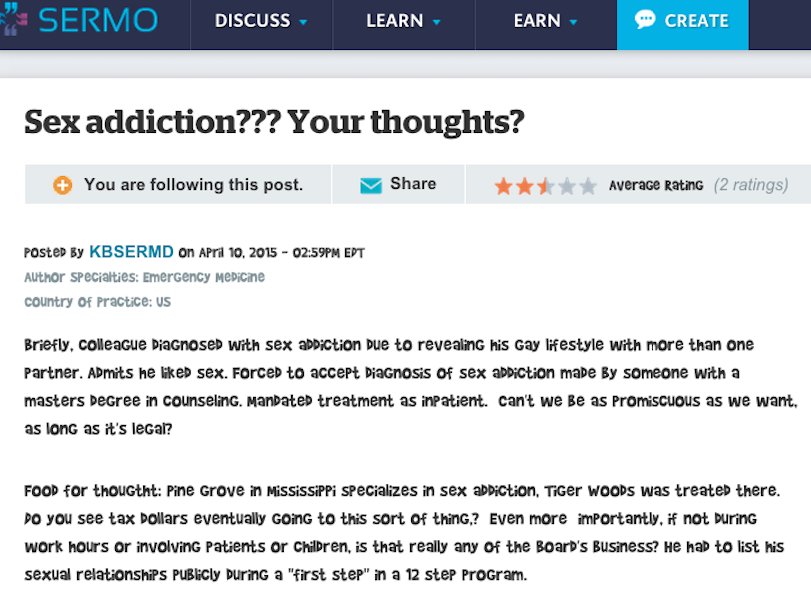
This anecdote concerning a gay doctor’s revelation he liked his non monogamous lifestyle leading to a forced acceptance of a “sex addiction” diagnosis, mandatory inpatient treatment and indoctrination into 12-step recovery was just posted on the physician social network SERMO. If the pattern looks familiar it is.
Physician Health Programs (PHPs) are non-profit NGOs that exist in every state ostensibly to help impaired doctors and protect the public from harm. PHPs have no regulation or oversight and have essentially removed all accountability. Under the ruse of protecting a doctors anonymity and providing confidentiality they have built barriers of opacity. Most doctors are unaware how they work unless they become involved with them and they are not on the radar of the public at large–they need to be.
Organized under the Federation of State Physician Health Programs, (FSPHP), state medical boards have abdicated their responsibility and consider them expert authority on all things related to physician health–a logical fallacy that has placed illegitimate and irrational authority in professional control of medicine once again proving that knowledge isn’t power and ignorance often reigns.
PHPs encourage confidential referrals for “warning signs” such as those on the list below from the Massachusetts PHP, PHS, Inc. and guarantee the reporters anonymity. All semblance of due process has been removed. Medical boards have given state PHPS complete and absolute managerial control over assessment, treatment and monitoring. PHPs are not healthcare providers but monitoring agencies. If a PHP recommends an “assessment” of a reported doctor there is no choice in the matter. No allowances for a second opinion, outside support or appeal exist.
This doctor was apparently reported to his state PHP because a patient thought she smelled alcohol on his breath. As it turned out, the accusation was bogus but by being honest and forthcoming about his sexual orientation in the interview the PHP mandated an “assessment.” for unrelated issues. A not uncommon scenario as reports of behavioral issues often end up with hair tests for alcohol and other substances resulting in mandated assessments for “substance use disorder” followed by a five-year monitoring contract with the PHP and weekly urine tests.
The PHP provides a list of three or four facilities drawn from the same pool of “PHP-approved” assessment and treatment centers. However, an audit of the N.C. PHP found no written objective criteria or quantitative measurements existed on how these assessment and treatment centers are “approved” by the PHP. The common denominator seems to be that these facilities are (1) 12-step ASAM directed, and (2) willing to “tailor” an assessment to support a predetermined diagnosis. It is, in fact, a rigged game. Unfortunately the medical boards have been duped into mandating assessments at these centers under threat of loss of medical license and specifically exclude non “PHP-approved” assessments.
This scaffold is also the unspoken and hushed major contributor to physician suicide—It is the elephant in the room no one speaks of out of fear of being targeted. Doctors who really need help for mental health, substance abuse or other issues are afraid to get it for fear of being reported to the PHP. Those already monitored are subject to all sorts of psychological, financial and emotional abuse.
The Federation of State Physician Health Programs (FSPHP) has a relationship with Pine Grove. It is one of the “PHP-approved” facilities and two of their staff, Phillip Hemphill, PhD and James C. “Jes” Montgomery, MD are are listed as Program Faculty at the FSPHP annual educational conference and business meeting on April 24-27, 2015 in Fort Worth Texas.

Political Abuse of Psychiatry
Political abuse of psychiatry is the “misuse of psychiatric diagnosis, detention and treatment for the purposes of obstructing the fundamental human rights of certain groups and individuals in a society. The coercive use of psychiatry represents a violation of basic human rights in all Cultures.
What has occurred in the medical profession is no different from China or the Soviet Union under totalitarian rule where dissent is disapproved, often punished, and those perceived as threats to the existing system can be effectively “neutralized with trumped up psychiatric illness” and by this stigmatization reputations were ruined, power was diminished, and voices were hushed.

Political abuse of psychiatry involves the deliberate action of diagnosing someone with a mental condition they do not have as a means of repression or control and if you do not believe it is occurring right here today then take a look here and here to see how they are colluding with commercial drug testing companies to engage in forensic fraud and the assessment and the treatment centers to fabricate data to support non-existent diagnoses.
“Sex Addiction” used as a tool to Discriminate
There has been a lot of “chatter” in PHP circles concerning “sex addiction” and I knew they had been aligning themselves and setting up specialized programs at certain facilities. It seemed unusual as many of the key players who erected and run this scaffold have themselves been involved in sexual misconduct. 
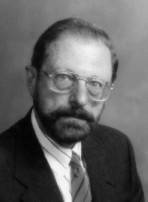
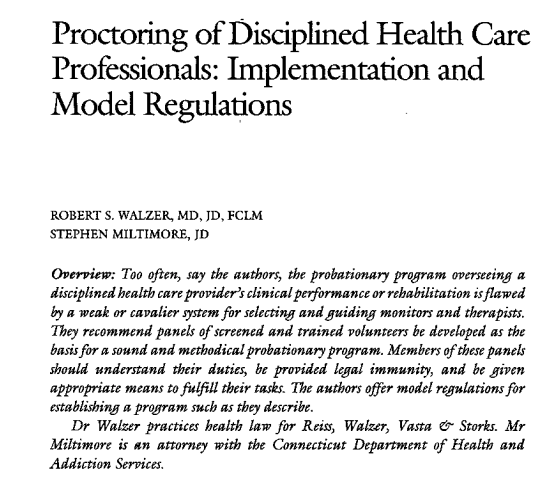
One of the architects of the current system, Dr. Robert Walzer, M.D., J.D. who was instrumental in tinkering with administrative and medical practice laws to remove the due process and appeal rights of doctors surrendered his license in 2001 due to inappropriate sexual relationships with patients. He was the co-author of the current physician health program paradigm.
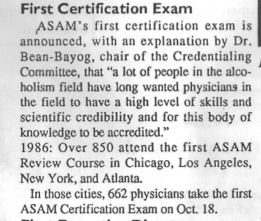
Dr. Margaret bean-Byog, M.D, Chairman of the credentialing  committee for the first certification exam and ASAM president surrendered her medical license after being accused of sexually abusing one of her patients, a Harvard medical student who subsequently died by suicide.
 And the FSPHP seems to treat doctors involved in sexually related misconduct in a favorable light. Take for instance, Dr. James Peak, M.D., a child psychiatrist who was sent to prison on a federal child pornography conviction taken under the wing of the Montana PHP. After “proving” he only ‘”looked” at pornography of young boys but never abused any using a polygraph “lie-detector” test his license was reinstated in no time at all. His treatment includes going to one AA meeting and one 12-step sex addict meeting per week. My guess is they need more staff at the PHP or one of the assessment centers.
I had been wondering what the motivation was behind this focus on “sex addiction” and my suspicions seem to be correct.
I have since heard of a second case of a gay doctor being forced into his state Physician Health Program (PHP) in Alabama.
Once under the control of the PHP most doctors are afraid to come forward because of the “swift and certain” consequences imposed on them. All they have to do is say the doctor was “noncompliant” to the medical board and it is over. They lose their license and there is not a thing they can do about. it. I have heard from doctors in multiple states going to law enforcement, the Attorney General, the media and the ACLU only to have the door slammed in their faces. Myself included. .
The coercion, control, ethics, and civil and human rights violations remain hidden. The crimes remain hidden. So too will this.
It appears the FSPHP is following the same pattern they have with the “impaired” and “disruptive” physicians–to discriminate. The targeting of gay, lesbian or transgender doctors for what they do in their private lives is predictable. It is an inevitable part of this well oiled slope of coercion, control, obedience and abuse.
The import of this can not be overestimated.
References:
Position Statement on Political Abuse of Psychiatry. Paper presented at: Global Initiative on Psychiatry2005.Birley JL.
Political abuse of psychiatry. Acta psychiatrica Scandinavica. Supplementum. 2000;399:13-15.



Firefighter Arson
In his book “Fire Lover: A True Story,” Joseph Wamnaugh profiles Fire Captain and Senior Arson Investigator for the Glendale California Fire Department John Orr. Known for his uncanny instincts in solving arson cases, Orr often astounded other investigators with his seemingly brilliant deductions in determining the causes of incendiary crime.
As it turns out, neither instinct nor brilliance played any role. Orr solved many of these cases by first-hand knowledge. He actually started many of the infernos he fought. Burning down businesses and homes for over a decade, investigators suspect Orr may have intentionally set as many as 2000 fires.
 John Orr
One involved a large Pasadena hardware store that killed four people including a 3-year old toddler and his grandmother. Orr is now serving a life-sentence at Lompoc Penitentiary. Details of his arsonist acts are described in chilling detail in his own book, “Points of Origin…playing with fire.”
The problem of arsonist firefighters…
View original post 5,057 more words


A draft document from the White House budget office, obtained by NPR, proposes nearly zeroing out funding for the Office of National Drug Control Policy, despite Trump campaign promises to tackle the opioid epidemic.
Office of National Drug Control Policy
In an all-staff email to employees in the Office of National Drug Control Policy, acting Director Richard Baum shared some news he described as “very discouraging for our Nation’s effort to address drug abuse.” A draft document from the White House budget office, obtained by NPR, proposes nearly zeroing out funding for the ONDCP and fully eliminating several programs involved in fighting the opioid crisis. Leaked documents indicate about a 94 percent overall cut.
“These drastic proposed cuts are frankly heartbreaking,” wrote Baum, whose position is also referred to as “drug czar.” His email explained that the document was “pre-decisional” and could change. He asked that the information not be shared outside of the agency. But it quickly leaked out, causing alarm in the tightknit addiction help community and among lawmakers.

The leaked document is what’s known in budget lingo as a “passback,” the proposal from the Office of Management and Budget for what should be included in the president’s budget. Agencies can appeal, and Baum wrote in his email that he and others have been trying.
“I want you to know that senior ONDCP staff have engaged, and continue to engage, with senior leadership in the White House Office of American Innovation and in OMB to address our agency’s budget concerns,” Baum wrote in the email to staffers. “These conversations are ongoing. We hope to turn this around.”
The document calls for reducing funding for ONDCP from $388 million in 2017 to $24 million in 2018, eliminating the High Intensity Drug Trafficking Areas grant program and the Drug-Free Communities Support Program. These are popular programs in states hit hard by the opioid crisis. The budget states these cuts would “reflect a smaller, more streamlined organization that can more effectively address drug control issues.”
Asked about the proposed cuts in Friday’s White House press briefing, Deputy Press Secretary Sarah Huckabee Sanders said, “When it comes to the opioid epidemic, I think the president’s been extremely clear this is a top priority for him. I certainly wouldn’t get ahead of conversations about the budget. We haven’t had a final document, and I think it would be ridiculous to comment on a draft version of something at this point.”

A White House spokesman wouldn’t say when a final budget document would be released.
A budget outline released earlier this year made no mention of ONDCP, but it called for a $500 million increase in spending on opioid treatment and recovery. The government funding bill signed by Trump on Friday also included a boost in funds to deal with the crisis.
The head of the Addiction Policy Forum said the administration “has taken several positive steps to support recovery and treatment efforts,” but that the cuts “would undermine the good already accomplished.”
“I would urge the Administration to reconsider these cuts, and continue to build a comprehensive plan to help Americans suffering with substance use disorders and their families,” the statement from President and CEO Jessica Nickel added.
President Trump made combating the epidemic of opioid-related overdose deaths a central theme of his campaign, delivering a speech in mid-October 2016 outlining a detailed policy prescription.
But since Trump took office, advocates and lawmakers have expressed concern over a lack of action. In March, Trump signed an executive order creating the President’s Commission on Combating Drug Addiction and the Opioid Crisis. The order directed the commission to present a report within 90 days. However, the president has not yet appointed anyone to serve on the commission (though New Jersey Gov. Chris Christie, who is supposed to chair it, has been holding meetings).
A White House spokesman, whom NPR has been asking about the commission, has responded for weeks with the same reply: “We don’t have any announcements at this time on that.”
Baum is the second acting drug czar in the Trump administration. Trump has yet to name his choice for director. For comparison, President Barack Obama’s first drug czar was confirmed by the Senate on May 7, 2009.
The ONDCP website, which was packed with information and resources during the Obama administration, was replaced when Trump took office with a message that says, “Check back soon for more information.” It hasn’t been updated since.

 Hope to see you there!
“To be sure, and to put this matter to rest for the Court once and for all, the Board has retrieved from off site storage those materials before the Board in December 2011. The documents that Dr. Langan claims were “suppressed” are in fact there—and this should not be surprising given the Board’s many orders since that time, all of which have disclaimed any reliance on the July 2011 PEth test.”
“Documents are typically entered into the electronic repository after being used or after a proceeding not before”
—Assistant Attorney General Bryan Bertram who is defending the Board of Registration in Medicine (“Board”) before Justice Hines in my case before the Massachusetts Supreme Judicial Court.
Related: MA Board Attorney Deb Stoller’s Fraud Upon the Court
See attached documents for a preview:








“To be sure, and to put this matter to rest for the Court once and for all, the Board has retrieved from off site storage those materials before the Board in December 2011. The documents that Dr. Langan claims were “suppressed” are in fact there—and this should not be surprising given the Board’s many orders since that time, all of which have disclaimed any reliance on the July 2011 PEth test.”
“Documents are typically entered into the electronic repository after being used or after a proceeding not before”
—Assistant Attorney General Bryan Bertram who is defending the Board of Registration in Medicine (“Board”) before Justice Hines in my case before the Massachusetts Supreme Judicial Court.
Related: MA Board Attorney Deb Stoller’s Fraud Upon the Court
See attached documents for a preview:
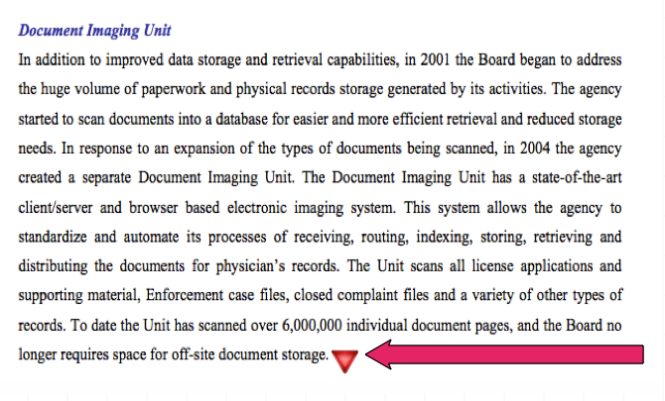 The excerpt above is taken from the 2006 Massachusetts Board of Registration in Medicine Annual Report and describes the Board’s Document Imaging Unit. The Document Imaging Unit scans agency documents into an electronic database and according to the Boards 2009 Annual Report has “allowed the agency to standardize and automate its processes for storing and retrieving documents.” The quotes above it are from Assistant AGO Bryan Bertram in response to recently acquired documents proving that Board attorney Deb Stoller was provided irrefutable, undeniable and unequivocal evidence of forensic-fraud between the Massachusetts PHP (Physician Health Inc.) and a drug testing lab but concealed it and has been concealing it for over five-years.
The appeal to an imaginary storage unit and cart-before-the horse logic are just two of many absurdly illogical and nonsensical statements that he has used to defend the indefensible.
On June 8, 2016 I requested a handful of documents from the Board of Registration in Medicine under a new Records Reform Act that had up until now been refused. 146 pages of docs were received within 24 hours and can be seen here: Langan PDF copy
Only one of the five documents had a legible date-stamp on it. The rest were blurred and indecipherable. Requests for clarification have been stifled with the last response from the Board on June 17th claiming they were “working on it. ” Multiple subsequent inquiries have been ignored. Verifying these dates should be simple and take a matter of minutes. Why all the fuss?
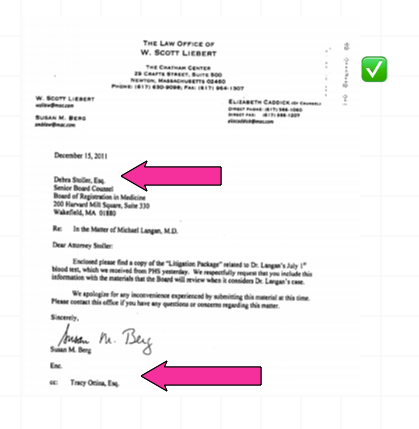
The only document with a legible date stamp was a December 15, 2011 letter from my attorney requesting an attached “litigation packet ” be considered at a December 21, 2011 Board proceeding. (I had requested the “litigation packet” as one of the documents but had never seen the letter). Needless to say it wasn’t.
.

Both the letter and the 47-page “litigation packet” are date-stamped January 17, 2012.
The letter is addressed to physician health and compliance unit (PHCU) Board counsel Deb Stoller and cc’d to her underling Tracy Ottina. The documents show clearly that the two were in possession of these documents prior to a December 21st Board hearing. They are date-stamped 27 days after the hearing and to support his claim that “documents are typically scanned into the electronic repository after being used or after a proceeding, not before” Bertram uses the transcript of the same proceedings as an example as the December 21 document is date stamped December 29 (8 days after the proceeding). Apples and oranges. Scanning a a transcript of a proceeding into the Board’s Digital Imaging Unit the following week is understandable but scanning a document that was submitted as evidence to be heard at that same proceeding 27-days after it took place and 18-days after the record of the proceeding was scanned is not. It is very fishy for a number of reasons and defies common sense.

But Bertram claims the date-stamp is meaningless and wants to put the matter to rest once and for all. In his response opposing a Motion to Produce Documents (he does not want to produce them) he provides 3 footnotes (presumably to give an impression of legitimacy) providing confirmation that the documents had been carefully considered at the December 21, 2011 proceedings by reviewing not only its minutes and records but procuring the original documents that were being stored off-site.

Bertram also claims PHS has not committed any crimes because they have not been charged with any crimes. This is called denying the antecedent or inverse error. It is a logical fallacy where the consequent is an indicative conditional claimed to be false because the antecedent is false. ( A, then B; not A, therefore not B).
The argument is invalid because there are other reasons for which the grass could be wet such as spaying it with a hose. There are multiple reasons for which someone who committed a crime has not been charged with a crime.
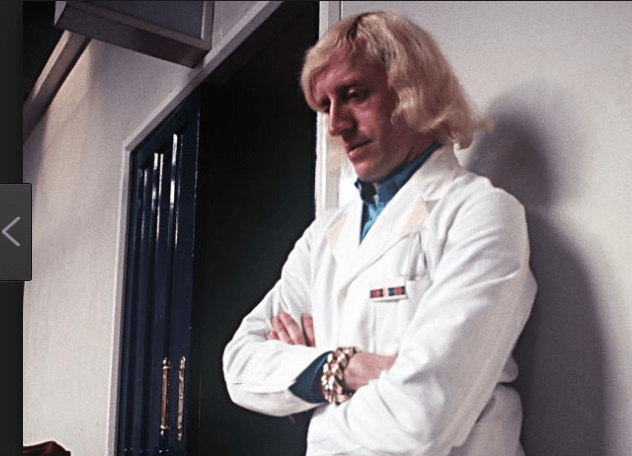
There is always a time-frame between the two and many who commit crimes never get caught. Luck, stealth, cleverness, and multiple other variables might be involved. Jimmy Savile molested and raped scores of children for decades and he was never caught. As a major fundraiser for hospitals this fiend had free rein to prey on sick and helpless little kids in hospital beds .

They have not been charged with any crimes because the very agencies capable of charging them with crimes are ignoring or otherwise overlooking them for various reasons. If I see someone being stabbed in the back I can reasonably conclude they committed a crime. Savile got away with what he did because of a culture of deference. Because he was powerful others made allowances for him. Monsters thrive in a culture of deference.
A Culture of Deference
According to Policy 94-002 (which has disappeared from the Board’s website) Board counsel for the Physician Health and Compliance Unit (PHCU) was created outside the Enforcement Division of the Massachusetts Board of Registration in Medicine (Board). PHCU advises the board on issues related to drug and alcohol abuse and mental or physical impairment that may affect a doctor’s ability to practice and unit staff prepare and present cases to the board’s complaint and licensing committees to make sure identified impaired physicians comply with the terms of any rehabilitation agreements. According to Policy 94-002 the responsibilities of PHCU Board counsel include “serving as a hearing officer in some cases and resource in all cases involving physician health and compliance issues.”
The Board appoints a “hearing officer” to conduct an adjudicatory proceeding according to the procedures set forth in the Massachusetts Administrative Procedures Act. Mass. Gen. L. ch. 30A. It is the hearing officers responsibility to make all decisions regarding the admission or exclusion of evidence. Administrative procedure requires that hearing officers consider the probative value of the evidence and file it in the Administrative Record.
Massachusetts Board of Registration in Medicine PHCU Board counsel is run by attorney Deb Stoller with attorneys Robert Harvey and Tracy Ottina. They have been given the power to act as “hearing-officers” on cases and present cases to the Board and recommend disciplinary action.
Medical Boards provide deference to their physician health experts and their in-house compliance counsel who have been given the power of judge, jury and executioners.
They give little thought or time to what is presented as predetermined fact. That the Board is not under any active supervision from the executive branch has been confirmed in writing to the Massachusetts Legislature by Governor Charles Baker in a letter accompanying his Bill (H.4188) which aimed to finally establish a framework for active supervision and oversight over the Board.
As independent units within the board who act as hearing officers and present cases the PHCU may be working with PHS in the same manner as the drug-testing labs engaging in laboratory fraud and the “PHP-approved” assessment and treatment centers that are “tailoring” diagnoses. It appears that Stoller and the PHCU is not representing the best interests of the Commonwealth but those of the state physician health programs and under current management state PHPs represent the best interests of the billion dollar drug and alcohol assessment, testing and treatment industry. The PHCU’s are clearly part of the racket. It is a rigged game with a stacked deck existing within a culture of deference.
Obtaining the evidence is one barrier that has prevented exposure of this corruption. Another is the unwillingness of agencies available to hold them accountable. PHS has no oversight or accountability and the labs and assessment and treatment centers have minimal oversight. As these are non-FDA approved lab tests the FDA provides no oversight. They have pushed public policy recommending regulatory agencies provide deference to their authority and expertise.
This creates an organizational systems failure as the Board is deferring to the state physician health program and the states attorney Generals are deferring to the Board. Each complacent in the integrity and good-faith of the agency before it. This creates a complete organizational systems failure.
Governor Baker’s recent move to control professional boards seemed a promising step and I provided detailed documentation to the Director of Constituent Services at the Office of the Commissioner for Public Health, Helen Rush-Lloyd ( Helen.Rush-Lloyd@state.ma.us 617-624-5223 ) who informed me on June 7 she would provide the name of the appropriate contact person to respond. The email can be seen here: Physician Health and Compliance Unit. Last I heard it was turfed to attorneys at the Board by whoever the appropriate contact person was and I have not been able to get a name. As this too appears to be a dead-end it is important to find out who is responsible. This is a system in which they often place their own people into positions where they can block, punt, deflect, dismiss and otherwise derail valid complaints. For example they have a “point-person”on the Massachusetts Medical Society ethics committee who blocks valid complaints from ever reaching review. They are turfed at the door and I would not be surprised if they placed one of their own or one of their apologists into this venue as well and this requires the provision of a name to see who is responsible and who should be held accountable.
The totality of evidence provides clear and convincing proof that PHCU Board counsel Deb Stoller has been suppressing evidence for years. The filed Administrative Record was missing every item I submitted including a critical document he claims was lost due to my “hand-delivery” of it. I still cannot wrap my head around the connection between hand-delivery and losing it. I believe he’s so entrenched in his pervasive denial of facts and outside opinion and so used to shifting the burden and blaming me he couldn’t think of anything else.
One thing is for certain. The Board does not want to produce the records to Justice Hines. I realized this after I filed the “Motion to Expand the Record” as Bertram made it clear on multiple occasions the Board would not object to anything I filed with the Court to add to it. Had I not known about the 10-day time limit to file the a motion to expand the record the Court would be limited the documents provided and none of mine were included. This is another administrative law trick frequently used to control the information that is seen. If the December 2011 documents were considered then I would like to hear the logic. The documents in question show black letter law crimes. They show specific crimes. Any schoolchild could detect them. The documents show flagrant forensic fraud between Dr. Luis Sanchez and the VP of Lab Operations at USDTL Joseph Jones and this is representative of the top-down corruption and unethical tone at the top that pervades this system.
None of the forensic fraud or perjury or concealment has ever been addressed by the Board and missing evidence and unaddressed key arguments provide clear and convincing proof that Stoller has been concealing evidence for years.

Dr. Luis T. Sanchez, M.D. served as the Director of the Massachusetts physician health program, Physician Health Services (PHS) from 1998 until 2013. He is past President (2005-2009) of their national organization, the Federation of State Physician Health Programs (FSPHP).
In Disruptive Behaviors Among Physicians stresses the importance of of “clear expectations and standards” and values and codes-of-conduct in the practice of medicine and calls on physician leaders “commit to professional behavior.”
One measure of integrity is truthfulness to words and deeds. These people claim professionalism, ethics and integrity. Colluding with a laboratory to intentionally misrepresent laboratory data is laboratory fraud and covered under Title 18 of the United States Criminal Code (Wire fraud 18 USC 1343, False Statements 18 USC 1001, Conspiracy 18-USC 371, False Claims 18-USC 287 and Obstruction of Justice 18-USC 1505). I believe all of these are applicable here. In addition Dr. Sanchez violated M.G.L 156 (B) Section 69 by making false statements to a state agency. Later documents show clear evidence of his perjury and concealment. August 6, 2014 to Langan with health materials.
The fact that medical boards and public health departments are aware of criminal acts being committed by this “authority” and others like him yet do nothing to address its existence will inevitably lead to worse. A culture of deference allows this type of behavior to fester and thrive for years and even decades. If dictatorships can be defined as systems in which there is a prevalence of thinking in destructive rather than ameliorative terms then the the physician health movement fits.
Many of the “PHP-approved attorneys” who ostensibly represent doctors who are under PHP monitoring but only do so within the boundaries of the PHPs wishes are former board attorneys and assistant AGOs. My suspicion is that the PHPs have preferred attorneys they use within the AGOs administrative legal division and the agency at large is unaware of what happens within this system.
Lord Acton warned that we should not make moral allowances for powerful people just because they are powerful. If a common man murdered someone, Acton explained, he should hang. But when a king or queen murders, we make allowances for it. “I would hang them higher than Haman, for reasons of quite obvious justice, still more, still higher, for the sake of historical science” Acton wrote. The same dynamic applies here.
One thing is for certain. There should be zero-tolerance for forensic fraud perpetrated by those in positions of power. This is worse than Annie Dookhan as her victims were abstractions. She did not see the damage that resulted from her laboratory misconduct.
And as far as I can find, these documents are the most elaborate and complete representation of the mechanics of forensic fraud available and show the sequential steps between the requesting party and complicit lab. The documents also show how easy laboratory misconduct is accomplished as well as the moral detachment of the involved parties.
Bertram knows these are crimes.
I have also informed him that since 2011 there have been multiple suicides related to allegedly falsified alcohol tests at the same lab seen here and the ongoing concealment of laboratory fraud is equally abhorrent as those who engage in it. I am unclear of his motive in defending a cover-up of forensic fraud in the wake of other lab scandals but one other thing is for certain. When this racket is exposed the record will show who knew about it and when.


The 146 pages provided within 24 hours is the package containing the December 11, 2011 docs and all the others with smudged dates. I already have the documents but I need the dates.

Bertram 11:16:15 e-mail requesting he address the issues
Bertram e-mail 11:16:15 requesting he address key arguments.


Please donate–Making significant gains.

Fraud Upon the Court
“Fraud Upon the court” occurs when the judicial machinery itself has been tainted, such as when an attorney, who is an officer of the court, is involved in the perpetration of a fraud or makes material misrepresentations to the court. Fraud upon the court makes void the orders and judgments of that court.
Bulloch v. United States, 763 F.2d 1115, 1121 (10th Cir. 1985 states: “Fraud upon the court is fraud which is directed to the judicial machinery itself and is not fraud between the parties or fraudulent documents, false statements or perjury. … It is where the court or a member is corrupted or influenced or influence is attempted or where the judge has not performed his judicial function — thus where the impartial functions of the court have been directly corrupted.”
It has recently become evident that the Director of the Board of Registration in Medicine’s Physician Health and Compliance Unit, attorney Deb Stoller, has been unethically and unlawfully withholding and concealing documentary evidence that is not only exculpatory to me but reveals that Physician Health Services (PHS) engaged in misconduct and fraud. She has essentially been concealing their crimes.
The “Administrative Record” filed by the Board was absent copious documentation of major importance and all of it was submitted through the care of Ms. Stoller. The missing documents include multiple petitions and supporting documents that are neither irrelevant nor superfluous. Each of these documents contains sufficient indicia of reliability to meet probative value.Concealing material fact, misrepresentation and making false statements to a state administrative agency is unethical. It constitutes abuse of power and fraud.
Fraud on the court occurs where a party tampers with the fair administration of justice by deceiving “the institutions set up to protect and safeguard the public” or otherwise abusing or undermining the integrity of the judicial process. Hazel-Atlas Glass Co. v. Hartford-Empire Co., 322 U.S. 238, 246 (1944).
The United States Court of Appeals for the First Circuit skillfully defined the concept of fraud on the court in Aoude, supra at 1118, as follows: “A `fraud on the court’ occurs where it can be demonstrated, clearly and convincingly, that a party has sentiently set in motion some unconscionable scheme calculated to interfere with the judicial system’s ability impartially to adjudicate a matter by improperly influencing the trier or unfairly hampering the presentation of the opposing party’s claim or defense.”
Ms. Stoller is in violation of the Rules of Professional Conduct including Mass.R.Prof.C. 3.4(c). Fairness to Opposing Party and Counsel which states in part: A lawyer shall not: (c) knowingly disobey an obligation under the rules of a tribunal except for an open refusal based on an assertion that no valid obligation exists.
Mass.R.Prof.C Advocate Rule 3.3 Candor Toward The Tribunal reads:
(a)A lawyer shall not knowingly:
(1) make a false statement of fact or law to a tribunal or fail to correct a false statement of material fact or law previously made to the tribunal by the lawyer; (3) offer evidence that the lawyer knows to be false. If a lawyer, the lawyer’s client, or a witness called by the lawyer, has offered material evidence and the lawyer comes to know of its falsity, the lawyer shall take reasonable remedial measures, including, if necessary, disclosure to the tribunal. A lawyer may refuse to offer evidence, other than the testimony of a defendant in a criminal matter, that the lawyer reasonably believes is false; (b) A lawyer who represents a client in an adjudicative proceeding and who knows that a person intends to engage, is engaging or has engaged in criminal or fraudulent conduct related to the proceeding shall take reasonable remedial measures, including, if necessary, disclosure to the tribunal,; (c) The duties stated in paragraphs (a) and (b) continue to the conclusion of the proceeding, and apply even if compliance requires disclosure of information otherwise protected by Rule 1.6.
And under Mass.R.Prof.C. 8.4(c, d, h. It is professional misconduct for a lawyer to: (c) engage in conduct involving dishonesty, fraud, deceit, or misrepresentation; (d) engage in conduct that is prejudicial to the administration of justice; (h) engage in any other conduct that adversely reflects on his or her fitness to practice law.
The Supreme Judicial Court (SJC) reviews the Board’s decisions in part for constitutional error, see Mass.Gen.L. ch. 30A, Sec. 14(7), and is permitted to gather evidence “in cases of alleged irregularities in procedure before the agency [when those irregularities are] not shown in the record.” Mass.Gen.L. ch. 30A, Sec. 14(5). The Court may look beyond the record if it appears the agency deliberately or negligently excluded documents that may have been adverse to its decision.
On a writ of certiorari, the court’s review “is confined to the record and is for the purpose of correcting legal error, [and therefore] the inquiry about the presence or absence of genuine issues of material fact, germane to summary judgment procedure, is inappropriate. . . . [The reviewing court] need only inquire whether the commission’s decision was ‘legally tenable and supported by substantial evidence on the record as a whole.”‘ Gloucester v. Civil Serv. Comm’n, 408 Mass. 292 , 297 (1990), quoting Commissioner of Health & Hosps. of Boston v. Civil Serv. Comm’n, 23 Mass. App. Ct. 410 , 411 (1987). See G.L.c. 31, s. 2 (b); Mayor of Revere, supra at 319-322.
Fraud is distinguished from negligence, ignorance, and error by virtue of the fact that it is intentional; involving some level of calculation. Negligence is: “the failure to use such care as a reasonably prudent and careful person would use under similar circumstances.” In a professional context, it is defined as: “conduct which falls below the standard established by law for the protection of others against unreasonable risk of harm… it is characterized chiefly by inadvertence, thoughtlessness, inattention, and the like.”. Fraud, in contrast, is not accidental in nature, nor is it unplanned. Those who commit fraud know what they are doing and are deliberate in their efforts. They are also aware that it is unethical, illegal, or otherwise improper.
Fraudulent intent is established by examining the documentation of decisions and behaviors associated with those under suspicion. As explained in Coenen: “Manipulation of documents and evidence is often indicative of such intent. Innocent parties don’t normally alter documents and conceal or destroy evidence.”
As explained in Black’s Law Dictionary, fraud is an intentional distortion of facts and truth for the purposes of inducing another to give up something of value that they possess or to relinquish a legal right that they might otherwise retain. It is additionally defined as a “false presentation of a matter of fact whether by words or by conduct, by false or misleading allegations or by concealment of that which should have been disclosed which deceives and is intended to deceive another.”
I believe it is safe to conclude that the parties here participated in fraud.
The “litigation-packet” did not merely show “chain-of-custody” issues but forensic fraud. Misrepresenting invalid forensic test results as valid is the definition of forensic fraud. Ms. Stoller should have immediately assessed the “clear-weight” of this evidence, entered it into the docket for reconsideration and given me an opportunity to be heard. She did not.
The Federation of State Medical Board Policy specifically requires strict “chain of custody.” She violated the Board’s very own standards and then blocked me from returning to practice by putting barriers in place, refusing to allow independent evaluations and protracting the time –drawing this out in order to cause as much damage as possible to my family and me.
PHS has convinced the Board not to “second-guess” their decisions and apparently the Board has convinced state AGOs to not “second-guess” theirs; each presupposing the integrity of the individuals and validity of the decisions of the agencies in question. As a result complaints by doctors of serious crimes and abuse are ignored. Fact and truth do not matter as the agencies blindly support one-another. This removes all aspects of accountability including answerability and justification for one’s actions. It is a flawed system.
In the past the SJC has overturned the Board’s decisions on due process grounds, see, e.g., Morris v. Board of Reg. in Medicine, 405 Mass. 103, 110, 539 N.E.2d 50, 54 (1989) (vacating Board decision because proceedings “denied [the physician] fairness in a due process sense.”).
This interference with the administration of Justice, abuse of authority and denial of constitutional rights warrant the Board Orders be reversed, vacated and corrected. “The touchstone of due process is protection of the individual against arbitrary action of government.” (Wolff v. McDonnell, 418 U.S. 539, 558 (1974). “[i]n a just society those who govern, as well as those who are governed, must obey the law.” (United States v. Leon, 104 S. Ct. 3430, 3457 (1984) (Stevens, J., dissenting).
The Courts have held that the Massachusetts and Federal Administrative Procedure Acts require both the agency and the court to consider the entire record, including testimony given at the hearing. In Friends of Edgartown Great Pond v. DEP, 446 Mass. 830, 845 (2006), the SJC recognized that the agency must consider the hearing evidence, finding the agency hearing complied with the Administrative Procedure Act requirements because “the record illustrates that over the course of the five-day hearing, the administrative law judge carefully considered all of the relevant evidence.”
The record compiled here illustrates that over the course of four years the Board not only failed to carefully consider any of the relevant evidence but most likely never saw any of it.
Our Constitution mandates that level of legal process due to reflect “respect enforced by law for that feeling of just treatment which has been evolved through centuries of Anglo-American constitutional history and civilization.” Joint Anti-Fascist Refugee Comm. v. McGrath, 341 U.S. 123, 162, 71 S.Ct. 624, 95 L.Ed. 817 (1951) (Frankfurter, J., concurring)
Ms. Stoller violated multiple professional regulations, ethics and the law in an ongoing campaign in which she blocked the administration of justice. By concealing the truth she prevented both exculpatory evidence favorable to my case and detrimental to the opposing party (involving misconduct and crimes from ever coming to light. It is quite clear the full Board never saw these documents. The fact that the latest Board action did not have any of the documents or petitions submitted over the past year is prima facie evidence of Fraud on the Court. Ms. Stoller needs to be held accountable and I am requesting the SJC uses whatever power it has available to make certain this occurs. Ms. Stoller needs to be disciplined for her actions and this discipline needs to be commensurate with her crime. In this case nothing less then disbarment and criminal charges would fit that bill.


Below images link to podcast.


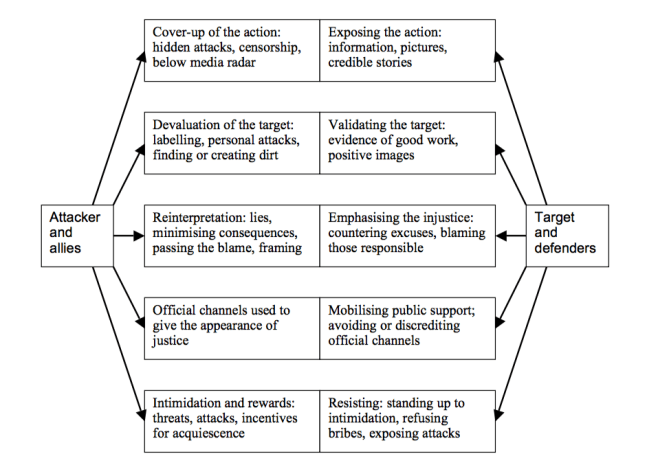 1. Supression of Dissent: Basic Information
2. The keys to backfire
• “Reveal: expose the injustice, challenge cover-up
• Redeem: validate the target, challenge devaluation
• Reframe: emphasize the injustice, counter reinterpretation
• Redirect: mobilize support, be wary of official channels• Resist: stand up to intimidation and bribery”
via Helpful resources for those abused and afraid — via www.bmartin.cc .



 Disrupted Physician