Misprision of a Felony-Need to Expose Corruption and Fraud in Health Care Systems

img_1154

The scope and severity of the crimes seen below is tremendous.  Equally abhorrent are those who know about what they are doing but look the other way.  The evidence seen here is clear and unequivocal. It also took a lot of work to get it and the fact that the Physician Health and Compliance Unit run by Board attorney Deb Stoller are given the power to act as hearing officers and present cases to the Board is mind boggling.

This is top down corruption.  Sanchez is former President of the FSPHP and Jones is VP of Lab Operations at USDT.   The tone at the top is unethical and these documents show how easy it is to fabricate a positive toxicology test on someone without hesitation or any apparent compunction.  That is frightening and sociopathic.  Additionally there are  increasing reports of physician suicides related to allegedly fabricated tests just like this one and at this very lab and as long as the tests are putting coins in his purse I doubt he gives two shits.  This corruption needs to be  addressed head on. It is only going to get worse and fester.  Sunshine is the best disinfectant and these groups have plans to  expand in scope to other segments of the population.


Argument by assertion is when someone tries to argue a point by merely asserting that it is true, regardless of contradiction.   It is a logical fallacy that has the following structure:

  1. X is true

An assertion itself is not proof of anything. It isn’t even a real or proper argument.  AAG Bryan Bertram has been defending the Massachusetts Board of Registration in Medicine (Board)  before the Supreme Judicial Court (SJC).  He has dug his heels into the ground in support of Deb Stoller and the Physician Health and Compliance Unit but all he has left is logical fallacies and lies.  In response to a Motion for Summary Judgment he simply replied he was not going to respond to any more motions. His dismissiveness of our precise and persuasive arguments is not appropriate as what we have presented is detailed below. He has acknowledged none of it.    For about a year he simply tried to make a round peg fit in a square hole by imposing administrative law technicalities on my complaint.  No matter what was presented he would simply change it to his script and deliberately avoid key facts. His logical fallacy took on the following structure where X = carefully considered, X= findings of fact, X=untimely challenged, X= stay of suspension,  X= quasi-judicial, etc. etc.

X is true. No really, X is true. , X is true  But X is true,

When justice Hines requested we come to an agreement it is interesting that he did not go beyond he Physician Health and Compliance Unit (PHCU) which is independent of the Board.  They are also given the power to act as their own hearing officers which explains how Stoller was able to conceal all of the evidence of fraud and corruption for so long.  Under Board Policy 94-002 Stoller and her associates simply intercept evidence and either toss it or enter it into the Digital Imaging Unit after the hearing.  Bertram claims entering evidence into the DIU after hearings is standard operating procedure but this is more wishful thinking.   Evidence is entered into the DIU prior to hearings so that Board members can see the documents on their home computers and laptops prior to the hearings.  Dr. Patricia Recupero’s report clearing me in 2013 and implicating PHS in misconduct was entered after the hearing at which it was supposed to be heard. Are we to believe they all thumbed through an 87-page report during the hearing?   A myriad of serious crimes is seen below.  Either disprove my assertion or do something about it.  This is a serious threat to the health and public welfare and the evidence is not going away and neither am I.


Bertram asserts the following:

  1. Physician Health Services (PHS) has not committed any crimes (because they have not been charged with any crimes)


I assert the following:

  1.  Former Medical Director Luis Sanchez has committed  multiple crimes including multiple felonies.  These involve fraud, falsely created evidence, conspiracy to commit fraud, false statements, perjury as well as conspiracy against rights and color of law abuse.  

  2. Physician Health and Compliance Unit Board counsel Deb Stoller has committed multiple crimes, including felonies and conspiracy against rights, concealment of a felony and others.


screen-shot-2016-09-11-at-11-29-03-am

Summary:

1.  Medical  Director of Physician Health Services (PHS) Dr. Luis Sanchez reports positive toxicology test to Medical Board July 2011.   Results in Requirements placed on medical license by Physician Health and Compliance Unit (PHCUU) Board counsel Deb Stoller (   December 22, 2011  Board Order)

2.  Sanchez reports non-compliance with the requirements imposed on license in October 2012  and  license suspended by Deb Stoller o ( February 6, 2013 Board Order)


  Timeline

 July 1, 2011–PHS requests blood sample at Quest Diagnostics lab.  Told it is for alcohol biomarker.   (No indication, no precipitating events or reason given. No history of alcohol related problems. No DWI.  no issues at work or home.   15 years at Massachusetts General Hospital. No malpractice.  Work performance, patient-care consistently rated as superlative.  Had filed patent-license agreement two weeks prior to bring epinephrine auto-injector device to FDA approval within 3-years).  Concerned about “set-up” and have two independent complete examinations.  I request I be tested in every way possible for alcohol (physical exam, labs (GGT/AST, CDT, ALT, AST, MCV, etc.)

July 19, 2011–Notified by Sanchez that the blood test was positive for alcohol biomarker and he requests an evaluation at an out-of-state “approved” assessment center. Sanchez provides written documentation that the July 1, 2011 blood test was positive on  July 28, 2011.   Provide him with the two independent evaluations both with no concern.  Have evaluation at Hazelden –assessment finds no past or present history of alcohol abuse)

I request the  “litigation packet” from PHS.- legal document generated on  all forensic drug tests that documents chain-of-custody.  ( USDTL Litigation Packet fee Schedule ). PHS initially refused.

The full “litigation packet” is dated December 3, 2011 and was provided to me by Sanchez with a letter dated December 11, 2011.


Full litigation packet can be seen here:   USDTL -Litigation Packet obtained 12/3/2011

Documents show  July 1,2011 blood test was  both invalid and falsely created.   No documents from the collecting lab (Quest)= No chain-of-custody = invalid test.

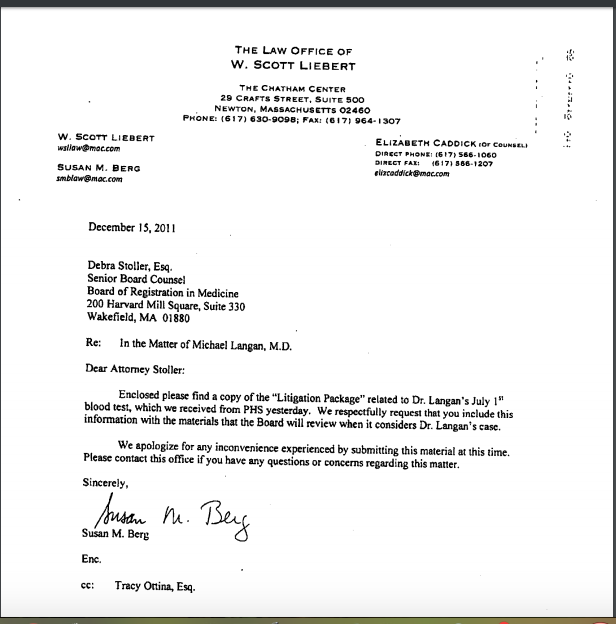
Documents sent to PHCU Board counsel Deb Stoller and copied to PHCU Board counsel Tracy Ottina with attached  letter dated December 15, 2011  from my attorney specifically requesting the litigation packet documents be heard at the December 21, 2011 board hearing to decide on sanctions.

NOTE:  Litigation packet is exculpatory.   Test both invalid and fraudulently created. Matter should have been dropped right then and closed the case.
Screen Shot 2014-11-04 at 10.47.41 PM


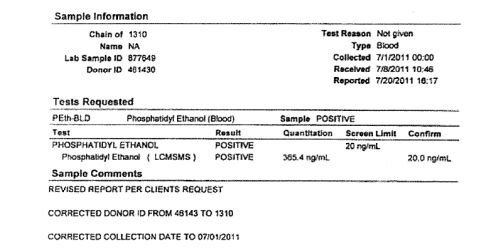
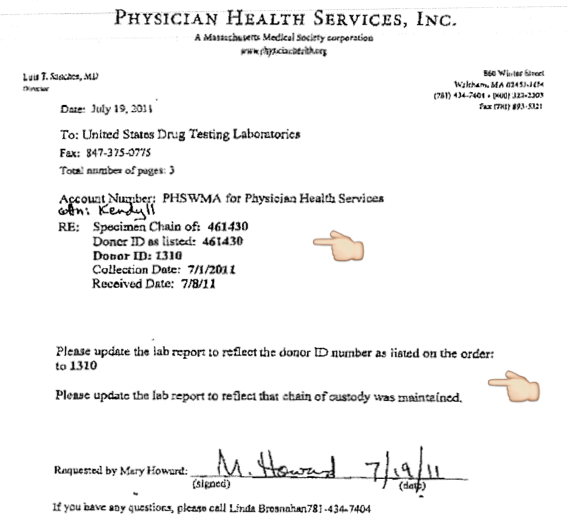
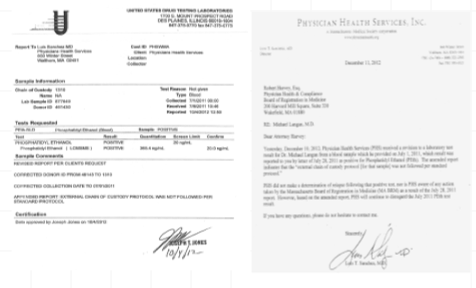
Documents include a faxed request from PHS to USDTL drug testing labs that requested an attached lab report (that was positive for the alcohol biomarker) be “updated” to reflect chain-of-custody was maintained and that the donor ID Number be changed to #1310.  The records also included the lab report that resulted from the fax from PHS to the lab which noted: “revised” (per clients request) and donor ID and collection date “corrected”
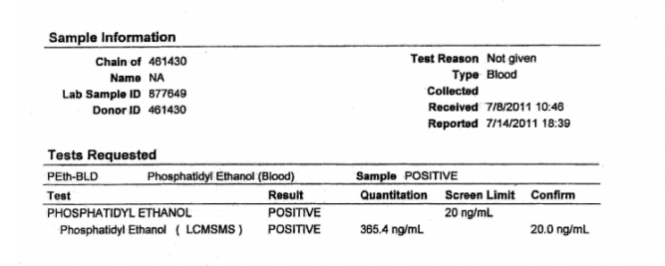
Screen Shot 2016-05-02 at 8.00.01 PM.pngChanges include:

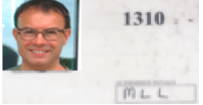
(1) Donor ID # 461430 changed to #1310 ( My ID # )  

(2) A Blank collection date is filled in with  July 1, 2011.

(3) Reporting date of July 14, 2011 is changed to July 20, 2011.   

The positive test result is reported  unchanged  with a level of 365.4 


BEFORE
screen-shot-2016-05-02-at-8-01-41-pm


AFTER


screen-shot-2016-05-02-at-8-05-56-pm


screen-shot-2016-09-11-at-11-34-37-am

This is no mistake. It bears repeating that July 19, 2011 is the date Sanchez reported the positive test.

It is a deliberate and intentional act.   #1310 is my unique identifier (just as my name is). Chain-of-custody is absent. It cannot be “updated” and the collusion between PHS and the lab is clear. 

Sanchez reported result to board with full knowledge the test was false in violation of M.G.L. 156 (B) Section 69  (false statements) and also a felony ( false statements under penalty of perjury)  General Laws of Massachusetts – Chapter 268 Crimes Against Public Justice – Section 13E Tampering with record, document or other object for use in an official proceeding ( c. 268 s. 13E(b))

18 USC-1343 (wire fraud), 18-USC-1001 (false statements) and 18-USC-371 (conspiracy to defraud). He has additionally broken the  General Laws of Massachusetts including Chapter 268 (Crimes Against Public Justice) and laws that specifically prohibit false material statements or the omission or concealment of “a material fact in a written statement.” M.G.L. 156 (B) Section 69

STOLLER COMPLICIT 

The December 21, 2011 Board hearing resulted in  Board Order dated December 22, 2011  and lists multiple requirements demanded on medical license.  These include  cessation of hand sanitizers;  discontinuation of asthma inhalers that were controlling severe asthma for over ten-years. ( multiple ER visits, hospitalizations as child/teenager including near fatal respiratory arrest) ;  that  I obtain an AA sponsor,  attend three 12-step meetings per week and provide  proof of attendance (PHS required I provide them with names and phone numbers of supposedly anonymous attendees who they could call) ; and that I do whatever they say promptly and any attempt to negotiate or dispute > immediate license suspension.  I am also warned that if I do not agree with the proposal I will face disciplinary action at the next board hearing.  This is signed by Deb Stoller.

Under the  new public records law signed by Governor Baker I requested  that the Board provide records they previously refused to provide including the “litigation packet” The documents sent by the Board on June 8, 2016 can be seen here.

Langan PDF copy

Only one of the five documents had a legible date-stamp on it.   The rest were blurred and indecipherable. Requests for clarification have been stifled with the last response from the Board on  June 17th claiming they were “working on it. ”  Multiple subsequent inquiries have been ignored by both Bertram and the Board..

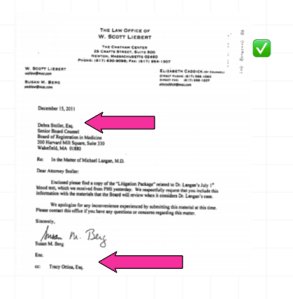
The only document with a legible date stamp was a December 15, 2011 letter  from my attorney  requesting  an attached “litigation packet ” be considered at a December 21, 2011 Board proceeding.  (I had requested the “litigation packet” as one of the documents but had never seen the letter).
Screen Shot 2016-08-08 at 7.29.02 PM

Screen Shot 2016-08-08 at 7.23.35 PM

Both the letter and the 47-page “litigation packet” are date-stamped   January 17, 2012.

The letter is addressed to physician health and compliance unit (PHCU) Board counsel Deb Stoller and cc’d to her underling Tracy Ottina.  The documents show clearly that the two were in possession of these documents  prior to a December 21st Board hearing.  They are date-stamped 27 days after the hearing and to support his claim that    “documents are typically scanned into the electronic repository after being used or after a proceeding, not before”


Both the letter and the 47-page “litigation packet” are date-stamped January 17, 2012.

The letter is addressed to physician health and compliance unit (PHCU) Board counsel Deb Stoller and cc’d to her underling Tracy Ottina. (both PHCU board counsel). The documents show clearly that both were in possession of the docs before the December 21st Board hearing. They are date-stamped 27 days after the hearing. Bertram claims they obtained new documents from off-site storage which does not exist.

Conclusion–documentary evidence that blood test was invalid  (with no chain of custody) and falsely-created (intentional) are provided to PHCU Board counsel Deb Stoller prior to December 21, 2011 Board hearing.

The invalidity and fraudulence should have immediately closed the case.  Instead Stoller sanctioned me at the hearing and made restrictions and demands on my license.   Documents obtained under new  Records Reform Act in August 2016.  

Date-stamps are not before the hearing but after suggesting they were withheld by Stoller.  

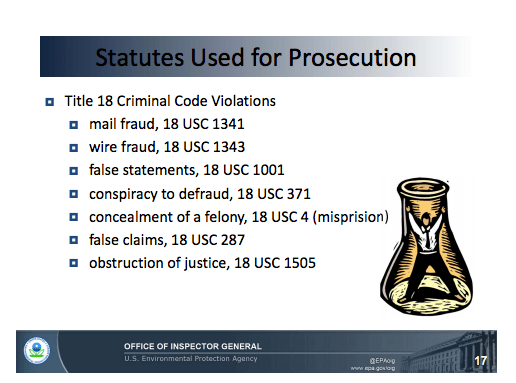
She is in violation of multiple Title 18 Criminal Codes including 18 USC-4 (concealment of a felony) and 18 USC-1505 (obstruction of justice).


False Statements in Procurement-State Violations

General Laws of Massachusetts – Chapter 268 Crimes Against Public Justice – Section 1A Statements containing declaration relative to penalties of perjury; verification; false statements.   The General Laws of Massachusetts specifically prohibit false material statements or the omission or concealment of “a material fact in a written statement.” M.G.L. 156 (B) Section 69  (false statements) and also a felony (false statements under penalty of perjury c. 268 s. 13E(b)(i).

268 s. 6 STATE AGENCY, FALSE STATEMENT TO
screen-shot-2016-09-09-at-9-08-56-pmscreen-shot-2016-09-09-at-9-09-10-pm


CONSTITUTIONAL  AND OTHER CIVIL RIGHTS VIOLATIONS

This  falsely-created test  resulted in restrictions on my medical license and impacted other constitutionally protected rights and I was forced to attend 3 12-step meetings per week and obtain names and phone numbers of fellow attendees (even though I am not an alcoholic–this was simply done to induce emotional distress)  I had 19 severe asthma attacks that year and had to stop going to the gym.  Multiple other issues are well documented and the Board’s very own recommended and approved evaluator Dr. Patricia Recupero wrote an 87-page report clearing me completely and implicating PHS in misconduct and the Certified Administrative Record contained the Recupero report and it was dated after the hearing at which it was supposedly heard.

Stoller has been suppressing evidence of serious crimes for over 5-years including national forensic fraud.

Conspiracy Against Rights:     Section 241 of Title 18 is the civil rights conspiracy statute. Federal law makes it a felony “for two or more persons to agree together to injure, threaten, or intimidate a person in any state, territory or district in the free exercise or enjoyment of any right or privilege secured to him/her by the Constitution or the laws of the Unites States, (or because of his/her having exercised the same). Unlike most conspiracy statutes, Section 241 does not require that one of the conspirators commit an overt act prior to the conspiracy becoming a crime.  The offense is punishable by a range of imprisonment up to a life term or the death penalty, depending upon the circumstances of the crime, and the resulting injury, if any.

Title 18, U.S.C. Section 242 deprivation of rights under color of law makes it a crime for any person acting under color of law, statute, ordinance, regulation, or custom to willfully deprive or cause to be deprived from any person those rights, privileges, or immunities secured or protected by the Constitution and laws of the U.S.   

Stoller is also in violation of Section 241 of Title 18 (the civil rights conspiracy statute) and Title 18, U.S.C. Section 242 (deprivation of rights under color of law).

The misconduct seen in the “litigation packet”has never been acknowledged by the Board. (or AAG Bertram).  I have long suspected that Stoller had been concealing  evidence of fraud, perjury or misconduct involving PHS.   The records that were sent contained only one document with a readable date-stamp was the “litigation packet” which was dated after the December 21, 2011 Board hearing.

CONCEALMENT AND FRAUD BY OMISSION

I had filed a complaint with the College of American Pathologists against USDTL drug testing lab (As the tests used by state PHPs are non-FDA approved laboratory -developed tests (LDTs) the only oversight that exists is CAP which is an accreditation agency not disciplinary.  They can force a lab to correct a test but do not have the ability to punish). I was informed they would be investigating  January 12, 2012.  ( CAPLetter)

In October 2012 I was told by PHS that they were going to report me for non-compliance with the meetings.  On October 19, 2012 Sanchez made a verbal report to the Board  of non-compliance.  On October 23, 2012 Sanchez provides the Board with written confirmation 10:23:12 PHS Letter to BORM-noncompliance.  This report of non-compliance results in the February 6, 2013 suspension.

In December 2013 I was  contacted by the Chief Investigator for CAP, Amy Daniels, who wants to know how things are going since the test was corrected on October 4, 2012.    I tell her I did not know anything about it and confront Sanchez who claimed to know nothing about a revision of the test.  Sanchez then wrote a letter stating that PHS “had just found out” about the amended test. The documentary evidence shows that he was made aware of the “corrected” test 67-days prior to his admission of it.

The full documents received from USDTL under HIPAA-Privacy Rule can be seen Complete USDTL Records Obtained 8/16/2014

Opinion Letter of Director of MGH Chemistry and Toxicology Laboratories Dr. James Flood
screen-shot-2016-09-09-at-7-48-17-pm

The contradictory documents from Sanchez alone constitute a crime (withholding information in concealment and providing false information to a state agency).  But what he did is far far worse.

In response to a  complaint I filed against the labs they revealed that the blood test was intentionally changed from a “forensic” specimen to a “clinical” specimen at the request of PHS and that makes it “Protected Health Information” (PHI) under the HIPAA Privacy-Rule and with the help of the College of American Pathologists I requested the records from both labs and received them.

(false statements) and also a felony (false statements under penalty of perjury c. 268 s. 13E(b)(i).  He has violated  c.268 s. 6 by making false statements to a state agency and has repeatedly engaged in perjury, a most serious common-law felony punishable

in Massachusetts by up to twenty years’ imprisonment under M. G. L. c. 268, § 1   Sanchez has also violated Title 18 U.S.C. Section 241 (the civil rights conspiracy statute) and a  felony under Federal law and also Title 18, U.S.C. Section 242 (deprivation of rights under color of law).  Additionally he has violated the HIPAA criminal statute, 42 U.S.C.A. § 1320d-6

AAG Bryan Bertram’s Willful Ignorance

Bertram’s assertion that PHS has not engaged in any crimes is absurd in light of the multiple serious crimes seen here. Sanchez, Jones and Stoller have engaged in very serious felonies and they need to be held accountable.     I am asserting that the crimes seen here are easily recognized and clear.  The evidence is substantial and easily proved by the documents alone.   

Therefore they cannot be ignored.  No plausible deniability exists.  These individuals should not get “allowances.”  They show no remorse and action must be taken.

Bertram has never directly addressed any of the crimes but pretends they don’t exist.  I have provided documentary evidence to him and pointed them out multiple times.

Any reasonable person could recognize the serious violations of law  by all parties.

Anyone can see that the statements are false.

Moreover,

A lawyer is prohibited from making false statements of material fact or offering evidence that the lawyer knows to be false under  Mass. R. Prof. C. 3.3.  A  “a lawyer cannot ignore the obvious.” (  Comment 3 to Rule 1.13).  And According to Mass. R. Prof. C. 1.13(c), a Government lawyer representing an organization must examine Mass. R. Prof. C. 1.6, 3.3, and 4.1 :  

Rule 1.6(b)(1) requires disclosure of confidential information gained in the representation to prevent conduct that is likely to cause, among other things, “substantial injury to the financial interests or property of another.”

Rule 3.3(a)(2) requires a lawyer to disclose a material fact to a tribunal to avoid assisting a client’s criminal or fraudulent act.

Mass. R. Prof. C. 4.1(b) prohibits a failure to disclose a material fact to a third person if disclosure is necessary to avoid assisting a client’s criminal or fraudulent act.

Any of the circumstances outlined in these three rules requires an attorney to blow the whistle and three should have been blowing long ago Pursuant to Mass. R. Prof. C. 1.6, 3.3, and 4.1 and Rule 1.6(b)(1) Bertram was required to disclose the misconduct and fraud not pretend it doesn’t exist.

And this presents a problem for him.  Comment 3 to Rule 1.13 of the Massachusetts Rules of Professional Conduct in reference to government attorneys representing organizations specifically states “a lawyer cannot ignore the obvious.”

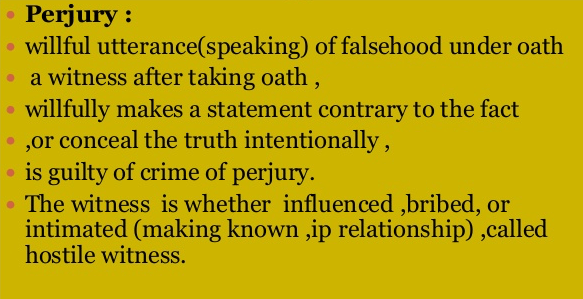
PERJURY

Perjury is a most serious common-law felony that is punishable in Massachusetts by up to twenty years’ imprisonment in noncapital cases under M. G. L. c. 268, § 1   The crime of perjury is committed when one “required to depose the truth in a judicial proceeding or in a proceeding in a course of justice, wilfully swears or affirms falsely in a matter material to the issue or point in question . . . .” G. L. c. 268, s. 1. Our case law instructs that a false statement is material if it “tend[s] in reasonable degree to affect some aspect or result of the inquiry.” Commonwealth v. McDuffee, 379 Mass. 353 , 360 (1979), quoting Commonwealth v. Giles, 350 Mass. 102 , 110 (1966).

Both Stoller and Sanchez concealed evidence while taking action against my license.  This is color of law abuse.and the documents clearly indicate Board counsel Deb Stoller was complicit in the presentation of full knowledge of its falsity and engaged in perjured testimony that was made willfully corruptly false and with the sole intent to deceive in violation of both state and federal law as criminalized by 18 U.S.C. §1621.

Moreover, the ordering a “clinical” test is outside PHS scope, practice, and function of PHS. According to M.G.L. c. 111, § 203 (c):

The HIPAA criminal statute, 42 U.S.C.A. § 1320d-6, reads in pertinent part:

”A person who knowingly and in violation of this part—

•   uses or causes to be used a unique health identifier;
•   obtains individually identifiable health information relating to an individual; or
discloses individual identifiable health information to another person, shall be punished as provided in subsection (b) of this section.”

”Whoever willfully causes an act to be done which if directly performed by him or another would be an offense against the United States, is punishable as a principal.” 18 U.S.C. § 2(b).

The contradictory documents from Sanchez alone constitute a crime (withholding information in concealment and providing false information to a state agency).  But what he did is far far worse. Sanchez also violated the Board of Registration in Medicine own rules as below.


243 CMR 1.03(5) (a) Disciplinary Proceedings for Physicians

  1. Commitment of an offense against any provision of the laws of the Commonwealth relating to the practice of medicine, or any rule or regulation adopted thereunder;
  1. Conduct which places into question the physician’s competence to practice medicine, including but not limited to gross misconduct in the practice of medicine, or practicing medicine fraudulently, or beyond its authorized scope, or with gross incompetence, or with gross negligence on a particular occasion or negligence on repeated occasions;
  1. Practicing medicine deceitfully, or engaging in conduct which has the capacity to

deceive or defraud.

  1. Violation of any rule or regulation of the Board
  1. Malpractice within the meaning of M.G.L. c. 112, § 61;
  1. Misconduct in the practice of medicine.

img_3919


img_8851


Request Discretionary Powers of Massachusetts Attorney General be Used to Intervene: Oversight and Application of Appropriate Professional Standards Urgently Needed

In “The Ethics of Willful Ignorance” which appeared in the Georgetown Journal of Legal Ethics Rebecca Roiphe notes that criminal enterprises “play with division of labor and responsibility and succeed by creating a sum more powerful than the enterprise’s parts and they do so, in part, by making sure that no individual and no firm is the repository for all the knowledge or all the wrongdoing. This creates “plausible deniability” , which protects both individuals and the enterprise. Lawyers often contribute to this dynamic by “defining their job narrowly.”

Government attorneys have broad obligations to the agencies they represent and the public and should act as ministers of justice in seeking to guide the court to the right and just decision as opposed to the “hired-gun” approach used by a private attorney  zealously advocating for a client to guide the court to a preferred decision. Government attorneys must examine all of the evidence, ask questions and not accept the answers they are given in blind faith. Both the agency and the public are best served when misconduct, is identified through investigation and confrontation. If misconduct is found it must be directly addressed not overlooked or minimized.  Comment 3 to Rule 1.13, referring to organizations as clients states “a lawyer cannot ignore the obvious.”  

The objective of judicial review is not only to resolve a disagreement between an individual and a government agency over a specific decision, but also to ascertain the legality of that decision, to prevent abuse of power, and to achieve justice.   Hopefully this will soon transpire. Justice also demands accountability and those responsible for wrongdoing must be identified and sanctioned for their misconduct.

What we have here is a lack of candor trying  to cover up a lack of candor covering up for a lack of candor. It is a lack of candor cubed.

The majority of those working for their  States  Attorneys General are undoubtedly honest and decent  people with integrity and possessing an intact moral compass that always guides them to try to do what is right in any given circumstance. This is why it is perplexing that complaints of corruption, fraud and serious color-of-law abuses are being reported by doctors in multiple states to their AGOs (and other law enforcement agencies) are seemingly being ignored.  Complaints of specific crimes and abuse seem to go nowhere  but a  black-hole; never investigated, never pursued and in most cases never even acknowledged with the most common responses being a patent dismissal by a generic form letter or no response at all.

Corrupt organization necessarily  put systems in place that are designed to prevent exposure of corruption and the “physician health racket”  is no different.  The absence of any meaningful oversight or regulation gives provides an unfair advantage to begin with as unlike most organizational systems in society (including prisons) no internal committee or outside agency exists to acknowledge or investigate the complaints of those who feel they have been treated unfairly or abused.   Neither the  state physician health programs nor their affiliates have any meaningful oversight or regulation.  The  “PHP-approved” assessment and treatment centers are cash only and without the involvement of insurance agencies it is hard to find anyone to investigate the “diagnosis rigging” and other misconduct.  The commercial drug-testing labs  use non-FDA approved drug and alcohol testing with no FDA or any meaningful oversight.    In fact no outside agency exists to hold anyone to account in this system even if misconduct or abuse is identified as the scant regulation and oversight that exists does not have the ability to punish. (for example the only organization overseeing the  non-FDA approved drug and alcohol testing in any manner is the College of American Pathologists (CAP).  CAP is an accreditation agency  and not a disciplinary agency and they cannot sanction or punish a lab even if misconduct is discovered or even if misconduct is repeated.  “Do better next time” is the best they can do. No direct accountability exists in this entire system.  It is a perfect storm for a hidden abuse of power and unaccountability.

They have additionally  put systems in place to prevent indirect exposure from doctors who complain to their state medical boards, state medical societies or national associations such as the American Medical Association (AMA) from reaching a discernible mass and the few complaints that actually do make it through these barriers are often written off as the product of  disgruntled bellyachers and isolated anomalies.

Although they may differ in mechanics state to state the PHPs have aligned themselves with medical boards in a manner that prevents exposure of the corruption.  They have pushed public policy supporting not only deference and blind faith in the authority and expertise of the PHP but protects them from exposure. Massachusetts board-of-registration-in-medicine-policy-94-002 created Board counsel for the physician-health-and-compliance-unit independent of the board and with no accountability to the board.  The policy also allowed the PHCU the ability to act as their own “hearing officers” and present cases and make recommendations on disposition to the board. These are tasks that are usually spread out among different individuals. This puts physician health cases entirely in their hands and removes due process for any physician health related case as these individuals are in charge of what is accepted as evidence and also what is presented to the board. They can do whatever they want and this is apparently what has been going on for some time as they  have become judge, jury and executioner. It urgently needs to be recognized that the PHCU does not represent the best interests of the  state or public. They are simply puppets for the state PHP.

Additionally, those involved with state physician health programs are often involved with ethics committees at state medical societies as well as local chapters of national organizations such as the  American Psychiatric Association (APA).  These committees appoint “cognizant reviewers”  who are  tasked with screening all complaints and separating the frivolous and inappropriate complaints from the valid complaints that are then passed on to the full committee.  Placing  themselves and those of like-mind in these positions is another way to block valid complaints and my guess is they have a similar system of blocking valid complaints at the state AGO.


Source: Request Discretionary Powers of Massachusetts Attorney General be Used to Intervene: Oversight and Application of Appropriate Professional Standards Urgently Needed

Quacks Selling Snake Oil-EtG and the Big Con.

images-3

It is hard to imagine a more stupid or more dangerous way of making decisions than by putting those decisions in the hands of people who pay no price for being wrong. 
-Thomas Sowell

“EtG” stands for ethyl glucuronide, a metabolite of alcohol, and was reported by Gregory Skipper, M.D. and Friedrich Wurst, M.D., in November 2002 at an international meeting of the American Medical Society, to provide proof of alcohol consumption as much as 5 days after drinking an alcoholic beverage, well after the alcohol itself had been eliminated from the body.

Almost 98% of ingested alcohol is eliminated through the liver in an oxidation process that involves its conversion to acetaldehyde and acetic acid, but the remaining 2% is eliminated through the urine, sweat, or breath.1

  • Ethyl Glucuronide (EtG) was introduced in 1999 as a biomarker for alcohol consumption,2 and was subsequently suggested as a tool to monitor health professionals by Dr. Gregory Skipper because of its high sensitivity to ethanol ingestion.3 In his study Dr. Skipper arbitrarily chose a value of 100 as a cut-off for EtG. The rationale behind this value is not cited.

In 2003, because of these and other reportedly remarkable results (e.g., positive findings, confirmed by admissions by the tested individuals, after traditional urine tests had registered negative)images-4

EtG testing began in the United States after Dr. Skipper pitched it to National Medical Services, Inc.  (NMS Labs) and it was developed as a Laboratory Developed Test (LDT).

The relevance to the article below is the fact that the EtG paved the way for the hair tests described.   The EtG is the index case and prototype for an array of unproven forensic tests introduced to the market as LDTs.

The LDT pathway was basically developed for laboratory tests that would not otherwise come to market due to the prohibitive costs of FDA approval (for example a test for a rare disease). Bringing an LDT to market does not require testing in humans (in vivo). Nor does it require that it be shown the test is testing for what it is purportedly testing for (validity). It is essentially an honor system. It was not designed for “forensic” testing but for simple testing with low risk.

None of this testing is approved by the FDA. It is essentially an unregulated industry.

NMS became a leading proponent of EtG testing and, starting in 2003, began publishing claims promoting the absolute validity and reliability of the EtG in detecting alcohol. Akin to the vitamin and supplement industry those promoting and selling the tests could say anything they want—and they did.

NMS initially established a reporting limit or cutoff of 250ng/ml at or over which EtG test results would be reported as “positive” for drinking alcohol. This was later upped to 500ng/ml, then 1000 ng/ml.

NMS reported it as the “Gold Standard” claiming any value above 250 ng/ml indicated “ethanol consumption.”

images-2It was subsequently found to be so sensitive that it could measure incidental exposure to alcohol in foods, over the counter cold medications, mouthwash4,5, hand sanitizer gel6, nonalcoholic beer7, and nonalcoholic wine.8

imagesAs the cutoff value got higher they added another minor metabolite of alcohol, EtS, as a “confirmatory” LDT.

The authors of a 2011 study demonstrating that hand sanitizer alone could result in EtG and EtS concentrations of 1998 and 94 mug/g creatinine concluded that:

“in patients being monitored for ethanol use by urinary EtG concentrations, currently accepted EtG cutoffs do not distinguish between ethanol consumption and incidental exposures, particularly when uine specimens are obtained shortly after sustained use of ethanol containing hand sanitizer.”9

Sauerkraut and bananas have even recently been shown to cause positive EtG levels.10

images-2A 2010 study found that consumption of baker’s yeast with sugar and water11 led to the formation of elevated EtG and EtS above the standard cutoff. EtG can originate from post-collection synthesis if bacteria is present in the urine.12 Collection and handling routines can result in false-positive samples.13

EtG varies among individuals.14 Factors that may underlie this variability include gender, age, ethnic group, and genetic polymorphisms.

“Exposure to ethanol-containing medications, of which there are many, is another potential source of “false” positives.15

On August 12, 2006, The Wall Street Journal published a front-page article, titled “A Test for Alcohol – And Its Flaws.”.16

Quoting Dr. Skipper, among others, the article includes:

“Little advertised, though, is that EtG can detect alcohol even in people who didn’t drink. Any trace of alcohol may register, even that ingested or inhaled through food, medicine, personal-care products or hand sanitizer.”

“The test ‘can’t distinguish between beer and Purell’ hand sanitizer, says H. Westley Clark, director of the Federal Substance Abuse and Mental Health Services Administration. . . ‘When you’re looking at loss of job, loss of child, loss of privileges, you want to make sure the test is right”, he says…”

images“Use of this screen has gotten ahead of the science,’ says Gregory Skipper…”

Methinks Dr. Skipper might have realized this when he initially proposed it as an accurate test after a pilot study done on only a handful of subjects. Or perhaps when he used the LDT pathway to bypass FDA approval and oversight.

On September 28, 2006, SAMHSA, a federal agency that is part of the U.S. Department of Health and Human Resources, issued an Advisory, which on the first page contained a “grey box” warning, as follows:

“Currently, the use of an EtG test in determining abstinence lacks sufficient proven specificity for use as primary or sole evidence that an individual prohibited from drinking, in a criminal justice or a regulatory compliance context, has truly been drinking. Legal or disciplinary action based solely on a positive EtG, or other test discussed in this Advisory is inappropriate and scientifically unsupportable at this time. These tests should currently be considered as potential valuable clinical tools, but their use in forensic settings is premature.”17

Bias has been identified as a large problem with drug trials.18   Industry-sponsored research is nearly four times as likely to be favorable to the company’s product as NIH-sponsored research.19 As an example, one survey of seventy articles about the safety of Norvasc (amlodipine) found that 96% of the authors who were supportive of the drugs had financial ties to the companies that made them.20

But what about the multi billion dollar drug-testing industry and the financial ties here?

Imagine if this was a drug and not a drug-test.

Essentially Greg Skipper and the FSPHP arm of ASAM launched a very lucrative joint business venture with a commercial drug-testing lab. They introduced the test via a loophole as a laboratory developed test.  An LDT has no FDA regulation so the lab was able to promote, market and sell these tests with no meaningful oversight or accountability.

The lab then contracted with state licensing boards and their state PHPs (who designed, implemented and managed drug and alcohol testing programs for nurses and doctors).   A mutually beneficial scheme for the labs (who collect the samples) and the PHPs (who utilize, interpret and report the results.

The PHPs develop the arbitrary cutoff levels based on alleged “scientific” research and the labs promote whatever they say. “Gold-Standard,” “accurate” and “reliable.”

How many lives were ruined by this test?   How many careers were lost, families shattered and futures erased. I would venture to say a lot. Just look through all of the legal cases as I have. It is unconscionable. Sociopathic profiteering.

How many committed suicide feeling helpless, hopeless and entrapped?

And the labs have taken a “stand your ground” approach. Never admit wrongdoing. Never settle.

In a February 2007 article in the magazine “New Scientist,” Dr. Skipper is quoted

that:

“…there is not yet an agreed threshold concentration that can be used to separate people who have been drinking from those exposed to alcohol from other sources. Below 1000 nanograms of EtG per millilitre of urine is probably ‘innocent’, and above 5000 booze is almost certainly to blame. In between there is a “question zone…”

No Dr. Skipper—it is you who is most certainly to blame and you alone. Every time you upped the threshold you claimed it was reliable and accurate starting with a level of 100.

And what of all the people whose lives you ruined by introducing junk science with no evidence base via a regulatory loophole. “probably innocent?”   Shame on you Dr. Skipper…. Shame..shame..shame.


  1. Bean P. State of the art contemporary biomarkers of alcohol consumption. MLO Med Lab Obs. Nov 2005;37(11):10-12, 14, 16-17; quiz 18-19.
  2. Wurst FM, Kempter C, Seidl S, Alt A. Ethyl glucuronide–a marker of alcohol consumption and a relapse marker with clinical and forensic implications. Alcohol Alcohol. Jan-Feb 1999;34(1):71-77.
  3. Skipper GE, Weinmann W, Thierauf A, et al. Ethyl glucuronide: a biomarker to identify alcohol use by health professionals recovering from substance use disorders. Alcohol Alcohol. Sep-Oct 2004;39(5):445-449.
  4. Costantino A, Digregorio EJ, Korn W, Spayd S, Rieders F. The effect of the use of mouthwash on ethylglucuronide concentrations in urine. J Anal Toxicol. Nov-Dec 2006;30(9):659-662.
  5. Reisfield GM, Goldberger BA, Pesce AJ, et al. Ethyl glucuronide, ethyl sulfate, and ethanol in urine after intensive exposure to high ethanol content mouthwash. J Anal Toxicol. Jun 2011;35(5):264-268.
  6. Rosano TG, Lin J. Ethyl glucuronide excretion in humans following oral administration of and dermal exposure to ethanol. J Anal Toxicol. Oct 2008;32(8):594-600.
  7. Thierauf A, Gnann H, Wohlfarth A, et al. Urine tested positive for ethyl glucuronide and ethyl sulphate after the consumption of “non-alcoholic” beer. Forensic Sci Int. Oct 10 2010;202(1-3):82-85.
  8. Hoiseth G, Yttredal B, Karinen R, Gjerde H, Christophersen A. Levels of ethyl glucuronide and ethyl sulfate in oral fluid, blood, and urine after use of mouthwash and ingestion of nonalcoholic wine. J Anal Toxicol. Mar 2010;34(2):84-88.
  9. Reisfield GM, Goldberger BA, Crews BO, et al. Ethyl glucuronide, ethyl sulfate, and ethanol in urine after sustained exposure to an ethanol-based hand sanitizer. J Anal Toxicol. Mar 2011;35(2):85-91.
  10. Musshoff F, Albermann E, Madea B. Ethyl glucuronide and ethyl sulfate in urine after consumption of various beverages and foods–misleading results? Int J Legal Med. Nov 2010;124(6):623-630.
  11. Thierauf A, Wohlfarth A, Auwarter V, Perdekamp MG, Wurst FM, Weinmann W. Urine tested positive for ethyl glucuronide and ethyl sulfate after the consumption of yeast and sugar. Forensic Sci Int. Oct 10 2010;202(1-3):e45-47.
  12. Helander A, Olsson I, Dahl H. Postcollection synthesis of ethyl glucuronide by bacteria in urine may cause false identification of alcohol consumption. Clin Chem. Oct 2007;53(10):1855-1857.
  13. Helander A, Hagelberg CA, Beck O, Petrini B. Unreliable alcohol testing in a shipping safety programme. Forensic Sci Int. Aug 10 2009;189(1-3):e45-47.
  14. Sarkola T, Dahl H, Eriksson CJ, Helander A. Urinary ethyl glucuronide and 5-hydroxytryptophol levels during repeated ethanol ingestion in healthy human subjects. Alcohol Alcohol. Jul-Aug 2003;38(4):347-351.
  15. Jatlow P, O’Malley SS. Clinical (nonforensic) application of ethyl glucuronide measurement: are we ready? Alcohol Clin Exp Res. Jun 2010;34(6):968-975.
  16. Helliker K. A test for alcohol–and its flaws. The Wall Street Journal2006.
  17. Administration SAaMHS. The role of biomarkers in the treatment of alcohol use disorders. In: Advisory SAT, ed2006:1-7.
  18. Bodenheimer T. Uneasy alliance–clinical investigators and the pharmaceutical industry. N Engl J Med. May 18 2000;342(20):1539-1544.
  19. Bekelman JE, Li Y, Gross CP. Scope and impact of financial conflicts of interest in biomedical research: a systematic review. JAMA. Jan 22-29 2003;289(4):454-465.
  20. Stelfox HT, Chua G, O’Rourke K, Detsky AS. Conflict of interest in the debate over calcium-channel antagonists. N Engl J Med. Jan 8 1998;338(2):101-106.


Request Discretionary Powers of Massachusetts Attorney General be Used to Intervene: Oversight and Application of Appropriate Professional Standards Urgently Needed

Honesty Concept

A conceptual look at honesty, condor, integrity,truthfulness,straightness.

“Most agencies do not need to be reminded of the need for complete candor with the Office of the Attorney General or the Court. Agencies must be diligent to disclose documents to us for production during litigation and provide us with agency affidavits that are completely accurate. Most agencies have avoided the problems that result from a failure to be forthcoming, and agency counsel have always acted conscientiously to avoid these incidents. … We will be happy to assist you in sending the message that the state must at all times be forthcoming and accurate, and I ask that you let your clients know that I will not stand for anything less. We generally have avoided the need for me to exercise the power to overrule an agency’ s position in litigation, but I view lack of candor as one of the most legitimate occasions for me to use that power and if necessary I will do so. “-
—Massachusetts Attorney General Scott Harshbarger (1991-1999)1

Government attorneys acting on behalf of state agencies have obligations to both the the client they represent and the general public.   Two approaches exist.  The “hired gun” model approach is no different from a private attorney representing a private client by zealously advocating for a preferred decision while the “minister of justice” model seeks to guide the court to the right and  just decision.

Assuming the interests are legal and no violations of professional conduct are involved the the strategic decisions in the “hired gun” approach are left completely up to the client.  Once decided the attorney must zealously pursue a preferred outcome regardless of its impact on the opposing party or others.  According to this model government attorneys are not in a position to determine the “public interest” and even if they were they should not take it into account because it is the agency that is politically accountable.  not the attorney2. The hired gun model employs blind faith and deference to the agency and presupposes its integrity and competency and, as emphasized by former Mass AGO Harschbarger above, it also  requires “complete candor.” He also states:

“Compliance with the law goes to the heart of your function as agency counsel and the role of my office as attorneys representing the public. Many of the cases that we handle involve more than just a question of who was right or wrong; they involve the public’s interest in knowing that their government is acting in accordance with the law.”

The “minister of justice” approach asserts that a government attorney must examine all of the evidence, ask pertinent questions and not accept the answers  in blind faith. It is self-evident that state agencies and the general public are best served when fraud and criminal activity are identified and exposed.

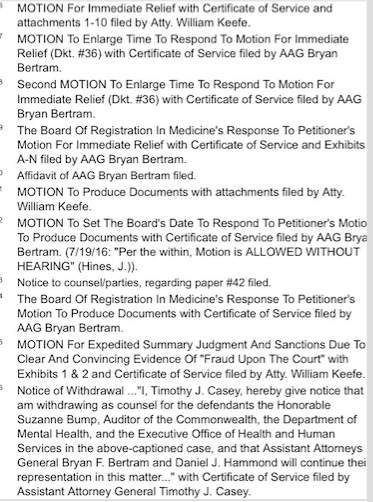
Assistant Attorney General (AAG) Bryan Bertram is representing the Board of Registration in Medicine in my case before the Massachusetts Supreme Judicial Court  under advisement by Justice Hines.   As a state  attorney representing a state agency he has taken the hired gun approach and his tactics are consistent with many  similar physician health related cases across the Country as his focus has been on administrative law technicalities and he has completely ignored the critical issues.  He has additionally protracted the time by tolling it to (or exceeding) administrative time limitations and filed multiple motions for extension as can be seen on the case docket. 

Tolling the time is the primary tactic for dismissing cases and limiting the scope of judicial review.  The Administrative Record was filed in my case after the 90-day deadline was missing everything I had submitted.  None of the  petitions or evidence of misconduct was found anywhere and had I not known about Massachusetts Superior Court Standing Order No. 1-96  (standing-order-1-96-amended ) Justice Hines review would have been limited to what they submitted.

Massachusetts Superior Court Standing Order No. 1-96 (3) (standing-order-1-96-amended) states in part that a “Motion for leave to present additional evidence “ must be served “in accordance with Superior Court Rule 9A not latcr than twenty (20) days after service of the record by the administrative agency” and that “any party failing to serve such a motion within the prescribed time limit, or within any court-ordered extension, shall be deemed to have waived any such motion (unless relating to jurisdiction) and the case shall Proceed solely on the basis of the record.”

screen-shot-2016-09-05-at-6-07-48-amSimilar restrictions exist in other states but the primary problem is the attorneys representing doctors in these cases do not divulge this information and do not “bite the hand that feeds.”   Much to the surprise and chagrin of those who filed the Administrative Record I knew about the time limitation and the filed Administrative Record was missing anything and everything related to fraud and criminal activity. Both the primary evidence and their petitionary arguments were nowhere to be found.   Bertram “corrected” the Administrative Record twice by adding the petition for the hearing currently under judicial review as well as a critical document that was submitted as evidence for the same hearing by adding my copies and making excuses for their absence claiming the former was inadvertently “left off the docket” and the latter was “lost” due to my hand delivery of it.   Both are implausible and under a recent public records law we were able to retrieve documents the medical board previously had refused to provide that were date-stamped long after the hearings at which they were supposedly heard.

Over time Bertram’s defense of the medical board has gone beyond zealous advocacy and into the realm of overzealous apologism and this begs the question-who or what is this man representing?  .His fabrications and absurd logical fallacy were the topic of my recent blog discussing his grasping at straws by fabricating an imaginary off-site storage unit and claiming documents are typically scanned after board proceeding not before in a perverse logic that defies the sacred writ to which he so fastidiously abides.  According to the Manual for Conducting Administrative Adjudicatory Proceedings 2012 edition edited by Assistant Attorney General Robert L. Quinlan, Jr. (admin-adjuc-training-manual):

“If a party intends to introduce a document into evidence at the hearing, copies of it should be provided to the other parties and to the presiding officer ahead of time.”3

In “The Ethics of Willful Ignorance” which appeared in the Georgetown Journal of Legal Ethics Rebecca Roiphe notes that criminal enterprises “play with division of labor and responsibility and succeed by creating a sum more powerful than the enterprise’s parts and they do so, in part, by making sure that no individual and no firm is the repository for all the knowledge or all the wrongdoing. This creates “plausible deniability” , which protects both individuals and the enterprise. Lawyers often contribute to this dynamic by “defining their job narrowly.”4

Government attorneys representing state medical boards often get cases dismissed based on administrative law technicalities. They are largely unaware of what lies beneath. Such is not the case here. From the beginning Bertram has been fully aware of the evidence and critical issues.  He has been given documentary evidence that is not only precise and unequivocal but abundant. These clearly and persuasively show criminal acts including fabricating evidence, concealing evidence and perjury.  Multiple felonies perpetrated by Dr. Luis Sanchez of the Massachusetts physician health program Physician Health Services, Inc. (PHS) are loud and clear but Bertram He has turned a blind eye to them.   These documents that were presented to Physician Health and Compliance Unit Board counsel Deb Stoller over the course of five-years as evidence were never seen by the Board and have been concealed.  Board Policy 94-002 ( physician-health-and-compliance-unit )which  created PHCU board counsel within but independent of the medical board afforded her and PHCU board counsel the power to act both as a “hearing officer” and present cases to the Board and recommend disposition.   Bertram’s raison d’etre appears to be as a lackey for Stoller rather than “minister of justice” as over the course of more than a year he has done nothing more than demur, nix, rebuff and evade substantive and serious issues that have import far beyond the Commonwealth. And when Justice Hines gave a clear order at an April 29th hearing to negotiate with the medical board he kept his cards close to the vest as the negotiations never went past Deb Stoller and her underlings at the PHCU in machinations that would have in effect removed me from judicial review and placed me directly in the palms of the perpetrators and relegating all of the evidence of criminal activity into oblivion.

The net-sum of all of this is that I do not believe Bertram is representing the best interests of the agency or the public good but protecting the physician health racket in the same manner as the PHCU as even a “hired gun” would have folded by now and another curious development is notable.   A Notice of Withdrawal was filed with the Supreme Judicial Court (SJC) immediately following a Motion for summary judgment submitted on August 9, 2016.

screen-shot-2016-09-03-at-3-10-32-am

The only plausible situations for such when considering the given situations for which an attorney must or may withdraw from a case are those that involve fraud and legal or professional conduct violations.  The  Massachusetts Rules of Professional Conduct Rule 1.16  provides the many situations in which an attorney must or may withdraw his or her appearance in a case before the Court. Under Rule 1.16 (a), an attorney must withdraw if:

  1. the representation will result in violation of the rules of professional conduct or other law;
  2. the lawyer’s physical or mental condition materially impairs the lawyer’s ability to represent the client; or
  3. the lawyer is discharged.

Rule 1.16 (b) lists the circumstances in which an attorney may withdraw and whether must or may this requires permission from the court and I suspect the attorney (who is in the same administrative law department at the AGO and a superior of Bertram) laid his eyes on what the documents show for the first time and high-tailed it down to the SJC to withdraw from the case as due to the scope and severity of what the evidence clearly shows and realized he too would be violating the Massachusetts Rules of Professional Conduct Rule 1.16 if he continued to get behind Bertram.   But why has Bertram not jumped ship? He not only should have jumped ship but was required to long ago.

The criminal misconduct and fraud is obvious to anyone and this includes any  pre-teen who has watched a a handful of “CSI” or “Law and Order.”  Comment 3 to Rule 1.13 (Organization as Client) states that “ As defined in Rule 1.0(f), knowledge can be inferred from circumstances and “a lawyer cannot ignore the obvious.”   The falsely-created evidence and perjury are here are not just obvious but glaringly obvious and bedazzled in sequins and day-glo.  The documents are specific, precise and crystal clear. They are also copious and redundant.  No ambiguity or doubt or alternative hypothesis exist.  Therefore Bertram’s “willful ignorance” card is is a bust. His continued defense of the indefensible is rife with contradictions, flip-flops, non-sequiturs, absolute nonsense  and outright fabrications.  This has  become glaringly obvious and his candor patina is chock full of holes.  The simple and direct but inconvenient fact is that the documentary evidence shows clear and detailed evidence of flagrant fraud and inexcusable misconduct that is displayed so plainly and comprehensibly that any reasonable person including a child could recognize it.  One does not have to be an attorney to see it as the only two conditions that would prevent its recognition are being asleep or the inability to read. The truth is neither arcane nor equivocal and this renders Bertram in full violation of the Rules of Professional conduct and he has dug his heels into the ground and stuck his head in the sand for over a year.  E-mail exchanges show exactly what he was told and when and ignorance here is not bliss as his falsely feigned “I know nothing” indifference is not not simply apathetic but pathetic.  It is unbelievable and absurd.   He might as well claim that he was under the impression that the  sky was  yellow and the sun was blue.

He has, however, scurrilously followed his physician health racket playbook to sling obstacles in my way. Most recently we filed a Motion for Immediate Relief with the Court and this request was met with Bertram filing two consecutive one-week extensions (which are perfectly legal) that tolled the time up to the beginning of his two-week vacation and egregiously the Motion that was filed was intended to prevent specific and irreversible consequences that would impact my daughters.  Bertram’s orchestrated month-long interlude has now assured those consequences to be inevitable and one has already occurred but the fact of the matter is that he has been in clear and flagrant violation of the Massachusetts Rules of Professional Conduct (Mass. R. Prof. C.) and American Bar Association (ABA) Model Rules of Professional Conduct for quite some time.

Sate physician health programs, their affiliated commercial drug testing labs and a number of “PHP-approved” drug and alcohol assessment and treatment engage respectively in “sham review,” forensic fraud and diagnostic rigging.  Profit is the primary directive and the means have become the ends.   This triumvirate machinery holds all the cards and it is a stacked deck  further compromised by “false shuffles” and “second dealing” perpetrated by moles within medical boards.   “Close to the vest” is a phrase that originated from poker players keeping their cards low on the table and close to their vests so they couldn’t be seen.  It is my guess that since my case has been in the Supreme Judicial Court nothing has made it past the physician health and compliance unit (PHCU) barricade and Bertram’s fraternization and skullduggery with the PHCU during the 60-days provided by Justice Hines is suspect.  When we asked to negotiate with individuals above and outside the PCHU Bertram claimed he did not have the authority to do so but as a representative of the chief legal officer of the state and given power to intervene  in legal proceedings this claim of powerlessness does not comport with reality and is just another one of his many excuses.  My guess is that the fraud and misconduct and Bertram’s actions are unbeknownst to his agency. Perhaps a  supervisor or two is in cahoots but the AGO at large is unaware of any of it just like the medical board is clueless to Stoller’s ethical and legal transgressions.   Any honest person with integrity and a moral compass would be shocked by what they are engaging in and sunshine is the best disinfectant.

What we have here is a lack of candor attempting to cover up a lack of candor covering up for a lack of candor. It is a lack of candor cubed.

My hope is that those of integrity who represent the majority of individuals at the AGO will take note and recognize the gravity of this and act accordingly as this is after all corruption and fraud.

Ethical Obligations of Government Attorneys

All lawyers are bound to adhere to the rules of professional conduct in the jurisdiction(s) where they practice. In Massachusetts, that means a lawyer must adhere to the Massachusetts Rules of Professional Conduct (Mass. R. Prof. C.), and additional guidance can be found in the American Bar Association (ABA) Model Rules of Professional Conduct and related opinions. Several courts have held attorneys who litigate for the government to a higher ethical standard than that expected of private lawyers. See, e.g., Freeport McMoran Oil & Gas Co. v. Fed. Energy Regulatory Comm’n, 962 F.2d 45 (D.C. Cir. 1992). The authority often cited by these cases is Ethical Consideration 7–14 of the Model Code of Professional Responsibility, which provides that government lawyers with discretionary power over the conduct of litigation have a responsibility to seek justice and should refrain from commencing or continuing unfair litigation and using the government’s economic power to bring about unjust settlements or results. Government attorneys should act as ministers of justice who seek to assist the court in reaching the right and just result and not act as zealous advocates assisting a particular government agency in reaching a preferred result.

In the United States, the chief legal officer of each state is known as the Attorney General. State Attorneys General (SAGs) can take a wide range of actions on behalf of their state and the public interest through law enforcement, litigation, investigatory activities, and law and policy reform work and the law grants the authority to use certain powers to carry out the requirements of their positions. These powers include “the duty to appear for and defend the state and its agencies,” “the right to intervene in legal proceedings on behalf of the public interest,” and “the authority to prosecute criminal activity, in the absence of express legislative restriction.” (NAT’L ASS’N OF ATTORNEYS GEN., STATE ATTORNEYS GENERAL POWERS AND RESPONSIBILITIES 20–23 (Emily Myers & Lynne Ross eds., 2007)

Duty to Reveal Falsehood and Perjury

Under Mass. R. Prof. C. 3.3, a lawyer is prohibited from making false statements of material fact or offering evidence that the lawyer knows to be false:

If the lawyer has offered, or the lawyer’s client or witnesses testifying on behalf of the client have given, material evidence and the lawyer comes to know of its falsity, the lawyer shall take reasonable remedial measures.

Screen Shot 2016-09-09 at 3.58.30 AM.png

A lawyer is in violation of that rule if any misrepresentation is made to the tribunal, irrespective of whether that misrepresentation is material and that duty continues to the conclusion of the proceeding and the comments to that rule affirmatively obligate an attorney to take reasonable remedial measures to correct to correct it and the obligation extends to all “tribunals” where statements and evidence are provided under oath. Mass. R. Prof. C. 1.0 (c) provides the following definition:

Tribunal” denotes a court, an arbitrator in a binding arbitration proceeding or a legislative body, administrative agency or other body acting in an adjudicative capacity. A legislative body, administrative agency or other body acts in an adjudicative capacity when a neutral official, after the presentation of evidence or legal argument by a party or parties, will render a binding legal judgment directly affecting a party’s interests in a particular matter.”

Under this definition, if the administrative agency is acting in an adjudicatory manner, an attorney has all the ethical duties as if she were appearing in court and the most significant duties involve those under Mass. R. Prof. C. 3.3 Candor Toward the Tribunal. This rule has several subparts which impose duties upon an attorney. Under Mass. R. Prof. C. 3.3 an attorney shall not knowingly:

  1. Make a false statement of fact or law, or fail to correct one previously made.
  2. Fail to disclose a material fact when disclosure is necessary to avoid assisting a client in a criminal or fraudulent act, unless such disclosure is prohibited under the confidentiality provisions of Mass. R. Prof. C, 1.6.
  3. Fail to disclose controlling legal authority directly adverse to the position of the client if the other side has not done so.
  4. Offer evidence the lawyer knows is false.
  5. If the lawyer has offered material evidence and comes to know it is false, this must be disclosed unless disclosure is prohibited under Mass. R. Prof. C. 1.6. A lawyer may refuse to offer evidence the lawyer reasonably believes is false.
  6. In an ex parte proceeding, the lawyer shall inform the tribunal of all material facts known to the lawyer to allow the tribunal to make an informed decision, even if the facts are adverse.

Under Mass. R. Prof. C. 1.6, a lawyer has the discretionary ability to disclose information relating to the representation to prevent, mitigate, or rectify substantial injury to the financial interests or property of another that is reasonably certain to result or has resulted from the client’s commission of a crime or fraud in which the client has used the lawyer’s services.

Mass. R. Prof. C. 1.6 provides that a lawyer representing a client before a legislative body or administrative agency in a non-adjudicatory proceeding shall disclose that the appearance is in a representative capacity and goes on to provide that the requirements of Mass. R. Prof. C. 3.3 “Candor Toward the Tribunal,” are also applicable, except the ex parte proceeding provision in Mass. R. Prof. C. 3.3(d). In addition, the lawyer is required to comply with the provisions of Mass. R. Prof. C. 3.4 “Fairness to Opposing Party and Counsel,” and Mass. R. Prof. C. 3.5, “Impartiality and Decorum of the Tribunal.”imgres-1

Willful Ignorance

How the Rules of Professional Conduct deal with willful ignorance is also examined in Rebecca Rolphe’s “The Ethics of Willful Ignorance.”4  When it comes to attorneys representing organizational client Rolphe notes:

“the tension between the duty of confidentiality and the reporting obligation plays no role.”

In other words, if an attorney working for an organization suspects that someone within that organization is engaged in misconduct it can be addressed.

The primary argument to support the willful ignorance of client misconduct is that confronting it could harm the attorney-client relationship. This argument fails, however,   when the attorney is representing an organization because the employees of an organization are not clients, the organization itself is.

An attorney generally has greater obligations due to the special role lawyers play in our legal system, and these obligations are recognized, if not clearly codified, in the Rules of Professional Conduct. And a government attorney has the greatest obligations of all, both as lawyer and as public servant.

If there is reasonable suspicion that an agency employee engaged in fraud or criminal activity it is the obligation of a government attorney to address the evidence directly and either affirm or refute wrongdoing. Brushing it off is not an option.

The Rules on competence and diligence (Rules 1.1 and 1.3) impose an obligation to know. To effectively advise it is essential that all facts be weighed not cherry picked.imgres

Ignoring the Obvious—Disregard for all Outside Opinion, Evidence and Fact

 In “The Ethics of Willful Ignorance” Rolphe notes that criminal enterprises “play with division of labor and responsibility and succeed by creating a sum more powerful than the enterprise’s parts and they do so, in part, by making sure that no individual and no firm is the repository for all the knowledge or all the wrongdoing. This creates “plausible deniability” , which protects both individuals and the enterprise. Lawyers often contribute to this dynamic by “defining their job narrowly.”

Government attorneys have broad obligations to the agencies they represent and the public and should act as ministers of justice in seeking to guide the court to the right and just decision. This opposed to a private attorney zealously advocating for a client to guide the court to a preferred decision. Government attorneys must examine all of the evidence, ask questions and not accept the answers they are given in blind faith. Both the agency and the public are best served when misconduct, is identified through investigation and confrontation. If misconduct is found it must be addressed and those responsible held to account.  Comment 3 to Rule 1.13, referring to organizations as clients states “a lawyer cannot ignore the obvious.”  

The “hired gun” model is deeply rooted in the adversarial system in which a lawyer’s duty is to provide zealous advocacy of a client’s interest as defined by that client. Assuming the client’s objective is legally permissible and that the representation does not violate some rule of legal ethics (such as the duty not to present knowingly perjured testimony), the strategic decisions are up to the client and once decided the attorney must zealously pursue it regardless of the impact on the opposing party or third parties. (See American Bar Association (ABA), ‘Model Rules of Professional Conduct’ (1983) r 1.2: ‘… A lawyer shall abide by a client’s decisions concerning the objectives of representation …’)

The standard set forth in rule 3.3 (e) “confirm[s] that the legal profession has accepted that an attorney’s ethical duty to advance the interests of his client is limited by an equally solemn duty to comply with the law and standards of professional conduct; it specifically ensures that the client may not use false evidence. This special duty of an attorney to prevent and disclose frauds upon the court derives from the recognition that perjury is as much a crime as tampering with witnesses or jurors by way of promises and threats, and undermines the administration of justice.” (Footnote and citation omitted.) Nix v. Whiteside, supra at 168-169. There is no constitutional or permissible right of a defendant to testify falsely.

Mass. R. Prof. C. 1.0 provides the following terminology:

(g) “Knowingly,” “known,” or “knows” denotes actual knowledge of the fact in question. A person’s knowledge may be inferred from circumstances.

(m) “Reasonably should know” when used in reference to a lawyer denotes that a lawyer of reasonable prudence and competence would ascertain the matter in question.

Fabrication, concealment and falsification of evidence and forensic fraud and perjury are all illustrated clearly and precisely and anyone looking at them could ascertain the import.

Falsely created evidence in collusion with a drug-testing lab is obvious forensic fraud and a civil conspiracy yet Bertram refers to this intentional and deliberate false creation of evidence as a “chain-of-custody issue.”  He claims no crimes exist because no criminal charges exist but the documentary evidence is consistent with the DOJ definition of laboratory fraud . Additional crimes include wire fraud-18 USC 1341 (the request to the lab was by fax), false statements 18-USC 1001 and conspiracy-18 USC 371.

There should be zero-tolerance for laboratory misconduct, especially in Massachusetts.   This also shows an unethical tone at the top and top-down corruption as the collusion is between the former president of the Federation of State Physician Health Programs (FSPHP) and VP of laboratory operations at USDTL. The fact that it involves a drug-testing lab serving state PHPs on a national basis and that multiple suicides have occurred from allegedly falsified tests renders this a very serious crime.

Perjury is a most serious common-law felony that is punishable in Massachusetts by up to twenty years’ imprisonment in noncapital cases under M. G. L. c. 268, § 1 and changing a forensic sample to clinical creates protected health information (PHI) and this  represents the worst HIPAA-criminal violation I can find anywhere and .Sanchez is practicing medicine fraudulently, in violation of G. L. c. 112, ‘ 5 (c), and 243 [Code Mass. Regs. ‘] 1.03(5)(a)(3) (1994) and engaging in “conduct that has the capacity to deceive or defraud, in violation of G. L. c. 112, ‘ 5 (h), and 243 Code Mass. Regs. ‘ 1.03(5)(a)(10) (1994)”; “misconduct in the practice of medicine, in violation of 243 Code Mass. Regs. ‘ 1.03(5)(a)(18) (1993)”; and “conduct which undermines public confidence in the integrity of the medical profession and shows a lack of good moral character as defined by Raymond v. Board of Registration in Medicine, 387 Mass. 708 (1982) and Levy v. Board of Registration [& Discipline] in Medicine, 378 Mass. 519 (1979).”  The Board may discipline doctors who lack good moral character or who undermine the public confidence in the integrity of the medical profession. Id.; Raymond v. Board of Registration in Med., 387 Mass. 708, 443 N.E.2d 391 (1982).  In this case any junior-high school student of reasonable prudence and competence could ascertain the fabrication, misrepresentation and suppression of evidence.   It is unequivocal.  It is also being overlooked and that is unacceptable.

Reasonable Remedial Measure Required

ABA Formal Opinion 87-353 states:

“If, prior to the conclusion of the proceedings, a lawyer learns that the client has given testimony the lawyer knows is false, and the lawyer cannot persuade the client to rectify the perjury, the lawyer must disclose the client’s perjury to the tribunal…z’

Reasonable remedial measures” include (1) trying to convince the client to offer truthful testimony, (2) attempting to withdraw from representation, (3) limiting the scope of questioning to avoid the perjury, and (4) as a last resort, disclosing the perjury (or intended perjury) to the court.

A lawyer is not required to take remedial measures merely because the lawyer suspects that a client has committed perjury or intends to commit perjury. The lawyer must have a firm factual basis, based in the lawyer’s actual knowledge, that the client has committed perjury or intends to commit perjury. A lawyer is not required to investigate the facts but also must not turn a blind eye to situations where false evidence or perjury is highly likely. Thus, if an attorney is aware of false evidence or perjury these ethical obligations come into play and a lawyer must attempt to remedy the situation.

According to Mass. R. Prof. C. 1.13(c), a Government lawyer representing an organization must examine Mass. R. Prof. C. 1.6, 3.3, and 4.1

Rule 1.6(b)(1) requires disclosure of confidential information gained in the representation to prevent conduct that is likely to cause, among other things, “substantial injury to the financial interests or property of another.”

Rule 3.3(a)(2) requires a lawyer to disclose a material fact to a tribunal to avoid assisting a client’s criminal or fraudulent act.

Mass. R. Prof. C. 4.1(b) prohibits a failure to disclose a material fact to a third person if disclosure is necessary to avoid assisting a client’s criminal or fraudulent act.

Any of the circumstances outlined in these three rules requires an attorney to blow the whistle and three should have been blowing long ago Pursuant to Mass. R. Prof. C. 1.6, 3.3, and 4.1 and Rule 1.6(b)(1) Bertram was required to disclose the misconduct and fraud not pretend it isn’t there and it is morally imperative that the evidence of fraud and criminal misconduct be exposed and those involved held accountable as the opportunity may never arise again.

The physician health racket relies primarily on silence, secrecy and control of the information. They have devised a system in which “point-people” punt and deflect complaints and systems are put in place to intercept and stifle valid complaints. For example placing an apologist or lackey on an ethics committee as a “cognizant reviewer” prevents complaints from ever being seen by the full committee—just intercept and toss it and Board Policy 94-002 creating Physician Health and Compliance Unit (PHCU) Board counsel and providing “hearing officer” powers put the fates of many completely in the hands of these shills and Bertram seems to be zealously representing their interests and not the interests of the agency or the public good unless you are among those lining your pockets in this racket.

The objective of judicial review is not only to resolve a disagreement between an individual and a government agency over a specific decision, but also to ascertain the legality of that decision, to prevent abuse of power, and to achieve justice.   Hopefully this will soon transpire. But justice requires that those responsible for wrongdoing be identified and held accountable and those include Sanchez, Stoller and Bertram.


  1. Harschbarger S. A Note From the Attorney General. Agency Counsel Newsletter. Office of the Attorney General One Ashburton Place Boston, MA 021081997.
  2. Lanctot CJ. ‘The Duty of Zealous Advocacy and the Ethics of the Federal Government Lawyer: The Three Hardest Questions’. Southern California Law Review. 1991;64(951).
  1. : ADMINISTRATIVE LAW DIVISION, GOVERNMENT BUREAU OFFICE OF ATTORNEY GENERAL MARTHA COAKLEYCOMMONWEALTH OF MASSACHUSETTS;2012.
  1. Roiphe R. The Ethics of Willful Ignorance. Georgetown Journal of Legal Ethics. 2011;24(1).


Junk Science and the Need for Regulatory Oversight of Forensic Laboratory Developed Tests

Although the current use of these tests is limited to the criminal justice system and professional monitoring programs this may soon change as the American Society of Addiction Medicine is proposing a “new paradigm” of zero-tolerance random widespread drug and alcohol testing. This is outlined  in the ASAM White Paper on Drug Testing and described by Robert Dupont in his keynote speech  before the Drug and Alcohol Testing Industry Association (DATIA) annual conference in 2012.The ASAM White paper states drug testing is “vastly underutilized” throughout healthcare and describes the use of drug testing “within the practice of medicine and, beyond that, broadly within American Society.”As the consequences of a single unregulated “forensic” test result can be grave, far-reaching and even permanent it is critical that these tests be included in the debate on regulation of LDTs.

Source: Junk Science and the Need for Regulatory Oversight of Forensic Laboratory Developed Tests

Physician Suicide and “Physician Wellness” –Time to start talking about the elephant in the room!

“Process addiction” was added as a potentially impairing illness including compulsive gambling, compulsive spending, compulsive video gaming, and “workaholism.” According to the FSPHP “the presence of a process addiction can be problematic or even impairing in itself, and it can contribute to relapse of a physician in recovery. As such, process addictions should be identified and treated.” They define three levels of relapse including the novel “relapse without use.”

mllangan1's avatarDisrupted Physician

Screen Shot 2016-05-24 at 7.30.05 PM

Physician Suicide and the Elephant in the Room

Michael Langan, M.D.

Although no reliable statistics exist, anecdotal reports suggest an alarming upsurge in physician suicide. This necessitates a reappraisal of known predisposing risk factors such as substance abuse and depression but also requires a critical examination of what external forces or vulnerabilities might be unique to doctors and how they might be involved in the descent from suicidal ideation to suicidal planning to completed suicide.

Depression and Substance Abuse Comparable to General Population

Depression and substance abuse are the two biggest risk factors for suicide. The prevalence of depression in physicians is close to that of the general population1,2 and, if one looks critically at the evidence based literature, substance abuse in medical professionals approximates that of the general population.  Controlled studies using DSM diagnostic criteria suggest that physicians have the same rates (8-14%) of substance abuse…

View original post 3,352 more words

Defending MA BORM Deb Stoller’s Five-Year Concealment of Fraud–Nothing Left but Logical Fallacy and Lies

Bertram also claims PHS has not committed any crimes because they have not been charged with any crimes.  This is called denying the antecedent or inverse error.  It is a logical fallacy where the consequent is an indicative conditional  claimed to be false because the antecedent is false. ( A, then B; not A, therefore not B).    If it is raining, then the grass is wet.It is not raining.Therefore, the grass is not wet.The argument is invalid because there are other reasons for which the grass could be wet such as spaying it with a hose.   There are multiple reasons for which someone who committed a crime has not been charged with a crime.There is always a time-frame between the two and many who commit crimes never get caught.    Luck, stealth, cleverness, and multiple other variables might be involved.  Jimmy Savile molested and raped scores of children for decades and he was never caught.  As a major fundraiser for hospitals this fiend had free rein to prey on sick and helpless  little kids in hospital beds .

Source: Defending MA BORM Deb Stoller’s Five-Year Concealment of Fraud–Nothing Left but Logical Fallacy and Lies

Bent Science and Bad Medicine: The Medical Profession, Moral Entrepreneurship and Social Control

“Shedding even a little light on how advocates bend policy -relevant science could go a long way toward remedying these problems. Indeed, precisely because the advocates have overtaken the law in this area, heightened attention to the social costs of bending science could itself precipitate significant change.”

But there are difficulties in challenging bent science including a general lack of recognition of the problem. With an absence of counter-studies to oppose deliberately manufactured ends-oriented research this would be expected.

The Medical Profession, Moral Entrepreneurship, and Social Control Sociologist Stanley Cohen  used the term “”moral panic” to characterize the amplification of deviance by the media, the public, an…

Source: Bent Science and Bad Medicine: The Medical Profession, Moral Entrepreneurship and Social Control

“New Paradigm” is a business model not a medical model

A February 2016 “Physician Health News”article written by Dr. Robert Dupont entitled “An Outsider Looks at PHP Care Management” is analogous to Willy Wonka writing a paper called “An Outsider Looks at Chocolate Factories.”

mllangan1's avatarDisrupted Physician

“I’m only here for a four day evaluation”– T-shirt sold at Talbott Recovery Center

Screen Shot 2016-06-02 at 1.07.06 AM

The  New York Times article below written by Robert Dupont advocates coercion to facilitate addiction treatment.

Inherent in the current chronic brain disease model of addiction is the importance of external control.  The addict has an uncontrollable brain disease and in denial so we must make decisions for him.   Coercion is certainly justifiable in some cases.  Someone deep in the throes of addiction or alcoholism may  indeed require coercion to get the help they need.  Coercion could save their life.

But that is not what we are talking about here. Claiming that the addict has an uncontrollable disease is increasingly being used to to exert control over individuals regardless of whether they need to be treated.  The “I’m only here for a four-day evaluation” T-shirts were sold at Talbott Recovery Center, one of the specialized assessment and treatment…

View original post 1,338 more words

Snakes in Smocks: Unrecognized Corporate Psychopathy in the Medical Profession

Although by no means a scientific study, Psycopaths, by their very nature, seek power and it would make sense that a psychopath among us might pick surgery over pediatrics or pathology as they are drawn to power, prestige, and control. Be this as it may the incidence of psycopathy or psychopathic traits in doctors of any specialty is low. Statistics indicate that no more than 1% of men in general exhibit psychopathic traits. In Women these characteristics are far less.

Psychopathy is present in all professions. In The Wisdom of Psychopaths: What Saints, Spies, and Serial Killers Can Teach Us About Success, Kevin Dutton provides a side-by-side list of …

Source: Snakes in Smocks: Unrecognized Corporate Psychopathy in the Medical Profession