EtG–The Rosie Ruiz of Bent Science and Bad Medicine

The Displacement of the idea that facts and evidence matter, by the idea that everything boils down to subjective interests and perspectives is — second only to American political campaigns — the most prominent and pernicious manifestation of anti-intellectualism in our time. — Larry Laudan, Science and Relativism (1990)Screen Shot 2015-03-19 at 11.55.08 PMOn April 21, 1980 Rosie Ruiz appeared to win the 84th Boston Marathon’s female category with a time of 2:31:56.  Her time would have been the fastest female time in Boston Marathon history and and the third-fastest female time ever recorded in any marathon.
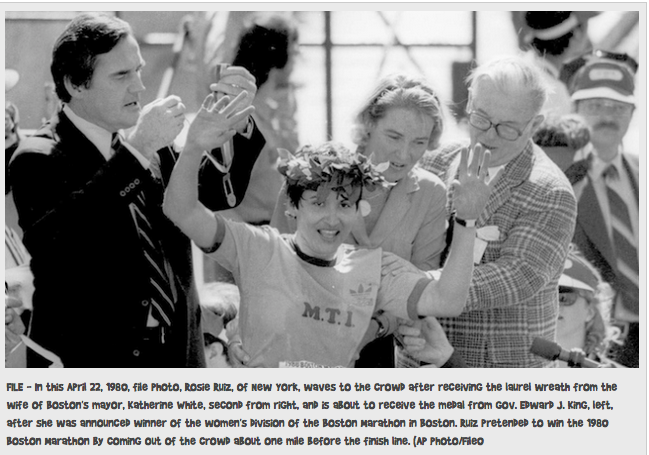
“Miss Ruiz, an administrative assistant for Metal Trading Inc. in Manhattan, received the traditional laurel wreath, a medal and a silver bowl for her victory,” According to the New York Times

Ruiz was unknown in the running world and her victory raised suspicions.  After studying marathon photographs she didn’t appear in any of them until the very end and conducting interviews.

The problem was that, according to Runners World: “Ruiz had dropped out of the race, hopped on the subway, got off about a mile from the finish line, and ran in from there.”   It is believed Ruiz intended to jump in in the middle of the pack but miscalculated when she joined so close to the end not realizing she was ahead of the other 448 female runners.Screen-Shot-2014-12-29-at-10.16.38-AM

Marathon officials stripped Ruiz of her title on April 29, 1980, and named Jacqueline Gareau of Canada the women’s division champion with a time of 2:34:28.  It was later discovered that she had also taken the subway during part of the New York City Marathon which qualified her for the Boston Marathon.  In 1982 she was caught stealing money from her employer and was subsequently caught selling drugs to an undercover officer in Florida.

Screen Shot 2015-03-19 at 9.02.57 PM

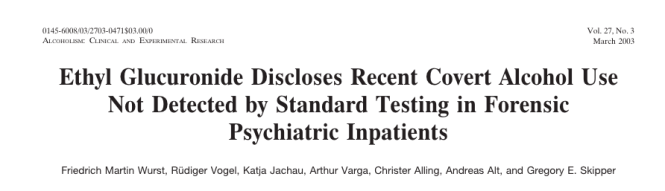
In the early 1950’s it was discovered that a small fraction of ingested alcohol in rabbits gets metabolized by conjugation with glucuronic acid to form Ethyl Glucuronide (EtG)..1,2 The potential of EtG as a marker for alcohol consumption was recognized in the 1990s and analytical methods for its determination were developed in urine, blood and hair.3-5

It’s use as a marker of alcohol consumption in forensic settings was subsequently suggested by Dr. Friedrich Wurst based on studies showing that urine EtG could be detected after complete elimination of alcohol from the body (up to 80 hours), and he suggested the alcohol biomarker be utilized in forensic monitoring to improve public health.   6,7

Wurst et al note that a “marker of high sensitivity and specificity capable of monitoring patients in treatment for alcohol or other drug abuse” could “improve therapy outcome and quality of life in patients, increase safety at work places and in traffic, avoid harm to the unborn during pregnancy (fetal alcohol syndrome) and reduce costs by making therapy more effective and reducing productivity loss.”7
Screen Shot 2015-03-19 at 8.52.29 PM

A literature search from 1952 to 2002 yields one conclusion and once conclusion only; EtG measurements increase with alcohol ingestion. There are no studies considering what other factors might increase EtG measurements.

The false logic takes the following form:

  • Premise: Event A occurred after (or with) event B.
  • Conclusion: Therefore, event A caused event B.

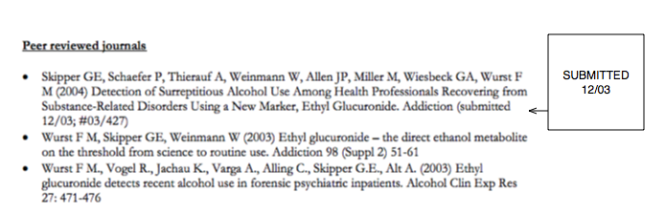
But in 2003 Wurst and Gregory Skipper, M.D., FASAM, Medical Director of the Alabama Physician Health Program reported at an international meeting of the American Medical Society that EtG provided proof of alcohol consumption as much as 5 days after drinking an alcoholic beverage and that there are now a substantial number of studies in the world literature that support the clinical importance and reliability of EtG as a marker of recent alcohol consumption.8

“In the future it will be negligent not to test for EtG when monitoring recovering alcoholics,” reported Dr. Skipper.8

Also, in 2003, Skipper pitched the test to National Medical Services, Inc. (NMS labs) who then developed it as a Laboratory Developed Test (LDT).9
Screen Shot 2015-03-19 at 11.49.56 PM

Because of its high sensitivity the newly marketed test was suggested as a tool to monitor health care professionals by Skipper in 2004.10   Skipper then approached the Federation of State Medical Boards and pitched the test to them proposing it be used in the assessment and monitoring of doctors by state Physician Health Programs.   In a stunning example of policy entrepreneurship a market was created and filled simultaneously.
images-4

“Detection of Alcohol Use in Monitored Aftercare Programs: A National Survey of State Physician Health Programs11 published in the Journal of Medical Licensure and Discipline in 2004 found that “surreptitious alcohol use was a significant concern” for state Physician Health Programs (PHPs) yet no “best methods for detecting alcohol use.” The 36-question phone interview was conducted with directors of PHPs in 46 states regarding current methods of drug testing and notes:Screen Shot 2015-03-20 at 4.06.32 AM
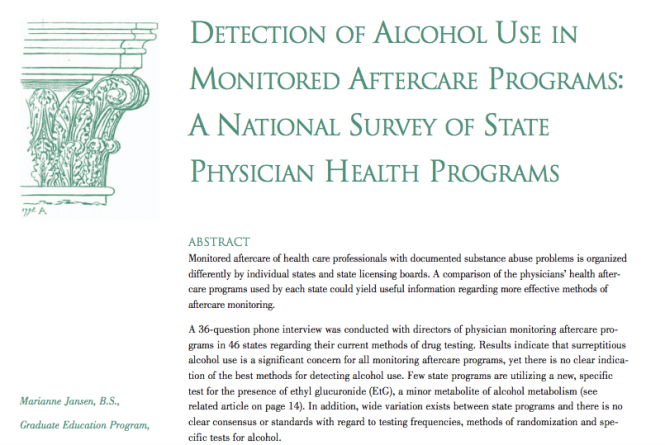
“Because alcohol is the most frequently abused substance adequate monitoring for alcohol is a major concern. During rehabilitation and recovery, the potential for alcohol abuse may increase due to the lack of efficient screening tests. The ingestion of alcohol while in aftercare is a violation of the contractual agreement made with the monitoring program and may lead to relapse and/or abuse of other psychoactive substances, thus rendering the practitioner unsafe to practice their profession. Therefore, alcohol detection remains an important component of contract compliance and sobriety.”
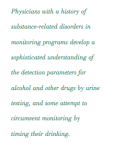
Screen Shot 2015-03-19 at 9.09.39 PMThey conclude that: “EtG can be detected in urine as long as 18 hours after blood alcohol levels reach zero and demonstrates exceptional specificity (100 percent) and sensitivity because even small amounts of alcohol (7 g, or less than one alcoholic beverage) can be detected.”

This very same issue of the Journal of Medical Licensure and Discipline contains an article written by Skipper concerning new marker to detect alcohol use in “recovering physicians” that “has recently been introduced in the United States and an assay for EtG is now commercially available.”12

Screen Shot 2015-03-19 at 9.08.30 PM

Skipper states that “EtG is not detectable unless alcohol has been consumed” and notes the “usefulness of the test was affirmed in one study involving psychiatric inpatients”Screen Shot 2015-03-19 at 9.09.15 PM
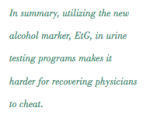
An EtG above 500 renders it “extremely unlikely” that alcohol was not ingested and adds “ In any event, if testing is positive” in monitored doctors it is advisable to refer them for further in-depth evaluation by clinicians or programs skilled and adept at evaluating physicians.”

In Bending Science: How Special Interests Corrupt Public Health Research13, Thomas McGarity and Wendy Wagner describe how special interest groups scheme to advance their own economic or ideological goals by using distorted or “bent” science to influence legal, regulatory and public health policy.

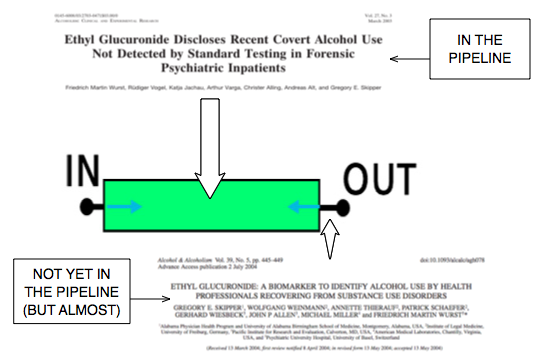
The authors describe a “separatist view” of the world that assumes scientific research is sufficiently reliable for public policy deliberations and legal proceedings once it flows out of the realm of science through a pipeline in which the scientific community has ensured through rigorous peer-review and professional oversight that the final product that exits the pipeline is unbiased and produced in accordance with the norms and procedures of science.

Screen Shot 2015-02-05 at 10.49.27 AM

This view does not consider the possibility that the scientific work exiting the pipeline could be distorted and contaminated by biasing influences.

If we look at this through the lens of “bent science” several issues arise including a failure to adhere to the norms and standards of toxicology and forensic drug and alcohol testing, an absence of evidence base and glaring conflicts of interests.

Norms and Standards of Toxicology and Forensic Drug Testing

On September 15, 1986 President Ronald Reagan signed Executive Order 12,564 requiring that the urine of federal employees in “sensitive” jobs be sampled randomly for illegal drugs. In 1988 Congress followed with the Drug-Free Workplace Act and drug testing became common organizational practice by the mid 1990s. Most followed the federal norms and procedures in their testing.

The Department of Health and Human Services (DHHS) had established specific cutoff levels that define a positive result.   These values were developed to help eliminate false-positive results.14 The cutoff levels were originally established at a drug concentration that produced an analytic signal some multiplicative factor above the noise level (the signal obtained from drug free urine).

“The concept of cutoff for major urine screening programs has two basic applications: the lower limit of reliable testing based on the techniques involved in the testing and the lower limit of reliable testing based on the possibility of interference from medications, foodstuffs, environmental exposure, or endogenous processes.”15

“Urine Drug Testing in Clinical Practice: Dispelling the myths & Designing Strategies cautions about “caveats to interpretation.” “As with any unexplained test result, it is important to clarify the interpretation with someone knowledgeable in clinical toxicology.”16

Evidence Base

What was in the pipeline when the EtG was proposed as a forensic monitoring tool can be illustrated below:

Screen Shot 2015-03-19 at 9.02.57 PM

Taking Advantage of a Loophole

The EtG was developed by NMS labs as a “Laboratory—Developed Test” or LDT. The LDT pathway does not even require proof of validity, that the test is actually testing for what it claims to be testing, and with no FDA oversight a lab can claim any validity it wants in its marketing and sales, and they did.   Proponents for regulation of LDTs argue this lack of oversight is a direct threat to patient care and safety. An viewpoint piece in JAMA states that a   “patient’s life or death could hinge on whether a single, unregulated diagnostic test result is meaningful.” 17

In the case of EtG Skipper arbitrarily chose a value of 100 as a cut-off for EtG. The rationale behind this value is not cited. Interference with foods, medications and environmental exposures had not been worked out. The results were predictable.

Aftermath was Predictable and Therefore Avoidable

The case of EtG is exemplifies ‘policy entrepreneurship” and “bent science” at its worst. It shows how junk-science can be introduced into the market without any real difficulties or meaningful opposition and how self-interest is promoted in defiance of science in an effort to manipulate public policy. This is nothing more than opportunist exploitation of the regulatory framework and the FSMB eagerly complied.   Without this “regulatory sanctification” none of these tests would have ever made it to market.

EtG was subsequently found to be so sensitive that it could measure incidental exposure to alcohol in foods, over the counter cold medications, mouthwash18,19, hand sanitizer gel20, nonalcoholic beer21, and nonalcoholic wine.22

“Exposure to ethanol-containing medications, of which there are many, is another potential source of “false” positives.

Forbidding patients/subjects access to such medications may be unrealistic, and even unwise.”23

The United States Substance Abuse and Mental Health Services Administration warned against using a positive EtG as primary or sole evidence of drinking for disciplinary or legal action.24 The advisory states:

“Although positive biomarker results should be taken seriously, use of certain biomarkers, such as EtG, is now warranted as stand-alone confirmation of relapse because research has not yet established an acceptable standard to distinguish possible exposure to alcohol in various commercial products from consumption of alcoholic beverages.”

The Wall Street Journal in 2006 reported the problems with the EtG to the general public.25

The authors of a 2011 study demonstrating that hand sanitizer alone could result in EtG concentrations of 1998 concluded that:

“in patients being monitored for ethanol use by urinary EtG concentrations, currently accepted EtG cutoffs do not distinguish between ethanol consumption and incidental exposures, particularly when urine specimens are obtained shortly after sustained use of ethanol containing hand sanitizer.”26

images-5Sauerkraut and bananas have even recently been shown to cause positive EtG levels.27

A 2010 study found that consumption of baker’s yeast with sugar and water28 led to the formation of elevated EtG above the standard cutoff.images-6

EtG can originate from post-collection synthesis if bacteria is present in the urine.29 Collection and handling routines can result in false-positive samples.30

EtG varies among individuals.31 Factors that may underlie this variability include gender, age, ethnic group, and genetic polymorphisms.

images-9

The Cochrane Collaboration does systematic reviews of the literature using conscientious, explicit, and judicious criteria to in order to produce and disseminate only high quality and evidenced based health care, exclude bias, and enhance transparency.

The Cochrane database is internationally recognized as the standard in evidence based health care.   It records just 5 controlled trials under the topic ethyl glucuronide.22,31-33

These 5 studies represent the only high-quality evidence regarding EtG to date. Information provided by the five studies suggests the following, and only the following:

  1. EtG measurements increase with alcohol ingestion.
  2. The window of detection is shorter than what is commonly proposed (80 hours).
  3. Individual values are variable both within and between subjects.
  4. Non-alcoholic wine can cause positive levels.

During this time period any rational authority would have admitted error and removed the test from the market. Skipper’s approach was to keep raising the cutoff level from 100 to 250 to 500 to 1000. With EtG paving the way for other laboratory developed tests he then added “confirmatory” LDTs such as EtS and PEth. The EtS was found to have the same problems and PEth inevitably will but this is now a billion dollar market and they plan on using these tests on almost everyone including kids.

There has been no academic, public policy or conflict of interest analysis of all of this. As probably the worst case of bent-science in history there needs to be.

  1. Kamil A, Smith JN, Williams RT. A New Aspect of Ethanol Metabolism: Isolation of ethylglucuronide. Biochemical Journal. 1952;51:32-33.
  2. Kamil IA, Smith JN, Williams RT. Studies in detoxication. L. The isolation of methyl and ethyl glucuronides from the urine of rabbits receiving methanol and ethanol. The Biochemical journal. Jun 1953;54(3):390-392.
  3. Schmitt G, Aderjan R, Keller T, Wu M. Ethyl glucuronide: an unusual ethanol metabolite in humans. Synthesis, analytical data, and determination in serum and urine. Journal of analytical toxicology. Mar-Apr 1995;19(2):91-94.
  4. Schmitt G, Droenner P, Skopp G, Aderjan R. Ethyl glucuronide concentration in serum of human volunteers, teetotalers, and suspected drinking drivers. Journal of forensic sciences. Nov 1997;42(6):1099-1102.
  5. Aderjan RE. Ethyl glucuronide. A non-volatile ethanol metabolite in hair. 1995.
  6. Wurst FM, Seidl S, Alt A, Metzger J. [Direct ethanol metabolite ethyl glucuronide. Its value as alcohol intake and recurrence marker, methods of detection and prospects]. Psychiatrische Praxis. Nov 2000;27(8):367-371.
  7. Wurst FM, Seidl S, Ladewig D, Muller-Spahn F, Alt A. Ethyl glucuronide: on the time course of excretion in urine during detoxification. Addiction biology. Oct 2002;7(4):427-434.
  8. Martin DM, G.E. S, Costantino A. Alcohol Use Can Now be Detected for Days Rather than Hours Using a New Test, Ethyl Glucuronide. 2003; http://www3.firstlab.com/media/16032/EtGFirstLabReport.pdf.
  9. Skipper G. “Urine Luck” Overview of New Drug Testing Technologies and Conundrums. http://gregskippermd.weebly.com/uploads/7/4/7/5/74751/skipper.urine_luck_2014_aaap_meeting.pdf. Accessed March 17, 2015.
  1. Skipper GE, Weinmann W, Thierauf A, et al. Ethyl glucuronide: a biomarker to identify alcohol use by health professionals recovering from substance use disorders. Alcohol Alcohol. Sep-Oct 2004;39(5):445-449.
  2. Jansen M, Bell LB, Sucher MA, Stoehr JD. Detection of Alcohol Use in Monitored Aftercare Programs: A National Survey of State Physician Health Programs. Journal of Medical Licensure and Discipline. 2004;90(2):8-13
  1. Skipper G, Weinmann W, Wurst F. Ethylglucuronide (EtG): A New Marker to Detect Alcohol Use in Recovering Physicians. Journal of Medical Licensure and Discipline. 2004;90(2):14-17.
  2. McGarity TO, Wagner WE. Bending Science: How Special Interests Corrupt Public Health Research. Cambridge, MA: Harvard University Press; 2008.
  3. US Department of Health and Human Services. Mandatory guidelines and proposed revisions to mandatory guidelines for federal workplace drug testing programs: notices. Federal Register. April 13, 2004;69(71):19659-19660.
  4. Clark HW. The role of physicians as medical review officers in workplace drug testing programs. In pursuit of the last nanogram. West J Med. May 1990;152(5):514-524.
  5. Resnick RB, Volavka J, Freedman AM, Thomas M. Studies of EN-1639A (naltrexone): a new narcotic antagonist. Am J Psychiatry. Jun 1974;131(6):646-650.
  6. Sharfstein J. FDA Regulation of Laboratory-Developed Diagnostic Tests: Protect the Public, Advance the Science. JAMA : the journal of the American Medical Association. Jan 5 2015.
  7. Costantino A, Digregorio EJ, Korn W, Spayd S, Rieders F. The effect of the use of mouthwash on ethylglucuronide concentrations in urine. Journal of analytical toxicology. Nov-Dec 2006;30(9):659-662.
  8. Reisfield GM, Goldberger BA, Pesce AJ, et al. Ethyl glucuronide, ethyl sulfate, and ethanol in urine after intensive exposure to high ethanol content mouthwash. Journal of analytical toxicology. Jun 2011;35(5):264-268.
  9. Rosano TG, Lin J. Ethyl glucuronide excretion in humans following oral administration of and dermal exposure to ethanol. Journal of analytical toxicology. Oct 2008;32(8):594-600.
  10. Thierauf A, Gnann H, Wohlfarth A, et al. Urine tested positive for ethyl glucuronide and ethyl sulphate after the consumption of “non-alcoholic” beer. Forensic Sci Int. Oct 10 2010;202(1-3):82-85.
  11. Hoiseth G, Yttredal B, Karinen R, Gjerde H, Christophersen A. Levels of ethyl glucuronide and ethyl sulfate in oral fluid, blood, and urine after use of mouthwash and ingestion of nonalcoholic wine. J Anal Toxicol. Mar 2010;34(2):84-88.
  12. Jatlow P, O’Malley SS. Clinical (nonforensic) application of ethyl glucuronide measurement: are we ready? Alcohol Clin Exp Res. Jun 2010;34(6):968-975.
  13. Administration SAaMHS. The role of biomarkers in the treatment of alcohol use disorders. In: Advisory SAT, ed2006:1-7.
  14. Helliker K. A test for alcohol–and its flaws. The Wall Street Journal2006.
  15. Reisfield GM, Goldberger BA, Crews BO, et al. Ethyl glucuronide, ethyl sulfate, and ethanol in urine after sustained exposure to an ethanol-based hand sanitizer. Journal of analytical toxicology. Mar 2011;35(2):85-91.
  16. Musshoff F, Albermann E, Madea B. Ethyl glucuronide and ethyl sulfate in urine after consumption of various beverages and foods–misleading results? Int J Legal Med. Nov 2010;124(6):623-630.
  17. Thierauf A, Wohlfarth A, Auwarter V, Perdekamp MG, Wurst FM, Weinmann W. Urine tested positive for ethyl glucuronide and ethyl sulfate after the consumption of yeast and sugar. Forensic Sci Int. Oct 10 2010;202(1-3):e45-47.
  18. Helander A, Olsson I, Dahl H. Postcollection synthesis of ethyl glucuronide by bacteria in urine may cause false identification of alcohol consumption. Clinical chemistry. Oct 2007;53(10):1855-1857.
  19. Helander A, Hagelberg CA, Beck O, Petrini B. Unreliable alcohol testing in a shipping safety programme. Forensic science international. Aug 10 2009;189(1-3):e45-47.
  20. Sarkola T, Dahl H, Eriksson CJ, Helander A. Urinary ethyl glucuronide and 5-hydroxytryptophol levels during repeated ethanol ingestion in healthy human subjects. Alcohol and alcoholism. Jul-Aug 2003;38(4):347-351.
  21. Hoiseth G, Bernard JP, Stephanson N, et al. Comparison between the urinary alcohol markers EtG, EtS, and GTOL/5-HIAA in a controlled drinking experiment. Alcohol and alcoholism. Mar-Apr 2008;43(2):187-191.
  22. Wojcik MH, Hawthorne JS. Sensitivity of commercial ethyl glucuronide (ETG) testing in screening for alcohol abstinence. Alcohol and alcoholism. Jul-Aug 2007;42(4):317-320.

Screen Shot 2013-10-28 at 10.24.14 PM


Class Action Suit Filed Against Michigan PHP Alleging Constitutional Violations Related to Involuntary Treatment

Screen Shot 2015-01-09 at 1.59.40 AMA Federal class action lawsuit has been filed in the Eastern District of Michigan against the state PHP program alleging constitutional violations related to the forced medical treatment of health care professionals involved in the State’s  “Professionals Health Program” (PHP)  and the “callous and reckless termination of professional licenses without due process.”  According to the complaint:
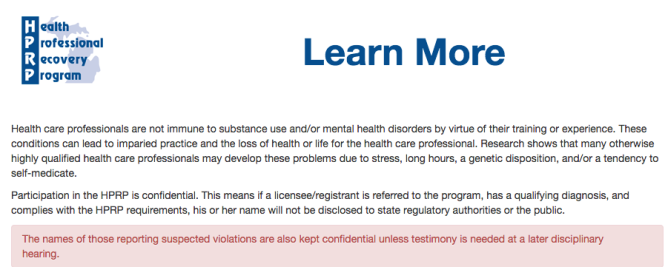
“The Health Professional Recovery Program (HPRP) was established by the Michigan Legislature as a confidential, non-disciplinary approach to support recovery from substance use or mental health disorders. The program was designed to encourage impaired health professionals to seek a recovery program before their impairment harms a patient or damages their careers through disciplinary action. Unfortunately, a once well-meaning program, HPRP, has turned into a highly punitive and involuntary program where health professionals are forced into extensive and unnecessary substance abuse/dependence treatment under the threat of the arbitrary application of pre-hearing deprivations (Summary Suspension) by LARA.filed in the the State of Michigan and a private contractor (Ulliance, Inc. of Troy, Michigan) engaged in a conspiracy to violate the civil rights of Michigan health professionals by involuntarily subjecting them to excessive and unnecessary treatment for substance abuse and suspending their licenses if they do not comply.”

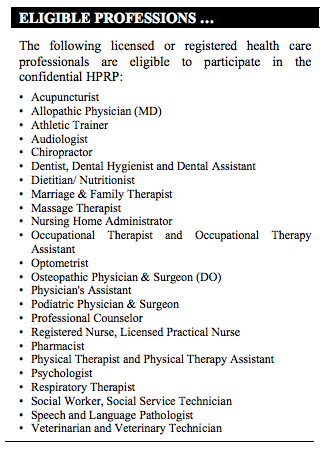
As is the case with most PHPs across the country taken over by the FSPHP the mechanics and mentality are the same.  Referrals can be made anonymously by “colleagues, partners, hospital administrations, patients, family members, or the State” to the PHP for any health professional (from acupuncturist to veterinarian) exhibiting “potential signs of impairment”

The HPRP website states the names of those reporting are kept confidential “unless testimony is needed at a later disciplinary hearing.”

Screen Shot 2015-03-16 at 3.28.39 AMAfter initial intake with HPRP, the licensee is referred to a “qualified evaluator” and “If the evaluation indicates a substance use and/or mental health disorder that represent a possible impairment” the HPRP makes referrals for treatment services to an “approved provider.Screen Shot 2015-03-16 at 3.29.35 AM
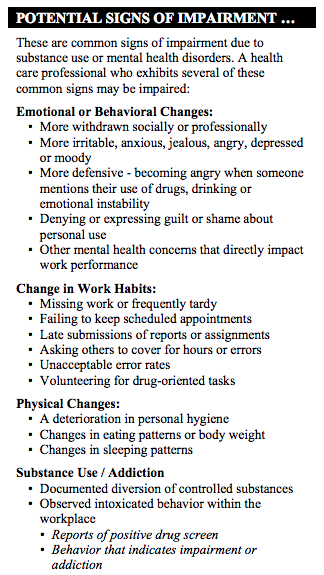
The “qualified evaluators” and “approved providers” are undoubtedly  the same out-of-state  facilities North Carolina state Auditor Beth Woods found her state program was referring to in her audit of the N.C. PHP under the undefinable justification they were “PHP-approved.”

As with North Carolina,  the Michigan PHP will be unable to provide what quality indicators and quantitative measurements are being used to “qualify” and “approve these facilities.    None exist as the common denominators in these “PHP-approved” and state mandated assessment and treatment centers are ideological and economic.  

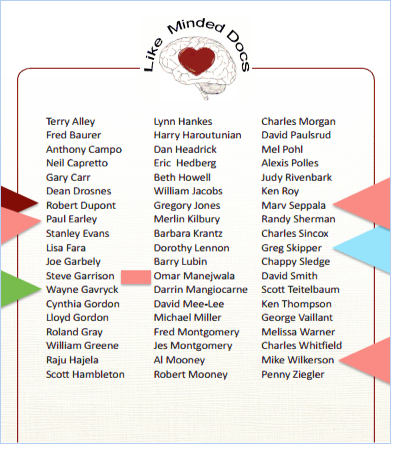
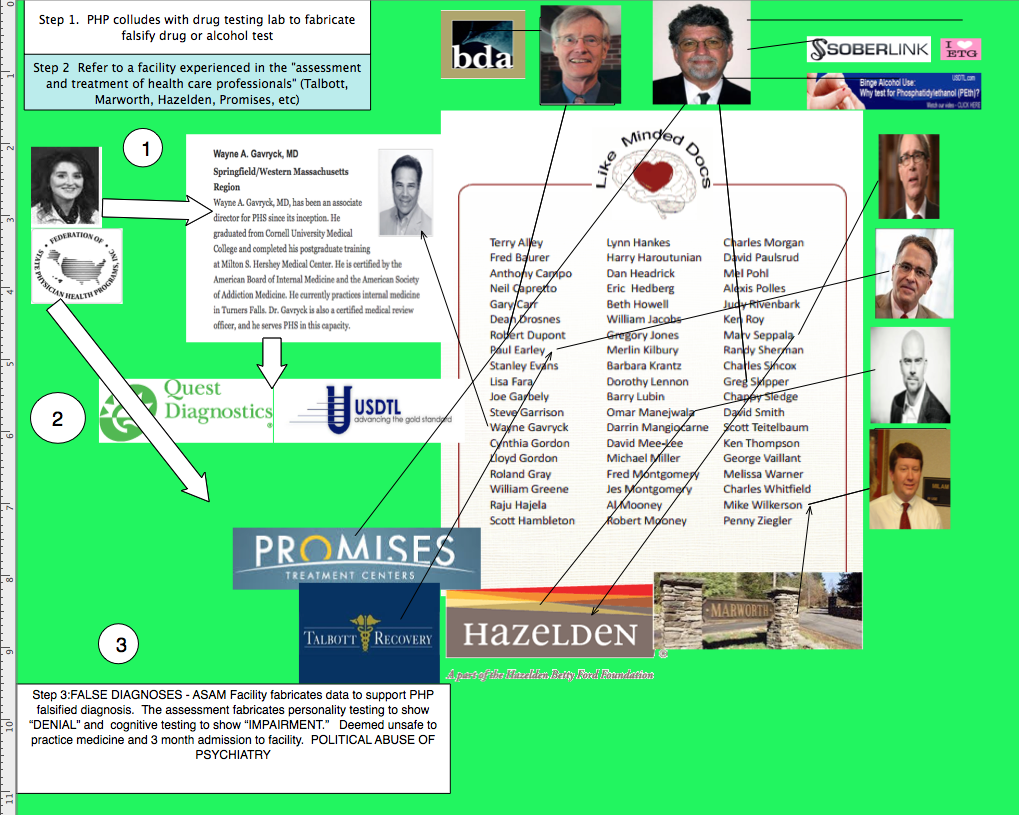
The medical directors of almost if not all of them can be seen on this list of “like-minded docs.”  The conflicts-of-interest and intertwined relationships among this group is staggering.

The philosophy of Like-Minded Docs is the following:

“We believe that evidence from extensive, well-designed studies demonstrates the great benefits of Twelve-Step recovery modalities including Twelve Step Facilitation in promoting long-term recovery. Further, Twelve-Step modalities are compatible with other treatment strategies including medication-management. We believe that Addiction specialists need to facilitate a path for our patients toward the best possible state of wellness and recovery as they receive treatment for this chronic disease.  We believe a well-rounded educational and clinical preparation for physicians choosing to practice addiction medicine or addiction psychiatry requires a comprehensive exposure to the psychosocial and spiritual modalities of treatment as well as the neurobiological and psychopharmacological modalities.”

This connection needs to be made by both North Carolina and Michigan as the state is mandating treatment not only to assessment and treatment centers with economic conflicts of interest but with ideological ones as well.  Health care practitioners are being forced into evaluations exclusively at 12-step facilities and excluding non-12 step assessment and treatment centers.  This is a clear violation of the Establishment Clause of the 1st Amendment.

The complaint goes on to state the HPRP:

“has expanded its role to include making treatment decisions in place of the opinions of qualified providers. Licensees are subjected to intake evaluations by a pre-selected cadre of providers who profit from the enrollment of HPRP members. This process culminates in a large number of health professionals receiving a “Monitoring Agreement” which is essentially a nonnegotiable contract for treatment selected by HPRP. While HPRP’s contract with the State requires that treatment be selected by an approved provider and that it be tailored in scope and length to meet the individual licensee’s needs, licensees generally receive the same across-the-board treatment mandates regardless of their diagnosis or condition. Further, treatment providers are not permitted to recommend the specific treatment rendered and HPRP has a policy that only HPRP can set the terms of the treatment required in the contract. Failure to “voluntarily” submit to unnecessary and costly HPRP treatment results in automatic summary suspension..”

“Facing the threat of summary suspension in the event of non-compliance, licensed health professionals are induced into a contract as a punitive tool of BHCS and are often required to refrain from working without prior approval, refrain from taking prescription drugs prescribed by treating physicians, and sign broad waivers allowing HPRP to disclose their private health information to employers, the State of Michigan, and/or treating physicians.”

“Every licensee in the State of Michigan who has received a summary suspension, as a result of HPRP non-compliance, has had their private health data transmitted to the BHCS for use during administrative proceedings. In short, the mandatory requirements of HPRP, coupled with the threat of summary suspension, make involvement in HPRP an involuntary program circumventing the due process rights of licensees referred to the program. The involuntary nature of HPRP policies and procedures as outlined above and the unanimous application of suspension procedures upon HPRP case closure are clear violations of Procedural Due Process under the Fourteenth Amendment.”

This is exactly the same system of institutional injustice seen at Ridgeview under G. Douglas Talbott.  Multiple physician suicides were attributed to these same abuses–involuntary forced treatment under extortion of loss of licensure.  It is time this elephant in the room be addressed in terms of the marked increased in suicide we are seeing now.


http://www.chapmanlawgroup.com/hprp-class-action/

Health Professionals File Class Action Against HPRP

Jurisdiction: U.S. District Court for the Eastern District of Michigan

Subject: Plaintiff’s filed a class action lawsuit on behalf of Michigan health care professionals, alleging constitutional violations related to the forced medical treatment of health care professionals involved in the State’s substance abuse monitoring program (HPRP) and the callous and reckless termination of professional licenses without due process by HPRP and the Bureau of Healthcare Services.

Three Michigan health professionals filed a federal class action for due process violations arising out of execution of a State substance abuse monitoring program known as the Health Professionals Recovery Program. According to the class action lawsuit filed today in the Eastern District of Michigan, the State of Michigan and a private contractor (Ulliance, Inc. of Troy, Michigan) engaged in a conspiracy to violate the civil rights of Michigan health professionals by involuntarily subjecting them to excessive and unnecessary treatment for substance abuse and suspending their licenses if they do not comply.

HPRP, intended as a voluntary treatment program by the legislature, has become a highly punitive and involuntary tool designed to circumvent due process, the complaint states. However, according to the complaint, Carole Engle, the Former Director of the Bureau of Healthcare Services, implemented a policy that any person who does not voluntarily submit to this unnecessary treatment would be immediately suspended without a hearing and prevented from practicing as a health professional. Carole Engle recently resigned her position after Governor Snyder refused to renew her contract with the State of Michigan. It is unclear whether her recent resignation is related to the recently filed class action.

The controversial treatment program has generated a significant amount of criticism in recent years from Michigan health professionals who have called for a class action in an effort to stop HPRP’s abuse of their broad sweeping power. For years, HPRP subjected nurses to three years of intense addiction treatment sometimes on the basis of an anonymous tip.

“We turned to the courts for fairness because HPRP’s mandate of unnecessary treatment has ruined countless lives. My life has been ripped apart by HPRP despite the fact that two evaluators determined that I do not need treatment. I am only one of hundreds who have had to choose between suspension of my license and tens of thousands of dollars worth of treatment that was unnecessary – I just couldn’t afford it, and now I can no longer practice as a nurse” said Carol Lucas, a registered nurse and a Plaintiff in the class action.

Chapman Law Group, a Michigan health care law firm, filed the complaint on behalf of three named Plaintiffs, each of whom fell victim to HPRP’s demand that they submit to unnecessary treatment or have their license suspended. The class includes Michigan health professionals who are or were participants in the Health Professionals Recovery Program during the period from January 1, 2011 to present.

The complaint and amended complaint can be seen below:

Michigan Case 2-15-cv-10337

Michigan Amended Complaint 2-15-cv-10337


Bent Science and Bad Medicine: The Medical Profession, Moral Entrepreneurship and Social Control

IMG_9005The Medical Profession, Moral Entrepreneurship, and Social Control

Sociologist Stanley Cohen  used the term “”moral panic” to characterize the amplification of deviance by the media, the public, and agents of social control.1  Labeled as being outside the central core values of consensual society, the deviants in the designated group are perceived as posing a threat to both the values of society and society itself.   Belief in the seriousness of the situation justifies intolerance and unfair treatment of the accused.   The evidentiary standard is lowered.

Howard Becker describes the role of “moral entrepreneurs,” who crusade for making and enforcing rules that benefit their own interests by bringing them to the attention of the public and those in positions of power and authority under the guise of righting a society evil. 2

And according to cultural theorist Stuart Hall, the media obtain their information from the primary definers of social reality in authoritative positions and amplify the perceived threat to the existing social order. The authorities then act to eliminate the threat.3  The dominant ideas or ideologies are reproduced by relying on the opinions of the defining authority and then spread through the media. The communal good has been assailed.

As a society governed by organizations, associations,  institutions and regulatory bodies, the medical profession is not immune to “moral panics.”  A threat to patient care or the values of the profession can be identified and amplified.   A buildup of public concern fueled by media attention ensues creating a need for governing bodies to act. Medical Professionalism and the Public Health has been assailed.

Unbeknownst to the general public and most members of the medical profession at large, certain groups have gained tremendous sway within medical society. Through  moral entrepreneurship they have gained authority and become  the primary definers of the governance of the medical profession and the social control of  doctors.  To benefit their own interests they have fostered and fueled “moral panics” and “moral crusades. ” Exhorting authorities to fight these  threats by any means necessary  they have successfully made and enforced rules and  regulations and introduced new definitions and tools with no meaningful resistance or opposition.

The Inquisition did not have to convince  individual citizens or the general public of their beliefs to advance an agenda; just Ecclesiastical and Political Authority.  Similarly, the  “impaired physicians movement” did not have to convince individual doctors or the medical profession of their beliefs  to further a self-serving agenda; just  regulatory and administrative authority.

Addiction Medicine Monopoly, False Authority and Conflicts of Interest

The “impaired physicians movement” can be defined as a group of physicians with alcohol and substance abuse problems who, having found sobriety through 12-step spirituality, banded together to promote the ideology behind their personal  “recovery”  to other doctors and the medical community at large. In the 1980s the movement gained momentum and as their numbers grew  began calling themselves  specialists in “addiction medicine.”  The American Society of Addiction Medicine (ASAM)  is not a true specialty, but a Self-Designated-Practice-Specialty, which simply means that is what they are calling themselves.  It reflects neither knowledge nor expertise..  “Board certification” by the American Board of Addiction Medicine (ABAM) is not recognized by the American Board of Medical Specialties (ABMS).

ABAM certification requires only a medical degree, a valid license to practice medicine, and completion of residency training in ANY specialty.  Addiction Psychiatry, a subspecialty of psychiatry under the American Board of Neurology and Psychiatry  is the only  specialty recognized by the ABMS. and their specialty society is the American Academy of Addiction Psychiatry.

The ASAM is schooled in just one one uncompromising model of addiction with the majority attributing their very own sobriety to that model–the chronic relapsing “brain disease” with lifelong abstinence and 12-step spiritual recovery model.   As the “voice of addiction medicine,” the ASAM has nevertheless defined the dominant treatment paradigm in the United States.   ASAM doctors outnumber addiction psychiatrists by 4:1 and the movement is well funded.   Because addiction is defined as a “disease”, addicts must be “treated” (more often coercive than voluntary), and “cured” (defined as abstinent).  The billion dollar  assessment and treatment industry and the drug and alcohol testing industry  lucratively profits from this model which has grown to monopolize addiction treatment  in the United States.

The goal of the ABAM Foundation is to “gain recognition of Addiction Medicine as a medical specialty by the American Board of Medical Specialties (ABMS).”   A monopoly defined by self-appointed experts without recognized  specialty training will soon likely Robber baron their way to being accepted as  a true specialty.Screen Shot 2015-02-28 at 8.15.35 AM

Physician Health Programs, Regulatory Agencies, and Treatment Centers

Physician Health Programs (PHPs) meet with, assess, and monitor doctors who have been referred to them for substance use or other mental or behavioral health problems. Unless being monitored by one, PHP practices are unknown to most physicians and operate outside the scrutiny of the medical community.  Initially funded by State Medical Societies and staffed by volunteer physicians,  PHPs  served the dual function of helping sick doctors and protecting the public.

As the populations of ASAM physicians proliferated  in the 1980s, many  joined their state Physician Health Programs. PHP doctors who did not agree with the ASAM groupthink were gradually removed  and they  organized under the Federation of State Physician Health Programs (FSPHP).  Other ASAM physicians found employment at treatment centers as staff physicians and medical directors.

The FSPHP cultivated a relationship with the  Federation of State Medical Boards (FSMB) and the state PHPs formed alliances with their  state medical boards. Promoting themselves as offering “treatment” rather than”punishment” they offered an alternative to disciplinary action.  They then began promoting their successful outcomes  in rehabilitating “impaired physicians”,  and this history can be seen by examining the archives of the Journal of Medical Regulation and similar  publications.  In 1995 the   Washington  PHP claimed a success rate of  95.4%,   Tennessee  claimed 93% and Alabama 90%.

Part of this success was attributed  to the specialized  treatment centers for doctors directed by their ASAM colleagues such as  Ridgeview Institute in Atlanta created by G. Douglas Talbott.  Talbott, who helped organize and serve as past president of the ASAM claimed a 92.3 percent recovery rate. He also put forth a Medical Urban Legend–the proposition that doctors were a different species, separate from the rest of society, who needed special treatment three times longer than anyone else.  Amazingly, this dicto simpliciter argument that can, in fact, be refuted simply by pointing it out  was allowed to enter regulatory medicine unopposed.  Simply because, sadly, no one ever pointed out the logical fallacy. It is now entrenched.    Three months or more of treatment is  standard of care for our profession. They did this by getting medical boards and the FSMB to accept fantasy as fact by relying on board members tendency to accept expert evidence at face value.

Physicians are unique only insofar as the unique elements required of the profession to become and be a physician such as going to medical school and completing the required board examinations.  That’s it.    I implore anyone to put forth any sound argument based on science and evidence that justifies a thrice lengthy stay in medical professionals.  Not gonna happen.   Thought stopping memes and logical fallacy is the best they have to offer.  And, unfortunately this type of  rabbling gibberish cuts the mustard in the regulatory medicine venue.   A “low-bar” evidentiary standard is not the problem.  If you look at the documentary evidence from a medico-historical perspective there never was a bar.  The FSMB has essentially given the impaired physicians movement carte blanche authority and unrestrained managerial prerogative.  A bar never even existed.  It’s a laissez-faire Lord of the Flies free-for-all.    The logical fallacy of appeal to authority–illegitimate and irrational authority.  Bamboozled by smoke and mirrors.

A 1995 issue of the FSMB publication  The Federal Bulletin: The Journal of Medical Licensure and Discipline contains reports on eight  separate state  PHPs.   The “almost 90% success rate” was  applauded by the editor, who added  “cooperation and communication between the medical boards and the physician health programs must occur in an effort to protect the public while assisting impaired physicians in their recovery.”   And more recent reports suggest PHPs   reduce malpractice claims. They are now being promoted as a replicable model  to be used in other populations.

The problem is no one bothered to examine the methodology to discern the validity of these claims.  There has been no critical analysis or Cochrane type review of any of these studies which are invariably small, methodologically flawed, and biased.

The FSMB has accepted them as  expert authority and  their authoritative opinion as fact.  It  is this acceptance of faith without objective assessment that has allowed the ASAM and FSPH to advance their agenda. By  confusing ideological opinion  with professional knowledge, the FSMB and state Medical Boards have acted as willing gulls each step of the way. No counter-forces existed.  And they still don’t.   Junk science and unvalidated neuropsychological testing is used by these groups unconstrained and willfully.  There is no regulation, oversight, or accountability.  They are using polygraph testing (despite the AMA’s previous public policy statement deeming it junk) to both condemn “disruptive” surgeons and deem convicted pedophiles fit to return to work.  They have introduced junk-science in drug and alcohol testing and unvalidated “neuropsychological” testing to detect “character-defects” by getting regulatory agencies to accept the validity of these tests not by the Scientific Method or Evidence Based Research but by (to coin a term) “Regulatory Sanctification”

To paraphrase one FSPHP member,   “Who needs evidence-based medicine when the boards have already accepted these tests as valid?”  Who indeed?

The ideological bias and financial conflicts of interest between PHPs and the  treatment centers was also not recognized. It still isn’t.  The  spotlights are apparently all  on Big Pharma  in this regard.    Some sunlight needs to be exposed in the direction of the billion dollar drug and alcohol testing and assessment industry as well.

Doctors  were held at Ridgeview three times longer than the rest of the population (and at three times the cost)  under threat of loss of licensure.   Although there is no evidence base or plausible explanation why an entire profession would have a three-times  longer length of stay than the rest of the population this continues to be the reality. There is no choice.

in 2011 The ASAM issued a Public Policy Statement on coordination between PHPs, regulatory agencies, and treatment providers recommending  that  only “PHP approved” treatment centers be used in the assessment and treatment of doctors.  It specifically excludes non “PHP -recognized” facilities.  And what defines a “PHP approved” treatment center?    In addition to finding essentially no oversight by the state medical society and medical board, a recent audit of the  North Carolina PHP found financial conflicts of interest and no  documented criteria for selecting the out of state treatment centers they used.  The common denominator the audit missed was that the 19  “PHP-approved” centers were all ASAM facilities just like Ridgeview whose medical directors can be seen on this list.

The appeal to authority logical fallacy has enabled the FSPHP to become the expert authority on physician impairment through the eyes of the medical boards.  It has also allowed them to increase their scope.

The FSMB House of Delegates adopted an updated Policy on Physician Impairment at their 2011 annual meeting distinguishing “impairment” and “illness”  stating that:

“Regulatory Agencies should recognize the PHP as their expert in all matters relating to licensed professionals with ‘potentially impairing illness.'”

According to the FSPHP, physician illness and impairment exist on a continuum with illness typically predating impairment, often by many years.”

The policy extends PHP authority to cover physical illnesses affecting cognitive, motor, or perceptive skills, disruptive physician behavior, and “process addiction” (compulsive gambling, compulsive spending, video gaming, and “workaholism”). It also defines “relapse without use” as “behavior without chemical use that is suggestive of impending relapse.”

G. Douglas Talbott defines  “relapse without use”  as  “emotional behavioral abnormalities” that often precede relapse or “in A A language –stinking thinking.”  AA language has entered the Medical Profession and no one even blinked.  It will get worse.

The ASAM has  monopolized addiction treatment in the United States.   It has imposed  it on doctors through the FSPHP.  The FSPHP political apparatus exerts a monopoly of force. It selects who will be monitored and dictates every aspect of what that entails.  It is a, in fact, a  rigged game.

Inherent in this model is the importance of external control.  It gives them power to exert control over the individual regardless of whether they need to be treated.

By bamboozling regulatory medicine this was accomplished.    And the maintenance of this relationship is necessary as this  presentation  by an FSPHP physician  warns, “guard this relationship jealously.”

Screen Shot 2015-03-04 at 7.27.11 PM

Moral Panics and Moral Crusades

By introducing and fueling moral panics the ASAM/FSPHP political apparatus has been able to expand in both scope and power.

The Medscape article “Drug Abuse Among Doctors:  Easy, Tempting, and Not Uncommon” published in the “Business of Medicine” section in January 2014 is characteristic example of the authoritative opinion, propaganda, and misinformation spun to maintain a pervasive climate of fear. Proof by anecdote.  Physicians are “5 times as likely as the general public to misuse prescription drugs” according to Lisa Merlo, PhD.  “Given the epidemic of prescription addiction sweeping the nation, that’s a grim statistic.”

Described as a “researcher at the University of Florida’s Center for Addiction Research and Education,” Merlo’s research involving 55 doctors being monitored by their state Physician Health Program published in the Journal of Addiction Medicine in October 2013 found “most physicians who abuse prescription drugs” do so to “relieve stress and physical or emotional pain.”  Nowhere is it mentioned on Medscape that Merlo is the Director of Research for the Florida state PHP Professionals Research Network.   Physician access to medications through prescriptions,  “networks of professional contacts, and proximity to hospital and clinic supplies” gives them “rare access to powerful, highly sought-after drugs” says Marvin D. Seppala, chief medical officer at Hazelden.  This access “sets them apart” and “not only foment a problem” but”perpetuate it” says Seppala.  “Access “becomes an addict’s top priority” and they “will do everything in their power to ensure it continues.”  

“They’re often described as the best workers in the hospital,” he says. “They’ll overwork to compensate for other ways in which they may be falling short, and to protect their supply. They’ll sign up for extra call and show up for rounds they don’t have to do.”-Dr. Marvin D. Seppala

Physicians are intelligent and skilled at hiding their addictions, he says. Few, no matter how desperate, seek help of their own accord.”  In reality this is absurd.  And if you look at any of the current “moral panics” that are being used to suggest random suspicion-less drug testing of all doctors or promoting the Physician Health Programs as the “New Paradigm” you will inevitably find a doctor, just like Marv Seppala who is on this list as  an author or interviewee.  It is a given.

The terms  “impaired physician” and  the “disruptive physician”  are used as labels of deviancy.  As deviants who allegedly threaten the very core of medicine (patient care) and  the business of medicine (profit)  they must be stopped at all costs.   Belief in the seriousness of the situation justifies intolerance and unfair treatment.  The evidentiary standard is lowered.  Aided by a  “conspiracy of silence” among doctors in which impaired colleagues are not reported  necessitates identification of them by any means necessary.   Increase the grand scale of the hunt.

In this way these front-groups have successfully acted as moral entrepreneurs to make and enforce rules and put forth new definitions and mandates that serve their own interests.     A retrospective non -blinded non-randomized cohort study with serious underlying methodological errors involving 904 physicians being monitored by PHPs is now being used to “set the standard for recovery.”

IMG_8365

Across the Country doctors are going to the media,  law enforcement, the AGO, and the ACLU only to be turned a deaf ear.   Many consider this a “parochial” issue best handled by the medical community. Doctors reporting crimes are turned back over to the very perpetrators of the crimes.   The Medical Societies and professional organizations contribute to the problem by willful ignorance.   Accusations are used to disregard the claims of the accused.   It is a system of institutional injustice that is driving many doctors to suicide.  Hopeless, helpless, and feeling entrapped many are taking this route.  And no one is talking about it.   This cannot be avoided any longer.

The next target is the “aging physician.”   And as they have done with the “impaired” and “disruptive” physician” the FSPHP and their affiliates are setting the stage for another “moral crusade.”

  1. Cohen S. Folk Devils and Moral Panics: The Creatio of the Mods and Rockers (New Edition). Oxford, U.K.: Martin Robertson; 1980.
  2. Becker H. Outsiders: Studies in the Sociology of Deviance. New York: Free Press; 1963.
  3. Hall SC, Critcher C, Jefferson T, Clark J, Roberts B. Policing the Crisis: Mugging, the State, and Law and Order. London: Macmillan; 1978.

images-4

← Back

Thank you for your response. ✨

“You have an Irish last name-good luck finding anyone who will believe you!” [ are not an alcoholic] -Linda Bresnahan, Director of Operations, PHS [after fabricating positive alcohol test]

image1

Integrity and Accountability—Going on two months and no winners stepping forward. Defend the MRO Procedurally, Ethically or Legally and you win all the prizes.

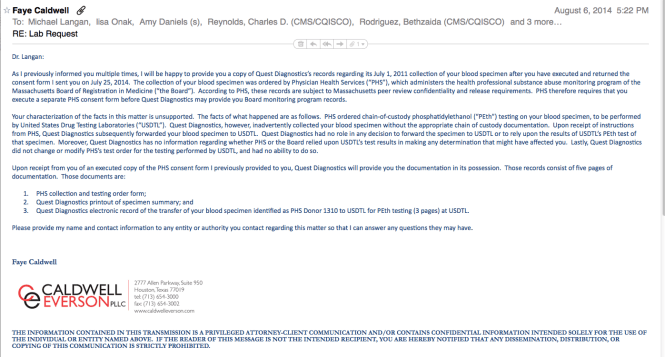
As the Medical Review Officer (MRO)  for the Massachusetts state Physician Health Program (PHP), Physician Health Services, Inc. (PHS, inc.), Dr. Wayne Gavryck’s responsibility is simple.  He is supposed to verify that the chain-of-custody  in any and all drug and alcohol testing is intact before reporting a test as positive.

Screen Shot 2014-12-03 at 12.53.49 AM

Dr. Gavryck evidently did not do that here.  In fact for more than a year he helped cover up an alcohol test that was intentionally fabricated at the behest of PHS Medical Director Dr. Luis Sanchez, M.D. and Director of Operations Linda Bresnahan (who told me when I confronted her with the fact that I have never had or ever even been suspected of having an alcohol problem “you have an Irish last name–good luck finding anyone who will believe you!”)

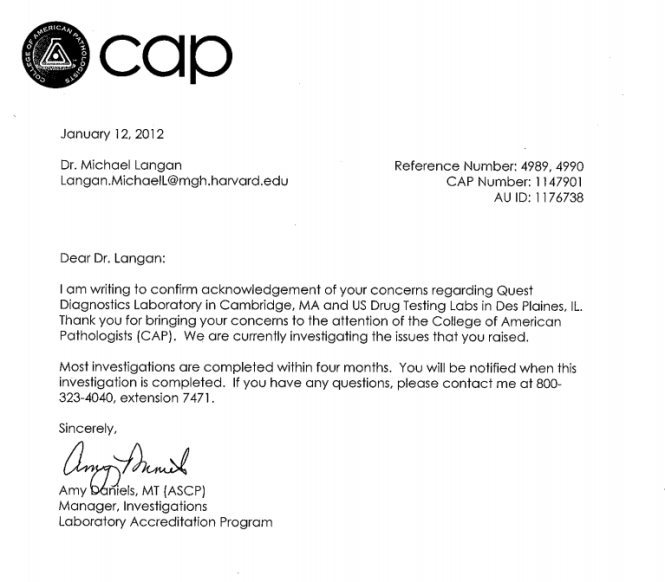
It took a formal complaint with the College of American Pathologists to get the truth out.  The whole fiasco can be seen here and here.

What Gavryck and his co-conspirators did is egregious and ethically reprehensible.  It shows a complete lack of moral compass and personal integrity.  What was done from collection to report to coverup  and everything in-between is indefensible on all levels (procedurally, ethically, and legally).

The documentary evidence shows with clarity that this was not accident or oversight.  It was intentional and purposeful misconduct.  I think everyone would agree that there should be zero-tolerance for forensic fraud in positions of power.    Any person of honor and civility would agree.

Transparency, regulation, and accountability are necessary for these groups.   It is an issue that needs to be acknowledged and addressed not ignored and covered up.

If Dr. Gavryck can give a procedural, ethical, or legal explanation of what was done then I stand corrected. Just one will suffice.  I’ll erase my blog and vanish into the woodwork.  But If he cannot then this needs to be addressed openly and publicly.   And whether he was involved in the original fraud or not is irrelevant. As the MRO for PHS it is his responsibility to correct it–however late the hour may be.

Perhaps Dr. Gavryck needs to see some of the damage he has caused in order to take this responsibility. Known as a “bag man” who simply rubber stamps positive tests at the request of Sanchez and Bresnahan (much like Annie Dookhan)  he does not see the damage that is caused. Forensic fraud has grave and far reaching effects and in this case has severely impacted many people and include patient deaths.

Perhaps Dr. Gavryck needs to take a “moral inventory” and see that this this type of behavior causes real damage to real people and put a face on it.

It is people just like this who are killing physicians across the country.   The body count is vast and multiple.  And those who are caught doing dirty deeds such as this need to be held accountable.

Please help me get this exposed, corrected, and rectified.  The doctors of Massachusetts and the doctors of this entire country deserve better than this.

via Integrity and Accountability—Defend the MRO Procedurally, Ethically or Legally and win 100 Volumes of the Classics in Medicine Library and Salk and Sabin Autographs!.

Details of how the state PHP scam operates can be seen below as pertains to my case.   Occurring in most states under the FSPHP  ( although some are worse than others) the Method of Operation (M.O)  is the same.

Screen Shot 2014-11-09 at 12.19.55 PM


I.  July 28th, 2011.   Reporting a Positive Test

This letter from Physician Health Services, Inc. Medical Director (and past President of FSPHP) Dr. Luis Sanchez, M.D. to  the Massachusetts Medical Board reports a markedly high level for Phosphatidylethanol (PEth), an alcohol biomarker test being used by Physician Health Programs to detect alcohol use.

The cutoff for heavy drinking is anything greater than 20 ng/mL.  Mine came back at a level of 365.4 ng/ml!  This level  is  suggestive of end-stage alcoholism and putting away a half-gallon a day of the hard stuff.   It is, in fact, reportedly the second highest level in history and the other guy was dead on arrival.

After reporting the blood test as dirty, Sanchez then requests a “reevaluation.”

Screen Shot 2015-02-01 at 11.41.40 PM


II.  Requested Evaluation Limited to “Like-Minded Docs”

Screen Shot 2014-07-27 at 7.55.16 PM copy

I was given three choices for this re-evaluation as listed above.   The Medical Directors can all be found on this list of “Like-Minded Docs”  Their philosophy of 12-step “intervention” can be seen here.

Screen Shot 2014-08-11 at 1.06.29 PM

Dr. David Withers, M.D.  Associate Medical Director of Marworth Treatment Center.

Dr. Marv Seppala, Chief Medical Director of Hazelden.

Dr. Omar Manejwala, M.D.   Medical Director of Hazelden.

Dr. Mike Wilkerson, M.D.,  Medical Director of Bradford Health Services-Warrior

This referral to “like-minds” is part of the state Physician Health Program scam. It is essentially self-referral as the choices are limited to “PHP-approved” assessment and treatment centers.    For doctors (and now pilots) an objective and independent referral is out of the question.    It is, in fact, a rigged system.

Note Dr. Wayne Gavryck, M.D.    Medical Review Officer (MRO) for the Massachusetts PHP, PHS, Inc. is also on the list of “Like-Minded Docs.”

Screen Shot 2014-11-26 at 1.33.19 AM

Dr. Greg Skipper, the physician who proposed and promoted the use of EtG, EtS, PEth and other non FDA approved “Laboratory Developed Tests (LDTs) for forensic testing is also on the list.

Former White House Drug Czar Dr. Robert Dupont who is claiming Physician Health Programs (PHPs) are the “new paradigm” for substance abuse treatment is also on the list.    Dupont wants to use the PHP model (including the non-FDA approved drug and alcohol tests they introduced) for other Employee Assistance Programs (EAPs) and populations (including kids and students.).

III. November 29, 2011.  PHS Agrees to my Request for “Litigation Packet”

Any and all forensic drug and alcohol testing requires strict chain-of-custody.   Documentation of chain-of-custody is necessary to protects both those ordering and doing the testing and the person being tested.       Forensic laboratories provide documentation of chain-of-custody in a document called a “litigation packet.”

On November 29, 2011 PHS agreed to my request.


IV. Discovering Procedural Misconduct and Forensic Fraud

Screen Shot 2014-11-09 at 12.19.15 PM

Screen_Shot_2013-09-04_at_2.21.51_AM

Screen_Shot_2013-09-04_at_2.22.36_AM

Screen Shot 2014-11-06 at 11.17.32 PM

The screenshot above is an ID card used for random drug and alcohol testing.  It is a card issued by Physician Health Services, Inc. and contains my picture, my initials and an ID # 1310.     The number #1310 is a unique identifier like a social security number or medical record number.  It is used to document “chain-of-custody” for testing and identifies who I am for laboratory testing.

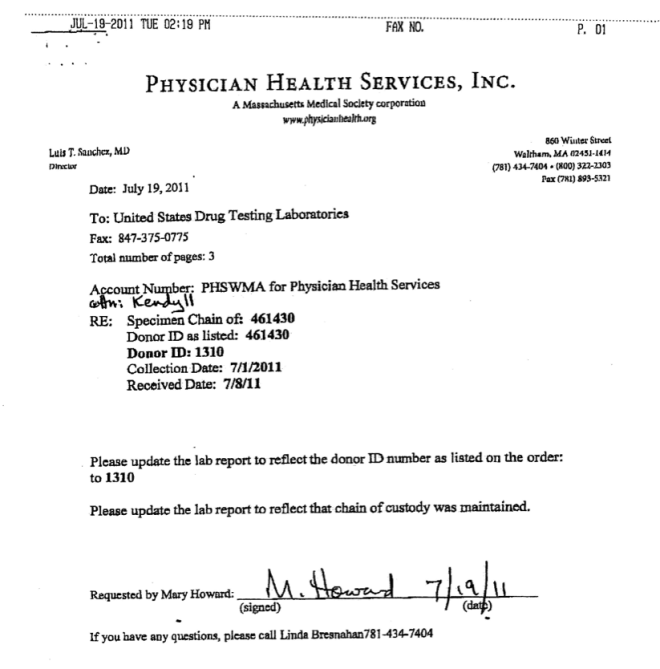
The document below is a fax from Physician Health Services, Inc.

IMG_8756 2

The document is signed by Mary Howard ,  whose job description is as below:

Screen Shot 2015-02-02 at 12.22.26 AM

“If you have any questions” the document sates, “please call Linda Bresnahan 781-434-7404.”   Ms. Howard assists Ms. Bresnahan in the drug and alcohol testing of doctors monitored by PHS.

Screen Shot 2015-02-02 at 12.22.44 AM

Screen Shot 2014-07-28 at 12.40.13 PM Screen Shot 2014-07-28 at 12.41.01 PM Screen Shot 2014-07-28 at 12.41.18 PM


Screen Shot 2014-08-20 at 12.03.56 PM

Screen Shot 2014-08-20 at 12.15.52 PM Screen Shot 2014-08-22 at 11.28.23 PM

Accountability Needed for Criminal Fraud Committed by Physician Health Programs

Screen Shot 2015-01-09 at 1.59.40 AM

If we’re looking for the source of our troubles we shouldn’t test people for drugs, we should test them for stupidity, ignorance, greed and love of power.” –P.J. O’ Rourke

Fraud is distinguished from negligence, ignorance, and error by virtue of the fact that it is Intentional; involving some level of calculation.1 Negligence is: “the failure to use such care as a reasonably prudent and careful person would use under similar circumstances,”  and characterized chiefly by “inadvertence, thoughtlessness, inattention, and the like.”2.  Fraud, in contrast, is not accidental in nature, nor is it unplanned.2-4 Those who commit fraud know what they are doing and are deliberate in their efforts. They are also aware that it is unethical, illegal, or otherwise improper.

Fraudulent intent  can be established by examining the documentation of decisions and behaviors associated with those involved. As explained in Coenen: “Manipulation of documents and evidence is often indicative of such intent. Innocent parties don’t normally alter documents and conceal or destroy evidence.”5

A chain of custody is generated in real time. It cannot be done retroactively. To do so constitutes fraud.   What is remarkable is with what apparent ease this was done.  There is no compunction, concern or inquiry from top to bottom at either of these agencies and documents a Machiavellian egocentricity. The acts are those of morally disengaged bullies who lack compassion and integrity.

One would assume that the state of Massachusetts would have a low tolerance for forensic fraud in the wake of the Annie Dookhan lab scandal,  especially when the perpetrators are contractors with the Department of Public Health (DPH) and work within the walls of the Massachusetts Medical Society (MMS).

The problem is Physician Health Programs (PHPs) have set up procedural barriers designed to bloc, ignore, marginalize and bury.  Truth is misrepresented, censored and suppressed.  The DPH and MMS have no oversight or regulation over Physician Health Services (PHS) and PHPs have convinced law enforcement that doctors police themselves.

Accountability needs to be rooted in organizational purpose and public trust.  When an organization operating within or contracting with an institution is committing  serious misconduct and fraud, then it becomes the institutions responsibility to investigate and correct it.  How low must the moral compass go before the MMS and DPH recognize what is self-evident to everyone else?   This would not have happened 20 years ago. What is happening to the profession of medicine when the institutions that are supposed to represent physicians and the public health allow individuals who are obviously and inexcusably engaging  in behavior antithetical to their own expressed ideals and purpose?

Corrupt individuals cannot be hired or retained by an employer without some level of institutional negligence, apathy or even encouragement.

Rationalization involves either self-delusion regarding the acceptability of fraud related to behavior under “special circumstances” or a disregard for the law as unjust or somehow inapplicable.5 Coenen explains that rationalization is the process by which someone   “determines that the fraudulent behavior is “okay” in her or his mind. For those with deficient moral codes the process of rationalization is easy. For those with higher moral standards it may not be quite so easy; they may have to convince themselves that a fraud is okay by creating “excuses” in their minds.

There is a diffusion of responsibility when verification is required and repercussions warranted.  This system of institutional injustice and forensic fraud between state Physician Health Programs and these corrupt labs is occurring across the country. I have spoken to the spouses and parents of multiple doctors who have killed themselves because this same thing was done to them.  Their deaths are being caused by people just like this and accountability is needed.


  1. Albrecht WS, Albrecht CO. Fraud Examination and Prevention. Mason, Ohio: South-Western Educational Publishing; 2003.
  2. Black HC. Black’s Law Dictionary. 6th ed. St. Paul, Minnesota: West Group; 1990.
  3. Albrecht WS, Albrecht CO, Albrecht CC, Zimbelman MF. Fraud Examination. 4th ed. Mason, Ohio: South Western Cengage Learning; 2011.
  4. O’ Lord A. The Prevalence of Fraud . What should we as academics be doing to address the problem? Accounting and Management Information Systems. 2010;9(1):4-21.
  5. Coenen T. Essentials of Corporate Fraud. Hoboken, NJ: John Wiley & Sons, Inc.; 2008.


← Back

Thank you for your response. ✨

33e7f-0905opedparini-master180-v3

capture

mllangan1's avatarDisrupted Physician


IMG_9516
“A body of men holding themselves accountable to nobody ought not to be trusted by anybody.”

― Thomas Paine 

USDTL drug testing laboratory claims to advance the”Gold Standard in Forensic Toxicology.”  “Integrity: Results that you can trust, based on solid science” is listed as a corporate value. “Unlike other laboratories, our drug and alcohol testing begins and ends with strict chain of custody.” “When people’s lives are on the line, we don’t skip steps.”  Joseph Jones, Vice President of Laboratory Operations explains the importance of chain-of-custody in this USDLT video presentation.

Dr. Luis Sanchez, M.D. recently published an article entitled Disruptive Behaviors Among Physicians in the Journal of the American Medical Association discussing the importance of  of a “medical culture of safety” with “clear expectations and standards.”  Stressing the importance of values and codes-of-conduct in the practice of medicine, he calls on physician leaders  “commit to professional behavior.”

Sanchez is Past President of…

View original post 4,712 more words

Happy New Year from DisruptedPhysician.Com

ark--38305-g4r49qgw-is-1

Please don’t forget to sign petition to request Massachusetts State Auditor Suzanne Bump investigate the  Massachusetts Board of Registration in Medicine Physician Health and Compliance Unit under the direction of Attorney Deb Stoller  and their unholy alliance with Physician Health Services, Inc. (PHS).

Accountability requires both the provision of information and consequences.  Those who are able to hold PHS accountable have been provided with information that unquestionably shows PHS is engaging in unethical and criminal activity including forensic fraud and collusion with third parties to commit fraud.  It is necessary that these agencies do their job, provide due diligence, investigate and provide the appropriate consequences to those who engage in misconduct and break the law. Anything less is indicative of complicity.

Happy New Year to you and yours.  Let’s end this type of corruption in healthcare in 2015.

← Back

Thank you for your response. ✨

5be84913767be62dd5ac5ec9d424416c


Please Sign Petition and Call (617-727-6200) MA State Auditor Suzanne Bump to Demand Audit of Corrupt Physician Health Services and the MA BORM Physician Health and Compliance Unit

Please Sign Petition and Call (617-727-6200) MA State Auditor Suzanne Bump to Demand Audit of Corrupt Physician Health Services and the MA BORM Physician Health and Compliance UnitThe Petition can be found here.  Or better yet, sign the petition and call her.  The evidence that Physician Health Services, Inc. (PHS) is committing crimes has been free-floating for the past two years.   It has been posted on Reddit, Twitter, Facebook, Linkedin, blogged, faxed, and phoned.  The response?  Absolute silence.

The procedural, ethical and criminal violations are clear and many.     The incontrovertible evidence has been directly delivered to individuals who should address this but for some reason do not.  This is not a matter of opinion folks but a matter of fact.    Time and time again we hear of  egregious misconduct hidden for decades because of  cognitive dissonance and blinkered apathy.

What evidentiary standard is required for action?   Over the past three years and under a lot of duress I have obtained indefensible documentary prima facie  proof of  crimes committed by individuals that should elicit immediate action but produced nothing but silence.

The crimes are many and they are of significance.  Accountability necessitates both the provision of information and justification for one’s actions.   This group has effectively blocked both of these. With much effort and under threat I have obtained proof of criminal activity with the expectation that the provision of this information would  result in those who should and could do something about it would.   They have not.

The documentary evidence of crimes is self-evident.  It is indefensible.    It is inexcusable that criminal activity is taking place within the walls of the Massachusetts Medical Society.   The fact that PHS is unregulated and without any meaningful accountability is irrelevant.  They are engaging in criminal activity within the walls of an institution whose very foundation is the antithesis of this groups actions and it must be addressed. Either support what the documents show or do something about it.

So please sign this petition and call  Massachusetts State Auditor Suzanne Bump at 617-727-6200

Institutional injustice just like that being committed by Luis Sanchez, Linda Bresnahan and the corrupt MRO Wayne Gavryck is killing doctors across the country.  They need to be held accountable.  Help me hold them accountable.

You do not need to be from Massachusetts to sign this petition. It is to raise public awareness–hopefully enough to elicit more exposure of this problem to prompt audits not only in Massachusetts but in other states as was recently done in North Carolina. The N.C. state auditor conducted an investigation and found poor oversight of the state PHP by both the state Medical Society and the state Medical Board, a lack of due process for physician’s who disputed the PHP’s evaluations and requirements, and multiple instances of potential conflicts-of-interest.

Dr. J. Wesley Boyd, who was previously an Associate Director at Physician Health Services, inc., the Massachusetts PHP is recommending that state government agencies audit their PHPs as well to “ensure that their vast power is wielded judiciously and with oversight.”  He adds that “doctors who are unsafe to practice medicine ought to be prevented from doing so. But every doctor who enters any kind of treatment or monitoring program should be treated respectfully and fairly, monitored appropriately, and have legitimate avenues of appealing decisions about their care.”

The Massachusetts PHP is engaging in unconscionable conduct including forensic fraud and self-evident criminal activity that is indefensible from within the walls of the Massachusetts Medical Society. Most are not aware of this. They need to be. This rigged game is a national problem and how the racket works in Massachusetts can be seen here.

 Please help me expose this and put a stop to it!

← Back

Thank you for your response. ✨

IMG_8564

Screen Shot 2014-11-26 at 6.52.55 PM

Disrupted Physician 101.4–The “Impaired Physician Movement” takeover of State Physician Health Programs

Forget what you see
Some things they just change invisibly–Elliott Smith

IMG_8923

Physician Impairment

The Sick Physician: Impairment by Psychiatric Disorders, Including Alcoholism and Drug Dependence, published by the American Medical Association’s (AMA) Council on Mental Health in The Journal of the American Medical Association in 1973,1 recommended that physicians do a better job of helping colleagues impaired by mental illness, alcoholism or drug dependence. The AMA defined an “impaired physician” as “a physician who is unable to practice medicine with reasonable skill and safety to patients because of mental illness or excessive use or abuse of drugs, including alcohol.”

Recognition of physician impairment in the 1970s by both the medical community and the general public led to the development of “impaired physician” programs with the purpose of both helping impaired doctors and protecting the public from them.

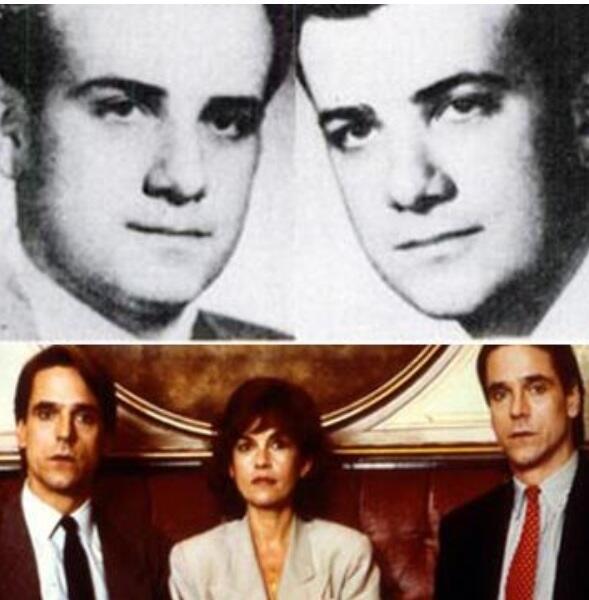
IMG_1010The 1975 media coverage of the deaths of Drs. Stewart and Cyril Marcus brought the problem of impaired physicians into the public eye. IMG_0940Leading experts in the field of Infertility Medicine, the twin gynecologists were found dead in their Upper East Side apartment from drug withdrawal that New York Hospital was aware of but did nothing about. Performing surgery with trembling hands and barely able to stand, an investigation revealed that nothing had been done to help the Marcus brothers with their addiction or protect patients. They were 45 –years old.

Top: Twin Gynecologists Stewart and Cyril Marcus Bottom: The Movie

Top: Twin Gynecologists Stewart and Cyril Marcus
Bottom: The Movie “Dead Ringers” starring Jeremy Irons based on the Marcus twins

Although the New York State Medical Society had set up its own voluntary program for impaired physicians three years earlier, the Marcus case prompted the state legislature to pass a law that doctors had to report any colleague suspected of misconduct to the state medical board and those who didn’t would face misconduct charges themselves.


Physician Health Programs

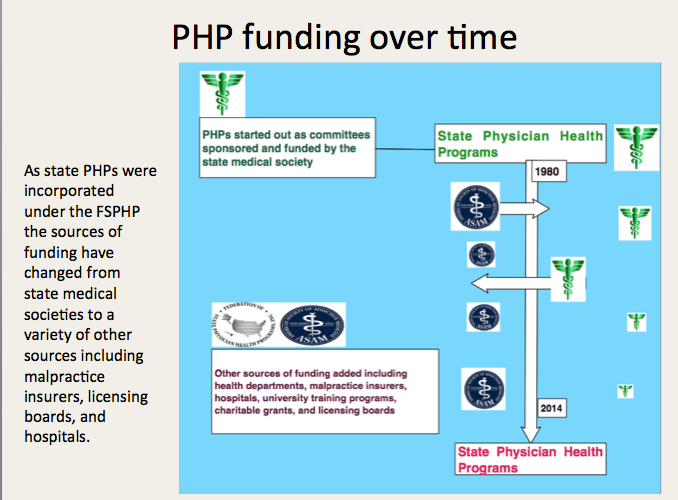
Physician health programs (PHPs)  existed in almost every state by 1980. Often staffed by volunteer physicians and funded by State Medical Societies, these programs served the dual purpose of helping sick colleagues and protecting the public. Preferring rehabilitation to probation or license revocation so long as the public was protected from imminent danger, most medical boards accepted the concept with support and referral.

As an alternative to discipline the introduction of PHPs created a perception of medical boards as “enforcers” whose job was to sanction and discipline whereas PHPs were perceived as “rehabilitators” whose job was to help sick physicians recover. One of many false dichotomies this group uses and it is perhaps this perceived benevolence that created an absence of the need to guard.


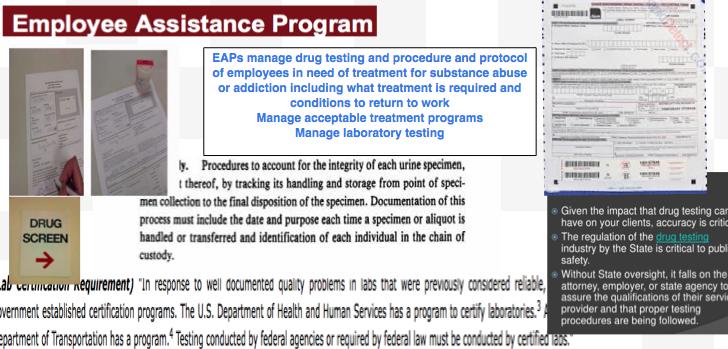
Employee Assistance Programs for Doctors

Physician Health Programs (PHPs) are the equivalent of Employee Assistance Programs (EAPs) for other occupations. PHPs meet with, assess, and monitor doctors who have been referred to them for substance use or other mental or behavioral health problems.

Most EAPs, however, were developed with the collaboration of workers unions or some other group supporting the rights and best interests of the employees. PHPs were created and evolved without any oversight or regulation.

Screen Shot 2014-02-24 at 10.32.36 PM

The American Society of Addiction Medicine can trace its roots to the 1954 founding of theNew York City Medical Society on Alcoholism (NYCMSA) by Ruth Fox, M.D whose husband died from alcoholism.

The society, numbering about 100 members, established itself as a national organization in1967, the American Medical Society on Alcoholism (AMSA).

By 1970 membership was nearly 500.

In 1973 AMSA became a component of the National Council on Alcoholism (NCA) in a medical advisory capacity until 1983.

But by the mid 1980’s ASAM’s membership became so large that they no longer needed to remain under the NCADD umbrella.

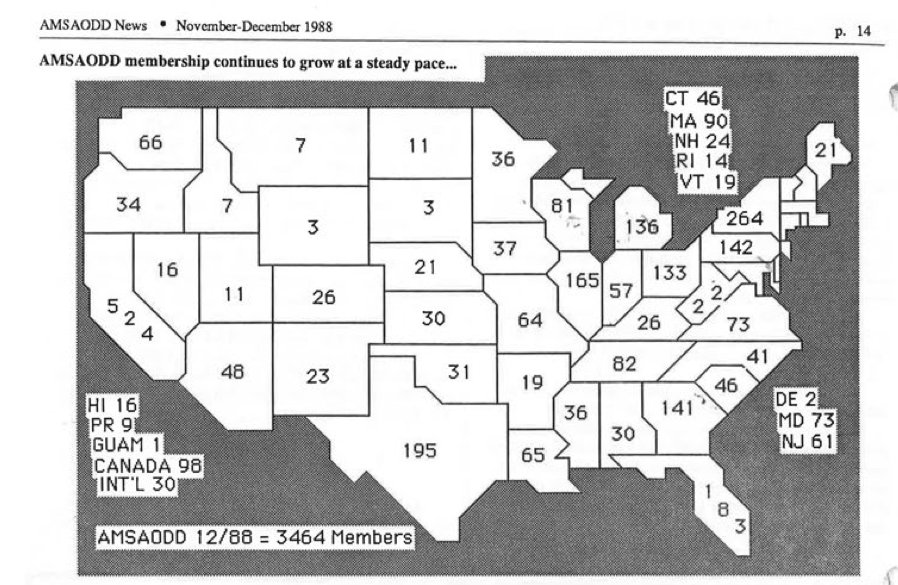
In 1985 ASAM’s first certification exam was announced. According to Dr. Bean-Bayog, chair of the Credentialing Committee, “a lot of people in the alcoholism field have long wanted physicians in the field to have a high level of skills and scientific credibility and for this body of knowledge to be accredited.”2 And in 1986 662 physicians took the first ASAM Certification Exam.

Slide16

By 1988 membership was over 2,800 with 1,275 of these physicians “certified” as “having demonstrated knowledge and expertise in alcoholism and other drug dependencies commensurate with the standards set forth by the society.”3 “The formation of State Chapters began with California, Florida, Georgia, and Maryland submitting requests.4

Screen Shot 2014-03-31 at 10.09.31 AM

In 1988 the AMA House of Delegates voted to admit ASAM to the House. According to ASAM News this “legitimizes the society within the halls of organized medicine.”2

By 1993 ASAM had a membership of 3,500 with a total of 2,619IMG_8919certifications in Addiction Medicine. The Membership Campaign Task Force sets a goal to double its membership of 3,500 to 7,000 by the year 2000 to assure “the future of treatment for patients with chemicals. It represents a blueprint for establishing addiction medicine as a viable entity.”5

Screen Shot 2014-11-09 at 11.30.55 PM

Many of these physicians joined state PHPs and over time have taken over under the umbrella of the FSPHP.

Others became medical directors of treatment centers such as Hazelden, Marworth and Talbott.


  1. The sick physician. Impairment by psychiatric disorders, including alcoholism and drug dependence. JAMA : the journal of the American Medical Association. Feb 5 1973;223(6):684-687.
  2. Four Decades of ASAM. ASAM News. March-April 1994, 1994.
  3. . American Medical Society on Alcoholism & Other Drug Dependencies Newsletter. Vol III. New York, NY: AMSAODD; 1988:12.
  4. . AMSAODD News. Vol III. New York, NY: American Medical Society on Alcoholism & Other Drug Dependencies; 1988.
  5. Membership Campaign Update. ASAM News. Vol VIII: American Society of Addiction Medicine; 1993:11.

Inquisition_10_Pushing_Off_Bridge

johnnyLawrence

Disrupted Physician 101.1: The “Impaired Physician Movement” and the History of the American Society of Addiction Medicine (ASAM)

Disrupted Physician 101.1: The “Impaired Physician Movement” and the History of the American Society of Addiction Medicine (ASAM).

Henry David Thoreau

“With one arm around the shoulder of religion and the other around the shoulder of medicine, we might change the world.”—Twelve Steps and Twelve Traditions, AA World Services, Inc (1953).

In 1985 the British sociologist G. V. Stimson wrote:

“The impaired physician movement is characterized by a number of evangelical recovered alcoholic and addict physicians, whose recovery has been accompanied by an involvement in medical society and treatment programs. Their ability to make authoritative pronouncements on physician impairment is based on their own claim to insider’s knowledge.”

The American Society of Addiction Medicine’s mission is to “establish addiction medicine as a specialty recognized by professional organizations, governments, physicians, purchasers, and consumers of health care products, and the general public.”  

In this they have succeeded.images-4

And in the year 2014 Stimson’s characterization of the “impaired physician movement” remains as accurate and apt as it was in 1985. But the “number of evangelical recovered alcoholic and addict physicians” has increased dramatically  (outnumbering Addiction Psychiatry by 4:1)  and their involvement in  medical society and treatment programs” has been realized and enforced through the state Physician Health Programs and their “PHP-approved’ assessment and treatment centers.

Their “ability to make authoritative pronouncements on physician impairment…based on their own claim to insider’s knowledge”  has become public policy and sanctified by Regulatory Medicine -essentially the Word of the Lord.

And the 1953 Alcoholics Anonymous prophecy that “With one arm around the shoulder of religion and the other around the shoulder of medicine, we might change the world” is also coming to pass.

But the world is not changing for the better as that arm around the shoulder of religion has its fingers deep in the pockets of the multi-billion dollar drug and alcohol testing and assessment and treatment industries.  And the arm around the shoulder of medicine has its fingers clamped tightly around its throat; a stranglehold in full throttle suffocating the Profession of Medicine with no meaningful opposition I can see.

A simplified schematic of how the Physician Health Program operates in Massachusetts

Step 1 = Fabricate positive test by colluding with Drug-Testing Labs 

Step 2 = Send to a “PHP-Approved” assessment and treatment center where like-minded friends will “tailor” the diagnosis

IMG_9115