Question Authority: The Need for Anti-Authoritarians in the Medical Profession

Anti-authoritarians question whether an authority is a legitimate one before taking that authority seriously.  To evaluate the legitimacy of  an authority it is necessary to:1. Assess whether they …

Source: Question Authority: The Need for Anti-Authoritarians in the Medical Profession

Jack Kerouac 2016 Birthday Celebration in Lowell, MA

IMG_3923

What: Jack Kerouac Birthday Celebration hosted by Lowell Celebrates Kerouac

When: Saturday, March 12

Where: Throughout Lowell

Information: Visit lowellcelebrateskerouac.org

Jack Kerouac 2016 Birthday Celebration in Lowell, MA

Lowell Celebrates Kerouac has planned another rollicking birthday celebration for its hometown hero, Jack Kerouac. This year it’s a one-day event occurring on his birthday, March 12.

Kerouac  would have been 94 on his next birthday. Come celebrate with like-minded Kerouacians in beautiful downtown Lowell this coming March 12!

Schedule of Events:
2016 Jack Kerouac Birthday Celebration
March 12, 2016 

10:00 am: Downtown Walking Tour of Lowell Kerouac Sites.
Begins at the Kerouac Commemorative at Bridge and French Streets and ends at
the Pollard Memorial Library. Led by Roger Brunelle.

12:30 pm: Pollard Library Tour.
This Library played a pivotal role in shaping Kerouac’s literary consciousness, and
now houses a “Kerouac Corner.”  Led by Bill Walsh. The Pollard Library is located

2:00 pm: “Woody and Jack: Two American Icons.”
A presentation comparing the lives and legacies of Jack Kerouac and Woody Guthrie by Steve Edington. Steve is a member of the LCK Committee and the author of The Beat Face of God
and Bring Your Own God—The Spirituality of Woody Guthrie.

Books available for signing following the presentation.

Visitors Center Theater at the Lowell National Historical Park.  246 Market Street.

4:00 pm: Open Mike at The Old Worthen.
141 Worthen Street.

8:00 pm “The Moody Street Sound” at the UnchARTed Gallery. 
With Special Guest David Amram. 103 Market Street.

A $5.00 donation is requested to support Lowell Celebrates Kerouac.

Reefer Madness Redux: Is your doctor a marijuana user? Maybe you should ask.

mllangan1's avatarDisrupted Physician

The article below was recently published on “social media’s leading physician voice” KevinMD.com.  A previous piece by the same author attempted to connect marijuana to heroin use.  Interestingly, this type of archaic rigid paternalistic chatter is becoming more and more common in the articles and social media of healthcare.   How, and more importantly why, is this type of tripe and rabble getting past editorial review?   It is 2016 not 1958!  Disappointingly, this absurd and sexist rant has generated a mere 20 comments thus far with the majority being negative.  I do agree with the apt and accurate observations of “FEDUP MD” who states the following:

“The answer is not that cut and dried.

Do I want a surgeon who is clinically impaired from marijuana operating on me at the time, who just smoked a joint before entering the OR? No.

Do I care if a surgeon two weeks ago went to Aspen on…

View original post 1,153 more words

Moral Crusades and Moral Panics as a Means of Social Control in the Medical Profession

IMG_9005The Medical Profession, Moral Entrepreneurship, and Social Control

Sociologist Stanley Cohen  used the term “”moral panic” to characterize the amplification of deviance by the media, the public, and agents of social control.1  Labeled as being outside the central core values of consensual society, the deviants in the designated group are perceived as posing a threat to both the values of society and society itself.   Belief in the seriousness of the situation justifies intolerance and unfair treatment of the accused.   The evidentiary standard is lowered.

Howard Becker describes the role of “moral entrepreneurs,” who crusade for making and enforcing rules that benefit their own interests by bringing them to the attention of the public and those in positions of power and authority under the guise of righting a society evil. 2

And according to cultural theorist Stuart Hall, the media obtain their information from the primary definers of social reality in authoritative positions and amplify the perceived threat to the existing social order. The authorities then act to eliminate the threat.3  The dominant ideas or ideologies are reproduced by relying on the opinions of the defining authority and then spread through the media. The communal good has been assailed.

As a society governed by organizations, associations,  institutions and regulatory bodies, the medical profession is not immune to “moral panics.”  A threat to patient care or the values of the profession can be identified and amplified.   A buildup of public concern fueled by media attention ensues creating a need for governing bodies to act. Medical Professionalism and the Public Health has been assailed.

Unbeknownst to the general public and most members of the medical profession at large, certain groups have gained tremendous sway within medical society. Through  moral entrepreneurship they have gained authority and become  the primary definers of the governance of the medical profession and the social control of  doctors.  To benefit their own interests they have fostered and fueled “moral panics” and “moral crusades. ” Exhorting authorities to fight these  threats by any means necessary  they have successfully made and enforced rules and  regulations and introduced new definitions and tools with no meaningful resistance or opposition.

The Inquisition did not have to convince  individual citizens or the general public of their beliefs to advance an agenda; just Ecclesiastical and Political Authority.  Similarly, the  “impaired physicians movement” did not have to convince individual doctors or the medical profession of their beliefs  to further a self-serving agenda; just  regulatory and administrative authority.

Addiction Medicine Monopoly, False Authority and Conflicts of Interest

The “impaired physicians movement” can be defined as a group of physicians with alcohol and substance abuse problems who, having found sobriety through 12-step spirituality, banded together to promote the ideology behind their personal  “recovery”  to other doctors and the medical community at large. In the 1980s the movement gained momentum and as their numbers grew  began calling themselves  specialists in “addiction medicine.”  The American Society of Addiction Medicine (ASAM)  is not a true specialty, but a Self-Designated-Practice-Specialty, which simply means that is what they are calling themselves.  It reflects neither knowledge nor expertise..  “Board certification” by the American Board of Addiction Medicine (ABAM) is not recognized by the American Board of Medical Specialties (ABMS).

ABAM certification requires only a medical degree, a valid license to practice medicine, and completion of residency training in ANY specialty.  Addiction Psychiatry, a subspecialty of psychiatry under the American Board of Neurology and Psychiatry  is the only  specialty recognized by the ABMS. and their specialty society is the American Academy of Addiction Psychiatry.

The ASAM is schooled in just one one uncompromising model of addiction with the majority attributing their very own sobriety to that model–the chronic relapsing “brain disease” with lifelong abstinence and 12-step spiritual recovery model.   As the “voice of addiction medicine,” the ASAM has nevertheless defined the dominant treatment paradigm in the United States.   ASAM doctors outnumber addiction psychiatrists by 4:1 and the movement is well funded.   Because addiction is defined as a “disease”, addicts must be “treated” (more often coercive than voluntary), and “cured” (defined as abstinent).  The billion dollar  assessment and treatment industry and the drug and alcohol testing industry  lucratively profits from this model which has grown to monopolize addiction treatment  in the United States.

The goal of the ABAM Foundation is to “gain recognition of Addiction Medicine as a medical specialty by the American Board of Medical Specialties (ABMS).”   A monopoly defined by self-appointed experts without recognized  specialty training will soon likely Robber baron their way to being accepted as  a true specialty.

Physician Health Programs, Regulatory Agencies, and Treatment Centers

Physician Health Programs (PHPs) meet with, assess, and monitor doctors who have been referred to them for substance use or other mental or behavioral health problems. Unless being monitored by one, PHP practices are unknown to most physicians and operate outside the scrutiny of the medical community.  Initially funded by State Medical Societies and staffed by volunteer physicians,  PHPs  served the dual function of helping sick doctors and protecting the public.

As the populations of ASAM physicians proliferated  in the 1980s, many  joined their state Physician Health Programs. PHP doctors who did not agree with the ASAM groupthink were gradually removed  and they  organized under the Federation of State Physician Health Programs(FSPHP).  Other ASAM physicians found employment at treatment centers as staff physicians and medical directors.

The FSPHP cultivated a relationship with the  Federation of State Medical Boards (FSMB) and the state PHPs formed alliances with their  state medical boards. Promoting themselves as offering “treatment” rather than”punishment” they offered an alternative to disciplinary action.  They then began promoting their successful outcomes  in rehabilitating “impaired physicians”,  and this history can be seen by examining the archives of the Journal of Medical Regulation and similar  publications.  In 1995 the   Washington  PHP claimed a success rate of  95.4%,   Tennessee  claimed 93% and Alabama 90%.

Part of this success was attributed  to the specialized  treatment centers for doctors directed by their ASAM colleagues such as  Ridgeview Institute in Atlanta created by G. Douglas Talbott.  Talbott, who helped organize and serve as past president of the ASAM claimed a 92.3 percent recovery rate. He also put forth a Medical Urban Legend–the proposition that doctors were a different species, separate from the rest of society, who needed special treatment three times longer than anyone else.  Amazingly, this dicto simpliciter argument that can, in fact, be refuted simply by pointing it out  was allowed to enter regulatory medicine unopposed.  Simply because, sadly, no one ever pointed out the logical fallacy. It is now entrenched.    Three months or more of treatment is  standard of care for our profession. They did this by getting medical boards and the FSMB to accept fantasy as fact by relying on board members tendency to accept expert evidence at face value.

Physicians are unique only insofar as the unique elements required of the profession to become and be a physician such as going to medical school and completing the required board examinations.  That’s it.    I implore anyone to put forth any sound argument based on science and evidence that justifies a thrice lengthy stay in medical professionals.  Not gonna happen.   Thought stopping memes and logical fallacy is the best they have to offer.  And, unfortunately this type of  rabbling gibberish cuts the mustard in the regulatory medicine venue.   A “low-bar” evidentiary standard is not the problem.  If you look at the documentary evidence from a medico-historical perspective there never was a bar.  The FSMB has essentially given the impaired physicians movement carte blanche authority and unrestrained managerial prerogative.  A bar never even existed.  It’s a laissez-faire Lord of the Flies free-for-all.    The logical fallacy of appeal to authority–illegitimate and irrational authority.  Bamboozled by smoke and mirrors.

A 1995 issue of the FSMB publication  The Federal Bulletin: The Journal of Medical Licensure and Discipline contains reports on eight  separate state  PHPs.   The “almost 90% success rate” was  applauded by the editor, who added  “cooperation and communication between the medical boards and the physician health programs must occur in an effort to protect the public while assisting impaired physicians in their recovery.”   And more recent reports suggest PHPs   reduce malpractice claims. They are now being promoted as a replicable model  to be used in other populations.

The problem is no one bothered to examine the methodology to discern the validity of these claims.  There has been no critical analysis or Cochrane type review of any of these studies which are invariably small, methodologically flawed, and biased.

The FSMB has accepted them as  expert authority and  their authoritative opinion as fact.  It  is this acceptance of faith without objective assessment that has allowed the ASAM and FSPH to advance their agenda. By  confusing ideological opinion  with professional knowledge, the FSMB and state Medical Boards have acted as willing gulls each step of the way. No counter-forces existed.  And they still don’t.   Junk science and unvalidated neuropsychological testing is used by these groups unconstrained and willfully.  There is no regulation, oversight, or accountability.  They are using polygraph testing (despite the AMA’s previous public policy statement deeming it junk) to both condemn “disruptive” surgeons and deem convicted pedophiles fit to return to work.  They have introduced junk-science in drug and alcohol testing and unvalidated “neuropsychological” testing to detect “character-defects” by getting regulatory agencies to accept the validity of these tests not by the Scientific Method or Evidence Based Research but by (to coin a term) “Regulatory Sanctification”

To paraphrase one FSPHP member,   “Who needs evidence-based medicine when the boards have already accepted these tests as valid?”  Who indeed?

The ideological bias and financial conflicts of interest between PHPs and the  treatment centers was also not recognized. It still isn’t.  The  spotlights are apparently all  on Big Pharma  in this regard.    Some sunlight needs to be exposed in the direction of the billion dollar drug and alcohol testing and assessment industry as well.

Doctors  were held at Ridgeview three times longer than the rest of the population (and at three times the cost)  under threat of loss of licensure.   Although there is no evidence base or plausible explanation why an entire profession would have a three-times  longer length of stay than the rest of the population this continues to be the reality. There is no choice.

in 2011 The ASAM issued a Public Policy Statement on coordination between PHPs, regulatory agencies, and treatment providers recommending  that  only “PHP approved” treatment centers be used in the assessment and treatment of doctors.  It specifically excludes non “PHP -recognized” facilities.  And what defines a “PHP approved” treatment center?    In addition to finding essentially no oversight by the state medical society and medical board, a recent audit of the  North Carolina PHP found financial conflicts of interest and no  documented criteria for selecting the out of state treatment centers they used.  The common denominator the audit missed was that the 19  “PHP-approved” centers were all ASAM facilities just like Ridgeview whose medical directors can be seen on this list.

The appeal to authority logical fallacy has enabled the FSPHP to become the expert authority on physician impairment through the eyes of the medical boards.  It has also allowed them to increase their scope.

The FSMB House of Delegates adopted an updated Policy on Physician Impairment at their 2011 annual meeting distinguishing “impairment” and “illness”  stating that Regulatory Agencies should recognize the PHP as their expert in all matters relating to licensed professionals with “potentially impairing illness.”

According to the FSPHP, physician illness and impairment exist on a continuum with illness typically predating impairment, often by many years.”

The policy extends PHP authority to cover physical illnesses affecting cognitive, motor, or perceptive skills, disruptive physician behavior, and “process addiction” (compulsive gambling, compulsive spending, video gaming, and “workaholism”). It also defines “relapse without use” as “behavior without chemical use that is suggestive of impending relapse.”

G. Douglas Talbott defines  “relapse without use”  as  “emotional behavioral abnormalities” that often precede relapse or “in A A language –stinking thinking.”  AA language has entered the Medical Profession and no one even blinked.  It will get worse.

The ASAM has  monopolized addiction treatment in the United States.   It has imposed  it on doctors through the FSPHP.  The FSPHP political apparatus exerts a monopoly of force. It selects who will be monitored and dictates every aspect of what that entails.  It is a, in fact, a  rigged game.

Inherent in this model is the importance of external control.  It gives them power to exert control over the individual regardless of whether they need to be treated.

By bamboozling regulatory medicine this was accomplished.    And the maintenance of this relationship is necessary as this  presentation  by an FSPHP physician  warns, “guard this relationship jealously.”

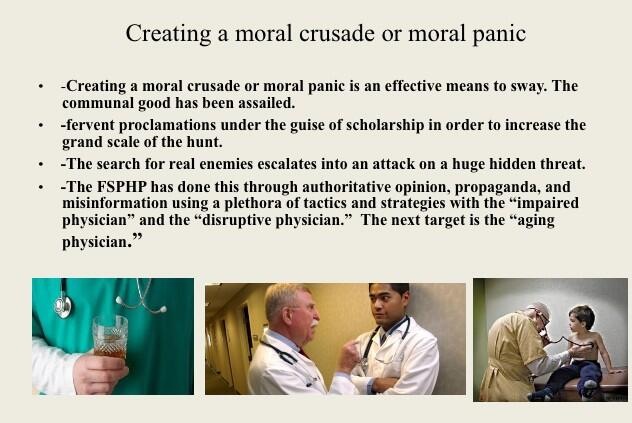
Screen Shot 2016-02-02 at 2.08.09 AM

Moral Panics and Moral Crusades

By introducing and fueling moral panics the ASAM/FSPHP political apparatus has been able to expand in both scope and power.

The Medscape article “Drug Abuse Among Doctors:  Easy, Tempting, and Not Uncommon”published in the “Business of Medicine” section in January 2014 is characteristic example of the authoritative opinion, propaganda, and misinformation spun to maintain a pervasive climate of fear. Proof by anecdote.  Physicians are “5 times as likely as the general public to misuse prescription drugs” according to Lisa Merlo, PhD.  “Given the epidemic of prescription addiction sweeping the nation, that’s a grim statistic.”

Described as a “researcher at the University of Florida’s Center for Addiction Research and Education,” Merlo’s research involving 55 doctors being monitored by their state Physician Health Program published in the Journal of Addiction Medicine in October 2013 found “most physicians who abuse prescription drugs” do so to “relieve stress and physical or emotional pain.”  Nowhere is it mentioned on Medscape that Merlo is the Director of Research for the Florida state PHPProfessionals Research Network.   Physician access to medications through prescriptions,  “networks of professional contacts, and proximity to hospital and clinic supplies” gives them “rare access to powerful, highly sought-after drugs” says Marvin D. Seppala, chief medical officer at Hazelden.  This access “sets them apart” and “not only foment a problem” but”perpetuate it” says Seppala.  “Access “becomes an addict’s top priority” and they “will do everything in their power to ensure it continues.”  

“They’re often described as the best workers in the hospital,” he says. “They’ll overwork to compensate for other ways in which they may be falling short, and to protect their supply. They’ll sign up for extra call and show up for rounds they don’t have to do.” Physicians are intelligent and skilled at hiding their addictions, he says. Few, no matter how desperate, seek help of their own accord.”  In reality this is absurd.  And if you look at any of the current “moral panics” that are being used to suggest random suspicion-less drug testing of all doctors or promoting the Physician Health Programs as the “New Paradigm” you will inevitably find a doctor, just like Marv Seppala who is on this list as  an author or interviewee.  It is a given.

The terms  “impaired physician” and  the “disruptive physician”  are used as labels of deviancy.  As deviants who allegedly threaten the very core of medicine (patient care) and  the business of medicine (profit)  they must be stopped at all costs.   Belief in the seriousness of the situation justifies intolerance and unfair treatment.  The evidentiary standard is lowered.  Aided by a  “conspiracy of silence” among doctors in which impaired colleagues are not reported  necessitates identification of them by any means necessary.   Increase the grand scale of the hunt.

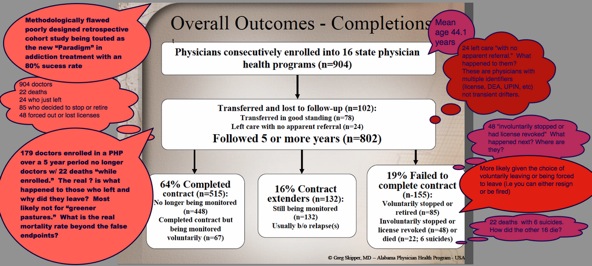
In this way these front-groups have successfully acted as moral entrepreneurs to make and enforce rules and put forth new definitions and mandates that serve their own interests.     A retrospective non -blinded non-randomized cohort study with serious underlying methodological errors involving 904 physicians being monitored by PHPs is now being used to “set the standard for recovery.”
IMG_8365

Across the Country doctors are going to the media,  law enforcement, the AGO, and the ACLU only to be turned a deaf ear.   Many consider this a “parochial” issue best handled by the medical community. Doctors reporting crimes are turned back over to the very perpetrators of the crimes.   The Medical Societies and professional organizations contribute to the problem by willful ignorance.   Accusations are used to disregard the claims of the accused.   It is a system of institutional injustice that is driving many doctors to suicide.  Hopeless, helpless, and feeling entrapped many are taking this route.  And no one is talking about it.   This cannot be avoided any longer.

The next target is the “aging physician.”   And as they have done with the “impaired” and “disruptive” physician” the FSPHP and their affiliates are setting the stage for another “moral crusade.”

  1. Cohen S. Folk Devils and Moral Panics: The Creatio of the Mods and Rockers (New Edition).Oxford, U.K.: Martin Robertson; 1980.
  2. Becker H. Outsiders: Studies in the Sociology of Deviance. New York: Free Press; 1963.
  3. Hall SC, Critcher C, Jefferson T, Clark J, Roberts B. Policing the Crisis: Mugging, the State, and Law and Order. London: Macmillan; 1978.


The Proposed Expansion of “physician health programs” (PHPs)and the urgent need for a critical analysis of irrational and illegitimate authority

Screen Shot 2016-02-09 at 5.35.03 AM

Physician Health Programs  (PHPs) claimed “gold standard” for addiction treatment. “80% success rate” being used to promote “new paradigm” to other populations. 

1. National Physician Health Program Blueprint Study Publications List

2.  Setting the Standard for Recovery: Physicians’ Health Programs

————————————————————————-

PHPs are essentially Employee Assistance Programs (EAPs)  for doctors.  The vast majority of people know little or nothing about Physician Health Programs (PHPs).

Physician Health Programs (PHPs) are being called  the “gold-standard” for EAPs.    Claims of unparalleled success are being used to promote PHPs to other populations as a “replicable model of recovery.”

Drs. Robert Dupont and Gregory Skipper are promoting PHPs as “A New Paradigm for Long-Term Recovery”  claiming an 80% success rate in doctors.

An article entitled “What Might Have Saved Philip Seymour Hoffman,” claims PHPs “ought to be considered models for our citizenry” and the “best evidence-based addiction treatment system we have going.”   The author repeats the 80% success rate for doctors and claims Philip Seymour Hoffman might still be alive if he had been treated using the PHP model.

The basis for these claims is a 2009 study published in the Journal of Substance Abuse Treatment entitled  Setting the Standard for Recovery: Physicians’ Health Programs and authored by Robert Dupont,  A. Thomas McLellan,  William White, Lisa Merlo and Mark Gold.

This  study is the cornerstone of the “PHP-blueprint.” It is the very  foundation on which everything else is based, a Magnum opus used to lay claim to supremacy that has been endlessly repeated and rehashed in a plethora of self-promotion and treatment community blandishment.

To date there has been no academic analysis of the “PHP-Blueprint.”    There has been no Cochrane type analysis or critical review.    There has been no opposition to its findings or conclusions which are paraded as fact and truth without challenge or question and there is a general lack of concern from those both within and outside the medical profession.


The Expansion of Physician Health Programs (PHPs) to Other Populations

1.  Although these programs claim to help doctors they may actually be harming many and contributing to suicide.

2.  The plan is to greatly expand these programs to other populations and you could be next.

In 2012 Robert Dupont delivered the keynote speech at the Drug and Alcohol Testing Industry Association annual conference and described a “new paradigm” for addiction and substance abuse treatment and proposed expansion of this paradigm to other populations including workplace, healthcare, and schools.

It is therefore critical that the “PHP-blueprint” be examined using critical reasoning and evidence base.   All of this needs to be assessed in terms of legitimacy and intent.

Lack of Evidence-Base and Conflicts of Interest

A  cursory  analysis of the study on which this success rate is based reveals very little evidence base.

The claim of 80% success rate in physicians is based on Setting the Standard for Recovery: Physicians’ Health Programs is unfounded.  The study is a poorly designed using a single data set (a sample of 904 physician patients consecutively admitted to 16 state PHP’s).

It  is non-randomized and non-blinded rendering the evidence for effectiveness of the PHP treatment model over any other treatment model (including no treatment) poor from a scientific perspective.  The study contains multiple flaws in both reasoning (type I and type II errors) and statistical analysis that render its conclusions invalid.

In addition the impact of undeclared but substantial financial conflicts-of-interest (including funding by drug testing and addiction treatment industries) and personal ideological biases (including personal 12-step recovery from addictions) in the authors of this study also needs to be considered.

Moreover the misdiagnosis and over-diagnosis of addiction in physicians in this paradigm  incentivized by lucrative self-referral dollars for expensive 90-day treatment programs is a significant factor.

False Endpoints and High Mortality Rate

The mean age of the 904 physicians was 44.1 years. They report that 24 of 102 physicians were transferred and lost to follow “left care with no apparent referral.”

What happened to them? These are physicians with multiple identifiers (state license, DEA, UPIN, etc) not transient drifters.

More importantly what happened to those 48 who were reported to the Medical Board for noncompliance and had their licenses revoked–that would be the critical time when this population would be at most risk for completing a suicide. That would be when hope was lost and the coerced physician, knowing that the fight was over, would take that step.

The outcomes they used were the last reported status of the PHP participant enrolled in the program.   Measuring success of program completion in doctors compared to the general population is meaningless as the short-term outcomes are quite different in terms of the external consequences imposed.   The consequence of not completing a PHP is the invariably career ending.    So what happened to the 24 of who “left care with no apparent referral,” the 85 who “voluntarily stopped or retired,” and the 48 who “involuntarily stopped or license revoked.”

Whether you leave a PHP voluntarily, involuntarily, or with no apparent referral it is the end game and your career is over.  Comparing this to other populations where the consequences of failing to complete the program are not so final is inappropriate.     Claiming superiority over programs with a 40% success rate is unfounded because for most of those people the consequences are not so final and may mean nothing more than an increase in testing frequency.

The big question is what happened to the 157 physicians who left or stopped?  How many of them killed themselves. With an average age of 44 there were  6 reported suicides 22 deaths, and another 157 no longer doctors.  I would venture to say the number of suicides is a lot higher than they claim.  But using the last recorded PHP status as the final outcome obfuscates this.

Due to the severity of the consequences a 20% failure rate is quite concerning. This is of particular concern because many doctors (if not most) monitored by PHPs are not addicts.

As noted above, PHPs are essentially Employee Assistance Programs (EAPs)  for doctors. Most EAPs, however, were developed in the presence of trade unions and other organizations working on behalf of the best interests of the employee. This collaborative effort led to EAPs that were more or less “organizationally just” with procedural fairness and transparency.

Imposed 12-step ideology and use of non-FDA Approved Drug and Alcohol Testing

No such organizations exist for doctors.   Due to the absence of oversight and accountability  PHPs have been able to use non-FDA approved laboratory developed tests of unknown validity on doctors without any opposition.

The distinction between professional and private life as a fundamental value of our society  and the importance of this boundary was also upheld by these groups.

In the PHP paradigm no procedural fairness or transparency exists and the boundary between professional and private life has eroded.

PHPs impose 12-step ideology on all doctors referred to these programs.   State Medical Boards  enforce this in violation of the Establishment Clause of the 1st Amendment yet there is little recourse for doctors as they are threatened with non-compliance and loss of licensure.

Selling the PHP Paradigm

The use of 12-step  is most likely not ideologically driven but profit driven.

Abstinence based 12-step programs justify the use of frequent drug and alcohol testing with ongoing lifelong assessment and treatment.    As with drug-courts,  PHPs provide a lucrative model to the drug and alcohol testing, assessment and treatment industry.

The plan to expand this to other populations is outlined in the ASAM White Paper.

This concerns all of us.  The first step needs to be a critical appraisal of  Setting the Standard for Recovery: Physicians’ Health Programs,  the foundation of their claims of an 80% success rate and a conflict-of-interest analysis of its authors.  The legitimacy of the study and its claims needs to be questioned.

It does not take a Cochrane review to see that the emperor has no clothes.  This is not difficult. It is straightforward and simple.

As an illegitimate and irrational authority it is necessary that this opinion remain unchallenged. We need to challenge it.

Historical, political, economic and social analysis reveals that the “PHP-blueprint” is a false-construct built on circumnavigation and obfuscation.  An evidence-based scrutiny of the literature would reveal it to be invalid and of little probative value.

But if  nobody speaks up it is inevitable that they will expand the “PHP blueprint”  to other employee assistance programs and schools.

This is not just about doctors.  You too are at risk for coercion, control, conformity and forced adherence to a  lifetime of abstinence and 12-step indoctrination and if you do not speak up now it won’t be a risk but a certainty.

The Federation of State Physician Health Programs and the Dead Doctors at Ridgeview-A Harbinger of the Medical Profession’s Current Suicide Epidemic

“There is enormous inertia—a tyranny of the status quo—in private and especially governmental arrangements. Only a crisis—actual or perceived—produces real change. When that crisis occurs, the actions that are taken depend on the ideas that are lying around. That, I believe, is our basic function: to develop alternatives to existing policies, to keep them alive and available until the politically impossible becomes politically inevitable.” –Milton Friedman

cropped-hanging_witch_01.jpg

“Gentlemen, it is a disagreeable custom to which one is too easily led by the harshness of the discussions, to assume evil intentions. It is necessary to be gracious as to intentions; one should believe them good, and apparently they are; but we do not have to be gracious at all to inconsistent logic or to absurd reasoning. Bad logicians have committed more involuntary crimes than bad men have done intentionally.”–Pierre S. du Pont (September 25, 1790)

 “It is easier to believe a lie one has heard a hundred times than a truth one has never heard before.” –Robert S. Lynd

Ridgeview Institute was a drug and alcohol treatment program for “impaired physicians” in Georgia created by G. Douglas Talbott, a former cardiologist who lost control of his drinking and recovered through the 12-steps of Alcoholics Anonymous.

Up until his death on October 18, 2014 at the age of 90, Talbott  owned and directed a number of treatment facilities for impaired professionals, most recently the Talbott Recovery Campus  in Atlanta, one of the preferred referrals for physicians ordered into evaluation and treatment by licensing boards today.

G. Douglas Talbott is a prototypical example of an “impaired physician movement” physician–in fact in many ways he may be considered the”godfather” of the current organization.  He helped organize and serve as past president of the American Society of Addiction Medicine (ASAM) and was a formative figure in the American Medical Association’s (AMA’s) Impaired Physician Program.

Screen-shot-2014-10-20-at-11.00.23-PM-1024x701

G. Douglas Talbott (center), with sons Mark (left) and Dave (right). (image: Ham Biggar)

The cost of a 28-day program for nonprofessionals at Ridgeview in 1987 was $10,000 while the cost was “higher for those going through impaired-health professionals program,” which lasted months rather than 28 days.1

In 1975 after creating the DeKalb County Impaired Physicians Committee for the Medical Association of Georgia, Talbott founded the Georgia Disabled Doctors Program for the assessment and treatment of physicians. Founded in part because “traditional one-month treatment programs are inadequate for disabled doctors,” and they required longer treatment to recover from addiction and substance abuse.   According to Talbott, rehabilitation programs that evaluate and treat the rest of the population for substance abuse issues are incapable of doing so in doctors as they are unlike any other of the inhabitants of our society. Physicians are unique. Unique because of their incredibly high denial”, and he includes this in what he calls the “Four MDs,” “M-Deity”, “Massive Denial” “Militant Defensiveness” and “More Drugs.”2   And these factors set doctors apart from the rest.

According to Talbott, “impaired doctors must first acknowledge their addiction and overcome their ‘terminal uniqueness’ before they can deal with a drug or alcohol problem.” “Terminal uniqueness “ is a phrase Talbott uses to describe doctors’ tendency to think they can heal themselves.

“M-Deity” refers to doctors “being trained to think they’re God;”3 blinded by an overblown sense of self-importance and thinking that they are invincible-an unfounded generalization considering the vast diversity of individuals that make up our profession.   Although this type of personality does exist in medicine,  it is a small minority -just one of many opinions with little probative value offered as factual expertise by the impaired physician movement and now sealed in stone.

Former Assistant Surgeon General (Ret) Admiral (Ret) John C. Duffy

Former Assistant Surgeon General (Ret) Admiral (Ret) John C. Duffy

This attitude, according to some critics, stems from the personal histories of the treatment staff, including Talbott, who are recovering alcoholics and addicts themselves. One such critic was Assistant Surgeon General under C. Everett Koop John C. Duffy who said that Ridgeview suffered from a “boot-camp mentality” toward physicians under their care and “assume every physician suffering from substance abuse is the same lying, stealing, cheating, manipulating individual they were when they had the illness. Certainly some physicians are manipulative, but it’s naïve to label all physicians with these problems.”1

001p3_xlg.preview

LeClair Bissell

American Society of Addiction Medicine (ASAM) President (1981-1983) LeClair Bissell was also highly critical of Talbott’s approach. Bissell, co-author of the first textbook of ethics for addiction professionals4 when asked if there was any justification to the claim that doctors are sicker than other people and more vulnerable to addiction replied:

“Well, based on my treatment experience, I think they are less sick and much easier to treat than many other groups. I think one reason for that is that in order to become a physician…one has to have jumped over a great many hurdles. One must pass the exams, survive the screening tests and the interviews, be able to organize oneself well enough to do examinations and so on, and be observed by a good many colleagues along the way. Therefore I think the more grossly psychotic, or sicker, are frequently screened out along the way. The ones we get in treatment are usually people who are less brain-damaged, are still quite capable of learning, are reasonably bright. Not only that, but they are quite well motivated in most cases to hang on to their licenses, the threat of the loss of which is frequently what puts them in treatment in the first place. So are they hard to treat? No! Are they easy patients? Yes! Are they more likely to be addicted than other groups? We don’t know.”5

“I’m not much for the bullying that goes along with some of these programs,” Bissell commented to the Atlanta Journal and Constitution in 1987.3

The constitution did a series of reports after five inpatients died by suicide during a four-year period at Ridgeview.6 In addition there were at least 20 more who had killed themselves over the preceding 12 years after leaving the treatment center.1

Bissell, the recipient of the 1997 Elizabeth Blackwell Award for outstanding contributions to the cause of women and medicine remarked: “When you’ve got them by the license, that’s pretty strong leverage. You shouldn’t have to pound on them so much. You could be asking for trouble.”3

According to Bissell: “There’s a lot of debate in the field over whether treatment imposed by threats is worthwhile…To a large degree a person has to seek the treatment on his own accord before it will work for him.”3

A jury awarded $1.3 million to the widow of one of the deceased physicians against Ridgeview,7 and other lawsuits initiated on behalf of suicides were settled out of court.6

The Constitution reported that doctors entered the program under threats of loss of licensure “even when they would prefer treatment that is cheaper and closer to home.” 8 The paper also noted that Ridgeview “enjoys unparalleled connections with many local and state medical societies that work with troubled doctors,” “licensing boards often seek recommendations from such groups in devising an approved treatment plan,” and those in charge are often “physicians who themselves have successfully completed Ridgeview’s program.”8

In 1997 William L. White interviewed Bissell whom he called “one of the pioneers in the treatment of impaired professionals.” The interview was not published until after her death in 2008 per her request.   Noting that her book Alcoholism in the Professions9 “remains one of the classics in the field”, White asked her when those in the field began to see physicians and other professionals as a special treatment population; to which she replied:

“When they started making money in alcoholism. As soon as insurance started covering treatment, suddenly you heard that residential treatment was necessary for almost everybody. And since alcoholic docs had tons of money compared to the rest of the public, they not only needed residential treatment, they needed residential treatment in a special treatment facility for many months as opposed to the shorter periods of time that other people needed.”10

Talbott claimed a “92.3 percent recovery rate according to information compiled from a five-year follow-up survey based on complete abstinence and other treatment.”11 A 1995 issue of The Federal Bulletin: The Journal of Medical Licensure and Discipline, published by the Federation of State Medical Boards, contains articles outlining impaired physician programs in 8 separate states. Although these articles were little more than descriptive puff-pieces written by the state PHP program directors and included no described study-design or methodology the Editor notes a success rate of about 90% in these programs and others like them 12 and concludes:

“cooperation and communication between the medical boards and the physician health programs must occur in an effort to protect the public while assisting impaired physicians in their recovery.” 12

No one bothered to examine the methodology to discern the validity of these claims and it is this acceptance of faith without objective assessment that has allowed the impaired physician movement through the ASAM and FSPH to advance their agenda;  confusing ideological opinions with professional knowledge.

“There is nothing special about a doctor’s alcoholism,” said Bissel

“These special facilities will tell you that they come up with really wonderful recovery rates. They do. And the reason they do is that any time you can grab a professional person by the license and compel him or her into treatment and force them to cooperate with that treatment and then monitor them for years, you’ll get good outcomes—in the high 80s or low 90s in recovery rates—no matter what else you do.”10
“The ones I think are really the best ones were not specialized. There were other well-known specialty clinics that claimed all the docs they treated got well, which is sheer rot. They harmed a great many people, keeping them for long, unnecessary treatments and seeing to it that they hit their financial bottom for sure: kids being yanked out of college, being forced to sell homes to pay for treatment, and otherwise being blackmailed on the grounds that your husband has a fatal disease. It’s ugly.”10

Stanton Peele’s “In the Belly of the American Society of Addiction Medicine Beast” describes the coercion, bullying, threats and indoctrination that are standard operating procedure in Talbott’s facilities.13  Uncooperative patients, “and this covers a range of sins of commission or omission including offering one’s opinion about one’s treatment,” are “threatened with expulsion and with not being certified-or advocated for with their Boards.”13

The cornerstone of treatment is 12-step spiritual recovery. All new patients are indoctrinated into A.A. and coerced to confess they are addicts or alcoholics. Failure to participate in A.A. and 12-step spirituality means expulsion from the program with the anticipated result being loss of one’s medical license.

In May 1999 Talbott stepped down as president of the American Society of Addiction Medicine (ASAM) as a jury awarded Dr. Leonard Masters a judgment of $1.3 million in actual damages and an undisclosed sum in punitive damages for fraud, malpractice, and the novel claim of false imprisonment.14

The fraud finding required a finding that errors in the diagnosis were intentional. Masters, who was accused of overprescribing narcotics to his patients was told by the director of the Florida PHP that he could either surrender his medical license until the allegations were disproved or submit to a four-day evaluation.

Masters agreed to the latter, thinking he would have an objective and fair evaluation. He was instead diagnosed as “alcohol dependent” and coerced into “treatment under threat of loss of his medical license. Staff would routinely threaten to report any doctor who questioned any aspect of their diagnosis or treatment to their state medical boards “as being an impaired physician, leaving necessary treatment against medical advice,”14  the equivalent of professional suicide.

Masters, however, was not an alcoholic.

According to his attorney, Eric. S. Block,  “No one ever accused him of having a problem with alcohol. Not his friends, not his wife, not his seven children, not his fellow doctors, not his employees, not his employers, No one.” 15

He was released 4 months later and forced to sign a five-year “continuing care” contract with the PHP, also under continued threat of his medical license.

Talbott faced no professional repercussions and no changes in their treatment philosophy or actions were made. They still haven’t.  They have simply tightened the noose and taken steps to remove accountability.

Up until his recent death, Talbott continued to present himself and ASAM as the most qualified advocates for the assessment and treatment of medical professionals for substance abuse and addiction.16

ASAM and like-minds still do.

In most states today any physician referred for an assessment for substance abuse will be mandated to do so in a facility just like Ridgeview.

There is no choice.   In mechanics and mentality, this same system of coercion, control, and indoctrination has metastasized to almost every state only more powerful and opaque in an unregulated gauntlet protected from public scrutiny, answerable and accountable to no one.  Laissez faire Machiavellian egocentricity unleashed.    For what they have done is taken the Ridgeview model and replicated it over time state by state and tightened the noose.  By subverting the established Physician Health Programs (PHPs) started by state medical societies and staffed by volunteer physicians they eliminated those not believing in the mentality of the groupthink.   They then mandated assessment and treatment of all doctors be done at a “PHP-approved” facility which means a facility identical to Ridgeview.  This was done  under the scaffold of the Federation of State Physician Health Programs (FSPHP).  They are now in charge of all things related to physician wellness in doctors.

  1. Durcanin C, King M. The suicides at Ridgeview Institute: Suicides mar success at Ridgeview with troubled professionals. Atlanta Journal and Constitution. December 18, 1987, 1987: A13.
  2. Gonzales L. When Doctors are Addicts: For physicians getting Drugs is easy. Getting help is not. Chicago Reader. July 28, 1988, 1988.
  3. King M, Durcanin C. The suicides at Ridgeview Institute: A Doctor’s treatment program may be too tough, some say. Atlanta Journal and Constitution. December 18, 1987a, 1987: A12.
  4. Bissell L, Royce JE. Ethics for Addiction Professionals. Center City, Minnesota: Hazelden; 1987.
  5. Addiction Scientists from the USA: LeClair Bissell. In: Edwards G, ed. Addiction: Evolution of a Specialist Field. 1 ed: Wiley, John & Sons, Incorporated; 2002:408.
  6. Durcanin C. The suicides at Ridgeview Institute: Staff members didn’t believe Michigan doctor was suicidal. Atlanta Journal and Constitution. December 18, 1987, 1987: A8.
  7. Ricks WS. Ridgeview Institute loses $1.3 million in suit over suicide. Atlanta Journal and Constitution. October 11, 1987, 1987: A1.
  8. King M, Durcanin C. The suicides at Ridgeview Institute: Many drug-using doctors driven to Ridgeview by fear of losing licenses. Atlanta Journal and Constitution. December 18, 1987b, 1987: A1.
  9. Bissell L, Haberman PW. Alcoholism in the Professions. Oxford University Press; 1984.
  10. White W. Reflections of an addiction treatment pioneer. An Interview with LeClair Bissell, MD (1928-2008), conducted January 22, 1997. Posted at http://www.williamwhitepapers.com. 2011.
  11. Williams c. Health care field chemical dependency threat cited. The Tuscaloosa News. January 16, 1988, 1988: 16.
  12. Schneidman B. The Philosophy of Rehabilitation for Impaired Physicians. The Federal Bulletin: The Journal of Medical Licensure and Discipline. 1995;82(3):125-127.
  13. Peele S. In the Belly of the American Society of Addiction Medicine Beast. The Stanton Peele Addiction Website (accessed March 28, 2014) http://web.archive.org/web/20080514153437/http://www.peele.net/debate/talbott.html.
  14. Ursery S. $1.3M verdict coaxes a deal for doctor’s coerced rehab. Fulton County Daily Report. May 12, 1999b 1999.
  15. Ursery S. I was wrongly held in alcohol center, doctor charges. Fulton Count y Daily Report. April 27, 1999a 1999.
  16. Parker J. George Talbott’s Abuse of Dr. Leon Masters MD ( http://medicalwhistleblowernetwork.jigsy.com/george-talbott-s-abuse-of-leon-masters ). Medical Whistelblower Advocacy Network.

Monopolies, Self-Referral and Shell Games: The Need for Antitrust Investigation of Physician Health Programs and their “PHP-Approved” Assessment and Treatment Centers

Ironically the  North Carolina physician health program (PHP) failed to follow guidelines they themselves introduced and demanded be followed.  They could produce no documentary evidence these criteria even exist or even provide a crumb of plausible criteria.

“Professional networks”, “reputation” and other informal sources are fine for some choices.  That’s how I picked out my first skateboard.

Resources such as these can play in important role in choosing a shirt, buying new sneakers or even purchasing a car but they do not constitute selection criteria for an assessment in which the consequences and recommendations made for the person being assessed are significant, potentially life-altering and possibly permanent!

And to top it all off the  Medical Director of the North Carolina PHP,  Dr. Warren Pendergast,  was the  President of the national organization for state PHPs, the Federation of State Physician Health Programs (FSPHP) at the time of the audit!

The President of the FSPHP being unable to define the selection criteria for approved and mandated facilities is like Anthony Bourdain being unable to explain the ingredients of an omelette.

Source: Monopolies, Self-Referral and Shell Games: The Need for Antitrust Investigation of Physician Health Programs and their “PHP-Approved” Assessment and Treatment Centers

“No matter what people tell you,words and ideas can change the world.”-Robin Williams.

“I stand upon my desk to remind myself that we must constantly look at things in a different way.”

-John Keating (Robin Williams)

Dead Poets Society

mllangan1's avatarDisrupted Physician

“No matter what people tell you,words and ideas can change the world.”-Robin Williams..

“I stand upon my desk to remind myself that we must constantly look at things in a different way.”

-John Keating (Robin Williams)

Dead Poets Society

View original post

Why are we tolerating the use of junk science against those in the medical profession? A direct question that begs for a direct answer.

I am no epidemiologist or statistician but as with pornography I know junk-science when I see it. Almost all of these tests were introduced with little or no evidence-base and, as with most of their endeavors, they did it below board via loopholes and cutting corners.

mllangan1's avatarDisrupted Physician

 “That everyone shall exert himself in that state of life in which he is placed, to practice true humanity towards his fellow men, on that depends the future of mankind.” – Albert Schweitzer 
“By and by never comes” –St Augustine

photo 1

“A day’s impact is better than a month of dead pull”-Justice Oliver Wendell Holmes, Jr.

 I am looking for a few honest and credible statisticians, biostatisticians or epidemiologists who want to make a difference in the spirit  of service and helping others.  I can’t pay you but you would be combating injustice, corruption and dishonesty.   You would be doing your part in helping the Medical Profession, honest and decent doctors, our country and  perhaps our future.  

It is only a few public policy steps and minor changes in state regulatory statutes before what is described in the ASAM White Paper on Drug Testing comes to fruition.  Before we know it…

View original post 2,506 more words