Injustice In The Media

Iris Martyn’s article below concerns mainstream media bias and the powerful role social media can play in combatting it. Tangential dissident voices often go unheard (or are silenced) when they oppose perceived authority or mainstream societal beliefs and majority mores.

Martyn gives the example of Suffragettes who were frequently accused of “having ‘magnificently succeeded … in their intention of making themselves a nuisance’, a dismissive claim that covers up the threat” and downplays both the validity of the cause and the character of those behind it.

According to cultural theorist Stuart Hall, the media obtain their information from the primary definers of social reality in authoritative positions and amplify those opinions irrespective of the foundation or veracity of those opinions.

Dissenting voices are all too frequently met with a wall of blinkered apathy or openly dismissed or opposed by mainstream media.

As a result valid complaints and concerns are either unreported, underreported or reported as invalid or misguided hyperbole.

The Galley Newspaper's avatarThe Galley

By Iris Martyn, Form 6 •

In 1903, outspoken suffragettes “defaced” thousands of one-penny coins by stamping “Votes for Women” onto them and releasing them back into circulation. In fact, ever since complex human social structures came into existence, those who have suffered under their dividing, categorising, and often somewhat arbitrary rules have sought to express themselves in ways that bring to light their humanity and the harsh reality of oppressive conditions.

Often, established media such as print journalism, only enforces the values of a biased society in which the privileged are accustomed to the predominance of their views.

This occurs at the expense of dissident voices. To continue the earlier example, “Suffragettes on the War Path” were frequently accused of having “magnificently succeeded … in their intention of making themselves a nuisance”, a dismissive claim that covers up the threat felt by male politicians at the thought…

View original post 1,071 more words

An Open Letter to Senator Elizabeth Warren Regarding Laboratory Developed Tests, Physician Health Programs and Institutional Injustice

Screen Shot 2015-01-08 at 9.54.30 PM

—There is no place in science for consensus or opinion, only evidence.-Claude Bernard

Dear Senator Warren,

Thank you for your reply regarding laboratory developed tests (LDTs) and the need for regulatory oversight.   As you mention, LDTs are developed without FDA approval—a pathway in which is not even necessary to prove validity of a test (that it is actually testing what it claims to be testing for) to bring it to market. With no FDA oversight or regulation a commercial lab can claim any validity they want in marketing these tests. The regulation debate has focused on the reliability and validity of a number of clinical tests marketed with unverified claims of accuracy such as prenatal screening and Lyme disease and this lack of oversight is a direct threat to patient safety.

I am sure you would agree with me that the importance of tests diagnostic accuracy is directly proportional to that tests potential to cause patient harm if reported inaccurately.

Sensitivity and specificity are important components of any diagnostic test because there are consequences associated with both false-positive and false negative results.

A test falsely indicating the absence of a condition in someone who truly has it can delay or prevent needed treatment wile a test falsely indicating the presence of a condition in someone who does not truly have it can result in unnecessary testing and treatment.

Incorrect treatment and false labeling of patients can also occur. Therefore diagnostic accuracy is paramount if a test is being used as the basis for further tests and treatment. Any test being used as a basis for further tests or treatment needs to be accurate. It needs to be reliable and valid. Moreover, if the consequences of a test can result in significant patient harm (such as unneeded chemotherapy) it needs to be either 100% accurate or be combined with other tests to confirm the true diagnosis.

 “Forensic” vs. “Clinical” Laboratory Testing

“Forensic” testing differs from “clinical” testing because of the consequences and the process is tightly controlled because false-positive results are unacceptable as the consequences can be grave, far-reaching and even permanent.

Forensic testing demands special handling and safeguards to protect the donor such as validated tests, certified labs, strict chain-of-custody procedures and MRO (Medical Review Officer) review. These safeguards of quality control assure the validity and integrity of the specimen.   The LDT pathway was not designed for forensic tests.

Forensic Laboratory Developed Tests (LDTs)

 Paradoxically, laboratory developed tests with the potential to cause  life-changing and possibly irreparable harm have been absent from the regulatory debate; LDT drug and alcohol tests used for “forensic” monitoring purposes.

A panoply of tests using urine, blood, hair, fingernails breath and saliva have been developed and brought to market since 2003 when the first one was introduced by Gregory Skipper, then Medical Director of the Alabama Physicians Health Program, who “convinced the initial lab in the USA, NMS near Philadelphia to start performing EtG testing.” 1

Developed as an LDT, Skipper and NMS then claimed the alcohol biomarker (which was discovered in the 1950s) “appeared to be 100 percent specific” in detecting covert use of alcohol based on a study he coauthored that involved a mere 35 forensic psychiatric inpatients in Germany, all male. 2   With this “evidence-base” and a not yet published paper in the pipeline,3   Skipper then pitched the test to the Federation of State Medical Boards (FSMB) as an accurate and reliable tool detect covert alcohol use in health care professionals.

Policy Entrepreneurship

In  “Agendas, Alternatives, and Public Policies,”4 John W. Kingdon describes the problem, policy and political streams involved in public policy making.   When these three streams come together a specific problem becomes important on the agenda, policies matching the problem get attention, and then policy change becomes possible.

Kingdon also describes “policy entrepreneurs’ who use their knowledge of the process to further their own policy ends. They ‘lie in wait… with their solutions at hand, waiting for problems to float by to which they can attach their solutions, waiting for a development in the political stream they can use to their advantage.”4

And due to a perfect confluence of streams ( Institute of Medicine report that 44,000 people die each year due to medical error,5 media reports of “impaired physicians,”  the the war-on-drugs, etc.)  the FSMB was swayed into accepting not just the validity but the necessity of using an alcohol biomarker of unknown reliability and validity on doctors referred to or monitored by state Physician Health Programs (PHPs) .

As the national organization that gives guidance to state medical boards through public policy development and recommendations, the individual state medical boards adopted use of the test without critical appraisal and no meaningful opposition.

Shortly after its founding in 1912, the FSMB began publishing a  journal called the Quarterly of the Federation of State Boards of the United States. Now known as the Journal of Medical Regulation, the publication has archived all issues with full articles dating back to 1967 and, as the official journal of the national organization involved in  medical licensing and regulation this facilitates an unskewed and impartial examination of how and when specific issues and problems were presented and who presented them and, in doing so, the “policy entrepreneurship” Kingdon describes can be seen quite clearly. For example a 1995 issue containing articles written by the program directors of PHPs in 8 different states contains an FSMB editorial acknowledging the reported 90% success rate claimed of these programs (in part attributed to the 90-day inpatient treatment programs) that concludes:

“Cooperation and communication between the medical boards and the physician health programs must occur in an effort to protect the public while assisting impaired physicians in their recovery.” 6

No one bothered to examine the methodology of these reports to discern the validity of the claims and it is this acceptance of faith without objective assessment that has allowed the passage of flawed public policy in medical regulation.

Nowhere  is “policy entrepreneurship” more glaringly displayed as it is in a 2004 issue promoting the use of EtG in monitoring doctors as under the same cover is an article identifying both the need7 for such a test and an article providing the solution.8  

“Detection of Alcohol Use in Monitored Aftercare Programs: A National Survey of State Physician Health Programs,” a survey of state Physician Health Programs (PHPs) concludes that “surreptitious alcohol use” is a significant concern” for PHPs, there is no current  “best method” for detection,  but a promising new test  with “exceptional specificity (100 percent) and sensitivity” in detecting small amounts of alcohol for up to 18 hours has recently become available.7

This same issue contains an article authored by Skipper about a new marker “not detectable unless alcohol has been consumed” recently introduced in the United States and now commercially available.”8

Notably absent from both of these articles is Skipper’s role in the commercial availability of the test. This conflict-of-interest is nowhere mentioned in this display of “creating a market then filling it.”

This “regulatory sanctification” of the test implied its tacit approval by the medical profession  (i.e. “if they are using it on doctors it must be valid”) and facilitated its marketing  to other monitoring agencies (nurses, airline pilots) as well as  Courts and Probation Departments where those doing the monitoring had absolute power while those being monitored had no voice.

Bent Science

In Bending Science: How Special Interests Corrupt Public Health Research9, Thomas McGarity and Wendy Wagner describe how special interest groups scheme to advance their own economic or ideological goals by using carefully crafted distorted or “bent” science to influence legal, regulatory and public health policy.  The authors describe how those making these decisions often assume the information that reaches them has been sufficiently vetted by the scientific community as it flows through a pipeline of rigorous peer-review and professional oversight and that the final product that exits the pipeline is unbiased and produced in accordance with the norms and procedures of science.

McGarity and Wagner note the serious and sometimes horrific consequences of bent science and provide examples involving Tobacco and Big Pharma . The authors call for:

“..immediate action to reduce the role that bent science plays in regulatory and judicial decision making” and the need for the scientific community to be involved in “designing and implementing reform.”

“Shedding even a little light on how advocates bend policy -relevant science could go a long way toward remedying these problems.  Indeed, precisely because the advocates have overtaken the law in this area, heightened attention to the social costs of bending science could itself precipitate significant change.”

In the case of EtG this shedding of light is not very hard as no “carefully crafted” studies bending science were used to sway opinion.   None existed. The only items in the pipeline were directly related to Skipper.  If anyone dare to look, the Emperor has no clothes.

Lack of Answerability and Accountability

There are difficulties in challenging bent science including a general lack of recognition of the problem and an absence of counter-studies to oppose deliberately manufactured ends-oriented research.   This has proven true with the myriad LDTs introduced into the marketplace as no counter-forces or competing economic interests producing counter-studies exist.

Multiple lawsuits, including a class-action, have been decided in favor of the labs who have taken a stand-your-ground approach supported by a body of industry-related “research” they or their affiliates produced to support the validity and reliability of the tests.

Those affected by these tests either have no power or have had their power removed. Most do not have the resources to mount a defense let alone produce counter-studies questioning the reliability and validity of the tests.

Most employee drug testing follows Department of Health and Human Services (DHHS) guidelines using FDA-approved tests that have specific cutoff levels defining a positive-result in an effort to eliminate false-positive results.10  Procedural safeguards are in place in these programs to protect the donor.  Forensic testing programs using LDTs provide no such safeguards as the testing is unregulated and there is no oversight from outside actors.

Unlike clinical LDTs “forensic” LDTs are even exempt from CLIA oversight.   The only avenue for complaint is through the College of American Pathologists (CAP) and, as an accrediting agency, they can only address problems by ensuring compliance with CAP guidelines.   If an investigation concludes lab error or misconduct CAP can mandate the lab correct the test result and come into compliance with their guidelines under threat of loss of accreditation but no other consequences exist.  Accountability has been removed yet the  consequences to those harmed by these are significant and without remedy.

State Physician Health Programs

As is the case with the LDTs  they introduced, Physician Health Programs have no oversight or regulation.   A 2013 Audit of the North Carolina PHP 11 prompted by complaints from doctors and performed by State Auditor Beth Woods found absolutely no oversight of the program by either the state medical board or medical society and that “abuse could occur without being detected.”

The Audit also found that doctors were predominantly referred to the same “PHP-approved” out-of-state facilities to which they in part attribute their high success rates in treatment. Interestingly the PHP could not identify what quality indicators or quantitative measurements were used by the PHP to “approve” the “PHP-approved” facilities.

In January of 2015 a Federal class action lawsuit was filed in the Eastern District of Michigan against the state PHP program and found health care providers were subject to the same referral system using these out-of-state facilities. The suit alleges constitutional violations related to the forced medical treatment of health care professionals and the “callous and reckless termination of professional licenses without due process.” 12

As with North Carolina, the Michigan PHP will be unable to provide what quality indicators and quantitative measurements are being used to “qualify” and “approve these facilities.    None exist. The sole indicators for approving these assessment centers are ideological and economic. In fact, the medical directors of most, if not all, of these facilities can be seen on this list of “like-minded docs.” 

Institutional Injustice

You once said “People feel like the system is rigged against them. And here’s the painful part: they’re right. The system is rigged.”

So too is this system.

As the Michigan lawsuit notes: “Unfortunately, a once well-meaning program has turned into a highly punitive and involuntary program where health professionals are forced into extensive and unnecessary substance abuse/dependence treatment under the threat of the arbitrary application of pre-hearing deprivations.”

This has become the rule not the exception. The Federation of State Physician Health Programs (FSPHP), the same group to which Dr. Skipper belongs, has systematically taken over these programs state by state by removing competent and caring doctors not agreeing with the groupthink and silenced them under threat of litigation if they violate their confidentiality agreements and “peer review” statutes.

The same system of coercion, control and abuse exists in Massachusetts.  In the past week alone I have heard from a medical student, a resident and two doctors who complained of misconduct  misconduct involving fraudulent testing and falsified diagnoses.

In “Ethical and Managerial Considerations Regarding State Physician Health Programs,” published in the Journal of Addiction Medicine in 2012, Drs. John Knight, M.D. and J. Wesley Boyd, M.D., PhD who collectively have more than 20 years experience with the Massachusetts Physician Health Program (PHP) state that:

“Because PHP practices are unknown to most physicians before becoming a client of the PHP, many PHPs operate out- side the scrutiny of the medical community at large. Physicians referred to PHPs are often compromised to some degree, have very little power, and are, therefore, not in a position to voice what might be legitimate objections to a PHP’s practices.”13

Noting that “for most physicians, participation in a PHP evaluation is coercive, and once a PHP recommends monitoring, physicians have little choice but to cooperate with any and all recommendations if they wish to continue practicing medicine,” Knight and Boyd raise serious ethical and managerial questions about current PHP policies and practice including conflicts of interest in referrals for evaluation and treatment, lack of adherence to standards of care for forensic testing of substances of abuse, violations of ethical guidelines in PHP research, and conflicts of interest with state licensing boards.

Knight and Boyd recommend “the broader medical community begin to reassess PHP’s as a whole” and that “consideration be given toward the implementation of independent ethical oversight and establish and appeals process for PHP clients who feel they are being treated unfairly.” 13

They recommend the relationship between PHP’s and the evaluation and treatment centers and licensing boards be transparent and that national standards be developed “that can be debated by all physicians, not just those who work within PHPs.”13

Accountability, or answerability, is necessary to prevent corruption.  This requires both the provision of information and justification for actions.    What was done and why? Accountability also requires that consequences be imposed on those who engage in misconduct.

In discussing the financial conflicts-of-interest between PHPs and “PHP-approved” assessment centers Knight and Boyd state:

“..if a PHP highlights a physician as particularly problematic, the evaluation center might–whether consciously or otherwisetailor its diagnosis and recommendations in a way that will support the PHP’s impression of that physician.”  

To “consciously tailor a diagnosis” is fraud. It is political abuse of psychiatry. And it is not only the assessment and treatment centers willing to “tailor” a diagnosis; so too are the labs involved.

Physician Suicide

I can think of nothing more institutionally unjust than an unregulated zero-tolerance monitoring program with no oversight using unregulated drug and alcohol testing of unknown validity.   But that is what is occurring.   Some of us are trying to expose this corrupt system but barriers exist. As with the Laboratory Developed Tests (LDTs), those involved have intentionally taken steps to remove both answerability and accountability.  Both the tests and the body of individuals administering these tests are notable for their lack of transparency, oversight and regulation.  This renders them a power unto themselves.

Doctors (and others coerced into Professional Health Programs) across the country have reported going to law enforcement and state agencies only to be turned away.   The Federation of State Physician Health Programs (FSPHP)  has convinced these outside agencies that this is a “parochial” issue best handled by the medical profession..   Those reporting crimes are turned back over to the very people committing the crimes.

The Massachusetts Medical Society and Massachusetts DPH claim no oversight of the Massachusetts PHP, PHS.inc. The Massachusetts Board of Registration in Medicine (BORM) will not address ethical or even criminal complaints about the doctors involved in the PHP and there is good evidence that some members of the BORM are in fact complicit in unethical and even criminal behavior. As the Massachusetts AGO represents the BORM they defer issues back to them and dig no deeper.

Drs. Knight and Boyd have suggested State Audits and we are hoping that MA State Auditor Suzanne Bump will investigate the MA PHP and the Board of Registration in Medicine’s Physician Health and Compliance Unit shortly.

One major problem is that barriers have been put in place to prevent information from getting to the right people.

The majority of people at medical societies, boards, departments of public health and other organizations are individuals of integrity and honesty but the system has been erected so that valid complaints are deflected, delayed, dismissed or otherwise tabled by sympathizers, apologists and those complicity.   The criminal activity the Massachusetts PHP is engaging in is undeniable and indefensible but who is going to hold them to account?

It is going to take a while to reform this system of institutional abuse and it has to be done state by state. Please take a look at the facts and documentary evidence and help me hold them accountable. This needs to be exposed, acknowledged and addressed.   Doctors are dying from this system of institutional abuse. It is a public health emergency no one is talking about.  Yet those behind the PHP programs are claiming this system of coercion, abuse and control is the “gold standard” of addiction treatment and, using another loophole, they want to expand this system to mainstream healthcare.

Sincerely,

Michael L. Langan, M.D.

  1. Skipper G. Exploring the Reliability, Frequency, and Methods of Drug Testing: What is Enough to Ensure Compliance?:   Alcohol Markers and Devices. 2013; http://www.fsphp.org/Skipper, Exploring the Reliability Frequency and Methods 2 Presentation.pdf.
  2. Wurst FM, Vogel R, Jachau K, et al. Ethyl glucuronide discloses recent covert alcohol use not detected by standard testing in forensic psychiatric inpatients. Alcoholism, clinical and experimental research. Mar 2003;27(3):471-476.
  3. Skipper GE, Weinmann W, Thierauf A, et al. Ethyl glucuronide: a biomarker to identify alcohol use by health professionals recovering from substance use disorders. Alcohol Alcohol. Sep-Oct 2004;39(5):445-449.
  4. Kingdon JW. Agendas, alternatives, and public policies. Updated 2nd ed. Boston: Longman; 2011.
  5. Leape LL. Institute of Medicine medical error figures are not exaggerated. JAMA : the journal of the American Medical Association. Jul 5 2000;284(1):95-97.
  6. Schneidman B. The Philosophy of Rehabilitation for Impaired Physicians. The Federal Bulletin: The Journal of Medical Licensure and Discipline. 1995;82(3):125-127.
  7. Jansen M, Bell LB, Sucher MA, Stoehr JD. Detection of Alcohol Use in Monitored Aftercare Programs: A National Survey of State Physician Health Programs. Journal of Medical Licensure and Discipline. 2004;90(2):8-13
  8. Skipper G, Weinmann W, Wurst F. Ethylglucuronide (EtG): A New Marker to Detect Alcohol Use in Recovering Physicians. Journal of Medical Licensure and Discipline. 2004;90(2):14-17.
  9. McGarity TO, Wagner WE. Bending Science: How Special Interests Corrupt Public Health Research. Cambridge, MA: Harvard University Press; 2008.
  10. US Department of Health and Human Services. Mandatory guidelines and proposed revisions to mandatory guidelines for federal workplace drug testing programs: notices. Federal Register. April 13, 2004;69(71):19659-19660.
  11. Wood B. State of North Carolina Performance Audit North Carolina Physicians Health Program. . http://www.ncauditor.net/EPSWeb/Reports/Performance/PER-2013-8141.pdf. Accessed March 17, 2015.
  12. U.S. District Court Eastern District of Michigan, Case No: 2:15-cv-10337-AJT-RSW (2015). Carole Lucas, R.N., Tara Vialpandno, R.N., Scott Sanders, R.N., Kelly Schultz, P.A., and all other similarly situated health professionals v. Michigan Department of Licensing and Regulatory Affairs, Carole Engel, J.D.Former Director of Michigan Bureau of Health Professions, Ulliance, Inc. (State Contractor), Carolyn Batchelor (HPRP Contract Administrator), Stephen Batchelor (HPRP Contract Administrator), and Nikki Jones, LMSW.   Filed January 30, 2015.
  13. Boyd JW, Knight JR. Ethical and managerial considerations regarding state physician health programs. Journal of addiction medicine. Dec 2012;6(4):243-246.

Screen Shot 2014-07-28 at 12.40.13 PMScreen Shot 2014-08-06 at 4.50.02 PM


photo 2

Class Action Suit Filed Against Michigan PHP Alleging Constitutional Violations Related to Involuntary Treatment

Screen Shot 2015-01-09 at 1.59.40 AMA Federal class action lawsuit has been filed in the Eastern District of Michigan against the state PHP program alleging constitutional violations related to the forced medical treatment of health care professionals involved in the State’s  “Professionals Health Program” (PHP)  and the “callous and reckless termination of professional licenses without due process.”  According to the complaint:
“The Health Professional Recovery Program (HPRP) was established by the Michigan Legislature as a confidential, non-disciplinary approach to support recovery from substance use or mental health disorders. The program was designed to encourage impaired health professionals to seek a recovery program before their impairment harms a patient or damages their careers through disciplinary action. Unfortunately, a once well-meaning program, HPRP, has turned into a highly punitive and involuntary program where health professionals are forced into extensive and unnecessary substance abuse/dependence treatment under the threat of the arbitrary application of pre-hearing deprivations (Summary Suspension) by LARA.filed in the the State of Michigan and a private contractor (Ulliance, Inc. of Troy, Michigan) engaged in a conspiracy to violate the civil rights of Michigan health professionals by involuntarily subjecting them to excessive and unnecessary treatment for substance abuse and suspending their licenses if they do not comply.”

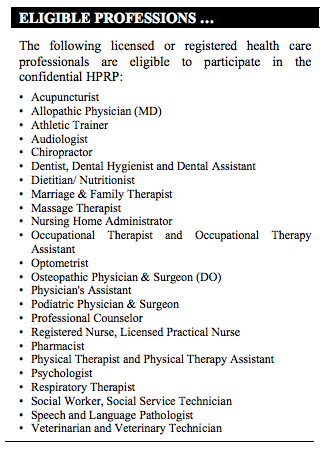
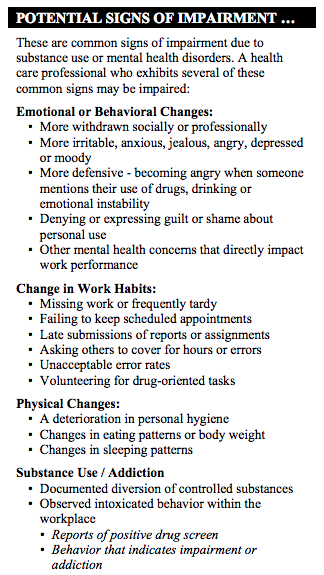
As is the case with most PHPs across the country taken over by the FSPHP the mechanics and mentality are the same.  Referrals can be made anonymously by “colleagues, partners, hospital administrations, patients, family members, or the State” to the PHP for any health professional (from acupuncturist to veterinarian) exhibiting “potential signs of impairment”

The HPRP website states the names of those reporting are kept confidential “unless testimony is needed at a later disciplinary hearing.”

Screen Shot 2015-03-16 at 3.28.39 AMAfter initial intake with HPRP, the licensee is referred to a “qualified evaluator” and “If the evaluation indicates a substance use and/or mental health disorder that represent a possible impairment” the HPRP makes referrals for treatment services to an “approved provider.Screen Shot 2015-03-16 at 3.29.35 AM
The “qualified evaluators” and “approved providers” are undoubtedly  the same out-of-state  facilities North Carolina state Auditor Beth Woods found her state program was referring to in her audit of the N.C. PHP under the undefinable justification they were “PHP-approved.”

As with North Carolina,  the Michigan PHP will be unable to provide what quality indicators and quantitative measurements are being used to “qualify” and “approve these facilities.    None exist as the common denominators in these “PHP-approved” and state mandated assessment and treatment centers are ideological and economic.  

The medical directors of almost if not all of them can be seen on this list of “like-minded docs.”  The conflicts-of-interest and intertwined relationships among this group is staggering.

The philosophy of Like-Minded Docs is the following:

“We believe that evidence from extensive, well-designed studies demonstrates the great benefits of Twelve-Step recovery modalities including Twelve Step Facilitation in promoting long-term recovery. Further, Twelve-Step modalities are compatible with other treatment strategies including medication-management. We believe that Addiction specialists need to facilitate a path for our patients toward the best possible state of wellness and recovery as they receive treatment for this chronic disease.  We believe a well-rounded educational and clinical preparation for physicians choosing to practice addiction medicine or addiction psychiatry requires a comprehensive exposure to the psychosocial and spiritual modalities of treatment as well as the neurobiological and psychopharmacological modalities.”

This connection needs to be made by both North Carolina and Michigan as the state is mandating treatment not only to assessment and treatment centers with economic conflicts of interest but with ideological ones as well.  Health care practitioners are being forced into evaluations exclusively at 12-step facilities and excluding non-12 step assessment and treatment centers.  This is a clear violation of the Establishment Clause of the 1st Amendment.

The complaint goes on to state the HPRP:

“has expanded its role to include making treatment decisions in place of the opinions of qualified providers. Licensees are subjected to intake evaluations by a pre-selected cadre of providers who profit from the enrollment of HPRP members. This process culminates in a large number of health professionals receiving a “Monitoring Agreement” which is essentially a nonnegotiable contract for treatment selected by HPRP. While HPRP’s contract with the State requires that treatment be selected by an approved provider and that it be tailored in scope and length to meet the individual licensee’s needs, licensees generally receive the same across-the-board treatment mandates regardless of their diagnosis or condition. Further, treatment providers are not permitted to recommend the specific treatment rendered and HPRP has a policy that only HPRP can set the terms of the treatment required in the contract. Failure to “voluntarily” submit to unnecessary and costly HPRP treatment results in automatic summary suspension..”

“Facing the threat of summary suspension in the event of non-compliance, licensed health professionals are induced into a contract as a punitive tool of BHCS and are often required to refrain from working without prior approval, refrain from taking prescription drugs prescribed by treating physicians, and sign broad waivers allowing HPRP to disclose their private health information to employers, the State of Michigan, and/or treating physicians.”

“Every licensee in the State of Michigan who has received a summary suspension, as a result of HPRP non-compliance, has had their private health data transmitted to the BHCS for use during administrative proceedings. In short, the mandatory requirements of HPRP, coupled with the threat of summary suspension, make involvement in HPRP an involuntary program circumventing the due process rights of licensees referred to the program. The involuntary nature of HPRP policies and procedures as outlined above and the unanimous application of suspension procedures upon HPRP case closure are clear violations of Procedural Due Process under the Fourteenth Amendment.”

This is exactly the same system of institutional injustice seen at Ridgeview under G. Douglas Talbott.  Multiple physician suicides were attributed to these same abuses–involuntary forced treatment under extortion of loss of licensure.  It is time this elephant in the room be addressed in terms of the marked increased in suicide we are seeing now.


http://www.chapmanlawgroup.com/hprp-class-action/

Health Professionals File Class Action Against HPRP

Jurisdiction: U.S. District Court for the Eastern District of Michigan

Subject: Plaintiff’s filed a class action lawsuit on behalf of Michigan health care professionals, alleging constitutional violations related to the forced medical treatment of health care professionals involved in the State’s substance abuse monitoring program (HPRP) and the callous and reckless termination of professional licenses without due process by HPRP and the Bureau of Healthcare Services.

Three Michigan health professionals filed a federal class action for due process violations arising out of execution of a State substance abuse monitoring program known as the Health Professionals Recovery Program. According to the class action lawsuit filed today in the Eastern District of Michigan, the State of Michigan and a private contractor (Ulliance, Inc. of Troy, Michigan) engaged in a conspiracy to violate the civil rights of Michigan health professionals by involuntarily subjecting them to excessive and unnecessary treatment for substance abuse and suspending their licenses if they do not comply.

HPRP, intended as a voluntary treatment program by the legislature, has become a highly punitive and involuntary tool designed to circumvent due process, the complaint states. However, according to the complaint, Carole Engle, the Former Director of the Bureau of Healthcare Services, implemented a policy that any person who does not voluntarily submit to this unnecessary treatment would be immediately suspended without a hearing and prevented from practicing as a health professional. Carole Engle recently resigned her position after Governor Snyder refused to renew her contract with the State of Michigan. It is unclear whether her recent resignation is related to the recently filed class action.

The controversial treatment program has generated a significant amount of criticism in recent years from Michigan health professionals who have called for a class action in an effort to stop HPRP’s abuse of their broad sweeping power. For years, HPRP subjected nurses to three years of intense addiction treatment sometimes on the basis of an anonymous tip.

“We turned to the courts for fairness because HPRP’s mandate of unnecessary treatment has ruined countless lives. My life has been ripped apart by HPRP despite the fact that two evaluators determined that I do not need treatment. I am only one of hundreds who have had to choose between suspension of my license and tens of thousands of dollars worth of treatment that was unnecessary – I just couldn’t afford it, and now I can no longer practice as a nurse” said Carol Lucas, a registered nurse and a Plaintiff in the class action.

Chapman Law Group, a Michigan health care law firm, filed the complaint on behalf of three named Plaintiffs, each of whom fell victim to HPRP’s demand that they submit to unnecessary treatment or have their license suspended. The class includes Michigan health professionals who are or were participants in the Health Professionals Recovery Program during the period from January 1, 2011 to present.

The complaint and amended complaint can be seen below:

Michigan Case 2-15-cv-10337

Michigan Amended Complaint 2-15-cv-10337


Helpful resources for those abused and afraid — via www.bmartin.cc 

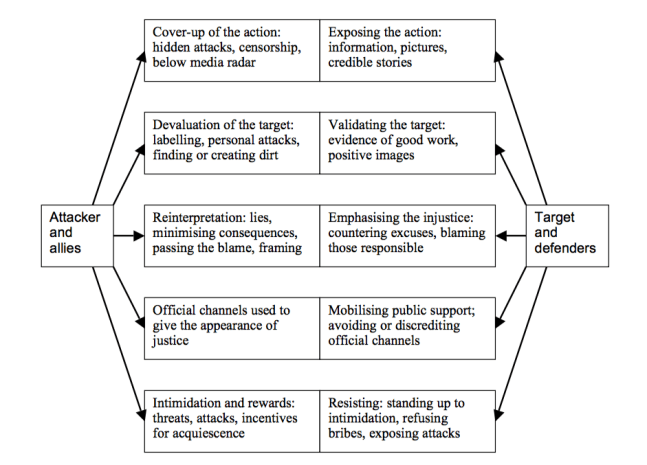
www-bmartin-cc-pubs-bf-bfbasics-pdf-51. Supression of Dissent: Basic Information

2. The keys to backfire

• “Reveal: expose the injustice, challenge cover-up

• Redeem: validate the target, challenge devaluation

• Reframe: emphasize the injustice, counter reinterpretation

• Redirect: mobilize support, be wary of official channels• Resist: stand up to intimidation and bribery”

via Helpful resources for those abused and afraid — via www.bmartin.cc .

Screen Shot 2015-01-09 at 1.59.40 AM

FullSizeRender 2

Letters From Those Abused and Afraid

IMG_0873


Letters From Those Abused and Afraid.

Please sign Petition.

I get many e-mails, letters and phone calls from doctors, nurses and others who have been abused by  “professional health programs” (PHPs).  Most do not want their letters published for fear of being identified and punished by the PHP.   They are reluctant to do so even with their names and states removed as they feel their complaints alone could reveal their identity to they prying eyes of the PHP.   A few have allowed their letters to be posted and I am doing so here:    Letters From Those Abused and Afraid

I am posting Dr. Roop’s  letter below at his request.  He specifically stated his name and contact information be included. I applaud his courage.   As was the case with the Inquisition, this is system  that relies, above all else,  on secrecy and silence.

Effective “Impression management” requires both promoting positive information and suppressing negative information.

The “PHP-blueprint” has been effectively propagandized via a back-slapping parade of congratulatory misinformation; a promotional campaign that includes exaggeration of the existence and dangers of the doctors they target as well as their inflated abilities and success in “helping” these doctors and protecting the public.   Aimed at the legal, regulatory, and administrative arenas of medicine as well as the the general public, the PHP moral crusade has flourished without any meaningful opposition.

 Suppression of negative information is necessary and  involves both removal  ( comments critical of PHPs are rapidly removed as spam) and prevention.   One way of preventing negative information is by silencing critics.  Those enrolled in PHP programs who speak out often suffer “swift and certain consequences” and this effectively silences the rest.

 In reality  If more people like Dr. Roop spoke up this abusive system of coercion, control and corruption could easily be identified, exposed and reformed.

Sunshine is the best disinfectant.

The stories are the same and these patterns must be recognized.

Doctors  are vulnerable to medical abuse, just like any other patient.  Their knowledge of medicine and the medical system, means that they question, as they should, the validity and appropriateness of any treatment.   It has long been proven that patients that question their doctor’s decisions and the quality of the care provided to them, fare better and have better outcomes and are less subject to medical error or medical fraud.

The Physicians Health Program is based on a flawed philosophy that Doctors must be beaten down, forced to be submissive and obedient to PHP authority who intimidate and control, deny access to services, impose punishments, and even create criminal records with impunity and immunity.

This not quality care for anyone. It is abuse.  The PHP paradigm is just another  example of how false constructs come to to be regarded as irrefutable truth.

Once in the clutches of a  PHP a doctor is told – obey us, or lose your license, your hospital privileges, your credit rating, your good reputation – obey us no matter what we tell you to do.

 If you stand up to them, they take you down, very publicly and humiliate you, and destroy your career and good name.  Then no other doctor who saw the retaliation that happened to you is willing to buck the PHP system.  It is essentially extortion.

Dr. Janet Parker, a a human rights and disability advocate has  personal knowledge of doctors forced into the Washington PHP program Dr. Roop speaks of below.

These doctors told her that they had a plan to kill themselves if a PHP  “peer counselor” came anywhere near them –  they meant it.

3 doctors in the Washington PHP did commit suicide during the period of time when she was interviewing the WPHP referred doctors.   Last year a doctor I went to high school with and have known since childhood hanged himself due to the abuses of the Washington PHP.  HIs crime?  He was pulled over for speeding five years prior after having a few drinks at a social function.  He was given a breathalyzer and blew just over the legal limit–his entry ticket into the system Dr. Roop describes below.   As is often the case, he was given a positive alcohol biomarker just as he was about to complete the five-year PHP contract  This results in re-assessment at a “PHP-approved” facility, a new contract with the PHP and another five-years of drug and alcohol testing  all paid for out of-pocket.

And this is a national problem–three doctors being monitored by the Oklahoma state PHP killed themselves during a one month period (August 2014).

There is no evidential standard used and false accusations and even forged documents are routinely used against the targeted doctor.   Physicians are ill prepared for such criminal tactics used against them,  by the time they realize it is happening, it is too late to stop the inevitable process that threatens their medical license.  This is very emotionally traumatic to doctors who have always excelled in their schooling, worked hard to get where they are, and are facing the loss of not only their professional careers but also financial security, their self esteem and self concept.


Name: Jonathan Crane Roop MD

Email: jonathanroop@hotmail.com

Comment: I am Board Certified in Internal medicine. I have endured years of emotional, psychological and spiritual abuse at the hands of the Washington Physician’s Health Program. I have suffered through a long list of injustices without recourse. They include, but are not limited to discrimination, abuse of power, breach of contract and repeated and WILLFUL medical negligence. 

Because the actions of the WPHP have been SO egregious, I assumed what was happening to me must be extraordinarily rare.

I have nothing to hide. And I have shared my story with any and all who would listen. To date, my voice, my rights and now my life have been dismissed as unimportant. MY LIFE!! It’s apparently better that I die than my tormentors be questioned and compelled to defend their indefensible and evil behavior. 

I am meeting with one last attorney tomorrow. I fully expect him to ignore the basic, indisputable and well documented facts of my case. Namely, there is massive and systematic malfeasance being committed by a tax payer funded agency in the State of Washington who act with omnipotence and without oversight. I have no reason to believe he will respond any differently than the others with whom I have met. HE WON’T CARE! HE WILL NOT BE MOVED. He will make statements that suggest I DESERVE this treatment. And that my life, as well as my imminent death, is unworthy of his time or efforts.

Once my assumptions about this last meeting are officially confirmed, I am committed to the only course of action available to me. The only thing which will put an end to this nightmare.

Today I stumbled upon your website. And today, for the first time, I have learned that my case is not rare. I suspect the other physician victims in this matter have occasionally allowed themselves to dream wistfully of justice. Justice which they have seen thwarted at every turn. Perhaps they, like me, have dreamily imagined the relief and joy and LIFE they would experience if the truth were simply presented and the perpetrators held accountable. I have imagined standing up in court and triumphantly affecting justice for myself as well as all of the other current and future victims. I deliver a powerful defense of justice. My ‘dream speech’. I have imagined that I might still live. And then I wake up. 

And so today, imagine my shock, when I found my ‘dream speech’ here. My speech. Reasonable. Honest. Consistent. And based firmly in truth, justice and defense of the powerless against the (arbitrarily) powerful. My speech, it seemed, but authored by another.

Thank you, Dr. Langan.  You have given a voice to my struggles. Please never stop speaking for me, and people like me, many of whom, I fear, will not survive to see justice. 

Despite my intention to die, I actually WANT TO LIVE! And I will live and fight on if I ever believe that there is even a small chance of justice for me and the other innocent victims of PHP’s and the ‘treatment’ centers with whom they contract (Talbott in my case. Purely evil and loathsome human beings, for the record).

So, because I do WANT to live…PLEASE HELP ME, SIR!

Can you refer me to attorneys, individuals or groups who might advocate for me and the other victims? Do you have any specific words of hope or encouragement?

Please note my name. Please add me to the list of innocent victims of these power hungry, narcissistic BULLIES.

I don’t expect to live through this. And in a way, the PHP, Talbott and the addiction ‘experts’ with whom I have been tragically acquainted are correct…My life is worth very little. But this issue is so much larger than I. I can die with some serenity if I believe there will be meaningful justice for others like me. And that those responsible will be held to account. 

Thank you Dr. Langan. Thanks to all of those involved in the creation and maintenance of this website. Although your shining beacon is barely perceivable through the darkness of injustice which surrounds and seeks to extinguish it…it is the only glimmer of hope I have found during my slow death by PHP.

Jonathan Crane Roop MD

811 S Cowley St #48

Spokane WA 99202

509-710-4641

How False Constructs Come to Be Regarded As Irrefutable Truth: The Malleus Maleficarum, Demonologists and Witch-Prickers–Let’s See if She Floats!

cropped-images-4.jpeg

“The belief that there are such things as witches is so essential a part of the faith that obstinately to maintain the opposite opinion manifestly savors of heresy.”  

So begins Malleus Maleficarum , a witch hunters manual published in 1486 that  launched a new paradigm for all those concerned with the identification and extirpation of witches.  Used as a judicial case-book the Malleus set forth definitions of witchcraft, rules of evidence, and the canonical procedures by which suspected witches were tortured and put to death.   Written by Inquisitors for Inquisitors, the Malleus construct came to be regarded as irrefutable truth and contributed to the identification and execution of as many as 60,000 “witches”, predominantly women.  The 29th and last edition was published in 1669.

images-16

Although there was a general belief in witches at the time the Malleus was published they were not regarded as evil or life threatening.  Society did not fear them and Church and Political authority  certainly did not feel the need to hunt them down.   There were many scholars who publicly doubted the existence of witches at the time.  That would soon change.

hanging_witch_01

After being snubbed by secular and ecclesiastical authorities in his witch-hunting pursuits, the  Dominican friar and German Inquisitor Heinrich Kramer told Pope Innocent VIII of a  dangerous outbreak of witches that had occurred in the region.    This diabolical conspiracy hell-bent on destroying humanity needed to be identified and destroyed for the public good, but church authorities were not cooperating.

On December 5th, 1484 Pope Innocent VIII issued the papal bull Summis Desiderantes affectibus giving full authority to proceed with “correcting, imprisoning, punishing, and chastising” such persons “according to their deserts,”  and threatening to sanction or excommunicate those who hindered the pursuit.

images-18From the late 15th century through the early 17th century a confederacy of “authorities” calling themselves demonologists assisted in identifying witches. Shaping ecclesiastical orthodoxy they set the standards that cooperating political authorities could follow in criminalizing, persecuting and punishing heretics.

Behavioral manifestations  included living alone, cultivating strange herb and saying hello to a neighbors cat.Witches were blamed for everything—plague, crop failure, and erectile dysfunction.

Using the nebulous “witch label” anyone with a grudge or suspicion could accuse anyone of witchcraft .

Propaganda, threats, misinformation, guilt assumed from the start.

male31Physician oversight of witch persecution was standard.

During the European witch-hunts the  legal notion of crimen exceptum (an exceptional and most dangerous crime] allowed for the suspension of normal rules of evidence to punish the guilty.

Because of the nature of the enemy the evidentiary bar was lowered and any witness, no matter what his credentials, could testify against the accused.

Belief in the seriousness of the situation rationalized cruelty.

Diable

The Devil’s mark (Stigmata diaboli) was taken as the mark of a witch entailing close inspection.

Professional witch-prickers used  needles, pins and bodkins to poke the skin with lack of bleeding confirming the accusation.   The accused did not bleed due to retractable needles and sleight of hand.   False accusations, if exposed, were excused if they were a result of “zeal for the faith.”

The consequences of being branded a heretic  by questioning the existence of witches essentially silenced any dissenting voices and the notion of crimen exceptum freed the consciences of those involved.

220px-Witch-pricking_Needles00

Sanctimony, feigned piety and  hypocritical devoutness was used as justification.  After all–Torture and torment are a small price to pay when it comes to protecting the public and saving souls.

Through the witch trials clerics, doctors, and lawyers used their expertise as witnesses to increase their prestige.  Witch hunts developed into a means of economic profit.  Some gained a lot of money from the witch trials.  The witch or her relatives paid for the salaries of those who worked the witch trials including judges, court officials, torturers, physicians, clergymen, scribes, guards, attendants. Even the people who made the stakes and scaffolds for executions gained from the conviction and death of each witch.

matthew“Witch hunting,” wrote the historian Rossell Hope Robbins, “was self-sustaining and became a major trade, employing many people, all battening on the savings of the victims.”

The costs of a witch trial were usually paid for by the estate of the accused or their family.

Far from the conventional image of a penniless hag, a significant proportion of accused witches, especially in Germany, were wealthy and male.

Their property was seized to pay the clergymen, judges, physicians, torturers, guards, scribes, and laborers who raked in increasingly large sums of money as well as other reliable assets.

With a single member accused, a moderately wealthy family could be ruined permanently.

In 1592 Father Cornelius Loos wrote:

Wretched creatures are compelled by the severity of the torture to confess things they have never done and so by cruel butchery innocent lives are taken; and by new alchemy, gold and silver are coined from human blood.

cropped-hanging_witch_01.jpg

 Context, characters and circumstances may differ but the mechanics do not.

The mosaic remains the same.

The Malleus shows how false constructs come to be regarded as irrefutable and the creation and chains of causation are timeless.

barbier_spielkarte_um_1455_teaser

1467328_10204263164611742_5151178521082290123_n

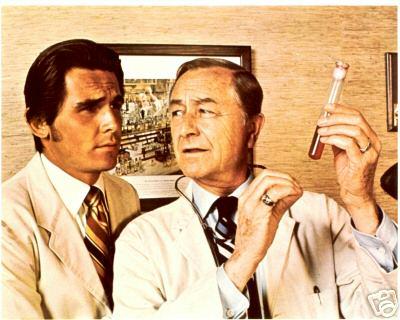
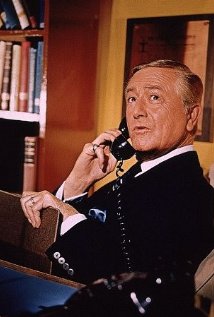
The Aging Physician—Goodbye Dr. Welby!

IMG_8902

As a specialist in geriatric medicine I have experience in taking care of a number of  doctors who were referred to me for suspected memory problems. Still operating and teaching residents in his 70s, my first was a well-respected surgeon, a pioneer or Maverick who had made advances in his particular subspecialty.  Known for his detailed knowledge of the history of medicine and sharp clinical acumen, he had not seemed himself for a while.  His colleagues noted he appeared slower,  fatigued and forgetful at times (not remembering his keys, having trouble finding the right word).  An internist friend and co-worker who knew him for 50 years curb-sided me and asked if I would see him.  He did not have a primary care physician or even seen a doctor professionally for decades (a common phenomenon in this age cohort of doctors).

I met him the next week and he readily admitted to having difficulty concentrating and having trouble with his short term memory.  On taking his history he told me of his life and career which started as an intern in Boston in 1942 and he was on duty the night 492 people were killed in the  Cocoanut Grove fire with many of the victims transported to his hospital.  “I can see every detail as if it were yesterday–beautiful young women wearing fashionable dresses and gowns and young men in formal evening wear who looked as if they were sleeping but were dead.”

“Gastric reflux ” was the only medical problem he reported, adding it was well controlled for the better part of a decade with anti-reflux medications from the office sample closet.   I tested his memory with several cognitive scales which showed some mild deficits in short-term memory and sent him to a neuropsychologist for more comprehensive testing.  His physical examination, including a comprehensive neurological exam was normal.  I ordered the usual lab work up for dementia to look for possible metabolic causes and his B12 level returned markedly low–a result of his long-term use of proton pump inhibitors.  He was given an intramuscular injection and started on high doses of oral B12.  As one of the “reversible’ causes of dementia he was back to his usual sprightly self several months later.

Another, a 70 old psychiatrist still teaching medical students and residents had asked a third-year psychiatric resident out on a date on two separate occasions. She reported him to administration on the second request.  When I  asked him about the incident he replied he didn’t see what was wrong with what he did and it was being blown out of proportion.  “She’s in her 20’s” I said to which he replied “Well I’m only 36.” Still giving lectures to first year medical students without error or pause from knowledge he learned long ago, he could not identify a pencil or a watch when I pointed to them and asked what there were. He knew neither the month, season or year.  After an MRI and neuropsychological testing he was given a diagnosis of probable Alzheimers disease.   He had no spouse or children and his work was his life.  After that he became  profoundly depressed and six months later was dead.

Another  elderly doctor, an internist, had a fairly sudden sudden onset of memory problems and symptoms of delirium.  It turned out he was having trouble sleeping and his cardiologist prescribed him Dalmane, a benzodiazepine similar to  Valium (medications that have a whole host of adverse effects in older patients including memory problems and falls).  But valium has a half-life of hours whereas Dalmane has a half life of days.   The medication was stopped and he was back to normal after a few days.

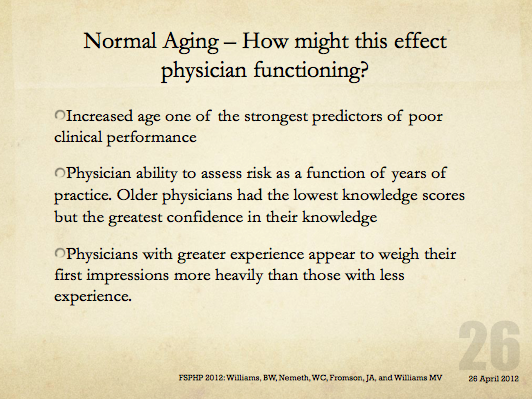
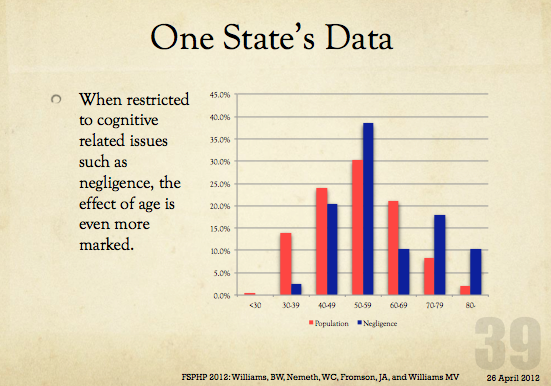
Aging  is associated with an increased  decline  in many areas including  cognition, motor-skills, muscle strength, and vision that can individually or cumulatively create risk to the person or others in a variety of situations (driving, living situation, occupation).

With advancing age comes advancing risk and the recognition and vigilance of others is often necessary for intervention. If the risk is recognized the problem can be addressed by the appropriate healthcare providers and specialists.

Doctors are not immune from cognitive impairment or dementia and the perspicacity of others is necessary should this occur.

Recognition and awareness are important.  So too is an assessment by a qualified physician Board Certified in Neurology, Geriatrics or Geriatric Psychiatry who has education and experience in the diagnosis and treatment of memory disorders.

Slide15

Recognition, Insight and Education Essential

In 2009 Dr. Ralph Blasier, M.D, J.D., published an article in the Journal  Clinical Orthopaedics and Related Research entitled “The Problem of the Aging Surgeon: When Surgeon Age Becomes a Surgical Risk Factor” discussing the ability of older physicians to practice medicine safely and effectively.

His primary message is that a decline in physical and cognitive abilities is associated with the aging process and that these issues are especially pertinent to the field of medicine.

An area  little researched, Blasier gives anecdotal examples such as a surgeon in his late 80s who had to regularly depend on younger colleagues to finish his operations. He concludes that these anecdotal examples suggest many surgeons lack insight into the degradation of their own skills and suggests recognition, insight, and education can help facilitate retirement of the aging surgeon  before  a decline in competency and skill creates a problem.

The awareness, education and insight of others is necessary to identify age associated illness in doctors who can then be referred to the proper specialists for evaluation.  And although no evidence base exists, anecdotal reports such as these caused some groups to see an opportunity to increase the grand scale of the hunt.

IMG_8901

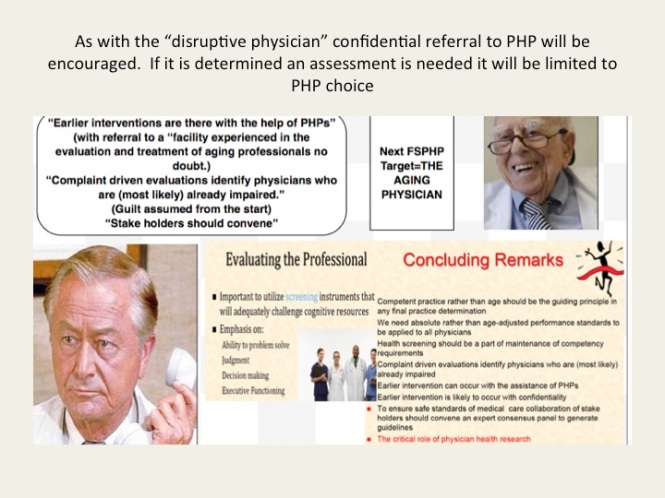
Aging Physicians Next Target of Physician Health Programs

As with the “impaired” and “disruptive” physician, the “physician health and wellness movement” organized as the Federation of State Physician Health Programs (FSPHP) is linking the “aging” physician with threats to patient safety and  hospital liability.  “Experts say doing nothing could result in lawsuits, higher liability insurance rates, ruined reputations for practices and all involved, and even possible losses of practices and the licenses of non-reporting physicians.”

And if you look at the articles and presentations aimed at  the administrative, regulatory, and legal arenas of medicine it appears a new moral panic is percolating in the “physician wellness” cauldron.

Labelling a group dangerous and creating fear in those responsible for that group is an effective means to sway policy and opinion.

With absolutely no evidence base these groups have acted as   “moral entrepreneurs ” and used this same methodology to successfully change policy and regulation in the medical profession and advance their goals.  The methodology is to

1. Label a group and link that group to danger

2. Offer to assist in identifying and eliminating that danger

3. Corner the market and control all aspects including assessment, testing and monitoring by swaying those in authority to make it public policy and regulation.  Screen Shot 2015-03-11 at 8.10.37 PM

The methodology is not new–witches are real, witches are dangerous and witches need to be identified and exterminated at all costs.  Convince the authorities to assist you in protecting the public from harm and advance  the greater good

In this manner the FSPHP has convinced state medical boards to adopt and enforce policies that have incrementally and systematically increased their autonomy, scope and power since they first cultivated a relationship with the Federation of State Medical Boards (FSMB).  This occurred in 1995 when they took an uninvited seat at the table of power by offering a non-disciplinary “safe harbor” as an alternative to discipline for doctors impaired by drugs or alcohol.

Since then they have increased their scope from  the “impaired” to the “disruptive” to everything else.  Arising from the “impaired physicians movement”  as “addiction specialists” these doctors whose specialty of addiction is not even recognized by the American Board of Medical Specialties have now become the “experts” in all matters related to physician health.  Jacks of all trades covering neurology, psychiatry, geriatrics, and occupational medicine.

A 2011 updated FSMB  Policy on Physician Impairment  states that Medical Boards should recognize the state Physician Heath Program (PHP) as their experts in all matters relating to licensed professionals with “potentially impairing illness,”   and these  include those potentially impairing maladies that increase as we age.

They are also using “everyone else does it why don’t we?” logical fallacy.  According to a Washington Post article “other professions are subject to age-related regulations. For example, airline pilots must undergo regular health screenings staring at age 40 and must retire at age 65. FBI agents must retire at age 57.”Screen Shot 2015-03-11 at 8.10.59 PM

Proposing drug testing in doctors a  JAMA article  uses this same logic stating when sentinel events occur in the airline, nuclear power and railway industry the get drug tested.  However all of these industries use FDA approved tests, certified labs, strict chain-of-custody and MRO review in their drug testing.  One of the authors of the JAMA paper, Dr. Greg Skipper, introduced the non-FDA approved and unvalidated Laboratory Developed Tests currently used in PHPs such as EtG.   He claims no conflicts-of-interest.   Comparing drug testing to industries that use the highest quality of testing and safeguards to protect the donor from false-positives to the junk science used in PHPs is comparing apples to oranges. Which one do you think they’s be using in the random drug testing of doctors?

Furthermore, airline pilots, railway engineers and nuclear power plant employees have a choice of assessment and treatment centers should they get a positive test.  Doctors do not.  They are mandated to “PHP-approved” facilities.  This is enforced by state medical boards as they adhere to an ASAM   Public Policy Statement  recommending only “PHP approved” treatment centers be used for assessment and treatment and a recent  audit  found the PHP in North Carolina could not provide any measurable indices  or qualitative indicators of how an assessment center is stamped “approved.” The best they could come up with is “reputation” and other ‘informal sources.  What the audit missed is all of the 19  out-of-state “PHP-approved” centers Medical Directors can be found on this list.

Screen Shot 2015-03-11 at 8.13.13 PM

And what will happen with the “aging physician” is the same.  Doctors will be forced into “assessments” at “PHP-approved” facilities where they will be misdiagnosed, over-diagnosed and forced into monitoring contracts under threat of loss of licensure. Goodbye Dr. Welby!

IMG_8900

← Back

Thank you for your response. ✨

IMG_0933

IMG_0706

HEALTH CARE RESILIENCE RESOURCES FOR HEALTH CARE PROVIDERS

Screen Shot 2015-03-11 at 1.48.00 AM“Whoever fights monsters should see to it that in the process he does not become a monster.” –Friedrich Nietzsche.
In our efforts to curtail spending in Health Care, our government perceived that medical professionals might be at the root of the problem. The national effort to target the medical profession began when the Clinton administration introduced the concept of “Health care offenses” into the general public lexicon in the proposed 1993 “Health Security Act.”This site is supported by health care providers who have overcome adverse actions.

If you feel isolated and alone in your situation. We encourage you to use our professional blog to     communicate with others in a similar place. This blog is reserved to professionals. You will need to sign up. If you are still concerned about privacy, you are welcome to select a pen name. The blog manager understands. Signup.

via About.

← Back

Thank you for your response. ✨

Screen Shot 2014-12-02 at 3.11.54 AM

images-8

Beyond the Schoolyard: Workplace Bullying

Screen Shot 2015-06-08 at 1.47.25 PMThis infographic on workplace bullying was created by International Business Degree Guide to convey the message that workplace bullies not only hurt people, they can also hurt business–driving away good employees in their quest for control.

Adept at dissimulation, those in authority often see what the bully expressly feigns and pretends to be. Under observation by authority the bully hides his true self and often cultivates an image designed to please and impress.

Veiling truth to those in power protects the bully.  Reports of abuse are disbelieved or ignored; dismissed or minimized as exaggeration; deemed a product of bellyachers and whiners.  In addition to hiding his true self the bully will often tell superiors what they want to hear. The workplace bully promotes an image of loyalty, dedication and hard work to superiors and may even feign common ideals and goals.   This  impression management often works.

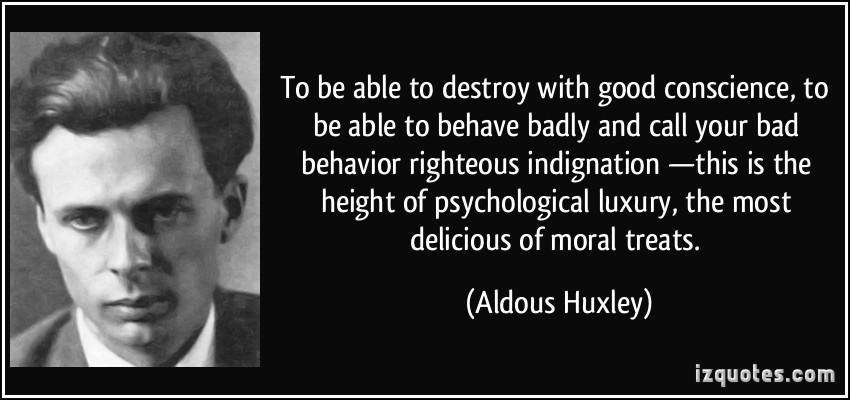
quote-to-be-able-to-destroy-with-good-conscience-to-be-able-to-behave-badly-and-call-your-bad-behavior-aldous-huxley-314332When bullying ends in tragedy it is often revealed that those who could and should have done something about it knew about it and did nothing.  This failure to act may be the result of blinkered apathy, willful ignorance and even malicious complicity.  This is especially true when the  political and ideological views of the bully align closely with  those in charge and the victim of bullying is remotely aligned.   Moral superiority, bigotry, racism,  and other biases all too often factor into the equation.

Perhaps those without sufficient empathy of others to take action when reports of abuse and harassment are reported to them will do their jobs if they realize workplace bullying might harm them personally or what they value most.

via Beyond the Schoolyard: Workplace Bullying.

Beyond the Schoolyard: Workplace Bullying

WorkplaceBullies

Share this infographic on your site!

Beyond the Schoolyard: Workplace Bullying

Not only do workplace bullies hurt people, they can also hurt business – driving away good employees in their quest for control. What can you do if you find yourself having to face a bully every day?

Not All That Different …

Schoolyard bullies vs. workplace bullies
Both share a need for control – exercising power through humiliation of a target. If reinforced by cheering kids, fearful teachers or ignoring administrators, there is no reason to change and it often continues into adulthood. (1)

What Is a Workplace Bully?

Characteristics of a workplace bully: (2)

  • Tormenters
  • Tattlers
  • Finger pointers
  • Publicly pick on people
  • CC the whole world in emails
  • Point out your mistakes and tell everyone

Narcissism and self-orientation

What workplace bullies usually score high on in personality tests (3)

Bullying Victims

How many workers are dealing with bullies?
50%
Workers who say they’re treated rudely at least once a week (in 2011); up from 25% in 1998 (4)
66%

Bullying victims who had to lose or give up their jobs to make the bullying stop (1)
40% of workplace bullies are women, picking on other women more than 70% of the time. (5)

How Bullying Can Hurt Your Business

Work is stressful enough on its own, but adding a bully to the mix can make it unbearable.
9% of people say they’re happy at the office. (3)
Less than 1/3
Employees who say they’re engaged at work (3)

Workplace bullying can have serious negative effects on employees, such as: (6)

  • Stress
  • Absenteeism and low productivity
  • Lowered self-esteem and depression
  • Anxiety
  • Digestive upset
  • High blood pressure
  • Insomnia
  • Trouble with relationships due to stress over work

All of this can hit the company’s bottom line, causing: (6)

  • High turnover
  • Low productivity
  • Lost innovations
  • Difficulty hiring quality employees due a “hostile work environment” reputation

Got a Bully? Here’s How to Deal

Avoid the workplace in the first place (1)

  • Ask why the job is open and how long the predecessor was there (turnover is a bullying sign)
  • Ask about the attitude toward “workaholics.” If it’s expected, then you can know what you’re getting into
  • Ask about policies and codes that help ensure a respectful workplace

Once you encounter a bully (5)

  • Don’t get emotional (bullies like that)
  • Don’t blame yourself (the problem is the bully, not you)
  • Do your best work
  • Build a support network
  • Document everything
  • Seek help
  • Get counseling
  • Stay healthy
  • Educate yourself about policies
  • Don’t expect to change the bully
  • Start a new job search

25% of workplace bullying deals with discrimination. If that’s the case, you can talk to an attorney. (7)

Don’t hire a bully
Recognize certain traits in an interview process: They usually interview well due to a desire to control the situation. Invite them to an informal lunch and see if they’re empathetic (good) or brag about “cracking the whip” (bad). (8)

Workplace Bullies

Sources:

1. http://www.workplacebullying.org
2. http://www.forbes.com
3. http://www.usatoday.com
4. http://hbr.org
5. http://www.huffingtonpost.com
6. http://www.bullyingstatistics.org
7. http://www.ivillage.com
8. http://www.ere.net

Monopolies, Self-Referral and Shell Games: The Need for Antitrust Investigation of Physician Health Programs and their “PHP-Approved” Assessment and Treatment Centers

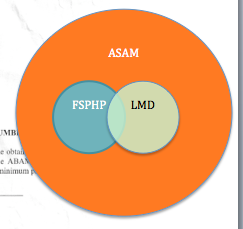
Screen Shot 2015-03-06 at 4.38.05 AMThree shells and a pea–ASAM, FSPHP, and LMD.

“PHP-Approved” Assessment and Treatment Centers

On the above list  can be found the Medical Directors of a number of drug and alcohol rehabilitation facilities.

Talbott, Marworth, Hazelden, Promises, and another two-dozen or so “PHP-approved”  assessment and treatment centers are represented on this list.    State Physician Health Programs (PHPs) refer doctors to these facilities for evaluations.  PHPs are non-profit tax-exempt organizations.  They do not evaluate or treat patients.   If a physician is referred to a PHP for a suspected problem the assessment must be done at an outside facility which will invariably be linked to a name on the list of Like-Minded Docs.

What most people do not know, however, is that this is an exclusive arrangement.    Evaluations are constrained to one of these facilities.   It is mandated.   No bargaining.  No compromises. No choice.  In other words it is a coercion.

“What’s wrong with that?” one might ask.   These facilities are all recognized as top-drawer and first-class.  Perhaps they were hand-picked on objective criteria and the PHPs are just making sure that doctors get the best assessments money can buy– decision making by experts based on knowledge and experience–picking a winner so you don’t have to.

Screen Shot 2014-07-27 at 7.55.16 PM copy


No documented Policy for Selecting Treatment Centers.  Criteria for “PHP-Approval” Unknown by those “Approving”

What objective criteria are used in selecting “PHP-approved” assessment and treatment centers?    According to a  Performance Audit of the North Carolina Physicians Health Program done by State Auditor Beth A. Wood that’s a good question.

The North Carolina State  Audit specifically noted the predominant use of out-of-state treatment centers.   In addition to “creating an undue burden on” those being evaluated the audit states that:

 “Program procedures did not ensure that physicians received quality evaluations and treatment because the Program had no documented criteria for selecting treatment centers and did not adequately monitor them”

In fact the audit found no documented policy for selecting treatment centers.  The very organizations demanding documentation of policy for approval and charged with approving the treatment centers could not even give a comprehensible, plausible or even simple explanation for what any of  these things even mean.    

Screen Shot 2014-05-07 at 5.38.23 PMThe auditor also noted this lack of concrete criteria goes against both The Federation of State Physician Health Programs (FSPHP) and the Federation of State Medical Boards (FSMB) requirements that physician health programs use established guidelines to select evaluation providers and treatment centers.

In its “Physician Health Program Guidelines,” the FSPHP established: • “Characteristics of Evaluation Providers Appropriate for PHP referrals,” and • “Characteristics of Treatment Programs which are appropriate for PHP referrals.”  And in its “Policy on Physician Impairment,” the FSMB states : • “PHPs should employ FSPHP Guidelines in selecting the providers/facilities to provide treatment of physicians with addictive and/or psychiatric illness.”

When the NC PHP was asked to define these characteristics they explained that they learned  of “new treatment centers through professional networks and other informal sources” and used the “treatment centers’ reputation as a basis for establishing a referral relationship.”      Staff credentials, quality of care, treatment methods and modalities, patient choice, follow-up data, outcomes and other objective information apparently took a back-seat to what appears to be ill-defined and subjective word-on-the-street.   Screen Shot 2014-03-15 at 7.33.14 PM

This  “failure to use FSPHP  recommended criteria to select treatment centers,” the Audit concluded “could cause the Program to enter into referral arrangements with service providers that do not meet quality standards”

Ironically the  NC PHP failed to follow guidelines they themselves introduced and demanded be followed.  They could produce no documentary evidence these criteria even exist or even provide plausible criteria.   “Professional networks”, “reputation” and other informal sources are fine for some choices.  That’s how I picked out my first skateboard.

Resources such as these can play in important role in choosing a shirt, buying new sneakers or even purchasing a car but they do not constitute selection criteria for an assessment in which the consequences and recommendations made for the person being assessed are significant, potentially life-altering and possibly permanent!

And to top it all off the  Medical Director of the North Carolina PHP,  Dr. Warren Pendergast,  was the  President of the national organization for state PHPs, the Federation of State Physician Health Programs (FSPHP) at the time of the audit!

PHPs are not clinical providers but monitoring agencies.  They meet with, assess and refer doctors for evaluations and then monitor doctors through drug and alcohol testing and periodic reports of supervisors, co-workers and others.        As such the PHP is tasked with just two jobs-referring doctors for evaluation and then monitoring them after they have been evaluated in a contractual agreement.  The fact that the state PHP 0r FSPHP could not produce the facts and reasoning  behind the mechanics and mentality of the very reason for which they exist is incomprehensible.  It is, in fact, ludicrous beyond belief.    The President of the FSPHP being unable to define the selection criteria for approved and mandated facilities is like Anthony Bourdain being unable to explain the ingredients of an omelette.

To summarize, doctors in North Carolina were being forced by the PHP  to have evaluations at “PHP-approved” assessment and treatment centers but the PHP was unable to explain anything substantive in defining any of it.  Why?  Because no qualitative objective selection criteria exist.

“Reputation” obfuscates and confuses.  It does nothing to support or justify.    It is like answering “numbers” to the question “what is 9 x 9?”

And this is especially concerning when it is realized that these evaluations are limited to facilities and people  tied financially and ideologically to the groups and individuals who are mandating the referral.

Screen Shot 2014-02-18 at 11.06.35 PM

All of the “PHP-approved” assessment centers are represented by medical directors who belong to “Like-minded docs”-an admittedly  12-step steeped conservative fundamentalist faction of the American Society of Addiction Medicine (ASAM).   And all of these facilities are private-pay rehabilitation centers that recommend doctors be treated three-times longer than the rest of the population–another medical “urban legend” that should have been debunked from the get-go.

Limiting assessment and recommendations to this close-knit  group of evaluators is a monopoly of force.  It is unethical if not criminal. And the fact that these are all heavily indoctrinated 12-step facilities also makes it a violation of the Establishment Clause of the 1st Amendment.  Moreover,  many of the medical directors at these facilities are also graduates of the same program in “recovery.”

And if it is looked at from this vantage point it is a system of  self-referral.  Self-referral harms patients and society as a whole.

It is a shell game that removes all choice and removes freedom, objectivity, fundamental fairness, autonomy and choice.


Antitrust law

American antitrust law was “designed to be a comprehensive charter of economic liberty aimed at preserving  free and unfettered competition as the mule of trade. It rests on the premise that the unrestrained interaction of competitive forces will yield the best allocation of our economic resources, the lowest prices, the highest quality and the greatest material progress, while at the same time providing an environment conducive to the preservation of our democratic political and social institutions” (29, p 4).

In this case it is a safe assumption that all doctors desire the “best possible” care and this requires objective and unbiased assessment and treatment when requested by Physician Health Programs.

Congress and the Supreme Court have made clear is that the “best” services are selected by  consumers when their choice is made in an open market free of restraints. Eventually the marketplace will determine the best medical care, not judges, juries, or even doctors (30, p 904).

PHPs are clearly bypassing patient choice.  In 2011 the American Society of Addiction Medicine (ASAM) issued a Public Policy Statement on coordination between PHPs, regulatory agencies, and treatment providers recommending  that  only “PHP approved” treatment centers be used in the assessment and treatment of doctors.  The state Medical Boards have accepted and adopted this policy and denying doctors requests for assessments at non “PHP-approved” facilities. Many have been sanctioned for resisting, protesting or even questioning this unlawful monopoly.  It is prohibition of patient choice.

The N.C. PHP is representative of most PHPs. This is not an exception but a rule.      PHPs are mandating assessments only at facilities they approve but cannot define or explain how these facilities are “approved”  Yet The ideological and financial conflicts of interest between the PHPs and their referral centers are self-evident.  Connect the dots.  

State medical boards are enforcing this mandate under threat of loss of licensure.   Your money or your life.

Federal Trade Commission

For these reasons an investigation by the Federal Trade Commission and Office of the Inspector General of the DHHS is necessary.  For those who have been abused by this unholy alliance I urge you to look at this list to see if the medical director of the facility at which you were evaluated is represented.

If so note it here.   My guess is almost everyone will find this correlation and representation in numbers would necessitate both state and Federal investigation.  If this were done it  could quickly transform a system of institutional injustice into one that allows choice.

Applying Antitrust law to the linkage of  PHPs  and “PHP approved” assessment and treatment centers is consistent with free-market law and theory.   Demanding accountability would provide a powerful deterrent to this type of unfettered abuse.

1. Northern Pacific Railway v U.S., 356 US I (1958).

.2.  Koefoot v American College of Surgeons. 652 F Supp 882 (ND Ill 1986).

← Back

Thank you for your response. ✨

Inquisition_10_Pushing_Off_Bridge

IMG_8301