Disrupted Physician 101.1: The “Impaired Physician Movement” and the History of the American Society of Addiction Medicine (ASAM)

Disrupted Physician 101.1: The “Impaired Physician Movement” and the History of the American Society of Addiction Medicine (ASAM).

Henry David Thoreau

“With one arm around the shoulder of religion and the other around the shoulder of medicine, we might change the world.”—Twelve Steps and Twelve Traditions, AA World Services, Inc (1953).

In 1985 the British sociologist G. V. Stimson wrote:

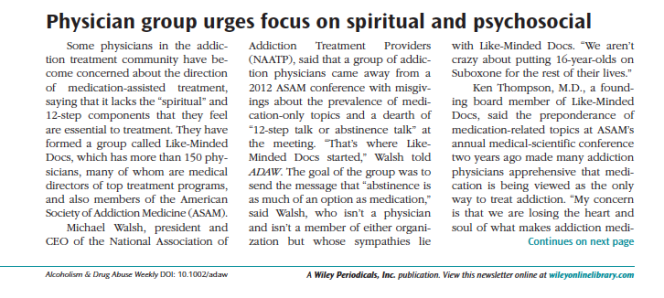
“The impaired physician movement is characterized by a number of evangelical recovered alcoholic and addict physicians, whose recovery has been accompanied by an involvement in medical society and treatment programs. Their ability to make authoritative pronouncements on physician impairment is based on their own claim to insider’s knowledge.”

The American Society of Addiction Medicine’s mission is to “establish addiction medicine as a specialty recognized by professional organizations, governments, physicians, purchasers, and consumers of health care products, and the general public.”  

In this they have succeeded.images-4

And in the year 2014 Stimson’s characterization of the “impaired physician movement” remains as accurate and apt as it was in 1985. But the “number of evangelical recovered alcoholic and addict physicians” has increased dramatically  (outnumbering Addiction Psychiatry by 4:1)  and their involvement in  medical society and treatment programs” has been realized and enforced through the state Physician Health Programs and their “PHP-approved’ assessment and treatment centers.

Their “ability to make authoritative pronouncements on physician impairment…based on their own claim to insider’s knowledge”  has become public policy and sanctified by Regulatory Medicine -essentially the Word of the Lord.

And the 1953 Alcoholics Anonymous prophecy that “With one arm around the shoulder of religion and the other around the shoulder of medicine, we might change the world” is also coming to pass.

But the world is not changing for the better as that arm around the shoulder of religion has its fingers deep in the pockets of the multi-billion dollar drug and alcohol testing and assessment and treatment industries.  And the arm around the shoulder of medicine has its fingers clamped tightly around its throat; a stranglehold in full throttle suffocating the Profession of Medicine with no meaningful opposition I can see.

Disrupted Physician 101.1: The “Impaired Physician Movement” and the History of the American Society of Addiction Medicine (ASAM)

“With one arm around the shoulder of religion and the other around the shoulder of medicine, we might change the world.”—Twelve Steps and Twelve Traditions, AA World Services, Inc (1953).
 
2055 

In order to comprehend the current plight of the Medical Profession and the dark clouds that lie ahead it is necessary to understand the history of the “impaired physician movement” and the American Society of Addiction Medicine.

In 1985 the British sociologist G. V. Stimson wrote:

“The impaired physician movement is characterized by a number of evangelical recovered alcoholic and addict physicians, whose recovery has been accompanied by an involvement in medical society and treatment programs. Their ability to make authoritative pronouncements on physician impairment is based on their own claim to insider’s knowledge.”1

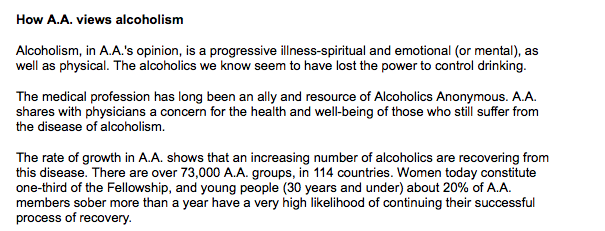
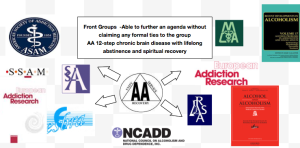
The impaired physician movement emphasizes disease and therapy rather than discipline and punishment and believes that addiction is a chronic relapsing brain disease requiring lifelong abstinence and 12-step spiritual recovery. The drug or alcohol abuser or addict is a person lacking adequate internal controls over his or her  behavior;  for his own protection as well as the protection of society external restraints are required including involuntary treatment.

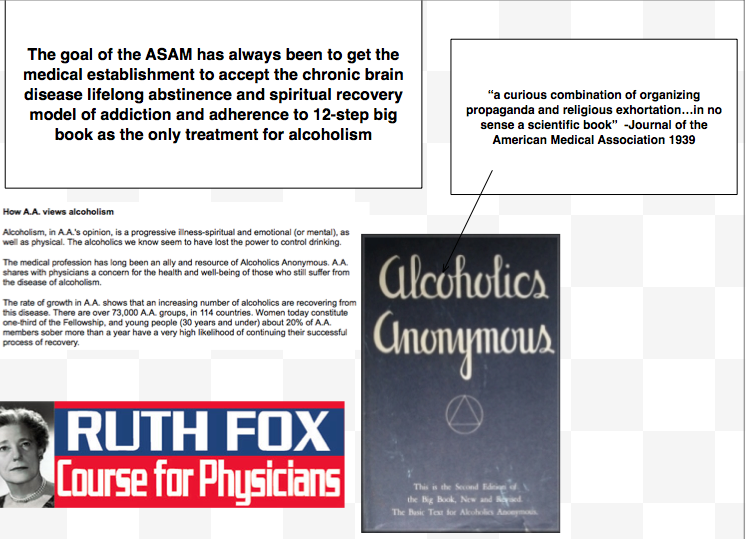
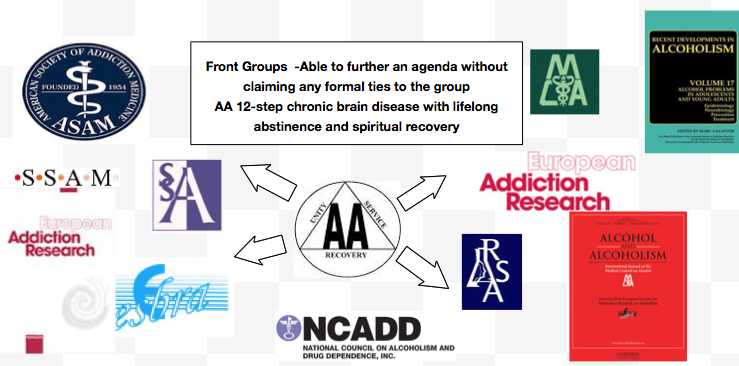
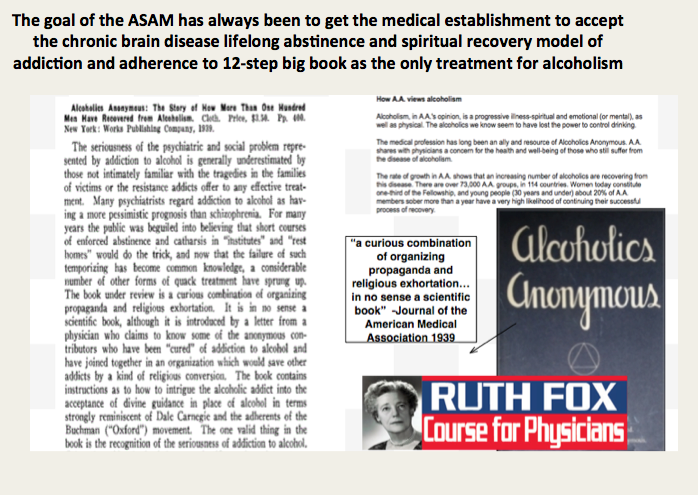
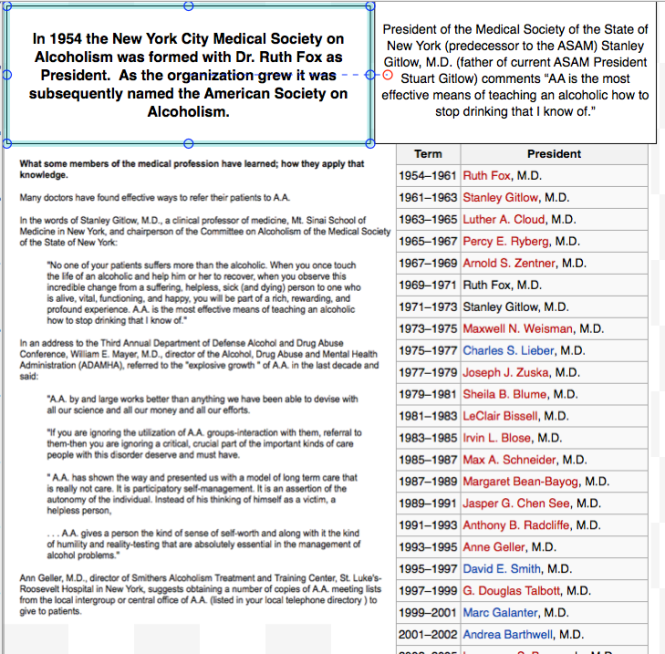
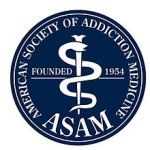
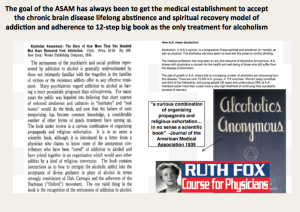
The American Society of Addiction Medicine can trace its roots to the 1954 founding of the New York City Medical Society on Alcoholism (NYCMSA) by Ruth Fox, M.D whose husband died from alcoholism.
Screen Shot 2014-02-23 at 4.42.15 PM

220px-ASAM_Logo

Finding that alcoholics in her psychoanalytic practice did not recover when she used conventional analytic approaches, she taught her patients about alcoholism as a disease and introduced “them to AA meetings held in her living room.”2

A number of physicians in the New York Medical Society were themselves recovering alcoholics who turned to Alcoholics Anonymous for care.3

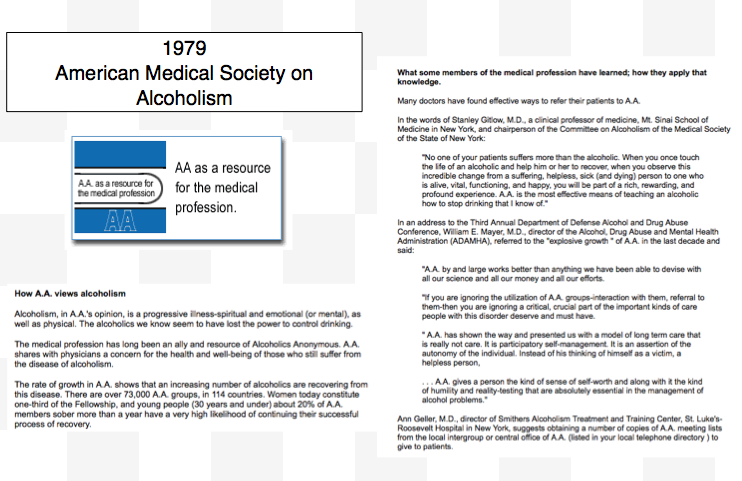
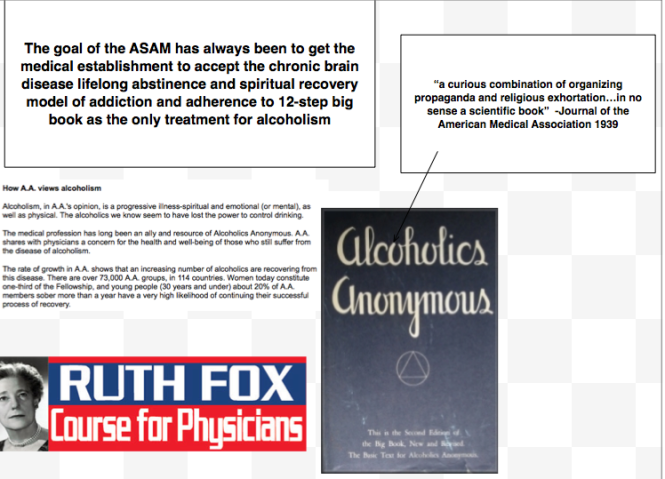
The society, numbering about 100 members, established itself as a national organization in 1967, the American Medical Society on Alcoholism (AMSA).3
Screen Shot 2014-02-23 at 4.52.08 PM

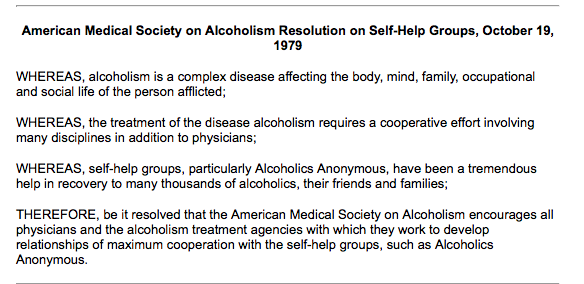
The group promoted the concept of alcoholism as a chronic relapsing disease requiring lifelong spiritual recovery through the 12-steps of AA.

By 1970 membership was nearly 500.2Screen Shot 2014-02-22 at 2.47.51 PM
In 1973 AMSA became a component of the National Council on Alcoholism (NCA), now the National Council on Alcoholism and Drug Dependence (NCADD) in a medical advisory capacity until 1983.

logo

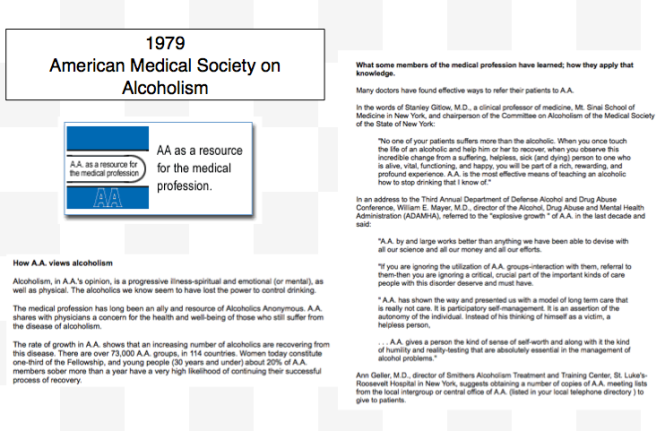
“Abstinence from alcohol is necessary for recovery from the disease of alcoholism” became the first AMSA Position Statement in 1974.2
Screen Shot 2014-02-22 at 3.55.08 PM

Screen Shot 2014-02-22 at 1.49.24 PM

Screen Shot 2014-02-22 at 1.59.25 PM

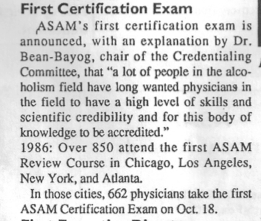
In 1985 ASAM’s first certification exam was announced. According to Dr. Bean-Bayog, chair of the Credentialing Committee:

“A lot of people in the alcoholism field have long wanted physicians in the field to have a high level of skills and scientific credibility and for this body of knowledge to be accredited.”2

And in 1986 662 physicians took the first ASAM Certification Exam.medical
By 1988 membership was over 2,800 with 1,275 of these physicians “certified” as:

“having demonstrated knowledge and expertise in alcoholism and other drug dependencies commensurate with the standards set forth by the society.”4
“While certification does not certify clinical skill or competence,” the Board explained, “it does identify physicians who have demonstrated knowledge in diagnosis and treatment of alcoholism and other drug dependencies.”5
Somehow, I don't think this is quite what they had in mind!

Somehow, I don’t think this is quite what they had in mind!

Achieving “recognized board status for chemical dependence” and fellowships in  “chemical dependency”  are among the five-year objectives identified by the group.  These are to come to fruition by  “careful discussion, deliberation, and consultation” to “determine its form and structure and how best to bring it about.”5

The formation of ASAM State Chapters begins with California, Florida, Georgia, and Maryland submitting requests.6

In 1988 the AMA House of Delegates votes to admit ASAM to the House. According to ASAM News this “legitimizes the society within the halls of organized medicine.”2

In 1989 the organization changes its name to the American Society of Addiction Medicine (ASAM).2

Since 1990, physicians have been able to list addiction medicine as a self-designated area of practice using the specialty code “ADM.”

By 1993 ASAM has a membership of 3,500 with a total of 2,619 certifications in Addiction Medicine.

The Membership Campaign Task Force sets  a goal to double its membership of 3,500 to 7,000 by the year 2000 to assure “the future of treatment for patients with chemicals. It represents a blueprint for establishing addiction medicine as a viable entity.”7
Screen Shot 2014-02-23 at 3.12.12 PM

Ninety physicians become Fellows of the American Society of Addiction Medicine (FASAM) in 1996 “to recognize substantial and lasting contributions to the Society and the field of addiction medicine.”8

Among the honorees are Robert DuPont, G. Douglas Talbott, Paul Earley, and Mel Pohl. In addition to at least five consecutive years of membership and certification by the Society, Fellows must have “taken a leadership role in ASAM through committee service, or have been an officer of a state chapter, and they must have made and continue to make significant contributions to the addictions field.”8

The American Board of Addiction Medicine (ABAM) is formed in 2007 as a non-profit 501(C)(6) organization “following conferences of committees appointed by the American Society of Addiction Medicine” to “examine and certify Diplomats.”9

In 2009 National Institute on Drug Abuse (NIDA) Director Nora Volkow, M.D., gives the keynote address at the first ABAM Screen Shot 2014-11-18 at 10.12.23 AMboard certification diploma ceremony.10
According to an article in Addiction Professional “Board certification is the highest level of practice recognition given to physicians.”

“A Physician membership society such as ASAM, however, cannot confer ‘Board Certification,’ ” but a“ “Medical Board such as ABAM has a separate and distinct purpose and mission: to promote and improve the quality of medical care through establishing and maintaining standards and procedures for credentialing and re-credentialing medical specialties.”

The majority of ASAM physicians meet these requirements by “working in a chemical dependency treatment facility, taking continuing medical education courses in addiction, or participating in research.”11

“In the United States accredited residency programs in addiction exist only for psychiatrists specializing in addiction psychiatry; nonpsychiatrists seeking training in addiction medicine can train in nonaccredited ‘fellowships,’ or can receive training in some ADP programs, only to not be granted a certificate of completion of accredited training.”11
Screen Shot 2014-02-28 at 1.13.17 PM

Specialty recognition by the American Board of Medical Specialties, fifty Addiction Medicine Fellowship training programs and a National Center for Physician Training in Addiction Medicine are listed as future initiatives of the ABAM Foundation in 2014.

The American Society of Addiction Medicine’s mission is to “establish addiction medicine as a specialty recognized by professional organizations, governments, physicians, purchasers, and consumers of health care products, and the general public’12   

In this they have succeeded.

And in the year 2014 G.V. Stimson’s characterization of the “impaired physician movement” remains as accurate and apt as it was in 1985. But the “number of evangelical recovered alcoholic and addict physicians” has increased dramatically  (outnumbering Addiction Psychiatry by 4:1)  and their involvement in  medical society and treatment programs” has been realized and enforced through the state Physician Health Programs and their “PHP-approved’ assessment and treatment centers.Screen Shot 2014-11-18 at 10.11.55 AM

Their “ability to make authoritative pronouncements on physician impairment…based on their own claim to insider’s knowledge”  has become public policy and sanctified by Regulatory Medicine -essentially the Word of the Lord.

And the 1953 Alcoholics Anonymous prophecy that “With one arm around the shoulder of religion and the other around the shoulder of medicine, we might change the world” is also coming to pass.

But the world is not changing for the better as that arm around the shoulder of religion has its fingers deep in the pockets of the multi-billion dollar drug and alcohol testing and assessment and treatment industries.  And the arm around the shoulder of medicine has its fingers clamped tightly around its throat; a stranglehold in full throttle suffocating the Profession of Medicine with no meaningful opposition I can see.

IMG_1686

  1. Stimson GV. Recent developments in professional control: the impaired physician movement in the USA. Sociology of health & illness. Jul 1985;7(2):141-166.
  2. Four Decades of ASAM. ASAM News. March-April 1994, 1994.
  3. Freed CR. Addiction medicine and addiction psychiatry in America: Commonalities in the medical treatment of addiction. Contemporary Drug Problems. 2010;37(1):139-163.
  4. . American Medical Society on Alcoholism & Other Drug Dependencies Newsletter. Vol III. New York, NY: AMSAODD; 1988:12.
  5. Ursery S. $1.3M verdict coaxes a deal for doctor’s coerced rehab. Fulton County Daily Report. May 12, 1999b 1999.
  6. . AMSAODD News. Vol III. New York, NY: American Medical Society on Alcoholism & Other Drug Dependencies; 1988.
  7. Membership Campaign Update. ASAM News. Vol VIII: American Society of Addiction Medicine; 1993:11.
  8. . ASAM News. Vol 12. Chevy Chase, MD: American Society of Addiction Medicine; 1997:20.
  9. http://www.abam.net/about/history/.
  10. Kunz KB, Gentiello LM. Landmark Recognition for Addiction Medicine: Physician certification by the American Board of Addiction Medicine will Benefit all Addiction Professionals. Addiction Professional. 2009. http://www.addictionpro.com/article/landmark-recognition-addiction-medicine.
  11. Tontchev GV, Housel TR, Callahan JF, Kunz KB, Miller MM, Blondell RD. Specialized training on addictions for physicians in the United States. Substance abuse : official publication of the Association for Medical Education and Research in Substance Abuse. Apr 2011;32(2):84-92.
  12. http://www.asam.org/about-us/mission-and-goals.

images-4Screen Shot 2014-07-24 at 4.15.40 PM


Physician Health Programs:  The Need for Integrity and Accountability of Organizations

Slide41

Accountability, or answerability,  is necessary to prevent abuse and corruption.  This requires both the provision of information and justification for actions.  What was done and why?

Professional guidelines and standards of care, ethical codes of conduct and the law are all objective benchmarks that can be used to assess the actions and decisions of others.  In any free society this necessitates the existence of organizations of truly independent opinion capable of standing in this judgment.

State PHPs are Non-Governmental Organizations (NGOs) over which the state health department has no supervisory oversight.  There is no regulation, no transparency and no accountability.  There is no public scrutiny and they police themselves.

In Ethical and Managerial Considerations Regarding State Physician Health Programs Drs. John Knight and J. Wesley Boyd call for greater oversight and scrutiny of PHPs by the medical community at large.   They recommended periodic auditing, national standards and regulation.  They also attempted to convince the Massachusetts Medical Society to implement changes at PHS where they served as Associate Directors with over two decades of collective experience.

These efforts to promote transparency and accountability at both local and national levels, however,  fell on deaf ears.

State PHPs have systematically removed those not conforming to groupthink.  Threatening them with litigation if they breached “peer-review” statutes and confidentiality agreements has effectively silenced them from reporting any misconduct, abuse or even crimes they may have witnessed.

In Massachusetts John Knight was removed in 2009 and J. Wesley Boyd in 2010.  In Ethical and Managerial Considerations Regarding State Physician Health Programs  they comment “if a PHP highlights a physician as particularly problematic, the evaluation center might–whether consciously or otherwisetailor its diagnosis and recommendations in a way that will support the PHP’s impression of that physician.”  So too will the clinical laboratories.  

How is this any different from the case of Dr. Farid Fata, the Michigan oncologist who intentionally diagnosed healthy patients with cancer so he could charge them for unneeded chemotherapy?  The U.S. Attorney called it the “most egregious” case of health care fraud ever. His acts may have contributed to one patient death.   The institutional injustice of the PHP system is causing countless deaths of physicians.

To consciously “tailor” a diagnosis is fraud.  To tailor a diagnosis of substance use disorder or any other psychiatric diagnosis is the political abuse of psychiatry.  Misrepresentation, dishonesty, deception, and distortion play no role in the Profession and Guild of Medicine.  To do so violates the basic moral principles of Medical Ethics–Autonomy, Beneficence, Non-Maleficence and Justice.

The “PHP-approved” assessment and treatment centers are all staffed by doctors of “like-mind.”  It is a rigged game.

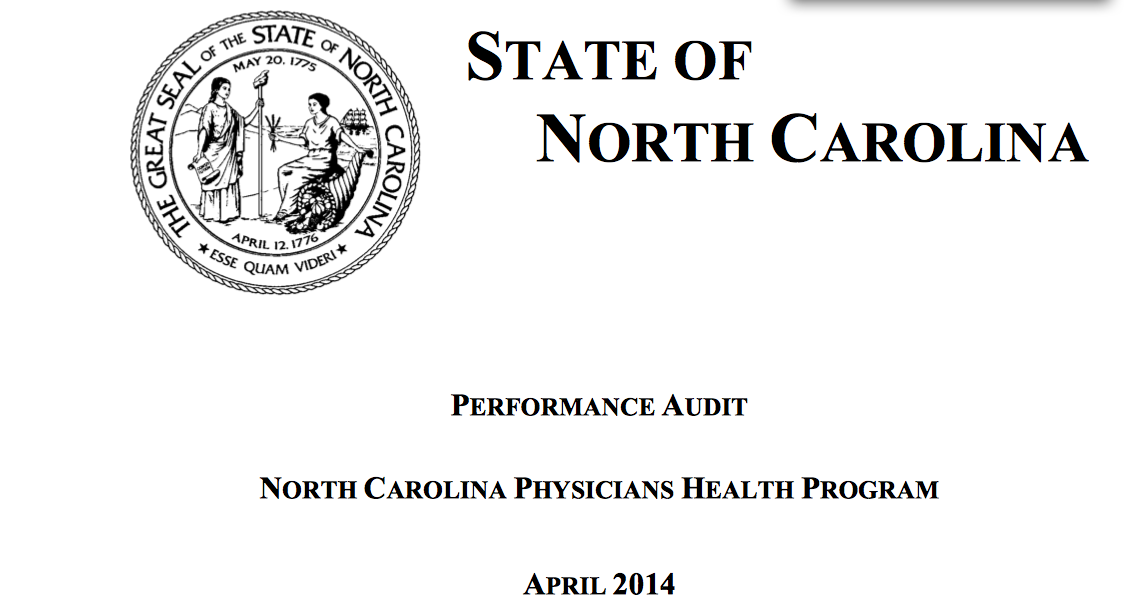
An audit of the North Carolina PHP found essentially no oversight from the Medical Board or Medical Society.  The audit found that “abuse could occur without being detected,” and this is by design.  By removing and blocking the provision of information necessary for accountability, restricting the liberties and freedoms of physicians, and increasing their power and control they have erected a framework of hidden abuse.

Screen Shot 2014-04-28 at 9.45.22 AM

The situation in North Carolina is standard operating procedure for PHPs under the Federation of State Physician Health Programs (FSPHP).  It is not the exception but the rule.

While outspoken in denouncing what they regard as unethical and unprofessional behavior by other doctors, they are resistant to apply even the most minimal standards to their own activities.

To whom are the PHPs accountable? Whom do they represent? There are legitimate concerns.

scotty

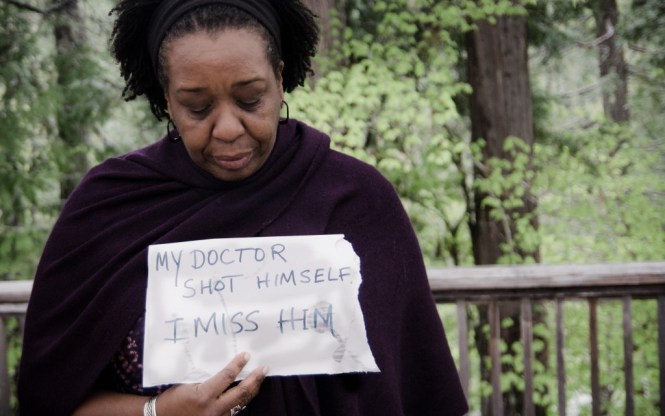
Article by Pamela Wible, M.D. discussing physician suicide and addressing the role of Physician Health Programs (PHPs)

Patient-with-sign-1024x641-1

Physician Suicide–What to do When Your Doctor Dies Suddenly by Pamela Wible, M.D.

32-640x472

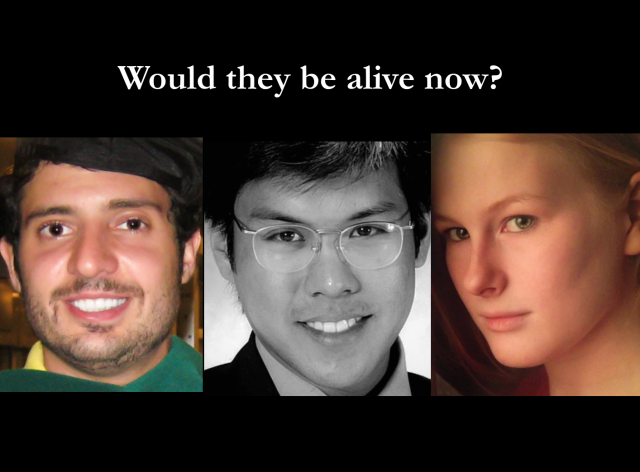
Physician Suicide 101: Secrets, Lies & Solutions by Dr. Pamela Wible, M.D

Physician Suicide 101:  Secrets, Lies & Solutions  By Dr. Pamela Wible, M.D. will hopefully serve as a stepping-stone to start discussing Physician Health Programs (PHPs) and their relationship to physician suicide.    (click on photo above to access article).

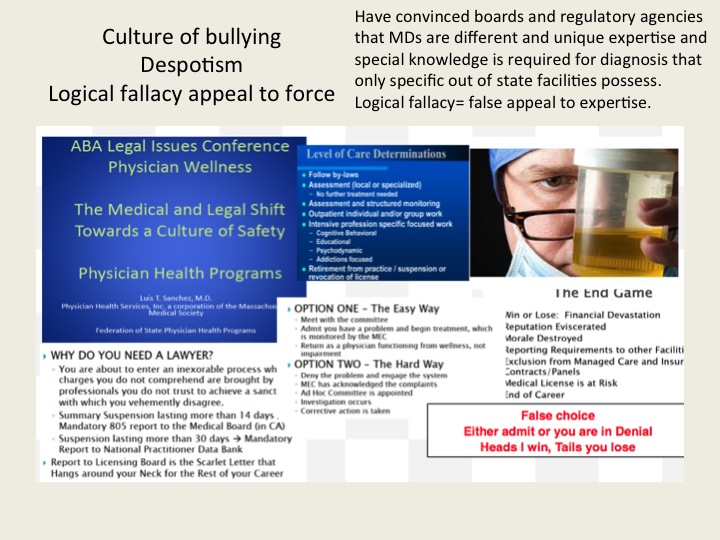
The current state-of-affairs is one of unrestrained  managerial authority and absolute power with no meaningful oversight, regulation or accountability.    Moreover, the authority bestowed on this group is both illegitimate and irrational.  The Federation of State Physician Health Programs is composed of American Society of Addiction Medicine “specialists” in “Addiction Medicine.”    The ASAM is not even recognized by the American Board of Medical Specialties as a bona fide specialty.  It is a Self-Designated-Medical-Specialty;  an AMA  term used to keep track of what any group of doctors is calling themselves.    American  Board of Addiction Medicine (ABMS) “board certification” is little more than a diploma mill.   Yet these “specialists” are now in charge of ALL things in PHYSICIAN HEALTH.    Many of the physicians running these programs had their licenses revoked and got them back by claiming salvation through the good graces of Alcoholics Anonymous and other 12-step methodology.  Many have felony convictions.  Some have double felonies.

At best we have unqualified zealots.   But one major problem I have heard over and over again from physicians forced into these programs is an absolute lack of justice, empathy and even civility by those in charge.  Misconduct, fraud, and even crimes are being reported.   Perhaps the 12-step salvation is just a ruse for some of them; a convenient cloak under which to hide all manner of abuse with impunity and immunity.

The majority of physicians would never do many of the things those now in charge have done no matter how inebriated, intoxicated or otherwise “impaired.”

Most doctors would never think of selling the “date-rape” drug to DEA agents or pilfering IV narcotics from cancer patients who need them.    But if you do a search of some of the doctors who run these PHP programs you’ll find this type of repugnant behavior is all represented.  “i’ve changed.”  “Give me a second chance.”     History will eventually look upon this like the lobotomy.  What the hell were they thinking.  Some of these people should never have gotten their licenses back.   They not only did but were put in charge. Brilliant!

And these are the individuals who have been granted unrestrained managerial prerogative and absolute power over all of doctors.  They decide not only who to monitor but how that monitoring proceeds in every last detail.  Our fates, literally, lie in the hands of this group.   No more physicians should die by this system of institutional injustice, bullying and pseudoscience.  The conflicts-of-interest are abhorrent and would be incomprehensible in any other venue.  Isn’t it time we take charge?  And the solution is fairly simple.  Oversight, regulation,  and auditing by OUTSIDE groups. That is how it’s done everywhere else.  Why do these guys get a pass?     Accountability is a rule not an exception.    Hopefully this article will succeed in framing certain questions for the medical profession; questions that we all need to think about now before the door closes for good.

← Back

Thank you for your response. ✨

IMG_0706

Oliver Wendell Holmes, the Massachusetts Medical Society, Tinsel Erudition and Pretended Science Redux

images-10As the oldest medical society in the United States the Massachusetts Medical Society can count some of the greatest minds in the history of American medicine as members.  My how far we have fallen.  This same author has previously unintelligibly compared the field of medicine to Barbra Streisand’s face and shamelessly and opportunistically blamed the Boston Marathon bombing on “marijuana withdrawal.”   
The sophomoric mnemonics are neither clever nor illuminating.  Unworthy of  Readers Digest circa 1957, this dumbing down of doctors needs to end.  The very soul and practice  of medicine is being castrated and lobotomized by the same dull and very very blunt instrument. 
How does one reconcile the fact that the very same medical society that publishes the New England Journal of Medicine is allowing this type of tripe and rabble to get past editorial review?  In 1969, through an act of the state legislature, the Massachusetts Medical Society updated its mission to read:
“The purposes of the Massachusetts Medical Society shall be to do all things as may be necessary and appropriate to advance medical knowledge, to develop and maintain the highest professional and ethical standards of medical practice and health care, and to promote medical institutions formed on liberal principles for the health, benefit and welfare of citizens of the commonwealth.”
With a foundation and history built and based on of scholarship and critical thought we need to support the highest levels of science, fact, intelligence and reason.  Stupidity tries but it should not win.  Before the Boston Society for the Diffusion of Useful Knowledge in 1842, Dr. Oliver Wendell Holmes delivered two long lectures entitled “Homeopathy and Its Kindred Delusions.” He characterized one of its popular practitioners, Dr. Robert Wesselhoeft, as one of those:  
“Emperics [quacks], ignorant barbers, and men of that sort…who announce themselves ready to relinquish all the accumulated treasure of our art, to trifle with life upon the strength of these fantastic theories.” That “pretended science” as Holmes called it, was “a mingled mass of perverse ingenuity, of tinsel erudition, of imbecile credulity, and artful misrepresentation, too often mingled in practice…with heartless and shameless imposition.”
 And Holmes words are as apt and appropriate today as they were in  mid 19th Century Boston!   Probably more so.  It’s no different. No different at all.    Be it homeopathy or 1939 quack spirituality, quackery is quackery is quackery.  Silence is definitely not the answer.
Screen Shot 2013-12-22 at 11.45.40 AM

Continue reading

Psychopathy and the Medical Profession

IMG_9598Psychopathy is present in all professions. In The Wisdom of Psychopaths: What Saints, Spies, and Serial Killers Can Teach Us About Success, Kevin Dutton provides a side-by-side list of professions with the highest (CEO tops the list) and lowest (care-aid) percentage of psychopaths.   Interestingly surgeons come in at #5 among the professions with the highest percentage of psychopathy while doctors  (in general) are listed among the lowest.

Although by no means a scientific study, Psycopaths, by their very nature, seek power and it would make sense that a psychopath among us might pick surgery over pediatrics or pathology as they are drawn to power, prestige, and control. Be this as it may the incidence of psycopathy or psychopathic traits in doctors of any specialty is low. Statistics indicate that no more than 1% of men in general exhibit psychopathic traits. In Women these characteristics are far less.

Due to irresponsible behavior and a tendency to ignore or violate social conventions and rules,  psychopaths frequently find themselves engaged in conduct involving the criminal justice system or involved in other disciplinary action. Juvenile delinquency, arrests, school suspensions and misconduct related issues are barriers that preclude professional careers for many and, with around 15% of the prison population estimated to be psychopathic, incarceration and recidivism are common final pathways. Because of this tendency it would be highly unlikely for most sociopaths to follow a standard professional career pathway involving academic rigor and normal professional and societal expectations,  because impulsive irresponsible actions commonly blocks it. This would predict a probably much lower prevalence of psycopathy in physicians compared to the general population.

That being said, such self imposed removal from a potential  career is the sole product of getting caught for misconduct and being held accountable for it.   Psychopaths possess several traits that make this difficult.    With a talent for “reading people” and identifying their weak spots and vulnerabilities they are able to get people to see what they want them to see.  Psychopaths often exude charm, confidence and charisma.  They can lie effortlessly and are very convincing..

The natural history of psychopathy involves risky behavior and the ability to get away with it or out of it. The consequences of this depend on if and when it occurs. It is entirely conceivable that some may live their entire lives undetected. With a need for stimulation and a proneness to boredom the psychopath is particularly prone to drug abuse and addiction and twice as likely as the general population to be diagnosed.

 Psycopathy involves a path of risky behavior as well as the potential for being held accountable for it. At any age the behavior that brings they psychopath to the attention of the criminal justice system is often drug or alcohol related. The natural history of the average psychopath reveals an overrepresentation in prison with a 15x greater risk in general. Any statistics on psycopathy in a population is based on psychometric evaluations retrospectively in specific populations. Being arrested or getting caught for something does not reveal the pathology or the correlation. You have to look for it.

And nothing is known of subpopulations of psychopaths and the impact of intelligence, education, profession and other factors and how they relate to outcomes and consequences over time. Egocentricity and a sense of entitlement drives they do not adapt to the environment but try to make the environment adapt to them. Without empathy and lacking remorse the goal is always self-serving and a question of what they can get out of it.

 Many judges, as an alternative to incarceration, have been requiring people arrested for drug and alcohol related offenses to attend AA meetings and provide proof of participation. As misguided as this is on other levels it is also dangerous. Given a choice between incarceration and attending AA the majority of any population, including those with psychopathic traits, would choose the latter. And as in any situation they would use it to see what they could get out of it. Masters of manipulation and impression management in a room full of potential victims. The reports of rape and theft coming out is no surprise. It is in all likelihood much worse.

And in reality psychopaths exist in every profession, including medicine.

What is the natural history and final common pathway of M.D. psychopaths?  Where do these shape-shifters end up?

Screen Shot 2014-11-08 at 11.10.42 PM

In his book Without Conscience, Dr. Robert Hare notes “If we can’t spot them, we are doomed to be their victims, both as individuals and as a society. ” Dr. Clive Boddy in Corporate Psychopaths observes that unethical leaders create unethical followers, which in turn create unethical companies and society suffers as a result.” And if you look at the FSPHP branch of the ASAM that is exactly what you will find.  less than 1/% of the population are psychopaths but they represent more that 10% of those in prisons.  What is the natural history of the physician psychopath? You do the math.

images-4

http://psychopathyinfo.wordpress.com/2012/03/22/characteristics-of-corporate-psychopaths-and-their-corporations/

Anatomy of a Forensic Fraud: The Reality of Drug and Alcohol Testing

Screen Shot 2014-09-15 at 7.16.09 PMDec 11, 2012

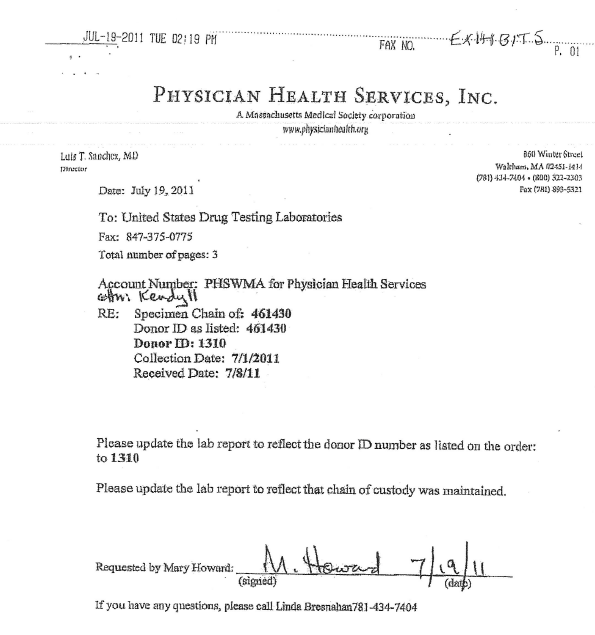
The juxtaposed documents in and of themselves reveal a number of red flags.  How does one “revise” a chain-of-custody”?    If you do a google search you will not find “chain-of-custody” as an object of the verb revise. It is an oxymoron.  A document or opinion can be revised.  A chain-of-custody, by its very definition, cannot.  This collusion to fabricate a positive test has coined a new oxymoron—“revised chain-of-custody.”     Go ahead and look it up. It is a novel one.     As it should be.

What these documents show is, in fact, indefensible ethically, procedurally and legally.  The first document signed by Dr. Luis Sanchez, past President of the FSPHP and past Medical Director of Physician Health Services, Inc.  (PHS) was sent to the Board of Registration in Medicine on December 11, 2012 and is notable for two statements.   The letter from Dr. Sanchez asserts that “Yesterday, December 10, 2012, Physician Health Services, PHS received a revision of a laboratory test result,” but it did not matter because PHS was {unaware} ” of any action taken by the Massachusetts Board of Registration in Medicine as a result of the July 28th, 2011 report.   However, based on the amended report, PHS will continue to disregard the July 21st PEth test result.”

The second document, addressed to Dr. Luis Sanchez, is dated October 4, 2012 (67 days earlier) and shows the first document to be a bald-faced lie.

On July 28h 2011 Dr. Luis Sanchez reported to the Medical Board that I had a positive alcohol test.

Although I knew that Dr. Sanchez had fabricated the test I  had no way of proving it. I requested the “litigation packet,” which records “chain-of-custody” from collection to analysis in August of 2011.  At first they  refused.  PHS then tried to dissuade me (“it will be costly, involve attorneys, etc). Finally they agreed but threatened me with “unintended consequences.”

I was finally able to get a copy of the “litigation packet”  in December of 2011.  Remarkably, it  showed that Sanchez had requested my ID # and a “chain-of-custody” be added to an already positive specimen. I reported this to the Board but they ignored it. I also filed a complaint with the College of American Pathologists.Screen Shot 2014-11-06 at 11.17.32 PM

On October 23, 2012 Sanchez reported to the Medical Board that I was “noncompliant” with requirements with A.A.  meetings that I was supposed to go to as a direct result of the positive test and my license to practice medicine was suspended as a result in December 2012.

On December 10, 2012 I contacted the College of American Pathologists who told me the test was “amended” from “positive” to “invalid” on October 4, 2012. I confronted Sanchez and PHS and they said they did not know anything about it.

The following day, December 11, 2012, they sent out a letter saying that the test was invalid but that they were “unaware of any action taken against my license as a result of the test.”  

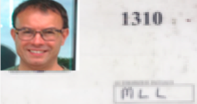
The documents show that on  July 19th, 2011 Sanchez requested my ID # 1310 and a “chain-of-custody” be added to an already positive specimen and on October 4th 2012 the test was “appended” to “external chain of custody not followed per standard protocol.”

Please note again that  Dr. Sanchez stated on December 11, 2012 that he “just learned” about this on December 10, 2012. He reported me to the Board as “noncompliant” on October 23, 2012 and my license was suspended in December 2012.   These documents show he had full knowledge that the test was invalid and as an agent of the Board this is under “color of law.”   Both he, and PHS, need to be held accountable for this.

Screen Shot 2014-09-21 at 12.22.30 AM

Lies, Lies, and More Lies

10:19:12-Verbal Compliant Noncompliance f:u written 10:19:12–BORM Complaint Committee

The contradictory documents from Sanchez alone constitute a crime (withholding information in concealment and providing false information to a state agency).  But what he did is far far worse.

I just obtained the October 4th document. Although I knew it existed, PHS suppressed it and refused to acknowledge it.   But in response to a complaint I filed against PHS and the labs it was revealed by USDTL that the test in question (phosphatidyl-ethanol) was not sent as a “forensic” specimen but collected as a “forensic” specimen, then changed to a “clinical” specimen at the request of PHS Program Director, Linda Bresnahan.   The specimen was kept at the collecting lab (Quest) for 7 days as a  “clinical” specimen, then sent to the analyzing lab (USDTL) with specific instructions from Quest to process it and report it as a “clinical” specimen.  PHS then used it as a “forensic” specimen by reporting me to the Board of Registration in Medicine and  requesting I undergo an evaluation for alcohol abuse.

As a “clinical” specimen it is rendered “Protected Health Information” (PHI) and thus under the HIPAA Privacy-Rule.   So with the help of the College of American Pathologists I requested my PHI from both Quest and USDTL. Quest refused (for obvious reasons) but USDTL complied.   And that is how I was able to obtain the October 4th document revealing that Dr. Sanchez lied to the Medical Board.     I would love to hear him, or PHS MRO Wayne Gavryck, defend the indefensible (and unconscionable).

Dr. Sanchez is correct when he pleads ignorance of any action taken by the Board as a result of the July 21st PEth result.   It was his report to the Medical Board  that I was “noncompliant” with attending AA meetings (that I was supposed to go to as the direct and sole result of the positive test)   that he reported to the Board just two weeks after the October 4th appended test.

The test was sent as a “clinical” specimen intentionally. PHS is not a clinical provider but a monitoring agency. They cannot send clinical samples.   But since clinical samples are “protected health information” and under HIPAA the lab had to give me the records and here you have them.

The distinction between “forensic” and “clinical” drug and alcohol testing is black and white.  PHS is a monitoring program not a treatment provider.  The fact that a monitoring agency with an MRO asked the lab to process and report it as a clinical sample and then used it forensically is an extreme outlier in terms of forensic fraud.  The fact that they collected it forensically, held it for 7 days and changed it from “forensic” to “clinical” to bypass strict “chain-of-custody” requirements  deepens the malice.  The fact that they then reported it to the Board as a forensic sample and maintained it was forensic up until now makes it egregious.   But the fact that the test was changed from “positive” to “invalid” on October 4th, 2012 and Sanchez then reported me to the Board on October 23rd 2012 for “noncompliance,” suppressed it and tried to send me to Kansas for damage control makes it wantonly egregious.   (they didn’t think I’d ever find out).

Add on that the fact that I’ve been questioning the validity of the test since day 1 and they violated the HIPAA Privacy Rule over and over and this is reckless and major health care fraud.

Screen Shot 2014-09-15 at 7.19.15 PM

Fax from PHS to USDTL on July 19th, 2011 asking that my ID #1310 be added to an already positive test and a “chain-of-custody” be “updated”

Screen Shot 2014-09-15 at 7.18.51 PM

USDTL complies with PHS request to and adds my ID #1310 and a date of collection (July 1, 2011) to an already positive specimen

Screen Shot 2014-09-15 at 7.18.06 PM

No date of collection, no unique identifier linking specimen to me. Multiple “fatal flaws.”

Screen Shot 2014-09-15 at 7.17.49 PM

I file complaint with CAP January 12, 2102. CAP forces USDTL to amend test from “positive” to “invalid” which they do on October 4, 2012. PHS conceals this fact until December 11, 2012

Letter from Chief of Toxicology at MGH–Ignored by PHS, USDTL, and the BORM         11:5:12-Dr. Flood Letter–Ignored by PHS:USDTL:BORM

Screen Shot 2014-09-05 at 7.32.59 PM

Screen Shot 2014-09-06 at 3.23.20 AM

Screen Shot 2013-09-04 at 6.14.30 PM

Physician sues Quest Diagnostics for forensic drug test fiasco

Massachusetts physician Dr. Michael Langan has filed a lawsuit against Quest Diagnostics, alleging the lab giant was negligent and engaged in fraud and deceit in its handling of his forensic drug test sample.

http://pathologyblawg.com/pathology-news/pathology-vendors/quest-diagnostics/physician-sues-quest-diagnostics-forensic-drug-test-fiasco/?utm_source=rss&utm_medium=rss&utm_campaign=physician-sues-quest-diagnostics-forensic-drug-test-fiasco