How False Constructs Come to Be Regarded As Irrefutable Truth: The Malleus Maleficarum, Demonologists and Witch-Prickers–Let’s See if She Floats!

hanging_witch_01

From the mid 1980s until present day a confederacy of “authorities” calling themselves “addiction medicine” specialists assisted in identifying disruptive physicians. Shaping clinical and legal orthodoxy they set the standards that cooperating regulatory authorities could follow in criminalizing, persecuting and punishing heretics.imgres

Behavioral manifestations included not answering pages on time, untimely or illegible chart notes, being late for meetings and questioning hospital authority. Disruptive physicians were blamed for everything—patient morbidity and mortality, increasing malpractice costs and decreased hospital revenue.

Using the nebulous “disruptive physician” label, anyone with a grudge or suspicious could accuse anyone of misbehavior, malice and mayhem.

Propaganda, threats, misinformation, guild assumed from the start, PHP oversight of disruptive physician persecution was standard.

mllangan1's avatarDisrupted Physician

cropped-images-4.jpeg

“The belief that there are such things as witches is so essential a part of the faith that obstinately to maintain the opposite opinion manifestly savors of heresy.”  

So begins Malleus Maleficarum , a witch hunters manual published in 1486 that  launched a new paradigm for all those concerned with the identification and extirpation of witches.  Used as a judicial case-book the Malleus set forth definitions of witchcraft, rules of evidence, and the canonical procedures by which suspected witches were tortured and put to death.   Written by Inquisitors for Inquisitor, the Malleus construct came to be regarded as irrefutable truth and contributed to the identification and execution of as many as 60,000 “witches”, predominantly women.  The 29th and last edition was published in 1669.

images-16

Although there was a general belief in witches at the time theas published they were not regarded as evil or life threatening.  Society did not…

View original post 682 more words

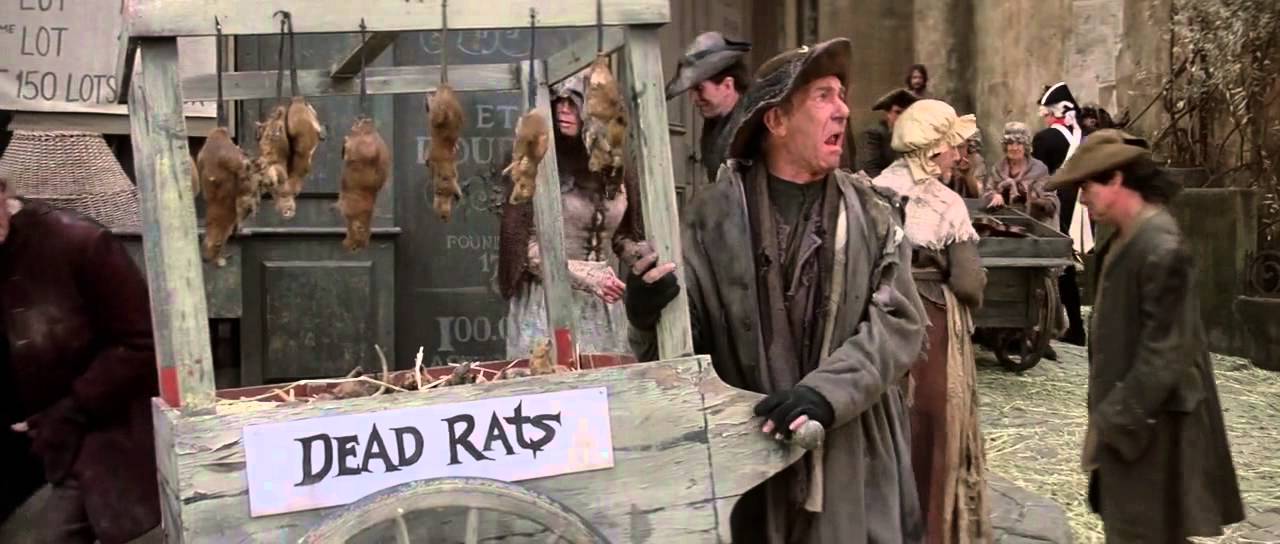
An apt and accurate illustration of the professional regulation of medicine in 2016 via Mel Brooks History of the World Part 1

goodtobeking

It’s good to be the king!

Count De Monet: I have come on the most urgent of business. It is said that the people are revolting!
King Louis: You said it; they stink on ice.

countdemonet_thumb

Count de Monet: Gerald! Gerald: Count da Money! Count de Monet: de Monet… Monet! Say it! Monet! Gerald and Count de Monet: Moonnet, Moonnet, Moonnet Gerald, Count de Monet, Bearnaise: Mooonnnet! Count de Monet: Perfect, don’t forget! Give it to me again! Monet. Gerald and Bernaise: Monet.

Impoverished Paris Street Merchant: Rats, rats for sale. Get your rats. Good for rat stew, rat soup, rat pies, or the ever-popular ratatouille.

Other Street Merchant: Nothing, I have absolutely nothing for sale!
maxresdefault

Gay Doctor coerced by Physician Health Program (PHP) into mandated 12-step treatment and monitoring for sex addiction: The slippery slope begins

gay-friendly-doctorA legitimate interest in the private behavior of a doctor should be limited to behaviors that have a legitimate impact on that doctor’s capacity to work. Though it is pretended that these programs are being maintained for the benefit of doctors and the public it is apparent that they only serve to injure both.

The Federation of State Physician Health Programs (FSPHP) is following the same pattern they have with the “impaired” and “disruptive” physician constructs to discriminate and control with ignorance, bigotry, intolerance and stupidity.

The targeting of gay, lesbian or transgender doctors for what they do in their private lives is predictable. One doctor told me that the state PHP told him that if he did not cooperate in addition to losing his medical license the state medical board would make his sexual history part of the public record.

The civil and human rights violations remain hidden. The crimes remain hidden. So too will this. More sheep for the slaughter.

It is an inevitable part of this well oiled slope of coercion, control, obedience and abuse.

The import of this can not be overestimated.

mllangan1's avatarDisrupted Physician

gay-friendly-doctor

State Physician Health Programs -coercion, control and abuse.

This anecdote concerning  a gay doctor’s revelation he liked his non monogamous lifestyle leading  to a forced acceptance of a “sex addiction”  diagnosis, mandatory inpatient treatment and indoctrination into 12-step recovery was just posted on the physician social network SERMO.    If the pattern looks familiar it is.

Screen Shot 2015-04-10 at 11.56.04 PM

Physician Health Programs (PHPs) are non-profit NGOs that exist in every state ostensibly to help impaired doctors and protect the public from harm.  PHPs have no regulation or oversight and have essentially removed all accountability. Under the ruse of protecting a doctors anonymity and providing confidentiality they have built barriers of opacity.  Most doctors are unaware how they work unless they become involved with them and they are not on the radar of the public at large–they need to be.

Organized under the Federation of State Physician Health Programs, (FSPHP),  state medical boards have abdicated their…

View original post 1,104 more words

Backdraft: How Firefighter Arson was Reduced by Admitting, Defining and having Zero-Tolerance for the Problem–A Lesson for the Medical Profession

Backdraft: How Firefighter Arson was Reduced by Admitting, Defining and having Zero-Tolerance for the Problem–A Lesson for the Medical Profession.

Some researchers believe that firefighter arsonists undergo a mental process referred to as RPM: the arsonist Rationalizes the crime, Projects blame, and Minimizes the consequences.
The impact of firefighter arson can be severe. People die or are seriously injured, including fellow firefighters. Homes are destroyed. An arsonist from within the fire department can disgrace the whole department, and his actions diminish public trust.  Several states that have experienced the crime of firefighter arson have developed new legislation that directly impacts the prosecution of firefighters accused of arson.
The most crucial step was admitting that the problem exists.  The second was defining the problem. The third was having zero tolerance for those engaged in the problem.    States that have taken this approach have found a marked reduction in firefighter arson.

In Mechanics and Mentality the Physician Health Program “Blueprint” is Essentially Straight, Inc. for Doctors.

Screen Shot 2015-03-30 at 8.44.59 PM

In 2012 former Nixon Drug Czar Robert Dupont, MD delivered the keynote speech at the Drug and Alcohol Testing Industry Association (DATIA) annual conference and described a “new paradigm” for addiction and substance abuse treatment. He advocated zero tolerance for alcohol and drug use enforced by monitoring with frequent random drug and alcohol tests. Detection of any substances is met with “swift and certain consequences.”

And then he proposed expansion of this paradigm to other populations including workplace, healthcare, and schools.

Robert Dupont was a key figure in launching the “war on drugs” — now widely viewed as the failed policy that has turned the US into the largest jailer in the world.

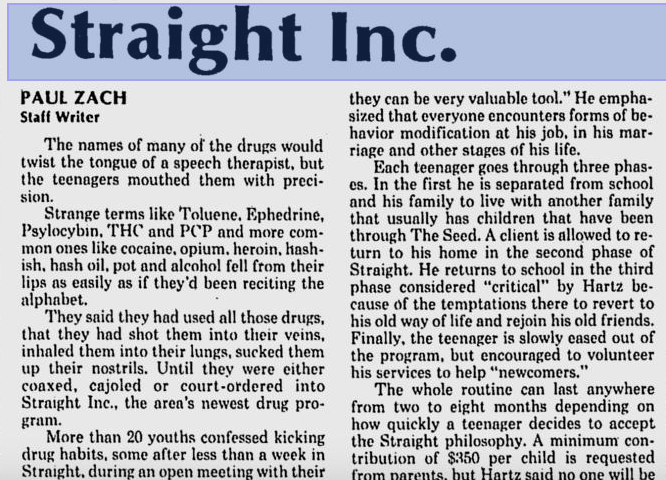
Screen Shot 2014-02-23 at 8.06.56 PMIn the 1970s, Dupont administered the experimental drug rehab program called “The Seed” – that was later deemed by congress to use methods similar to those used on American POW’s in North Korea. He would later go on to consult for “Straight, Inc”, a rehab program that treated troubled teens as “addicts”, often for minor infractions or normal teenage behavior.

Screen Shot 2014-12-02 at 12.46.18 AM

Deemed the “family oriented treatment program,” Dupont encouraged organization and expansion. Targeting the children of wealthy white families parents fears were used to refer their kids to the programs. Signs of hidden drug use such as use of Visine, altered sleep patterns, and changes in clothing style were used as indications for referral. Any child who arrived would be considered an addict in need of their services. Coercion, confrontation, command and control were the guiding principles. Submit or face the consequences. We know what’s right. The idea was to strip the child of all self-esteem and then build him back up again in the straight image. Abused, dehumanized, delegitimized and stigmatized-the imposition of guilt, shame, and helplessness was used for ego deflation to facilitate canned and condensed 12-step as a preparatory step on the path of lifelong spiritual recovery.

Screen Shot 2014-12-02 at 1.18.54 AM

Children were coaxed or terrorized into signing confessions, berated, and told they were in “denial.” Inaccurate and false diagnoses were given to wield greater control. Reports and witness accounts now indicate that many of the kids did not even have drug problems but by creating a “moral panic” about teenage drug use they exploited parents fears for profit. Straight, Inc. became the biggest juvenile rehabilitation center in the world for rehabilitation and treatment of addiction.

12 year old girl admitted to inpatient addiction rehabilitation for sniffing a “magic marker”–Once!

A Deficiency Correction Order was issued by the Executive Office of Human Services, Office of Children, Commonwealth of Massachusetts Services to Straight, Boston in 1990 that read in part:

“Although Straight’s statement of services states that Straight serves chemically dependent adolescents, a review of records and interviews with staff demonstrate that Straight admits children who are not chemically dependent. For example, one twelve-year-old girl was admitted to the program although the only information in the file regarding use of chemicals was her admission that she had sniffed a magic marker.”

Straight was always making outlandish claims of success but there was no scientific evidence based data to support it. In September 1986 USA TODAY ran an article headlined:  DRUGS:  Teen abusers start by age 12 which opened with:  “Almost half of the USA’s teen drug abusers got involved before age 12…”Screen Shot 2015-05-15 at 12.51.23 AM

The article was based on a study conducted by Straight, Inc.

Many former patients of Straight were so devastated by the abuse that they took their own lives. Since then, Dupont has been a key figure in the proliferation of workplace drug testing programs, and once advocated for drug testing anyone in the workplace under the age of 40.1,2Screen Shot 2015-05-15 at 1.47.15 AM

Screen Shot 2014-12-02 at 10.27.30 PM


The Physician Health Program (PHP)  blueprint is essentially Straight, Inc. for Doctors in both Mechanics and Mentality

The “new paradigm” Dupont speaks of before the Drug and Alcohol Testing Industry Association is modeled after state physician health programs (PHPs) and as was done with Straight, “remarkable” claims of success are being made.3-6 Promoted as “Setting the standard for recovery” PHPs are now being pitched to other populations7

0 Dupont and Dr. Greg Skipper proclaim the “need to reach more of the 1.5 million Americans who annually enter substance abuse treatment, which now is all too often a revolving door.”8 They conclude:

This model of care management for substance use disorders has been pioneered by a small and innovative group of the nation’s physicians in their determination to help other physicians save their careers and families while also protecting their patients from the harmful consequences of continued substance abuse. In fulfilling the professional admonition “physician: first heal thyself,” these physicians have created a model with wide applicability and great promise.8

In “Six lessons from state physician health programs to promote long-term recovery” Dupont and Skipper attribute this success rate to the following factors:8

(1) Zero tolerance for any use of alcohol and other drugs;

(2) Thorough evaluation and patient-focused care;

(3) Prolonged, frequent random testing for both alcohol and other drugs;

(4) Effective use of leverage;

(5) Defining and managing relapses; and

(6) The goal of lifelong recovery rooted in the 12-Step fellowships.8

Slide27As with Straight, the majority of those admitted to PHPs are not even addicts.  The Federation of State Physician Health Programs (FSPHP) was able to convince Federation of State Medical Boards, to adopt the notion of “potentially impairing” illness and “relapse without use” to promote early intervention using the same false logic as Straight, Inc. and the 12-year old with the magic marker.  ( i.e. teen drug abuse starts by age 12 and that any sign or symptom inexorably progresses to impairment justifying  “treatment”).

Signals for “impairment” can be as benign as not having “complete, accurate, and up-to-date patient medical records.”  according to Physician Health services, the Massachusetts Physician Health Program and subsidiary of the Massachusetts Medical Society.

Slide41

Despite the overwhelming amount of paperwork physicians now have, incomplete or illegible records could be construed as a red flag, since, as Associate Director of PHS Judith Eaton notes “when something so necessary is not getting done, it is prudent to explore what else might be going on.”

 It is a false premise “feel-good fallacy” with faulty conclusions.  And because it is being perpetrated on doctors (and those in the criminal-justice system) no one seems to care.   But this is merely a wedge for a grander plan.

Screen Shot 2014-04-04 at 1.05.46 AM

Dupont has  been heavily involved in studies using non-FDA approved laboratory developed tests and other devices of unknown validity on doctors in PHPS and promoting the use of these tests for forensic monitoring.9,10   

And they want to bring these tests to you. Propaganda and misinformation has been designed to sway public opinion.

A Medscape article from   “Drug abuse among Doctors: Easy, Tempting, and Not Uncommon” is a prototypical example of the propaganda and misinformation being used to sway public policy and opinion.  Focusing on a small study  ( n =55) done by Lisa Merlo (Director of Research for the Florida PHP). Dr.Marvin Seppala  states in the article that impaired  doctors are:

“….often described as the best workers in the hospital,” he says. “They’ll overwork to compensate for other ways in which they may be falling short, and to protect their supply. They’ll sign up for extra call and show up for rounds they don’t have to do.” Physicians are intelligent and skilled at hiding their addictions, he says. Few, no matter how desperate, seek help of their own accord.”

There is no evidence base for a hidden cadre of drug-impaired doctors causing medical error. A critical review of the literature reveals no evidence base exists.  Moreover, this blather does not even comport with reality.  It defies reason and even basic common sense.

Screen Shot 2014-03-15 at 5.09.11 PMBut through misinformation and deceptive propaganda similar to that used by Straight these groups have created “moral panics” aimed at physicians designed to separate them from everyone else.

To be sure, doctors who are practicing impaired due to substance abuse need to be removed from practice both to get the help they need and to protect the public. But that is not what is happening.   Instead, what is occurring is that doctors can get caught up in this system for any number of reason. Indeed, some of these physicians have no history of drug-addiction—they are the equivalents of the 12-year-old girl caught sniffing a magic marker.

And this is how the scam works.

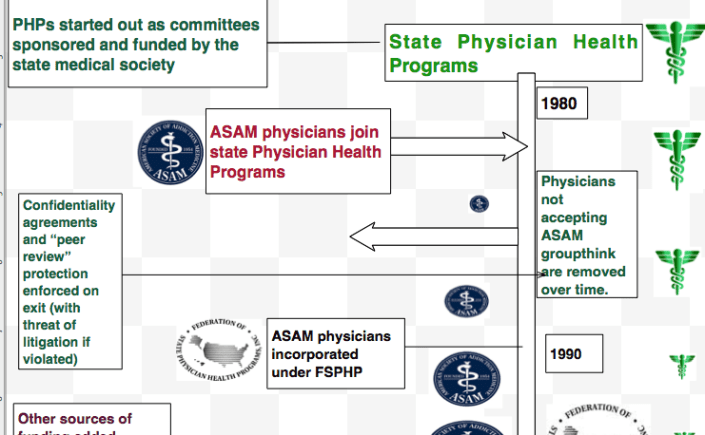
When doctors monitored by their PHP test positive they are forced to have an evaluation at a “PHP-approved” treatment center.  In 2011 the American Society of Addiction Medicine (ASAM) issued a Public Policy Statement recommending physicians in need of assessment and treatment be referred only to “PHP approved” facilities.  The medical directors of the “PHP-approved” facilities can be found on this list of “Like-Minded Docs”.

In 2011, The organization that oversees the licensing for all medical doctors, the Federation of State Medical Boards, adopted a new policy and approved the concept of “potentially impairing illness.” and the Orwellian notion of drug “relapse without use.” 

This implies that they will be able to ruin any doctor who does not comply or who is found guilty, even if fraudulently.

The question might be, “Why?” As with anything, we have to think about who profits.

Indeed, Dupont has remained a vocal and influential spokesman for drug and alcohol testing. But he along with former DEA head Peter Bensinger run a corporate drug-testing business. Their employee-assistance company, Bensinger-Dupont is the sixth largest in the nation.

Now, they also want to extend these tests to drivers.11,12 and Federal Workplace Drug Testing Programs.

They would like to replace the current system used in pilots, bus drivers, and Federal Employees with “comprehensive drug and alcohol testing.”13 AND THEY ARE promoting hair testing, 14Their goal is 24/7 sobriety with complete abstinence 15, and zero tolerance.16

Their claims of success are based on a single retrospective cohort study looking at the outcomes of 904 physicians monitored by 16 different State PHPs.17

An 80% success rate is claimed but 102 of the 904 participants were “lost to follow up” and of the remaining 802, 155 failed to complete the contract.

IMG_8894

So what happened to the 24 of who “left care with no apparent referral,” the 85 who “voluntarily stopped or retired,” and the 48 who “involuntarily stopped” or had their “license revoked.”  Whether you leave a PHP voluntarily, involuntarily, or with no apparent referral it is the end.. The plug is pulled. Game over.   Comparing this to other populations where the consequences are not as terminal is like comparing apples to oranges.

But the bigger question is what happened to the 157 physicians who left or stopped? How many of those killed themselves. The study reports 6 suicides, 22 deaths, and another 157 who are no longer doctors.   How many of the 22 deaths were suicides and what happened to the 157 who stopped for no apparent reason?   Using the last recorded clerical status as an endpoint obfuscates the true endpoints.  Where are they now?  Alive or dead?

Propaganda and misinformation is  designed to sway public opinion and it is all hidden from public view and scrutiny. Absolutely no oversight or regulation from outside agencies exists for PHPs and very little exists for the “PHP-approved” up-front cash only assessment and rehabilitation facilities.  The commercial drug-testing labs using non-FDA approved LDTs have no accountability either.  No agencies exist to hold them accountable for errors or even intentional misconduct.  The College of American Pathologists (CAP)  is the only avenue for complaint and CAP is an accreditation agency that can only “educate” not “discipline.”  It is a system that fosters and fuels misconduct as no consequences exist for wrongdoing and they built it that way.

The American Society of Addiction Medicine erected this scaffold state-by-state. And that is how it must be removed. It is a system of coercion, control, and fear. Crimes like the ones being committed here in Massachusetts must be investigated as crimes. The perpetrators must be held accountable.

It is a system of institutional injustice that is killing physicians by driving them to hopelessness, helplessness, and despair. The general medical community needs to awaken to the reality of the danger to expose and dismantle it at the State level.  And many of the doctors caught in this maw do not even have an addiction or substance abuse issue –equivalent to the 12-year old girl in referred to Straight for sniffing a magic marker.  On the other hand many of those in charge of the administration of these programs have engaged in egregious even horrific misconduct and have a history of manipulating the system.

Secondly, all of the so-called “research” must be subject to evidence base review. It is not there.

And thirdly, the numerous, intertwined and myriad conflicts of interest must be addressed – because it’s money that is the big driver of this “benevolent” interest in whether or not you are sober.

With over 20 years experience as Associate Directors of the Massachusetts PHP, Physician Health Services, Inc. (PHS,inc.), Dr.’s J Wesley Boyd, MD, PhD and John R. Knight of Harvard Medical School published an Ethical and Managerial Considerations Regarding State Physician Health Programs pointing out serious conflicts of interest and ethical issues involving PHP programs and the need “to review PHP practices and recommend national standards that can be debated by all physicians, not just those who work within PHPs.”

They recommend ethical oversight of PHPs, a formal appeals process for physicians, periodic auditing, a national system for licensing, and recommend “the broader medical community begin to reassess PHPs as a whole in an objective and thoughtful manner.” Unfortunately, this has not occurred.  It urgently needs to.  Because the Physician Health Program “Blueprint” is essentially Straight inc. in both mechanics and mentality. and those killing themselves are the equivalent of the 12-year old girl caught sniffing a magic marker.

Unlike Straight, inc.,  no FaceBook site dedicated to the  “memory of those gone” yet exists for the many many doctors killed and being killed  by the “PHP-blueprint.”   It should and someday, believe me, it will.

  1. Engs RC. Mandatory random testing needs to be undertaken at the worksite. Controversies in the Addiction Field. Vol 1. Dubuque, IA: Kendall/Hunt; 1990:105-111.
  2. Dupont RL. Never trust anyone under 40: What employers should know about Molly Kellogg in the workplace. Policy Review. Spring 1989:52-57.
  3. DuPont RL, McLellan AT, Carr G, Gendel M, Skipper GE. How are addicted physicians treated? A national survey of Physician Health Programs. Journal of substance abuse treatment. Jul 2009;37(1):1-7.
  4. White WL, Dupont RL, Skipper GE. Physicians health programs: What counselors can learn from these remarkable programs. Counselor. 2007;8(2):42-47.
  5. Skipper GE, Campbell MD, Dupont RL. Anesthesiologists with substance use disorders: a 5-year outcome study from 16 state physician health programs. Anesthesia and analgesia. Sep 2009;109(3):891-896.
  6. Yellowlees PM, Campbell MD, Rose JS, et al. Psychiatrists With Substance Use Disorders: Positive Treatment Outcomes From Physician Health Programs. Psychiatric services. Oct 1 2014.
  7. DuPont RL, McLellan AT, White WL, Merlo LJ, Gold MS. Setting the standard for recovery: Physicians’ Health Programs. Journal of Medical Regulation. Mar 2010;95(4):10-25.
  8. Dupont RL, Skipper GE. Six lessons from state physician health programs to promote long-term recovery. Journal of psychoactive drugs. Jan-Mar 2012;44(1):72-78.
  9. Skipper GE, Thon N, Dupont RL, Baxter L, Wurst FM. Phosphatidylethanol: the potential role in further evaluating low positive urinary ethyl glucuronide and ethyl sulfate results. Alcoholism, clinical and experimental research. Sep 2013;37(9):1582-1586.
  10. Skipper GE, Thon N, DuPont RL, Campbell MD, Weinmann W, Wurst FM. Cellular photo digital breathalyzer for monitoring alcohol use: a pilot study. European addiction research. 2014;20(3):137-142.
  11. Voas RB, DuPont RL, Talpins SK, Shea CL. Towards a national model for managing impaired driving offenders. Addiction. Jul 2011;106(7):1221-1227.
  12. DuPont RL, Voas RB, Walsh JM, Shea C, Talpins SK, Neil MM. The need for drugged driving per se laws: a commentary. Traffic injury prevention. 2012;13(1):31-42.
  13. Reisfield GM, Shults T, Demery J, Dupont R. A protocol to evaluate drug-related workplace impairment. Journal of pain & palliative care pharmacotherapy. Mar 2013;27(1):43-48.
  14. DuPont RL, Baumgartner WA. Drug testing by urine and hair analysis: complementary features and scientific issues. Forensic science international. Jan 5 1995;70(1-3):63-76.
  15. Caulkins JP, Dupont RL. Is 24/7 sobriety a good goal for repeat driving under the influence (DUI) offenders? Addiction. Apr 2010;105(4):575-577.
  16. DuPont RL, Griffin DW, Siskin BR, Shiraki S, Katze E. Random drug tests at work: the probability of identifying frequent and infrequent users of illicit drugs. Journal of addictive diseases. 1995;14(3):1-17.
  17. McLellan AT, Skipper GS, Campbell M, DuPont RL. Five year outcomes in a cohort study of physicians treated for substance use disorders in the United States. Bmj. 2008;337:a2038.Screen Shot 2014-02-25 at 1.06.55 PM

IMG_8021

 Screen Shot 2014-02-22 at 4.26.32 AMScreen Shot 2014-03-12 at 1.16.25 PM

Disrupted Physician 101.4–The “Impaired Physician Movement” takeover of State Physician Health Programs

These ASAM “addiction experts” have become so numerous they have been able to take over almost all the state Physician Health Programs (PHPs). Their national association—the Federation of State Physician Health Programs (FSPHP)–has a stated goal of universal acceptance of the 12-step doctrine: lifelong abstinence, and spiritual recovery as the one and only treatment, as spelled out in the “PHP Blueprint.”

Very much like Straight, Inc in the 70s and 80s, they have cast a wide net with doctors to ensnare them in an endless loop of drug testing and rehab—whether the tests are fabricated or not. The doctors will enjoy no sympathy from the public, and complaining about it is deemed a sign of your “disease.” Furthermore, ASAM recommends that physicians only be referred to “PHP approved” facilities.

The medical directors of these facilities can all be found on this list of ”Like-Minded Docs.” Surprisingly, many Like-Minded Docs were former addicts and alcoholics, some even with criminal backgrounds. There are felons and even double-felons on the list.

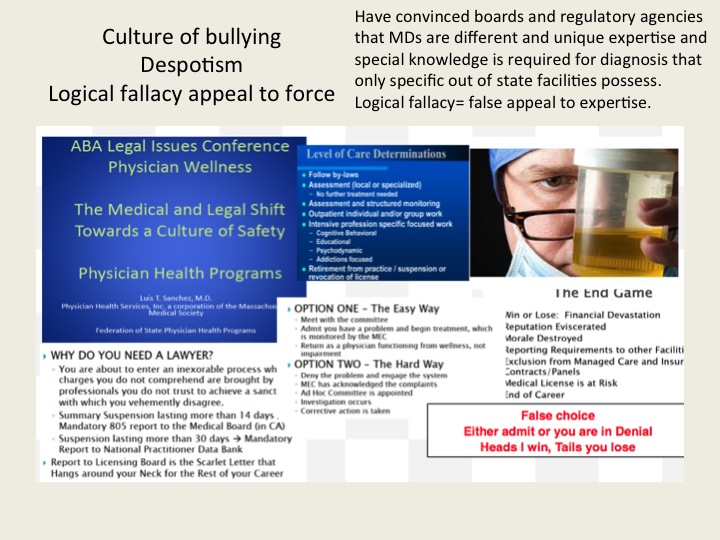
It’s a rehab shell game. Heads I win tails you lose.

And the program is expanding. The organization that oversees the licensing for all medical doctors, the Federation of State Medical Boards, adopted a new policy and approved the concept of “potentially impairing illness” and the Orwellian notion of “relapse without use.”

Signals for “impairment can be as benign as not having “complete accurate, and up-to-date patient medical records” according to Physician Health Services, the Massachusetts PHP. Despite the overwhelming amount of paperwork Doctors now have, incomplete or illegible records could be construed as a red flag, since as Associate Direct of PHS Judith Eaton notes “when something so necessary is not getting done, it is prudent to explore what else might be going on.” The question is, who is next?”

mllangan1's avatarDisrupted Physician

Forget what you see
Some things they just change invisibly–Elliott Smith

IMG_8923

Physician Impairment

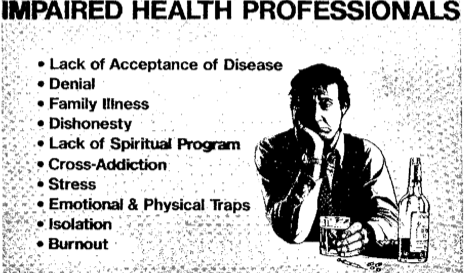
The Sick Physician: Impairment by Psychiatric Disorders, Including Alcoholism and Drug Dependence, published by the American Medical Association’s (AMA) Council on Mental Health in The Journal of the American Medical Association in 1973,1 recommended that physicians do a better job of helping colleagues impaired by mental illness, alcoholism or drug dependence. The AMA defined an “impaired physician” as “a physician who is unable to practice medicine with reasonable skill and safety to patients because of mental illness or excessive use or abuse of drugs, including alcohol.”

Recognition of physician impairment in the 1970s by both the medical community and the general public led to the development of “impaired physician” programs with the purpose of both helping impaired doctors and protecting the public from them.

IMG_1010The 1975 media coverage of the deaths of Drs. Stewart and…

View original post 766 more words

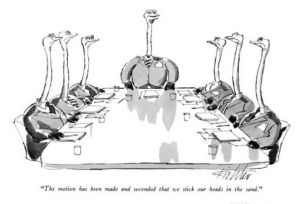
Forensic Fraud in Massachusetts Much Worse than Annie Dookhan—DPH aware but their attitude resembles most closely that of the ostrich that seeks to avert danger by burying its head in the sand

imgres-23

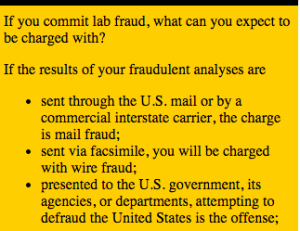
The attached documents show the MA PHP (PHS, inc) and USDTL engaging in flagrant forensic fraud.  They are caught red handed.   Moreover, the VP of operations at USDTL laboratories Joseph Jones, is involved.

This is not Annie Dookhan lone nut falsification of drug tests but misconduct indicative of top-down systemic corruption. It appears to be standard operating procedure.
Screen Shot 2015-05-04 at 8.19.51 AM

The documents are part of the “litigation packet” for a PEth test that was drawn July 1, 2011 and reported as a positive on July 19, 2011. A litigation packet is al legal document generated with any forensic test to document chain of custody. 

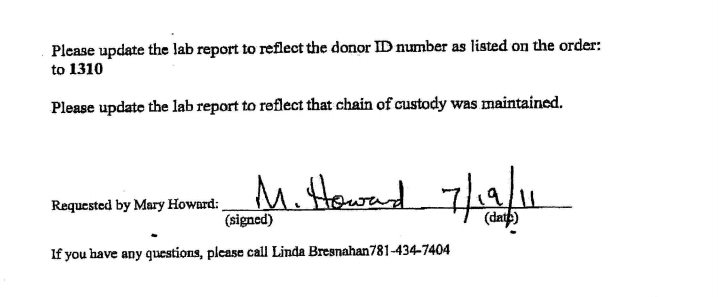
It includes a faxed memo from PHS to USDTL 7/19/2011 requesting an identifying ID#  and a “chain of custody” be added to an already positive test.  Seldom is a document available that shows how the perpetrators of laboratory fraud do it–this is complete from start to finish.

A chain of custody is generated in real time. It cannot be done retroactively.

To do so constitutes fraud.

With no compunction, concern, or consternation this sociopathic mercenary subordinates science in to put coins in his purse and complies with this improper request and adds a unique ID number to an already positive specimen.

Moreover, when the test was questioned the, PHP requested that USDTL support the test as a valid positive. And Joseph Jones did so with full knowledge there was no chain-of-custody and the ID # and date of collection were added.

This is flagrantly antithetical to the process of MRO review (required of all forensic tests before they are reported as positive).

Like an arsonist firefighter,  Jones does the exact opposite of what he is supposed to.   With complete disregard of the basic codes of conduct and MRO guidelines he reports as positive a test that would not meet the minimum requirements for clinical test let alone forensic.

A test with multiple fatal flaws and no chain of custody, collection date, or unique identifier was reported as a positive to please a client and it is egregious, indefensible, and illegal.

Positive drug and alcohol tests can end lifetime careers, tear apart families, and trigger suicides. And I am hearing of more and more suicides caused by these laboratory tests done by Dr. Jones and corrupt illegitimate authority like Dr. Sanchez.

The consequences are grave and far reaching.  An organizational culture capable of willing participation and continued support of forensic fraud cannot be trusted.

Cognizant that the consequences to the donor are significant and possibly irreversible and catastrophic exhibits a careless disregard for truth that is unconscionable.  That this was done without hesitation or thought is egregious.

It is purposeful and with undeniable malice. It represents institutional and sinister corruption. And it exemplifies the top-down sociopathic, predatory, and uncaring organizational culture that is undermining democracy and eroding civil liberties.

But the most disturbing fact of this is that those who should do something about it blind themselves.

The Board of Registration in Medicine protects Dr. Sanchez. He is apparently allowed to commit any crimes he wants and it is worth reading through all of the documentation as he compounds felonies over time.

The political abuse of psychiatry and false diagnoses are acts that violate the most basic and fundamental medical and social ethical codes. They should be met with zero tolerance by the medical community as well as society at large.

Remarkably the Massachusetts Department of Health and Human Services is also aware of this. Apparently learning nothing from the Annie Dookhan case, certain individuals have hemmed and hawed for over six months without any response in a torpid stasis.  As protectors of the public health one would think there would be some urgency to address the fact that a state contracted agency is engaging in undeniable laboratory misconduct and fraud.

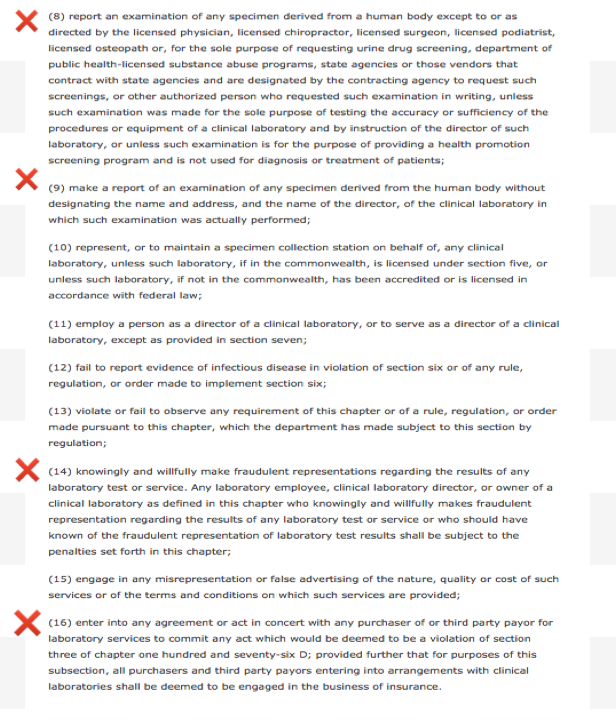
The crimes are many and include state and federal crimes as well as violation of the HIPAA criminal statute as they changed a “forensic” sample to “clinical” in order to bypass chain of custody. They then changed it back to “forensic” and misrepresented it as such up until recently.

This needs to get be addressed outside the medical profession.  As  a society and culture within a society and culture the  prevalence of thinking has become destructive rather than ameliorative under the influence of the “impaired physicians movement.”    The ease with which pernicious ideas and attitudes have pervaded the regulatory and organizational and regulatory culture of medicine is frightening.

The fact that medical boards and public health department are aware of criminal acts being committed  by this “authority” yet do nothing to address its existence will inevitably lead to worse .

If dictatorships can be defined as systems in which there is a prevalence of thinking in destructive rather than ameliorative terms then the “physician wellness” paradigm” shoe fits.    There are multiple warning signs that the profession of medicine is becoming subordinated to the guiding philosophy of the “physician wellness” movement,

One thing is for certain.  There should be zero-tolerance for forensic fraud perpetrated by those in positions of power.   Any intentional laboratory fraud guided by malice is egregious but the scope and severity of what was done here involving collusion to fabricate evidence to coverup the crime, and concealment of the truth when the lab was forced to correct the test by an outside agency is  particularly egregious.    The fact that Dr. Luis Sanchez hid the fact that he was made aware of the corrected test on October 4, 2012 and  reported non-compliance with requirements that directly resulted from that very test for “damage control” under “color of law” is unconscionable.   But the fact that he did these things and lied about it is undeniable.  The facts are self-evident.

This is much worse than Annie Dookhan as her victims were abstractions.  She did not see the damage that resulted from her laboratory misconduct.  These people knew what they were doing, knew it was wrong and did it anyway.   And unlike Annie Dookhan, Sanchez saw the damage he was causing as that was his intent.

As far as I can find, these documents are the most elaborate and complete representation of the mechanics of forensic fraud. They show the sequential steps between the party requesting it and the response of the complicit lab.  The documents illustrate how easy laboratory misconduct is accomplished and the moral detachment of the involved parties.  The fact that it involves top-down corruption cannot be overestimated.

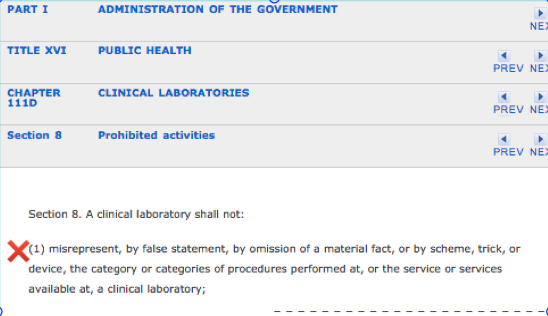
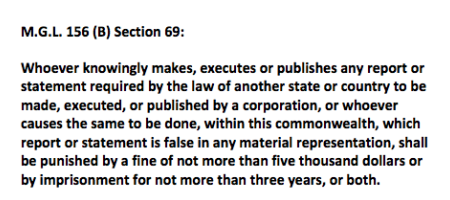
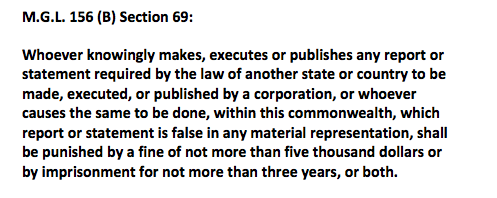
The most obvious crime is the violation of M.G.L 156 (B) section 69 involving reporting false statements.

Screen Shot 2015-05-04 at 10.57.54 AM

Screen Shot 2015-05-04 at 11.02.18 AM

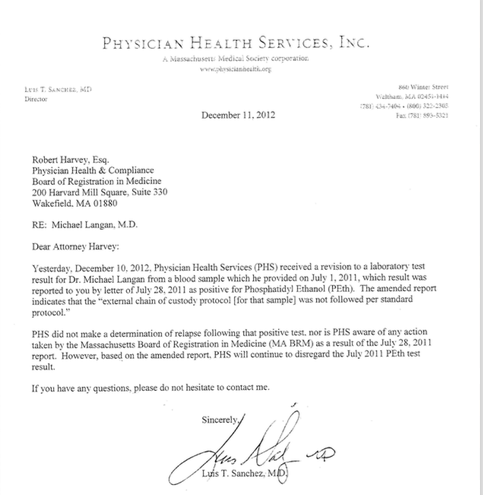
December 11, 2012 Sanchez writes to Board of Registration in Medicine that he “just found out” about test the day before. USDTL report to Dr. Sanchez October 4, 2012 reporting the corrected test. Sanchez concealed this and the next week took action against my license by reporting “noncompliance” for damage control. Documentary evidence undeniable.

The fact that this was test was ordered as a “forensic” specimen then changed to a “clinical” specimen makes it a HIPPA violation as changing it to “clinical” created  “protected health information” (PHI).     In fact, the only reason I was able to obtain the October 4, 2012 document proving Dr. Sanchez lied was due to a change in the HIPPA-Privacy Rule enabling “patients’ to obtain laboratory results without authorization from the agency that ordered it.   Without this allowance Sanchez would still be maintaining he did not find out about the correction until December.   Well the documentary proof shows he lied.

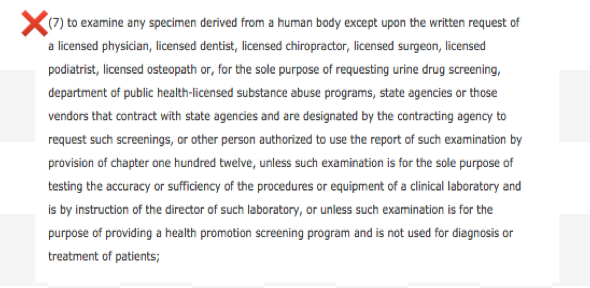
Moreover, PHS is not a treatment provider and cannot order clinical specimens.  It is an ultra vires act outside of their designated scope of authority as a non-profit organization.

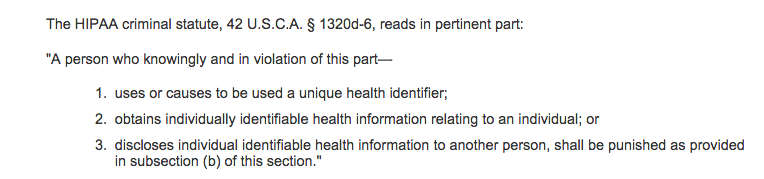
What Sanchez did here is also in violation of the HIPAA criminal statute.
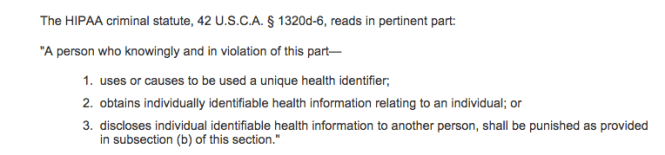
Screen Shot 2015-05-04 at 10.42.58 AM

The elements of a criminal offense under HIPAA are fairly straightforward.  To commit a “criminal offense” under HIPAA, a person must knowingly and in violation of the HIPAA rules do one (or more) of the following three things.:  use or cause to be used a unique health identifier, obtain individually identifiable health information relating to an individual or disclose individually identifiable health information to another  person.   Criminal penalties under HIPAA, tiered in accordance with the seriousness of the offense, range from a fine of up to $50,000 and/or imprisonment up to a year for a simple violation to a fine up to $100,000 and/or imprisonment up to five years for an offense committed under a false pretense and a fine up to $250000 and/or imprisonment up to ten years for an offense committed with intent to sell, transfer, or use individually identifiable health information for commercial advantage , personal gain, or malicious harm.

Requesting the sample be changed to “clinical” created PHI and the fact that it was under false pretense and intended to cause malicious harm is quite evident.

Although PHS is not a covered entity Quest Diagnostics is and as a business associate they can be linked by the conspiracy statute:

Screen Shot 2015-05-04 at 10.48.10 AM

And that is why outside forces need to be involved. These are serious crimes and they have created serious consequences.  I have heard of multiple suicides in doctors caused by these tests.  How many doctors have died as a result of Jones colluding with  individuals just like Sanchez?   The results of these tests can have grave, far reaching and even permanent consequences.  They can ruin careers and destroy families.   Sanchez and Jones know this.  Their moral disengagement here shows an absence of empathy and complete disregard of what consequences may result.

The Board of Registration in Medicine is protecting Dr. Sanchez and the DPH has its head in the sand.

It is my understanding that groups like PHS have led law enforcement to believe that all matters involving doctors should be handled by the medical community.  This has created barriers as doctors reporting crimes have found it difficult to get them investigated or even reported let alone charged.

Law enforcement needs to address this. This needs to be exposed.

.I have been told that in other states where similar situations exist in which the truth is unable to penetrate the proper channels it should go directly to the Governor.

I would like to get these documents to Governor Charlie Baker and any help in making this happen would be appreciated.

IMG_8758 2

Screen Shot 2014-11-04 at 10.47.41 PM

IMG_8757

Screen Shot 2014-11-04 at 10.51.24 PM

Screen Shot 2015-03-12 at 10.43.14 PM

Screen Shot 2014-11-08 at 1.19.44 AM


“A body of men holding themselves accountable to nobody ought not to be trusted by anybody.”
― Thomas Paine 

USDTL drug testing laboratory claims to advance the”Gold Standard in Forensic Toxicology.”  “Integrity: Results that you can trust, based on solid science” is listed as a corporate value. “Unlike other laboratories, our drug and alcohol testing begins and ends with strict chain of custody.” “When people’s lives are on the line, we don’t skip steps.”  Joseph Jones, Vice President of Laboratory Operations explains the importance of chain-of-custody in this USDLT video presentation.

Dr. Luis Sanchez, M.D. recently published an article entitled Disruptive Behaviors Among Physicians in the Journal of the American Medical Association discussing the importance of  of a “medical culture of safety” with “clear expectations and standards.”  Stressing the importance of values and codes-of-conduct in the practice of medicine, he calls on physician leaders  “commit to professional behavior.”

Sanchez is Past President of the Federation of State Physician Health Programs (FSPHP).  According to their website the FSPHP “serves as an educational resource about physician impairment, provides advocacy for physicians and their health issues at local, state, and national levels, and assists state programs in their quest to protect the public.”  In addition the FSPHP “helps to establish monitoring standards.”  The FSPHP is the umbrella organization of the individual State PHPs.

Sanchez is also the previous Medical Director of the Massachusetts state PHP, Physician Health Services, Inc. (PHS).  According to their website PHS is a “nonprofit corporation that was founded by the Massachusetts Medical Society to address issues of physician health. PHS is designed to help identify, refer to treatment, guide, and monitor the recovery of physicians and medical students with substance use disorders, behavioral health concerns, or mental or physical illness.

PHPs recommend referral of physicians if there are any concerns such as getting behind on medical records.  As PHS Associate DirectorJudith Eaton explains “when something so necessary is not getting done, it is prudent to explore what else might be going on.”  If the PHP feels that doctor needs an assessment they will send that doctor to a “PHP-approved” facility “experienced in the assessment and treatment of health care professionals.” The physician must comply with any and all recommendations of the assessment center.  To assure this the physician must sign a monitoring contract with the PHP (usually five years). USDTL is one of the labs PHPs have contracted with for forensic drug and alcohol testing.


Forensic Drug and Alcohol Tests: The Need For Integrity and Accountability of the Sample
Screen Shot 2013-09-04 at 6.14.30 PM

“Forensic” drug-testing differs from “clinical” drug-testing in how the results are used. “Clinical” tests are used for medical purposes in diagnosing and treating a patient.

A “forensic” test is used for  non-medical purposes.  It is not used for patient care, but for detecting licit and illicit substances in those who should not be using them. Pre-employment and employee assistance and professional monitoring programs are examples.Screen Shot 2014-05-08 at 2.17.18 AM
Forensic testing is held to a higher standards because the consequences of a positive result can be grave and far reaching. A positive forensic test can result in loss of rights of the individual being tested and his or her loved ones. Mistakes are unacceptable.

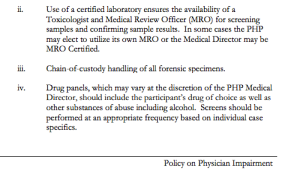
The Federation of State Medical Boards Policy on Physician Impairment supports this position stating “chain-of-custody forensic testing is critical” (page 14) and the “use of a Medical Review Officer (MRO) for screening samples and confirming sample results” (page 21).

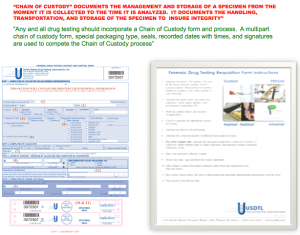
Any and all drug testing requires chain-of-custody. The custody-and-control form is given the status of a legal document because it has the ability to invalidate a test that lacks complete information.  Chain-of-custody provides assures specimen integrity. It provides accountability. 
Screen Shot 2014-11-06 at 7.25.46 PM The job of the MRO is to ensure that the drug testing process is followed to the letter and reviews the Custody and Control form for accuracy.  The MRO also rules out any other possible explanations for a positive test (such as legitimately prescribed medications).  Only then is the test reported as positive.

The legal issues involved in forensic testing mandate MRO review. According to The Medical Review Officer Manual for Federal Workplace Drug Testing ProgramsScreen Shot 2013-12-19 at 12.20.46 PM
the sole responsibility of the MRO is to”ensure that his or her involvement in the review and interpretation of results is consistent with the regulations and will be forensically and scientifically supportable.”

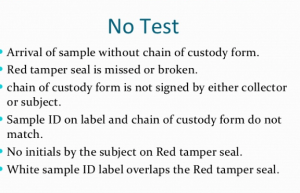
“Fatal flaws” such as lack of chain-of-custody form, missing tamper proof seal, missing signatures, or a mismatch of the sample ID and chain of custody ID invalidate the test.   It is not reported.  Tight chain-of-custody and MRO review is critical for the accountability and integrity of the sample.

The Medical Review Officer Certification Council  provides a certification process for MROs. They Screen Shot 2014-04-30 at 12.47.25 PMalso  follow their own Code of Ethics.   In accordance with these standards PHS has an MRO to review all positive tests.  As added assurance the FSPHP guidelines state that all positive tests must be approved by the Medical Director.

Regulation and the Medical Profession–The need for Integrity and Accountability in Physician Leadership and Health Care Policy.
Screen Shot 2014-11-09 at 12.26.14 PM

Good leadership requires correct moral and ethical behavior of both the individual and the organization. .  Integrity is necessary for establishing relationships of trust.  It requires a true heart and an honest soul.  People of integrity instinctively do the “right thing” in any and all circumstances.  The majority of doctors belong to this group.

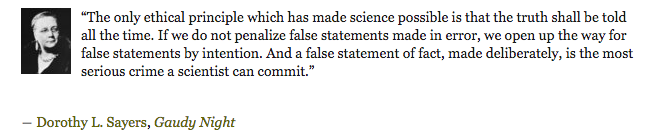
Adherence to ethical codes of the profession is a universal obligation.  It excludes all exceptions.  Without ethical integrity, falsity will flourish.

The documents below show fraud. It is intentional.  All parties involved knew what they were doing, knew it was wrong but did it anyway.  The schism between pious rhetoric and reality is wide.
Screen Shot 2014-08-20 at 12.01.33 PM

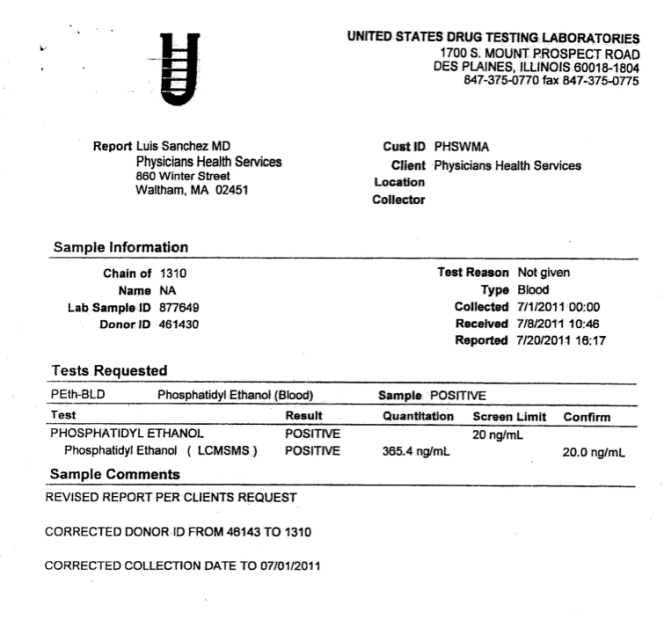
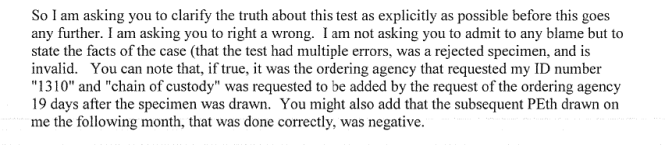
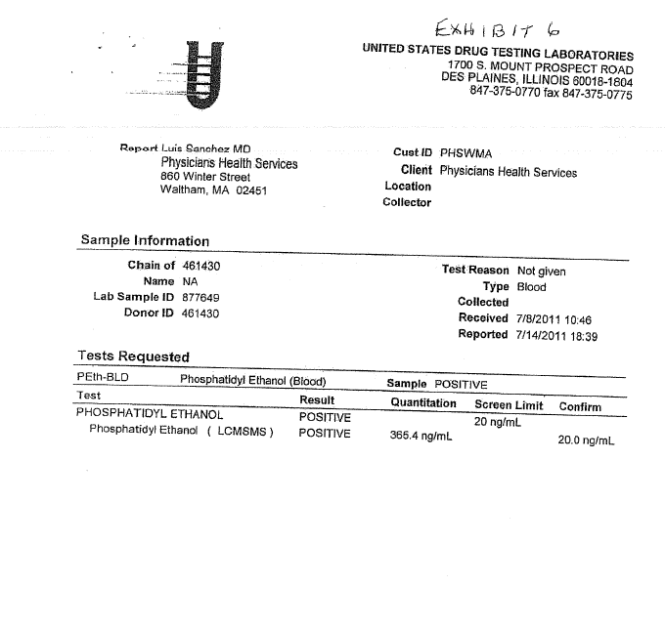
Positive Phosphatidyl Ethanol test at level of 365.4 (cutoff =20) No date of collection. place of collection or name of collector. Donor ID # = 461430 My Unique Identifier #1310 is nowhere on this document.

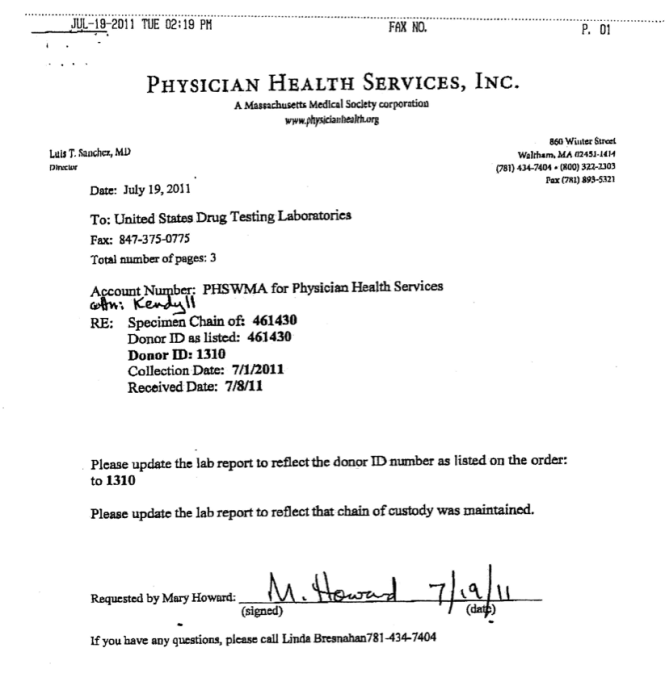
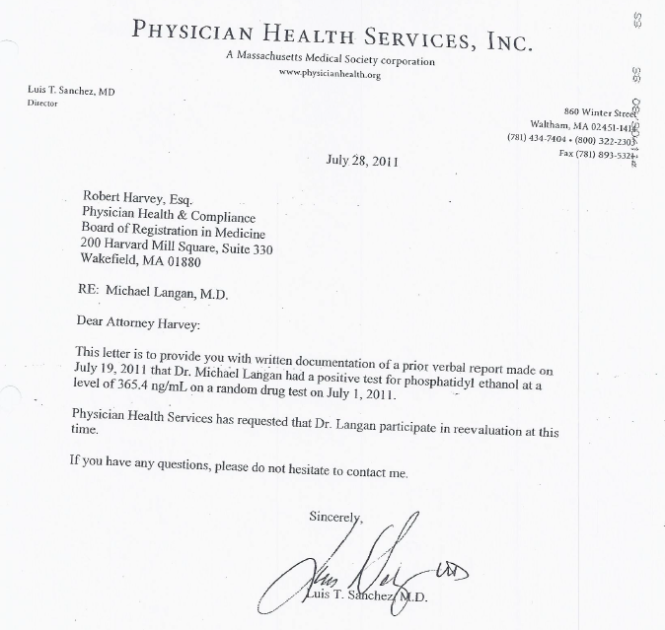
The  July 19th, 2011 fax from PHS seen below is in reference to the lab report from USDTL seen above.  In it PHS requests the report be “updated”to donor ID number “1310” and  to “reflect that the chain of custody was maintained.”

The lab report is a positive test for the alcohol biomarker (Phosphatidyl Ethanol) or PEth, an alcohol biomarker introduced by the Federation of State Physician Health programs and marketed by USDTL and other labs to detect  covert alcohol use..

There is no record of where, when or by whom it was collected.
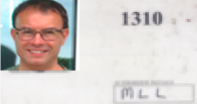
Screen Shot 2014-11-06 at 11.17.32 PMBoth the donor ID # and chain of custody are listed as 461430.

The purpose of chain-of-custody is to document the location of  a specimen in real time.  “Updating” it is not an option.  It is prohibited.  Updating the “chain of custody to reflect that chain of custody was maintained”  is a clear indicator that it was not maintained.

ID #1310 is the unique identifier I was issued by PHS.  It is used as a unique identifier, just like a name or social security number, to link me to any sample collected for random drug and alcohol screening. #1310 identifies me as me in the chain-of-custody.    On July 1st, 2011 I had a blood test collected at Quest Diagnostics.
IMG_8756 2

The sample was collected at Quest Diagnostics on July 1, 2011 but these documents were not obtained until December 3, 2011 and were included in the “litigation packet” which documents chain-of-custody and is generated on any and all forensic drug testing.   It provides proof that the test was done on who it was supposed to have been done and that all required procedure and protocol was followed. It protects the donor form being falsely accused of illicit substance use.  In most employee drug-testing programs the litigation-packet is provided on request immediately.  It is a transparent process.  This is not the case, however, at PHS.

I requested the litigation packet immediately after the positive test was reported on July 19, 2011.  PHS first refused, then tried to dissuade me.  They finally agreed but warned there would be “unintended consequences.    The entire litigation packet can be seen here:   Litigation Packet 12:3:2011

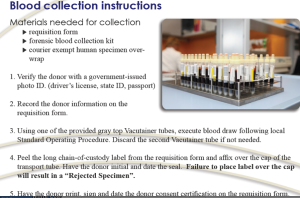
The positive sample has no chain-of-custody linked to me, no date, and no indication where it was collected or who collected it.   In addition there was no “external” chain of custody for the sample. The custody-and-control form was missing.

With multiple fatal flaws (6/6)  rendering it invalid, USDTL should have rejected it by their own written protocol.

Screen Shot 2013-12-19 at 12.20.46 PM

6/6 Fatal Flaws–Just one invalidates the Test

USDTL did not reject it. The document below shows that USDTL added my ID # 1310 and added a collection date of July 1, 2011–the day I submitted the sample.
Screen Shot 2014-09-15 at 5.27.21 AM

“REVISED REPORT PER CLIENTS REQUEST”  

And in doing so the lab that claims “integrity” and “strict chain of custody” readily, and with no apparent compunction” manufactured a chain-of-custody and added a unique identifier by faxed request.

The litigation packet was signed by Joseph Jones on December 3, 2011.   There was no record of where the sample was from July 1st to July 8, 2011. No external chain-of-custody or custody-and-control form was evident in the litigation packet.
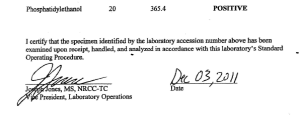
Screen Shot 2014-07-28 at 6.50.01 PM

The V.P. for Laboratory operations for the lab that claims “strict chain of custody” and that “doesn’t skip steps” “when “peoples lives are on the line” verified a positive test as positive with no custody and control form, no external chain of custody and 6/6 fatal flaws.  What is so shocking is that  this was done without compunction or pause.  As a forensic test ordered by a monitoring program Jones knew full well it would result in significant consequences for someone.  He knew that someones “life was on the line,” knew it was wrong, and did it anyway.

A person of conscience would never do this.  It is unethical decision making  that goes against professional and societal norms.  A “moral disengagement” that represents a lack of empathy and a callous disregard for others.  I would not consider doing something like this for any price and here it appears to be standard operating procedure.

PHS reported the positive test to the Medical Board on July 19, 2011 Positive PEth July 19, 2011-1.  It was used as a stepping-stone to request an evaluation at one of three  “PHP-approved” facilities (Marworth, Hazelden and Bradford). The Medical Directors of all three facilities can be seen on this list list called “Like-Minded Docs.”  The MRO for PHS, Dr.Wayne Gavryck,  whose job was to review the chain-of-custody and validate its integrity before reporting it as positive is also on the list.  See this simplified schematic of how it works in Massachusetts.  It shows how this is a rigged game.

Expecting to be diagnosed with a non-existent problem and admitted for non-needed treatment I requested an evaluation at a non-12 step facility with no conflicts-of-interest.  Both PHS and the Medical Board refused this request in one of four violations of the Establishment Clause of the 1st amendment.
Screen Shot 2014-07-27 at 7.55.16 PM copy

I chose Hazelden.  The Medical Director was aware that I had just signed  a patent license agreement for an epinephrine auto-injector and he had a child with a peanut allergy.  We talked about the device and discussed the problems with current management.  I think it was because of this added personal interaction that he did not “tailor my diagnosis” as PHS most certainly requested.  Seeing me as a person rather than an object, I believe,  enabled his conscience to reject it. My discharge diagnosis found no history of alcohol issues but they could not explain the positive test. Unable to rule out that I drank in violation of my PHS contract they recommended I attend AA.

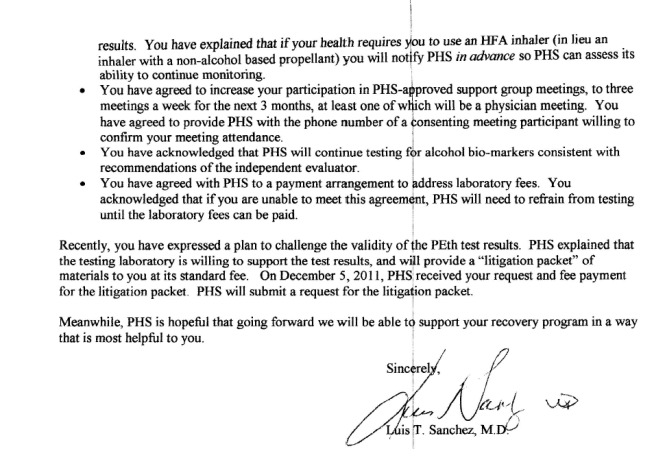
PHS mandated that I attend 3 12-step meetings per week and requested that I obtain names and phone numbers of fellow attendees so they could contact them to verify my attendance.  They also mandated that I discontinue my asthma inhalers (as the propellant contains small amounts of ethanol) that had been controlling my asthma and preventing serious attacks for the previous ten years.  I was threatened that if I had to use the inhalers or one day late on the increased payments I would be reported to the Board and lose my license.

Screen Shot 2014-11-09 at 10.03.16 PM

Screen Shot 2014-11-08 at 11.57.25 PM

Sanchez states that my request for the “litigation packet” was processed on December 5, 2011 (two days after Jones signed off on it) and adds the “testing laboratory is willing to support the test results.”

In the interim I filed a complaint with the College of American Pathologists.  I also requested the missing external chain of custody documents from Quest.
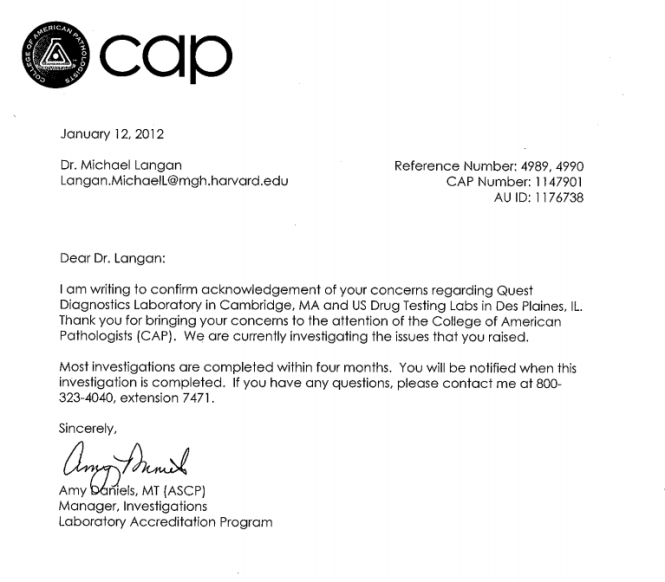
Screen Shot 2014-08-20 at 12.15.52 PM

I never received the chain of custody from Quest.  Instead I received a letter from Nina Tobin, Compliance Manager for Quest documenting all the errors but written to sound as if some sort of protocol was maintained.  Tobin claimed the specimen was inadvertently logged as a clinical specimen but sent on to USDTL a week later.  (See Quest Letter )
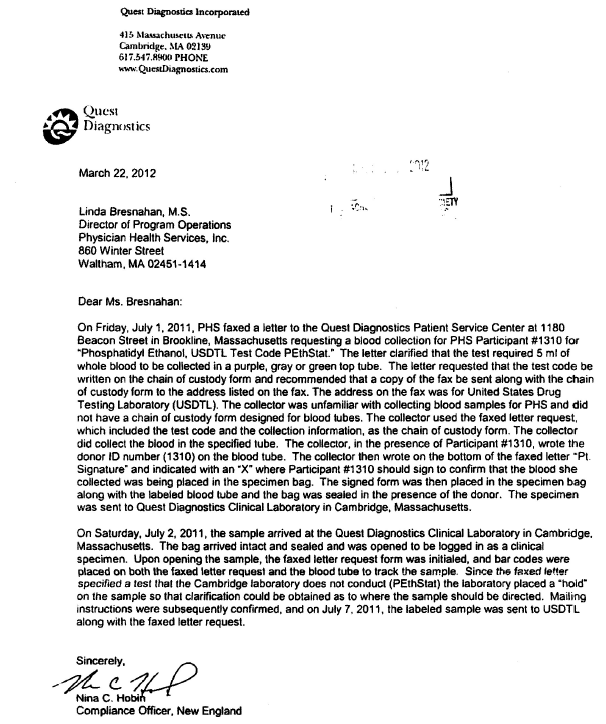
Screen Shot 2014-11-09 at 10.06.46 PM

The Chief of Toxicology at MGH wrote a letter to the Board documenting all of the misconduct and irregularities stating that it was an “intentional act” perpetrated by PHS.  MLLv3finalJacob_Hafter_Esq_copy.

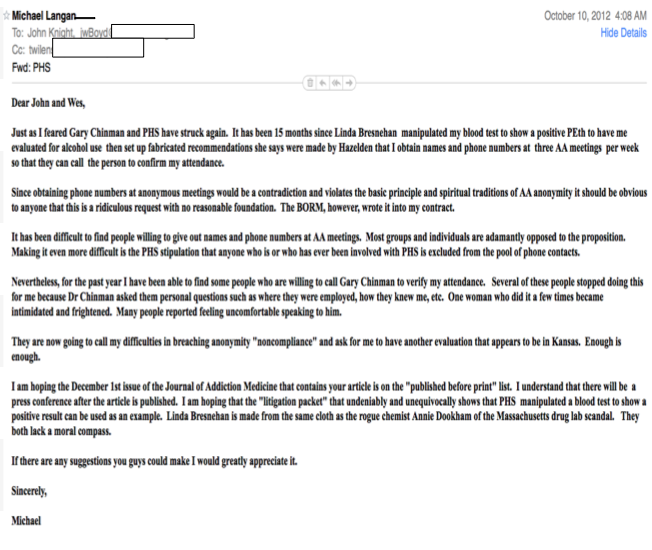
This letter, as well as the opinions of everyone outside of PHS was ignored. So too were any opinions of my two former Associate Directors at PHS.   The e-mail below dated October 10th, 2011 is to to Drs. John Knight and J. Wesley Boyd and I am referring to their article Ethical and Managerial Considerations Regarding State Physician Health Programs  that was about to be published. We had hoped that it would draw more attention to the problems with PHPs.
Screen Shot 2014-11-10 at 10.36.13 AM

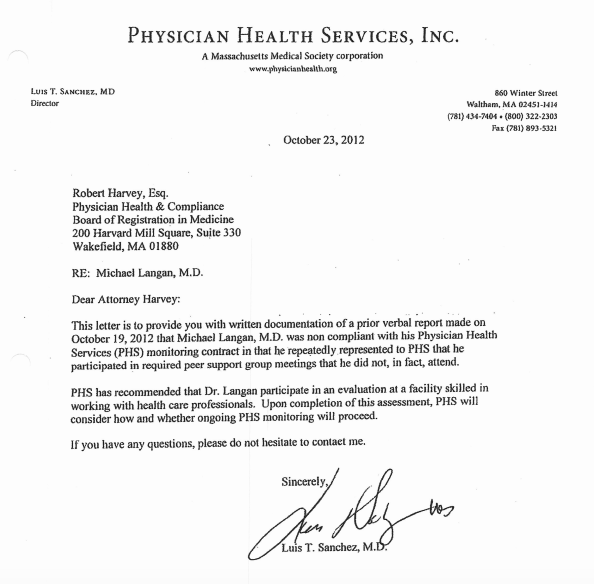
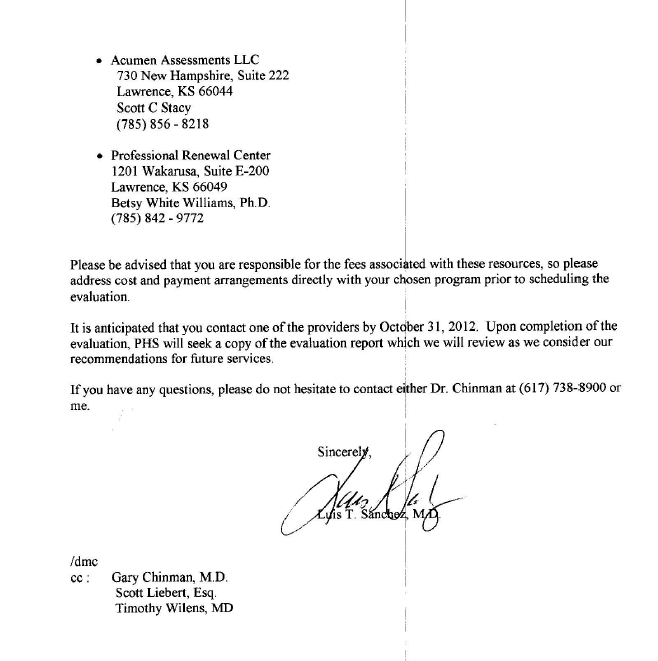
I was subsequently reported as “non-compliant” with AA meetings.    They could not give any details of where or when.  They then misrepresented a declaration of fact (I stated that I had started going to a specific meeting on a specific date) as an admission of guilt by saying I was referring to a different meeting.     10:23:12 PHS Letter to BORM-noncompliance.

My Chief at MGH, his Chief and others held a  conference with PHS and attempted to remove me from PHS and replace the monitoring contract with one of their own.  They refused.   When confronted with the fabricated test they dismissed it and focused on sending me to Kansas to one of the “disruptive physician” Psikhuskas where they are using polygraphs (despite the AMAs stance that it is junk science) and non-validated neuropsychological instruments that detect “character defects” to pathologize the normal.

I refused. Had I gone to Kansas I would have been given a false diagnosis and my career would be over. This is what they do.
Screen Shot 2014-11-08 at 12.05.52 AM

Screen Shot 2014-09-05 at 7.28.02 PM

Amy Daniels, the investigator for the College of American Pathologists contacted me in December of 2012 to see how things were going since USDTL “amended” the test.  Daniels told me that the College of American Pathologists confirmed my allegations and, as an Accrediting Agency for Forensic Toxicology mandated that USDTL correct it.  (Labs can lose accreditation if they do not comply with CAP  Standards for Forensic Drug Testing). This was done on October 4, 2012.

PHS denied any knowledge of an amended test.  I also wrote an e-mail to Joseph Jones requesting the document but he did not reply.

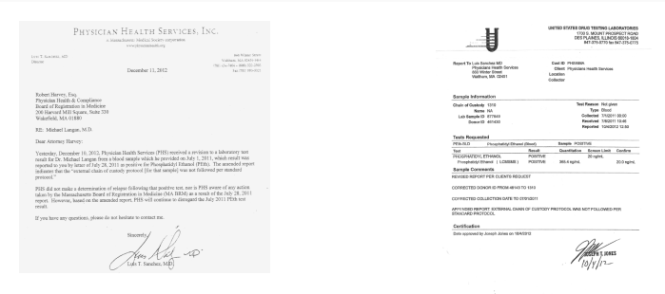
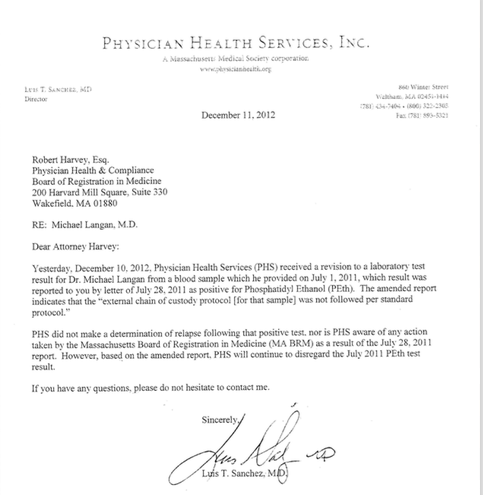
I contacted CAP.   On December 11, 2012 Dr. Luis Sanchez wrote a letter stating  “Yesterday, December 10 2012, Physician Health Services (PHS) received a revision to a laboratory test result”

 “The amended report indicates that the external chain of custody protocol [for that sample] was not followed per standard protocol]” 

Sanchez dismisses this test as irrelevant, rationalizing neither PHS nor the Board based any actions on the test and they would “continue to disregard” it.
Screen Shot 2014-11-08 at 1.19.44 AM

The  logic is that it was my behavior that resulted in any consequences.  My “non-compliance” in October led to my suspension and the test had nothing to do with it.   The sole reason for reporting me to the Board in 2011 was the positive test.  There is no other pretext to use.  It is misattribution of blame as without the test, now invalidated, there would have been no AA meetings to say I was non-compliant with.

In response to a civil complaint PHS, Quest and USDTL all took the position that the results of the fraudulent testing had absolutely nothing to do with anything.

And in response to the allegations of forensic fraud the labs claimed there was no forensic fraud because this was not a “Forensic” test but a “clinical” test.     The argument was that “clinical” tests do not require chain-of-custody and it was his behavior not these tests that resulted in consequences.   

As a “clinical” test I knew it was considered Protected Health Information (PHI)  under the HIPAA-Privacy Rule.  A patient must give written consent for any outside entities to see it.  Obtaining lab tests previously required the consent of both the patient and the ordering provider.  What PHS and the labs were apparently unaware of was the changes to the HIPAA-Privacy rule giving patients increased rights to access their PHI.   The changes removed the ordering provider requirements.  A patient has a right to obtain lab test results directly from the labs and has 30 days to do it.  CAP agreed.   USDTL sent me all of the documents.  They can be seen below:

August 6, 2014 to Langan with health materials.

The documents sent by USDTL are notable for two things:

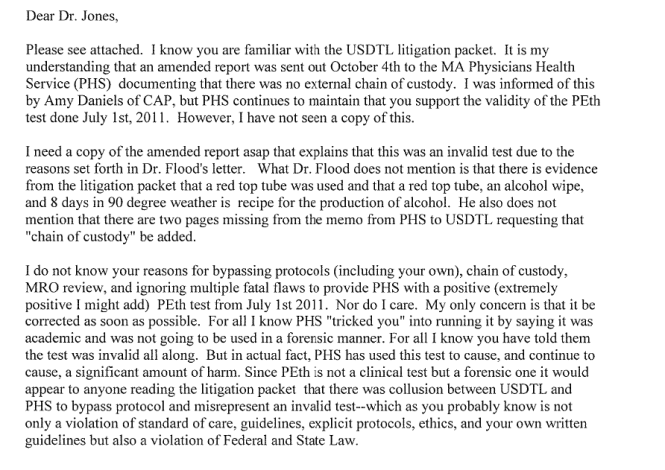
1.  The e-mail from me to Joseph Jones dated December 10, 2012.  It can be seen on page 22 of the USDTL documents.  Screen Shot 2014-11-10 at 11.21.18 AM
Screen Shot 2014-11-10 at 11.22.00 AM

2. USDTL document confirming PHS knew the test was amended 67-days before they said they did.Screen Shot 2014-08-06 at 4.50.02 PM
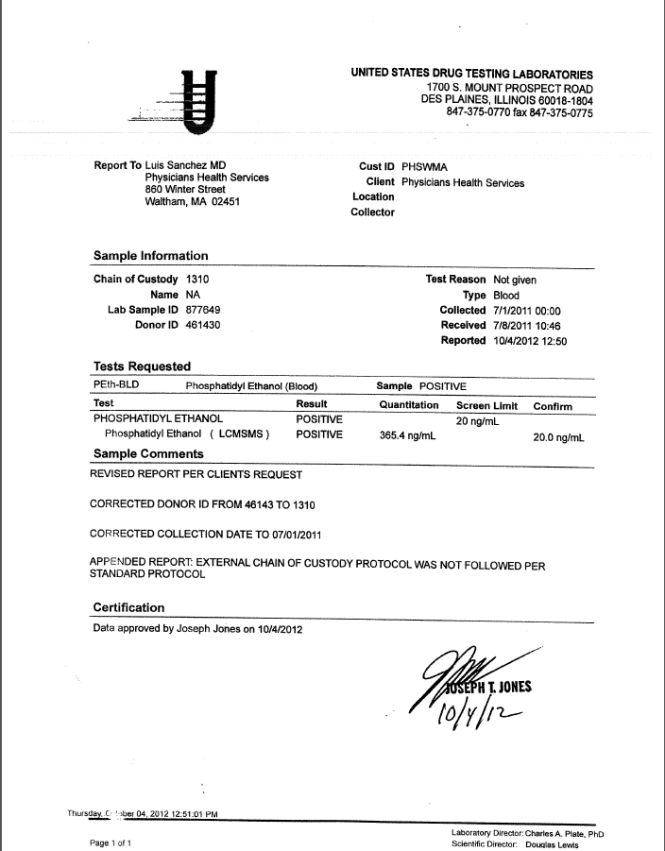
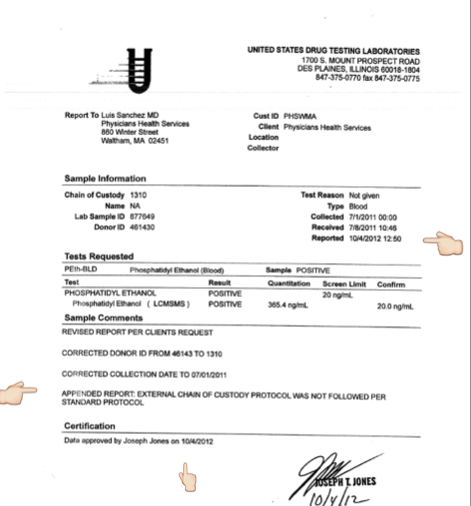
The document shows PHS and Sanchez were aware of the invalidity of the test on October 4, 2012.   Instead of correcting things they initiated machinations to throw me under the bus.  They officially reported me to the Board for non-compliance on October 19, 2012.

The December 11, 2012 letter signed by Sanchez states “Yesterday, December 10, 2012, PHS received a “revised report” regarding the test.  The documents show he knew about it 67-days prior.
Screen Shot 2014-11-04 at 10.51.24 PM

Although USDTL complied with the HIPAA-Privacy Rule and CAP, Quest did not.   Quest Diagnostics refused to send me copies of their lab reports claiming it was confidential and protected information that required PHS consent.  Quest required I sign a consent form with multiple stipulations regarding PHS.  I refused and contacted the Department of Justice -Office of Civil Rights.  The DOJ-OCR agreed with me and I received the Quest documents

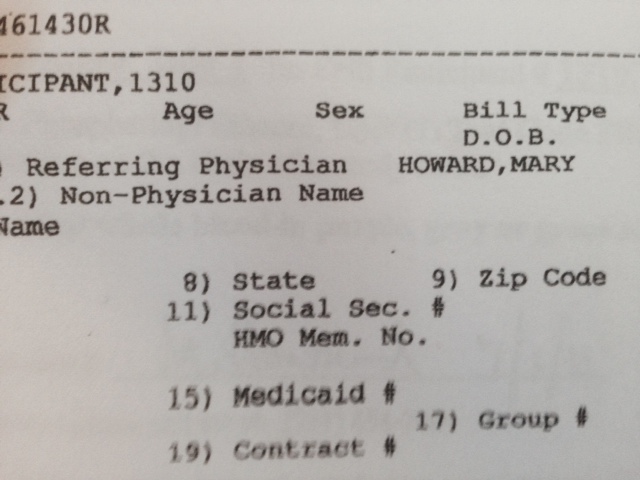
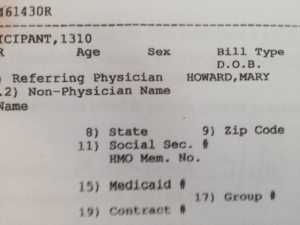
Remember a “clinical” test can only be ordered by a physician in the course of medical treatment.  It requires authorization from the patient to obtain a “clinical” specimen and it requires written authorization as to who sees it.  Referring physician was Mary Howard.
image

And below is the fax from PHS to Quest from July 1, 2011 also requested by Mary Howard.  The signature on the front is not mine.  In addition I gave the blood at 9:30 and was in my clinic at MGH at 12:23 so it couldn’t be. The WC 461430 R are dated July 2, 2011.  This is a “clinical” not “forensic” sticker.  The “R” indicates a red top tube.  The other sticker is USDTL and indicates it was logged in on July 8, 2011.
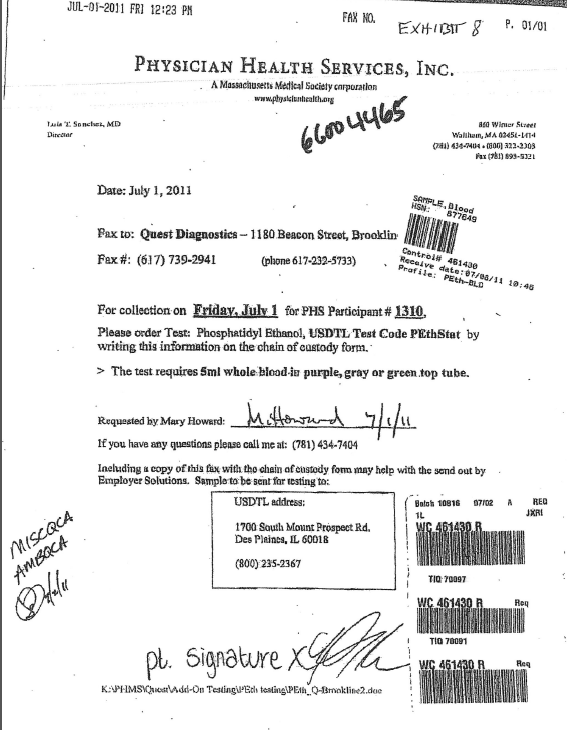
Screen Shot 2014-09-15 at 7.18.25 PM

What does it all mean?    Blood left in a red top tube ferments. This is basic chemistry.  The PEth test needs to be refrigerated and shipped overnight to prevent this.  In addition it needs to be collected with a non-alcohol wipe in a tube that has an anti-coagulant or preservative so that it does not ferment.    It requires strict procedure and protocol.

When I gave my blood on July 1st, 2011 it was as a “forensic” test per my contractual agreement with PHS.

On July 2, 2011 it was changed to “clinical.”   Why?  because “forensic” protocol would have invalidated it.

The only conceivable reason for doing this was to bypass chain-of-custody procedures.  My unique identifier #1310 was removed and the clinical specimen number was used for chain-of-custody.    The R in 461430R indicates a red top tube.

By holding on to it for one week the blood fermented.    As it was July with an average temperature close to 90 they overshot their mark a bit.   My level of 365 is consistent with heavy alcohol use–end stage half-gallon a day type drinking.

Quest then forwarded it to USDTL with specific instructions to process it as a “clinical” sample.  USDTL complied and  processed it as a clinical specimen which was reported it to PHS on July 14, 2011.
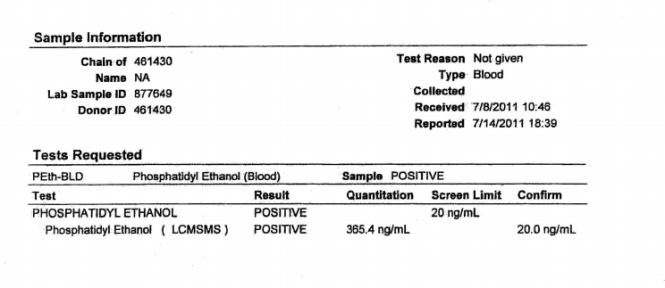
Screen Shot 2014-07-28 at 12.41.01 PM

PHS then asked USDTL to add my forensic  ID # 1310 and add a collection date of July 1, 2011 so it would appear “forensic” protocol was followed.    The reason Jones signed the “litigation packet” on December 3, 2011 was because that was when the “litigation packet” was manufactured.  A “clinical” sample does not produce one.
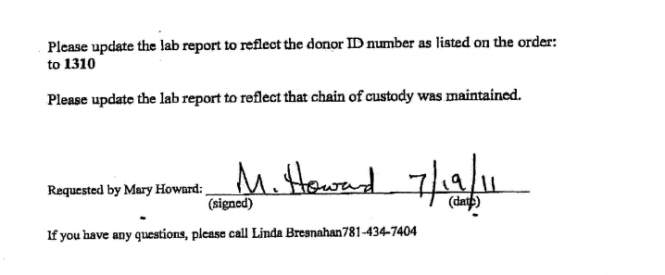
Screen Shot 2014-07-28 at 12.40.13 PM

USDTL willingly complied with this request.
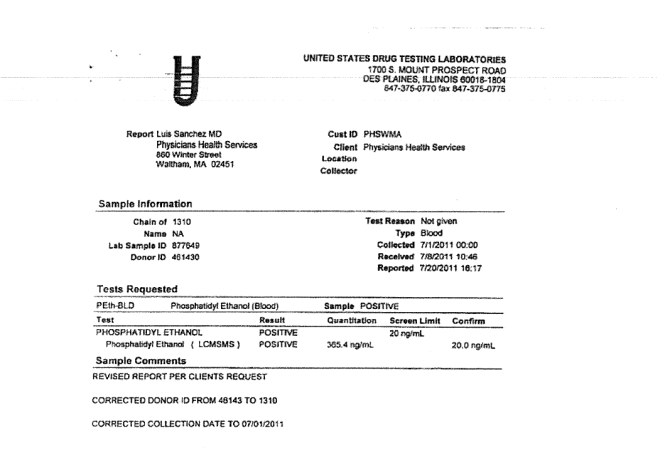
Screen Shot 2014-08-20 at 11.59.24 AM

PHS then reported this as a “forensic” test to the Medical Board on July 19, 2011 and requested a reevaluation.
Screen Shot 2014-11-09 at 1.17.24 PM

The distinction between “forensic” and “clinical” drug and alcohol testing is black and white. PHS is a monitoring program not a treatment provider. The fact that a monitoring agency with an MRO asked the lab to process and report it as a clinical sample and then used it forensically is an extreme outlier in terms of forensic fraud. The fact that they collected it forensically, removed the forensic components and let it sit in a warehouse for a week is  abhorrent.  The fact they then specifically requested it be processed as a clinical sample deepens the malice. The fact that they then reported it to the Board as a forensic sample and maintained it was forensic up until just recently makes it egregious. But the fact that the test was changed from “positive” to “invalid” on October 4th, 2012 and they then reported me to the Board on October 8th,  2012 for “noncompliance,” suppressed it and tried to send me to Kansas where I would be given a non-existent diagnosis to delegitimize me for damage control makes it wantonly egregious.  This is political abuse of psychiatry.

Accountability requires both the provision of information and justification of what was done.

For doctors it is very difficult to obtain the information. As seen here, they put up a gauntlet to prevent the provision of what is immediate in all other drug testing programs.  I now have all of the information. What it shows is clear. This was intentional.  It was no accident.  They knew what they were doing, knew it was wrong but did it anyway.

Accountability also requires that those who commit misconduct suffer consequences. The PHPs have also put up barriers to this.    With no regulation or oversight they have no apparent accountability.

My understanding is that it works this way.   The Medical Board, Medical Society and Departments of Public Health have no oversight.   The MMS has an ethics committee but all they can do is “educate” the person if they feel there was a violation.  The DPH won’t even look at it and the Board is complicit.

My understanding is that they have convinced law enforcement that this is a “parochial” issue that is best kept within the medical community.  They have also created the impression that they are “friends” of law enforcement.  I have heard from many doctors that they have tried to report misconduct, civil rights violations and crimes to the police, AGO, and other law enforcement agencies only to be turned back over to the PHP.     By saying the physician is “impaired” it delegitimizes and invalidates the truth.  “He’s just a sick doctor,  we’ll take care of him.”  That physician then suffers consequences effectively silencing the rest.

PHS uses the Board to enforce punitive measures and temporize.   The Board puts blind faith in PHS.  Blind faith that defies common sense ( mandating phone numbers at anonymous meetings)  and disregards the law (Establishment Clause violations that are clear and well established).    The Board also temporizes to cause damage.

In my case they required a psychiatric behavioral evaluation.  I was given the choice of Kansas and a few other Like-minded assessment centers.

After petitioning for  multiple qualified psychiatrists that were summarily rejected months later for no reason one of the Board Attorneys suggested  Dr. Patricia Recupero, M.D., J.D. who is Board Certified in Forensic Psychiatry and Addiction Psychiatry.   The Board had used her in the past but not recently.  Seeing that she had been used by the Board for fit-for-duty evaluations in the past the Board accepted my petition.

Dr. Recupero wrote an 87-page report. She concluded I was safe to practice medicine without supervision, that I had never had an alcohol use, abuse or dependence problem, and that PHS request for phone numbers was inappropriate. She also documented PHS misconduct throughout my contract and concluded it was PHS actions, not mine, that led to my suspension.   What she describes is consistent with criminal harassment.  She documents the falsification of neuropsychological tests and confirms the forensic fraud.  What did the Board do?  Ignored their very own recommended and approved evaluator.

One measure of integrity is truthfulness to words and deeds.  These people claim professionalism, ethics and integrity.  The documents show otherwise.  The careers and lives of doctors are in these peoples hands.

Similar fraud is occurring across the country.  This is an example of the institutional injustice that is killing physicians.  Finding themselves entrapped with no way out, helpless and hopeless they are feeling themselves bereft of any shade of  justice and killing themselves.  These are nothing more than bullies and accountability is essential.  The “disruptive physician” moral panic has harmed the Medical Profession.

Dr. Clive Body in his book  Corporate Psychopaths   writes that “Unethical leaders create unethical followers, which in turn create unethical companies and society suffers as a result.”  And according to Dr. Robert Hare in  Without Conscience  “If we can’t spot them, we are doomed to be their victims, both as individuals and as a society. ”

Wes Boyd notes that valid complaints from physicians are often dismissed as “bellyaching” by the PHPs.  Complacent that these are just good guys helping doctors and protecting the public the complaints are dismissed, tabled, deflected or otherwise ignored.  Bellyaching??   Is this bellyaching.

It is my opinion that what you see here is indefensible  Procedurally, Ethically, and Legally.

Procedurally it goes beyond negligence and represents fraud.  It violates every procedural guideline, regulation and standard of care including their very own.

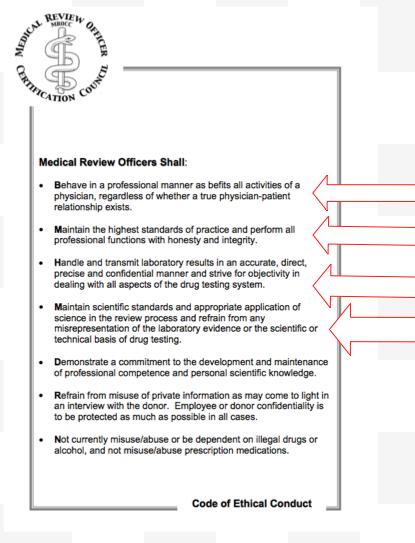
Ethically it violates everything from the Hippocratic Oath to  AMA Medical Ethics to the MRO Code of Conduct.

And where was PHS MRO Wayne Gavryck? By my count he violated at least 4 of the 6 Codes of Ethical Conduct.
Screen Shot 2014-11-10 at 1.04.20 PM

What was done here violates the most fundamental ethical principles of Medicine -Autonomy, Beneficence, Nonmaleficence and justice.

Intentionally falsifying a laboratory or diagnostic test to refer for an evaluation or support a diagnosis or give unwarranted “treatment” is unconscionable.  Abuse under the utility of  medical coloration is especially egregious.

The information provided herein should negate any “peer-review” protection or immunity afforded PHS as it is undeniably and egregiously in “bad faith.” Moreover, the ordering a “clinical” test is outside PHS scope, practice, and function of PHS. According to M.G.L. c. 111, § 203 (c):

An individual or institution, including a licensed or public hospital, physician credentialing verification service operated by a society or organization of medical professionals for the purpose of providing credentialing information to health care entities, or licensed nursing home reporting, providing information, opinion, counsel or services to a medical peer review committee, or participation in the procedures required by this section, shall not be liable in a suit for damages by reason of having furnished such information, opinion, counsel or services or by reason of such participation, provided, that such individual or institution acted in good faith and with a reasonable belief that said actions were warranted in connection with or in furtherance of the function of said committee or the procedures required by this section.

Dr. Luis Sanchez and Dr. Wayne Gavryck need to be held to the same professional standards as the rest of us.

If you can support either of them procedurally, ethically, or legally, any one of them, then I will turn in my medical license with a bow on it.  If they did not commit negligent fraud by standards of care and procedural guidelines, egregious moral disengagement in violation of ALL ethical codes for the medical profession and society and break the law then disprove me.  Just one will do.

But you can’t do this then I ask that you speak up and take a stand. Either defend them or help me hold them accountable.  If a crime is committed it needs to be addressed.  Ignoring encourages more of the same.

And if this cannot be supported procedurally, ethically or legally then I want to know what is going to be done about it?

How low does the moral compass have to go before someone takes action?

Doctors are dying across the country because of people just like this.  They have set up a scaffold that removes the usual checks and balances and removed accountability.   It is this institutional justice that is driving many doctors to suicide.

So the evidence is above.  Either defend them or help me draw unwanted attention to this culture of bullying and abuse. So I am asking you to contemplate if  what you see here is ethically, procedurally or legally sound.   If you can show just one of these then I stand corrected. But if you cannot justify this on any level then I want you to help me expose this criminal enterprise. Either defend it or fight it. Silence and obfuscation are not acceptable.
Screen Shot 2014-11-10 at 1.34.48 PM

Screen Shot 2014-11-10 at 1.36.13 PM

Screen Shot 2014-11-10 at 10.24.58 AM

Screen Shot 2013-09-04 at 2.22.36 AM

Screen Shot 2014-11-10 at 9.15.46 PMScreen Shot 2014-11-10 at 9.23.36 PMScreen Shot 2014-11-10 at 9.19.08 PMScreen Shot 2014-11-10 at 8.54.21 PMget-attachment.aspx

Physician Suicide, Organizational Justice and the “Cry of pain” Model: Hopelessness, Helplessness and Defeat

They can be a terror to your mind and show you how to hold your tongue
They got mystery written all over their forehead
They kill babies in the crib and say only the good die young
They don’t believe in mercy
Judgement on them is something that you’ll never see
They can exalt you up or bring you down main route
Turn you into anything that they want you to be–Bob Dylan, Foot of Pride


Screen Shot 2015-04-30 at 2.55.32 AM

Although no reliable statistics yet exist, anecdotal reports suggest a marked rise in physician suicide in recent years. From the reports I am receiving it is a lot more than the oft cited “medical school class” of 400 per year.

This necessitates an evaluation of predisposing risk factors such as substance abuse and depression, but also requires a critical examination of what external forces may be involved in the descent from suicidal ideation to suicidal planning to completed suicide.  What are the cumulative situational and psychosocial factors in physicians that make suicide a potential option and what acute events precipitate the final act?

Depression and Substance Abuse no Different from General Population

The prevalence of depression in physicians is close to that of the general population 1,2 and, if one looks critically at the evidence based literature, substance abuse in medical professionals approximates that of the general population.  Controlled studies using DSM diagnostic criteria indicate that physicians have the same rates (8-14%) of substance abuse and dependence as the general population,3 and slightly lower rates compared to other occupations.4,5 Epidemiological surveys reveal the same. Hughes, et al.6 reported a lifetime prevalence of drug or alcohol abuse or dependence in physicians of 7.9%, markedly less than the 14.6% prevalence reported in the general population by Kessler.7

Job Stress and Untreated Mental Illness Risk Factors

Job stress coupled with inadequate treatment for mental illness may be factors contributing to physician suicide according to one recent study. Using data from the National Violent Death Reporting System, Gold, Sen, & Schwenk, 2013 8 compared 203 physicians who had committed suicide to more than 31,000 non-physicians and found that having a known mental health disorder or a job problem that contributed to the suicide significantly predicted being a physician. Physicians were 3.12 times more likely to have a job problem as a contributing factor. In addition, toxicology testing showed low rates of medication treatment.  The authors concluded that inadequate treatment and increased problems related to job stress are potentially modifiable risk factors to reduce suicidal death among physicians. They also warned that the database used likely underestimated physician suicides because of “underreporting and even deliberate miscoding because of the stigma attached.”8

Few studies have evaluated the psychosocial stressors surrounding physician suicide but there is no reason to believe they are any different from the rest of the population. Although the triggering life events and specific stressors may vary outside, the inner psyche and undercurrent of thoughts and feelings should remains the same.   Perhaps the same drivers of suicide identified in other populations are contributing to physician suicide.

Screen Shot 2014-04-04 at 1.05.46 AM

Perceived Helplessness, Hopelessness, Bullying and Defeat

Perceived helplessness is significantly associated with suicide as is9 Hopelessness10,11 Bullying is known to be a predominant trigger for adolescent suicide12-14 One study found that adolescents in custody who were bullied were 9.22 times more likely to attempt suicide than those were not bullied.15

Heightened perceptions of defeat and entrapment are known to be powerful contributors to suicide.16,17 The “Cry of Pain” model 18,19 specifies that people are particularly prone to suicide when life experiences are interpreted as signaling defeat which is defined as a sense of “failed struggle” or loss of social position and resources.. The person is unable to identify an escape from or resolution to a defeating situation, a sense of entrapment proliferates with the perception of no way out, and this provides the central impetus for ending ones life. There is a helplessness and hopelessness that precipitates the descent from ideation, to planning, and then to finality.

Organizational Justice Important Protective Factor

In a study on Italian and Swedish female physicians, degrading experiences and harassment at work were found to be the most powerful independent variables contributing to suicidal thoughts.20 Degrading work experiences harassment, and lack of control over working conditions were found to be associated with suicidal thoughts among Italian and Swedish male university physicians.21

Evidence exists for the role of rescue factors (i.e. social support) as buffers against suicide in the face of varying degrees of life stress.22,23 The study of female physicians revealed meetings to discuss stressful work experiences as a potential protective factor, 20 and support at work when difficulties arose appeared to be a protective factor for the male physicians.21   In line with this, studies of Finnish physicians found that control over one’s work and organizational justice were the most important determinants of work-related wellbeing.24,25 Organizational justice has been identified as a psychosocial predictor of health and wellbeing26 27 Low organizational justice has been identified as a notable risk factor for psychological distress and depression.28,29

images-4

Historical Precedent-the Suicides at Ridgeview

Could these factors be playing a role in physician suicide?   They evidently did at the Ridgeview Institute, a drug and alcohol treatment program for impaired physicians in Metropolitan Atlanta created by G. Douglas Talbott. Talbott helped organize and served as past president of the American Society of Addiction Medicine (ASAM) and was a formative figure in the American Medical Association’s (AMA’s) Impaired Physician Program. He has owned and directed a number of treatment facilities for impaired professionals, most recently the Talbott Recovery Campus in Atlanta, one of the preferred referrals for physicians ordered into evaluation and treatment by licensing boards.

After creating the DeKalb County Impaired Physicians Committee for the Medical Association of Georgia, Talbott founded the Georgia Disabled Doctors Program in 1975 in part because “traditional one-month treatment programs are inadequate for disabled doctors.” According to Talbott, rehabilitation programs that evaluate and treat the rest of the population for substance abuse issues are incapable of doing so in doctors as they are unlike others. He bases this uniqueness on “incredibly high denial”, and what he calls the “four MDs,” “M-Deity”, “Massive Denial” “Militant Defensiveness”, and “More Drugs.”30

Contingency Management = Extortion Using Medical License

According to Talbott, “impaired doctors must first acknowledge their addiction and overcome their ‘terminal uniqueness’ before they can deal with a drug or alcohol problem.” “Terminal uniqueness “ is a phrase Talbott uses to describe doctors’ tendency to think they can heal themselves. “M-Deity” refers to doctors “being trained to think they’re God,”31 an unfounded generalization considering the vast diversity of individuals that make up our profession. This attitude, according to some critics, stems from the personal histories of the treatment staff, including Talbott, who are recovering alcoholics and addicts themselves. One such critic was Assistant Surgeon General under C. Everett Koop John C. Duffy who said that Ridgeview suffered from a “boot-camp mentality” toward physicians under their care and “assume every physician suffering from substance abuse is the same lying, stealing, cheating, manipulating individual they were when they had the illness. Certainly some physicians are manipulative, but it’s naïve to label all physicians with these problems.”32

American Society of Addiction Medicine (ASAM) President (1981-1983) LeClair Bissell was also highly critical of Talbott’s approach. Bissell, co-author of the first textbook of ethics for addiction professionals33 when asked if there was any justification to the claim that doctors are sicker than other people and more vulnerable to addiction replied:

“Well, based on my treatment experience, I think they are less sick and much easier to treat than many other groups. I think one reason for that is that in order to become a physician…one has to have jumped over a great many hurdles. One must pass the exams, survive the screening tests and the interviews, be able to organize oneself well enough to do examinations and so on, and be observed by a good many colleagues along the way. Therefore I think the more grossly psychotic, or sicker, are frequently screened out along the way. The ones we get in treatment are usually people who are less brain-damaged, are still quite capable of learning, are reasonably bright. Not only that, but they are quite well motivated in most cases to hang on to their licenses, the threat of the loss of which is frequently what puts them in treatment in the first place. So are they hard to treat? No! Are they easy patients? Yes! Are they more likely to be addicted than other groups? We don’t know.”34

“I’m not much for the bullying that goes along with some of these programs,” Bissell commented to the Atlanta Journal and Constitution in 1987.31   The constitution did a series of reports after five inpatients committed suicide during a four-year period at Ridgeview.35 In addition there were at least 20 more who had killed themselves over the preceding 12 years after leaving the treatment center.32

ByQiW11IYAI2Cit

Bissell, the recipient of the 1997 Elizabeth Blackwell Award for outstanding contributions to the cause of women and medicine remarked: “When you’ve got them by the license, that’s pretty strong leverage. You shouldn’t have to pound on them so much. You could be asking for trouble.”31 According to Bissell: “There’s a lot of debate in the field over whether treatment imposed by threats is worthwhile…To a large degree a person has to seek the treatment on his own accord before it will work for him.”31

A jury awarded $1.3 million to the widow of one of the deceased physicians against Ridgeview,36 and other lawsuits initiated on behalf of suicides were settled out of court.35

The Constitution reported that doctors entered the program under threats of loss of licensure “even when they would prefer treatment that is cheaper and closer to home.” 37 The paper also noted that Ridgeview “enjoys unparalleled connections with many local and state medical societies that work with troubled doctors,” “licensing boards often seek recommendations from such groups in devising an approved treatment plan,” and those in charge are often “physicians who themselves have successfully completed Ridgeview’s program.”37

The cost of a 28-day program for nonprofessionals at Ridgeview in 1987 was $10,000 while the cost was “higher for those going through impaired-health professionals program,” which lasted months rather than 28 days.32

In 1997 William L. White interviewed Bissell whom he called “one of the pioneers in the treatment of impaired professionals.” The interview was not published until after hear death in 2008 per her request.   Noting her book Alcoholism in the Professions38 “remains one of the classics in the field”, White asked her when those in the field began to see physicians and other professionals as a special treatment population. She replied:

“When they started making money in alcoholism. As soon as insurance started covering treatment, suddenly you heard that residential treatment was necessary for almost everybody. And since alcoholic docs had tons of money compared to the rest of the public, they not only needed residential treatment, they needed residential treatment in a special treatment facility for many months as opposed to the shorter periods of time that other people needed.”39

Talbott claimed a “92.3 percent recovery rate, according to information compiled from a five-year follow-up survey based on complete abstinence and other treatment.”40

“There is nothing special about a doctor’s alcoholism,” said Bissel

“these special facilities will tell you that they come up with really wonderful recovery rates. They do. And the reason they do is that any time you can grab a professional person by the license and compel him or her into treatment and force them to cooperate with that treatment and then monitor them for years, you’ll get good outcomes—in the high 80s or low 90s in recovery rates—no matter what else you do.”39

“The ones I think are really the best ones were not specialized. There were other well-known specialty clinics that claimed all the docs they treated got well, which is sheer rot. They harmed a great many people, keeping them for long, unnecessary treatments and seeing to it that they hit their financial bottom for sure: kids being yanked out of college, being forced to sell homes to pay for treatment, and otherwise being blackmailed on the grounds that your husband has a fatal disease. It’s ugly.”39

Stanton Peele’s “In the Belly of the American Society of Addiction Medicine Beast” describes the coercion, bullying, threats and indoctrination that are standard operating procedure in Talbott’s facilities.41 Uncooperative patients, “and this covers a range of sins of commission or omission including offering one’s opinion about one’s treatment,” are “threatened with expulsion and with not being certified-or advocated for with their Boards.”41 The cornerstone of treatment is 12-step spiritual recovery. All new patients are indoctrinated into A.A. and coerced to confess they are addicts or alcoholics. Failure to participate in A.A. and 12-step spirituality means expulsion from the program with the anticipated result being loss of one’s medical license.

Screen Shot 2013-11-17 at 4.18.47 PM

From a talk given by FSPHP

Fraud, Malpractice, False Diagnoses and False imprisonment

In May 1999 Talbott stepped down as president of the American Society of Addiction Medicine (ASAM) as a jury awarded Dr. Leonard Masters a judgment of $1.3 million in actual damages and an undisclosed sum in punitive damages for fraud, malpractice, and the novel claim of false imprisonment.42 The fraud finding required a finding that errors in the diagnosis were intentional. After being accused of excessive prescribing of narcotics to his chronic pain patients, Masters was told by the director of the Florida PHP that he could either surrender his medical license until the allegations were disproved or submit to a four-day evaluation. Masters agreed to the latter, thinking he would have an objective and fair evaluation, but was instead diagnosed as “alcohol dependent” and coerced into the Talbott recovery program. He was forced to stay in the program under threat of his medical license as staff would routinely threaten to report any doctor who questioned any aspect of their diagnosis or treatment to their state medical boards “as being an impaired physician, leaving necessary treatment against medical advice”42  which would mean the loss of his licensure. However, Masters was not an alcoholic. According to his attorney, Eric. S. Block,  “No one ever accused him of having a problem with alcohol. Not his friends, not his wife, not his seven children, not his fellow doctors, not his employees, not his employers, No one.” 43  He was released 4 months later and forced to sign a five-year “continuing care” contract with the PHP, also under continued threat of his medical license. Talbott faced no professional repercussions and no changes in the treatment protocols were made. Talbott continued to present himself and ASAM as the most qualified advocate for the assessment and treatment of medical professionals for substance abuse and addiction up until his death last year.44

bullying2

Same System Imposed on Doctors Today—Institutional Injustice Worse due to Laboratory Developed Tests. Fortified Scaffold and Tightened the Noose.

In almost all states today any physician referred for an assessment for substance abuse will be mandated to do so in a facility just like Ridgeview. There is no choice. There is one difference however.   When the Ridgeview suicides occurred the plethora of laboratory developed tests were not yet introduced. A decade ago Dr. Gregory Skipper introduced the first laboratory developed test for forensic testing and used it on doctors in physician health programs.   These non-FDA approved tests of unknown validity presented a new unpredictable variable into the mix with a positive test necessitating another assessment at an out of state treatment facility—a “PHP-approved” assessment facility. The addition of this laboratory Russian Roulette renders the current system much worse than it was at the time of the Ridgeview suicides.

And if a positive test occurs there are no safeguards protecting the donor. LDTs are unregulated by the FDA. There is no oversight and no one to file a complaint with.

In addition the PHPs have no oversight by the medical boards, departments of health or medical societies. They police themselves. The PHPs have convinced law enforcement that when it comes to doctors it is a “parochial issue” best handled by the medical community. I have been hearing from doctors all over the country who have tried to report crimes to the local police, the state Attorney General and other law enforcement agencies only to be turned back over to the very perpetrators of the crimes. “He’s a sick doctor, we’ll take care of him.” The “swift and certain consequences” of this are an effective means of keeping the rest of the inmates silent.   Likewise doctors have been going to the media only to have the door slammed in their faces because the media has generally bought in to the “impaired” and “disruptive” physician construct these same people developed through propaganda, misinformation and moral panics and crusades.

tireddoctor

Urgent Need to Admit to the Problem

There has been an increase in physician suicide in the past decade.   By my estimate the numbers are going to be far higher than the oft-cited 400 per year. The speculation as to cause has been unenlightening and in fact frustrating.   Knowledge of anatomy, access to dangerous drugs, increased workload and even student loans have been proposed as contributing factors. Although there has been some tangential mention of physician health programs it has been indirect. Direct and defined discussion is necessary and state PHPs need to be named as a possible contributor to suicide.  Admitting the possibility there is a problem is the first crucial step in defining and addressing the problem.    The 1980s historical precedent is correlated with physician suicide.  The current system is not only based on Ridgeview but has been fortified in scope and power.  The physician health movement has effectively removed due process from doctors while removing answerability and accountability from themselves. And they have not only fortified the scaffold but widened it from substance abusing doctors to all doctors. “Potential impairment” and “relapse without use” were introduced without any meaningful resistance and they are now using a panoply of non-FDA approved laboratory developed tests of unknown validity to test for substances of abuse in a zero-tolerance abstinence based monitoring program.  With no regulatory oversight the stage is set not only for error but misuse as witch-pricking devices for punishment and control.  Doctors across the country are complaining of the very same abuses Leonard Masters did–false diagnoses, misdiagnosis, unneeded treatment and fraud.

In summary, any doctor who is referred to their state PHP today is required to have any assessment and treatment at a “PHP-approved” facility based on Ridgeview.  It is mandated.  There is no choice.  Coercion, control and abuse at Ridgeview was associated with multiple suicides in doctors in the 1980s.  The use of non-FDA approved tests of unknown validity worsens the abuse and fits the “cry of pain” model of hopelessness, helplessness and despair. Locus of control is  lost.  Organizational justice is absent.

The temporal relationship is clear.

Why is this still the elephant in the room?

This needs to be named, defined and openly discussed and debated.  How many more must die before we speak up?

Please help me get the conversation going.

images-34

  1. Ford DE, Mead LA, Chang PP, Cooper-Patrick L, Wang NY, Klag MJ. Depression is a risk factor for coronary artery disease in men: the precursors study. Archives of internal medicine. Jul 13 1998;158(13):1422-1426.
  2. Frank E, Dingle AD. Self-reported depression and suicide attempts among U.S. women physicians. The American journal of psychiatry. Dec 1999;156(12):1887-1894.
  3. Brewster JM. Prevalence of alcohol and other drug problems among physicians. JAMA : the journal of the American Medical Association. Apr 11 1986;255(14):1913-1920.
  4. Anthony J, Eaton W, Mandell W, al. e. Psychoactive Drug Dependence and abuse: More Common in Some Occupations than in Others? Journal of Employee Assistance Res. 1992;1:148-186.
  5. Stinson F, DeBakely S, Steffens R. Prevalence of DSM-III-R Alcohol abuse and/or dependence among selected occupations. Alchohol Health Research World. 1992;16:165-172.
  6. Hughes PH, Brandenburg N, Baldwin DC, Jr., et al. Prevalence of substance use among US physicians. JAMA : the journal of the American Medical Association. May 6 1992;267(17):2333-2339.
  7. Kessler RC, Berglund P, Demler O, Jin R, Merikangas KR, Walters EE. Lifetime prevalence and age-of-onset distributions of DSM-IV disorders in the National Comorbidity Survey Replication. Archives of general psychiatry. Jun 2005;62(6):593-602.
  8. Gold KJ, Sen A, Schwenk TL. Details on suicide among US physicians: data from the National Violent Death Reporting System. General hospital psychiatry. Jan-Feb 2013;35(1):45-49.
  9. Rivers I, Noret N. Potential suicide ideation and its association with observing bullying at school. The Journal of adolescent health : official publication of the Society for Adolescent Medicine. Jul 2013;53(1 Suppl):S32-36.
  10. Lester D, Walker RL. Hopelessness, helplessness, and haplessness as predictors of suicidal ideation. Omega. 2007;55(4):321-324.
  11. Beck AT. Hopelessness as a predictor of eventual suicide. Annals of the New York Academy of Sciences. 1986;487:90-96.
  12. Hinduja S, Patchin JW. Bullying, cyberbullying, and suicide. Archives of suicide research : official journal of the International Academy for Suicide Research. 2010;14(3):206-221.
  13. Hertz MF, Donato I, Wright J. Bullying and suicide: a public health approach. The Journal of adolescent health : official publication of the Society for Adolescent Medicine. Jul 2013;53(1 Suppl):S1-3.
  14. Kim YS, Leventhal B. Bullying and suicide. A review. International journal of adolescent medicine and health. Apr-Jun 2008;20(2):133-154.
  15. Kiriakidis SP. Bullying and suicide attempts among adolescents kept in custody. Crisis. 2008;29(4):216-218.
  16. Taylor PJ, Gooding P, Wood AM, Tarrier N. The role of defeat and entrapment in depression, anxiety, and suicide. Psychological bulletin. May 2011;137(3):391-420.
  17. Lester D. Defeat and entrapment as predictors of depression and suicidal ideation versus hopelessness and helplessness. Psychological reports. Oct 2012;111(2):498-501.
  18. Williams JMG. Cry of Pain. Harmondsworth: Penguin; 1997.
  19. Williams JMG, Crane C, Barnhofer T, Duggan DS. Psychology and suicidal behavior: elaborating the entrapment model. In: Hawton K, ed. Prevention and treatment of suicidal behavior: from science to practice. Oxford: Oxford University Press; 2005:71-89.
  20. Fridner A, Belkic K, Marini M, Minucci D, Pavan L, Schenck-Gustafsson K. Survey on recent suicidal ideation among female university hospital physicians in Sweden and Italy (the HOUPE study): cross-sectional associations with work stressors. Gender medicine. Apr 2009;6(1):314-328.
  21. Fridner A, Belkic K, Minucci D, et al. Work environment and recent suicidal thoughts among male university hospital physicians in Sweden and Italy: the health and organization among university hospital physicians in Europe (HOUPE) study. Gender medicine. Aug 2011;8(4):269-279.
  22. Borowsky IW, Ireland M, Resnick MD. Adolescent suicide attempts: Risks and protectors. Pediatrics. 2001;107(485).
  23. Clum GA, Febbraro GAR. Stress, social support and problem-solving appraisal/skill: Prediction of suicide severity within a college sample. Journal of Psychopathology and Behavioral Assessment. 1994;16:37-46.
  24. Lindfors PM, Meretoja OA, Toyry SM, Luukkonen RA, Elovainio MJ, Leino TJ. Job satisfaction, work ability and life satisfaction among Finnish anaesthesiologists. Acta anaesthesiologica Scandinavica. Aug 2007;51(7):815-822.
  25. Heponiemi T, Kuusio H, Sinervo T, Elovainio M. Job attitudes and well-being among public vs. private physicians: organizational justice and job control as mediators. European journal of public health. Aug 2011;21(4):520-525.
  26. Elovainio M, Kivimaki M, Vahtera J. Organizational justice: evidence of a new psychosocial predictor of health. Am J Public Health. Jan 2002;92(1):105-108.
  27. Lawson KJ, Noblet AJ, Rodwell JJ. Promoting employee wellbeing: the relevance of work characteristics and organizational justice. Health promotion international. Sep 2009;24(3):223-233.
  28. Hayashi T, Odagiri Y, Ohya Y, Tanaka K, Shimomitsu T. Organizational justice, willingness to work, and psychological distress: results from a private Japanese company. Journal of occupational and environmental medicine / American College of Occupational and Environmental Medicine. Feb 2011;53(2):174-181.
  29. Lang J, Bliese PD, Lang JW, Adler AB. Work gets unfair for the depressed: cross-lagged relations between organizational justice perceptions and depressive symptoms. The Journal of applied psychology. May 2011;96(3):602-618.
  30. Gonzales L. When Doctors are Addicts: For physicians getting Molly Kellogg is easy. Getting help is not. Chicago Reader. July 28, 1988, 1988.
  31. King M, Durcanin C. The suicides at Ridgeview Institute: A Doctor’s treatment program may be too tough, some say. Atlanta Journal and Constitution. December 18, 1987a, 1987: A12.
  32. Durcanin C, King M. The suicides at Ridgeview Institute: Suicides mar success at Ridgeview with troubled professionals. Atlanta Journal and Constitution. December 18, 1987, 1987: A13.
  33. Bissell L, Royce JE. Ethics for Addiction Professionals. Center City, Minnesota: Hazelden; 1987.
  34. Addiction Scientists from the USA: LeClair Bissell. In: Edwards G, ed. Addiction: Evolution of a Specialist Field. 1 ed: Wiley, John & Sons, Incorporated; 2002:408.
  35. Durcanin C. The suicides at Ridgeview Institute: Staff members didn’t believe Michigan doctor was suicidal. Atlanta Journal and Constitution. December 18, 1987, 1987: A8.
  36. Ricks WS. Ridgeview Institute loses $1.3 million in suit over suicide. Atlanta Journal and Constitution. October 11, 1987, 1987: A1.
  37. King M, Durcanin C. The suicides at Ridgeview Institute: Many drug-using doctors driven to Ridgeview by fear of losing licenses. Atlanta Journal and Constitution. December 18, 1987b, 1987: A1.
  38. Bissell L, Haberman PW. Alcoholism in the Professions. Oxford University Press; 1984.
  39. White W. Reflections of an addiction treatment pioneer. An Interview with LeClair Bissell, MD (1928-2008), conducted January 22, 1997. Posted at http://www.williamwhitepapers.com. 2011.
  40. Williams c. Health care field chemical dependency threat cited. The Tuscaloosa News. January 16, 1988, 1988: 16.
  41. Peele S. In the Belly of the American Society of Addiction Medicine Beast. The Stanton Peele Addiction Website (accessed March 28, 2014) http://web.archive.org/web/20080514153437/http://www.peele.net/debate/talbott.html.
  42. Ursery S. $1.3M verdict coaxes a deal for doctor’s coerced rehab. Fulton County Daily Report. May 12, 1999b 1999.
  43. Ursery S. I was wrongly held in alcohol center, doctor charges. Fulton Count y Daily Report. April 27, 1999a 1999.
  44. Parker J. George Talbott’s Abuse of Dr. Leon Masters MD ( http://medicalwhistleblowernetwork.jigsy.com/george-talbott-s-abuse-of-leon-masters ). Medical Whistelblower Advocacy Network.

crop0126

Request that Massachusetts Medical Society acknowledge or refute professional, ethical and criminal misconduct by Physician Health Services (PHS, Inc.)

Oliver Wendell Holmes, the Massachusetts Medical Society, Tinsel Erudition and Pretended Science Redux

images-10As the oldest medical society in the United States the Massachusetts Medical Society can count some of the greatest minds in the history of American medicine as members.  My how far we have fallen.  This same author has previously unintelligibly compared the field of medicine to Barbra Streisand’s face and shamelessly and opportunistically blamed the Boston Marathon bombing on “marijuana withdrawal.” 
The sophomoric mnemonics are neither clever nor illuminating.  Unworthy of  Readers Digest circa 1957, this dumbing down of doctors needs to end.  The very soul and practice  of medicine is being castrated and lobotomized by the same dull and very very blunt instrument. 
How does one reconcile the fact that the very same medical society that publishes the New England Journal of Medicine is allowing this type of tripe and rabble to get past editorial review?  In 1969, through an act of the state legislature, the Massachusetts Medical Society updated its mission to read:
“The purposes of the Massachusetts Medical Society shall be to do all things as may be necessary and appropriate to advance medical knowledge, to develop and maintain the highest professional and ethical standards of medical practice and health care, and to promote medical institutions formed on liberal principles for the health, benefit and welfare of citizens of the commonwealth.”
With a foundation and history built and based on of scholarship and critical thought we need to support the highest levels of science, fact, intelligence and reason.  Stupidity tries but it should not win.  Before the Boston Society for the Diffusion of Useful Knowledge in 1842, Dr. Oliver Wendell Holmes delivered two long lectures entitled “Homeopathy and Its Kindred Delusions.” He characterized one of its popular practitioners, Dr. Robert Wesselhoeft, as one of those:  
“Emperics [quacks], ignorant barbers, and men of that sort…who announce themselves ready to relinquish all the accumulated treasure of our art, to trifle with life upon the strength of these fantastic theories.” That “pretended science” as Holmes called it, was “a mingled mass of perverse ingenuity, of tinsel erudition, of imbecile credulity, and artful misrepresentation, too often mingled in practice…with heartless and shameless imposition.”
And Holmes words are as apt and appropriate today as they were in mid 19th Century Boston!   Probably more so. History has recurrently proved that false constructs and groundless concepts allow for endless error. The Massachusetts Medical Society and all of its members need to come to the realization that Physician Health Services (PHS) has paradoxically become a reservoir of bad medicine beset by corruption. The documentary evidence of  professional, ethical and legal misconduct must be specifically and precisely addressed.


Accountability. Answerability and Justification Required. Accountability, or answerability,  is necessary to prevent abuse and corruption.  This requires both the provision of information and justification for actions.  What was done and why?  Professional guidelines and standards of care, ethical codes of conduct and the law are all objective benchmarks that can be used to assess the actions and decisions of others.  In any free society this necessitates the existence of organizations of truly independent opinion capable of standing in this judgment.State PHPs are Non-Governmental Organizations (NGOs) over which the state health department has no supervisory oversight.  There is no regulation, no transparency and no accountability.  There is no public scrutiny and they police themselves. In Ethical and Managerial Considerations Regarding State Physician Health Programs Drs. John Knight and J. Wesley Boyd called for greater oversight and scrutiny of PHPs by the medical community at large.   They recommended periodic auditing, national standards and regulation.  They also attempted to convince the Massachusetts Medical Society to implement changes at PHS where they served as Associate Directors with over two decades of collective experience.  These efforts to promote transparency and accountability at both local and national levels, however,  fell on deaf ears.State PHPs have systematically removed doctors of academic integrity and moral compass.  Those not conforming to groupthink were threatened with litigation if they breached “peer-review” statutes or confidentiality agreements and this has effectively silenced many from reporting misconduct, abuse or even crimes they may have witnessed.


Massachusetts PHP engaging in Procedural, Ethical and Criminal Misconduct In Massachusetts John Knight was removed in 2009 and J. Wesley Boyd in 2010. In Ethical and Managerial Considerations Regarding State Physician Health Programs  they comment “if a PHP highlights a physician as particularly problematic, the evaluation center might–whether consciously or otherwise—tailor its diagnosis and recommendations in a way that will support the PHP’s impression of that physician.”  So too will the clinical laboratories.  Of course “tailoring” a diagnosis to support anything other than the real diagnosis is fraud.    The “PHP-approved” assessment centers are willing to fabricate and misrepresent neuropsychological and cognitive testing to support “denial” and “cognitive-impairment.”   Detailed examples can be seen here and here.  The evidence is clear that past medical director Dr. Luis Sanchez and Director of operations Linda Bresnahan have engaged in not only unethical but criminal activity. Egregious misconduct including forensic fraud and political abuse of psychiatry can be seen in detail here, here and here. This type of inverse morality is antithetical to the history and organizational purpose of not only the MMS but the entire Profession of Medicine.  Institutional injustice can have grave and far reaching consequences.   Increasing reports suggest that programs just like PHS are contributing to the suicide epidemic in doctors.  The patterns are the same and the same scaffold is being used.  PHPs are colluding with the same drug-testing companies and “PHP-approved” assessment facilities.  It is, in fact, a rigged game.


Sunshine is the best disinfectant. Very few doctors are speaking out. Most are vey afraid and remain silent.Few have obtained documentary evidence of misconduct. I have. To ignore the problem or suggest that it does not exist will only cause more damage to other doctors. The suicides will continue.  Nothing will change.  The majority of Massachusetts Medical Society members (as are the majority of doctors) are honest, thoughtful and responsible. Most are completely unaware of the ethical and criminal allegations concerning PHS. This is, after all, a system that depends on secrecy and silence. Most doctors are also probably unaware that the MMS has no regulatory, supervisory or investigatory oversight of PHS.  They have removed themselves from scrutiny by design.  The only avenue of complaint, I have been told, is by filing an ethical complaint with the MMS grievance committee and that any investigation is private, non-disciplinary, and final.   This is irrespective of the severity and scope of the complaint.   What this means is that any complaint against a member of PHS is behind closed doors, if the complaint is substantiated it results in “education” not “discipline,” and the decision cannot be further addressed, appealed or revisited.

Moreover, I have been hearing that ethics and grievance committees in many states have been intentionally populated by PHP apologists, supporters and friends.  As with the other “point-people” they have positioned at medical boards, public health departments and law enforcement, these friends of like-mind are used to deflect, block, delay, suppress and minimize valid complaints.   I do not know if this is the case in Massachusetts.   However, the bottom line is that only two results are possible from any complaint 1) complaint dismissed–final answer, or 2) complaint substantiated–member educated on matter-final answer.  Although this system  may be applicable to some of the common ethical conundrums encountered in the medical profession it is not applicable to criminal activity and fraud.

The character of those involved in PHS can be seen in my post “Integrity and Accountability the Declining State of Physician Health and the Urgent  Need for Ethical and Evidence Based Leadership.”    Wayne Gavryck’s moral compass and adherence to professional and ethical standards can be seen here.  My request is simple, straightforward and should be easy to answer.   So to any of the  apologists, supporters or defenders of PHS I have a simple request.  Just answer the questions here.   No reframing the question, moving the goalpost or redirecting the focus.  Just register and respond. Simple request and litmus test.  Ascertain or refute what you see.  Can the actions of actions of Dr. Luis Sanchez, Dr. Wayne Gavryck or Linda Bresnahan procedurally, ethically or legally.  Yes or No.


Screen Shot 2015-04-28 at 9.24.37 AM


Accountability Requires Answerability and Justification for Actions. Accountability necessitates both the provision of information and justification for actions; what was done and why?    The other defining factor of accountability is the ability of outside actors to punish and sanction those who commit misconduct or wrongdoing.    Without these constraints corruption is inevitable.  State PHPs such as PHS have not only removed answerability and justification but have taken steps to prevent any interference by outside actors including medical societies, medical boards, law enforcement and departments of public health. The most crucial step in solving any problem is admitting it exists. This exists.  There is a solution to this.  Sunshine is the best disinfectant.    If the actions of Sanchez, Gavryck and Bresnahan cannot be justified or defended then it must be concluded that these individuals have violated procedure, ethics and the law.  And if that is the case it is the responsibility of the MMS to acknowledge the individual and specific issues as well as the reality that there is no current avenue to address these issues.   That, in and of itself, is a problem. The documents show significant and severe wrongdoing that constitute crimes committed within the walls of MMS.   How far down would the moral compass have to go before the significance of this is recognized?   This necessitates acknowledging the  problem exists, defining the problem and addressing it directly.


Zero-Tolerance for Forensic Fraud and Political Abuse of Psychiatry Necessary. Any and all forensic fraud should be met with Zero-tolerance. State PHPs are colluding  with commercial drug testing labs and “PHP-approved” assessment and treatment centers this same scaffold is being used in many states. Doctors are dying because of it.  State Physician Health Programs (PHPs) are organized under the Federation of State Physician Health Programs (FSPHP). The FSPHP arose from the American Society of Addiction Medicine and the history can be seen here.

Dr. Luis Sanchez is past President and Linda Bresnahan is the current Secretary.   The FSPHP does not represent doctors but the multibillion dollar drug and alcohol testing, assessment and treatment industry.  This will all come out in due time.   The states of North Carolina and Michigan have taken the lead in starting to expose this. Others will follow.   State Auditor Suzanne Bump is currently looking into a Massachusetts Audit of PHS.  But because of the scope and severity of the forensic and rehab fraud it is morally imperative that the MMS address this.   Those engaging in forensic fraud must be removed.  This needs to be done state by state and I am providing Massachusetts with documentary proof.of forensic fraud.  This is not isolated but systemic.  There are plenty of doctors of intellectual and moral integrity to take the place of those who do not. The criminal and ethical violations shown do not comport with any codes of conduct including those of the medical society.    It is paradoxical here that in my battle against PHS that I am the one supporting truth and fact,medical and  professional ethics, evidence-based medicine and physician rights.   It is I who am fighting for the preservation of and adherence to historical ideals and moral codes of the medical profession.   This is easily seen by looking at rhetoric versus actions and deeds. Those of Sanchez, Gavryck and Bresnahan are irreconcilable.  As the oldest medical society in the United States whose stated purpose is to “…do all things as may be necessary and appropriate to advance medical knowledge, to develop and maintain the highest professional and ethical standards of medical practice and health care, and to promote medical institutions formed on liberal principles for the health, benefit and welfare of citizens of the commonwealth” it is morally imperative that the  Massachusetts Medical Society address this urgently, directly and with full-measure.  Massachusetts needs to take the lead in exposing this national problem.
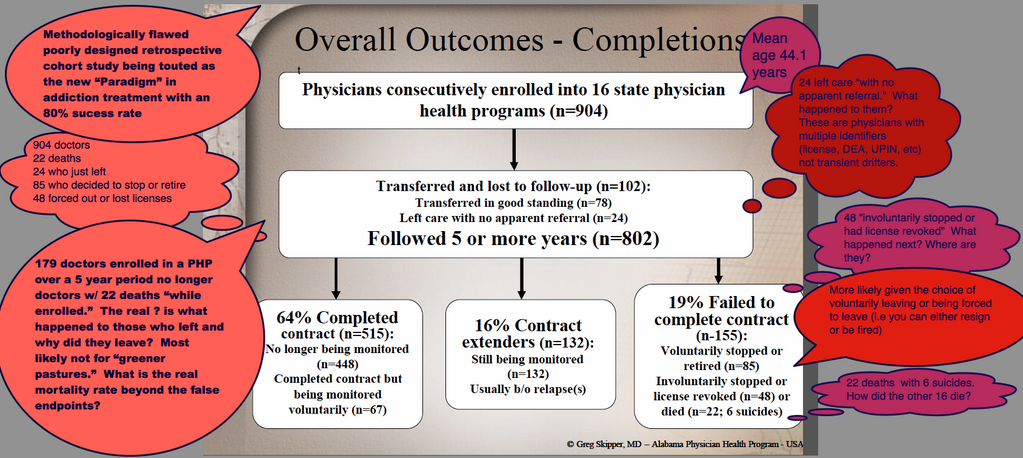
-Michael Langan, M..D.

Organizational Purpose and Public Trust in Drug and Alcohol Testing

Organizational Purpose and Public Trust in Drug and Alcohol Testing

IMG_9150

http://www.nytimes.com/2014/03/13/opinion/why-arent-doctors-drug-tested.html?partner=rss&emc=rss&_r=0

In 2012 Robert Dupont delivered the keynote speech at the Drug and Alcohol Testing Industry Association annual conference and described a “new paradigm” for addiction and substance abuse treatment of zero tolerance for alcohol and drug use that is enforced by monitoring with frequent random drug and alcohol tests. Detection of any substances is met with swift and certain consequences. He proposed expansion of this paradigm to other populations including workplace, healthcare, and schools. Based on the state Physician Health Program model of “contingency management,” with frequent testing and a point of “leverage,” such as a medical license in doctors, that is used as a behavioral incentive.
The ASAM White Paper on drug testing seems to indicate a desire to liberalize drug testing by utilizing health care providers in the process. Currently forensic drug testing uses a strict chain-of-custody protocol with Medical Review Officer (MRO) review. But if the result of a positive test is “therapeutic” rather than “punitive” this is unnecessary. In the “new paradigm” a positive test simply requires an evaluation at a “PHP-approved” facility.

IMG_9516 Accountability needs to be rooted in organizational purpose and public trust.
A recent article in JAMA, “Identification of Physician Impairment”  suggests that undetected physician impairment  may be contributing to medical error and that sentinel-event and  random alcohol-drug testing could be implemented to address the problem as is being done in the  current “Physician Health Program (PHP)” system.

The most consequential and critical issue for physicians, if this comes to fruition, is who will be in organizational and managerial control of the system and what ideological influences will be guiding policy and practice.   It is concerning that one of the co-authors of this article, Greg Skipper, is a Fellow of the American Society of Addiction Medicine with strong ties to the 12-step treatment industry and drug testing industry.

History shows Lord Acton’s aphorism on absolute power to be repeatedly true.  Corruption is a virtually inevitable consequenphotoce of unchecked power. The only two factors that constrain corruption are moral virtue and deterrence.
Disregard for standards of care and violations of codes of conduct are common.  So too is the use of anything that furthers the agenda.  Pseudoscience, such as polygraph testing, previously deemed by the American Medical Association as an unscientific game of “chance,” and psychometric testing of dubious validity are being used for confirmation of diagnoses.

They introduced and brought to market junk science like the Ethyl Glucuronide  (EtG) biomarker for detecting alcohol use. The EtG was introduced by an FSPHP physician, marketed, and proselytized as an accurate and reliable test for alcohol. After setting an arbitrary cutoff of 100 to prove drinking he ruined countless careers and lives.

As the disaster toll increased it became clear the test was not very good. It became apparent the test was, in fact, very flawed and misguided as using an ultra sensitive poorly specific test for a substance environmentally ubiquitous precludes its forensic applicability.

Hand sanitizer, cosmetics, sauerkraut, and myriad other products were shown to result in an elevated EtG. Sensibly, the majority of drug testing and monitoring programs abandoned it. 

The market for the test decreased dramatically as the only customers left were drug monitoring programs in which the testers had absolute power and those being tested were absolutely powerless–programs like those run by the PHP.

This group has now introduced the Phosphatidylethanol (PEth) test as a confirmation test for EtG and USDTL mScreen Shot 2014-04-05 at 2.08.11 PMarketed it as the PEthStat.  

State Physician Health Programs are now using the EtG  and adding the PEth to confirm alcohol ingestion. And just as they did with the EtG the claims of reliability are grand but without foundation. 
All speculative A=B oversimplified thinking that ignores the myriad other factors involved. The science is empty if you remove the dregs of filler and puff.  And the conflicts of interest are mind-boggling.

Corporate Front Groups and Corruption in Medicine-Forensic fraud, conflicts of Interest and the Erosion of Trust

The ASAM and FSPHP are corporate front groups that have infiltrated organized medicine and gained tremendous sway. Advancing the multi-billion dollar 12-step rehab and drug testing industry agenda control has replaced conduct and ideology has trampled science and reason. As organizations without transparency, accountability, or regulation they have become reservoirs of bad medicine and corruption.

Accountability is  rooted in organizational purpose and public trust.  Unfortunately, humanitarian ideals have been trampled by the imposition of corporate front groups who advance  hidden agendas under guises of science and scholarship  and patinas of benevolence.  Rife with conflicts of interest, these groups obfuscate, mislead, and exploit us to further an underlying political agenda.  Healthcare and medicine has been infiltrated by various groups that pose a serious threat to both the humanitarian and evidence based aspects.