The drug and alcohol testing and treatment industry plan to use the medical profession as a urine collection agency to bypass procedural protections: The ASAM White Paper on Drug Testing and the “Future of American Drug Policy.”

screen-shot-2016-10-04-at-3-56-07-pm  

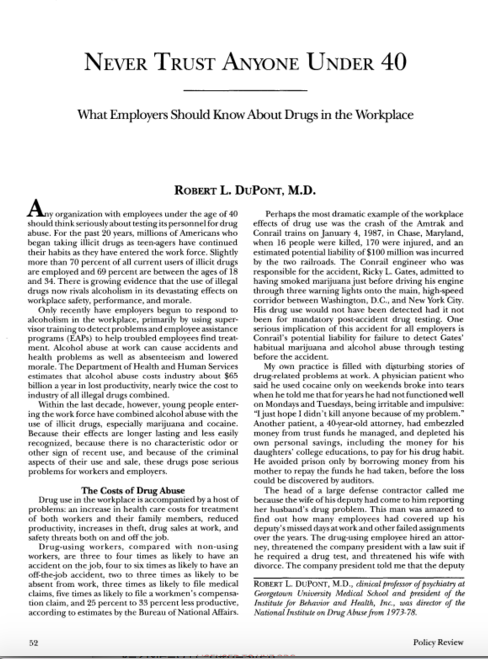
Before the  2012 Drug and Alcohol Testing Industry Association (DATIA) annual conference, Dr. Robert Dupont delivered a speech entitled “Drug Testing and the Future of American Drug Policy.”    He describes a “New Paradigm” for substance abuse treatment that enforces “zero tolerance for alcohol and drug use”  enforced by monitoring with frequent random drug and alcohol tests in which any positive test is  “met with swift, certain” consequences.” The paradigm is based on the current Physician Health Programs blueprint.  Dupont states:

“…physician health programs , have set the standard for effective use of drug testing. These pioneering state programs provide services to health care professionals with substance use disorders. The programs are run by physicians, some of whom in recovery themselves. PHPs feature relatively brief but highly focused treatment followed by active lifelong participation in the 12-step fellowships of Alcoholics Anonymous and Narcotics Anonymous. The key to the success of the PHP system of care management is the enforcement of the standard of zero tolerance for any alcohol or other drug use by intensive long-term random testing for both alcohol and drugs with swift and certain consequences for even a single use of alcohol or any other drugs of abuse. PHPs use drug panels of 20 or more drugs. The PHPs commonly use EtG and EtS tests to detect recent alcohol use. Similar comprehensive programs have been developed for commercial pilots and attorneys. These innovative programs of care management produce unprecedented long-term, outcomes.”

Physician Health Programs use a doctor’s medical license as “leverage” in what they call “contingency management.”   What this means is that a doctor who is being monitored by a PHP must comply with any and all demands of the PHP under threat of being reported to the state Medical Board and immediate suspension of  licensure. Dupont wants to extend this model to other populations including our elderly, our pregnant mothers, college and high school students and schoolchildren.

The 2013 American Society of Addiction Medicine White Paper on Drug Testing describes the organizational structure of the “New Paradigm” and this includes utilizing the medical profession as a urine collection agency for their drug and alcohol testing and the loophole they plan to exploit is this:  When a doctor-patient relationship exists drug and alcohol testing is rendered “clinical” rather than “forensic”so the consequences of a positive test can legitimately be called  “treatment” rather than punishment.  Because addiction is currently defined as a disease, addicts must be “treated” (which in the United States is more often coercive than voluntary), and “cured” (which is defined as remaining abstinent). When the disease concept is not strictly reserved for medical conditions but is expanded to any and all drug and alcohol use.

The proposed system bypasses the strict chain-of-custody and Medical Review Officer requirements designed to ensure accuracy and minimize false-positives.  These strict protocols are used by essentially all employee assistance programs (EAPs) in workplace drug testing programs.    Forensic drug testing is tightly regulated because the results of a positive test can be grave and far reaching and erroneous results are unacceptable.

Screen Shot 2014-11-04 at 8.25.02 PM

THE ASAM PAPER DESCRIBES MANDATED DRUG-TESTING FOR PATIENTS IN A NUMBER OF SPECIALTIES INCLUDING ADOLESCENT MEDICINE, PSYCHIATRY, OBSTETRICS, AND GERIATRICS.  CONTINGENCY MANAGEMENT WILL INVOLVE “THE POTENTIAL FOR LOSS OF CURRENT OR DESIRED EMPLOYMENT, OR THREATENED LOSS OF OR RESTRICTIONS ON A PROFESSIONAL OR COMMERCIAL LICENSE, OR LEGAL AND FORENSIC NECESSITY.”
 “THIS WHITE PAPER ENCOURAGES WIDER AND “SMARTER” USE OF DRUG TESTING WITHIN THE PRACTICE OF MEDICINE AND, BEYOND THAT,BROADLY WITHIN AMERICAN SOCIETY. SMARTER DRUG TESTING MEANS INCREASED USE OF RANDOM TESTING* RATHER THAN THE MORE COMMON SCHEDULED TESTING,* AND IT MEANS TESTING NOT ONLY URINE BUT ALSO OTHER MATRICES SUCH AS BLOOD, ORAL FLUID (SALIVA), HAIR, NAILS, SWEAT AND BREATH WHEN THOSE MATRICES MATCH THE INTENDED ASSESSMENT PROCESS. IN ADDITION, SMARTER TESTING MEANS TESTING BASED UPON CLINICAL INDICATION FOR A BROAD AND ROTATING PANEL OF DRUGS RATHER THAN ONLY TESTING FOR THE TRADITIONAL FIVE-DRUG PANEL.”

Federal workplace drug testing is done in accordance with mandatory guidelines. This testing is regulated using FDA approved tests with established sensitivity, specificity and cutoff levels.  FDA approval requires rigorous research and proven validity.    The FDA requires valid scientific evidence (with both clinical and analytical validation).

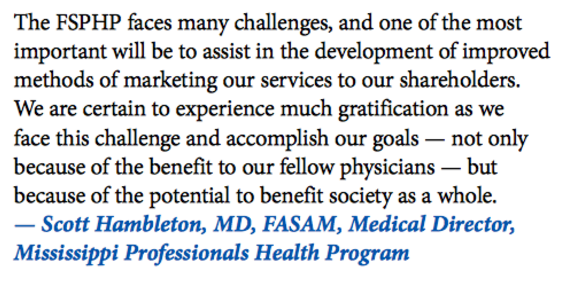
The  Federation of State Physician Health Programs (FSPHP), the group currently in managerial control of state physician health programs in 47-states,  has introduced non-FDA drug testing via a loophole that removes all accountability.  The EtG, EtS, and PEth tests were introduced as  Laboratory Developed Tests (LDTs) with little to no evidence base through pathway  developed for “clinical” tests of low market potential that would not otherwise be developed due to the prohibitive cost of the FDA approval process.  An LDT  does not even require testing in humans (“in vivo”) or even proof that the test is testing what it claims to be testing (validity) for.  It is an honor system and without FDA oversight a lab can can claim anything they want about these tests with no accountability. They do not have to provide any proof of what they claim or justify what they claim.     After partnering with labs to develop these tests, the FSPHP then convinced the Federation of State Medical Boards they were valid and accurate tests that were necessary to detect a bogus cadre of drunk and drugged doctors able to hide their impairment and who were protected by a “code of silence.”    This bogus danger was then used to convince state Medical Boards to use these unvalidated tests on doctors in state physician health programs.
screen-shot-2016-10-04-at-3-55-28-pm

(Source: ASAM Physician Health News March 2015)ASAM Physician Health News March 2015)

The ASAM white paper contains the following quote minimizing the critical role of the MRO in drug testing.   They feel clinical testing is good enough.

Unlike forensic drug testing where the test results must be able to meet rules of evidence in administrative, civil or criminal proceedings, clinical drug testing* is part of a patient examination performed by a clinician with whom the patient is in a therapeutic relationship. The testing is used for the purposes of diagnosis, treatment, and the promotion of long-term recovery. Clinical drug test results must meet the established standards of medical practice and benefit the therapeutic relationship, rather than meeting the formal legal requirements of forensic testing. Drug testing in medicine employs the same sound procedures, safeguards, and systems of information management that are used for all other health-related laboratory tests, tests on which life-and death medical decisions are commonly made.

Changing Public Policy and Regulatory Authority to Increase Power and avoid Accountability

 The Federation of State Physician Health Programs has been able to construct this scaffold with no meaningful opposition and below the public radar. They have done this by removing accountability at multiple levels.  By preventing access to information and erecting a system without oversight no consequences exist to deter misconduct and abuse.  The same tactics and strategies will be used as they expand this to other populations.

The Federation of State Physician Health Programs trumpets the the 12-step chronic relapsing brain disease model of addiction as defined by A.A. because it supports the drug and alcohol assessment, testing and treatment industries goals of more and more testing and treatment. For example  a 2011 FSMB Policy on Physician Impairment identifies, defines and essentially legitimizes “potential impairment” and “relapse without use.”

A PHP Should be empowered to conduct an intervention based on clinical reasons suggestive of potential impairment.  Unlike the Board which must build a case capable of withstanding
legal challenge, a PHP can quickly intervene based on reasonable concern."

“Empowered” to conduct an “Intervention” for reasons “suggestive” of “potential” impairment means a doctor can be pulled out of practice for anything.  It essentially gives them carte blanche authority. Due process and fundamental freedoms of choice are removed.

in 2011 The ASAM issued a Public Policy Statement on coordination between PHPs, regulatory agencies, and treatment providers recommending  that  only “PHP approved” treatment centers be used in the assessment and treatment of doctors.  A recent audit of the  North Carolina PHP found financial conflicts of interest and no  documented criteria for selecting the out of state treatment centers they used.  The common denominator the audit missed was that the 19  “PHP-approved” centers were all ASAM facilities whose medical directors can be seen on this list.

The FSMB House of Delegates adopted an updated Policy on Physician Impairment at their 2011 annual meeting distinguishing “impairment” and “illness”  stating that Regulatory Agencies should recognize the PHP as their expert in all matters relating to licensed professionals with “potentially impairing illness.”

According to the FSPHP, physician illness and impairment exist on a continuum with illness typically predating impairment, often by many years.”

The policy extends PHP authority to cover physical illnesses affecting cognitive, motor, or perceptive skills, disruptive physician behavior, and “process addiction” (compulsive gambling, compulsive spending, video gaming, and “workaholism”). It also defines “relapse without use” as “behavior without chemical use that is suggestive of impending relapse.”

G. Douglas Talbott defines  “relapse without use”  as  “emotional behavioral abnormalities” that often precede relapse or “in A A language –stinking thinking.”  AA language has entered the Medical Profession and no one seems to have even noticed.

The FSPHP political apparatus exerts a monopoly of force. It selects who will be monitored and dictates every aspect of what that entails.  It is a, in fact, a  rigged game.

The Need for Regulation, Oversight, and Accountability

Accountability is necessary to prevent corruption and requires both the provision of information and justification for actions. What was done and why?   Accountability also necessitates consequences-the ability of outside actors to punish and sanction those who commit the misconduct.  Without these constraints corruption is inevitable.

In  2012 Drs. John Knight and Wes Boyd recommended the medical community outside of PHPS provide oversight and demand accountability.  In  Ethical and Managerial Considerations Regarding State Physician Health Programs  they noted the financial conflicts of interest between PHPs and their “approved  centers,  coercion and abuse and even possible violations of the Nuremberg Code of Medical Ethics yet their paper generated little interest in the medical community.  The North Carolina PHP audit  revealed financial conflicts-of-interest and no oversight by the state medical society or board and that abuse of doctors could occur undetected due to the complete absence of accountability.  State Auditor Beth Woods told  the British Medical Journal in a recently  published article that the state program had holes in it “big enough to drive a truck through.”

In  Ethical and Managerial Considerations Regarding State Physician Health Programs Knight and Boyd state:  “Because PHP practices are unknown to most physicians before becoming a client of the PHP, many PHPs operate outside the scrutiny of the medical community at large. Physicians referred to PHPs are often compromised to some degree, have very little power, and are, therefore, not in a position to voice what might be legitimate objections to a PHP’s practices.”  And when objections do occur many take the side of the PHP, complacent in their belief that these are just altruistic and competent doctors just helping sick colleagues and protecting the public and valid complaints are deemed nothing more than “bellyaching.  In reality the ethical and criminal misconduct occurring in PHPs rivals that of Dr. Farid Fata,  the Detroit Oncologist who intentionally misdiagnosed patients with cancer so he could make money off unnecessary chemotherapy treatment.  Dr. Fata’s egregious betrayal of trust and unconscionably vile acts resulted in an appropriate response.
Screen Shot 2015-04-13 at 9.53.44 AMThe exact same misconduct is being perpetrated by PHPs but being overlooked, justified or otherwise ignored.  Dr. Fata intentionally misdiagnosed patients with cancer who did not have cancer so he could give them chemotherapy to make money.   PHPs are intentionally misdiagnosing substance abuse and behavioral disorders in physicians who do not have them in order to give them unneeded treatment and force them into monitoring contracts for profit and control.

This  undermines the very integrity of the profession.  It is particularly vile when the betrayal of trust involves doing the opposite of what was entrusted.   Abuse of positions of power, trust and influence in the field of medicine need to be both prevented, recognized and addressed.    Oversight, regulation and accountability are essential  if this is going to be accomplished.  There are no exceptions.   Policies and procedures must be enforced in a consistent manner.

The medical boards, medical societies, and departments of health have given the state PHPs carte blanche control and absolute power.  They refuse to even investigate accusations and they have convinced law enforcement that this is a parochial matter best handled by within the medical profession. As a result, valid complaints of crimes are not taken seriously.  This refusal to investigate  or even acknowledge valid and factual complaints of professional misconduct has not only prevented the exposure of  wrongdoing and corruption but deepened it.    The Federation of State Physician Health Programs and “Like-minded docs” must be recognized for what they are.  Front-groupsscreen-shot-2016-10-04-at-3-49-21-pm for the drug and alcohol assessment, testing and treatment industry.   This is glaringly obvious and you don’t have to look that deep to figure it out.  And these are the very same groups being proposed as advocacy bodies for addiction treatment and public policy change.  It is not that hard to figure out what they will be advocating for –more diagnoses, more testing and more treatment.

screen-shot-2016-10-04-at-3-48-53-pm

The American philosopher Eric Hoffer noted:

“The only way to predict the future is to have power to shape the future. Those in possession of absolute power can not only prophesy and make their prophecies come true, but they can also lie and make their lies come true.” 

The “PHP-blueprint”  is built on the very foundation Hoffer describe and unless you want mandated randomized  non-FDA approved drug and alcohol testing with “swift and certain” consequences at future visits with your doctor you will need to speak up.

This occurred in the medical profession rapidly and with little notice and that is exactly what will happen here.

 “Every time we turn our heads the other way when we see the law flouted, when we tolerate what we know to be wrong, when we close our eyes and ears to the corrupt because we are too busy or too frightened, when we fail to speak up and speak out, we strike a blow against freedom and decency and justice.” 

Robert F. Kennedy

61141_121358938015778_1369375864_n1

The proposed advocacy for addicts provides an altruistic cover enabling the group to pursue legal, regulatory and healthcare public policy change on behalf of addiction treatment for self benefit.

Screen Shot 2016-09-30 at 3.40.29 PM.png

ASAM Weekly is a publication of the American Society of Addiction Medicine (ASAM) circulated by E-mail to “more than 25,00 addiction professionals” every Tuesday.  It provides timely news briefings of top stories related to addiction medicine. The current issue includes a  National Survey on Drug Use and Health study correlating substance use with suicidal ideation;  original research  suggesting a strong link between  alcohol use and”thwarted belonging”  ( wanting and needing to be with others being socially isolated ) with both homicidal and suicidal ideation in a group under community corrections supervision by the criminal justice system; a study of privately billed services looking at the economic impact of the opioid epidemic on the healthcare system (Fair Health White Paper) which found a 1000% increase in opioid related treatment and service costs between 2011 and 2014;  and an article written for the  Huffington Post entitled  “When ‘All or Nothing’ Means Life or Death”  that questions the abstinence based model that currently monopolizes addiction treatment in the United States which the author notes  “is not only harmful and killing people,” but also “defies much of what we know about addiction.”

In his weekly editorial Editor-in-Chief William Haning refers to prescription database finding that the number of opioid prescriptions written in Tennessee last year outnumbered the number of people in Tennessee.  He appropriately notes this should “stun the readership” as it should. He notes several other articles this week “remind us that most of the public is not terribly interested in whether somebody has an addiction”  or the socioeconomic impact of addiction. He states “the public really can’t be expected to care” is someone with a substance use disorder is using substance and may not even be “realistically expected to care very much” about those who recover.

“What they do and rightly care about,” Haning declares,  “is the outcome of substance usage” and the public “is much more impressed by and will react to the consequences, ” As consequences he points to the two articles concerning suicidal and homicidal ideation and a report concerning sexual assault and violence from the University of Wisconsin .  He goes on to state:  “It causes an understandable lack of sympathy when a group of illnesses imparts injury to others.”  He lists crime, trauma in the workplace, spread of infectious disease and impact of childhood development of the disordered family as additional outcomes or consequences.

Haning notes a dilemma for those in recovery–they want to advocate for others but do not want to draw attention to themselves as the attention is far different from a diabetic or parent of a child with muscular dystrophy pushing for increased research or approval of a new medication.  He points out a national organization advocating for the treatment of the mentally ill exists (NAMI) that is comprised largely of those being treated but  “no strong national equivalent exists for substance use disorder yet” with two “organized bodies” as exceptions:    “physicians who have themselves entered recovery (IDAA), and another, smaller body of physicians in recovery who are engaged in the treatment of SUDs” These “organized bodies” have generally been focused on “ensuring identification of and care of their colleagues and patients” but have more recently become involved in the “pursuit of public policy changes.”  

Screen Shot 2016-09-29 at 6.56.16 AM.png

Screen Shot 2016-09-29 at 6.56.36 AM.png

Propoganda, Truth and Credibility

In   Propaganda: The Formation of Men’s Attitudes  Jacques Ellul discusses the underlying assumptions and ideology that give rise to propaganda and the structures and belief systems needed for propaganda to flourish.  Propagandists  move with an “assortment of soothing and easily digestible notions.”  He discusses how easy it is for most people to accept propaganda as the individual does not want information but only value judgments and preconceived positions.  On the surface Haning’s proposal is rational and seems like a good idea. Who could argue with it?

It is important to recognize what Haning is referring to.    IDAA is an acronym for International Doctors in Alcoholics Anonymous , an AA fellowship of more than 9500 doctors.  The organized body focused on ensuring “identification” of “colleagues” are the state physician health (basically employee assistance programs for doctors).  47 of them are under the management of the  Federation of State Physician Health Programs (FSPHP).  The organized body focused on “care” of “patients is a group called   Like Minded Docs (LMDs). Collectively these groups represent the physician health program model and it is being promoted as “gold standard addiction treatment” based on a 2009 study called the“PHP-blueprint”  that reported remarkable success rates (80%).  The  high success rate is attributed primarily to close linkage with 12-step programs and the use of “residential and outpatient treatment programs that were selected for their excellence.”

Screen Shot 2014-06-11 at 12.24.47 PM
Mechanics and Mentality

The “PHP-blueprint” is abstinence based and 12-step participation is mandatory.   Random frequent drug and alcohol testing is used with zero-tolerance. A positive test results in an out-of-state “PHP-approved” assessment center and concepts such as “potentially impairing illness” and “relapse without use” are accepted.  The core organizational structure includes the state PHP, commercial drug testing labs and a number of  out-of-state “PHP-approved” assessment and treatment centers.  The PHP’s have no regulation or oversight.  The testing, assessments and treatment are out -of-pocket cash only.The assessment and treatment centers have very little oversight and because the  commercial drug-testing labs use non-FDA approved laboratory developed tests (LDTs)  they are not regulated.  No agency exists to provide sanctions for faulty or even fraudulent testing.  No internal or external avenues of complaint exist.  It is essentially a closed system in which no outside opinion is acknowledged let alone addressed.    Transparency and accountability are absent. Due process is absent.   Every “PHP-approved” facility is represented by a Like-Minded Doc and many of the doctors involved in the drug-testing process are also on the list of LMDs.   It is a rigged system and explained  here.    Choice in assessment and treatment is removed and the “PHP-approved” facilities engage in “diagnosis rigging” and are willing to label people with diagnoses when they do not in fact meet the diagnostic criteria for that diagnosis.  Pervasive problems include:

–Labeling normal variations in behavior as pathological

–Failing to receive proper diagnosis and effective treatment in those who need it

–Forcing unneeded evaluations and treatments including forced committment

Pervasive and Serious Concerns

Physician Health Programs- More Harm Than Good?  was the first article critical of  PHPs. “Physician health programs under fire” was recently published in the British Medical Journal (BMJ). The lack of accountability and financial and ideological conflicts of interest are addressed.  Complaints include coercion,  threats, “diagnoses rigging,” lab fraud and false diagnoses to  to support unneeded treatment.    The physician health program model is a major factor in the current suicide epidemic in doctors.

Profit Motive and Plans for Expansion

In his Editorial Haning  mentions a “national organization for advocacy of treatment of the mentally ill” called NAMI and this stands for the  National Association of Mental Illness (NAMI). It is considered a pharmaceutically funded front-group founded by Abott Labs, Pfizer, Eli-Lilly and pharmaceutical manufacturers.  They all market drugs for mental illness.    Mother Jones reported  $11+ million over 5 years from Big Pharma, and an Eli Lilly executive directed operations from their headquarters..  A U.S. Senate investigation revealed Big Pharma contributed $23 million in a just two years and until forced by the Senate Finance Committee to identify its corporate donors  had refused to do so. The “Campaign to Stop the Stigma of Mental Illness”  was started by NAMI and the group claims one out of five adults will suffer some form of mental illness in their lifetime.    The system is designed to provide a seemingly altruistic agenda but is in actual fact driven and funded by groups who profit from labelling more people mentally ill.     It is, in fact, the very same business model as what we see here but the primary profiteers are not Big Pharma but Big Rehab -the multi-billion dollar drug and alcohol testing, assessment and treatment industry.images-4

What is planned is explicitly spelled out in the  ASAM White Paper on Drug Testing . This is a Trojan horse for expanding the “PHP-blueprint.”  The business mode is similar to the razor or printer model.  The razor or printer does not generate a profit, the razor and printer cartridge replacements do recurrently.  PHPs are simply employee assistance programs (EAPs). Selling the PHP (i.e replacing an existing EAP) does not turn a profit, the non-FDA approved drug and alcohol testing does (and the referrals to the “approved” assessment and treatment centers.    The New York Times reported that the size of the US drug-screening industry grew from $800 million in 2000 to $2 billion in 2013.

Infrastructure Already in Place 

The drug and alcohol assessment, treatment and testing organizations are already present To replace an EAP with the PHP model  it is only necessary to convince an employer or  administrative agency in charge of professional licensure.   If elected as public policy advocates for addiction treatment they will most assuredly be lobbying and working on state and federal laws and aligning themselves with licensing boards to remove due process and civil liberties by “medicalization”.  This could impact anyone from our elderly, to our military, pregnant women, nursing mothers and school children. It is a testing and treatment  Trojan Horse.   They will be pushing public policy to coerce people into treatment who do not need treatment.

screen-shot-2016-09-28-at-1-33-33-amCreating Bogus Risks of Danger

Linking patient harm to “impaired” doctors is one of the primary propaganda techniques used by the FSPHP to forward the assessment, testing and treatment agenda. Be creating fear in hospital administrators, medical boards and the public ( “The Junkie in the O.R.” ) This appeal to  consequences (argumentum ad consequentiam) is suggested by Haning in the editorial. He states the public will react to consequences such as crime, trauma in the workplace, spread of infectious disease and “impact of childhood development of the disordered family “as potential consequences. The PHP system uses a medical license as “leverage” but any other license or benefit provided by the state could be used in the same manner.   This is what is called “contingency management” and how this is done is discussed in the ASAM White Paper on Drug Testing.

FSPHP/FASAM/LMD

screen-shot-2016-09-29-at-7-11-01-amThe primary architects of this system can be found on a list of Fellows of the American Society of Addiction Medicine. The list can be seen  here and includes  G. Douglas Talbott,  Robert Dupont, and  Paul Earley whose contributions to the current paradigm I have detailed in previous posts.   The list also includes  Greg Skipper  who introduced the first non-FDA approved  laboratory developed test for alcohol and is currently promoting  Soberlink -another junk science gadget that is prominently advertised as the top header in the current issue of   ASAM Weekly.

The list of like-minded docs was taken down from the website several months ago. Below is a screenshot taken the week prior.  On this list are Dupont, Earley, Skipper and the medical director’s of every single “PHP-approved” assessment and treatment center and it must be a small world after all because if you look at this list it has the name “Bill Haning” on it.  You will also find him on the list of ASAM Fellows.

Screen Shot 2015-05-30 at 12.47.51 AM

screen-shot-2016-09-30-at-1-34-17-pm

screen-shot-2016-09-30-at-1-35-39-pm

The Regulatory Capture of American Medicine by the Drug and Alcohol Testing, Assessment and Treatment Industry

But in this Court, what Diff’rence does appear!
For every one’s both Judge and Jury here;
Nay, and what’s worse, an Executioner.

William Congreve, The Double-dealer

Screen Shot 2016-08-06 at 2.21.37 PM

Regulatory capture is a form of government failure that occurs when a regulatory agency created to act in the public interest, instead advances the commercial or political concerns of special interest groups that dominate the industry or sector it is charged with regulating and introduced in an article by George J. Stigler in 1971 entitled The Theory of Economic Regulation. The main idea of the article can be summarized in Stigler’s (1971: 3) affirmation that:

“…as a rule, regulation is acquired by the industry and is designed and operated primarily for its benefits.”

The basic hypothesis of Stigler is that an industry may use—or rather abuse—the coercive public power of the State to establish and enforce rules in order to obtain private gain.

Historians will at some point recognize 1995 as the “regulatory capture” inception point of American medicine when the  Federation of State Physician Health Programs ( FSPHP ) forged a relationship with the Federation of State Medical Boards (FSMB), the national organization responsible for the licensing and discipline of doctors and memorialized in a 1995 Journal of Medical Licensure and Discipline(Vol82N3)with articles claiming high success rates in eight state PHPs.

An accompanying Editorial written by past President of the FSMB Barbara S. Schneidman, MD, MPH concluded that:

“cooperation and communication between the medical boards and the physician health programs must occur in an effort to protect the public while assisting impaired physicians in their recovery.”

Roger A. Goetz of the the Florida Impaired Practitioners Program, for example reported that 84% of all referrals to the PRN “Occur prior to any violation of the Medical Practice Act or any evidence of patient harm.” Journal of Medical Licensure and Discipline(Vol82N3)  As protecting the public from patient harm is the primary directive of medical boards those statistics seem pretty impressive!   That the PRN prevented inevitable spirals of drug addled and besotted doctors from mayhem is questionable as how many were just like Leonard Masters?  After being accused of overprescribing Goetz told Masters he could either relinquish his license or have an evaluation. Masters chose the evaluation thinking he would be returning in 4-days but was diagnosed as an alcoholic and spent 4-months.  He didn’t even have a drinking problem.  He successfully sued G. Douglas Talbott and the facility for false imprisonment, malpractice and fraud.

Screen Shot 2016-08-06 at 2.38.30 PM

Goetz was also instrumental in promoting the chronic-relapsing brain disease model as a pathway to return revoked medical licenses.  No matter how abhorrent their  behavior,  by misplacing blame on the “disease” doctors who should have hung up their smocks forever quickly returned to practice as they didn’t do it the drugs or alcohol did.    In this manner serial sex-offenders, pedophiles,  date-rapists using roofies and fiends who replaced dying cancer patients narcotics with saline and let them die in agony were quickly returned to the fold.    The error in this thinking is that for the most part drugs and alcohol may induce good people to do disinhibited things or stupid things but they do not make good people do bad bad things. Empathy and moral compass are innate and the majority of doctors would not roofie drinks or take away dying patients pain meds under any influence. Unfortunately no test exists for psychopathy.

Many found employment as medical directors of these specialized programs and others became active in their states PHPs.

Since that time the FSPHP has duped the FSMB easier easier than a carney dupes a rube.

They asked the FSMB to approve public-policy to request state medical boards provide absolute deference to their state PHPs as their experts in all things related to physician health and to agree to never ever question their decision making skills regarding monitored doctors lest it “undermine a culture of professionalism” and this was agreed to.

Deference is acceptable but agreeing to blind deference and accepting the delusion of infallibility is unwise.  A culture of deference is unacceptable.  Lord Acton noted in a letter to a friend that the main point he was trying to get across when he wrote “Power tends to corrupt, and absolute power corrupts absolutely”was not that power corrupts powerful people but that power corrupts other people.  This dynamic certainly holds here. They make allowances.

Since that time they have expanded from ‘impaired physicians” to “disruptive physicians” to the “aging physician.”  They have gained power and autonomy without regulation or oversight and by removing transparency and absolutely zero accountability they have essentially run amuck.

Screen Shot 2016-08-06 at 2.27.57 PM

In 1995 this was a simple but growing shakedown scheme using a medical license to extract money under the threat of its loss. The PHP refers doctor X to “PHP-approved facility” for an evaluation and the “PHP-approved” facility tells doctor X you will stay here until I say so or I tell the PHP you ain’t gettin your license back.  Doctor X  stays because he knows the PHP can do it as the PHP is not going to be questioned by the medical board.They refer to it as “contingency-management” but it essentially meets the criminal definition of extortion.

Business has boomed since 1995 as they introduced non-FDA approved drug and alcohol tests into the market even though they are unvalidated with very low specificity. Junk-gadgets such as the SCRAM alcohol monitoring bracelet and the Soberlink cellular photo breathalyzer have been promoted as accurate and valid.  None of this has any oversight but their linkages with the drug and alcohol testing, assessment and treatment industry has become an enormous gold mine.  Both the drug-testing and assessment and treatment industry are multi-billion dollar enterprises.

The FSMB even made it public policy for medical boards to provide deference to PHPs and consider them experts in all things  physician health.   In this manner they have introduced a panoply of junk science, brought legions of polygraph examiners out of their basements and rebranded the 360 degree personal development employee assistance tool as a bona fide diagnostic instrument used for disruptive physician evaluations.  The FSMB has also accepted concocted and imaginary concepts such as “potentially impairing illness” and “relapse without use” as not only nonfictional but medically scientific truth.   If they proposed tiddlywinks for assessment of the “aging” physician the FSMB would probably buy it.  Is potentially potentially impairing illness next.?   There has been no apparent inquiry or opposition to this.

Accountability requires both the provision of information and justification for actions and they have minimized both.  Prohibiting doctors from obtaining their own assessments, medical records and drug-testing records markedly reduces risk of exposure as does prohibiting release of those records to third parties.   Cash only prevents inquiry from insurers. The PHPs have no oversight or regulation.  The drugscreen-shot-2016-02-09-at-3-39-27-am and alcohol testing labs have no FDA oversight as the tests are non-FDA approved. Other than accreditation agencies such as the College of American Pathologists there is no agency to investigates error or misconduct. CAP cannot sanction.  The assessment and treatment centers have little oversight or regulation.   In sum this system refuses to provide information and even if they did provide information they do not have to justify it to anyone and no agency exists to punish them even if they could not justify it.  Zero accountability.

And with zero accountability corruption not only thrives but is inevitable.   The simple extortion scheme from 1995 has now grown to around two dozen “PHP-approved” assessment and treatment centers and state boards require that only “PHP-approved” facilities be used and specifically excludes non “PHP-approved” facilities.   The preferred facilities engage in “diagnosis rigging” and false diagnoses to warrant unneeded treatment.  The labs such as USDTL and Quest engage in laboratory misconduct and will create a falsely positive test at client request.    It is a closed system where everything is kept within the PHP circle.

And complete regulatory capture has been achieved through autonomous units within Boards that essentially serve as PHP protection units and hired guns.  They protect the PHP and their friends and also act as an assassin squad to do whatever the PHP wants them to do to suspend, revoke and interfere with the medical licenses of doctors any which way they want.

In Massachusetts Policy 94-002 created Physician Health and Compliance Unit (PHCU) Board counsel as an independent unit outside the enforcement division of the Massachusetts Board of Registration in Medicine by design.

These units were created at the request of state physician health programs ostensibly to monitor the compliance of doctors under monitoring their monitoring contracts.   The MA PHCU Board counsel is run by attorney Deb Stoller and also includes attorneys Robert Harvey and Tracy Ottina.

Screen Shot 2016-08-06 at 2.22.27 PMPHCU Board counsel were additionally afforded the  power to act as both “hearing-officers” on cases and present these same cases to the Board and recommend disciplinary action. This was by design also.  They were set up to hold all the cards and it is a stacked deck.
This additional circle around the closed-loop system provides an additional layer of protection to prevent the fraud and abuse from being discovered.  That the  Massachusetts Board is not under any active supervision from the executive branch has been confirmed in writing to the Massachusetts Legislature by Governor Charles Baker in a letter accompanying his Bill (H.4188) which aimed to finally establish a framework for active supervision and oversight over the Board.

These units enforce PHP policy and requirements including the restriction of assessments to the out of state (“PHP-approved”) assessment and treatment centers and forbid any outside assessments.    Any doctor in Massachusetts will be forced to go to Georgia, Alabama, Arkansas, Kansas  or some other remote venue for an evaluation under the guise of special knowledge.   Any doctor reported to the PHCU as “non-compliant” is summarily suspended. Truth and evidence are irrelevant. The opinions of all outside experts no matter how qualified or how many are not only dismissed they are patently ignored  with eyes wide shut.   They simply do not register anything outside the racket.  They abuse administrative law procedure to dismiss, deflect and delay.   Having the power to act as both a  hearing-officer to accept or exclude evidence and present cases to the Board and make disciplinary recommendations provides them with absolute power to render judgment.   It means they are in charge of every decision made, and they have the power to be rid of whomever they choose as judge, jury and executioner.  The Board’s simply defer to PHCU Board counsel and give little thought or time to what was presented and ratify whatever is asked. They are uninformed and disengaged.

The system is almost foolproof.   It is a culture of impunity and deference.  To make matters worse states Attorney Generals defer to the medical-board and their physician health experts.  The AGO represents the state agency and its expert in legal challenges and crimes reported by doctors are dismissed at the outset.  The agency responsible for investigating rackets and laboratory and healthcare fraud as well as civil rights violations and color of law abuse is the states AGO. No one is minding the minders.

The assistant AGOs representing boards appear to use the same tactics as the PHCU Board counsel and a similar moral disengagement mentality but it is unclear what the interface is with the PHP/medical board and states AGOs.  If anyone has any insight please advise as I have not figured it out.  Perhaps they agreed to deference to the medical board/PHP just as the medical board agreed to deference to the PHP.  Perhaps they have specific administrative attorneys who they use or even a cadre within but it is implausible that the entire AGO would be supporting the rehab racket.

But in the final analysis this has resulted in is a complete systems failure where corruption and abuse is occurring as a product of bad apples in plain view and within the walls of regulatory medicine with each agency deferring to the integrity and honesty of its predecessor. This is not good governance.

Historians will someday look back at the fall of American medicine and wonder how it was allowed to happen and link systemic as well as specific problems pervasively plaguing the profession with regulatory capture by the drug and alcohol testing, assessment and treatment industry.


Screen Shot 2015-07-03 at 2.51.31 AM

Screen Shot 2016-08-08 at 5.51.35 PM

Physician Suicide and “Physician Wellness” –Time to start talking about the elephant in the room!

Screen Shot 2016-05-24 at 7.30.05 PM

Physician Suicide and the Elephant in the Room

Michael Langan, M.D.

Although no reliable statistics exist, anecdotal reports suggest an alarming upsurge in physician suicide. This necessitates a reappraisal of known predisposing risk factors such as substance abuse and depression but also requires a critical examination of what external forces or vulnerabilities might be unique to doctors and how they might be involved in the descent from suicidal ideation to suicidal planning to completed suicide.

Depression and Substance Abuse Comparable to General Population

Depression and substance abuse are the two biggest risk factors for suicide. The prevalence of depression in physicians is close to that of the general population1,2 and, if one looks critically at the evidence based literature, substance abuse in medical professionals approximates that of the general population.  Controlled studies using DSM diagnostic criteria suggest that physicians have the same rates (8-14%) of substance abuse and dependence as the rest of the population 3 and slightly lower rates compared to other occupations.4,5 Epidemiological surveys reveal the same. Hughes, et al.6 found a lifetime prevalence of drug or alcohol abuse or dependence in physicians of 7.9%, markedly less than the 14.6% prevalence reported in the general population by Kessler.7

State Physician Health Programs

Perhaps it is how physicians are treated differently when they develop a substance abuse or mental health problem.

Physician Health Programs (PHP) may be considered the equivalent to Employee Assistance Programs (EAPs) for other occupations. PHPs meet with, assess and monitor doctors who have been referred to them for substance use or other mental or behavioral health problems. Originally developed as “impaired physician” programs, the PHPs were created to help doctors who developed problems with substance abuse or addiction as an alternative to disciplinary action by State Medical Boards. These programs existed in almost every state by 1980. Often staffed by volunteer physicians and funded by State Medical Societies, “impaired physician” programs served the dual purpose of both helping sick colleagues and protecting the public. Preferring rehabilitation to probation or license revocation (so long as the public was protected from imminent danger)  most medical boards accepted the concept with support and referral.   However, most EAPs were developed with the collaboration of workers unions or some other group supporting the rights and interests of the workers.  Not so with PHPs  as there is no such organization representing doctors.   PHPs developed in the absence of regulation or oversight.    As a consequence there is no meaningful accountability.   

In Ethical and Managerial Considerations Regarding State Physician Health Programs published in the Journal of Addiction Medicine in 2012, John Knight, M.D. and J. Wesley Boyd, M.D., PhD who collectively have more than 20 years experience with the Massachusetts PHP state that:

“Because PHP practices are unknown to most physicians before becoming a client of the PHP, many PHPs operate out- side the scrutiny of the medical community at large. Physicians referred to PHPs are often compromised to some degree, have very little power, and are, therefore, not in a position to voice what might be legitimate objections to a PHP’s practices.”8

Noting that “for most physicians, participation in a PHP evaluation is coercive, and once a PHP recommends monitoring, physicians have little choice but to cooperate with any and all recommendations if they wish to continue practicing medicine,” Knight and Boyd raise serious ethical and managerial questions about current PHP policies and practice including conflicts of interest in referrals for evaluation and treatment, lack of adherence to standards of care for forensic testing of substances of abuse, violations of ethical guidelines in PHP research, and conflicts of interest with state licensing boards.

Knight and Boyd recommend “that the broader medical community begin to reassess PHP’s as a whole” and that “consideration be given toward the implementation of independent ethical oversight and establish and appeals process for PHP clients who feel they are being treated unfairly.” 8 They also recommend the relationship of PHP’s between the evaluation and treatment centers and licensing boards be transparent and that national organizations review PHP practices and recommend national standards “that can be debated by all physicians, not just those who work within PHPs.”8 Unfortunately this has not happened. Most physicians have no idea that the state physician health programs have been taken over by the “impaired physicians movement.”

In his Psychology Today blog,  Boyd again recommends oversight and regulation of PHPs.   He cites the North Carolina Physicians Health Program Audit released in April of 2014 that reported the below key findings:

As with Knight and Boyd’s paper outlining the ethical and managerial problems in PHPs, the NC PHP audit finding that abuse could occur and not be detected generated little interest from either the medical community or the media.

Although state PHPs present themselves as confidential caring programs of benevolence they are essentially monitoring programs for physicians who can be referred to them for issues such as being behind on chart notes. If the PHP feels a doctor is in need of PHP “services” they must then abide by any and all demands of the PHP or be reported to their medical board under threat of loss of licensure.

State PHP programs require strict adherence to 12-step doctrine9 yet many of the physicians monitored by them are neither addicts nor alcoholics. Some do not even have substance abuse issues and there are reports of “disruptive” physicians being diagnosed with “character defects” at the “PHP-approved” facilities that do these assessments.   PHPs require abstinence from drugs and alcohol yet use  non-FDA approved Laboratory Developed Tests in their monitoring programs. Many of these tests were introduced to commercial labs and promoted by ASAM/FSPHP physicians.10-12

LDTs bypass the FDA approval process and have no meaningful regulatory oversight.   The LDT pathway was not designed for “forensic” tests but clinical tests with low risk.   Some are arguing for regulation and oversight of LDTs due to questionable validity and risk of patient harm.13

These same physicians are claiming a high success rate for PH programs9 and suggesting that they be used for random testing of all physicians.14

As with LDTs, the state PHPs are unregulated, and without oversight. State medical societies and departments of health have no control over state PHPs.

Their opacity is bolstered by peer-review immunity, HIPPA, HCQIA, and confidentiality agreements. The monitored physician is forced to abide by any and all demands of the PHP no matter how unreasonable-all under the coloration of medical utility and without any evidentiary standard or right to appeal.

The ASAM has a certification process for physicians and claim to be “addiction” specialists. This“board certification” is not recognized by the American Board of Medical Specialties and is not a recognized medical specialty. The goal of the ASAM is to be recognized as the experts in addiction medicine with the consensus expert opinion based on the 12-step prohibitionist brain disease model. The ASAM has aligned itself with a number of inpatient drug treatment centers  (Hazelden, Talbott, Marworth, Bradford,etc) and are heavily funded by the drug testing industry.   It is in fact a “rigged game.”

State PHPs are non-profit non-governmental organizations and have been granted quasi-governmental immunity by most State legislatures from legal liability.

By infiltrating “impaired physician” programs they have established themselves in almost every state by joining, gaining power, and removing dissenters. Groupthink and 12-step indoctrination are the goals. By advertising as advocates for doctors who are “caring,” “confidential resources,” “giving help,” and advocating for “colleagues in need” the outward appearance is one of benevolence.

The biggest obstacle is that this system allows them to throw the normal rules of conduct under the imperative of a higher goal assumed to trump all other consideration. Those outside of programs either defend or ignore the reports of ethical and criminal violations, complacent in their trust of these “experts” claiming they are just helping sick doctors and protecting the public.

With no oversight or regulatory body involved this is all done with impunity, immunity, and undercover. They use the accusation of substance abuse as an indication to disregard the claims of the accused. The physician is left without rights, depersonalized, and dehumanized. The imposition of confinement, stigmatization, lack of oversight of the organizations, peer-review protected confidentiality, and lack of procedural protection is a one-way train to hopelessness and despair.

By establishing a system that of coercion, control, secrecy, and misinformation, the FSPHP is claiming an “80% success rate” 15and deeming the “PHP-blueprint” as “the new paradigm in addiction medicine treatment.

The ASAM/FSPHP had a major influence on the DSM-V where drug abuse and dependence are no longer separate entities. They are also working behind the scenes to get legislation to randomly drug test all physicians.

They are now after the “disruptive physician” and the evidentiary criteria are fairly low and red flags include “deviating from workplace norm in dress or conduct” and being tardy for meetings.

They have identified “the aging physician” as a potential problem because “as the population of physicians ages,””cognitive functioning” becomes “a more common threat to the quality of medical care.”

The majority of physicians are unaware that the Federation of State Medical Boards House of Delegates adopted an updated Policy on Physician Impairment in 2011 that uses addiction as an example of a “potentially impairing illness.”  According to the Federation of State Physician Health Programs …”physician illness and impairment exist on a continuum with illness typically predating impairment, often by many years. This is a critically important distinction. Illness is the existence of a disease. Impairment is a functional classification and implies the inability of the person affected by disease to perform specific activities.”

“Process addiction” was added as a potentially impairing illness including compulsive gambling, compulsive spending, compulsive video gaming, and “workaholism.” According to the FSPHP “the presence of a process addiction can be problematic or even impairing in itself, and it can contribute to relapse of a physician in recovery. As such, process addictions should be identified and treated.” They define three levels of relapse including the novel “relapse without use.”

Bullying, Helplessness, Hopelessness and Despair

Perceived helplessness is significantly associated with suicide.16 So too is hopelessness, and the feeling that no matter what you do there is simply no way out17,18 Bullying is known to be a predominant trigger for adolescent suicide19-21 One study found that adolescents in custody who were bullied were 9.22 times more likely to attempt suicide than those were not bullied.22

Heightened perceptions of defeat and entrapment are known to be powerful contributors to suicide.23,24 The “Cry of Pain” model 25,26 specifies that people are particularly prone to suicide when life experiences are interpreted as signaling defeat which is defined as a sense of “failed struggle” or loss of social position and resources.. The person is unable to identify an escape from or resolution to a defeating situation, a sense of entrapment proliferates with the perception of no way out, and this provides the central impetus for ending ones life.

There is also evidence that rescue factors such as social supports may play a role in preventing suicide. These rescue factors act buffers to protect against suicide in the face of varying degrees of life stress.27,28 The study of female physicians revealed meetings to discuss stressful work experiences as a potential protective factor, 29 and support at work when difficulties arose appeared to be a protective factor for the male physicians.30   Research involving Finnish physicians found that control over one’s work and organizational justice were the most important determinants of work-related wellbeing.31,32 Organizational justice is related to fairness and refers to an individuals perception of an organizations behaviors, decisions, and actions and how these influence one’s own attitudes and behaviors and has been identified as a psychosocial predictor of health and wellbeing33 34Low organizational justice has been identified as a notable risk factor for psychological distress and depression.35,36

A recent report indicates that job stress, coupled with inadequate treatment for mental illness may play a role in physician suicide..

Using data from the National Violent Death Reporting System the investigators compared 203 physicians who had committed suicide to more than 31,000 non-physicians and found that having a known mental health disorder or a job problem that contributed to the suicide significantly predicted being a physician.1

Physicians were 3.12 times more likely to have a job problem as a contributing factor. In addition, toxicology testing showed low rates of medication treatment.  The authors concluded that inadequate treatment and increased problems related to job stress are potentially modifiable risk factors to reduce suicidal death among physicians.

They also warned that the database used likely underestimated physician suicides because of “underreporting and even deliberate miscoding because of the stigma attached.”

I can think of nothing more institutionally unjust than an unregulated zero-tolerance monitoring program with no oversight using unregulated drug and alcohol testing of unknown validity.

We have heard of numerous suicides due to these institutionally unjust programs.   Three doctors died by suicide in Oklahoma in a one month period alone (August 2014).   All three were being monitored by the Oklahoma PHP.   I went to an all boys high-school of less than 350 students yet a classmate a couple years ahead of me died by suicide a few months ago. He was being monitored by the Washington PHP. His crime?  A DUI in 2009–a one-off situational mistake that in all likelihood would never have recurred.  But as is often the case with those ensnared by state PHPs he was forced to have a “re-assessment” as his five-year monitoring contract was coming to an end.  These re-assessments are often precipitated by a positive Laboratory Developed Test (LDT) and state medical boards mandate these assessments can only be done at an out-of-state “PHP-approved” facility.    Told he could no longer operate and was unsafe to practice medicine by the PHP and assessment center he then hanged himself.  And at the conclusion of Dr. Pamela Wible’s haunting video below are listed just the known suicides of  doctors; many were being monitored by their state PHPs–including the first name on the list– Dr. Gregory Miday.

None of these deaths were investigated. None were covered in the mainstream media.   These are red flags that need to be acknowledged and addressed!    This anecdotal evidence suggests the oft-used estimate of 400 suicides per year (an entire medical school class) is a vast underestimation of reality—extrapolating just the five deaths above to the entire population of US doctors suggests we are losing at least an entire medical school per year.

As physicians we need to demand transparency, oversight, regulation and auditing by outside groups. This is a public health emergency.

To wit:

They first came after the substance abusers and I did not speak out because I was not a substance abuser.

They then came for those with psychiatric diagnoses and I did not speak out because I was not diagnosed with a psychiatric disorder.

They then came after the “disruptive physician” and I did not speak out because I was not disruptive.

They then came after the aging physician and I did not speak out because I was young.

They then came after me and there was no one else to speak out for me.

  1. Ford DE, Mead LA, Chang PP, Cooper-Patrick L, Wang NY, Klag MJ. Depression is a risk factor for coronary artery disease in men: the precursors study. Archives of internal medicine. Jul 13 1998;158(13):1422-1426.
  2. Frank E, Dingle AD. Self-reported depression and suicide attempts among U.S. women physicians. The American journal of psychiatry. Dec 1999;156(12):1887-1894.
  3. Brewster JM. Prevalence of alcohol and other drug problems among physicians. JAMA : the journal of the American Medical Association. Apr 11 1986;255(14):1913-1920.
  4. Anthony J, Eaton W, Mandell W, al. e. Psychoactive Drug Dependence and abuse: More Common in Some Occupations than in Others? Journal of Employee Assistance Res.1992;1:148-186.
  5. Stinson F, DeBakely S, Steffens R. Prevalence of DSM-III-R Alcohol abuse and/or dependence among selected occupations. Alchohol Health Research World. 1992;16:165-172.
  6. Hughes PH, Brandenburg N, Baldwin DC, Jr., et al. Prevalence of substance use among US physicians. JAMA : the journal of the American Medical Association. May 6 1992;267(17):2333-2339.
  7. Kessler RC, Berglund P, Demler O, Jin R, Merikangas KR, Walters EE. Lifetime prevalence and age-of-onset distributions of DSM-IV disorders in the National Comorbidity Survey Replication.Archives of general psychiatry.Jun 2005;62(6):593-602.
  8. Boyd JW, Knight JR. Ethical and managerial considerations regarding state physician health programs. Journal of addiction medicine. Dec 2012;6(4):243-246.
  9. DuPont RL, McLellan AT, White WL, Merlo LJ, Gold MS. Setting the standard for recovery: Physicians’ Health Programs. Journal of Medical Regulation. Mar 2010;95(4):10-25.
  10. Skipper GE, Weinmann W, Thierauf A, et al. Ethyl glucuronide: a biomarker to identify alcohol use by health professionals recovering from substance use disorders. Alcohol and alcoholism.Sep-Oct 2004;39(5):445-449.
  11. Skipper GE, Thon N, Dupont RL, Baxter L, Wurst FM. Phosphatidylethanol: the potential role in further evaluating low positive urinary ethyl glucuronide and ethyl sulfate results.Alcoholism, clinical and experimental research. Sep 2013;37(9):1582-1586.
  12. Skipper GE, Thon N, DuPont RL, Campbell MD, Weinmann W, Wurst FM. Cellular photo digital breathalyzer for monitoring alcohol use: a pilot study.European addiction research.2014;20(3):137-142.
  13. Sharfstein J. FDA Regulation of Laboratory-Developed Diagnostic Tests: Protect the Public, Advance the Science. JAMA : the journal of the American Medical Association. Jan 5 2015.
  14. Pham JC, Pronovost PJ, Skipper GE. Identification of physician impairment.JAMA : the journal of the American Medical Association. May 22 2013;309(20):2101-2102.
  15. McLellan AT, Skipper GS, Campbell M, DuPont RL. Five year outcomes in a cohort study of physicians treated for substance use disorders in the United States. Bmj. 2008;337:a2038.
  16. Rivers I, Noret N. Potential suicide ideation and its association with observing bullying at school.The Journal of adolescent health : official publication of the Society for Adolescent Medicine. Jul 2013;53(1 Suppl):S32-36.
  17. Lester D, Walker RL. Hopelessness, helplessness, and haplessness as predictors of suicidal ideation. Omega. 2007;55(4):321-324.
  18. Beck AT. Hopelessness as a predictor of eventual suicide. Annals of the New York Academy of Sciences. 1986;487:90-96.
  19. Hinduja S, Patchin JW. Bullying, cyberbullying, and suicide. Archives of suicide research : official journal of the International Academy for Suicide Research. 2010;14(3):206-221.
  20. Hertz MF, Donato I, Wright J. Bullying and suicide: a public health approach. The Journal of adolescent health : official publication of the Society for Adolescent Medicine. Jul 2013;53(1 Suppl):S1-3.
  21. Kim YS, Leventhal B. Bullying and suicide. A review. International journal of adolescent medicine and health. Apr-Jun 2008;20(2):133-154.
  22. Kiriakidis SP. Bullying and suicide attempts among adolescents kept in custody.Crisis.2008;29(4):216-218.
  23. Taylor PJ, Gooding P, Wood AM, Tarrier N. The role of defeat and entrapment in depression, anxiety, and suicide. Psychological bulletin. May 2011;137(3):391-420.
  24. Lester D. Defeat and entrapment as predictors of depression and suicidal ideation versus hopelessness and helplessness. Psychological reports. Oct 2012;111(2):498-501.
  25. Williams JMG. Cry of Pain. Harmondsworth: Penguin; 1997.
  26. Williams JMG, Crane C, Barnhofer T, Duggan DS. Psychology and suicidal behavior: elaborating the entrapment model. In: Hawton K, ed. Prevention and treatment of suicidal behavior: from science to practice. Oxford: Oxford University Press; 2005:71-89.
  27. Borowsky IW, Ireland M, Resnick MD. Adolescent suicide attempts: Risks and protectors.Pediatrics. 2001;107(485).
  28. Clum GA, Febbraro GAR. Stress, social support and problem-solving appraisal/skill: Prediction of suicide severity within a college sample.Journal of Psychopathology and Behavioral Assessment. 1994;16:37-46.
  29. Fridner A, Belkic K, Marini M, Minucci D, Pavan L, Schenck-Gustafsson K. Survey on recent suicidal ideation among female university hospital physicians in Sweden and Italy (the HOUPE study): cross-sectional associations with work stressors. Gender medicine. Apr 2009;6(1):314-328.
  30. Fridner A, Belkic K, Minucci D, et al. Work environment and recent suicidal thoughts among male university hospital physicians in Sweden and Italy: the health and organization among university hospital physicians in Europe (HOUPE) study. Gender medicine. Aug 2011;8(4):269-279.
  31. Lindfors PM, Meretoja OA, Toyry SM, Luukkonen RA, Elovainio MJ, Leino TJ. Job satisfaction, work ability and life satisfaction among Finnish anaesthesiologists. Acta anaesthesiologica Scandinavica. Aug 2007;51(7):815-822.
  32. Heponiemi T, Kuusio H, Sinervo T, Elovainio M. Job attitudes and well-being among public vs. private physicians: organizational justice and job control as mediators. European journal of public health. Aug 2011;21(4):520-525.
  33. Elovainio M, Kivimaki M, Vahtera J. Organizational justice: evidence of a new psychosocial predictor of health. Am J Public Health. Jan 2002;92(1):105-108.
  34. Lawson KJ, Noblet AJ, Rodwell JJ. Promoting employee wellbeing: the relevance of work characteristics and organizational justice. Health promotion international. Sep 2009;24(3):223-233.
  35. Hayashi T, Odagiri Y, Ohya Y, Tanaka K, Shimomitsu T. Organizational justice, willingness to work, and psychological distress: results from a private Japanese company. Journal of occupational and environmental medicine / American College of Occupational and Environmental Medicine. Feb 2011;53(2):174-181.
  36. Lang J, Bliese PD, Lang JW, Adler AB. Work gets unfair for the depressed: cross-lagged relations between organizational justice perceptions and depressive symptoms. The Journal of applied psychology. May 2011;96(3):602-618.


http://widgets.wp.com/likes/#blog_id=60903257&post_id=38425&origin=mllangan1.wordpress.com&obj_id=60903257-38425-557a238eb4a31

Michael Langan, M.D.

“Implicit faith belongs to fools, and truth is comprehended by examining principles”-Algernon Sidney (1683)

Screen Shot 2016-05-02 at 2.19.38 AM

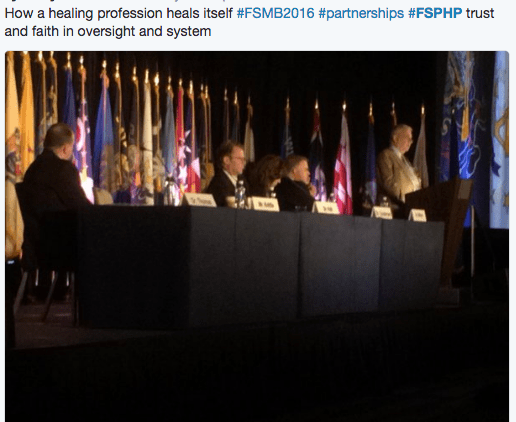
The photo above was taken at the 104th Annual Meeting of the Federation of State Medical Boards (FSMB) held in San Diego April 28-30 and tweeted last night in reference to the partnership between the FSMB and the Federation of State Physician Health Programs (FSPHP) with the caption:

“How a healing profession heals itself #FSMB2016 partnerships #FSPHP trust and faith in oversight and system.”

Within the the allotted 140 character twitter limit this succinct observation is nevertheless very revelatory.   Both systems and the oversight of systems demand accountability and answerability to outside and independent agencies.  Trust and Faith are not in the equation.  Why has this lesson not been learned?

Answerability requires the obligation to answer questions regarding decisions and actions. Accountability requires transparency, explanation and justification. What was done and why?  Standards, rules, regulations, codes, laws and other objective benchmarks need to be applied by outside actors.  This is critical. It is the very essence of oversight.

“Trust and faith in oversight and system” is both  oxymoronic and nonsensical. “Faith and trust” in oversight equates with an “absence” of oversight.  “Faith and trust” in systems inevitably results in “systems failure” and therein lies the problem.

Blind faith and deference to authority has led to a systems failure  in the regulation of the medical profession.   Physician health programs (PHP’s) have convinced state medical boards to give them complete deference.  Medical board’s in turn have convinced state attorney generals and law enforcement to give them complete deference.  This has led to a complete systems failure.  No investigatory or oversight body exists.  No one is minding the minders. It is a complete and utter free for all.

Making sound decisions about regulation calls for an understanding of the problem it is intended to solve. Legitimate policy must be based on recognized institutions and experts. Regulatory changes demand methodologically sound science and evidence-based facts arrived at through rigorous peer review and professional oversight. The science must be reliable and unbiased. Legitimate policy must be based on recognized institutions and experts. If the information regulatory agencies rely on to discipline doctors and protect the public is unreliable then serious consequences can occur.

The validity and reliability of opinions lie in their underlying methodology and evidence base. Reliance on the personal authority of any expert or group of experts is the fallacy of appeal to authority and a more apt and accurate twitter caption to the photo above would be Algernon Sidney’s 1683 statement that:

“Implicit Faith belongs to Fools, and Truth is comprehended by examining Principles”

images-25

The Federation of State Physician Health Programs and the Dead Doctors at Ridgeview-A Harbinger of the Medical Profession’s Current Suicide Epidemic

“There is enormous inertia—a tyranny of the status quo—in private and especially governmental arrangements. Only a crisis—actual or perceived—produces real change. When that crisis occurs, the actions that are taken depend on the ideas that are lying around. That, I believe, is our basic function: to develop alternatives to existing policies, to keep them alive and available until the politically impossible becomes politically inevitable.” –Milton Friedman

cropped-hanging_witch_01.jpg

“Gentlemen, it is a disagreeable custom to which one is too easily led by the harshness of the discussions, to assume evil intentions. It is necessary to be gracious as to intentions; one should believe them good, and apparently they are; but we do not have to be gracious at all to inconsistent logic or to absurd reasoning. Bad logicians have committed more involuntary crimes than bad men have done intentionally.”–Pierre S. du Pont (September 25, 1790)

 “It is easier to believe a lie one has heard a hundred times than a truth one has never heard before.” –Robert S. Lynd

Ridgeview Institute was a drug and alcohol treatment program for “impaired physicians” in Georgia created by G. Douglas Talbott, a former cardiologist who lost control of his drinking and recovered through the 12-steps of Alcoholics Anonymous.

Up until his death on October 18, 2014 at the age of 90, Talbott  owned and directed a number of treatment facilities for impaired professionals, most recently the Talbott Recovery Campus  in Atlanta, one of the preferred referrals for physicians ordered into evaluation and treatment by licensing boards today.

G. Douglas Talbott is a prototypical example of an “impaired physician movement” physician–in fact in many ways he may be considered the”godfather” of the current organization.  He helped organize and serve as past president of the American Society of Addiction Medicine (ASAM) and was a formative figure in the American Medical Association’s (AMA’s) Impaired Physician Program.

Screen-shot-2014-10-20-at-11.00.23-PM-1024x701

G. Douglas Talbott (center), with sons Mark (left) and Dave (right). (image: Ham Biggar)

The cost of a 28-day program for nonprofessionals at Ridgeview in 1987 was $10,000 while the cost was “higher for those going through impaired-health professionals program,” which lasted months rather than 28 days.1

In 1975 after creating the DeKalb County Impaired Physicians Committee for the Medical Association of Georgia, Talbott founded the Georgia Disabled Doctors Program for the assessment and treatment of physicians. Founded in part because “traditional one-month treatment programs are inadequate for disabled doctors,” and they required longer treatment to recover from addiction and substance abuse.   According to Talbott, rehabilitation programs that evaluate and treat the rest of the population for substance abuse issues are incapable of doing so in doctors as they are unlike any other of the inhabitants of our society. Physicians are unique. Unique because of their incredibly high denial”, and he includes this in what he calls the “Four MDs,” “M-Deity”, “Massive Denial” “Militant Defensiveness” and “More Drugs.”2   And these factors set doctors apart from the rest.

According to Talbott, “impaired doctors must first acknowledge their addiction and overcome their ‘terminal uniqueness’ before they can deal with a drug or alcohol problem.” “Terminal uniqueness “ is a phrase Talbott uses to describe doctors’ tendency to think they can heal themselves.

“M-Deity” refers to doctors “being trained to think they’re God;”3 blinded by an overblown sense of self-importance and thinking that they are invincible-an unfounded generalization considering the vast diversity of individuals that make up our profession.   Although this type of personality does exist in medicine,  it is a small minority -just one of many opinions with little probative value offered as factual expertise by the impaired physician movement and now sealed in stone.

Former Assistant Surgeon General (Ret) Admiral (Ret) John C. Duffy

Former Assistant Surgeon General (Ret) Admiral (Ret) John C. Duffy

This attitude, according to some critics, stems from the personal histories of the treatment staff, including Talbott, who are recovering alcoholics and addicts themselves. One such critic was Assistant Surgeon General under C. Everett Koop John C. Duffy who said that Ridgeview suffered from a “boot-camp mentality” toward physicians under their care and “assume every physician suffering from substance abuse is the same lying, stealing, cheating, manipulating individual they were when they had the illness. Certainly some physicians are manipulative, but it’s naïve to label all physicians with these problems.”1

001p3_xlg.preview

LeClair Bissell

American Society of Addiction Medicine (ASAM) President (1981-1983) LeClair Bissell was also highly critical of Talbott’s approach. Bissell, co-author of the first textbook of ethics for addiction professionals4 when asked if there was any justification to the claim that doctors are sicker than other people and more vulnerable to addiction replied:

“Well, based on my treatment experience, I think they are less sick and much easier to treat than many other groups. I think one reason for that is that in order to become a physician…one has to have jumped over a great many hurdles. One must pass the exams, survive the screening tests and the interviews, be able to organize oneself well enough to do examinations and so on, and be observed by a good many colleagues along the way. Therefore I think the more grossly psychotic, or sicker, are frequently screened out along the way. The ones we get in treatment are usually people who are less brain-damaged, are still quite capable of learning, are reasonably bright. Not only that, but they are quite well motivated in most cases to hang on to their licenses, the threat of the loss of which is frequently what puts them in treatment in the first place. So are they hard to treat? No! Are they easy patients? Yes! Are they more likely to be addicted than other groups? We don’t know.”5

“I’m not much for the bullying that goes along with some of these programs,” Bissell commented to the Atlanta Journal and Constitution in 1987.3

The constitution did a series of reports after five inpatients died by suicide during a four-year period at Ridgeview.6 In addition there were at least 20 more who had killed themselves over the preceding 12 years after leaving the treatment center.1

Bissell, the recipient of the 1997 Elizabeth Blackwell Award for outstanding contributions to the cause of women and medicine remarked: “When you’ve got them by the license, that’s pretty strong leverage. You shouldn’t have to pound on them so much. You could be asking for trouble.”3

According to Bissell: “There’s a lot of debate in the field over whether treatment imposed by threats is worthwhile…To a large degree a person has to seek the treatment on his own accord before it will work for him.”3

A jury awarded $1.3 million to the widow of one of the deceased physicians against Ridgeview,7 and other lawsuits initiated on behalf of suicides were settled out of court.6

The Constitution reported that doctors entered the program under threats of loss of licensure “even when they would prefer treatment that is cheaper and closer to home.” 8 The paper also noted that Ridgeview “enjoys unparalleled connections with many local and state medical societies that work with troubled doctors,” “licensing boards often seek recommendations from such groups in devising an approved treatment plan,” and those in charge are often “physicians who themselves have successfully completed Ridgeview’s program.”8

In 1997 William L. White interviewed Bissell whom he called “one of the pioneers in the treatment of impaired professionals.” The interview was not published until after her death in 2008 per her request.   Noting that her book Alcoholism in the Professions9 “remains one of the classics in the field”, White asked her when those in the field began to see physicians and other professionals as a special treatment population; to which she replied:

“When they started making money in alcoholism. As soon as insurance started covering treatment, suddenly you heard that residential treatment was necessary for almost everybody. And since alcoholic docs had tons of money compared to the rest of the public, they not only needed residential treatment, they needed residential treatment in a special treatment facility for many months as opposed to the shorter periods of time that other people needed.”10

Talbott claimed a “92.3 percent recovery rate according to information compiled from a five-year follow-up survey based on complete abstinence and other treatment.”11 A 1995 issue of The Federal Bulletin: The Journal of Medical Licensure and Discipline, published by the Federation of State Medical Boards, contains articles outlining impaired physician programs in 8 separate states. Although these articles were little more than descriptive puff-pieces written by the state PHP program directors and included no described study-design or methodology the Editor notes a success rate of about 90% in these programs and others like them 12 and concludes:

“cooperation and communication between the medical boards and the physician health programs must occur in an effort to protect the public while assisting impaired physicians in their recovery.” 12

No one bothered to examine the methodology to discern the validity of these claims and it is this acceptance of faith without objective assessment that has allowed the impaired physician movement through the ASAM and FSPH to advance their agenda;  confusing ideological opinions with professional knowledge.

“There is nothing special about a doctor’s alcoholism,” said Bissel

“These special facilities will tell you that they come up with really wonderful recovery rates. They do. And the reason they do is that any time you can grab a professional person by the license and compel him or her into treatment and force them to cooperate with that treatment and then monitor them for years, you’ll get good outcomes—in the high 80s or low 90s in recovery rates—no matter what else you do.”10
“The ones I think are really the best ones were not specialized. There were other well-known specialty clinics that claimed all the docs they treated got well, which is sheer rot. They harmed a great many people, keeping them for long, unnecessary treatments and seeing to it that they hit their financial bottom for sure: kids being yanked out of college, being forced to sell homes to pay for treatment, and otherwise being blackmailed on the grounds that your husband has a fatal disease. It’s ugly.”10

Stanton Peele’s “In the Belly of the American Society of Addiction Medicine Beast” describes the coercion, bullying, threats and indoctrination that are standard operating procedure in Talbott’s facilities.13  Uncooperative patients, “and this covers a range of sins of commission or omission including offering one’s opinion about one’s treatment,” are “threatened with expulsion and with not being certified-or advocated for with their Boards.”13

The cornerstone of treatment is 12-step spiritual recovery. All new patients are indoctrinated into A.A. and coerced to confess they are addicts or alcoholics. Failure to participate in A.A. and 12-step spirituality means expulsion from the program with the anticipated result being loss of one’s medical license.

In May 1999 Talbott stepped down as president of the American Society of Addiction Medicine (ASAM) as a jury awarded Dr. Leonard Masters a judgment of $1.3 million in actual damages and an undisclosed sum in punitive damages for fraud, malpractice, and the novel claim of false imprisonment.14

The fraud finding required a finding that errors in the diagnosis were intentional. Masters, who was accused of overprescribing narcotics to his patients was told by the director of the Florida PHP that he could either surrender his medical license until the allegations were disproved or submit to a four-day evaluation.

Masters agreed to the latter, thinking he would have an objective and fair evaluation. He was instead diagnosed as “alcohol dependent” and coerced into “treatment under threat of loss of his medical license. Staff would routinely threaten to report any doctor who questioned any aspect of their diagnosis or treatment to their state medical boards “as being an impaired physician, leaving necessary treatment against medical advice,”14  the equivalent of professional suicide.

Masters, however, was not an alcoholic.

According to his attorney, Eric. S. Block,  “No one ever accused him of having a problem with alcohol. Not his friends, not his wife, not his seven children, not his fellow doctors, not his employees, not his employers, No one.” 15

He was released 4 months later and forced to sign a five-year “continuing care” contract with the PHP, also under continued threat of his medical license.

Talbott faced no professional repercussions and no changes in their treatment philosophy or actions were made. They still haven’t.  They have simply tightened the noose and taken steps to remove accountability.

Up until his recent death, Talbott continued to present himself and ASAM as the most qualified advocates for the assessment and treatment of medical professionals for substance abuse and addiction.16

ASAM and like-minds still do.

In most states today any physician referred for an assessment for substance abuse will be mandated to do so in a facility just like Ridgeview.

There is no choice.   In mechanics and mentality, this same system of coercion, control, and indoctrination has metastasized to almost every state only more powerful and opaque in an unregulated gauntlet protected from public scrutiny, answerable and accountable to no one.  Laissez faire Machiavellian egocentricity unleashed.    For what they have done is taken the Ridgeview model and replicated it over time state by state and tightened the noose.  By subverting the established Physician Health Programs (PHPs) started by state medical societies and staffed by volunteer physicians they eliminated those not believing in the mentality of the groupthink.   They then mandated assessment and treatment of all doctors be done at a “PHP-approved” facility which means a facility identical to Ridgeview.  This was done  under the scaffold of the Federation of State Physician Health Programs (FSPHP).  They are now in charge of all things related to physician wellness in doctors.

  1. Durcanin C, King M. The suicides at Ridgeview Institute: Suicides mar success at Ridgeview with troubled professionals. Atlanta Journal and Constitution. December 18, 1987, 1987: A13.
  2. Gonzales L. When Doctors are Addicts: For physicians getting Drugs is easy. Getting help is not. Chicago Reader. July 28, 1988, 1988.
  3. King M, Durcanin C. The suicides at Ridgeview Institute: A Doctor’s treatment program may be too tough, some say. Atlanta Journal and Constitution. December 18, 1987a, 1987: A12.
  4. Bissell L, Royce JE. Ethics for Addiction Professionals. Center City, Minnesota: Hazelden; 1987.
  5. Addiction Scientists from the USA: LeClair Bissell. In: Edwards G, ed. Addiction: Evolution of a Specialist Field. 1 ed: Wiley, John & Sons, Incorporated; 2002:408.
  6. Durcanin C. The suicides at Ridgeview Institute: Staff members didn’t believe Michigan doctor was suicidal. Atlanta Journal and Constitution. December 18, 1987, 1987: A8.
  7. Ricks WS. Ridgeview Institute loses $1.3 million in suit over suicide. Atlanta Journal and Constitution. October 11, 1987, 1987: A1.
  8. King M, Durcanin C. The suicides at Ridgeview Institute: Many drug-using doctors driven to Ridgeview by fear of losing licenses. Atlanta Journal and Constitution. December 18, 1987b, 1987: A1.
  9. Bissell L, Haberman PW. Alcoholism in the Professions. Oxford University Press; 1984.
  10. White W. Reflections of an addiction treatment pioneer. An Interview with LeClair Bissell, MD (1928-2008), conducted January 22, 1997. Posted at http://www.williamwhitepapers.com. 2011.
  11. Williams c. Health care field chemical dependency threat cited. The Tuscaloosa News. January 16, 1988, 1988: 16.
  12. Schneidman B. The Philosophy of Rehabilitation for Impaired Physicians. The Federal Bulletin: The Journal of Medical Licensure and Discipline. 1995;82(3):125-127.
  13. Peele S. In the Belly of the American Society of Addiction Medicine Beast. The Stanton Peele Addiction Website (accessed March 28, 2014) http://web.archive.org/web/20080514153437/http://www.peele.net/debate/talbott.html.
  14. Ursery S. $1.3M verdict coaxes a deal for doctor’s coerced rehab. Fulton County Daily Report. May 12, 1999b 1999.
  15. Ursery S. I was wrongly held in alcohol center, doctor charges. Fulton Count y Daily Report. April 27, 1999a 1999.
  16. Parker J. George Talbott’s Abuse of Dr. Leon Masters MD ( http://medicalwhistleblowernetwork.jigsy.com/george-talbott-s-abuse-of-leon-masters ). Medical Whistelblower Advocacy Network.

The “PHP-Blueprint”–A Trojan Horse for Profit and Wider Social Control


Screen Shot 2016-02-19 at 2.47.54 AM.png“In the small world of drug testing, these four—Angarola, Bensinger, DuPont and Willette—are affectionately referred to as the Gang of Four. Dr. John Morgan explains, “They are the ones responsible for a good deal of drug testing’s success, and some of the fear that goes along with it. Remember these names. These men are among the most competent and knowledgeable about drug testing—scientifically and politically. They are well-informed: they have to be. Their livelihoods depend upon their credibility. Unfortunately their expertise represents the greatest threat to the civil liberties we seek to protect. Know your enemy.” 1

Steal This Urine Test – Fighting Drug Hysteria In America – By Abbie Hoffman with Jonathan Silvers. 1986


A recent Huffington Post article written by Maia Szalavitz, The Rehab Industry Needs to Clean Up Its Act Here’s How, describes the need to radically rethink and reform American addiction treatment.. The article quotes Dr. Mark Willenbring who states

“What we simply need is a nice bulldozer, so that we could level the entire industry and start from scratch.”

Agreed, but the chances of this are slim to none if the “PHP-blueprint” becomes the “New Paradigm.”  To prevent this from happening it is critical to disprove the claims, recognize the threat, and address the matter directly and collectively.   We need political and social activism in the same spirit as Abbie Hoffman whose words from three decades ago are aptly accurate.  His prescient warnings remain unknown, forgotten, or irrelevant to us today but their accuracy is crystal clear.  Few people know the enemy.

Screen Shot 2016-02-19 at 2.45.36 AMOn April 23, 2015 Dr. Robert Dupont, MD addressed the House Subcommittee on Oversight and Investigations Combatting the Opioid Abuse Epidemic and proposed widespread application of a “New Paradigm” for substance abuse management based on the nation’s physician health program (PHP) model of care.

This model is being brandished as “gold standard for addiction treatment” to the drug and alcohol rehabilitation community and general public. The medical literature contains numerous articles claiming the high success rate of these programs4,6,9,10 and they are being promoted to set the “ standard for recovery” as a replicable model to be used for treating “other addicted populations.”11  In his speech before the House Subcommittee Dupont states critics call the expansion “utopian” but many would beg to differ. “Dystopian” would be more like it.

There has been an increasing scrutiny of these programs recently  not yet covered by mainstream media.  The link between the marked increase in physician suicide (which is much more than the oft quoted medical school class of 400 per year is directly related to the FSPHP takeover of PHPs).  A recent Medscape article   describes the coercion, control, secrecy and conflicts-of-interest between the PHPs and their “PHP-approved” assessment and treatment centers.  The simple fact is the majority of doctors referred to these programs do not have a substance use disorder or psychiatric problem but are given one nevertheless. This removes their locus of control and puts the PHP in complete power.  Their fate is in the hands of the PHP.

The assessment and treatment facilities used by PHPs do not take insurance and require payment up front. It is all out of pocket because if insurance was involved the fraud would have been discovered long ago. The PHPs have no accountability.  There is no oversight by medical boards or medical societies and answerability and justification for actions are absent.  And as we are hearing the rehabilitation industry itself is unregulated.  So too are the junk-science lab tests used in PHP programs as these non-FDA lab tests and the corrupt labs that use them have no oversight form the FDA or any other agency able to hold them to account.  It is a free for all.

Those ensnared in this web do know the enemy but can do nothing about it.   I am hearing story after story of doctors seeking help from their medical societies, law enforcement,  the media and the ACLU only to be turned away.

Their stories are remarkably similar An increasing number of complaints involving PHPs and the preferred assessment and treatment centers and contracted commercial labs are being reported.   A recent lawsuit filed by a doctor against the North Carolina PHP and Medical Board reported on Medscape last week is a prototypical case. The scenario typically goes like this: An accusation is made against a doctor who has had no previous disciplinary history or concerns (alcohol on breath, throwing a surgical instrument) and referred to the state PHP; An assessment is recommended by the PHP at an out-of-state “PHP-approved” assessment and treatment center; the assessment confirms a psychiatric problem or substance use disorder and recommends typically three-months of inpatient treatment followed by a 5-year contract with the state PHP for monitoring. It is becoming clear that doctors who do not fit the diagnostic criteria for a disease are being diagnosed with a disease. There are also complaints of laboratory misconduct and forensic fraud.

It is important to recognize that State PHP programs require strict adherence to 12-step doctrine11 and limit assessments to not only ASAM facilities but to a specific constellation of 12-step assessment and treatment centers with medical directors who belong to a group called like-minded docs.  It is in fact a “rigged game.”

In “Six lessons from state physician health programs to promote long-term recovery” Dupont and Dr. Greg Skipper attribute this success rate to the following factors:12

(1) Zero tolerance for any use of alcohol and other drugs;

(2) Thorough evaluation and patient-focused care;

(3) Prolonged, frequent random testing for both alcohol and other drugs;

(4) Effective use of leverage;

(5) Defining and managing relapses; and

(6) The goal of lifelong recovery rooted in the 12-Step fellowships.12

In truth the sole basis for these claims is a single retrospective cohort study of 904 physicians monitored by 16 state PHPs initially published in the British Medical Journal in 2008.2 In 2009 the same study was published in the Journal of Substance Abuse Treatment3 and deemed the “PHP-blueprint. Methodologically flawed and rife with conflicts-of-interest this study is the sole foundation of all of the claims.   Of the 904 participants 102 were “lost to follow up” and of the remaining 802, 155 failed to complete the contract but despite the small numbers this study has been hashed and rehashed to brandish the claims of an 80% success rate physician including subsets of psychiatrists,4 surgeons5 and anesthesiologists6  In his address to the House Subcommittee Dupont, who is a co-author on every one of these papers, claims similar success in a subgroup of opioid addicted doctors.

None of this has been subjected to normal scientific peer-review procedures and represents a serious departure from the normal standards of scientific inquiry

The same forces that have created and sustained the current monopoly of 12-step oriented treatment in America have grand plans through links  forged though government, private agencies and the drug and alcohol testing assessment and treatment industry.

Through a combination of large-scale funding, rhetorical persuasion and moral panics they have gained both tremendous sway and power in the profession of medicine and the collateral damage they have caused is widespread and permanent.   They are poised to do the same to others using the  same methods and the procedural protections afforded to those currently being tested for substances of abuse in Federal Workplace Drug Testing programs will be removed without your consent or knowledge.   I recently heard from someone  that these groups are lobbying the Nuclear Regulatory Commission into accepting this model with some resistance.

As far-fetched as all of this sounds all one has to do is look. The greatest threat to the civil liberties we seek to protect is no longer a threat but a reality.

Examine the documents below and connect the dots to see the coming Trojan horse for systemic application of a flawed substance abuse management program with no evidence base.

Medicalization of 12-step  will be accomplished when “addiction medicine” becomes recognized as a bona-fide medical specialty by the American Board of Medical Specialties.(ABMS) which is slated to occur within the next couple years. At that point this group will deem 12-step ideology as best practice  “evidence-based” doctor recommended care. This will “sanctify” the  ideology as medical “standard of care” and can then be imposed on anyone with impunity and immunity.   Medicalization subverts the Establishment clause of the 1st Amendment and the propaganda supporting this has already begun.   See the 12-step “facilitation”  piece below giving the reasoning they will use.  This is not facilitation but coercion.

The ASAM White Paper on Drug Testing promotes random testing of everyone using the Non-FDA approved tests of unknown validity currently used in state physician health programs. This will be implemented through the healthcare system by removing procedural protections currently in place under federal guidelines. This is sure to be a boon for anyone battening and fattening off the Drug and Alcohol Testing Industry Association or rehab racket gravy train but a burden and pain for the rest of us.

The conflicts of interest are unfathomable.

Dupont and fellow “Gang of Four” member Peter Bensinger (DEA chief, 1976–1981) run a corporate drug-testing business. Their employee-assistance company, Bensinger, DuPont & Associates is the sixth largest in the nation and managing drug testing for some 10 million Americans including Kraft Foods,  the FAA and even the Justice Department.  They sell drug-testing management programs.  The “New Paradigm” is simply a ruse to get non-FDA approved testing into the wider workplace via loopholes and workarounds.  His ties to the drug and alcohol testing and treatment industry are easy to find.  Drug testing is a multi-billion-dollar-a-year industry. DATIA [Drug & Alcohol Testing Industry Association] represents more than 1,200 companies and employs a DC-based lobbying firm, Washington Policy.  Many of the non-FDA approved tests they are using in the “PHP-blueprint” they in fact introduced to the market themselves with no evidence base. It is reprehensible.

And the people who will suffer most in the “New Paradigm” will be those who are already marginal in American society. That’s a given. I have heard from doctors who are gay or belong to a minority group who claim they were referred to a PHP due to discrimination but had no recourse.

Medicalization of behavior  removes due process as the victimized are simply put in a labeled group and via actuarial logic that safely that removes the underlying prejudice from view by categorization of risk.   Discrimination is justified and rationalized.   So read the documents below and connect the dots. Then do something about it.  Say something. Write something.  Do something.  The Emperor has no clothes and this needs to be exposed. Either defend what you read below or protest this New Inquisition.  We need revolt and Revolution.  The Federation Of State Physician Health Programs (FSPHP) regime is simply another front-group designed to force the medical profession in line for the profits of the rehab racket.  The FSPHP is the enemy and State PHPs need to be reformed and repaired  with transparency and accountability. And to accomplish this the entire long running mess needs  to be bulldozed  and rebuilt from scratch.

  1. Robert Dupont’s 2012 Keynote speech before the Drug and Alcohol Testing Industry Association
  2. Robert Dupont’s address before the House Subcommittee on Oversight and Investigation Combatting the Opioid Epidemic
  3. 2014 Journal of the American Medical Association (JAMA) article entitled “Addiction Medicine: The Birth of a New Discipline
  4. The ASAM White Paper on Drug Testing
  5. Why good addiction centers connect clients to AA or NA

Screen Shot 2016-02-19 at 2.47.37 AM.png

  1. Hoffman A, Silvers J. Steal This Urine Test: Fighting Drug Hysteria in America. 1 ed: Penguin Books.
  2. DuPont RL, McLellan AT, Carr G, Gendel M, Skipper GE. How are addicted physicians treated? A national survey of Physician Health Programs. Journal of substance abuse treatment. Jul 2009;37(1):1-7.
  3. White WL, Dupont RL, Skipper GE. Physicians health programs: What counselors can learn from these remarkable programs. Counselor. 2007;8(2):42-47.
  4. Skipper GE, Campbell MD, Dupont RL. Anesthesiologists with substance use disorders: a 5-year outcome study from 16 state physician health programs. Anesthesia and analgesia. Sep 2009;109(3):891-896.
  5. Yellowlees PM, Campbell MD, Rose JS, et al. Psychiatrists With Substance Use Disorders: Positive Treatment Outcomes From Physician Health Programs. Psychiatric services. Oct 1 2014.
  6. DuPont RL, McLellan AT, White WL, Merlo LJ, Gold MS. Setting the standard for recovery: Physicians’ Health Programs. Journal of Medical Regulation. Mar 2010;95(4):10-25.
  7. Dupont RL, Skipper GE. Six lessons from state physician health programs to promote long-term recovery. Journal of psychoactive drugs. Jan-Mar 2012;44(1):72-78.
  8. McLellan AT, Skipper GS, Campbell M, DuPont RL. Five year outcomes in a cohort study of physicians treated for substance use disorders in the United States. Bmj. 2008;337:a2038.
  9. DuPont RL, McLellan AT, White WL, Merlo LJ, Gold MS. Setting the standard for recovery: Physicians’ Health Programs. Journal of substance abuse treatment. Mar 2009;36(2):159-171.
  10. Buhl A, Oreskovich MR, Meredith CW, Campbell MD, Dupont RL. Prognosis for the recovery of surgeons from chemical dependency: a 5-year outcome study. Archives of surgery. Nov 2011;146(11):1286-1291.


Please donate here:  https://www.gofundme.com/PHPReform

There is a very urgent need for a “counterpower” to state physician health programs (PHPs). On average five or six medical students, doctors or residents contact me each week and I want to continue to help them and work toward advocacy and watchdog groups.  Unfortunately I am losing ground quickly.  We have made tremendous advances in the last year and I am working in many different venues to expose the problems written about here.  Those involved in this corrupt system are hoping that I will run out of resources and simply go away and have done everything they can to accomplish this. Without your help this will occur and it will unfortunately occur soon.


MD Sues NC Medical Board/Physician Health Program-A Prototypical Case

A prototypical case involving PHP and Medical Board. PHPs’ integrity varies state by state depending on:

1. How entrenched the FSPHP is in the state PHP

2. Whether that state’s Medical Board has become a partner in PHP’s crimes.

It is very curious that states who have had a Medical Director who has also been President of the Federation of State Physician Health Programs seem to be the worst of the violators.

Based on over 200 responses I have received on my PHP survey [PHP Survey], North Carolina, Florida, Massachusetts and Washington State are physician career destroyers whereas West Virginia seems relatively unscathed (although I have learned that the FSPHP has been attempting to impose its “PHP-Bluprint” on the Board with some resistance.

What you see here is a classic case. Physicians and med schools urgently need to become aware and take a stance of resistance to these abuses. Wouldn’t you find this distressing – that only over the past [3 years], I have heard this same story from medical students to doctors in their 80s – through detailed and lengthy conversations – over and over again.

The identical same patterns of PHPs and medical boards acting in collusion emerge. As much as I don’t want to believe it, PHPs, acting in tight collusion with their sibling agencies, the medical licensing boards, have expanded their power and uniformly deprived physicians (and med students!) of their due process rights, against all understandings of appropriate powers with which they were originally vested.

No accountability exists as they have removed due process and freedom of choice.  The PHP controls every aspect of the assessment and monitoring process with absolutely no oversight.  As the North Carolina state PHP audit revealed, there is no oversight from the medical society or medical board.  In addition the assessment and treatment centers and drug-testing labs have no meaningful regulation.  No oversight or regulation of the multiple non-FDA approved laboratory developed tests (LDTs) of unknown validity exist.

As a power accountable to no one, PHPs have become predators who not only stalk and victimize doctors but harm the very public they were supposed to protect!

These PHPs, along with the cozy relationships with medical licensing boards, need to be confronted, as Dr.Manion has done, and dissembled and then rebuilt into accountable organizations state by state.

It seems apparent from my research that the FSPHP is not only an illegitimate but an irrational and opportunistic authority exclusively representing the interests of the medical board and the drug and alcohol testing, assessment and treatment industry.

PHPs are being promoted as a “gold standard”  and replicable model by the American Society of Addiction Medicine (ASASM), a “self designated practice specialty” not recognized by ABMS. The ASAM White Paper on Drug Testing  is recommending widespread application of the PHP model in other populations.  The FSPHP arose from ASAM state chapters and their intimate relationship with the Drug and Alcohol Testing Industry Association (DATIA) is as tight as thieves.

In addition the medical directors of every one of the “PHP-approved” assessment and treatment programs are not only ASAM doctor but belong to a self-described 12-step group called “like-minded docs.”

Like a treatment industry of the Taliban, they play on the dangers of alcohol use. To some of us, they are little more than prohibitionist profiteers and dimwitted “addiction addicts” who have “recovered (even in the sense of the word that would suggest that they have “recovered” [retrieved and had destroyed] and “re-covered” their felonious past) and are now in firm control of the gates to the rehab farm. As evidenced from previous articles, narcissistic and psychopathic personality disorders abound in this PHP movement. Physicians need to wake up and confront and dismantle this Frankenstein the state PHPs have become. PHPs urgently need accountability and answerability, not more immunity and secrecy. Here we are in a time of great physician scarcity and PHPs and Boards are eliminating physicians with utterly no accountability.

Link to complaint obtained via Pacer:  Manion v NC Medical Board and PHP

2016-02-09 DOC 2 Corrected Complaint and Demand for Jury Trial

Screen Shot 2016-02-16 at 7.47.54 PM

A lawsuit filed by a physician against the North Carolina Physicians Health Program (NCPHP) claims loss of significant and potential earnings as well as public humiliation, irreparable harm to his professional reputation, and severe emotional distress.

Kernan Manion, MD, a practicing psychiatrist for some 30 years, is suing the NCPHP as well as the North Carolina Medical Board (NCMB), the North Carolina Medical Society, several past and present medical board officials, and current NCPHP Chief Executive Officer Warren Pendergast, MD.
The suit alleges “arbitrary and unlawful application of summary suspension procedures” resulting from “intentionally and/or negligently abusive practices” and other common law, statutory, and constitutional violations.

In court documents, Dr Manion, who has never before been disciplined by any licensing entity in any state and has never been found liable for malpractice, said he was forced to inactivate his medical license in February 2013 after “wrongful and flawed” diagnoses conducted by the NCPHP and its agents.

He describes the experience with the PHP as “a Kafkaesque nightmare.”

According to events outlined in a statement of facts, Dr Manion, who maintains he has never suffered from mental or emotional health problems or from alcohol, drug, or any other form of substance abuse, was dismissed in September 2009 from his position as a civilian contracted psychiatrist with the Deployment Health Center at Naval Hospital Camp Lejeune.

He had raised concerns, which he described as “whistleblowing,” regarding what he felt was deficient care of active duty service members with posttraumatic stress disorder.
Dr Manion brought claims against his employers, alleging retaliatory discharge, after which he says he was harassed and followed, prompting him to contact local police.

Shortly thereafter, Dr Manion said he was notified by the NCMB that someone at the police department had expressed “concern” about his mental health and that the NCMB had opened an investigation.

Malice?

On his own initiative, Dr Manion obtained a comprehensive psychological evaluation, which, he said, concluded that he did not have a delusional disorder and that recommended that he be permitted to retain his unrestricted medical license. Despite this, says the statement, the NCMB ordered Dr Manion to undergo an assessment by the NCPHP, which he did.

That assessment, carried out by Dr Pendergast, concluded “wrongly and negligently or intentionally and with malice” that Dr Manion was mentally ill and in doing so, “relied upon only the unofficial information provided by the police office, reviewed no clinical records, and failed to interview any collateral sources as is required in such evaluations.”

Dr Pendergast apparently then recommended that Dr Manion complete a comprehensive psychological evaluation at an out-of-state mental facility. Such facilities, says the court document, often charge thousands of dollars and require that physicians incur costs for travel and spend multiple days, if not months, away from their medical practice.

According to the court document, PHPs have been criticized for “rampant fraud and abuse” and that the NCPHP and NCMB are “riddled with conflicts of interest.”

An audit carried out by the North Carolina state auditor, and reported by Medscape Medical News, found no abuse by the NCPHP but did state that there were “multiple conflicts of interest inherent in the relationships between NCPHP and its preferred assessment and treatment centers and an alarming potential for abuse and violations of the process rights by NCPHP.”

The filed court document also states that there was “no reasonable basis” for the NCMB and the NCPHP to conclude that Dr Manion was impaired and unfit to practice medicine, “conclusions that forced him into a Kafkaesque nightmare that ultimately concluded in the loss of his license and his livelihood.”

Dr Manion said he proposed an alternative in-state evaluation, but in January 2012, “based wholly” on its “intentionally flawed diagnosis and recommendation,” the NCPHP again voted to order Dr Manion to undergo evaluation and treatment at an out-of-state facility.

According to the court files, the NCMB brought formal charges against Dr Manion that alleging he failed to cooperate with the NCPHP. Dr Manion claims he submitted to yet another evaluation to assess his mental health status against his will.

This evaluation concluded that he was delusional “based chiefly on information…received from Dr Pendergast about Dr Manion and not based on medical evidence or corroborative fact checking,” according to the statement.

“Frightened and Threatened”

Told to inactivate his license and immediately resign from his position as medical director at a clinic or have felony charges brought against him for practicing without a license, Dr Manion said he was “frightened and threatened” into inactivating his license on February 9, 2013.

In trying to reactivate his license in December 2014, Dr Manion agreed to submit to another evaluation, which concluded that he “is not delusional, that he is fit to practice medicine, and that the prior evaluations conducted by or at the direction of NCPHP…are flawed and incorrect,” says the statement. It adds that the assessor believed that Dr Manion’s “display of anxiety, distress and intensity is proportionate to the circumstances which have occurred.”

Despite this, Dr Manion said the NCMB wanted him to submit to another NCPHP evaluation in order to activate his license, but he objected to undergoing another assessment.

As a result of these events, Dr Manion claims he has suffered, among other things, loss of significant earnings and potential earnings and the burden and cost of defense against unwarranted action, as well as “public humiliation, irreparable harm to professional reputation, and severe emotional distress.” The suit also claims one of his former patients committed suicide because of interruption of highly specialized care.

The broadly applied policies and practices of the NCPHP “draw unimpaired licensees into a Kafkaesque ‘damned if you do, damned if you don’t’ catch-22 scenario that almost always ends in severe and underserved harm,” says the statement.

The document estimates that Dr Manion has suffered and continues to suffer damages “in excess of $75,000.”

The suit was filed February 8 in the US District Court, Eastern District of North Carolina, Western Division.

“Unprofessional Conduct”

Medscape Medical News contacted the NCMB for comment, and spokesperson Jean Fisher Brinkley provided the following statement: “NCMB is aware of Dr Manion’s lawsuit but cannot discuss it as the matter is pending litigation.”

However, Brinkley provided a link to public documents on the NCMB website related to the disciplinary case at issue in the lawsuit, which includes “a detailed account of the Board’s concerns regarding Dr Manion.”

According to the October 10, 2012, Notice of Charges and Allegations, the NCMB outlined two charges against Dr Manion: “failure to respond reasonably to a Board inquiry” and “unprofessional conduct.”

On the first charge, the NCMB claims that in failing to undergo an assessment at Acumen Assessments Inc, which is the recommended out-of-state treatment facility, as required by a Board order issued February 27, 2012, Dr Manion’s conduct “constitutes a failure to respond, within a reasonable period of time and in a reasonable manner,” to inquiries from the Board concerning any matter affecting the license to practice medicine, within the meaning of the state’s general statutes.

On the second charge, the NCMB states that Dr Manion’s failure to undergo an assessment at Acumen, as required by the Board, “constitutes unprofessional conduct, including, but not limited to, departure from, or the failure to conform to, the ethics of the medical profession and is the commission of an act contrary to honesty, justice or good morals” within the meaning of the state’s general statutes.

According to the NCMB, for both charges, there are grounds under the general statutes for the Board “to annul, suspend, revoke, condition or limit Dr Manion’s license” to practice medicine.

In addition, the legal notice describes concerns about Dr Manion from a single police officer who reported them to the NCMB in 2010.

According to the NCMB, the police officer was subsequently interviewed by a Board investigator. According to an account of this interview, the officer alleged that Dr Manion spoke to the Wilmington Police Department chief of police in November 2010 and expressed concerns that he was being followed and that a tracking or listening device had been placed on his car.

According to the NCMB report, the officer outlined other instances that were cause for further concern.

Medscape Medical News contacted the NCPHP. However, Dr Pendergast declined to comment, noting that the “NCPHP cannot comment on this matter as it is pending litigation.”


Robert Dupont claims PHPs result in a “lifetime of well-being” LMAO

Screen Shot 2016-02-14 at 11.15.40 PM

The Medscape article  Physician Health Programs- More Harm Than Good? by Pauline Anderson shed some light on coercive, controlling  secretive lair of Physician Health Programs.    Coercive v. supportive is the question Alissa Katz presents in todays Emergency Medicine News.  Supporting coercion, John Knight and J. Wesley Boyd claim that any doctor caught in the maw of their state PHP must abide by whatever the PHP requests in order to continue practicing medicine. Susan Haney concurs who notes the unwary self-referrer who unwarily steps into the lions den.

Screen Shot 2016-02-14 at 11.34.00 PM


 Former White House Drug Czar (1973-1977) Robert Dupont, M.D. disagrees claiming the programs are worth the price of a “lifetime of well-being.”

You don’t say?     Robert Dupont’s ties to the Drug and Alcohol Testing Association (DATIA) are thick  and the designs of the former National Institute on Drug Abuse Director are spelled out in the ASAM White Paper on Drug Testing as well as his keynote speech before DATIA proposing expansion of this paradigm to other populations including workplace, healthcare, and schools.  He profits from both drug tests and employee assistance program management.  The “PHP-blueprint” is simply Straight, inc. for doctors and the same propaganda, fabricated studies, 12-step indoctrination, coercion, control and abuse remain unfettered and just as vile.

Screen Shot 2014-02-07 at 8.38.55 AM

Dupont wants to swindle the PHP system into other EAPs such as as DOT proclaiming the “need to reach more of the 1.5 million Americans who annually enter substance abuse treatment, which now is all too often a revolving door.”1 They conclude:

This model of care management for substance use disorders has been pioneered by a small and innovative group of the nation’s physicians in their determination to help other physicians save their careers and families while also protecting their patients from the harmful consequences of continued substance abuse. In fulfilling the professional admonition “physician: first heal thyself,” these physicians have created a model with wide applicability and great promise.1image1

“Based on abundant evidence, a “new paradigm” for substance abuse treatment has evolved that is the exact opposite of harm reduction. This paradigm enforces a standard of zero tolerance for alcohol and drug use that is enforced by monitoring with frequent random drug and alcohol tests. Detection of any drug or alcohol use is met with swift, certain, but not draconian, consequences.”


Straight, Inc. –Torture as treatment


In 1981 Dupont made similar claims about Straight, Inc., a non-profit teenage rehabilitation center.   The predecessor of Straight, Inc., the Seed, was started in 1970 in Florida with a start up grant of $1 million dollars from the federal governments National Institute on Drug Abuse (NIDA). Director of NIDA, Robert L. DuPont, Jr. had approved the grant.on the antidrug cult Synanon founded in 1958. Deemed a the “family oriented treatment program,” Dupont encouraged organization and expansion. Targeting the children of wealthy white families they exploited parents fears for profit. Signs for hidden drug use such as use of Visine, altered sleep patterns, and changes in clothing style were used as indications for referral. Any child who arrived would be considered an addict in need of their services. Coercion, confrontation, command and control as the guiding principles,. Submit or face the consequences. .We know what’s right. The idea was to strip the child of all self-esteem and then build him back up again in the straight image. Abused dehumanized, delegitimized, and stigmatized-the imposition of guilt, shame, and helplessness for ego deflation and murder of the psyche to facilitate canned and condensed 12-step as a preparatory step on the path of lifelong spiritual recovery.

Screen Shot 2014-12-02 at 12.46.18 AM

Children were coaxed or terrorized into signing confessions, berated, and told they were in “denial. Inaccurate and false diagnoses were given to wield greater control. Reports and witness accounts now indicate that many of the kids did not even have drug problems but by creating a “moral panic” about teenage drug use they exploited parents fears for profit. Straight, Inc. became the biggest juvenile rehabilitation center in the world. Health officials in Boston cited Straight for treating a 12 -year old girl for drug addiction when her records revealed all she did was sniff a magic marker! Pathologizing normality.

Screen Shot 2014-02-22 at 1.39.26 AM

Methodologically flawed research , deceptive marketing, and propaganda were all used to support the continuation of the program. Designed to be hidden from public view. Straight, Inc. had no regulation or oversight. These programs of torture and abuse resulted in many suicides, suicide attempts, post-traumatic stress disorder and other psychological   and grave psychological trauma.There is a FB page dedicated in memory to all of those who died.

Of course Dupont brandishes the “PHP-blueprint” claiming  remarkable success in the same old saw we have heard ad nauseam.  This paper is paraded around as ifs the holy grail but it is methodologically bottom of the barrel and the conflicts-of-interest are obscene.  This retrospective five year cohort study published in 2008 is their flagship and shining star and they claim an 80% success rate in treating doctors which sounds pretty good until you consider 80% of the doctors therein do not have a substance use disorder.

The 2008 Physicians Health Program study inexplicably excluded resident physicians because they “were both younger than the average practicing physician and therefore at higher risk of substance abuse.”  Other than cherry picking to favor success what is the logic behind that.

Screen Shot 2014-11-25 at 7.09.15 PM

More importantly, however, is the 24 that “left care with no apparent referral” and the 48 that “involuntarily stopped or had their licenses revoked.”  It is my understanding they chose these endpoints due to the large number of doctors who died by suicide so instead of identifying “suicide” they chose what they did to them as an endpoint.  “left care with no apparent referral” sounds better then “left care and shot himself in the head.”

Dupont is bragging and flagging  the “blueprint” as a successful model applicable to other populations and plans to bring it to you.  Why?  To sell long-term inpatient treatment and frequent drug testing.   Dupont once recommended everyone under 40 be tested when he was 41.  This man wants to test everyone.  If he could he would test infants–hell he’d test fetuses if he could.  One thing is for certain though–if the blinkered masses don’t wake up from their apathetic slumber they will not too far from now be waking up to pee in in a cup and won’t be able to do a damn thing about it.Screen Shot 2016-02-15 at 12.09.01 AM


IMG_8894


Emergency Medicine News:
doi: 10.1097/01.EEM.0000480794.97823.49
News

News: Physician Health Programs: Coercive or Supportive?

Katz, Alissa

You wouldn’t think physician health programs — designed to help doctors recover from substance abuse — would be such a contentious topic. But more than a few physicians complain that participation is “coercive” if a physician wants to retain his license.

Figure. No caption a...

Image Tools

The programs are run on a state level, and have evolved into for-profit entities, according to physicians who have been through one. You can find one in all 48 states and Washington, D.C., charged with preventing “substance abuse problems among physicians and to detect, intervene, refer to treatment, and continuously monitor recovering physicians with substance use disorders.” (J Subst Abuse Treat 2009;37[1]:1.)

Physician health programs (PHPs) are funded a variety of ways depending on location, including state licensing board grants, fees charged to participants, and contributions from state medical associations, according to reports. When a physician agrees to cooperate with the PHP and adhere to any and all recommendations, it decreases the probability he will be subject to disciplinary action and increases the likelihood he will be able to remain in practice, PHP proponents say. But not everyone agrees.

“Participation is coercive, and once a PHP recommends monitoring, physicians have little choice but to cooperate if they have any intention of ever practicing medicine again,” J. Wesley Boyd, MD, PhD, and John R. Knight, MD, former PHP associate directors in Massachusetts, said in an editorial in the Journal of Addiction Medicine. (2012;6[4]:243.)

Physician health programs report results of compliance, including drug test results to licensing boards, credentialing agencies, and employers whether the physician is sober, compliant with his treatment, and capable of safely practicing medicine.

“Programs are generally structured to encourage professionals to get help early before the onset of problems in the workplace, but the consequences depend on the situation and the state policies,” said Warren Pendergast, MD, a psychiatrist and the CEO of the North Carolina PHP (NCPHP)

Compliance Mentality

North Carolina’s PHP was audited in 2013-2014. “There were a number of protections they wanted us to institute. There was a conflict of interest issue raised about our every-other-year retreat having a small amount of contribution from assessment and treatment centers, and we stopped that in 2012. Our policy was similar to many medical meetings sponsored by vendors,” said Dr. Pendergast.

Drs. Boyd and Knight said in their editorial the programs have a compliance mentality that reports physicians to their medical board for possible disciplinary action if they don’t comply with the program’s recommendations, depriving the physicians of having a say in their own treatment.

So why are physicians opting into these programs? Colleagues can recommend them for an evaluation and they have to comply, and others who self-refer just don’t know any better, said Susan Haney, MD, an emergency physician in Oregon, who went through treatment assigned by her state’s PHP.

“That’s the problem. You assume, as I assumed, that the medical board is staffed with caring and competent physicians, and that the health program is there to help. So you go to them naïvely asking for help or your colleagues refer you to them thinking you’ll get help. I guess some people find help. But a lot of physicians are exploited by the system,” she said.

Robert DuPont, MD, the president of the Institute for Behavior and Health and a supporter of physician health programs, said such criticisms aren’t looking at what the programs have achieved. “Outcomes are very positive, with only 22 percent of physicians testing positive at any time during the five years and 71 percent still licensed and employed at the five-year point,” according to a study Dr. DuPont co-authored. (J Subst Abuse Treat 2009;37[1]:1.)

Abstinence rates among substance-abusing physicians who engage with PHPs are in the 75 to 80 percent range, which is far higher than almost any other form of substance abuse treatment. This can be attributed to PHPs’ demographic and higher socioeconomic status, compared with those in other substance abuse programs, and the risk-to-reward ratio is often higher for PHP participants. (BMJ2008;337:a2038.)

“Programs have no leverage. They have no punishment; they have no consequences. The consequences are all kneaded out by other organizations, by the medical boards or the hospitals. I think all these critics have gotten it mixed up. The physicians who are coming to the PHPs have big problems; they’re under a lot of pressure, not from the PHP but from somewhere else.”

Back to Top | Article Outline

Costly Treatment

Dr. DuPont’s study said PHPs don’t provide formal addiction treatment, either, but instead function as long-term case managers and monitors for participants. Evaluations through PHP-recommended treatment centers aren’t usually covered by insurance, for example, and can cost as much as $4,500 for a 96-hour evaluation, if not more, and can go as high as $39,000 for a typical three-month length of stay.

“If treatment is priced so high that it is out of the reach of potential physician-patients, it does not serve the purpose for which it was created and thus represents an administrative and management failure on the part of the PHP,” Drs. Boyd and Knight wrote. (J Addict Med 2012;6[4]:243.)

Because many centers that specialize in evaluating health care professionals also provide costly treatment, Drs. Boyd and Knight said they are left wondering whether financial incentives play a role in the recommendation. Reports argue that physicians charge a lot for their time and services, so they are financially able to pay more than a non-physician would for the same treatment. “In our experience, it is far more common for physicians to simply stay at the same facility for treatment rather than packing up and moving elsewhere,” they wrote.

Evaluation and treatment centers support PHPs financially, too, adding to a potential conflict of interest between the two. Dr. DuPont said he thinks the price to pay for assessments and treatment, however, is small compared with the perspective of a lifetime of well-being. “My experience is that PHPs are certainly willing to work with physicians on cost issues. I think it’s not realistic to think the people in the programs are not going to need treatment. To me it goes without saying the treatment is part of the package,” he said.

North Carolina has a scholarship program administered through the state’s Medical Society Foundation, and the several-thousand-dollar assessments are part of the reason the program screens. “We don’t send everybody for assessment,” said Dr. Pendergast.

Share this article on Twitter and Facebook.

Access the links in EMN by reading this on our website or in our free iPad app, both available at www.EM-News.com.

Comments? Write to us at emn@lww.com.

Copyright © 2016 Wolters Kluwer Health, Inc. All rights reserved.

Hopelessness, Helplessness and Defeat: Organizational Justice and Physician Suicide

They can be a terror to your mind and show you how to hold your tongue
They got mystery written all over their forehead
They kill babies in the crib and say only the good die young
They don’t believe in mercy
Judgement on them is something that you’ll never see
They can exalt you up or bring you down main route
Turn you into anything that they want you to be–Bob Dylan, Foot of Pride


Screen Shot 2015-04-30 at 2.55.32 AM

Although no reliable statistics yet exist, anecdotal reports suggest a marked rise in physician suicide in recent years. From the reports I am receiving it is a lot more than the oft cited “medical school class” of 400 per year.

This necessitates an evaluation of predisposing risk factors such as substance abuse and depression, but also requires a critical examination of what external forces may be involved in the descent from suicidal ideation to suicidal planning to completed suicide.  What are the cumulative situational and psychosocial factors in physicians that make suicide a potential option and what acute events precipitate the final act?

Depression and Substance Abuse no Different from General Population

The prevalence of depression in physicians is close to that of the general population 1,2 and, if one looks critically at the evidence based literature, substance abuse in medical professionals approximates that of the general population.  Controlled studies using DSM diagnostic criteria indicate that physicians have the same rates (8-14%) of substance abuse and dependence as the general population,3 and slightly lower rates compared to other occupations.4,5 Epidemiological surveys reveal the same. Hughes, et al.6 reported a lifetime prevalence of drug or alcohol abuse or dependence in physicians of 7.9%, markedly less than the 14.6% prevalence reported in the general population by Kessler.7

Job Stress and Untreated Mental Illness Risk Factors

Job stress coupled with inadequate treatment for mental illness may be factors contributing to physician suicide according to one recent study. Using data from the National Violent Death Reporting System, Gold, Sen, & Schwenk, 2013 8 compared 203 physicians who had committed suicide to more than 31,000 non-physicians and found that having a known mental health disorder or a job problem that contributed to the suicide significantly predicted being a physician. Physicians were 3.12 times more likely to have a job problem as a contributing factor. In addition, toxicology testing showed low rates of medication treatment.  The authors concluded that inadequate treatment and increased problems related to job stress are potentially modifiable risk factors to reduce suicidal death among physicians. They also warned that the database used likely underestimated physician suicides because of “underreporting and even deliberate miscoding because of the stigma attached.”8

Few studies have evaluated the psychosocial stressors surrounding physician suicide but there is no reason to believe they are any different from the rest of the population. Although the triggering life events and specific stressors may vary outside, the inner psyche and undercurrent of thoughts and feelings should remains the same.   Perhaps the same drivers of suicide identified in other populations are contributing to physician suicide.

Screen Shot 2014-04-04 at 1.05.46 AM

Perceived Helplessness, Hopelessness, Bullying and Defeat

Perceived helplessness is significantly associated with suicide as is9 Hopelessness10,11 Bullying is known to be a predominant trigger for adolescent suicide12-14 One study found that adolescents in custody who were bullied were 9.22 times more likely to attempt suicide than those were not bullied.15

Heightened perceptions of defeat and entrapment are known to be powerful contributors to suicide.16,17 The “Cry of Pain” model 18,19 specifies that people are particularly prone to suicide when life experiences are interpreted as signaling defeat which is defined as a sense of “failed struggle” or loss of social position and resources.. The person is unable to identify an escape from or resolution to a defeating situation, a sense of entrapment proliferates with the perception of no way out, and this provides the central impetus for ending ones life. There is a helplessness and hopelessness that precipitates the descent from ideation, to planning, and then to finality.

Organizational Justice Important Protective Factor

In a study on Italian and Swedish female physicians, degrading experiences and harassment at work were found to be the most powerful independent variables contributing to suicidal thoughts.20 Degrading work experiences harassment, and lack of control over working conditions were found to be associated with suicidal thoughts among Italian and Swedish male university physicians.21

Evidence exists for the role of rescue factors (i.e. social support) as buffers against suicide in the face of varying degrees of life stress.22,23 The study of female physicians revealed meetings to discuss stressful work experiences as a potential protective factor, 20 and support at work when difficulties arose appeared to be a protective factor for the male physicians.21   In line with this, studies of Finnish physicians found that control over one’s work and organizational justice were the most important determinants of work-related wellbeing.24,25 Organizational justice has been identified as a psychosocial predictor of health and wellbeing26 27 Low organizational justice has been identified as a notable risk factor for psychological distress and depression.28,29

images-4

Historical Precedent-the Suicides at Ridgeview

Could these factors be playing a role in physician suicide?   They evidently did at the Ridgeview Institute, a drug and alcohol treatment program for impaired physicians in Metropolitan Atlanta created by G. Douglas Talbott. Talbott helped organize and served as past president of the American Society of Addiction Medicine (ASAM) and was a formative figure in the American Medical Association’s (AMA’s) Impaired Physician Program. He has owned and directed a number of treatment facilities for impaired professionals, most recently the Talbott Recovery Campus in Atlanta, one of the preferred referrals for physicians ordered into evaluation and treatment by licensing boards.

After creating the DeKalb County Impaired Physicians Committee for the Medical Association of Georgia, Talbott founded the Georgia Disabled Doctors Program in 1975 in part because “traditional one-month treatment programs are inadequate for disabled doctors.” According to Talbott, rehabilitation programs that evaluate and treat the rest of the population for substance abuse issues are incapable of doing so in doctors as they are unlike others. He bases this uniqueness on “incredibly high denial”, and what he calls the “four MDs,” “M-Deity”, “Massive Denial” “Militant Defensiveness”, and “More Drugs.”30

Contingency Management = Extortion Using Medical License

According to Talbott, “impaired doctors must first acknowledge their addiction and overcome their ‘terminal uniqueness’ before they can deal with a drug or alcohol problem.” “Terminal uniqueness “ is a phrase Talbott uses to describe doctors’ tendency to think they can heal themselves. “M-Deity” refers to doctors “being trained to think they’re God,”31 an unfounded generalization considering the vast diversity of individuals that make up our profession. This attitude, according to some critics, stems from the personal histories of the treatment staff, including Talbott, who are recovering alcoholics and addicts themselves. One such critic was Assistant Surgeon General under C. Everett Koop John C. Duffy who said that Ridgeview suffered from a “boot-camp mentality” toward physicians under their care and “assume every physician suffering from substance abuse is the same lying, stealing, cheating, manipulating individual they were when they had the illness. Certainly some physicians are manipulative, but it’s naïve to label all physicians with these problems.”32

American Society of Addiction Medicine (ASAM) President (1981-1983) LeClair Bissell was also highly critical of Talbott’s approach. Bissell, co-author of the first textbook of ethics for addiction professionals33 when asked if there was any justification to the claim that doctors are sicker than other people and more vulnerable to addiction replied:

“Well, based on my treatment experience, I think they are less sick and much easier to treat than many other groups. I think one reason for that is that in order to become a physician…one has to have jumped over a great many hurdles. One must pass the exams, survive the screening tests and the interviews, be able to organize oneself well enough to do examinations and so on, and be observed by a good many colleagues along the way. Therefore I think the more grossly psychotic, or sicker, are frequently screened out along the way. The ones we get in treatment are usually people who are less brain-damaged, are still quite capable of learning, are reasonably bright. Not only that, but they are quite well motivated in most cases to hang on to their licenses, the threat of the loss of which is frequently what puts them in treatment in the first place. So are they hard to treat? No! Are they easy patients? Yes! Are they more likely to be addicted than other groups? We don’t know.”34

“I’m not much for the bullying that goes along with some of these programs,” Bissell commented to the Atlanta Journal and Constitution in 1987.31   The constitution did a series of reports after five inpatients committed suicide during a four-year period at Ridgeview.35 In addition there were at least 20 more who had killed themselves over the preceding 12 years after leaving the treatment center.32

ByQiW11IYAI2Cit

Bissell, the recipient of the 1997 Elizabeth Blackwell Award for outstanding contributions to the cause of women and medicine remarked: “When you’ve got them by the license, that’s pretty strong leverage. You shouldn’t have to pound on them so much. You could be asking for trouble.”31 According to Bissell: “There’s a lot of debate in the field over whether treatment imposed by threats is worthwhile…To a large degree a person has to seek the treatment on his own accord before it will work for him.”31

A jury awarded $1.3 million to the widow of one of the deceased physicians against Ridgeview,36 and other lawsuits initiated on behalf of suicides were settled out of court.35

The Constitution reported that doctors entered the program under threats of loss of licensure “even when they would prefer treatment that is cheaper and closer to home.” 37 The paper also noted that Ridgeview “enjoys unparalleled connections with many local and state medical societies that work with troubled doctors,” “licensing boards often seek recommendations from such groups in devising an approved treatment plan,” and those in charge are often “physicians who themselves have successfully completed Ridgeview’s program.”37

The cost of a 28-day program for nonprofessionals at Ridgeview in 1987 was $10,000 while the cost was “higher for those going through impaired-health professionals program,” which lasted months rather than 28 days.32

In 1997 William L. White interviewed Bissell whom he called “one of the pioneers in the treatment of impaired professionals.” The interview was not published until after hear death in 2008 per her request.   Noting her book Alcoholism in the Professions38 “remains one of the classics in the field”, White asked her when those in the field began to see physicians and other professionals as a special treatment population. She replied:

“When they started making money in alcoholism. As soon as insurance started covering treatment, suddenly you heard that residential treatment was necessary for almost everybody. And since alcoholic docs had tons of money compared to the rest of the public, they not only needed residential treatment, they needed residential treatment in a special treatment facility for many months as opposed to the shorter periods of time that other people needed.”39

Talbott claimed a “92.3 percent recovery rate, according to information compiled from a five-year follow-up survey based on complete abstinence and other treatment.”40

“There is nothing special about a doctor’s alcoholism,” said Bissel

“these special facilities will tell you that they come up with really wonderful recovery rates. They do. And the reason they do is that any time you can grab a professional person by the license and compel him or her into treatment and force them to cooperate with that treatment and then monitor them for years, you’ll get good outcomes—in the high 80s or low 90s in recovery rates—no matter what else you do.”39

“The ones I think are really the best ones were not specialized. There were other well-known specialty clinics that claimed all the docs they treated got well, which is sheer rot. They harmed a great many people, keeping them for long, unnecessary treatments and seeing to it that they hit their financial bottom for sure: kids being yanked out of college, being forced to sell homes to pay for treatment, and otherwise being blackmailed on the grounds that your husband has a fatal disease. It’s ugly.”39

Stanton Peele’s “In the Belly of the American Society of Addiction Medicine Beast” describes the coercion, bullying, threats and indoctrination that are standard operating procedure in Talbott’s facilities.41 Uncooperative patients, “and this covers a range of sins of commission or omission including offering one’s opinion about one’s treatment,” are “threatened with expulsion and with not being certified-or advocated for with their Boards.”41 The cornerstone of treatment is 12-step spiritual recovery. All new patients are indoctrinated into A.A. and coerced to confess they are addicts or alcoholics. Failure to participate in A.A. and 12-step spirituality means expulsion from the program with the anticipated result being loss of one’s medical license.

Screen Shot 2013-11-17 at 4.18.47 PM

From a talk given by FSPHP

Fraud, Malpractice, False Diagnoses and False imprisonment

In May 1999 Talbott stepped down as president of the American Society of Addiction Medicine (ASAM) as a jury awarded Dr. Leonard Masters a judgment of $1.3 million in actual damages and an undisclosed sum in punitive damages for fraud, malpractice, and the novel claim of false imprisonment.42 The fraud finding required a finding that errors in the diagnosis were intentional. After being accused of excessive prescribing of narcotics to his chronic pain patients, Masters was told by the director of the Florida PHP that he could either surrender his medical license until the allegations were disproved or submit to a four-day evaluation. Masters agreed to the latter, thinking he would have an objective and fair evaluation, but was instead diagnosed as “alcohol dependent” and coerced into the Talbott recovery program. He was forced to stay in the program under threat of his medical license as staff would routinely threaten to report any doctor who questioned any aspect of their diagnosis or treatment to their state medical boards “as being an impaired physician, leaving necessary treatment against medical advice”42  which would mean the loss of his licensure. However, Masters was not an alcoholic. According to his attorney, Eric. S. Block,  “No one ever accused him of having a problem with alcohol. Not his friends, not his wife, not his seven children, not his fellow doctors, not his employees, not his employers, No one.” 43  He was released 4 months later and forced to sign a five-year “continuing care” contract with the PHP, also under continued threat of his medical license. Talbott faced no professional repercussions and no changes in the treatment protocols were made. Talbott continued to present himself and ASAM as the most qualified advocate for the assessment and treatment of medical professionals for substance abuse and addiction up until his death last year.44

bullying2

Same System Imposed on Doctors Today—Institutional Injustice Worse due to Laboratory Developed Tests. Fortified Scaffold and Tightened the Noose.

In almost all states today any physician referred for an assessment for substance abuse will be mandated to do so in a facility just like Ridgeview. There is no choice. There is one difference however.   When the Ridgeview suicides occurred the plethora of laboratory developed tests were not yet introduced. A decade ago Dr. Gregory Skipper introduced the first laboratory developed test for forensic testing and used it on doctors in physician health programs.   These non-FDA approved tests of unknown validity presented a new unpredictable variable into the mix with a positive test necessitating another assessment at an out of state treatment facility—a “PHP-approved” assessment facility. The addition of this laboratory Russian Roulette renders the current system much worse than it was at the time of the Ridgeview suicides.

And if a positive test occurs there are no safeguards protecting the donor. LDTs are unregulated by the FDA. There is no oversight and no one to file a complaint with.

In addition the PHPs have no oversight by the medical boards, departments of health or medical societies. They police themselves. The PHPs have convinced law enforcement that when it comes to doctors it is a “parochial issue” best handled by the medical community. I have been hearing from doctors all over the country who have tried to report crimes to the local police, the state Attorney General and other law enforcement agencies only to be turned back over to the very perpetrators of the crimes. “He’s a sick doctor, we’ll take care of him.” The “swift and certain consequences” of this are an effective means of keeping the rest of the inmates silent.   Likewise doctors have been going to the media only to have the door slammed in their faces because the media has generally bought in to the “impaired” and “disruptive” physician construct these same people developed through propaganda, misinformation and moral panics and crusades.

tireddoctor

Urgent Need to Admit to the Problem

There has been an increase in physician suicide in the past decade.   By my estimate the numbers are going to be far higher than the oft-cited 400 per year. The speculation as to cause has been unenlightening and in fact frustrating.   Knowledge of anatomy, access to dangerous drugs, increased workload and even student loans have been proposed as contributing factors. Although there has been some tangential mention of physician health programs it has been indirect. Direct and defined discussion is necessary and state PHPs need to be named as a possible contributor to suicide.  Admitting the possibility there is a problem is the first crucial step in defining and addressing the problem.    The 1980s historical precedent is correlated with physician suicide.  The current system is not only based on Ridgeview but has been fortified in scope and power.  The physician health movement has effectively removed due process from doctors while removing answerability and accountability from themselves. And they have not only fortified the scaffold but widened it from substance abusing doctors to all doctors. “Potential impairment” and “relapse without use” were introduced without any meaningful resistance and they are now using a panoply of non-FDA approved laboratory developed tests of unknown validity to test for substances of abuse in a zero-tolerance abstinence based monitoring program.  With no regulatory oversight the stage is set not only for error but misuse as witch-pricking devices for punishment and control.  Doctors across the country are complaining of the very same abuses Leonard Masters did–false diagnoses, misdiagnosis, unneeded treatment and fraud.

In summary, any doctor who is referred to their state PHP today is required to have any assessment and treatment at a “PHP-approved” facility based on Ridgeview.  It is mandated.  There is no choice.  Coercion, control and abuse at Ridgeview was associated with multiple suicides in doctors in the 1980s.  The use of non-FDA approved tests of unknown validity worsens the abuse and fits the “cry of pain” model of hopelessness, helplessness and despair. Locus of control is  lost.  Organizational justice is absent.

The temporal relationship is clear.

Why is this still the elephant in the room?

This needs to be named, defined and openly discussed and debated.  How many more must die before we speak up?

Please help me get the conversation going.

images-34

  1. Ford DE, Mead LA, Chang PP, Cooper-Patrick L, Wang NY, Klag MJ. Depression is a risk factor for coronary artery disease in men: the precursors study. Archives of internal medicine. Jul 13 1998;158(13):1422-1426.
  2. Frank E, Dingle AD. Self-reported depression and suicide attempts among U.S. women physicians. The American journal of psychiatry. Dec 1999;156(12):1887-1894.
  3. Brewster JM. Prevalence of alcohol and other drug problems among physicians. JAMA : the journal of the American Medical Association. Apr 11 1986;255(14):1913-1920.
  4. Anthony J, Eaton W, Mandell W, al. e. Psychoactive Drug Dependence and abuse: More Common in Some Occupations than in Others? Journal of Employee Assistance Res. 1992;1:148-186.
  5. Stinson F, DeBakely S, Steffens R. Prevalence of DSM-III-R Alcohol abuse and/or dependence among selected occupations. Alchohol Health Research World. 1992;16:165-172.
  6. Hughes PH, Brandenburg N, Baldwin DC, Jr., et al. Prevalence of substance use among US physicians. JAMA : the journal of the American Medical Association. May 6 1992;267(17):2333-2339.
  7. Kessler RC, Berglund P, Demler O, Jin R, Merikangas KR, Walters EE. Lifetime prevalence and age-of-onset distributions of DSM-IV disorders in the National Comorbidity Survey Replication. Archives of general psychiatry. Jun 2005;62(6):593-602.
  8. Gold KJ, Sen A, Schwenk TL. Details on suicide among US physicians: data from the National Violent Death Reporting System. General hospital psychiatry. Jan-Feb 2013;35(1):45-49.
  9. Rivers I, Noret N. Potential suicide ideation and its association with observing bullying at school. The Journal of adolescent health : official publication of the Society for Adolescent Medicine. Jul 2013;53(1 Suppl):S32-36.
  10. Lester D, Walker RL. Hopelessness, helplessness, and haplessness as predictors of suicidal ideation. Omega. 2007;55(4):321-324.
  11. Beck AT. Hopelessness as a predictor of eventual suicide. Annals of the New York Academy of Sciences. 1986;487:90-96.
  12. Hinduja S, Patchin JW. Bullying, cyberbullying, and suicide. Archives of suicide research : official journal of the International Academy for Suicide Research. 2010;14(3):206-221.
  13. Hertz MF, Donato I, Wright J. Bullying and suicide: a public health approach. The Journal of adolescent health : official publication of the Society for Adolescent Medicine. Jul 2013;53(1 Suppl):S1-3.
  14. Kim YS, Leventhal B. Bullying and suicide. A review. International journal of adolescent medicine and health. Apr-Jun 2008;20(2):133-154.
  15. Kiriakidis SP. Bullying and suicide attempts among adolescents kept in custody. Crisis. 2008;29(4):216-218.
  16. Taylor PJ, Gooding P, Wood AM, Tarrier N. The role of defeat and entrapment in depression, anxiety, and suicide. Psychological bulletin. May 2011;137(3):391-420.
  17. Lester D. Defeat and entrapment as predictors of depression and suicidal ideation versus hopelessness and helplessness. Psychological reports. Oct 2012;111(2):498-501.
  18. Williams JMG. Cry of Pain. Harmondsworth: Penguin; 1997.
  19. Williams JMG, Crane C, Barnhofer T, Duggan DS. Psychology and suicidal behavior: elaborating the entrapment model. In: Hawton K, ed. Prevention and treatment of suicidal behavior: from science to practice. Oxford: Oxford University Press; 2005:71-89.
  20. Fridner A, Belkic K, Marini M, Minucci D, Pavan L, Schenck-Gustafsson K. Survey on recent suicidal ideation among female university hospital physicians in Sweden and Italy (the HOUPE study): cross-sectional associations with work stressors. Gender medicine. Apr 2009;6(1):314-328.
  21. Fridner A, Belkic K, Minucci D, et al. Work environment and recent suicidal thoughts among male university hospital physicians in Sweden and Italy: the health and organization among university hospital physicians in Europe (HOUPE) study. Gender medicine. Aug 2011;8(4):269-279.
  22. Borowsky IW, Ireland M, Resnick MD. Adolescent suicide attempts: Risks and protectors. Pediatrics. 2001;107(485).
  23. Clum GA, Febbraro GAR. Stress, social support and problem-solving appraisal/skill: Prediction of suicide severity within a college sample. Journal of Psychopathology and Behavioral Assessment. 1994;16:37-46.
  24. Lindfors PM, Meretoja OA, Toyry SM, Luukkonen RA, Elovainio MJ, Leino TJ. Job satisfaction, work ability and life satisfaction among Finnish anaesthesiologists. Acta anaesthesiologica Scandinavica. Aug 2007;51(7):815-822.
  25. Heponiemi T, Kuusio H, Sinervo T, Elovainio M. Job attitudes and well-being among public vs. private physicians: organizational justice and job control as mediators. European journal of public health. Aug 2011;21(4):520-525.
  26. Elovainio M, Kivimaki M, Vahtera J. Organizational justice: evidence of a new psychosocial predictor of health. Am J Public Health. Jan 2002;92(1):105-108.
  27. Lawson KJ, Noblet AJ, Rodwell JJ. Promoting employee wellbeing: the relevance of work characteristics and organizational justice. Health promotion international. Sep 2009;24(3):223-233.
  28. Hayashi T, Odagiri Y, Ohya Y, Tanaka K, Shimomitsu T. Organizational justice, willingness to work, and psychological distress: results from a private Japanese company. Journal of occupational and environmental medicine / American College of Occupational and Environmental Medicine. Feb 2011;53(2):174-181.
  29. Lang J, Bliese PD, Lang JW, Adler AB. Work gets unfair for the depressed: cross-lagged relations between organizational justice perceptions and depressive symptoms. The Journal of applied psychology. May 2011;96(3):602-618.
  30. Gonzales L. When Doctors are Addicts: For physicians getting Molly Kellogg is easy. Getting help is not. Chicago Reader. July 28, 1988, 1988.
  31. King M, Durcanin C. The suicides at Ridgeview Institute: A Doctor’s treatment program may be too tough, some say. Atlanta Journal and Constitution. December 18, 1987a, 1987: A12.
  32. Durcanin C, King M. The suicides at Ridgeview Institute: Suicides mar success at Ridgeview with troubled professionals. Atlanta Journal and Constitution. December 18, 1987, 1987: A13.
  33. Bissell L, Royce JE. Ethics for Addiction Professionals. Center City, Minnesota: Hazelden; 1987.
  34. Addiction Scientists from the USA: LeClair Bissell. In: Edwards G, ed. Addiction: Evolution of a Specialist Field. 1 ed: Wiley, John & Sons, Incorporated; 2002:408.
  35. Durcanin C. The suicides at Ridgeview Institute: Staff members didn’t believe Michigan doctor was suicidal. Atlanta Journal and Constitution. December 18, 1987, 1987: A8.
  36. Ricks WS. Ridgeview Institute loses $1.3 million in suit over suicide. Atlanta Journal and Constitution. October 11, 1987, 1987: A1.
  37. King M, Durcanin C. The suicides at Ridgeview Institute: Many drug-using doctors driven to Ridgeview by fear of losing licenses. Atlanta Journal and Constitution. December 18, 1987b, 1987: A1.
  38. Bissell L, Haberman PW. Alcoholism in the Professions. Oxford University Press; 1984.
  39. White W. Reflections of an addiction treatment pioneer. An Interview with LeClair Bissell, MD (1928-2008), conducted January 22, 1997. Posted at http://www.williamwhitepapers.com. 2011.
  40. Williams c. Health care field chemical dependency threat cited. The Tuscaloosa News. January 16, 1988, 1988: 16.
  41. Peele S. In the Belly of the American Society of Addiction Medicine Beast. The Stanton Peele Addiction Website (accessed March 28, 2014) http://web.archive.org/web/20080514153437/http://www.peele.net/debate/talbott.html.
  42. Ursery S. $1.3M verdict coaxes a deal for doctor’s coerced rehab. Fulton County Daily Report. May 12, 1999b 1999.
  43. Ursery S. I was wrongly held in alcohol center, doctor charges. Fulton Count y Daily Report. April 27, 1999a 1999.
  44. Parker J. George Talbott’s Abuse of Dr. Leon Masters MD ( http://medicalwhistleblowernetwork.jigsy.com/george-talbott-s-abuse-of-leon-masters ). Medical Whistelblower Advocacy Network.
  45. images-10

crop0126