

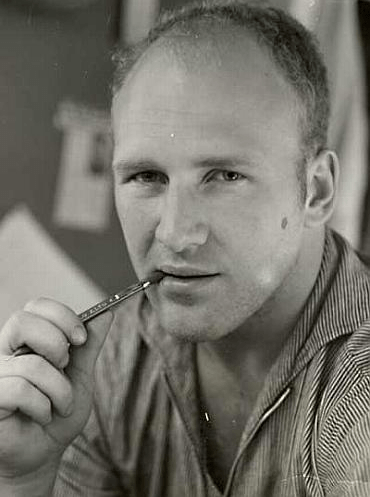
Milton Friedman (July 31, 1912 – November 16, 2006) was an American economist who received the 1976 Nobel Memorial Prize in Economic Sciences
In an article written for the March 2015 Physician Health News, the official newsletter of the Federation of State Physician Health Programs (FSPHP) President Doris Gunderson reviews the history of the organization in honor of its 25th anniversary. She writes:
“In 1990 the FSPHP was born out of a need for individual state programs to work together in discussing and promoting best practices and especially to influence national public policy.”
For the last quarter century the FSPHP has pushed a plethora of both practice and policy (legal, regulatory and healthcare) that claims to assist state physician health programs in identifying, managing and monitoring impaired physicians and protect the public from harm.It was recently suggested by the Chief Editor of American Society of Addictions Medicine (ASAM) Weekly News that this same group take the helm in influencing public policy for addiction medicine at large (i.e. not just doctors but everyone from our kids to our pregnant mothers to our elderly) on a national organizational level.
It is time we examined both the authority and the knowledge claims on which they are based.
In her rebuttal to Pauline Anderson’s August 2015 Medscape article ‘Physician Health Programs: More Harm Than Good? Gunderson dismissed criticisms as “allegations rather than facts” and “second hand anecdotes.”
In response to allegations that PHPs have no oversight Gunderson comments:
“In fact, we operate under a microscope, answering to individual practitioners, medical boards, malpractice carriers, defense attorneys, state attorneys, medical societies, hospitals, medical schools and residency training programs. We are also accountable to patient safety entities and a Board of Directors.”
The list of organizations Gunderson has to “answer” to appears to be many of the organizations and societies that physician health programs interact with. She might as well add Blockbuster for getting her videos back on time. This is not meaningful oversight. Oversight equates with accountability and that requires answerability (the provision of information) and justification for one’s actions. It also requires the presence of an outside organization truly independent of the group that is able to sanction or punish individuals for wrongdoing or misconduct. No such organization exists for state physician health programs. Period. There is no organization that exists that is able to investigate a complaint of misconduct and provide sanctions. The same applies to their primary business associates, the assessment and treatment centers (because they are private pay and out-of-pocket) and drug and alcohol testing labs (because they use non-FDA approved tests). The entire racket is unaccountable and unexamined.
Kathryn Pyne Addelson warned that what we should fear most is “unexamined” authority. “Illegitimate politicization and rampant irrationality find their most fruitful soil when our activities are mystified and protected from criticism.”
This group has been protected from criticism for the better part of a generation. They have enjoyed making authoritative pronouncements as unexamined authority. Their power depends entirely on not being questioned as what is behind the curtain is flimsy and dredged, a Potemkin village. The recent Medscape and BMJ articles are revealing that confrontation with direct and precise questions results in nothing but logical fallacy, distortions and lies. They are utterly incapable of responding with a direct and precise answer. Gunderson’s response to absent oversight is just another example of this logical fallacy and distortion. This is not how rational authority responds. This is not how legitimate authority responds. I kindly invite her to debate this. I would like a back-and-forth to clarify. It is a simple question that deserves a simple answer and I know she follows my blog as she used her own name and e-mail address.
The cumulative comments on the articles critical of these programs are revealing a system of oppressions, injustices and illusions. A more recent article on Medscape, “One-Man Fight: MD Takes on State Medical Board, PHP” reports the same pattern of coercion, absence of due process and diagnosis rigging for sham peer review that I am hearing from doctors across the country. The comments section to this article are also overwhelmingly critical of PHPs. They are pertinent, articulate and precise and missing from them is any semblance of a rebuttal by the FSPHP, their apologists or anyone else. The writing is on the wall as they say. And for that reason we call upon all those of good will in both the medical profession and the public at large to join us in this confrontation with illegitimate, irrational and immoral authority.
- Gunderson D. Message From the President Twenty-Five Years: A Remarkable Journey. Physician Health News. 2015;20(March).
- Addelson KP. The Man of Professional Wisdom. In: Fonow MM, Cook JA, eds. Beyone Methodology: Feminist Scholarship as Lived Research. Bloomington: Indiana University Press; 1991:16-35.
“Physician Health”



Monopolies, Self-Referral and Shell Games: The Need for Antitrust Investigation of Physician Health Programs and their “PHP-Approved” Assessment and Treatment Centers

As noted, outcomes for physicians who take part in treatment and monitoring programs are often excellent. In a recent study by the North Carolina PHP, for instance, 91 percent of substance-impaired physicians ultimately had a good outcome, compared to only 59 percent of physician assistants.8 One reason for this discrepancy may be physician assistants as a group don’t have the same ability to pay for long-term treatment. “They just don’t have as deep of pockets as the physicians when they get into trouble,” say Warren Pendergast, M.D., medical director of the North Carolina PHP and coauthor of the study. Another contributing factor may be that physicians have more to lose. “For a lot of physicians, if they’re not able to keep their license or get their license back, they don’t have a lot to fall back on,” says Pendergast. “Many of us don’t have other skills. Medicine is really all we’ve done.” The prospect of losing one’s livelihood and identity as a physician is a major motivator.
Three shells and a pea–ASAM, FSPHP, and LMD. “PHP-Approved” Assessment and Treatment Centers On the above list can be found the Medical Directors of a number of drug and alcohol …
Share this:

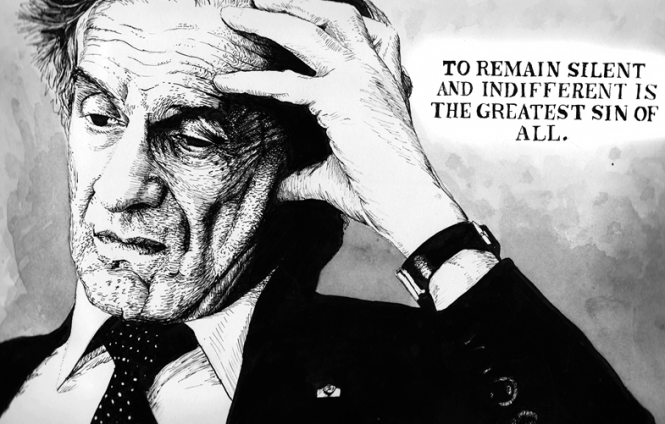
“We must take sides. Neutrality helps the oppressor, never the victim”-Elie Wiesel
 History teaches us that silence and secrecy are often the most effective tools of power. “We must take sides. Neutrality helps the oppressor, never the victim. Silence encourages the tormentor, nev…
Source: “We must take sides. Neutrality helps the oppressor, never the victim”-Elie Wiesel
Share this:

“We must take sides. Neutrality helps the oppressor, never the victim”-Elie Wiesel
A performance of Brundibár was filmed for Nazi propaganda and all of the participants in the Theresienstadt production were herded into cattle trucks and sent to Auschwitz as soon as filming was finished. Most were gassed immediately upon arrival, including the children, the composer Hans Krása, the director Kurt Gerron, and the musicians.
History teaches us that silence and secrecy are often the most effective tools of power.
“We must take sides. Neutrality helps the oppressor, never the victim. Silence encourages the tormentor, never the tormented. Sometimes we must interfere. When human lives are endangered, when human dignity is in jeopardy, national borders and sensitivities become irrelevant. Wherever men and women are persecuted because of their race, religion, or political views, that place must – at that moment – become the center of the universe.”-― Elie Wiesel
Theresienstadt was a concentration camp established by the SS during World War II in the garrison city of Terezín (German: Theresienstadt) located in German-occupiedCzechoslovakia. Late in the war, after D-Day and the invasion of Normandy, the Nazis permitted representatives from the Danish Red Cross and the International Red Cross to visit Theresienstadt to dispel rumors about the extermination camps.
Weeks of preparation preceded…
View original post 456 more words
Share this:

What is a policy entrepreneur?
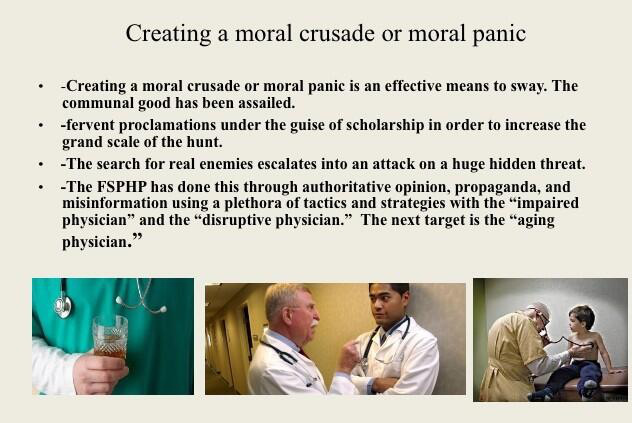 In order to understand the current incarnation of Physician Health Programs (PHPs) it is important to understand the concept of “policy entrepreneurship” in the evolution of these programs since the 1980s.Once this is understood it is easy to see how moral entrepreneurship, moral panics, moral crusades and “bent-science” were used to form public policy. rules, and regulations in the profession of medicine. The historical, cultural and professional context of this can be pieced together by using the recently archived Journal of Medical Regulation (the peer-reviewed publication of the Federation of State Medical Boards) as a template.
Source: What is a policy entrepreneur?
Share this:

http://www.medscape.com/viewarticle/871569#vp_3?src=soc_tw_share
Share this:

“New Paradigm” is a business model not a medical model
“I’m only here for a four day evaluation”– T-shirt sold at Talbott Recovery Center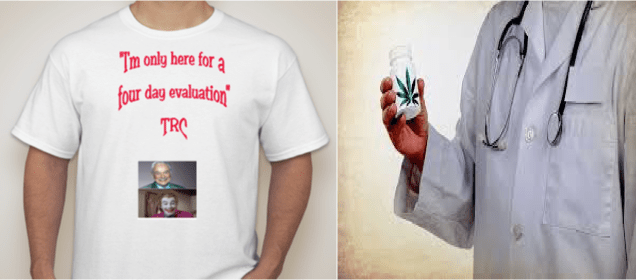 Reblogged on WordPress.com
Source: “New Paradigm” is a business model not a medical model
Inherent in the current chronic brain disease model of addiction is the importance of external control. The addict has an uncontrollable brain disease and in denial so we must make decisions for him. Coercion is certainly justifiable in some cases. Someone deep in the throes of addiction or alcoholism may indeed require coercion to get the help they need. Coercion could save their life.
But that is not what we are talking about here. Claiming that the addict has an uncontrollable disease is increasingly being used to to exert control over individuals regardless of whether they need to be treated. The “I’m only here for a four-day evaluation” T-shirts were sold at Talbott Recovery Center, one of the specialized assessment and treatment centers. It is a joke because most doctors assessed at Talbott end up staying for about four-months not four-days.
In state physician health Programs (PHPs) the concept of denial is being used to dismiss oppositional opinion and fact and coercion is being used to provide unneeded treatment is to individuals who do not even come close to meeting the diagnostic criteria for substance use disorder.
An article entitled “Drug Abuse Among Doctors: Easy, Tempting, and Not Uncommon”is typical of the alarmist propaganda used to promote these programs.
“Physician access to medications through prescriptions, networks of professional contacts, and proximity to hospital and clinic supplies” gives them “rare access to powerful, highly sought-after drugs” says Marvin D. Seppala, chief medical officer at Hazelden. This access “sets them apart” and “not only foment a problem” but”perpetuate it” says Seppala. “Access “becomes an addict’s top priority” and they “will do everything in their power to ensure it continues.” He states:
“They’re often described as the best workers in the hospital,” he says. “They’ll overwork to compensate for other ways in which they may be falling short, and to protect their supply. They’ll sign up for extra call and show up for rounds they don’t have to do.” Physicians are intelligent and skilled at hiding their addictions, he says. Few, no matter how desperate, seek help of their own accord.”
This is pure preposterous nonsense. The entire purpose of this vignette is to temper the responses of others when the best worker in the hospital is hauled away and coerced into treatment for a non-existent disease. It is to deflect inquiry, skepticism and doubt about the event.
The Federation of State Medical Boards House of Delegates adopted an updated Policy on Physician Impairment at their 2011 annual that approved the concept of “potentially impairing illness” and “relapse without use.” PHPs can now coerce doctors into treatment for “relapse” to a disease that they never had in the first place. “Relapse without use” is a 12-step concept G. Douglas Talbott defines as “stinkin thinkin.” The Federation of State Medial Boards provided “regulatory sanctification” to an A.A. concept.
A February 2016 “Physician Health News”article written by Dupont entitled “An Outsider Looks at PHP Care Management” is analogous to Willy Wonka writing a paper called “An Outsider Looks at Chocolate Factories.” Dupont notes “many physicians entering into PHP care are angry and feel beleaguered because they do not think they have problems or need treatment.”
The simplistic binary chronic relapsing brain disease model as defined by the American Society of Addiction Medicine (ASAM) is the foundation for this model.
They have been given the power to coerce and control physicians, They also force 12-step ideology and force doctors to to accept ideas that are anathema to them.
The concept of denial is used to force people into treatment and justify abuse during treatment. The chronic recurring model as espoused by 12-step justifies both ongoing drug and alcohol testing and a revolving door of treatment. They have been given the power to coerce physicians to accept ideas that are anathema to them.
Designating abstinence as the only acceptable treatment outcome is also a necessary component.
Cui bono? The drug and alcohol assessment, treatment and testing industry to which Dupont has strong ties.
Dupont and former DEA head Peter Bensinger run a corporate drug-testing business. Their employee-assistance company, Bensinger-Dupont is the sixth largest in the nation.
It is important to recognize that this is not a medical model but a business model. No research, information, logic or anything else is going to change the business plan. PHPs are essentially employee assistance programs (EAPs) for doctors. They are selling an EAP (the PHP-blueprint) and the junk-science non-FDA approved drug and alcohol testing that goes along with it.
In “Six lessons from state physician health programs to promote long-term recovery” Dupont and Dr. Greg Skipper (attribute this success rate to the following factors:8
(1) Zero tolerance for any use of alcohol and other drugs;
(2) Thorough evaluation and patient-focused care;
(3) Prolonged, frequent random testing for both alcohol and other drugs;
(4) Effective use of leverage;
(5) Defining and managing relapses; and
(6) The goal of lifelong recovery rooted in the 12-Step fellowships.
This is a business model plain and simple and all the trumpeting of success and glory is based on a single retrospective poorly designed bullshit study of 16 state PHPs rife with conflicts of interest. The “PHP blueprint” needs to be attacked.
Reflecting on Lord Acton’s observation that “absolute power corrupts absolutely” the American philosopher Eric Hoffer added that “Those in possession of absolute power can not only prophesy and make their prophecies come true, but they can also lie and make their lies come true.” The “PHP-Blueprint” is being brandished by Dupont as the “new paradigm” of substance abuse treatment but the majority of doctors being monitored do not meet the criteria for substance use disorder. This system is not designed to help doctors or protect the public. It is designed to profit and line the purses of the drug and alcohol assessment, testing and treatment industry. This needs to be recognized and addressed before the new paradigm expands to other occupations, college students and kids.
Drug Addiction Recovery Often Starts With Coercion

Robert L. DuPont, a psychiatrist, is the president of the Institute for Behavior and Health Inc. He was the director of the National Institute on Drug Abuse from 1973 to 1978.
UPDATED NOVEMBER 12, 2015, 12:52 PM
Addiction hijacks the brain. Families dealing with addicted loved ones know this. Research shows that 95 percent of people suffering from substance use disordersdo not think that they have a problem or need treatment. Few addicts enter treatment without meaningful coercion, most often from families or the criminal justice system.
The challenge in responding to this seemingly simple question about coerced treatment is in the details. Surely not everyone who is addicted to drugs should be committed to treatment. The opposite is also true. Some addicts should be committed to treatment against their will. Not all coercion is commitment and not all commitment has the force of law.
Programs with effective coercion and serious consequences, such as HOPE Probation and Physician Health Programs, often produce excellent outcomes for most participants.
Two good examples of effective coercion that overcome addiction are HOPE Probation and the state-based Physician Health Programs, both of which are enforced by intensive random monitoring and permit no use of alcohol or other drugs. While these two programs share many similar features, they deal with very different populations of serious substance users: one with convicted felons on probation and the other with physicians. Both are voluntary in the sense that individuals can choose to not abide by the program requirements, but in both cases the consequences may be serious. For probationers in HOPE, the risk of failing is prison and for physicians in P.H.P., it is the loss of a medical license. Both programs produce excellent outcomes for most participants.
Families faced with addiction often reluctantly, and only after many failures, use “tough love” to promote treatment and recovery while insisting that their addicted loved ones be drug-free. Families usually have to use a significant measure of coercion not only to get addicts into treatment but also to keep them there and to prevent relapse upon discharge.
As a psychiatrist specializing in the treatment of addiction, I am struck by the stark contrast between addicted people who are using alcohol and other drugs actively and those who are in stable recovery. In the process of recovery there is a transition from near-universal denial of problems and rejection of treatment to gratitude for and acceptance of the coercion that got them on that path. The addict’s will is different when using drugs and when in recovery.
Recovery from addiction may or may not involve treatment. It takes years of hard work – usually with the sustained support of recovery communities. Because of the denial that characterizes the cunning, baffling and powerful disease of addiction, recovery often starts with substantial coercion.
Join Opinion on Facebook and follow updates on twitter.com/roomfordebat
Share this:

“In any given situation there will always be more dumb people than smart people. We ain’t many!”–Ken Kesey
Share this:

Defending MA BORM Deb Stoller’s Five-Year Concealment of Fraud–Nothing Left but Logical Fallacy and Lies
 The scope and severity of the crimes committed here are mind boggling. This is systemic corruption involving former FSPHP President Dr. Luis Sanchez and VP of laboratory operations Joseph jones. I have heard of multiple suicides due to allegedly falsified positive PEth given just before the end of a monitoring contract. This appears to be common and some kill themselves rather than endure another five-years under PHS monitoring.
I have been providing evidence of forensic fraud to Deb Stoller since December of 2011. The litigation packet clearly shows collusion between Sanchez and Jones. Due to the consequences of forensic drug testing any civil person would attempt to expose the forensic fraud but Stoller suppressed it and all of the other evidence that was difficult to obtain.. I wonder how many suicides have been the result of falsified PEth tests over the past five-years? This is far worse than Annie Dookhan and USDTL is used by PHPs across the country not just Massachusetts and the consequences can be permanent.
“To be sure, and to put this matter to rest for the Court once and for all, the Board has retrieved from off site storage those materials before the Board in December 2011. The documents that Dr. L…
Share this:

Reliability of hair drug tests up for debate
 Forensic testing needs to be as close to 100% specific as possible because the results of a positive test can be grave and far reaching. Getting this test (and all the others) approved and marketed through a loophole and then getting the state Boards and Federation of State Medical Boards to approve them by moral entrepreneurship is unconscionable. Using the LDT pathway is just another example of how the “impaired physician movement” removes accountability and culpability by bending, ignoring or otherwise making their own rules.And the labs have taken a “stand your ground” approach. Never admit wrongdoing. Never settle.In a February 2007 article in the magazine “New Scientist,” Dr. Skipper is quotedthat:“…there is not yet an agreed threshold concentration that can be used to separate people who have been drinking from those exposed to alcohol from other sources. Below 1000 nanograms of EtG per millilitre of urine is probably ‘innocent’, and above 5000 booze is almost certainly to blame. In between there is a “question zone…”No Dr. Skipper—it is you who is most certainly to blame. And what of all the people whose lives you ruined by introducing junk science with no evidence base via a regulatory loophole?? “probably innocent?” Shame on you Dr. Skipper…. Shame..shame..shame.
Source: Reliability of hair drug tests up for debate

 Disrupted Physician