Flagrant Corruption by Massachusetts PHP-Help me Hold them Accountable

Many similar stories surfacing! Time to hold them accountable for their systematic misconduct and crimes.Source: Flagrant Corruption by Massachusetts PHP-Help me Hold them Accountable

According to an attorney for the  Massachusetts Board of Registration in Medicine the state physician health program (PHP), Physician Health Services, Inc. (PHS),  has not committed any crimes “because they have not been charged” with any crimes.

I am not sure what type of logical fallacy she is using here but it is utter nonsense.  As an attorney she should know a crime is determined by what someone does as measured by a thing called the law.  The documents below show a flagrant case of forensic fraud, cover-up and perjury.  They also show criminal violation of HIPPA as the agency created a “clinical” sample (and therefore protected health information (PHI)) when they are not a clinical entity and not legally entitled to do so.  As a 501(c)(3) charitable corporation they cannot engage in “clinical” medical practice and are  violating their non-profit status by engaging in ultra vires acts.

The documents below show forensic fraud.  This is undeniable and indefensible.

Request Medical School Administrators Question PHP Authority to Prevent Future Medical Profession Brain Drain

In reality, a zero-tolerance paradigm utilizing this type of testing would be ruinous. With recreational and experimental drug use common in young adults a profession that refuses to accept anyone who tests positive for drugs will exclude large numbers of brilliant, talented individuals. Dismissing highly talented people in medicine for what might be a one-off recreational non problematic drug experience would retard its advance.

Source: Request Medical School Administrators Question PHP Authority to Prevent Future Medical Profession Brain Drain

The “PHP-Blueprint”–A Trojan Horse for Profit and Wider Social Control

And the people who will suffer most in the “New Paradigm” will be those who are already marginal in American society. That’s a given. I have heard from doctors who are gay or belong to a minority group who claim they were referred to a PHP due to discrimination but had no recourse.

Source: The “PHP-Blueprint”–A Trojan Horse for Profit and Wider Social Control

MD Sues NC Medical Board/Physician Health Program-A Prototypical Case

Multiple similar stories being shared on Medscape. This needs national and mainstream media attention!

mllangan1's avatarDisrupted Physician

A prototypical case involving PHP and Medical Board. PHPs’ integrity varies state by state depending on:

1. How entrenched the FSPHP is in the state PHP

2. Whether that state’s Medical Board has become a partner in PHP’s crimes.

It is very curious that states who have had a Medical Director who has also been President of the Federation of State Physician Health Programs seem to be the worst of the violators.

Based on over 200 responses I have received on my PHP survey [PHP Survey], North Carolina, Florida, Massachusetts and Washington State are physician career destroyers whereas West Virginia seems relatively unscathed (although I have learned that the FSPHP has been attempting to impose its “PHP-Bluprint” on the Board with some resistance.

What you see here is a classic case. Physicians and med schools urgently need to become aware and take a stance of resistance to…

View original post 1,919 more words

The “PHP-Blueprint”–A Trojan Horse for Profit and Wider Social Control


Screen Shot 2016-02-19 at 2.47.54 AM.png“In the small world of drug testing, these four—Angarola, Bensinger, DuPont and Willette—are affectionately referred to as the Gang of Four. Dr. John Morgan explains, “They are the ones responsible for a good deal of drug testing’s success, and some of the fear that goes along with it. Remember these names. These men are among the most competent and knowledgeable about drug testing—scientifically and politically. They are well-informed: they have to be. Their livelihoods depend upon their credibility. Unfortunately their expertise represents the greatest threat to the civil liberties we seek to protect. Know your enemy.” 1

Steal This Urine Test – Fighting Drug Hysteria In America – By Abbie Hoffman with Jonathan Silvers. 1986


A recent Huffington Post article written by Maia Szalavitz, The Rehab Industry Needs to Clean Up Its Act Here’s How, describes the need to radically rethink and reform American addiction treatment.. The article quotes Dr. Mark Willenbring who states

“What we simply need is a nice bulldozer, so that we could level the entire industry and start from scratch.”

Agreed, but the chances of this are slim to none if the “PHP-blueprint” becomes the “New Paradigm.”  To prevent this from happening it is critical to disprove the claims, recognize the threat, and address the matter directly and collectively.   We need political and social activism in the same spirit as Abbie Hoffman whose words from three decades ago are aptly accurate.  His prescient warnings remain unknown, forgotten, or irrelevant to us today but their accuracy is crystal clear.  Few people know the enemy.

Screen Shot 2016-02-19 at 2.45.36 AMOn April 23, 2015 Dr. Robert Dupont, MD addressed the House Subcommittee on Oversight and Investigations Combatting the Opioid Abuse Epidemic and proposed widespread application of a “New Paradigm” for substance abuse management based on the nation’s physician health program (PHP) model of care.

This model is being brandished as “gold standard for addiction treatment” to the drug and alcohol rehabilitation community and general public. The medical literature contains numerous articles claiming the high success rate of these programs4,6,9,10 and they are being promoted to set the “ standard for recovery” as a replicable model to be used for treating “other addicted populations.”11  In his speech before the House Subcommittee Dupont states critics call the expansion “utopian” but many would beg to differ. “Dystopian” would be more like it.

There has been an increasing scrutiny of these programs recently  not yet covered by mainstream media.  The link between the marked increase in physician suicide (which is much more than the oft quoted medical school class of 400 per year is directly related to the FSPHP takeover of PHPs).  A recent Medscape article   describes the coercion, control, secrecy and conflicts-of-interest between the PHPs and their “PHP-approved” assessment and treatment centers.  The simple fact is the majority of doctors referred to these programs do not have a substance use disorder or psychiatric problem but are given one nevertheless. This removes their locus of control and puts the PHP in complete power.  Their fate is in the hands of the PHP.

The assessment and treatment facilities used by PHPs do not take insurance and require payment up front. It is all out of pocket because if insurance was involved the fraud would have been discovered long ago. The PHPs have no accountability.  There is no oversight by medical boards or medical societies and answerability and justification for actions are absent.  And as we are hearing the rehabilitation industry itself is unregulated.  So too are the junk-science lab tests used in PHP programs as these non-FDA lab tests and the corrupt labs that use them have no oversight form the FDA or any other agency able to hold them to account.  It is a free for all.

Those ensnared in this web do know the enemy but can do nothing about it.   I am hearing story after story of doctors seeking help from their medical societies, law enforcement,  the media and the ACLU only to be turned away.

Their stories are remarkably similar An increasing number of complaints involving PHPs and the preferred assessment and treatment centers and contracted commercial labs are being reported.   A recent lawsuit filed by a doctor against the North Carolina PHP and Medical Board reported on Medscape last week is a prototypical case. The scenario typically goes like this: An accusation is made against a doctor who has had no previous disciplinary history or concerns (alcohol on breath, throwing a surgical instrument) and referred to the state PHP; An assessment is recommended by the PHP at an out-of-state “PHP-approved” assessment and treatment center; the assessment confirms a psychiatric problem or substance use disorder and recommends typically three-months of inpatient treatment followed by a 5-year contract with the state PHP for monitoring. It is becoming clear that doctors who do not fit the diagnostic criteria for a disease are being diagnosed with a disease. There are also complaints of laboratory misconduct and forensic fraud.

It is important to recognize that State PHP programs require strict adherence to 12-step doctrine11 and limit assessments to not only ASAM facilities but to a specific constellation of 12-step assessment and treatment centers with medical directors who belong to a group called like-minded docs.  It is in fact a “rigged game.”

In “Six lessons from state physician health programs to promote long-term recovery” Dupont and Dr. Greg Skipper attribute this success rate to the following factors:12

(1) Zero tolerance for any use of alcohol and other drugs;

(2) Thorough evaluation and patient-focused care;

(3) Prolonged, frequent random testing for both alcohol and other drugs;

(4) Effective use of leverage;

(5) Defining and managing relapses; and

(6) The goal of lifelong recovery rooted in the 12-Step fellowships.12

In truth the sole basis for these claims is a single retrospective cohort study of 904 physicians monitored by 16 state PHPs initially published in the British Medical Journal in 2008.2 In 2009 the same study was published in the Journal of Substance Abuse Treatment3 and deemed the “PHP-blueprint. Methodologically flawed and rife with conflicts-of-interest this study is the sole foundation of all of the claims.   Of the 904 participants 102 were “lost to follow up” and of the remaining 802, 155 failed to complete the contract but despite the small numbers this study has been hashed and rehashed to brandish the claims of an 80% success rate physician including subsets of psychiatrists,4 surgeons5 and anesthesiologists6  In his address to the House Subcommittee Dupont, who is a co-author on every one of these papers, claims similar success in a subgroup of opioid addicted doctors.

None of this has been subjected to normal scientific peer-review procedures and represents a serious departure from the normal standards of scientific inquiry

The same forces that have created and sustained the current monopoly of 12-step oriented treatment in America have grand plans through links  forged though government, private agencies and the drug and alcohol testing assessment and treatment industry.

Through a combination of large-scale funding, rhetorical persuasion and moral panics they have gained both tremendous sway and power in the profession of medicine and the collateral damage they have caused is widespread and permanent.   They are poised to do the same to others using the  same methods and the procedural protections afforded to those currently being tested for substances of abuse in Federal Workplace Drug Testing programs will be removed without your consent or knowledge.   I recently heard from someone  that these groups are lobbying the Nuclear Regulatory Commission into accepting this model with some resistance.

As far-fetched as all of this sounds all one has to do is look. The greatest threat to the civil liberties we seek to protect is no longer a threat but a reality.

Examine the documents below and connect the dots to see the coming Trojan horse for systemic application of a flawed substance abuse management program with no evidence base.

Medicalization of 12-step  will be accomplished when “addiction medicine” becomes recognized as a bona-fide medical specialty by the American Board of Medical Specialties.(ABMS) which is slated to occur within the next couple years. At that point this group will deem 12-step ideology as best practice  “evidence-based” doctor recommended care. This will “sanctify” the  ideology as medical “standard of care” and can then be imposed on anyone with impunity and immunity.   Medicalization subverts the Establishment clause of the 1st Amendment and the propaganda supporting this has already begun.   See the 12-step “facilitation”  piece below giving the reasoning they will use.  This is not facilitation but coercion.

The ASAM White Paper on Drug Testing promotes random testing of everyone using the Non-FDA approved tests of unknown validity currently used in state physician health programs. This will be implemented through the healthcare system by removing procedural protections currently in place under federal guidelines. This is sure to be a boon for anyone battening and fattening off the Drug and Alcohol Testing Industry Association or rehab racket gravy train but a burden and pain for the rest of us.

The conflicts of interest are unfathomable.

Dupont and fellow “Gang of Four” member Peter Bensinger (DEA chief, 1976–1981) run a corporate drug-testing business. Their employee-assistance company, Bensinger, DuPont & Associates is the sixth largest in the nation and managing drug testing for some 10 million Americans including Kraft Foods,  the FAA and even the Justice Department.  They sell drug-testing management programs.  The “New Paradigm” is simply a ruse to get non-FDA approved testing into the wider workplace via loopholes and workarounds.  His ties to the drug and alcohol testing and treatment industry are easy to find.  Drug testing is a multi-billion-dollar-a-year industry. DATIA [Drug & Alcohol Testing Industry Association] represents more than 1,200 companies and employs a DC-based lobbying firm, Washington Policy.  Many of the non-FDA approved tests they are using in the “PHP-blueprint” they in fact introduced to the market themselves with no evidence base. It is reprehensible.

And the people who will suffer most in the “New Paradigm” will be those who are already marginal in American society. That’s a given. I have heard from doctors who are gay or belong to a minority group who claim they were referred to a PHP due to discrimination but had no recourse.

Medicalization of behavior  removes due process as the victimized are simply put in a labeled group and via actuarial logic that safely that removes the underlying prejudice from view by categorization of risk.   Discrimination is justified and rationalized.   So read the documents below and connect the dots. Then do something about it.  Say something. Write something.  Do something.  The Emperor has no clothes and this needs to be exposed. Either defend what you read below or protest this New Inquisition.  We need revolt and Revolution.  The Federation Of State Physician Health Programs (FSPHP) regime is simply another front-group designed to force the medical profession in line for the profits of the rehab racket.  The FSPHP is the enemy and State PHPs need to be reformed and repaired  with transparency and accountability. And to accomplish this the entire long running mess needs  to be bulldozed  and rebuilt from scratch.

  1. Robert Dupont’s 2012 Keynote speech before the Drug and Alcohol Testing Industry Association
  2. Robert Dupont’s address before the House Subcommittee on Oversight and Investigation Combatting the Opioid Epidemic
  3. 2014 Journal of the American Medical Association (JAMA) article entitled “Addiction Medicine: The Birth of a New Discipline
  4. The ASAM White Paper on Drug Testing
  5. Why good addiction centers connect clients to AA or NA

Screen Shot 2016-02-19 at 2.47.37 AM.png

  1. Hoffman A, Silvers J. Steal This Urine Test: Fighting Drug Hysteria in America. 1 ed: Penguin Books.
  2. DuPont RL, McLellan AT, Carr G, Gendel M, Skipper GE. How are addicted physicians treated? A national survey of Physician Health Programs. Journal of substance abuse treatment. Jul 2009;37(1):1-7.
  3. White WL, Dupont RL, Skipper GE. Physicians health programs: What counselors can learn from these remarkable programs. Counselor. 2007;8(2):42-47.
  4. Skipper GE, Campbell MD, Dupont RL. Anesthesiologists with substance use disorders: a 5-year outcome study from 16 state physician health programs. Anesthesia and analgesia. Sep 2009;109(3):891-896.
  5. Yellowlees PM, Campbell MD, Rose JS, et al. Psychiatrists With Substance Use Disorders: Positive Treatment Outcomes From Physician Health Programs. Psychiatric services. Oct 1 2014.
  6. DuPont RL, McLellan AT, White WL, Merlo LJ, Gold MS. Setting the standard for recovery: Physicians’ Health Programs. Journal of Medical Regulation. Mar 2010;95(4):10-25.
  7. Dupont RL, Skipper GE. Six lessons from state physician health programs to promote long-term recovery. Journal of psychoactive drugs. Jan-Mar 2012;44(1):72-78.
  8. McLellan AT, Skipper GS, Campbell M, DuPont RL. Five year outcomes in a cohort study of physicians treated for substance use disorders in the United States. Bmj. 2008;337:a2038.
  9. DuPont RL, McLellan AT, White WL, Merlo LJ, Gold MS. Setting the standard for recovery: Physicians’ Health Programs. Journal of substance abuse treatment. Mar 2009;36(2):159-171.
  10. Buhl A, Oreskovich MR, Meredith CW, Campbell MD, Dupont RL. Prognosis for the recovery of surgeons from chemical dependency: a 5-year outcome study. Archives of surgery. Nov 2011;146(11):1286-1291.


Please donate here:  https://www.gofundme.com/PHPReform

There is a very urgent need for a “counterpower” to state physician health programs (PHPs). On average five or six medical students, doctors or residents contact me each week and I want to continue to help them and work toward advocacy and watchdog groups.  Unfortunately I am losing ground quickly.  We have made tremendous advances in the last year and I am working in many different venues to expose the problems written about here.  Those involved in this corrupt system are hoping that I will run out of resources and simply go away and have done everything they can to accomplish this. Without your help this will occur and it will unfortunately occur soon.


Review of “Bad Medicine: Doctors Doing Harm Since Hippocrates” by David Wootton, Social Affairs Unit Blog, August 31st 2006

Next edition I have some additions for you — may need to be 2 volumes!

Séamus Sweeney's avatarA Medical Education

My penultimate piece (so far) for the SAU Blog. This book greatly impressed me at the time, which is surely clear. Since I have learnt a lot about the philosophy of medicine and am perhaps a little more sceptical about the scientific pretensions of medicine (let alone the medical pretensions of psychiatry). Nevertheless Wootton’s arguments seem important and difficult for even the most critical theorist to fully evade. I came across references to Thomas McKeown lately, having nearly forgotten about him.

Bad Medicine: Doctors Doing Harm Since Hippocrates
by David Wootton
Pp. 304. Oxford: Oxford University Press, 2006
Hardback, £16.99
www.badmedicine.co.uk

Not only were the Ancient Greeks influential, in many fields they are still directly influential today. Whitehead famously remarked that all Western philosophy is footnotes to Plato. Euclidean geometry is still central to mathematics. Aeschylus, Sophocles, Euripides and Aristophanes are still performed. While the practice of history today is…

View original post 2,433 more words

Request Medical School Administrators Question PHP Authority to Prevent Future Medical Profession Brain Drain

clip-americas

Physician Health Programs (PHPs) now targeting medical students–More sheep for the slaughter

The attached article entitled “Medical school drug testing is a moral and scientific failure” opposes testing medical students for drugs and alcohol but things are going to get a whole lot worse.

In the past six-months I have been contacted by an increasing number of  medical students searching for help after being  trapped in quagmire of their state physician health program  (PHP).   Each of them had either been referred to a “PHP-approved” assessment center or had already had an evaluation recommending inpatient treatment.

Some of these students were subjected to non-FDA approved laboratory developed tests including hair testing for marijuana metabolites and the  alcohol  biomarker EtG.  These typeof tests can detect substances that were used days, weeks and even months prior to testing.

Medical students and physicians are just as likely to have experimented with illicit substances in their lifetimes as their age and gender matched peers.1

Although medical students as a group drink slightly more alcohol than the general population, the pattern and prevalence of alcohol, dependence is consistent with their age mates in the general population.1 2

Like it or not recreational and experimental drug use is widespread in young adults and most of them “grow out of it” and the 21st Amendment repealed the Volstead Act in 1933.  Alcohol is legal and those that can handle it have a right to a round of beers after a long day or imbibe a cocktail with a dinner date.  But according to the prohibitionist profiteers and moral preeners any drug or alcohol use is a sign of “potentially impairing illness” that must be addressed and treated early to prevent an inexorable slide into a chronic relapsing brain disease and abstinence and lifelong adherence to the principles 12-step spirituality are the only way to do so.

An old joke asks “How does a doctor define an alcoholic?”  Answer–“anybody who drinks more than he does.”   How does a PHP define an alcoholic?  Answer –anybody who walks through the front door.

In reality, a zero-tolerance paradigm utilizing this type of testing would be ruinous. With recreational and experimental drug use common in young adults a profession that refuses to accept anyone who tests positive for drugs will exclude large numbers of brilliant, talented individuals. Dismissing highly talented people in medicine for what might be a one-off recreational non problematic drug experience would retard its advance.

The use of these non-FDA approved tests of unknown validity should not be allowed to begin with but there needs to be a concerted direct attack on their use on medical students or the brain-drain on the profession will bring it back to the dark ages.  The ASAM White Paper on Drug Testing proposes imposing this system with mandatory drug testing by the healthcare system from childhood to old age.  College loans are proposed as “leverage” for college students in this “contingency management” paradigm so a lot of promising students could be weeded out before even applying to medical school.  Forget GPA and MCATS as the primary criteria for medical school admission will be sobriety and clean urine screens..

Diagnosing disease without meeting the diagnostic criteria for that disease.

None of the students who contacted me seemed to fit the diagnostic criteria for the diagnosis given to them stories which were articulate, detailed and sincere.   All cases involved either a naive mistake or isolated incident.

One student made the disastrous revelation to a PHP director who had just given a class lecture that she had smoked marijuana with her high school friends in her home state of Colorado.   She was then called in by the PHP and referred for an evaluation at an out of state facility where she was diagnosed with “marijuana dependence” based on a positive low level THC metabolite on a hair follicle test.  She was told she was in denial and inpatient treatment was recommended.  Although she admitted to occasional weekend marijuana use there were absolutely no problems in any realm of her life. It is self-evident that impairment due to drugs or alcohol impacting someones capacity to work or function needs to be addressed but the penalty imposed on her for her private behavior was to end her career in medicine before it even started.  The medical school administration mandated she either complete the treatment required by the PHP or she would not be able to enroll the following semester and not being able to come up with the up-front out-of-pocket cost for treatment she was not able to return to the medical school and has decided to pursue a different career.

Another student was anonymously reported to the PHP for smoking marijuana at a weekend party which resulted in a similar assessment and recommendation for inpatient treatment.  After spending 3 months at a facility in Alabama he is now under monitoring contract with his PHP but returned to school.

Healthy student asks for help in his organizational skills–ends up with a psychiatric and substance abuse diagnosis

After reading an advertisement in the state medical society newsletter promoting work-life balance a second-year medical student contacted his state PHP to obtain advice on his problem with “procrastination.”    Classes and working part time in the endocrinology lab left him with little time and he found himself slacking off on his exercise routine and burning the midnight oil before test nights.  He told the PHP director about his history of depression after his father died immediately before his freshman year at college. That October he became overwhelmed with sadness and missed his dad and hometown.  He sought help from the campus physician who prescribed prozac which was discontinued in a years time without return of any symptoms.

Realizing there were no classes in work-life balance but only a support group for “burnout” the student declined the PHP directors offer of an assessment of his “mental health.”  Much to his surprise he was called in the following week by a medical school administrator and told that the PHP was requiring an assessment at one of two out of state “PHP-approved” assessment centers in Lawrence Kansas.  He was at first confused at the nonsense he was hearing and then became indignant  at the nonsensical and illogical request without rhyme or reason and the betrayal of trust and ethics.  “Surely this must be a HIPPA violation.”   He obtained an outside consultation from a psychiatrist and contacted the campus physician who confirmed his diagnosis was acute situational depression and bereavement but the PHP disregarded the information.  He bartered for a local evaluation but this was refused.  He arranged for the 96-hour assessment in  Kansas.  His mother paid the requisite out-of-pocket up-front $4,500.00 to the facility and  she told him not to worry as his life would get back to normal after they confirmed he had no psychological problems.  “Dysthymia, Major depressive disorder, severe, in remission and alcohol use disorder” were given as diagnoses.  “Alcohol use disorder” was based on a hair test for EtG which was the result of his drinking an occasional beer or two with friends after school and on the weekends.  He was told  he may be “self-medicating” and playing “Russian roulette” given his history of depression.  Recommendations included inpatient treatment followed by a “structured aftercare program” of abstinence and monitoring by for alcohol and drugs of abuse.  Forced to sign a contract with the PHP he was understandably upset at the serious and unfounded sequelae that was the result of asking for help.

Another fourth-year student got into a bit of a shoving match with his buddy at the bar on a Saturday night and was reported  to his PHP anonymously.  He is awaiting evaluation.

This brings up another potential problem–sham peer review. As PHPs accept anonymous referrals what is in place to prevent inappropriate referrals based on removing a competitor and improving your academic standing.

A legitimately prescribed stimulant for ADHD bought a third year student into a PHP contract. He was  forced to discontinue the medication prescribed by a psychiatrist specializing in childhood ADHD by a family practitioner in “recovery” from abusing intravenous fentanyl who had been monitored by the PHP himself for ten years then became medical director after getting board certified as an addiction medicine specialist.

This student got 99th percentile across the Board on his MCATs and may one day cure cancer but now faces an uncertain future as he recently got a positive EtG on a urine test and they are currently “sorting this out.”

The most bizarre story was from a student who sought help for sleep troubles after reading about the PHP as a referral source. He subsequently saw a sleep-specialist and was diagnosed with an oversized uvula which was surgically corrected.  His sleep troubles improved but his troubles with the PHP remained.  A triathlete and excellent student the PHP determined he had a “thought disorder” and discussions of “schizophrenia” were entertained by the PHP and they recommended an out of state evaluation at one of the three gulags used by the FSPHP for  “disruptive physician”  and behavioral exams–Vanderbilt, Acumen and the Professional Renewal Center.  All of these facilities come with a guaranteed diagnosis.   Polygraphs and unvalidated neuropsychological instruments designed to detect “character defects”  cast a pretty wide net.

Question FSPHP with direct questions to undermine a “culture of professionalism.

It is important that medical school administrators refuse to engage in  blind deference to the authority of the state PHP.  Authority must always be questioned and to not do so is irresponsible.  Unquestioning allegiance to an authority does not comport with the history of the medical profession or science.  Faith in institutions demands mass adherence to faith in that authority and direct challenges to the status quo are needed to undermine that faith.   They have bamboozled the medical boards into implementing bad policy, approving bad science and making bad decisions.  They have duped state legal authorities into deference to their expertise and integrity under the notion that questioning these attributes undermines a culture of professionalism.  Fact of the matter is they have no expertise, no integrity and no professionalism.

PHPs have been contaminated with an outside influence and support an agenda that has nothing to do with protecting the public or helping medical students.  They are an illegitimate authority that has become an irrational authority and their recommendations mandate direct answers and justification.

If the PHP has concerns about a student then the first step should be to obtain an independent second opinion.  PHPs discourage second these second opinions and disregard all outside expert opinion no matter how well qualified and experienced that expert is.  Anyone outside this brood of addiction addicts is scoffed at as biased or unenlightened to the simplistic belief system with which they have contaminated the medical profession.     Look into the assessment centers to which they are mandating referral.  Ask what qualitative factors and quantitative measurements were used to approve that facility and why no one in Massachusetts has the ability come to a competent diagnosis.   The yarn that doctors and medical student have an ability to dissemble and appear normal while harboring a “potentially impairing condition” is one of the medical urban legends they started.  Ask to see the evidence base.  There is none and it defies common sense, logic and science.

An increasingly bright light is being shed towards the malfunctions and corrupt practices of this unaccountable confederacy of “authorities” and at some point soon their jig will inevitably be up.     In the interim, if you are referred to a PHP it would be a good idea obtain independent lab tests and two second opinions.  Although the PHP will disregard this documentation it would be wise to obtain it to prove both your normality and the discrepancy between your independent evaluation results and the cherry-picked pulled out of a hat multiple diagnoses confabulated and misrepresented by the PHP.

  1. Hughes PH, Brandenburg N, Baldwin DC, Jr., et al. Prevalence of substance use among US physicians. JAMA : the journal of the American Medical Association. May 6 1992;267(17):2333-2339.
  2. Flaherty JA, Richman JA. Substance use and addiction among medical students, residents, and physicians. The Psychiatric clinics of North America. Mar 1993;16(1):189-197.


Screen Shot 2016-01-11 at 12.51.47 AM


Medical school drug testing is a moral and scientific failure
ANONYMOUS | EDUCATION | MAY 11, 2014

Before the 1980s, drug testing was uncommon. It was widely viewed as an invasion of privacy and an infringement on fourth amendment rights. Today, a medical student is likely to be drug tested before entering medical school, before clinical rotations, and/or before residency. If preventing drug use among medical students is the goal of these tests, they have failed miserably. Urinalysis drug tests are ineffective. But more importantly, they are immoral.

Drug tests are ineffective for two reasons. First, they basically just test for marijuana. A 10 panel urinalysis technically tests for 10 different drugs, but marijuana is one of the only drugs that can be detected for more than 30 days. Cocaine can be detected for 4 days. Amphetamine, methamphetamine, ecstasy, heroin, and codeine all can be detected in urine for only 2 days. This means that a user of drugs far more dangerous than marijuana needs to abstain for just a couple of days. Psilocybin mushrooms, as well as several other mind-altering drugs, are not tested for at all.

For a marijuana user, a drug test might seem like a nightmare. But here we arrive at the second reason why drug tests are ineffective, they are easily beaten. A marijuana user may choose to drink a lot of water before his drug test to dilute his urine. Alternatively, he may choose to use a friend’s urine who he knows does not use marijuana. Either one of these options might work. But fortunately for such a marijuana user, there is another option that is essentially risk free, synthetic urine. There are several companies that make synthetic urine capable of beating drug tests. The word on the Internet is that Quick Fix is a safe bet. I personally know some people who would agree. At just $30 for a bottle, it looks like the drug test is no match for the free market.

Do not just take my word for it though. In 2003, the University of Michigan conducted a study on the effectiveness of drug testing students. From nearly 900 schools, the study found that drug testing, whether routine, random, or based on suspicion, had no measurable effect on drug use among students. Put simply, drug testing accomplishes nothing.

The most important concern I have about drug testing medical students is a moral one. Regardless of their effectiveness, or ineffectiveness, the endgame of drug testing is to prevent drug users from becoming doctors. Users, not addicts; and there is a big difference. A marijuana user might use on weekends or at night to relax, much like an alcohol user. A marijuana addict, although rare, is the type of person who might show up to important occasions intoxicated. The statistics on marijuana addiction vary. They usually show that less than 10% of users become addicts, but they always show that alcohol users have higher rates of addiction. A urinalysis detects alcohol for no more than 12 hours after use. This means that medical students who use alcohol are more likely to be addicted, and they face basically no risk of failing a drug test.

Should we be worried about medical students being drunk in clinical settings? Of course. And we should also be worried about medical students being high in clinical settings. Intoxication could be disastrous and it needs to be prevented. The good news is that this is done naturally. It is highly unlikely to find medical students who are addicts of marijuana, alcohol, or any mind-altering drug. I believe it is safe to say that the rigor of medical school itself prevents drug addicts from becoming doctors. There are, however, drug users who will make it into medical school or other rigorous scientific careers. Actually, many of them thrive. Richard Feynman, Kary Mullis, and Francis Crick used marijuana and LSD, Carl Sagan used marijuana, and Oliver Sacks used several illicit drugs. When drug tests are required for every medical student, the casual drug user, no matter how much potential he has, is bullied for no reason. The potentially dangerous drug addict has already been weeded out long ago.

Medical school is supposed to be based on science. The science shows that drug testing does not work. If it did work, then many great scientists would have been removed from their professions. These facts alone should be enough to settle the issue, but it is important to look at two more moral objections we should all have.

First, drug tests are not free. Before entering medical school, I paid about $30 for one. This does not sound like much. But charging students even one penny is unacceptable, for there is not even a fraction of a penny in benefit from these tests. The nearest drug testing facility for me was a 20 minute drive from my house. I could have driven anywhere for 20 minutes and just handed $30 to any random person. Surely, that $30 would bring more value to society than $30 wasted on a drug test. Imagine if a police officer searched a person’s car for drugs against his will, found none, and then charged this person $30. That is the reality of drug testing.

Second, drug tests are an invasion of privacy. Medical students should not be forced to prove their innocence. This creates a guilty until proven innocent environment. It immediately creates resentment among students, and rightfully so. Furthermore, what about people with paruresis? The International Paruresis Association estimates that 7% of people suffer from this condition, also known as shy bladder. Type “paruresis drug test” into a search engine and spend some time reading through the horror stories that are shared. These people suffer from a medical condition, and of all places, their medical school is completely inconsiderate.

Drug testing is a moral and scientific failure. Medical schools should be too embarrassed to take part in such nonsense.

The author is an anonymous medical student who blogs at unchainedmedical.
TAGGED AS: MEDICAL SCHOOL

A Golden Age

Screen Shot 2014-08-13 at 11.12.09 PMScreen Shot 2014-08-13 at 11.08.55 PM

Disappointed that his grandiose proposal to test the urine of half the U.S. population for illicit drugs was declined in the 1980’s, Bob realizes such a large swath was too tall an order. Acknowledging that his dream of lifelong urine drops for each and every one of the riffraff at least once a fortnight will take time, he decides to focus his attention on specific subsets of the great unwashed such as school-children, welfare mothers, the unemployed and whatever they are calling Hippies these days.

Why is this man smiling?  Because the alchemist has figured out a way to turn your urine into gold.

image1

mllangan1's avatarDisrupted Physician

BY TIMOTHY STEELE

Even in fortunate times,
The nectar is spiked with woe.
Gods are incorrigibly
Capricious, and the needy
Beg in Nineveh or sleep
In paper-gusting plazas
Of the New World’s shopping malls.
Meantime, the tyrant battens
On conquest, while advisers,
Angling for preferment, seek
Expedient paths. Heartbroken,
The faithful advocate looks
Back on cities of the plain
And trudges into exile.
And if any era thrives,
It’s only because, somewhere,
In a plane tree’s shade, friends sketch
The dust with theorems and proofs,
Or because, instinctively,
A man puts his arm around
The shoulder of grief and walks
It (for an hour or an age)
Through all its tears and telling.

Timothy Steele, “Golden Age” from Sapphics and Uncertainties: Poems 1970-1986. Copyright � 1986, 1995 by Timothy Steele. Reprinted with the permission of the University of Arkansas Press, www.uapress.com.

Source: Sapphics Against Anger and Other…

View original post 87 more words

Robert Dupont claims PHPs result in a “lifetime of well-being” LMAO

Screen Shot 2016-02-14 at 11.15.40 PM

The Medscape article  Physician Health Programs- More Harm Than Good? by Pauline Anderson shed some light on coercive, controlling  secretive lair of Physician Health Programs.    Coercive v. supportive is the question Alissa Katz presents in todays Emergency Medicine News.  Supporting coercion, John Knight and J. Wesley Boyd claim that any doctor caught in the maw of their state PHP must abide by whatever the PHP requests in order to continue practicing medicine. Susan Haney concurs who notes the unwary self-referrer who unwarily steps into the lions den.

Screen Shot 2016-02-14 at 11.34.00 PM


 Former White House Drug Czar (1973-1977) Robert Dupont, M.D. disagrees claiming the programs are worth the price of a “lifetime of well-being.”

You don’t say?     Robert Dupont’s ties to the Drug and Alcohol Testing Association (DATIA) are thick  and the designs of the former National Institute on Drug Abuse Director are spelled out in the ASAM White Paper on Drug Testing as well as his keynote speech before DATIA proposing expansion of this paradigm to other populations including workplace, healthcare, and schools.  He profits from both drug tests and employee assistance program management.  The “PHP-blueprint” is simply Straight, inc. for doctors and the same propaganda, fabricated studies, 12-step indoctrination, coercion, control and abuse remain unfettered and just as vile.

Screen Shot 2014-02-07 at 8.38.55 AM

Dupont wants to swindle the PHP system into other EAPs such as as DOT proclaiming the “need to reach more of the 1.5 million Americans who annually enter substance abuse treatment, which now is all too often a revolving door.”1 They conclude:

This model of care management for substance use disorders has been pioneered by a small and innovative group of the nation’s physicians in their determination to help other physicians save their careers and families while also protecting their patients from the harmful consequences of continued substance abuse. In fulfilling the professional admonition “physician: first heal thyself,” these physicians have created a model with wide applicability and great promise.1image1

“Based on abundant evidence, a “new paradigm” for substance abuse treatment has evolved that is the exact opposite of harm reduction. This paradigm enforces a standard of zero tolerance for alcohol and drug use that is enforced by monitoring with frequent random drug and alcohol tests. Detection of any drug or alcohol use is met with swift, certain, but not draconian, consequences.”


Straight, Inc. –Torture as treatment


In 1981 Dupont made similar claims about Straight, Inc., a non-profit teenage rehabilitation center.   The predecessor of Straight, Inc., the Seed, was started in 1970 in Florida with a start up grant of $1 million dollars from the federal governments National Institute on Drug Abuse (NIDA). Director of NIDA, Robert L. DuPont, Jr. had approved the grant.on the antidrug cult Synanon founded in 1958. Deemed a the “family oriented treatment program,” Dupont encouraged organization and expansion. Targeting the children of wealthy white families they exploited parents fears for profit. Signs for hidden drug use such as use of Visine, altered sleep patterns, and changes in clothing style were used as indications for referral. Any child who arrived would be considered an addict in need of their services. Coercion, confrontation, command and control as the guiding principles,. Submit or face the consequences. .We know what’s right. The idea was to strip the child of all self-esteem and then build him back up again in the straight image. Abused dehumanized, delegitimized, and stigmatized-the imposition of guilt, shame, and helplessness for ego deflation and murder of the psyche to facilitate canned and condensed 12-step as a preparatory step on the path of lifelong spiritual recovery.

Screen Shot 2014-12-02 at 12.46.18 AM

Children were coaxed or terrorized into signing confessions, berated, and told they were in “denial. Inaccurate and false diagnoses were given to wield greater control. Reports and witness accounts now indicate that many of the kids did not even have drug problems but by creating a “moral panic” about teenage drug use they exploited parents fears for profit. Straight, Inc. became the biggest juvenile rehabilitation center in the world. Health officials in Boston cited Straight for treating a 12 -year old girl for drug addiction when her records revealed all she did was sniff a magic marker! Pathologizing normality.

Screen Shot 2014-02-22 at 1.39.26 AM

Methodologically flawed research , deceptive marketing, and propaganda were all used to support the continuation of the program. Designed to be hidden from public view. Straight, Inc. had no regulation or oversight. These programs of torture and abuse resulted in many suicides, suicide attempts, post-traumatic stress disorder and other psychological   and grave psychological trauma.There is a FB page dedicated in memory to all of those who died.

Of course Dupont brandishes the “PHP-blueprint” claiming  remarkable success in the same old saw we have heard ad nauseam.  This paper is paraded around as ifs the holy grail but it is methodologically bottom of the barrel and the conflicts-of-interest are obscene.  This retrospective five year cohort study published in 2008 is their flagship and shining star and they claim an 80% success rate in treating doctors which sounds pretty good until you consider 80% of the doctors therein do not have a substance use disorder.

The 2008 Physicians Health Program study inexplicably excluded resident physicians because they “were both younger than the average practicing physician and therefore at higher risk of substance abuse.”  Other than cherry picking to favor success what is the logic behind that.

Screen Shot 2014-11-25 at 7.09.15 PM

More importantly, however, is the 24 that “left care with no apparent referral” and the 48 that “involuntarily stopped or had their licenses revoked.”  It is my understanding they chose these endpoints due to the large number of doctors who died by suicide so instead of identifying “suicide” they chose what they did to them as an endpoint.  “left care with no apparent referral” sounds better then “left care and shot himself in the head.”

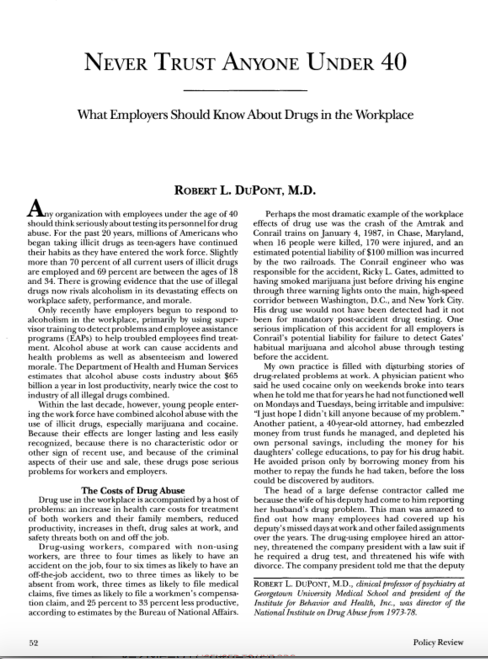
Dupont is bragging and flagging  the “blueprint” as a successful model applicable to other populations and plans to bring it to you.  Why?  To sell long-term inpatient treatment and frequent drug testing.   Dupont once recommended everyone under 40 be tested when he was 41.  This man wants to test everyone.  If he could he would test infants–hell he’d test fetuses if he could.  One thing is for certain though–if the blinkered masses don’t wake up from their apathetic slumber they will not too far from now be waking up to pee in in a cup and won’t be able to do a damn thing about it.Screen Shot 2016-02-15 at 12.09.01 AM


IMG_8894


Emergency Medicine News:
doi: 10.1097/01.EEM.0000480794.97823.49
News

News: Physician Health Programs: Coercive or Supportive?

Katz, Alissa

You wouldn’t think physician health programs — designed to help doctors recover from substance abuse — would be such a contentious topic. But more than a few physicians complain that participation is “coercive” if a physician wants to retain his license.

Figure. No caption a...

Image Tools

The programs are run on a state level, and have evolved into for-profit entities, according to physicians who have been through one. You can find one in all 48 states and Washington, D.C., charged with preventing “substance abuse problems among physicians and to detect, intervene, refer to treatment, and continuously monitor recovering physicians with substance use disorders.” (J Subst Abuse Treat 2009;37[1]:1.)

Physician health programs (PHPs) are funded a variety of ways depending on location, including state licensing board grants, fees charged to participants, and contributions from state medical associations, according to reports. When a physician agrees to cooperate with the PHP and adhere to any and all recommendations, it decreases the probability he will be subject to disciplinary action and increases the likelihood he will be able to remain in practice, PHP proponents say. But not everyone agrees.

“Participation is coercive, and once a PHP recommends monitoring, physicians have little choice but to cooperate if they have any intention of ever practicing medicine again,” J. Wesley Boyd, MD, PhD, and John R. Knight, MD, former PHP associate directors in Massachusetts, said in an editorial in the Journal of Addiction Medicine. (2012;6[4]:243.)

Physician health programs report results of compliance, including drug test results to licensing boards, credentialing agencies, and employers whether the physician is sober, compliant with his treatment, and capable of safely practicing medicine.

“Programs are generally structured to encourage professionals to get help early before the onset of problems in the workplace, but the consequences depend on the situation and the state policies,” said Warren Pendergast, MD, a psychiatrist and the CEO of the North Carolina PHP (NCPHP)

Compliance Mentality

North Carolina’s PHP was audited in 2013-2014. “There were a number of protections they wanted us to institute. There was a conflict of interest issue raised about our every-other-year retreat having a small amount of contribution from assessment and treatment centers, and we stopped that in 2012. Our policy was similar to many medical meetings sponsored by vendors,” said Dr. Pendergast.

Drs. Boyd and Knight said in their editorial the programs have a compliance mentality that reports physicians to their medical board for possible disciplinary action if they don’t comply with the program’s recommendations, depriving the physicians of having a say in their own treatment.

So why are physicians opting into these programs? Colleagues can recommend them for an evaluation and they have to comply, and others who self-refer just don’t know any better, said Susan Haney, MD, an emergency physician in Oregon, who went through treatment assigned by her state’s PHP.

“That’s the problem. You assume, as I assumed, that the medical board is staffed with caring and competent physicians, and that the health program is there to help. So you go to them naïvely asking for help or your colleagues refer you to them thinking you’ll get help. I guess some people find help. But a lot of physicians are exploited by the system,” she said.

Robert DuPont, MD, the president of the Institute for Behavior and Health and a supporter of physician health programs, said such criticisms aren’t looking at what the programs have achieved. “Outcomes are very positive, with only 22 percent of physicians testing positive at any time during the five years and 71 percent still licensed and employed at the five-year point,” according to a study Dr. DuPont co-authored. (J Subst Abuse Treat 2009;37[1]:1.)

Abstinence rates among substance-abusing physicians who engage with PHPs are in the 75 to 80 percent range, which is far higher than almost any other form of substance abuse treatment. This can be attributed to PHPs’ demographic and higher socioeconomic status, compared with those in other substance abuse programs, and the risk-to-reward ratio is often higher for PHP participants. (BMJ2008;337:a2038.)

“Programs have no leverage. They have no punishment; they have no consequences. The consequences are all kneaded out by other organizations, by the medical boards or the hospitals. I think all these critics have gotten it mixed up. The physicians who are coming to the PHPs have big problems; they’re under a lot of pressure, not from the PHP but from somewhere else.”

Back to Top | Article Outline

Costly Treatment

Dr. DuPont’s study said PHPs don’t provide formal addiction treatment, either, but instead function as long-term case managers and monitors for participants. Evaluations through PHP-recommended treatment centers aren’t usually covered by insurance, for example, and can cost as much as $4,500 for a 96-hour evaluation, if not more, and can go as high as $39,000 for a typical three-month length of stay.

“If treatment is priced so high that it is out of the reach of potential physician-patients, it does not serve the purpose for which it was created and thus represents an administrative and management failure on the part of the PHP,” Drs. Boyd and Knight wrote. (J Addict Med 2012;6[4]:243.)

Because many centers that specialize in evaluating health care professionals also provide costly treatment, Drs. Boyd and Knight said they are left wondering whether financial incentives play a role in the recommendation. Reports argue that physicians charge a lot for their time and services, so they are financially able to pay more than a non-physician would for the same treatment. “In our experience, it is far more common for physicians to simply stay at the same facility for treatment rather than packing up and moving elsewhere,” they wrote.

Evaluation and treatment centers support PHPs financially, too, adding to a potential conflict of interest between the two. Dr. DuPont said he thinks the price to pay for assessments and treatment, however, is small compared with the perspective of a lifetime of well-being. “My experience is that PHPs are certainly willing to work with physicians on cost issues. I think it’s not realistic to think the people in the programs are not going to need treatment. To me it goes without saying the treatment is part of the package,” he said.

North Carolina has a scholarship program administered through the state’s Medical Society Foundation, and the several-thousand-dollar assessments are part of the reason the program screens. “We don’t send everybody for assessment,” said Dr. Pendergast.

Share this article on Twitter and Facebook.

Access the links in EMN by reading this on our website or in our free iPad app, both available at www.EM-News.com.

Comments? Write to us at emn@lww.com.

Copyright © 2016 Wolters Kluwer Health, Inc. All rights reserved.

Flagrant Corruption by Massachusetts PHP-Help me Hold them Accountable

According to an attorney for the  Massachusetts Board of Registration in Medicine the state physician health program (PHP), Physician Health Services, Inc. (PHS),  has not committed any crimes “because they have not been charged” with any crimes.

I am not sure what type of logical fallacy she is using here but it is utter nonsense.  As an attorney she should know a crime is determined by what someone does as measured by a thing called the law.  The documents below show a flagrant case of forensic fraud, cover-up and perjury.  They also show criminal violation of HIPPA as the agency created a “clinical” sample (and therefore protected health information (PHI)) when they are not a clinical entity and not legally entitled to do so.  As a 501(c)(3) charitable corporation they cannot engage in “clinical” medical practice and are  violating their non-profit status by engaging in ultra vires acts.

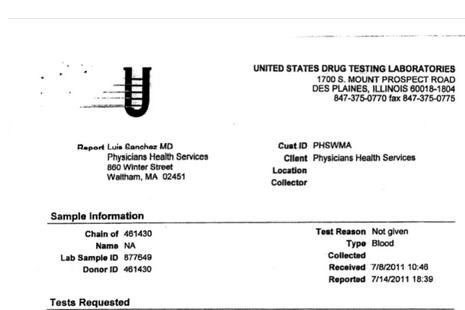
The documents below show forensic fraud.  This is undeniable and indefensible. It does not take a toxicologist or Medical Review Officer to understand what “chain-of-custody” is and that “updating” one constitutes misconduct, fraud and (as seen here) criminal activity.   These documents were obtained 5 months after a falsified test was ordered by Linda Bresnahan, Director of Operations at Physician Health Services, Inc.  in which a fax is sent to USDTL requesting my ID be added and a “chain-of-custody.

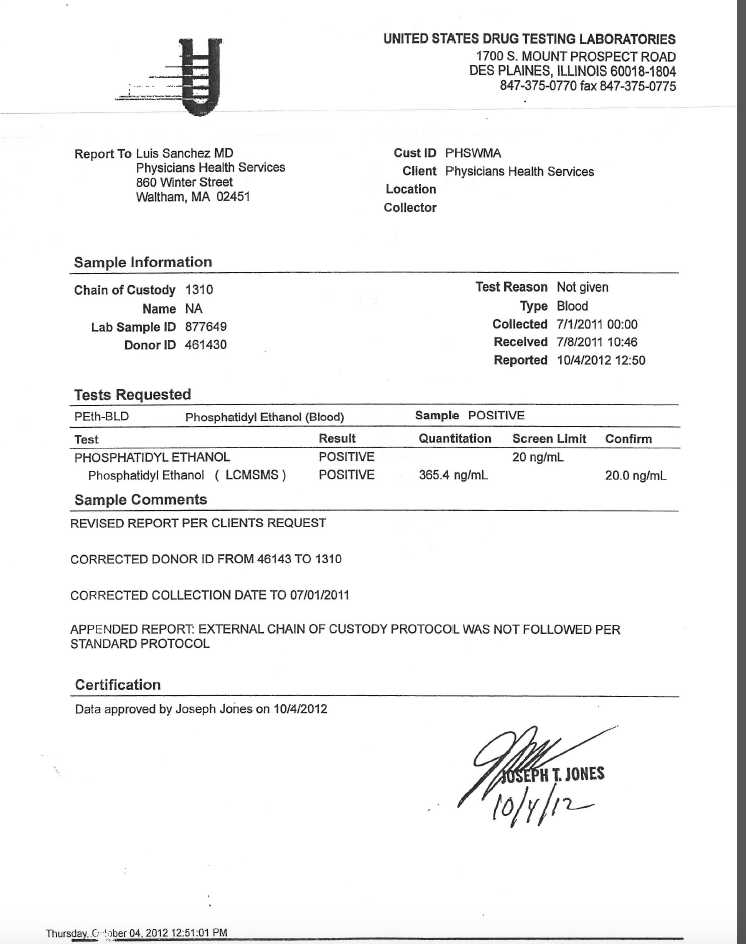
The blood test was drawn on July 1, 2011.  On July 19th, 2011 Ms Bresnahan requests (through the PHP secretary Mary Howard) that an already positive test for the alcohol biomarker phosphatidylethanol be “updated” with  ID # 1310 and a “chain-of-custody. (which is an oxymoron-a “chain-of-custody” by definition cannot be “updated.”)

Joseph Jones of USDTL does this without hesitation or any apparent compunction.   As there is increasing reports of physician suicide related to allegedly fabricated tests such as this one it is important that this be acknowledged and addressed head on.

In my opinion these are more murder than suicide and I implore anti-fraud, civil-rights and qui tam attorneys to examine the following document obtained from USDTL as it appears to be standard operating procedure:

August 6, 2014 to Langan with health materials

Unless we do something about this now this  flagrant fraud under “color-of-law” will not only continue with impunity against those already targeted but expand in scope to other segments of the population.

This information was provided to Board attorney Deb Stoller starting in 2011.  She had a moral obligation to act but apparently suppressed all of the documents to protect Dr. Sanchez and PHS.  The official “administrative record” contains none of it.

All of the documents below are missing from the official “administrative record” submitted to the  Massachusetts Supreme Judicial Court by the  Board of Registration in Medicine.

12:3:2011 Litigation Packet (Selected)

9:3:2015 Petition
MLLv3finalJacob Hafter Esq

2:24:2015 Petition to Board

1:20:2015 Petition to Invalidate Suspension
Establishment Clause Docs (selected) copy

The documents speak for themselves.  ID # 1310 just happens to be my ID number.  When I complained that no one ever accused me of ever having an alcohol problem she replied:

“You have an Irish last name-good luck finding anyone who will believe you!” 

For a more detailed analysis see here, here and here.  And where was the Medical Review Officer during all of this?  Good question and one he will not answer!  And no one else is holding him to account.

This is public corruption and state PHPs are in need of reform.

This needs to be addressed now.  It is my understanding they have convinced law enforcement that doctors are under their turf and that the AGO has agreed to defer to their judgment.  This shows why that is not good public policy. Neither the PHP nor the lab testing agency has any meaningful oversight.  No accountability or answerability exists.

So please read through this and either justify it or help me expose it.   Doctors are killing themselves because of this racket and being a bystander is not an option.


Screen Shot 2014-11-06 at 11.17.32 PM


IMG_8756 2


IMG_8758 2


IMG_8757 2


Screen Shot 2014-11-04 at 11.38.57 PM


Screen Shot 2015-03-12 at 10.40.47 PM

Screen Shot 2015-09-11 at 3.10.07 AM


Screen Shot 2015-09-11 at 3.07.23 AM

Screen Shot 2015-09-10 at 5.27.26 PM

Screen Shot 2014-11-06 at 11.17.32 PMimgres-8

Laboratory developed tests (LDTs) have no FDA or CLIA oversight.  Avoiding regulatory oversight is just one of the ways those involved in the use of these tests avoid accountability.  Without answerability to third parties they have essentially removed themselves from consequences.

College of American Pathologists (CAP) accreditation is the sole avenue for complaint.  CAP does not sanction.  They only have the ability to educate lab to come under compliance with CAP standards under threat of loss of accreditation and it is under this threat that they can force a laboratory to correct both unintentional and intentional errors.  This is what was done in my case.

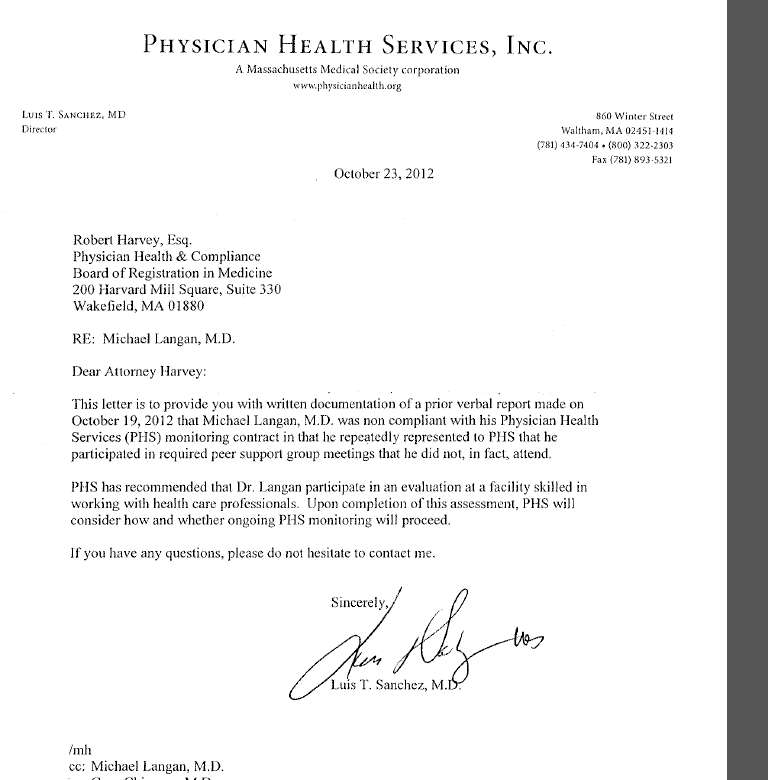
I filed a complaint with CAP in January of 2012.  The “Litigation packet ” showing forensic fraud was sent to CAP and I was informed that the investigation could take many months.    In October of 2012 I was suddenly reported to the Board of Registration in Medicine for  “noncompliance” with AA meetings (that were the sole and direct result of this test) and action was taken against my medical license which resulted in my suspension.

In December of 2012,  the Chief Investigator for CAP, Amy Daniels  called me to see how I was doing in light of the “amended” test.  She told me that the test had been invalidated on October 4, 2012.   I told her this was news to me as I was in the process of being suspended for “noncompliance” and called the Director of Operations at Physician Health Services (PHS) Linda Bresnahan who predictably told me she was unaware of any revision to the test.

But the very next day a letter was  sent out  signed by PHS Medical Director Dr. Luis Sanchez, M.D. stating that they had just  found out about the amended test on December 10. 2012, the day before when I called them.  Interestingly the letter acknowledged the invalidity of the test but  stated PHS and the BORM would  “continue to disregard” it.  Sanchez also made it a point in the letter to state they were  were not aware of any consequences resulting from it.  They denied any knowledge of an October 4, 2012 revision which would have been 67-days earlier than this acknowledgment and dismissal of the test.

In response to 93-A demand letters from my attorney for fraud, PHS, Quest and USDTL all refused to consider any damages by blaming my suspension on me.   They claimed my suspension was due to my “noncompliance” with attending AA meetings that was officially reported to the Board October 18, 2012.     The claimed the test that was used as a stepping-stone for all subsequent adverse events was completely irrelevant and had nothing to do with anything.    This is what is known as “moving the goalpost.”   What they did not know was that I would eventually be able to get the document proving they knew what they knew and when they knew it.

The response letters revealed important information that was previously only speculative with no way to prove.  Both labs, in defense, claimed that  the test was sent as “clinical” specimen at the request of PHS (an ultra vires out of scope act as they are a 503(B) charity. PHS is not a healthcare provider and is not authorized to practice medicine.

PHS and the labs were apparently unaware of the new HIPAA Privacy rule that requires labs to provide patients with their lab tests without approval from the agency ordering the test.  PHS had previously refused to provide labs by hiding under confidentiality and medical records regulations.

At first they refused but CAP and the DOJ -civil rights division forced USDTL to provide the document below dated October 4, 2012 informing Dr. Luis Sanchez of the amended test he reported in a signed letter to a state agency that he had just found out about December 10, 2012.  The letter undeniably shows Sanchez lied to a state agency in a written letter.  This is also a prima facie crime.  It is just one of many crimes that Board Attorney Deb Stoller has facilitated for PHS as her job is to ignore, suppress, minimize and deflect any criminal acts committed by PHS and protect them.  And this needs to be made public.  PHS needs to be held accountable.  So too do the actions of Ms. Stoller whose job as an agent of the state makes her involvement even more egregious than the perpetrators.

The documents below show a clear violation of M.G.L. 256 (B) Section 69 done under Color of Law.

Screen Shot 2014-11-10 at 1.34.48 PM

Title 18, U.S.C., Section 242
Deprivation of Rights Under Color of Law

This statute makes it a crime for any person acting under color of law, statute, ordinance, regulation, or custom to willfully deprive or cause to be deprived from any person those rights, privileges, or immunities secured or protected by the Constitution and laws of the U.S.

This law further prohibits a person acting under color of law, statute, ordinance, regulation or custom to willfully subject or cause to be subjected any person to different punishments, pains, or penalties, than those prescribed for punishment of citizens on account of such person being an alien or by reason of his/her color or race.

Screen Shot 2015-01-08 at 10.04.47 PM


Screen Shot 2015-04-07 at 4.52.21 AM

Screen Shot 2015-04-07 at 5.00.04 AM

Screen Shot 2015-04-07 at 5.00.40 AM

Screen Shot 2015-04-07 at 4.50.05 AM

Screen Shot 2014-11-10 at 1.34.48 PM

Screen Shot 2014-11-10 at 1.25.03 PM

False Statements Relating to Health Care Matters (18 U.S.C. § 1035) It is a crime to knowingly and willfully falsify or conceal a material fact, make any materially false statement, or use any materially false, fictitious, or fraudulent writing or document in connection with the delivery of or payment for health care benefits, items, or services. 11 Chapter 2 ~ Summary of Fraud and Abuse Laws


Mail and Wire Fraud (18 U.S.C. §§1341 and 1343)  Statutes, which prohibit the use of the mails or the wires to further “schemes” to defraud


Perjury and False Statements

PERJURY BY WRITTEN INSTRUMENT. 

FALSE STATEMENTS (18 U.S.C. § 1001)

This statute prohibits the making of any false, fictitious, or fraudulent statement to the United States or a government agency. This statute is exceedingly broad: It covers any statement or representation made to the government or any of its agents. A statement can be made either orally or in writing, and it can be sworn or unsworn.


Screen Shot 2014-11-10 at 1.36.13 PM

BTwgkTwCMAABmSA

Supression of Dissent: Basic Information