How False Constructs Come to Be Regarded As Irrefutable Truth: The “Disruptive Physician”, Addiction Medicine Specialists and the 21st Century Inquisition of Doctors–Let’s See if She Floats!

Screen Shot 2014-02-24 at 9.19.46 AM“This physician may be clinically competent; indeed, he may be technically superior. However, no one wants to refer patients to him. No one wants to assist him in surgery. He is the one who screams at nurses, belittles medical students and makes criticisms that go beyond the bounds of fair professional comment. However, he is not always loud. He can be the passive physician who will not answer the pager while on call, who does not show up at meetings and will not help find solutions to departmental problems. Indeed, this physician is not always male, but more often than not that seems to be the case.”

So begins “The Dreaded Task of Confronting Disruptive Physicians,” 1 a call to arms by Dr. Graeme M. Cunningham, M.D. (Fellow of the American Society of Addiction Medicine) published in the Journal of Medical Licensure and Discipline in 2004  (The official publication of the  Federation of State Medical Boards (FSMB)) that helped launch a new paradigm for all those concerned with the physician “who has long eluded regulatory action, even though his behavior may have posed a risk to patient care and created chaos in his workplace for a number of years.”1

These experiences lead us to the tentative conclusion that disruptive behavior, if not dealt with properly, is often the symptom of a greater underlying problem that will impede the safe practice of medicine. What may seem to be largely an annoyance could be a symptom, endangering patients. If identified early, disruptive physicians can be effectively treated and should be referred to appropriate programs for treatment.2

Screen Shot 2014-02-24 at 12.03.38 AM

The American Society of Addiction Medicine and Federation of State Physician Health Programs (PHPs) set forth definitions of disruptive behavior, rules of evidence and regulation and the administrative procedures by which suspected doctors were “evaluated” and removed from practice.3

Written by the PHP doctors for PHP doctors, the disruptive physician construct came to be regarded as irrefutable truth and contributed to the identification and removal of an undetermined number of medical doctors. Although there was a general belief in “disruptive physicians” at the time of this call to arms they were not regarded as evil or life threatening. Society did not fear them and hospital administration and regulatory medicine did not feel the need to hunt them down. There were many scholars who publicly doubted this epidemic of disruptive physicians at the time. That would soon change.

Screen Shot 2014-02-24 at 12.03.58 AM

On July 9, 2008 the Joint Commission became so concerned about “behaviors that undermine a culture of safety” that it issued a “Sentinel Event Alert” on the topic and developed a “Leadership Standard” requiring all hospitals to have a code of conduct as well as a process for managing disruptive and inappropriate behaviors.4-6

BitxKjHCIAAcDvB

In 2011 the Federation of State Medical Boards issued an updated “Policy on Physician Impairment” giving full authority to physician health programs in the evaluation, treatment and ultimate fate of these doctors. The  FSMB House of Delegates adopted an updated Policy on Physician Impairment at their annual meeting distinguishing “impairment” and “illness”  stating that

“Regulatory Agencies should recognize the PHP as their expert in all matters relating to licensed professionals with “potentially impairing illness.”

Screen Shot 2015-03-29 at 11.02.09 PM

According to the FSPHP, physician illness and impairment exist on a continuum with illness typically predating impairment, often by many years.” The policy extends PHP authority to cover physical illnesses affecting cognitive, motor, or perceptive skills, disruptive physician behavior, and “process addiction” (compulsive gambling, compulsive spending, video gaming, and “workaholism”). It also defines “relapse without use” as “behavior without chemical use that is suggestive of impending relapse.”

From the mid 1980s until present day a confederacy of “authorities” calling themselves “addiction medicine” specialists assisted in identifying disruptive physicians. Shaping clinical and legal orthodoxy they set the standards that cooperating regulatory authorities could follow in criminalizing, persecuting and punishing heretics.imgres

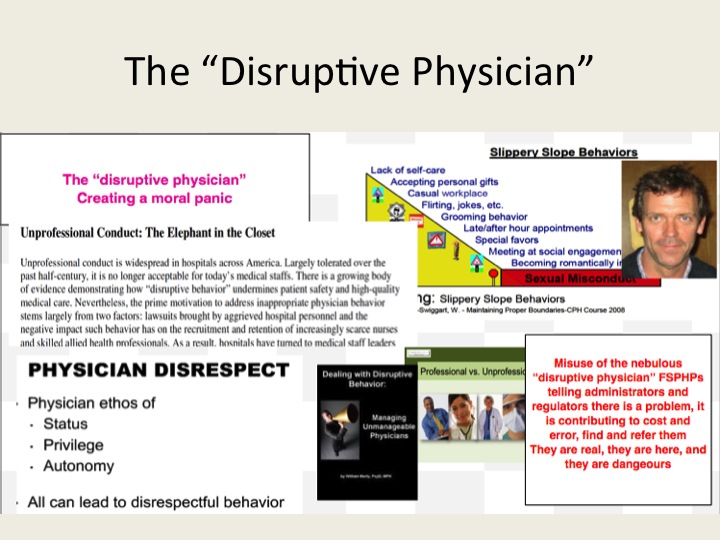
Behavioral manifestations included not answering pages on time, untimely or illegible chart notes, being late for meetings and questioning hospital authority.   Disruptive physicians were blamed for everything—patient morbidity and mortality, increasing malpractice costs and decreased hospital revenue.

Using the nebulous “disruptive physician” label, anyone with a grudge or suspicious could accuse anyone of misbehavior, malice and mayhem.

Propaganda, threats, misinformation, guild assumed from the start, PHP oversight of disruptive physician persecution was standard.
Screen Shot 2015-03-29 at 11.00.37 PM

During the state PHP “disruptive physician” with-hunts the legal notion of crimen exceptum (an exceptional and most dangerous crime) allowed for the suspension of normal rules of evidence to punish the guilty.

Because of the nature of the enemy the evidentiary bar was lowered and any witness, no matter what his credentials, could report a doctor to the state PHP.

Belief in the seriousness of the situation rationalized cruelty.

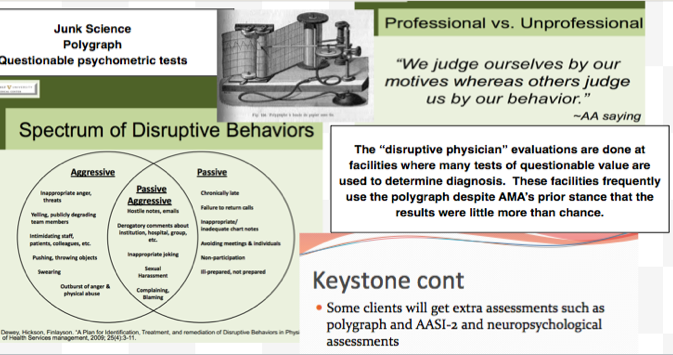
Professional experts used lie-detector tests (polygraphs), non-validated neuropsychological instruments, and non-FDA approved drug and alcohol tests to confirm the accusations.   The accused often did not pass these tests due to “tailoring” the results to fit the PHPs wishes and often received positive biomarker tests due to the ubiquity of the chemicals tested for. Bananas, sauerkraut, bakers yeast, urinary tract infections and hand sanitizer were often the cause. False accusations, if exposed, were excused if they were a result of “zeal for the faith.”

The consequences of being branded a heretic by questioning the existence “disruptive physicians” essentially silenced any dissenting voices and the notion of crimen exceptum freed the consciences of those involved.

Sanctimony, feigned piety and hypocritical devoutness was used as justification.  After all–Torture and torment are a small price to pay when it comes to protecting the public and saving souls.

Through the “disruptive physician” trials clerics, “addiction medicine” specialists, psychologists, neuropsychologists, commercial drug-testing labs, assessment and rehabilitation facilities and lawyers used their expertise as witnesses to increase their prestige.   The “disruptive physician” developed into a means of economic profit.  Some gained a lot of money from the “disruptive physician”.  The accused doctor and his or her relatives paid out of pocket for those who worked the “disruptive physician” trials including those doing the testing, assessment and treatment.
Slide40

“Witch hunting,” wrote the historian Rossell Hope Robbins, “was self-sustaining and became a major trade, employing many people, all battening on the savings of the victims.” So too is hunting the “impaired,” “disruptive” and “aging” physician and the costs are usually paid by the accused.

Their property was lost to pay the revolving door of testing, assessment and treatment and those overseeing it raked in increasingly large sums of money as well as other reliable assets. A doctor accused could easily be ruined permanently.

In 1592 Father Cornelius Loos wrote:

“Wretched creatures are compelled by the severity of the torture to confess things they have never done and so by cruel butchery innocent lives are taken; and by new alchemy, gold and silver are coined from human blood.”

And in 2015 nothing has changed.

Context, characters and circumstances may differ but the mechanics do not.

The mosaic remains the same.  

False constructs come to be regarded as irrefutable and the creation and chains of causation remain timeless

Screen Shot 2015-03-12 at 11.17.43 PM

  1. Cunningham GM. Editorial: The Dreaded Task of Confronting Disruptive Physicians. Journal of Medical Licensure and Discipline. 2004;90(2):6-7.
  2. Summer GL, Ford CV, Lightfood WM. The Disruptive Physician, I: The Alabama Physicians Recovery Network. Federation Bulletin. 1997;84(4):236-243.
  3. Bohigian GM, Bondurant R, Croughan J. The impaired and disruptive physician: the Missouri Physicians’ Health Program–an update (1995-2002). Journal of addictive diseases. 2005;24(1):13-23.
  4. Grenny J. Crucial conversations: the most potent force for eliminating disruptive behavior. Physician executive. Nov-Dec 2009;35(6):30-33.
  5. Huff DJ, Cline LE. Another reason to be on your best behavior: the Joint Commission’s new disruptive physician standard. Journal of the Medical Association of Georgia. 2009;98(2):17-18.
  6. Leiker M. Sentinel events, disruptive behavior, and medical staff codes of conduct. WMJ : official publication of the State Medical Society of Wisconsin. Sep 2009;108(6):333-334.Max-1


cropped-images-4.jpeg

“The belief that there are such things as witches is so essential a part of the faith that obstinately to maintain the opposite opinion manifestly savors of heresy.”  

So begins Malleus Maleficarum , a witch hunters manual published in 1486 that  launched a new paradigm for all those concerned with the identification and extirpation of witches.  Used as a judicial case-book the Malleus set forth definitions of witchcraft, rules of evidence, and the canonical procedures by which suspected witches were tortured and put to death.   Written by Inquisitors for Inquisitor, the Malleus construct came to be regarded as irrefutable truth and contributed to the identification and execution of as many as 60,000 “witches”, predominantly women.  The 29th and last edition was published in 1669.

images-16

Although there was a general belief in witches at the time theas published they were not regarded as evil or life threatening.  Society did not fear them and Church and Political authority  certainly did not feel the need to hunt them down.   There were many scholars who publicly doubted the existence of witches at the time.  That would soon change.

hanging_witch_01

After being snubbed by secular and ecclesiastical authorities in his witch-hunting pursuits, the  Dominican friar and German Inquisitor Heinrich Kramer told Pope Innocent VIII of a  dangerous outbreak of witches that had occurred in the region.    This diabolical conspiracy hell-bent on destroying humanity needed to be identified and destroyed for the public good, but church authorities were not cooperating.

On December 5th, 1484 Pope Innocent VIII issued the papal bull Summis Desiderantes affectibus giving full authority to proceed with “correcting, imprisoning, punishing, and chastising” such persons “according to their deserts,”  and threatening to sanction or excommunicate those who hindered the pursuit.

images-18From the late 15th century through the early 17th century a confederacy of “authorities” calling themselves demonologists assisted in identifying witches. Shaping ecclesiastical orthodoxy they set the standards that cooperating political authorities could follow in criminalizing, persecuting and punishing heretics.

Behavioral manifestations  included living alone, cultivating strange herb and saying hello to a neighbors cat.Witches were blamed for everything—plague, crop failure, and erectile dysfunction.

Using the nebulous “witch label” anyone with a grudge or suspicion could accuse anyone of witchcraft .

Propaganda, threats, misinformation, guilt assumed from the start.

male31Physician oversight of witch persecution was standard.

During the European witch-hunts the  legal notion of crimen exceptum (an exceptional and most dangerous crime] allowed for the suspension of normal rules of evidence to punish the guilty.

Because of the nature of the enemy the evidentiary bar was lowered and any witness, no matter what his credentials, could testify against the accused.

Belief in the seriousness of the situation rationalized cruelty.

Diable

The Devil’s mark (Stigmata diaboli) was taken as the mark of a witch entailing close inspection.

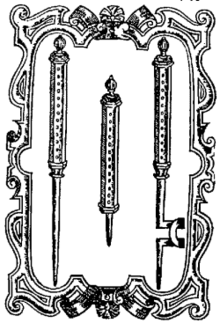
Professional witch-prickers used  needles, pins and bodkins to poke the skin with lack of bleeding confirming the accusation.   The accused did not bleed due to retractable needles and sleight of hand.   False accusations, if exposed, were excused if they were a result of “zeal for the faith.”

The consequences of being branded a heretic  by questioning the existence of witches essentially silenced any dissenting voices and the notion of crimen exceptum freed the consciences of those involved.
220px-Witch-pricking_Needles00

Sanctimony, feigned piety and  hypocritical devoutness was used as justification.  After all–Torture and torment are a small price to pay when it comes to protecting the public and saving souls.

Through the witch trials clerics, doctors, and lawyers used their expertise as witnesses to increase their prestige.  Witch hunts developed into a means of economic profit.  Some gained a lot of money from the witch trials.  The witch or her relatives paid for the salaries of those who worked the witch trials including judges, court officials, torturers, physicians, clergymen, scribes, guards, attendants. Even the people who made the stakes and scaffolds for executions gained from the conviction and death of each witch.

matthew“Witch hunting,” wrote the historian Rossell Hope Robbins, “was self-sustaining and became a major trade, employing many people, all battening on the savings of the victims.”

The costs of a witch trial were usually paid for by the estate of the accused or their family.

Far from the conventional image of a penniless hag, a significant proportion of accused witches, especially in Germany, were wealthy and male.

Their property was seized to pay the clergymen, judges, physicians, torturers, guards, scribes, and laborers who raked in increasingly large sums of money as well as other reliable assets.

With a single member accused, a moderately wealthy family could be ruined permanently.

In 1592 Father Cornelius Loos wrote:

Wretched creatures are compelled by the severity of the torture to confess things they have never done and so by cruel butchery innocent lives are taken; and by new alchemy, gold and silver are coined from human blood.

cropped-hanging_witch_01.jpg

 Context, characters and circumstances may differ but the mechanics do not.

The mosaic remains the same.  

The Malleus shows how false constructs come to be regarded as irrefutable and the creation and chains of causation are timeless.

barbier_spielkarte_um_1455_teaser

← Back

Thank you for your response. ✨


Junk-Science in the Medical Profession: The Resurgence of Polygraph “Lie-Detection” in an age of Evidence-Based Medicine

Junk-Science in the Medical Profession: The Resurgence of Polygraph “Lie-Detection” in an age of Evidence-Based Medicine.

33755_1527129670651_5081648_n

Circa 1995

The article below was published in the now defunct magazine Gray Areas almost twenty years ago. (Vol. 4, No. 1, Spring 1995 pp. 75-77).   Antipolygraph.og founder George Maschke noted in 2008 that article “makes a good introduction to the pseudoscience of polygraphy” and “the criticisms of polygraphy remain valid today.”  They still do.

images-3

The Art of Deception: Polygraph Lie Detection

By Michael Lawrence Langan, M.D.

I’d swear to it on my very soul, If I lie, may I fall down cold.”

– Rubin and Cherise
(Hunter/Garcia)

The accuracy of polygraphic lie detection is slightly above chance. Nevertheless, State and local police departments and law enforcement agencies across the United States are devoted proponents of this unscientific and specious device. In addition, the American public seems to lend an implicit credence to the “lie detector” as evinced by its ubiquitous use on television crime shows and in “whodunit” literature. It is given overt attributions of credibility on tabloid type talk shows and news shows. For example, in the highly publicized case of Tonya Harding a reporter stated, not with removed objectivity but with sardonic grin and mocking emphasis, that the accused had failed two polygraph tests. The implied assumption is that if the person has failed the polygraph test, then therefore he or she is guilty regardless of other evidence. Bottom line. Culpa ex machina. End of story.

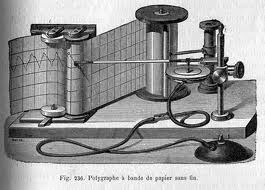
Lie detection by the polygraph is based on the premise that the act of telling a lie causes specific, universal, and reproducible physiological responses as manifested by the autonomic nervous system. (Saxe, 1991) These physiological responses, which are largely outside the influence of voluntary control, are then measured by the polygraph instrument. The polygraph itself is simplistic in design. It consists of several devices which are attached to the subject to record blood pressure, pulse, respiration, and galvanic skin response (which is related to perspiration). The results are then recorded on a moving paper by a “kymograph.” Hence any change of one of the autonomic nervous system variables will be recorded on the paper as a change from baseline. The polygraph examiner then interprets the tracing. A characteristic change from baseline on a relevant question is interpreted as a lie.

images-5

In fact, the polygraph test does measure autonomic nervous system activity. The role of the autonomic nervous system with its sympathetic and parasympathetic branches is well defined within the field of medicine, and was well described by the French physician Claude Bernard over a century ago. The primary role of the autonomic nervous system is to maintain bodily homeostasis to allow the individual to exist in a changing environment.

Simplistically described, the autonomic nervous system is a part of the peripheral nervous system which consists of a variety of outgoing nerve pathways that regulate important physiological functions generally outside of voluntary and conscious control. Thus, respiration, body temperature, heart rate, digestion, sweating, and blood pressure are all, partly or entirely, regulated by the autonomic nervous system. It is divided into sympathetic and parasympathetic branches which have contrasting functions in terms of effect. The sympathetic branch increases heart rate, respiratory rate, blood pressure, and perspiration. It is active at all times but varies with the constantly changing environment, and is especially active during rage or fright and prepares the body for the so called “fight or flight” phenomenon. Many of these reactions are caused by the release of epinephrine. The parasympathetic nervous system, on the other hand, is primarily involved with conservation and restoration. It is the sympathetic branch of the autonomic nervous system that the polygraph measures in terms of its activity. Thus, from a medical perspective it is entirely valid that the polygraph will accurately measure sympathetic nervous system activity with its instrumentation.

The false assumption of the polygraph test is that dishonesty is the sole cause of sympathetic arousal during a polygraph examination. Deception is a cognitive phenomenon that cannot be measured. Indeed, throughout the entire history of medicine there has not been a single scientific study that demonstrated evidence that a cognitive phenomenon (such as love, hatred, truth, altruism, jealousy) could be measured. Since, in the complex realm of truth and deception, there is no known physiological response that correlates with lying, then there is no validity to the test. Although the act of lying can elicit fear and anxiety via the sympathetic nervous system, so can multiple other confounding and complex emotional factors including stress, embarrassment, anger, and fear. “Deception itself cannot be measured directly.” (Steinbrook, 1992) In addition, each individual differs in autonomic lability. Some people stay calm with a gun at their head. While others get autonomically excited, with heart thumping and palms sweating at simply shaking someone’s hand.

In reality, the examination itself is inherently designed to elicit fear and anxiety. It is an interrogation. If this fear and anxiety are recorded on a relevant question, then you have failed that question according to the polygraph “experts.”

The polygraph technique begins with a pre-test. After a sixth-grade level lecture on the nervous system and a proclamation of the test’s infallibility, the examiner will go over all of the questions that have been formulated.

These questions consist of control questions, relevant questions, and irrelevant questions. The subject will then be attached to the polygraph equipment and the formal testing begins.

The most crucial questions on the polygraph examination, or “Control Question Test,” are the control questions and relevant questions. The control questions are garnered from the suspect by asking him an innocuous question which could not be truthfully denied. For example, “Have you ever thought of hurting someone?” or “Have you ever lied to anyone?” The responses to the control questions will elicit some degree of autonomic activity which can then serve as a baseline for which to compare subsequent questions. The relevant questions pertain to the actual investigation at hand. The magnitude of responses to relevant questions and control questions as compared with the irrelevant questions is then interpreted, in a non-blinded manner, by the examiner. The assumption is, that if you are prevaricating, the relevant questions will cause a greater response than the control questions. So if the question “Have you ever been late for an appointment?” (control question) elicits less of an emotive response on the polygraph equipment than “Did you murder and rape your girlfriend?” (relevant question) you have failed the test. And, according to the American Polygraph Association (APA) you are lying. Assuming the subject is innocent, it is fairly obvious that he would respond with more emotional autonomic activity to a question regarding a recently deceased loved one than he would an inquiry about punctuality. Obvious to everyone, that is, but the APA.

The APA is a professional organization for polygraph examiners who have complete faith in the accuracy of the test. They have their own trade journalPolygraph in which they report scientifically worthless studies and brandish anecdotes of the wonders of their trade. The majority of these members can pride themselves on completing a 6 week to 6 month post- high school training course in the art of polygraphy. They have no formal training in medicine, psychology, physiology, or behavior; the very disciplines on which the testing is based. The majority of them cater to the legal system wherein their economic livelihood depends.

Since they are primarily paid to identify guilty suspects, motivational factors may play a part in their eagerness to find the guilty suspect. (Kleinmuntz, 1987)

The accuracy of any test is determined by that test’s sensitivity (ability to find a positive) and specificity (ability to find a negative). A polygraph examiner will ardently tell you that the exam has somewhere in the neighborhood of a 95% sensitivity rate. This means that if 100 guilty suspects are given a polygraph exam, 95 of them will be detected through the test. Only five of the 100 will be a false negative and not be detected by this miraculous method. Likewise they will claim a similar specificity rate, and state that if you are telling the truth then you have almost a 100% chance of being cleared by the test. John Reid, the inventor of the Control Question Test claimed 99% accuracy. (Reid and Inbau, 1977)

This is clearly not accurate. The polygraph was not subjected to much critical and scientific investigation until the last two decades. (Saxe, et al., 1983) Since this time there have been a number of studies of sound scientific design and methodology which clearly refute the high specificity and sensitivity that polygraph advocates claim. These studies have appeared in reputable peer-reviewed journals and not trade publications. Horvath, for example, reported a sensitivity of 76 percent and a specificity of 52 percent. (Horvath, 1977) This means that out of 100 liars 76 of them will be detected by the polygraph. What is astonishing though is the specificity of 52 percent. This means that out of 100 people who are not lying, 52 will be identified as telling the truth while 48 of the honest individuals will be branded as liars. The odds are similar to that of a coin toss which would have a specificity of 50 percent. Barland and Raskin’s study actually demonstrated a specificity of 45%. Worse than a coin toss. (Barland and Raskin, 1976) Multiple other studies have shown similar results. (Brett, et al., 1986, Kleinmuntz and Szucko, 1984, Lykken, 1984).

The polygraph examiner likens his “skill” to that of the radiologist reading a chest X-Ray or a cardiologist interpreting an EKG. (Barefoot, 1974) This analogy is not only ridiculous but, in fact, if a medical test had a similar sensitivity and specificity to that of the polygraph examination it would simply not be used in the field of medicine. They will cite the fact that the polygraph has been used in the United States for greater than 70 years as if longevity is directly related to validity. They will state that they have personally administered hundreds or thousands of these tests, and have almost never been wrong, as if total number of tests given constitutes accuracy.

They are so convinced of the accuracy of the polygraph that they regard opponents of polygraphy as communists and do-nothing professors. (Arther, 1986) It doesn’t occur to them that someone with a Ph.D. and years of research experience, in the very subjects they ignorantly dabble in, may know something more than they do.

It is astounding that the criminal justice system has institutionalized and perpetuated a so called “technology” that lacks scientific evidence and is in fact rejected by the scientific community. It is as ludicrous as procuring the so called “love meter” machine from the amusement park which measures galvanic skin response and placing it in the courtroom. But in a backward legal system which has been known to use psychics to help with unsolved murders and has allowed the mentally retarded to serve as jurors, it is not entirely surprising.

The tool is useful to them, however, in that 25 to 50 percent of examinees will, under the tense psychological pressure of the exam, confess to the misdeed at hand. (Lykken, 1981, Lykken, 1991) Persuaded that they have been proven dishonest by “scientific” means they give up hope. It is usual for the polygraph examiner to interrogate the subject who has failed the test. They will state that there is no way now to deny the objective guilt demonstrated by this impartial and unbiased scientific device, and that the only available option is to confess.

The assessment by the polygrapher is genuinely convincing because, sadly, he believes it himself. Thus the instrument is clearly useful as a confession inducing device. One wonders, over the past 70 years, how many false confessions have been obtained in this way from innocent persons.

In summary, the polygraph is a ludicrous implementation of pseudo-science at its worst. The members of the APA are non-scientists practicing science, and the consequences are often dire. Lykken reports the cases of three men who were convicted of murder largely due to the polygraph examiner’s testimony that in their “expert opinion” they had failed the test. All three were subsequently found to be innocent. (Lykken, 1991) Polygraph examiners ignore such cases or rationalize that they are due to the rare incompetence of some examiners.

The continued use of polygraphic lie detection has the potential to cause much harm to those who are judged dishonest by its results. The specificity and sensitivity are not dissimilar to that of a coin toss. Innocent suspects have about a 50/50 chance. One failure is all it takes to ruin your life. Since the 1923 Federal Court decision of Frye vs United States (293 F 1013 [DC Cir 1923]), polygraph evidence has not been admissible in federal court cases because there was deemed a lack of scientific validity to the test. This travesty however is still used widely by the state court system. Furedy characterizes the continued use of polygraphy as a serious “social disease.” (Furedy, 1987) State laws regarding abuse of the polygraph must change, and it is time for the medical and scientific communities to educate lawmakers and policy makers about the true validity of this perversion of science. It must be forever banished to the same realm of parapsychology as the Ouija Board, phrenology, and palmistry. The relatively conservative American Medical Association’s Council on Scientific Affairs recommended that the polygraph not be used in pre-employment screening and security clearance. (Council on Scientific Affairs, 1986) It is time to extend this recommendation across the board, and put the greater than 3000 anachronistic polygraph examiners in the United States out of business.

Meanwhile, if you are asked to take a polygraph test–don’t do it. Those involved in the criminal justice system, including lawyers, are largely uneducated in the realm of scientific scrutiny and experimental methodology.

They may not separate science and pseudo-science, and erroneously believe that the polygraph is an accurate scientific instrument. Their interactions are with polygraph examiners who proselytize its use, and they have little or no interaction with scientists, psychologists, and physicians who refute its use. Refuse to take the test and educate them. Cite the Frye doctrine, go to the medical library, copy the scientific articles which belie its validity, and present them to whomever requested you to take the test. State that the principles and assumptions underlying polygraphy are not supported by our understanding of psychology, neurology, and physiology. Then put the burden of proof on their heads. Tell them to present you with scientific evidence that corroborates the validity of the test. There is simply no rational basis for a machine to detect liars.

References

Arther RO. 1986. The polygraph’s enemies: An update. Journal of Polygraph Science. 20: 133-136.

Barefoot J. 1974. The Polygraph Story. Cluett Peabody and Co., New York.

Barland, G, Raskin D. 1976. Validity and reliability of polygraph examinations of criminal suspects (Report 76-1, Contract 75 NI-99-0001).

Brett AS, Phillips M, Beary JF. 1986. Predictive power of the polygraph: Can the “lie detector” really detect liars? The Lancet. 1: 544-547.

Council on Scientific Affairs. 1986. Polygraph. Journal of the American Medical Association. 256: 1172-1175.

Furedy JJ. 1987. Evaluating polygraphy from a psychophysiological perspective: a specific-effects analysis. Pavlovian Journal of Biological Sciences.22: 145-151.

Horvath F. 1977. The effect of selected variables on interpretation of polygraph records. Journal of Applied Psychology. 62: 127-136.

Kleinmuntz B. 1987. The predictive power of the polygraph: The lies lie detectors tell. Journal of the American Medical Association. 257: 189-190.

Kleinmuntz B, Szucko J. 1984. A field study of the fallibility of polygraphic lie detection. Nature. 308: 449-450.

Lykken D. 1984. Polygraph Interrogation. Nature. 307: 681-684.

Lykken DT. 1981. A tremor in the blood: Uses and abuses of the lie detector. McGraw-Hill, New York.

Lykken DT. 1991. Why (some) Americans believe in the lie detector while others believe in the guilty knowledge test. Integrative Physiological and Behavioral Science. 26: 214-222.

Reid JE, Inbau FE. 1977. Truth and deception: The polygraph (“lie detector”) technique. Williams & Wilkins, Baltimore.

Saxe L. 1991. Science and the CQT polygraph: A theoretical critique. Integrative Physiological and Behavioral Science. 26: 223-231.

Saxe L, Dougherty D, Crosse T. 1983. Scientific validity of polygraph testing: a research review and evaluation. Conference: OTA-TM. U.S. Congress Office of Technology Assessment.

Steinbrook R. 1992. The polygraph test – A flawed diagnostic method. The New England Journal of Medicine. 327: 122-123.

png-1


← Back

Thank you for your response. ✨


Transcription and HTML by AntiPolygraph.org

Published in Gray Areas, Vol. 4, No. 1 (spring 1995), pp. 75-77. This article may also be downloaded as a 1 mb scanned PDF file.https://antipolygraph.org/articles/article-053.pdf


AntiPolygraph.org Home Page > Reading Room

graycvr7

Lies, And Cover-ups – An American Business Policy

rustygarnersmith's avatarMy Blog News And Blues Reviews

This is a comment I found on a blog out there. It may affect any of us, were we in a profession that requires drug and substance testing. A friend of mine, Michael Langan is a doctor of medicine. As laws are in effect that mandatory licit and illicit substance testing is required, my friend has been framed.

The lab where this testing is done made some mistakes, and to cover up their blunders, have falsified documents. This wasn’t done to Michael to hurt him. It was done to cover their butts, and save the company name.

The lab is just another big business, whose sole purpose is to make money, and if their results were to show inattentive and sloppy work, it may invalidate all of the tests run by said lab. The lab can’t have that, so Michael is supposed to allow an injustice done to him.

Michael…

View original post 436 more words

Physician Suicide, the “Impaired Physician Movement” and ASAM: The Dead Doctors at Ridgeview Institute under G. Douglas Talbott

mllangan1's avatarDisrupted Physician

Physician Suicide, the “Impaired Physician Movement” and ASAM: The Dead Doctors at Ridgeview Institute under G. Douglas Talbott.

In May 1999 G. Douglas Talbott stepped down as president of the American Society of Addiction Medicine (ASAM) as a jury awarded Dr. Leonard Masters a judgment of $1.3 million in actual damages and an undisclosed sum in punitive damages for fraud, malpractice, and the novel claim of false imprisonment.

The fraud finding required a finding that errors in the diagnosis were intentional. Masters, who was accused of overprescribing narcotics to his patients was told by the director of the Florida Physician Health Program (PHP) that he could either surrender his medical license until the allegations were disproved or submit to a four-day evaluation.

Thinking he would have an objective and fair evaluation, Masters agreed to the latter.  He was instead diagnosed as “alcohol dependent” and coerced into “treatment under threat of loss…

View original post 730 more words

Disrupted Physician 101.1: The “Impaired Physician Movement” and the History of the American Society of Addiction Medicine (ASAM).

Disrupted Physician 101.1: The “Impaired Physician Movement” and the History of the American Society of Addiction Medicine (ASAM).

Henry David Thoreau

“With one arm around the shoulder of religion and the other around the shoulder of medicine, we might change the world.”—Twelve Steps and Twelve Traditions, AA World Services, Inc (1953).

In 1985 the British sociologist G. V. Stimson wrote:

“The impaired physician movement is characterized by a number of evangelical recovered alcoholic and addict physicians, whose recovery has been accompanied by an involvement in medical society and treatment programs. Their ability to make authoritative pronouncements on physician impairment is based on their own claim to insider’s knowledge.”

The American Society of Addiction Medicine’s mission is to “establish addiction medicine as a specialty recognized by professional organizations, governments, physicians, purchasers, and consumers of health care products, and the general public.”  

In this they have succeeded.images-4

And in the year 2014 Stimson’s characterization of the “impaired physician movement” remains as accurate and apt as it was in 1985. But the “number of evangelical recovered alcoholic and addict physicians” has increased dramatically  (outnumbering Addiction Psychiatry by 4:1)  and their involvement in  medical society and treatment programs” has been realized and enforced through the state Physician Health Programs and their “PHP-approved’ assessment and treatment centers.

Their “ability to make authoritative pronouncements on physician impairment…based on their own claim to insider’s knowledge”  has become public policy and sanctified by Regulatory Medicine.

And the 1953 Alcoholics Anonymous prophecy that “With one arm around the shoulder of religion and the other around the shoulder of medicine, we might change the world” is also coming to pass.

But the world is not changing for the better as that arm around the shoulder of religion has its fingers deep in the pockets of the multi-billion dollar drug and alcohol testing and assessment and treatment industries.  And the arm around the shoulder of medicine has its fingers clamped tightly around its throat; a stranglehold in full throttle suffocating the Profession of Medicine with no meaningful opposition I can see.

Press Release | Forensic Science Misconduct: A Dark and Cautionary Tale | @csidds

Press Release | Forensic Science Misconduct: A Dark and Cautionary Tale | @csidds.

capture11

Originally posted on FORENSICS in FOCUS @ CSIDDS | News and Trends:

mbAPphoto

Don’t expect a “whodunnit” version of CSI victories in this Op-ed blog article about a darker side of the forensic sciences. It is from an author with ample forensic credentials and experience from both within and outside criminal courts of the US. The article has topics ranging from the continued use of outdated or grossly over hyped “CSI” methods, ethical and moral failures in some forensic groups, to the criminal courts inability to understand much of anything about what is “real ” versus self-serving personal opinion called “science.” A measure of proof confirming these systemic problems is the article’s presenting a glimpse into the multi-million dollar costs to taxpayers for damages won by those wrongfully convicted with the help of court-qualified forensic testimony. Some optimism about better scientific scrutiny is presented but the institutional inertia resisting legitimate change in some forensic organizations, government agencies, and criminal  justice institutions is still…

View original 56 more words

Hubris

mllangan1's avatarDisrupted Physician

images-9Three shells and a pea–ASAM, FSPHP, and LMD.

Hubris (/ˈhjuːbrɪs/, also hybris, from ancient Greek ὕβρις) means extreme pride or self-confidence. When it offends the gods of ancient Greece, it is usually punished. The adjectival form of the noun hubris is “hubristic”.

Hubris is usually perceived as a characteristic of an individual rather than a group, although the group the offender belongs to may suffer consequences from the wrongful act. Hubris often indicates a loss of contact with reality and an overestimation of one’s own competence, accomplishments or capabilities, especially when the person exhibiting it is in a position of power.

View original post