Medical Urban Legend–The Legacy of the 4 MDs and why B.S. Needs to be Identified from the Get-Go!

photo

“Because I can Biotches! That’s right..because I can!” 

According to G. Douglas Talbott, rehabilitation programs that evaluate and treat the rest of the population for substance abuse issues are incapable of doing so in doctors as they are unlike any other inhabitants of our society.   Physicians are unique. Unique because of their incredibly high denial”, and this genetically inherent denial is part of what he calls the “four MDs.” Used to justify the thrice lengthier length of stay in physicians the “four-MDs” are as follows: “M-Deity”, “Massive Denial” “Militant Defensiveness” and “More Drugs.”

He states that “Impaired doctors must first acknowledge their addiction and overcome their ‘terminal uniqueness’ before they can deal with a drug or alcohol problem.”
Now some  doctors are arrogant undisciplined egotists but narcissistic personalities exist in any profession and expanding traits that may apply to a small percentage of doctors to include all doctors as a universal truth contradicts reality. Applying a stereotypical paternalistic length of treatment in doctors three times as long as non-doctors to force a “one-size” fits all treatment on them has no evidence base.

tumblr_kuwuugSEmN1qz6z0no1_500This dicto simpliciter argument can, in fact, be refuted simply by pointing it out! Sadly, no one ever did so the ASAM front-group hasbeen able to establish this caricature of the arrogant paternalistic know it all needing 3 months or more of treatment as standard of care for our profession. They did this by getting medical boards and the FSMB to accept fantasy as fact by relying on board members tendency to accept expert evidence at face value–which they always do and that is a personality characteristic that I would argue is not dicto simpliciter.

Physicians are unique only insofar as the unique elements required of the profession to become and be a physician such as going to medical school and completing the required board examinations.

Any and all doctors referred to a PHP for assessment will spend at least 3 months in treatment if the facility feels it is indicated. It is inevitable. No one has challenged a patently absurd generalization that has absolutely no evidence base or plausible scientific or medical explanation. Of course those sentenced to the 3 or more months have complained but by that time they are de-legitimized and stigmatized. No one to complain to.  After all, these are just redeemed altruistic non-profit  good guys protecting the public and helping colleagues forge a path to salvation!
All the ASAM/FSPHP quacks have to do at that point to deflect legitimate concerns is point out the one doing the complaining is an “addict” who is “in denial” and it is part of his “disease.”  The mere accusation of substance abuse is used to disregard the claims of the accused.
Authoritative opinion entrenched. Someone should have called B.S. long ago.  But no one did and if they had we would not be in the current situation which is only going to go from bad to worse as the ASAM plan for universal contingency-management and urine usury unfolds-–A “golden age.” And the 4MDs Talbott attributes to doctors are all wrong. There is only one MD and it is “medical license.” On second thought that may not be entirely true.  “More money” may be another. And I am not talking about a doctor’s income. I am referring to insurance and the specter of depleting home and hearth.   Fiscal annihilation. Your license or your life.   And the only true  and plausible answer that Talbott could give to justify the lengthy stay is “Because I can biotches!” And “contingency-management” sounds better than extortion doesn’t it?  And  using your medical license as “leverage” sounds a helluva lot better than holding it for ransom.
10561776_1446076165663276_673756111807603530_n-1
The ‘A’ Word: Are Doctors Arrogant?
Leslie Kane
June 17, 2014
Good Doctors Have Some Bad MomentsDoctors’ personalities have become a hot topic, not only because warmth and pleasantness count toward patient satisfaction, but also because positive patient interactions have a role in better outcomes.Physicians’ personalities are under the microscope as patients post reviews of doctors on numerous Websites. In some reviews, the word “arrogant” has shown up. But calling doctors arrogant is nothing new.Are there really so many arrogant doctors? No doubt, some physicians deserve the label, but it seems to be a stereotype that has blossomed and taken on its own life.”Arrogance among doctors is not the norm”, says Marion Stuart, PhD, co-author of The 15 Minute Hour: Therapeutic Talk in Primary Care, and Professor Emeritus in the Department of Family Medicine at UMDNJ-Robert Wood Johnson Medical School. “Someone who has done the hard work and has gone into medicine because they care about people, and are interested in helping peoples’ lives and making the world a better place, is not going to be arrogant.”So how did the arrogant doctor epithet arise?In the past, doctors were considered authorities who told compliant patients what to do and treated them with a paternalistic attitude. Some doctors may retain those behaviors today.Another possibility is overgeneralizing. A patient sees a doctor who has a difficult personality and assumes that the trait is more widespread within the profession than it really is.

Arrogance or Self-confidence?

“Arrogance is totally different from self-confidence,” says Dr. Stuart. “When you’re confident, that’s your assessment of your own competence. You have the experience and the wisdom, you know what you can do, and your confidence says that. It’s your relationship to yourself and your own expertise,” she says.

Arrogance is a different ballgame. “This has to do with your judging that other people are inferior,” she says. “It has more to do with not seeing other people as being up to your standards.”

Could the confidence that comes with being accomplished and successful make someone arrogant? Typically no, says Dr. Stuart. The trait of arrogance develops or resides within a person at a much earlier stage, arising from one of two paths:

“I am indeed better.” Someone who has always lived a privileged life, feels entitled to all of the finer things, or has always been looked up to may take it as a given that he or she is better than others. “People who had a sheltered, protected existence with no perception of what the real world is like for other people may consider themselves an elite group, entitled to feel superior,” says Dr. Stuart.

“I made it, so why can’t you?” By contrast, a person who was deprived as a child and worked very hard to pull himself up by the bootstraps may then look down on others who don’t have the same perseverance or initiative to take charge of their life and create similar success.

Doctors Are Harried and Pressured; Patients Are More Demanding

Some doctors have admitted that at times it’s hard to maintain their patience, and frustration triggers a snappish response. Throw into the mix the fact that doctors may have less time to see each patient and answer questions, and you have the ingredients for a negative interaction.

“I’ve had eight years of medical education and I’ve been trying to get my patient to make healthy lifestyle changes, and he comes in with a page ripped out of a tabloid, convinced that the information is right…there’s a limit to how much time I can spend ‘educating’ or convincing them that their ‘cure’ has no scientific basis,” one physician told me.

People have come to expect the stance of “the customer is always right” and get annoyed if doctors don’t accede to all of their requests. But because of new medical practice guidelines, a doctor may not readily give the patient the test or medication they ask for. “Now, with healthcare insurers and companies setting limits on doctors, many times the patient feels that the doctor is not so much on their side, and this could be perceived as arrogant,” says Dr. Stuart.

Is There an Outbreak of Rudeness?

Barry Silverman, MD, a cardiologist and coauthor with pediatrician Saul Adler, MD, of Your Doctors’ Manners Matter: Better Health Through Civility in the Doctor’s Office and in the Hospital, says, “While most doctors are appreciated and respected by their patients, there’s a general perception that professionalism has declined.

“Patients are often more informed, ask detailed questions, and demand a high level of service, while demands on the doctor’s time increase and reimbursements fall,” says Dr. Silverman. “What patients interpret as arrogance is many times a rushed and harried doctor, not an uncaring one. Medicine can be mentally and physically exhausting, but the bottom line is that the doctor must listen and communicate with the patient to deliver quality medical care.”

Still, remaining pleasant and calm is easier for some doctors than for others. There’s no uniform physician personality; many doctors have a natural “people person” inclination, while others are more stoic.

Are doctors expected to smile and be nice in every circumstance, no matter what?

“Professionalism is not about putting on a happy face or being someone you are not; it is about providing quality care for the patient,” says Dr. Adler. “Patients are more informed and have access to more information than ever before. Much of that information is incorrect and sometimes harmful. That means that part of the professional duty is to teach as well as treat.

“Patients understand that doctors have significant restraints on their time, and it is not unreasonable for doctors to use preprinted written materials, educational resources outside the doctor’s personal office, and honest and informative Websites,” says Dr. Adler. “However, under no circumstances should the doctor be rude or abrupt; a smile and kind, considerate behavior is always appropriate.”

It would be naive to say that there aren’t arrogant doctors. But there are far more doctors trying to do their best for patients and relate to them.

Medscape Business of Medicine © 2014 WebMD, LLC

Go back

Your message has been sent

Warning
Warning
Warning
Warning

Warning.

The Addiction Medicine Control Machine

imgres-1

In his 1969 novel The Wild Boys, William S. Burroughs writes “Under pretext of drug control suppressive police states have been set up throughout the Western world…. The police states maintain a democratic façade from behind which they denounce as criminals, perverts and drug addicts anyone who opposes the control machine.”

15 years earlier Dr. Ruth Fox formed the New York City Medical Society on Alcoholism. This organization subsequently became the American Medical Society on Alcoholism and eventually the American Society of Addiction Medicine.    The goal has always been to convince the medical establishment that 12-step recovery is the one and only treatment for alcoholism and drug addiction.

Unable to convince the medical establishment of this they decided that a better tactic would be to impose it on them.

And through propaganda, misinformation, lobbying, misleading public relations, and myriad other machinations used to promote a static ideology and suppress anything that contradicts, detracts, or otherwise not fit their world view as a product of themselves, they have admittedly succeeded.

This  includes creating a  “medical specialty” that requires neither knowledge nor competence.  Like Grimm fairy tale number 98, Doktor Allwissend (Doctor know-All) in which a poor peasant becomes a famous medical expert by declaring himself so ( by dressing like an expert, brandishing an ABC book with a rooster on the front, and having a sign painted with the words ‘I am Doctor Know-All’ and nailing it above the door to his house), the ASAM has “faked it til they made it.”

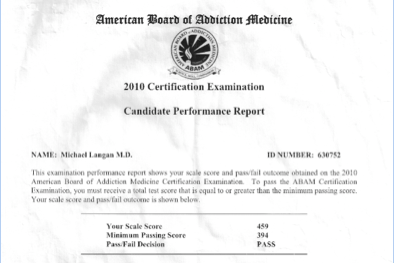
To make this point I sat for the exam with absolutely no preparation in 2010, passed by a respectable margin, and was “board certified” in addiction medicine. ABAM “board certification” is not recognized by the American Board of Medical Specialties (ABMS).  It is a “self-designated” medical specialty which means exactly what it sounds like.  “I hereby declare myself..”

Except for a year of psychopharmacology research, some MRO work, and “moonlighting” at local mental health facilities I have no education or training in addiction yet I was able to join the ASAM fold—–an exercise somewhat like showing how easy it is to buy a gun at Walmart.  The analogy does not end there however as they can both be “licenses” to kill.

Like  an NRA wallet card I never intended to use it.  I let it lapse so there is no need for the ASAM to revoke it.    It was in effect an  “academic exercise” to make a point-and that point being that I am no “expert” in addiction medicine and neither is 4000 of me.

Screen Shot 2014-08-11 at 12.15.07 AM Screen Shot 2014-08-11 at 12.15.40 AM


By proclaiming themselves the cream of the crop, bestowing phony “board certification,” and creating the myth of expertise at the expense of the real experts and lobotomizing evidence based thought and critical thinking they have created a monopoly of despotism in addiction medicine treatment.  The ASAM and FSPHP  have created a tyranny in regulatory medicine that is unsupervised and opaque.  Moreover, they have grand plans for the rest of the population. They have influenced the DSM-V, are trying to gain control of MRO education and regulation, and pose a great danger to all of us.  This front-group for the 12-step assessment and treatment centers and the drug and alcohol testing industry is indeed fulfilling Burrough’s prediction of a police state.

They have money and and a monopoly of force by number (they outnumber Addiction Psychiatrists by 4:1) and the risks of this unqualified authoritarian control and influence involve all of us as a society.  And it impacts freedom, life, and liberty.

Alarmist call to arms about the dangers of drugs and hidden addicts protected by others and posing danger to create untrue hype is propaganda and misinformation to further the ASAM drug-testing 12-step inpatient rehab agenda and gain control. Drug war sloganeering designed to get everyone aboard. Logical fallacy, deceptive facts, pseudoscience, and misinformation is obvious if anyone cares to look a little deeper. The conflicts-of-interest are immense. The ASAM and FSPHP are front-groups that use ends-justifies-the-means coercion and deception to get public recognition of the righteousness of the twelve steps of recovery.

Neither doctors nor US citizens should be subject to the whims of a religion based political group composed of unqualified, inexperienced, paternalistic and biased individuals who are truncheons of dogmatic ideology and refuse to accept evidence based treatment, transparency, and accountability as important. ASAM board certification is not recognized by the ABMS. These are self-proclaimed specialists–great pretenders.   Underneath is a Potemkin village.  The emperor is bereft of all clothes.

The problem is that regulatory agencies, politicians, medical boards, and others have bought into the lie. Most people take them at face value resulting in the perception that they are indeed experts in addiction medicine and they are well on the way to becoming the only experts in addiction medicine. Within the next couple of years this will become a reality. The ASAM will shortly gain ABMS specialty certification. They are well funded.

The addiction psychiatrist subspecialty has already being pushed into a corner. Some have even joined in in rather than fade away–kind of like what happened to the proctologists as the gastroenterologists moved further up. But that analogy doesn’t quite work  as gastroenterology swallowing proctology represents an advancement in science.  Medicine, like all of science is fluid. What they represent is frozen.  Additionally it’s a lucrative gig.

This situation is more like the anti-vacciners parading themselves as experts in immunology and gaining enough support to run out the real McCoy.

IMG_9516

 Pseudoscience, groupthink, deception, and coercion. A framework not built on the scientific method, evidence based decision making, autonomy and benevolence; but based on unproven ideological dogma, righteous inflexible worldview, rigid rules, obedience, and control. Drug testing of all physicians will be done by ASAM, FSPHP physicians. They will demand prohibition, testing, and treatment and will be in complete control. Even with 100% specificity and sensitivity there are valid arguments against this. But if you throw in the corruption and other issues that are obvious if one looks, then medicine as we know it is going to be lobotomized by dabblers and clowns.

It will come in a whimper not a bang and by then it will be too late. The goal of the ASAM has been to be recognized as the “experts” in addiction medicine ever since The American Society of Addiction Medicine (ASAM) was started by Dr. Ruth Fox in the 1950’s to promote AA and the 12-steps to doctors as a treatment for alcoholism.

PHP’s function to monitor and control. . Mandating coercive 12-step ideology onto physicians is SOP. The marked rise in physician suicide over the past decade is directly correlated with the FSPHP taking over state impaired physician programs. And the “kill em all let God sort em out” logical fallacy of saving doctors and protecting patients is propaganda with no evidence base.

This system, that encourages referring doctors confidentially for evaluation, is a nearly foolproof means to silence any physician they feel the need to. An accusation of substance abuse is made relatively easy. Then recommend an evaluation to one of your own people who will confirm the problem and force them into a 5 -year monitoring program where you must abide by the twelve step road to salvation.

By colluding with a short list of inpatient drug treatment centers such as Hazelden, Talbott, Marworth, Farley, and others where co-conspirators there will engage in “confirmatory bias” and “confirmatory distortion” to make the assessment fit the diagnosis they have a nearly perfect system to remove any physician from practice. It is “political abuse of psychiatry.”


In the former Soviet Union during the Khrushchev-Brezhnev era, the KGB used its forensic psychiatric institutions to brand, arbitrarily and for political reasons, large numbers of political dissidents as suffering from “schizophrenia” and “paranoid psychosis” and then incarcerated them for long periods in “special psychiatric hospitals.” In 1976, the Soviet Union was severely censured on this account by psychiatrists from all over the world at a conference in Hawaii of the World Psychiatric Association. Only after Gorbachev’s rise to power were these errors rectified. We have now discovered that similar practices have also occurred in certain parts of China.”1– Jia Yicheng (China’s top forensic psychiatrist), 1998


Well to quote Zoolander “Earth to Mathilda” it’s occurring right here in the U.S. of A. but they have substituted “substance use disorder” for “schizophrenia” to delegitimize, marginalize, and ignore.

The ASAM claims an 80% success rate. If you look at the data they are basing this on it is illusory–sloganeering and propaganda with no substance.

The biggest obstacle is that this system allows them to throw the normal rules of conduct under the imperative of a higher goal assumed to trump all other consideration. Those outside of the FSPHP, ASAM system either defend or ignore the reports of ethical and criminal violations, complacent in their trust of these “experts” claiming they are just helping sick doctors and protecting the public.

The ASAM and FSPHP are gaining power and expanding in scope. They have effectively muscled forth the “war on drugs’ agenda to further their goals by establishing a system that of coercion, control, secrecy, and misinformation. The first wave was substance abusers, they then added any psychiatric diagnoses, then the disruptive physician”, and the next target is the “aging physician”.  Goodbye Dr. Welby.

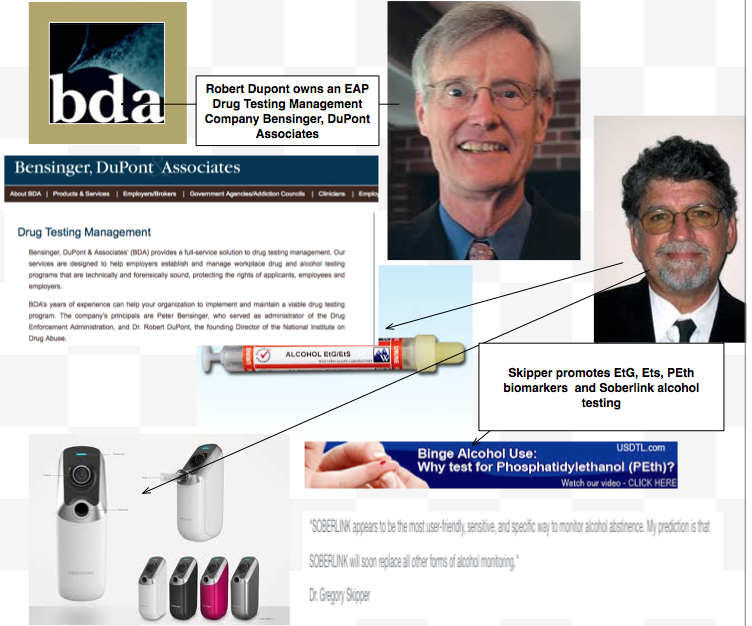
The testing of physicians will inevitably include EtG and PEth—tests that Alabama PHS Director and ex-felon Greg Skipper introduced, proselytized, and brought to the drug testing industry like a carnival huckster. Introduced as  Laboratory developed tests (LDTs) to bypass FDA approval and regulation this junk science was commercialized, marketed, and paraded as scholarship.  Introduced with an arbitrary cutoff point of 100 it ruined countless lives.  God knows how many suicides were caused by this prohibitionist profiteer.

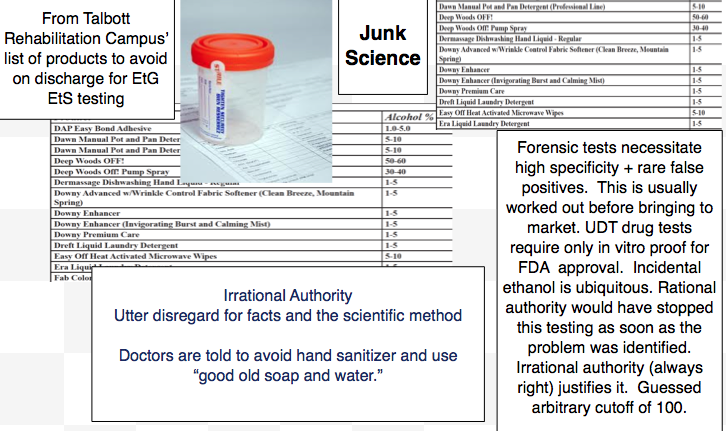
A 2011 study revealed that hand sanitizer alone can result in EtG levels c lose to 2000 ng/ml.

Dr. Skipper and Robert Dupont, are now recommending PEth as a confirmation test for an elevated EtG.

The evidence base is empty. Anecdotal reports supporting these tests and mostly done with Skipper as a co-author are essentially all that exist.

The June 2013 journal “Alcoholism: Clinical and Experimental Research”contains an article coauthored by Skipper and DuPont , Greg Skipperand Robert Dupont looking at 18“subjects” who tested positive for EtG and concluded that “positive PEth testing following positive EtG/EtS results confirm recent drinking.”Although they were unaware of it, these “subjects” were physicians enrolled in the Physician Health Program.

This is a system that oppresses physicians and is about to enter the domain of individual freedom, destroy the Bill of Rights, force 12-step philosophy and erode freedom of religion, stifle freedom of speech, and take us back decades.. They have convinced medical societies, medical boards, regulatory agencies, parole boards and others to not only accept them as experts, but to write legislation in states to declare them “the” experts in addiction medicine. They did this with a torrent of strategic lobbying efforts on behalf of the 12-step addiction treatment industry towards the AMA (and indirectly through the FSPHP towards the AMA), ABMS, APA, FSMB, ABIM, JCAO, CSAT, consumer groups, presidential candidates, state medical societies, congress, corrections agencies, social service agencies, faith-based community centers, the media and many other targets.

By convincing others of their expertise they have strategically placed themselves in a position of power that includes the ability to remove any doctor from practice.

“With one arm around the shoulder of religion and the other around the shoulder of medicine, we might change the world.”-Twelve Steps and Twelve Traditions, AA World Services, Inc (1953).

And unless something is done soon, every physician in the US will be at risk of losing everything at the whim of of a 12-step front group that places ideology above evidence base and dogma above virtue.

Claiming success they now want to bring it to you. Take a look at Robert Dupont’s keynote speech before the Drug and Alcohol Testing Industry Association.  Prohibitionist profiteers euphoric about the future bumper crop of clear cups and urine. “Test em all” Dupont wants to include schools and children in the net.  Reminiscent of the Nuremberg rallies he received a a thundering standing ovation.    And for this to happen all you have to do is one thing-nothing.

rushmore-jason-swartzman


Organizational Purpose and Public Trust in Drug and Alcohol Testing

IMG_9150


http://www.nytimes.com/2014/03/13/opinion/why-arent-doctors-drug-tested.html?partner=rss&emc=rss&_r=0


In 2012 Robert Dupont delivered the keynote speech at the Drug and Alcohol Testing Industry Association annual conference and described a “new paradigm” for addiction and substance abuse treatment of zero tolerance for alcohol and drug use that is enforced by monitoring with frequent random drug and alcohol tests. Detection of any substances is met with swift and certain consequences. He proposed expansion of this paradigm to other populations including workplace, healthcare, and schools. Based on the state Physician Health Program model of “contingency management,” with frequent testing and a point of “leverage,” such as a medical license in doctors, that is used as a behavioral incentive.

The ASAM White Paper on drug testing seems to indicate a desire to liberalize drug testing by utilizing health care providers in the process. Currently forensic drug testing uses a strict chain-of-custody protocol with Medical Review Officer (MRO) review. But if the result of a positive test is “therapeutic” rather than “punitive” this is unnecessary. In the “new paradigm” a positive test simply requires an evaluation at a “PHP-approved” facility.

IMG_9516 Accountability needs to be rooted in organizational purpose and public trust.
A recent article in JAMA, “Identification of Physician Impairment”  suggests that undetected physician impairment  may be contributing to medical error and that sentinel-event and  random alcohol-drug testing could be implemented to address the problem as is being done in the  current “Physician Health Program (PHP)” system.

The most consequential and critical issue for physicians, if this comes to fruition, is who will be in organizational and managerial control of the system and what ideological influences will be guiding policy and practice.   It is concerning that one of the co-authors of this article, Greg Skipper, is a Fellow of the American Society of Addiction Medicine with strong ties to the 12-step treatment industry and drug testing industry.

History shows Lord Acton’s aphorism on absolute power to be repeatedly true.  Corruption is a virtually inevitable consequenphotoce of unchecked power. The only two factors that constrain corruption are moral virtue and deterrence.
Disregard for standards of care and violations of codes of conduct are common.  So too is the use of anything that furthers the agenda.  Pseudoscience, such as polygraph testing, previously deemed by the American Medical Association as an unscientific game of “chance,” and psychometric testing of dubious validity are being used for confirmation of diagnoses.

They introduced and brought to market junk science like the Ethyl Glucuronide  (EtG) biomarker for detecting alcohol use. The EtG was introduced by an FSPHP physician, marketed, and proselytized as an accurate and reliable test for alcohol. After setting an arbitrary cutoff of 100 to prove drinking he ruined countless careers and lives.

As the disaster toll increased it became clear the test was not very good. It became apparent the test was, in fact, very flawed and misguided as using an ultra sensitive poorly specific test for a substance environmentally ubiquitous precludes its forensic applicability.

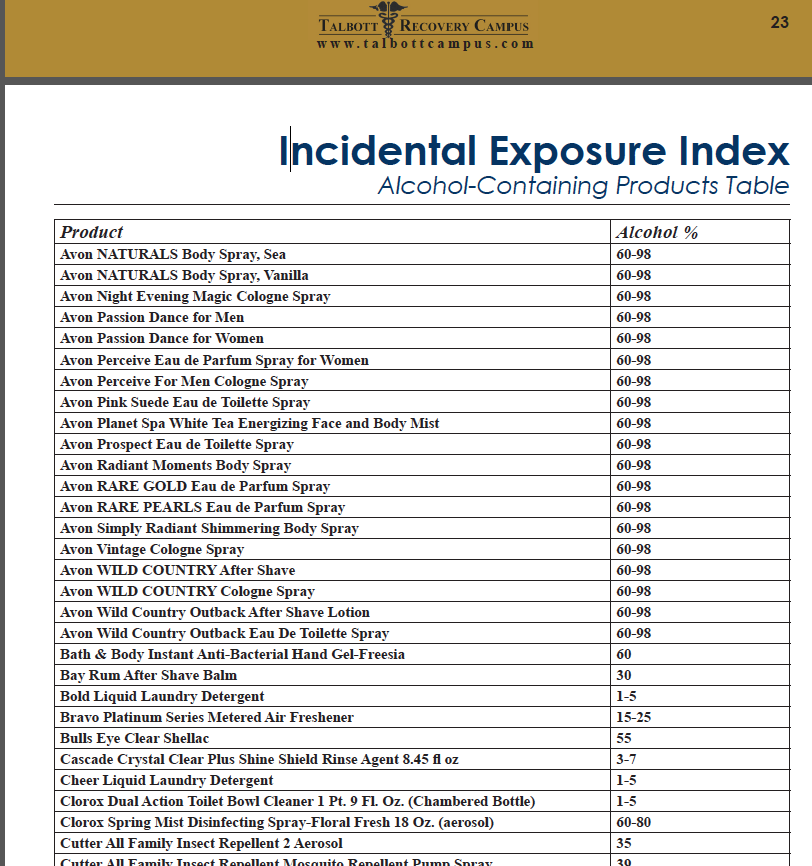
Hand sanitizer, cosmetics, sauerkraut, and myriad other products were shown to result in an elevated EtG. Sensibly, the majority of drug testing and monitoring programs abandoned it. 

The market for the test decreased dramatically as the only customers left were drug monitoring programs in which the testers had absolute power and those being tested were absolutely powerless–programs like those run by the PHP.

This group has now introduced the Phosphatidylethanol (PEth) test as a confirmation test for EtG and USDTL mScreen Shot 2014-04-05 at 2.08.11 PMarketed it as the PEthStat.  

State Physician Health Programs are now using the EtG  and adding the PEth to confirm alcohol ingestion. And just as they did with the EtG the claims of reliability are grand but without foundation. 
All speculative A=B oversimplified thinking that ignores the myriad other factors involved. The science is empty if you remove the dregs of filler and puff.  And the conflicts of interest are mind-boggling.

Corporate Front Groups and Corruption in Medicine-Forensic fraud, conflicts of Interest and the Erosion of Trust

The ASAM and FSPHP are corporate front groups that have infiltrated organized medicine and gained tremendous sway. Advancing the multi-billion dollar 12-step rehab and drug testing industry agenda control has replaced conduct and ideology has trampled science and reason. As organizations without transparency, accountability, or regulation they have become reservoirs of bad medicine and corruption.

Accountability is  rooted in organizational purpose and public trust.  Unfortunately, humanitarian ideals have been trampled by the imposition of corporate front groups who advance  hidden agendas under guises of science and scholarship  and patinas of benevolence.  Rife with conflicts of interest, these groups obfuscate, mislead, and exploit us to further an underlying political agenda.  Healthcare and medicine has been infiltrated by various groups that pose a serious threat to both the humanitarian and evidence based aspects.

Laboratory Misconduct in Drug Testing–Processing “Forensic” as “Clinical” to Bypass Chain-of-Custody


IMG_4651


In “Ethical and Managerial Considerations Regarding State Physician Health Programs, ” Dr.’s J Wesley Boyd and John Knight note the significant and multiple conflicts of interest that exist between State Physician Health Programs and the referral treatment centers that they use.     They state:

“To further complicate matters, many evaluation/treatment centers depend on state PHP referrals for their financial viability. Because of this, if, in its referral of a physician, the PHP highlights a physician as particularly problematic, the evaluation center might—whether consciously or otherwise—tailor its diagnoses and recommendations in a way that will support the PHP’s impression of that physician.”

There is an obvious difference between impartially evaluating evidence in order to come to an unbiased conclusion and building a case to justify a conclusion already drawn. To consciously “tailor” a diagnosis of addiction or relapse based on anything other than the objective evidence violates the basic principles of medical ethics.

A state audit of the North Carolina Physicians Health Program that was released in 2014 documented the conflicts of interest and lack of quality assurance in referrals to out of state “PHP-approved” assessment and treatment programs.  The same centers are used in most states including Massachusetts.  and the the medical directors of the “PHP-approved” facilities can all be found on this list of “Like-Minded Docs.”  The financial and political conflicts-of-interest are obvious between the PHPs and the “PHP-approved” assessment and treatment centers.  And there is no choice in the matter.

In 2011 the ASAM issued a Public Policy Statement on Coordination between Treatment Providers, Professionals Health Programs, and Regulatory Agencies recommending physicians in need of assessment and treatment be referred only to “PHP approved” facilities and also that PHPs need the full cooperation of the board  if they deem a monitored physician noncompliant as “criticism or doubt could unintentionally undermine the PHP”   In addition the ASAM wants regulatory agencies to  recognize the PHP their expert in all matters relating to licensed professionals with “potentially impairing illness.”  You read that right, “potentially impairing illness.”  The  Federation of State Medical Boards House of Delegates adopted an updated Policy on Physician Impairment at their 2011 annual meeting and approved the concept of “potentially impairing illness” and “relapse without use.”  

And what might signal a potentially impairing illness you ask? According to Physician Health Services, Inc. (PHS), not having “complete, accurate, and up-to-date records” could be a red flag as “when something so necessary is not getting done, it is prudent to explore what else might be going on.”

Boyd writes in Psychology Today that when he and John Knight published this paper, reviewers at 2 different journals said that the issues raised were very important but it “should not be published, essentially because doing so might bring unwanted outside attention to PHPs” and —one of them wrote the paper should be withdrawn and instead be presented at the national federation of PHPs’ annual meeting. Boyd recommends more state audits and national standards and that “because PHP practices are largely unknown to physicians until they themselves are referred to one, physicians who do register complaints about standard PHP practice are often dismissed as bellyaching”

On July 1st 2011 I was asked to have a blood test for alcohol. 19 days later it was reported at an impossibly high level and I was reported to the Board of Registration in Medicine and asked to have an evaluation at one of the “PHP-approved” facilities.

One potential conflict-of-interest that has not been entertained is that between the PHP and the contracting labs.  Just like the assessment and treatment centers there is a lot of money involved in drug and alcohol testing and the FSPHP is a big referral source.  In addition, some of the tests these labs are using on physicians were actually introduced by an ASAM/FSPHP doctor and developed as Laboratory Developed Tests (LDTs). LDTs do not require the stringent FDA approval process. In actual fact , you don’t even have to show that it is even detecting the substance you claim it to be testing for.  Some internal protocol has to be provided but other than that it is an honor system.  And without FDA oversight, the labs can claim anything they want as far as validity, sensitivity, and specificity.  Once these tests were developed as LDTs they were pitched to the  Federation of State Medical Boards as reliable and valid.   The PHPs then contracted with the labs to use the tests they introduced for monitoring physicians in the programs.  The EtG was introduced with essentially no evidence-base other than a small study on less than 20 psychiatric inpatients in Europe with an arbitrary cutoff of 100.  Countless lives were ruined with lost medical and nursing licenses, incarceration, loss of custody of children and most programs abandoned it in 2006. A SAMHSA advisory was issued that it was unreliable.  The Wall Street Journal wrote an article about the “flawed test.”  Most monitoring programs abandoned it. The PHPs did not and continued to use it on doctors without pause.  The PHPs put the responsibility on the monitored physicians to avoid hand sanitizer, cologned, sauerkraut, and hundreds of other products as ethanol is ubiquitous in our environment.  Irrational authority. The EtS, and PEth were also introduced by an FSPHP physician.

Screen Shot 2014-02-25 at 1.06.55 PM

It was just discovered that after 7 days and under unknown conditions my PEthStat Forensic test was changed to “clinical” with specific instructions to USDTL to run it as “clinical.” PHS then misrepresented it to the Board as forensic for  the last three years.  PHS is not a “clinical” provider.

USDTL-Litigation Packet(selected)

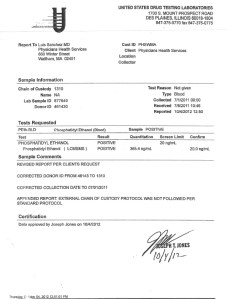
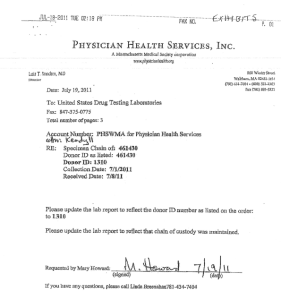
What we see here is a letter from Luis Sanchez reporting a positive test for phosphatidylethanol (PEth) from July 19th, 2011 to the Board of Registration in Medicine.   I have also attached documents from the “litigation packet” received from USDTL that is generated with any forensic drug test as a record of chain-of-custody.   This document ensures the integrity of the drug testing by recording the specimens whereabouts at all times.  The Medical Review Officers job is to make certain everything was done correctly by confirming that everything was documented and their were no breaks in the chain-of-custody.    If a donor disagrees with a positive test then the litigation packet is used to check the integrity of the specimen. It is a quality control measure that protects both parties.

The litigation packet contains all of the information that the MRO reviews when reporting the results of a positive specimen. If the custody and control form contains all of the information it is supposed to and confirms chain of custody then it is reported as a positive.  If the chain-of- custody contains so called “fatal flaws”  (lacking collectors signature, missing date and time, mismatched ID #’s, specimen not sealed, etc.) then it is deemed “invalid.” it must be thrown out by protocol.  That is standard operating procedure, standard of care, and required.  This is the MROs sole and simple responsibility.

collectioninstructions_PEth_ FD_021810

In my case I disagreed with the positive result and requested the litigation packet on the specimen.   This was at first refused by PHS.  Linda Bresnahan and the PHS attorney Deb Grausbaum then tried to dissuade me from obtaining it deeming it complicated and costly.  But I insisted on obtaining it and sent the  $500.00 fee and when I did so was told that there would be “unintended consequences” as a result of my request. I finally received it in December of 2011 and it included a “summary of results” dated December 3, 2011 and signed by the director of Laboratory operations, Joseph Jones, supporting it as a true positive. (even though it contradicts his own written protocol on forensic collection procedure.)   what he preaches apparently does not apply when it comes to pleasing a big client such as the FSPHP. $$

So what do we see here in the litigation packet?   Evidence of deliberate forensic fraud perpetrated by PHS, drylabbing, and intentional misrepresentation of lab data.  It shows clear and deliberate falsification of lab data at the request of PHS and includes a memo from Linda Breshahan on July 19th requesting that the ID# on a positive specimen with no collection date be “updated” to my ID # 1310 and that it be updated to show “chain-of-custody” be maintained.  Well that would seem highly unusual as a “chain-of-custody” cannot be backdated and “correcting” a unique identifier on forensic specimen is prohibited.  In actual fact there was no chain-of-custody and not even a  custody and  control form the collecting lab (Quest Diagnostics)!    When this   complete absence of external  chain of  custody was pointed out to PHS they pleaded ignorance but eventually produced a letter from Quest Diagnostics dated March 22, 2012 that appears to be written in language suggesting legitimacy but in actuality documents all of the fatal flaws.

A six-month investigation was done by CAP and USDTL was forced to change the test from “positive” to “invalid” on October 4th 2012.    This was reported to PHS but not conveyed to anyone else.   The Chief Investigator for CAP called me in December of 2012 to make sure the test had been corrected. It had not.  Instead PHS reported me to the Board for “noncompliance” the 2nd week of October for damage control.  They apparently did this as a pre-emptive strike thinking I would never find out!

It does not take a forensic toxicologist or  chemist to interpret the attached documents. They show collusion to commit fraud with USDTL, collusion to cover up fraud with Quest Diagnostics, misrepresentation of facts to a State Agency, and obstruction of the truth when the test was mandated by CAP to be corrected by USDTL.  These documents show conspiracy, fraud, and corruption.  What they show is procedurally, ethically, and legally indefensible.

Screen Shot 2014-09-15 at 7.16.09 PMScreen Shot 2014-09-15 at 7.19.15 PM

The distinction between “forensic” and “clinical” drug and alcohol testing is black and white. Forensic testing is done to detect illicit substances. Pre-employment, random monitoring, or for cause drug testing is done in individuals to see if they are using drugs or alcohol when they should not be.   Because the consequences of a positive test can be significant and even permanent, forensic drug and alcohol testing requires strict procedure and protocol to prevent harming the innocent. A custody and control form documenting the chain-of-custody and review by a Medical Review Officer (MRO) before reporting a positive test are necessary to ensure the validity of the test.   It is the responsibility of the MRO to make sure no other explanations exist for the positive test (such as a prescribed medication) and check chain-of-custody. If the chain-of-custody contains any “fatal flaws” (specimen not sealed with sticker and signed by donor, missing date or collector signature, etc.) it is rejected as an invalid specimen.

A clinical test is used in patient care. Ordered by a doctor, it is use for purposes of treating a patient. A clinical test does not have the strict requirements of a forensic test.   I could send a sample of fluid from a tin of pickled herring or Jagermeister to the clinical lab for electrolytes and would still get a result back.

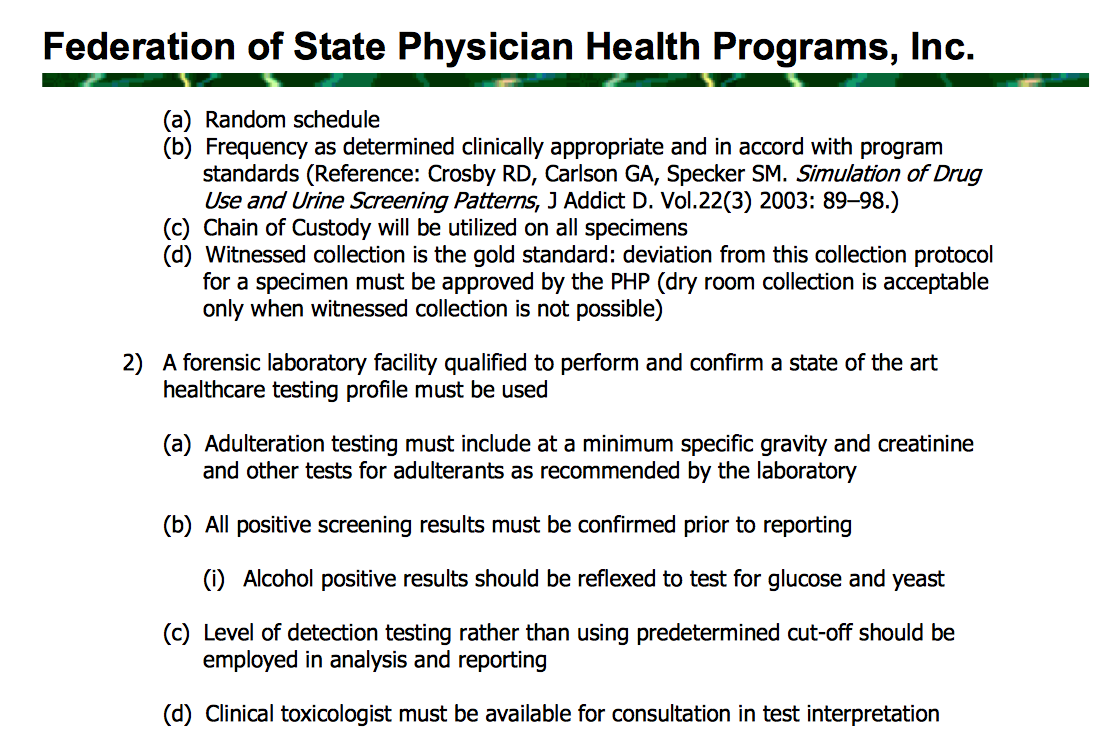
PHS is a monitoring program not a treatment provider.  According to PHS documentation they follow NIDA drug and alcohol testing protocol. Guidelines for both the Federation of State Medical Boards (FSMB) and the Federation of State Physician Health Programs (FSPHP) state chain-of custody and MRO review on all specimens. In addition to MRO review the guidelines also specify that the PHP Medical Director confirm all positive tests. PHS has an MRO, Wayne Gavryck.

I have multiple emails sent to Gavryck asking him to correct this and inquiring why as an ardent 12-step zealot he was not practicing what he preaches by promptly admitting his wrong and making amends for it.  He ignored me. Can’t wait to hear him have to explain his doublethink and hypocrisy publicly.

MRO Code of Ethics

The fact that a monitoring agency with an MRO asked the lab to process and report it as a clinical sample and then used it forensically is an extreme outlier in terms of forensic fraud.  The fact that they collected it forensically, found out it was collected wrong with no chain of custody and the wrong tube 7 days after it was drawn and then changed it from forensic to clinical deepens the malice.  The fact that they then reported it to the Board as a forensic sample and maintained it was forensic up until now makes it egregious.   But the fact that the test was changed from “positive” to “invalid” on October 4th, 2012 and they then reported me to the Board on October 8th 2012 for “noncompliance,” suppressed it and tried to send me to Kansas for damage control makes it wantonly egregious.   (they didn’t think I’d ever find out but the CAP investigator called me in December.  Add on that the fact that I’ve been questioning the validity of the test since day 1 and they violated the  HIPAA Privacy Rule over and over and this is reckless and major health care fraud.

Like other front groups the primary motive is profit for the drug testing and rehab industry, and “recovered” physicians like Dr. Gavryck have become “willing gulls” in all sorts of fraud and chicanery.  Ideology trumps science and control usurps conduct.  including Dr. Gavryck, are “in recovery” themselves and, having only a hammer, see everything as a nail. PHS, inc. is a non-profit NGO that has become corrupt.  This occurred under the leadership of the prior Medical Director Luis Sanchez, MD who has since retired.   The director of operations, Ms. Linda Bresnahan is engaging in fraud with apparent impunity.   Forensic (in contrast to clinical) drug testing mandates strict adherence to protocol including proper collection procedures, unbroken chain-of-custody, and Medical Review Officer (MRO)  review prior to reporting a forensic  test as a true positive.  It is held to a higher standard because the potential   consequences can be grave and far reaching.   There are no exceptions.   The Federation of State Medical Boards and the Federation of State Physician Health Programs require chain-of-custody and MRO review for any and all drug testing according to their guidelines.   PHS, inc has an MRO, Dr. Wayne Gavryck, who has holds this responsibility.  I have attached the MRO Code of Ethics and an explanation of the importance of chain-of-custody.

Medical Review Officers need to have honorable values and follow the same standards as everyone else.

If an individual’s identity is tied to a sub-group that is unregulated, unaccountable, and with no oversight, such as PHS, fraud may be committed even though they have excellent knowledge about cultural norms and values on a more general level.  So called “noble cause corruption is quite common and one someone gives up their integrity in lock step with the other members of the group, no matter how small the enticement, the potential for continued and more severe forms of corruption is increased.

collectioninstructions_PEth_ FD_021810

PHS provided a letter from the New England Compliance Manager, Nina Tobin, on March 22, 2012 in response to my persistence in obtaining the absent  Quest “chain-of-custody.” After going into great detail about the faxed document from PHS, she states “the collector was unfamiliar with collecting blood samples for PHS and did not have a “chain-of custody” form designed for blood tubes.” “The collector used the faxed letter request, which included the test code and the collection information, as the chain of custody form.”   This is analogous to not receiving an item you requested by express mail and having them reply the person was “unfamiliar with the postal system in the United States and did not have a postage stamp, she wrote U.S. Postal Service on a piece of paper and wrote “express mail” on the flat side and folded it into an envelope.”  The very nature and purpose of both are removed.  You cannot manufacture a chain-of-custody any more than you can manufacture a stamp.

MLLv3finalJacob Hafter Esq

ThePhysician suicide has increased dramatically across the country and as Pamela Wible observes in the Washington Post it is “often hushed up.” It is only going to get worse. Heightened perceptions of defeat and entrapment are known to be powerful predictors of suicide.

Quest lists “accountability” as one of six company values  on their corporate website claiming “as a company and as individuals, we accept full responsibility for our performance and acknowledge our accountability for the ultimate outcome of all that we do.”   Quest lists “integrity” as a value noting all  “decisions and actions ultimately are driven by integrity,”  and an  Integrity Commitment Pledge.  The Quest Code of Business Ethics includes compliance with laws, rules, and regulations. confidentiality in release of test results and protected health information (PHI), avoidance of Conflicts of Interest (COI), and fair dealing; “no person may take unfair advantage of anyone through manipulation, concealment, abuse, or privileged or confidential information, misrepresentation of facts or any other unfair dealing practice.”  Quest “actively promotes honest and ethical behavior in all its business activities,” and require employees to report violations to, among others with supervisory capacity, a “Compliance Officer.”

Screen Shot 2014-07-28 at 3.18.50 AM

iScreen Shot 2014-07-28 at 3.19.34 AM