“Addiction Medicine” is not recognized by the American Board of Medical Specialties (ABMS)–It is a “self-designated-practice specialty” (SDPS) and indicates neither knowledge nor expertise.

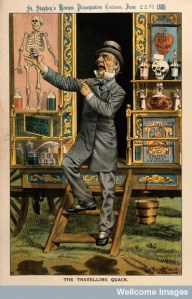
V0011377 A quack doctor selling remedies from his caravan; satirizingEducational and Professional Standards in Medical Specialties and Subspecialties
The increasingly rapid growth and complexity of medical knowledge in twentieth century American medicine resulted in the creation of specialties and subspecialties.

A related development was the creation of “boards”  to “certify” physicians as  knowledgeable and competent in the specialties and subspecialties in which they claimed to have expertise.   The American Board of Ophthalmology, organized in 1917, was the first of these.

As the number of medical specialties proliferated an umbrella organization was formed to accomplish this task. The Advisory Board for Medical Specialties was created  in 1933 and reorganized as the American Board of Medical Specialties (ABMS) in 1970.  This non-profit organization oversees board certification of all physician specialists and sub-specialists in the United States.

The ABMS recognizes 24 medical specialties in which physicians can pursue additional training and education to pursue Board Certification.Screen Shot 2014-11-07 at 7.44.56 PM

In 1991 the American Board of Medical Genetics was approved as the 24th ABMS board and these 24 boards grant the  37 general certificates and 88 subspecialty certificates available to medical specialists today.

The ABMS Member Boards are responsible for developing and implementing the educational and professional standards for quality practice in a particular medical specialty or subspecialty and evaluate physician candidates for Board Certification.  They set the bar of knowledge and competence for their given area of expertise.

All of the ABMS Member Boards are:

“committed to the principle of examining doctors based on six general competencies designed to encompass quality care: patient care, medical knowledge, practice-based learning and improvement, interpersonal and communication skills, professionalism, and systems-based practice.”

These areas have been collectively identified by the ABMS, the American College of Graduate Medical Education (ACGME) and the Institute of Medicine (IOM) in order to standardize graduate medical education in any specialty  from medical school graduation through retirement.1

One of the  24 medical specialties ABMS recognizes in which physicians can pursue additional training and education and pursue Board Certification is Psychiatry.

Founded in 1934, The American Board of Psychiatry and Neurology (ABPN) is one of the 24 ABMS specialty boards. In 1959, the ABPN issued its first subspecialty certificate in Child and Adolescent Psychiatry and was the only ABNP subspecialty until 1991 when the first examination in Geriatric Psychiatry was administered.4 Addiction Psychiatry became a subspecialty of ABPN in 1993.

The ABPN governs the specialty of Psychiatry, of which Addiction Psychiatry is a subspecialty.   Board Certification in Addiction Psychiatry requires a four-year psychiatric-residency program for training in the prevention, diagnosis and treatment of mood, anxiety, substance-abuse as well as other psychological and interpersonal problems followed by an additional year of training in one of the 40 accredited Addiction Psychiatry Fellowship programs. The Accreditation Council for Graduate Medical Education (ACGME) is the professional organization responsible for the accreditation residency education programs in the US for ABMS specialty and subspecialty areas of medicine. Addiction Psychiatry training programs are governed by the ACGME and graduates are eligible for ABPN Certification in Addiction Psychiatry.

When this rigorous education and training is complete a candidate is Board Eligible and can then take the subspecialty certification exam. The exam assesses competency in the dand consultation, pharmacotherapy, pharmacology of drugs, psychosocial treatment and behavioral basis of practice to be Board Certified in the subspecialty of Addiction Psychiatry by the ABPN.

Candidates must then be assessed in  a number of areas including psychiatric evaluation and consultation, pharmacotherapy, pharmacology, toxicology, psychosocial treatment, behavioral basis of practice, and many other areas in which for the past half-decade they where taught and apprenticed.

The current structure of residency training is little changed from when it was conceived originally by William Stewart Halsted in the late 19th Century.  Physicians acquire knowledge and skills necessary to safely and competently manage patients through apprenticeship. Training in a specialty area provides a comprehensive platform that allows medical school graduates to apply a body of knowledge to patient care and the treatment of disease. This forms the foundation of our Guild–undifferentiated and general but pluripotential.

The American Academy of Addiction Psychiatry (AAAP) is the only professional organization in the US focused on the subspecialty of Addiction Psychiatry.   The AAAP Mission Statements are to: 2

  • PROMOTE HIGH QUALITY EVIDENCE-BASED SCREENING, ASSESSMENT AND TREATMENT FOR SUBSTANCE USE AND CO-OCCURRING MENTAL DISORDERS.
  • TRANSLATE AND DISSEMINATE EVIDENCE-BASED RESEARCH TO CLINICAL PRACTICE AND PUBLIC POLICY.
  • STRENGTHEN ADDICTION PSYCHIATRY SPECIALTY TRAINING AND FOSTER CAREERS IN ADDICTION PSYCHIATRY.
  • PROVIDE EVIDENCE-BASED ADDICTION EDUCATION TO HEALTH CARE TRAINEES AND HEALTH PROFESSIONALS TO ENHANCE PATIENT CARE AND PROMOTE RECOVERY.
  • EDUCATE THE PUBLIC AND INFLUENCE PUBLIC POLICY FOR THE SAFE AND HUMANE TREATMENT OF THOSE WITH SUBSTANCE USE DISORDERS.
  • PROMOTE PREVENTION AND ENHANCE ADDICTION TREATMENT AND RECOVERY ACROSS THE LIFE SPAN.
  • PROMOTE RESEARCH ON THE ETIOLOGY, PREVENTION, IDENTIFICATION AND TREATMENT OF SUBSTANCE USE AND RELATED DISORDERS.

Self-Designated Practice Specialty :  An AMA Census Term Indicating What a Group of Doctors are Calling Themselves.

Screen Shot 2014-03-18 at 5.22.16 PMThe American Medical Association records a physician’s Self-Designated Practice Specialty (SDPS) in response to an annual credentialing survey. According to the AMA, SDPS are “historically related to the record-keeping needs of the American Medical Association and do not imply ‘recognition’ or ‘endorsement’ of any field of medical practice by the Association. SDPS refers to a self-designated specialty and this is not equivalent nor does it imply ABMS [American Board of Medical Specialties] Board Certification.a_meissen_group_of_harlequin_and_the_quack_doctor_circa_1741_faint_blu_d5585085_001h

“The fact that a physician chooses to designate a given specialty/area of practice on our records does not necessarily mean that the physician has been trained or has special competence to practice the SDPS.”3

Physicians have been able to list addiction medicine as a self-designated area of practice using the specialty code “ADM” since 1990.Screen Shot 2014-11-07 at 7.45.43 PM

In contrast to these accepted board credentials, American Board of Addiction Medicine (ABAM)  certification requires only a medical degree, a valid license to practice medicine, completion of a residency training in ANY specialty, and one year‘s full time involvement plus 50 additional hours of medical education in the field of alcoholism and other drug dependencies. The majority of American Society of Addiction Medicine (ASAM) physicians meet these requirements by “working in a chemical dependency treatment facility, taking continuing medical education courses in addiction, or participating in research.”6

The American Society of Addiction Medicine’s mission is to “establishScreen Shot 2014-11-07 at 7.47.55 PM addiction medicine as a specialty recognized by professional organizations, governments,, physicians, purchasers, and consumers of health care products, and the general public.’5   They have succeeded in doing this as many consider them to be the experts in addiction medicine including regulatory agencies.

The goal of the American Board of Addiction Medicine (ABAM) Foundation is to “gain recognition of Addiction Medicine as a medical specialty by the American Board of Medical Specialties (ABMS).”

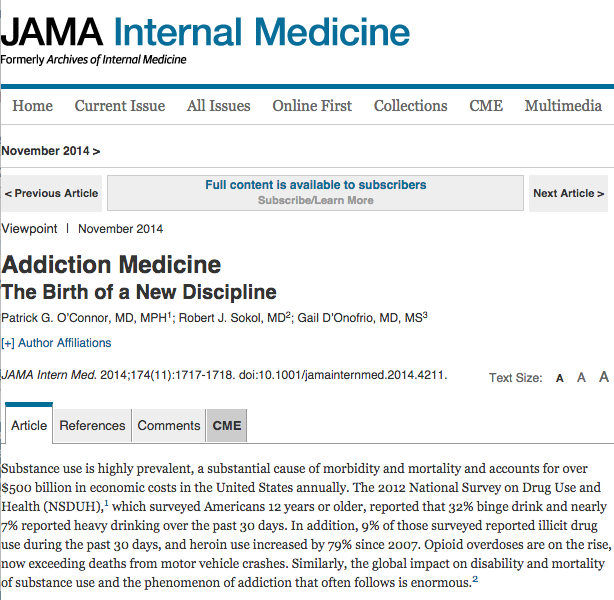
But Addiction Medicine is currently not recognized by the ABMS.  It is still a a Self-Designated Practice Specialty and the ABAM is a Self-Designated Board.  So too is the American Academy of Ringside Medicine and Surgery, the American Academy of Bloodless Medicine and Surgery and the Council of Non-Board Certified Physicians.   But these Self-Designated Boards do not have the multi-billion dollar drug and alcohol testing and treatment industry supporting them. Addiction Medicine has deep pockets, and if the November 2014 issue of the Journal of the American Medical Association (JAMA) is a harbinger of what’s to come, this self-designated practice specialty currently being certified by a self-designated Board and bereft of anything resembling the the educational and professional standards for quality practice in a particular medical specialty or subspecialty may soon robber baron its way into acceptance by the American Board of Medical Specialties.
Screen Shot 2014-11-23 at 11.15.15 PM

One thing is for certain.  When society gives power of diagnosis and treatment to individuals within a group schooled in just one uncompromising model of addiction with the majority attributing their very own sobriety to that model, they will exercise that power to diagnose and treat anyone and everyone according to that model.  The birth of Addiction Medicine as an ABMS accepted discipline is sure to be a success for the drug and alcohol testing and 12-step treatment industry, but its spawn is sure to be an inauspicious mark on the Profession and Guild of Medicine and a bane of society for years to come.

cropped-jester

  1. Stevens RA. In: Stevens R, Rosenberg C, Burns L, eds. History and Health Policy in the United States: Putting the Past Back in: Rutgers University Press; 2006:49-83.
  2. American Association of Addiction Psychiatry Website http://www.aaap.org/about-aaap/mission-statement (accessed 4/2/2014).
  3. American Medical Association. List & Definitions of Self-Designated Practice Specialties. August 21, 2012 http://www.ama-assn.org/ama.
  4. Juul D, Scheiber SC, Kramer TA. Subspecialty certification by the American Board of Psychiatry and Neurology. Academic psychiatry : the journal of the American Association of Directors of Psychiatric Residency Training and the Association for Academic Psychiatry. Spring 2004;28(1):12-17.
  5. http://www.asam.org/about-us/mission-and-goals.
  6. Tontchev GV, Housel TR, Callahan JF, Kunz KB, Miller MM, Blondell RD. Specialized training on addictions for physicians in the United States. Substance abuse : official publication of the Association for Medical Education and Research in Substance Abuse. Apr 2011;32(2):84-92.
IMG_6274 2

“mail order” expertise; Diploma Mill

American Medical Association (AMA) Seeks to Test Older Physicians: The Aging Physician–Goodbye Dr. Welby!

imgres-3

The AMA is seeking to test older physicians.  This is no doubt due to the influence and lobbying of the “impaired physicians movement” and the “addiction medicine” specialists who brought us the “impaired” and “disruptive” physician constructs.    As do all groups of this ilk, they want to expand.  It is predictable and that is what we are seeing here.


Originally posted on Disrupted Physician:

The Aging Physician—Goodbye Dr. Welby!

IMG_8902

As a specialist in geriatric medicine I have experience in taking care of a number of  doctors who were referred to me for suspected memory problems. Still operating and teaching residents in his 70s, my first was a well-respected surgeon, a pioneer or Maverick who had made advances in his particular subspecialty.  Known for his detailed knowledge of the history of medicine and sharp clinical acumen, he had not seemed himself for a while.  His colleagues noted he appeared slower,  fatigued and forgetful at times (not remembering his keys, having trouble finding the right word).  An internist friend and co-worker who knew him for 50 years curb-sided me and asked if I would see him.  He did not have a primary care physician or even seen a doctor professionally for decades (a common phenomenon in this age cohort of doctors).

I met him the next week and he readily admitted to having difficulty concentrating and having trouble with his short term memory.  On taking his history he told me of his life and career which started as an intern in Boston in 1942 and he was on duty the night 492 people were killed in the  Cocoanut Grove fire with many of the victims transported to his hospital.  “I can see every detail as if it were yesterday–beautiful young women wearing fashionable dresses and gowns and young men in formal evening wear who looked as if they were sleeping but were dead.”

“Gastric reflux ” was the only medical problem he reported, adding it was well controlled for the better part of a decade with anti-reflux medications from the office sample closet.   I tested his memory with several cognitive scales which showed some mild deficits in short-term memory and sent him to a neuropsychologist for more comprehensive testing.  His physical examination, including a comprehensive neurological exam was normal.  I ordered the usual lab work up for dementia to look for possible metabolic causes and his B12 level returned markedly low–a result of his long-term use of proton pump inhibitors.  He was given an intramuscular injection and started on high doses of oral B12.  As one of the “reversible’ causes of dementia he was back to his usual sprightly self several months later.

Another, a 70 old psychiatrist still teaching medical students and residents had asked a third-year psychiatric resident out on a date on two separate occasions. She reported him to administration on the second request.  When I  asked him about the incident he replied he didn’t see what was wrong with what he did and it was being blown out of proportion.  “She’s in her 20’s” I said to which he replied “Well I’m only 36.” Still giving lectures to first year medical students without error or pause from knowledge he learned long ago, he could not identify a pencil or a watch when I pointed to them and asked what there were. He knew neither the month, season or year.  After an MRI and neuropsychological testing he was given a diagnosis of probable Alzheimers disease.   He had no spouse or children and his work was his life.  After that he became  profoundly depressed and six months later was dead.

Another  elderly doctor, an internist, had a fairly sudden sudden onset of memory problems and symptoms of delirium.  It turned out he was having trouble sleeping and his cardiologist prescribed him Dalmane, a benzodiazepine similar to  Valium (medications that have a whole host of adverse effects in older patients including memory problems and falls).  But valium has a half-life of hours whereas Dalmane has a half life of days.   The medication was stopped and he was back to normal after a few days.

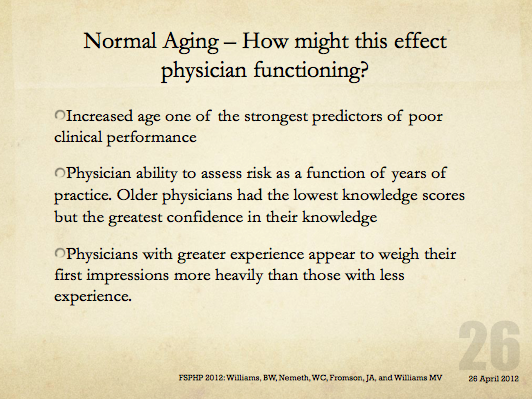
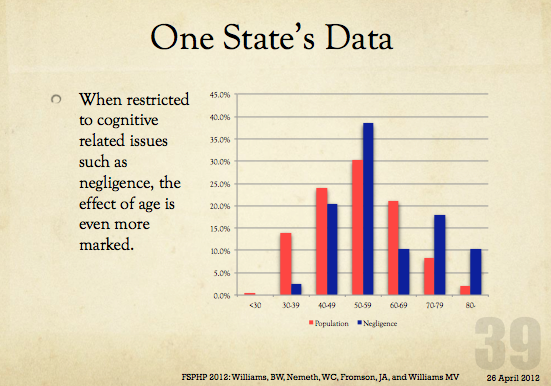
Aging  is associated with an increased  decline  in many areas including  cognition, motor-skills, muscle strength, and vision that can individually or cumulatively create risk to the person or others in a variety of situations (driving, living situation, occupation).

With advancing age comes advancing risk and the recognition and vigilance of others is often necessary for intervention. If the risk is recognized the problem can be addressed by the appropriate healthcare providers and specialists.

Doctors are not immune from cognitive impairment or dementia and the perspicacity of others is necessary should this occur.

Recognition and awareness are important.  So too is an assessment by a qualified physician Board Certified in Neurology, Geriatrics or Geriatric Psychiatry who has education and experience in the diagnosis and treatment of memory disorders.

Slide15

Recognition, Insight and Education Essential

In 2009 Dr. Ralph Blasier, M.D, J.D., published an article in the Journal  Clinical Orthopaedics and Related Research entitled “The Problem of the Aging Surgeon: When Surgeon Age Becomes a Surgical Risk Factor” discussing the ability of older physicians to practice medicine safely and effectively.

His primary message is that a decline in physical and cognitive abilities is associated with the aging process and that these issues are especially pertinent to the field of medicine.

An area  little researched, Blasier gives anecdotal examples such as a surgeon in his late 80s who had to regularly depend on younger colleagues to finish his operations. He concludes that these anecdotal examples suggest many surgeons lack insight into the degradation of their own skills and suggests recognition, insight, and education can help facilitate retirement of the aging surgeon  before  a decline in competency and skill creates a problem.

The awareness, education and insight of others is necessary to identify age associated illness in doctors who can then be referred to the proper specialists for evaluation.  And although no evidence base exists, anecdotal reports such as these caused some groups to see an opportunity to increase the grand scale of the hunt.

IMG_8901

Aging Physicians Next Target of Physician Health Programs

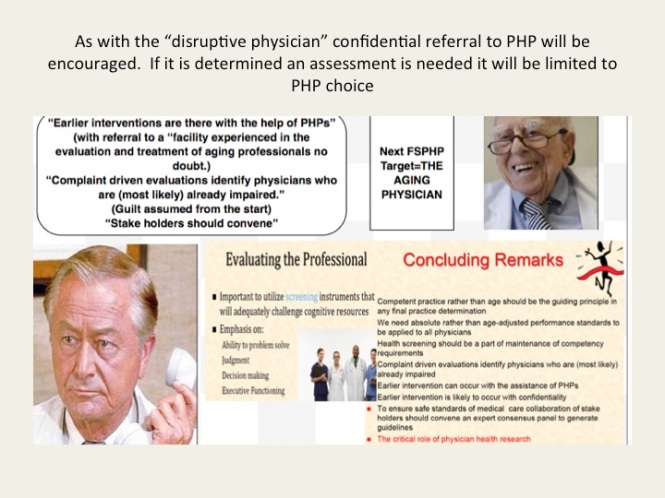
As with the “impaired” and “disruptive” physician, the “physician health and wellness movement” organized as the Federation of State Physician Health Programs (FSPHP) is linking the “aging” physician with threats to patient safety and  hospital liability.  “Experts say doing nothing could result in lawsuits, higher liability insurance rates, ruined reputations for practices and all involved, and even possible losses of practices and the licenses of non-reporting physicians.”

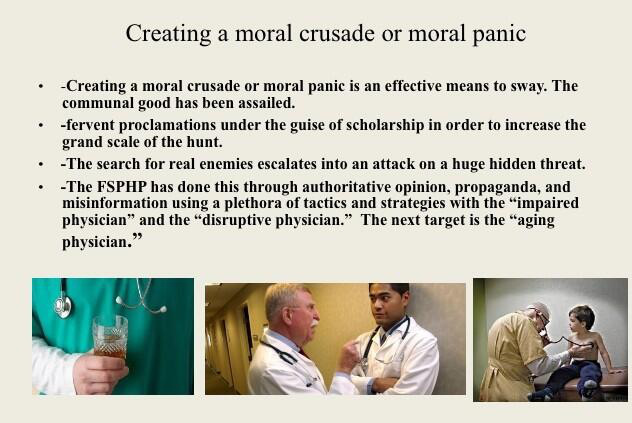
And if you look at the articles and presentations aimed at  the administrative, regulatory, and legal arenas of medicine it appears a new moral panic is percolating in the “physician wellness” cauldron.

Labelling a group dangerous and creating fear in those responsible for that group is an effective means to sway policy and opinion.

With absolutely no evidence base these groups have acted as   “moral entrepreneurs ” and used this same methodology to successfully change policy and regulation in the medical profession and advance their goals.  The methodology is to

1. Label a group and link that group to danger

2. Offer to assist in identifying and eliminating that danger

3. Corner the market and control all aspects including assessment, testing and monitoring by swaying those in authority to make it public policy and regulation.  Screen Shot 2015-03-11 at 8.10.37 PM

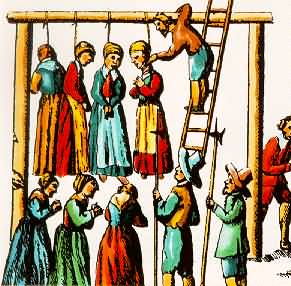
The methodology is not new–witches are real, witches are dangerous and witches need to be identified and exterminated at all costs.  Convince the authorities to assist you in protecting the public from harm and advance  the greater good

In this manner the FSPHP has convinced state medical boards to adopt and enforce policies that have incrementally and systematically increased their autonomy, scope and power since they first cultivated a relationship with the Federation of State Medical Boards (FSMB).  This occurred in 1995 when they took an uninvited seat at the table of power by offering a non-disciplinary “safe harbor” as an alternative to discipline for doctors impaired by drugs or alcohol.

Since then they have increased their scope from  the “impaired” to the “disruptive” to everything else.  Arising from the “impaired physicians movement”  as “addiction specialists” these doctors whose specialty of addiction is not even recognized by the American Board of Medical Specialties have now become the “experts” in all matters related to physician health.  Jacks of all trades covering neurology, psychiatry, geriatrics, and occupational medicine.

A 2011 updated FSMB  Policy on Physician Impairment  states that Medical Boards should recognize the state Physician Heath Program (PHP) as their experts in all matters relating to licensed professionals with “potentially impairing illness,”   and these  include those potentially impairing maladies that increase as we age.

They are also using “everyone else does it why don’t we?” logical fallacy.  According to a Washington Post article “other professions are subject to age-related regulations. For example, airline pilots must undergo regular health screenings staring at age 40 and must retire at age 65. FBI agents must retire at age 57.”Screen Shot 2015-03-11 at 8.10.59 PM

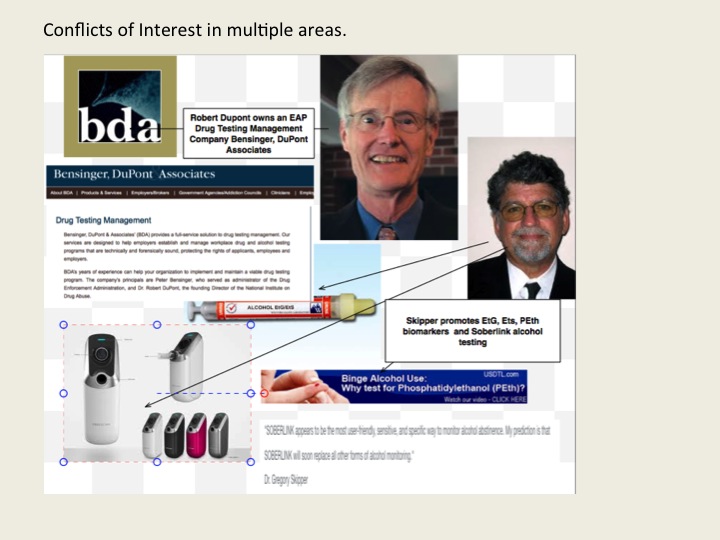
Proposing drug testing in doctors a  JAMA article  uses this same logic stating when sentinel events occur in the airline, nuclear power and railway industry the get drug tested.  However all of these industries use FDA approved tests, certified labs, strict chain-of-custody and MRO review in their drug testing.  One of the authors of the JAMA paper, Dr. Greg Skipper, introduced the non-FDA approved and unvalidated Laboratory Developed Tests currently used in PHPs such as EtG.   He claims no conflicts-of-interest.   Comparing drug testing to industries that use the highest quality of testing and safeguards to protect the donor from false-positives to the junk science used in PHPs is comparing apples to oranges. Which one do you think they’s be using in the random drug testing of doctors?

Furthermore, airline pilots, railway engineers and nuclear power plant employees have a choice of assessment and treatment centers should they get a positive test.  Doctors do not.  They are mandated to “PHP-approved” facilities.  This is enforced by state medical boards as they adhere to an ASAM   Public Policy Statement  recommending only “PHP approved” treatment centers be used for assessment and treatment and a recent  audit  found the PHP in North Carolina could not provide any measurable indices  or qualitative indicators of how an assessment center is stamped “approved.” The best they could come up with is “reputation” and other ‘informal sources.  What the audit missed is all of the 19  out-of-state “PHP-approved” centers Medical Directors can be found on this list.

Screen Shot 2015-03-11 at 8.13.13 PM

And what will happen with the “aging physician” is the same.  Doctors will be forced into “assessments” at “PHP-approved” facilities where they will be misdiagnosed, over-diagnosed and forced into monitoring contracts under threat of loss of licensure. Goodbye Dr. Welby!

IMG_8900

Screen Shot 2015-06-18 at 2.17.48 AM

IMG_0933

IMG_0706

Physician Health Programs (PHPs) are not above the law: They have simply manufactured a “culture of impunity” by removing themselves from all aspects of accountability

brick_wall

Physician Health Programs are not Above the Law

Are Physician Health Programs (PHPs) above the law?  

 Unable to get law enforcement to take cognizance of reported abuse, many doctors I have spoken with believe that the actors involved are impervious to criminal liability.  Complaints of fabrication and fraud involving PHPs and their affiliates to the police, the Attorney General and other law enforcement agencies have been given no credence,  tabled or dismissed with little investigation.

Believing these agencies are deliberately ignoring credible complaints and the documentary evidence placed before them, some have concluded that state PHPs have been given the power to commit crimes with impunity and immunity.

PHPs are not above the law.  It is by removing themselves from and blocking the usual routes of accountability and absolute operational control of the testing, assessment and treatment process that has enabled misconduct to remain hidden, unrecognized or excused. The crimes exist but they remain undetected, unnoticed and unpunished.

Removing Accountability

The essence of accountability is answerability which means having the obligation to answer questions regarding decisions and actions.   This requires the transmission of information when it is requested.  The accountable actor provides the information to the overseeing actors in a transparent manner.

Accountability also requires explanation and justification for the information provided. What was done and why? Standards, rules, regulations, codes, laws and other benchmarks are then applied by the overseeing actor to determine if the information provided was appropriate or inappropriate.

The availability and application of sanctions for illegal or inappropriate actions uncovered through answerability is also a necessary component of accountability. This is necessary to impose restraint on authority and power.  Lack of enforcement of sanctions contribute to the creation of a culture of impunity.

The usual mechanisms that exist to impose restraint and create incentives for appropriate behavior and actions are absent. No outside oversight exists to limit their power or subject them to a set of rules.  No regulation exists to curb abuse.

A Culture of Impunity

The authority accorded PHPs and the power they exercise exist in a culture of impunity.

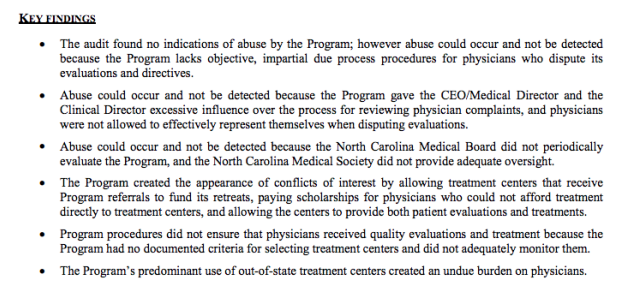
The key findings of the2014  North Carolina PHP Audit are below:.

Screen Shot 2015-06-14 at 2.15.41 AM

No indications of abuse were found,  a point brandished by the PHP as redeeming  and proving no abuse was occurring. In actual fact it is an ominous finding that also relates to their apparent ability to violate the law. 

The audit found no indications of abuse but that abuse could occur and not be detected because of an absence of due process for the complainant, excessive control of the complaint process by the PHP and absence of oversight by either the medical board or medical society.  What this means is that a doctor with no power is making a complaint against an unsupervised agency with enough power to influence the investigation of a complaint against itself.  The reason no indications of abuse were found is because the system is specifically designed to hide abuse.  That is the intent.

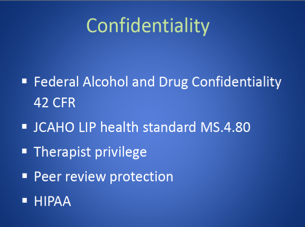
Absence of transparency, regulation and oversight coupled with control of information enables both censorship and doctoring of records.   Strict Confidentiality is enforced by HIPAA, peer review protection, and drug and alcohol confidentiality law.  

Quest Diagnostics

PHPs are able to suppress and conceal criminal activity but they are also able to  manufacture information designed to hide misconduct.  

The North Carolina Audit found no objective selection criteria for the out of state assessment and treatment centers because none exist other than ideological mindset and monetary gain.  The same facilities are used by most state PHPS.  They are, in fact, mandated as they are the “PHP-preferred” facilities.  

In 2011 The American Society of Addiction Medicine (ASAM) issued a public policy statement on coordination between PHPs, regulatory agencies, and treatment providers. recommending only “PHP-approved” treatment centers be used and the statement specifically excludes ‘non-PHP” recognized facilities.  

What the Audit diid not discover is the medical directors of all of the “PHP-approved” facilities can all be seen on this list of Like-Minded Docs.  It is a rigged game    Every aspect of drug-testing, assessment and treatment is kept hidden and secret and within control of the PHP.

It is a rigged game in which they have removed themselves from all aspects of accountability.  They have, in effect, manufactured a culture of impunity at our expense.

images-25

The Medical Profession under Dictatorship–Revisiting Dr. Leo Alexander’s prescient warnings from 1949

“Let it be considered, too, that the present inquiry is not concerning a matter of right, if I may say so, but concerning a matter of fact.”–Adam Smith

“Most men endure the sacrifice of the intellect more easily than the sacrifice of their daydreams.  They cannot bear that their utopias should run aground on the unalterable necessities of human existence”  -Ludwig von Mises

Screen Shot 2015-04-08 at 9.36.31 AM


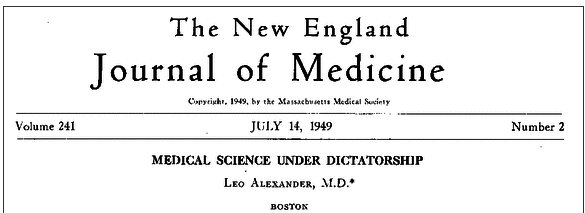
“Science under dictatorship becomes subordinated to the guiding philosophy of the dictatorship.” So begins Medical Science Under Dictatorship1 written in 1949 by Leo Alexander and published in the New England Journal of Medicine. Alexander acted as consultant to the Secretary of war and the Chief Counsel for the Nuremberg trials.

The guiding philosophic principle is Hegelian or “rational utility” and “corresponding doctrine and planning”, Alexander said “replaced moral, ethical and religious values” and Nazi propaganda was highly effective in perverting public opinion and public conscience. He explains how this expressed itself in a rapid decline in standards of professional ethics in the medical profession.   This all “started from small beginnings” with subtle shifts in the attitudes of physicians to accept the belief that there is such a thing as “a life not worthy to be lived.”

In 1985 the British Sociologist G.V. Stimson wrote of a new form of professional control in the United States that had emerged in the preceding decade whose “success rests on the ability to take certain areas of conduct such as alcoholism and drug abuse (which are formally disciplinary issues) and handle them as diseases.”2

Stimson writes:

“The impaired physician movement is characterized by a number of evangelical recovered alcoholic and addict physicians, whose recovery has been accompanied by an involvement in medical society and treatment programs. Their ability to make authoritative pronouncements on physician impairment is based on their own claim to insider’s knowledge.”2

Among these authoritative pronouncements was the use of specialized treatment centers. Many professionals were critical of these programs including Assistant Surgeon General John C. Duffy who criticized the “boot-camp mentality”4 toward doctors and American Society of Addiction Medicine President Leclair Bissel who when asked in a 1997 interview when the field began to see physicians as a specialized treatment population replied “when they started making money..” .” 5

Amid reports of abuse, coercion and control in facilities using a doctor’s medical license as “leverage,” the Atlanta Journal Constitution ran a series of reports in 1987 documenting the multiple suicides of health care practitioners at one of these programs (5 while in the facility and at least 20 after discharge).6   Neither these suicides nor a large settlement against the same facility (finding a non-alcoholic doctor was intentionally misdiagnosed as an alcoholic and forced into months of treatment)  for fraud, malpractice, and false imprisonment involving intentional misdiagnosis7 generated any interest among the medical community at large.

And by 1995 the door had closed as the Federation of State Physician Health Programs ( FSPHP ) relationship with the Federation of State Medical Boards (FSMB), the national organization responsible for the licensing and discipline of doctors,  was forged.  A 1995 issue of The Federal Bulletin: The Journal of Medical Licensure and Discipline, contains articles outlining the high success rates of these programs in 8 states with an editorial comment from the FSMB that concludes:

“cooperation and communication between the medical boards and the physician health programs must occur in an effort to protect the public while assisting impaired physicians in their recovery.”8

The Federation of State Medical Boards (FSMB) has approved any and all policy and regulation put forth by the impaired physician movement  then organized under the Federation of State Physician Health Programs (FSPHP) with no apparent inquiry or opposition.

In 2003 Dr. Gregory Skipper, one of the key players of the impaired physician movement partnered with NMS labs to develop the alcohol metabolite ethyl-glucuronide (EtG) as a laboratory developed test13 14 he proposed be used as a monitoring tool for covert alcohol use in physicians after a pilot study involving just 14 psychiatric inpatients.15

The policy entrepreneurship this group so effectively uses to advance their goals can be seen in the August 25, 2004 Journal of Medical Licensure and Discipline which contains articles both presenting the problem 11 and providing the solution.11   The EtG was then introduced as an accurate and reliable indicator of covert alcohol use and the impact of this cannot be underestimated as it introduce to the market not only unregulated non FDA approved tests for forensic use but tests reaching further back into history then those used by workplace drug-testing programs.

The limitations of any test needs to be understood both in the forensic and clinical context but there is a lot less flexibility in the forensic context when people’s liberties, freedoms or property rights ( as with a medical license) are in jeopardy.

Sensitivity and specificity need to be carefully considered.  The positive predictive value of a test is the true positives over the true positives plus false positives.  If you are going to sanction somebody as a result of a single test that test needs to have 100% sensitivity.

When workplace drug testing was introduced debates over both the accuracy and scope of tests occurred. The employees right to privacy and the employers right to have a drug-free workplace were discussed with the general consensus being testing for impairment was a legitimate concern but preservation of private life should remain.

What was done here dissolves both.

PHP programs require abstinence from all substances including alcohol and strict adherence to 12-step doctrine9 yet many of the physicians monitored by them are neither addicts nor alcoholics. Requiring abstinence from drugs and alcohol while using non-FDA approved Laboratory Developed Tests in monitoring programs is a dangerous combination. The suicides reported by the Atlanta Journal Constitution in 1987 were prior to the introduction of these tests. Adding these tests of unknown validity to an already abusive program of coercion and control would only worsen the situation.

I have been hearing of multiple suicides involving both the fear of results and false results. I have also been hearing of doctors who have killed themselves because they were suffering from depression but did not seek help as their fear of being ensnared into the PHP outweighed the need to get help.

Three decades after G.V. Stimson so accurately defined the impaired physician movement the impaired physician movement defines the professional control of medicine..   Their involvement in medical society physician health programs (PHPs) and treatment programs has evolved into absolute control of both. Pronouncements on physician impairment have evolved from insider’s claims to written edict.   And their reach has extended from impairment due to drugs and alcohol to “potential impairment” and “relapse without use.” Their reach has extended from drug and alcohol impairment to all other aspects of medicine and the impact has been profound.   Medicine has been subordinated to the guiding philosophy of the impaired physician movement and doctors are dying in droves du to institutional injustice.

How does the profession of medicine reconcile the fact that we have allowed an as yet non ABMS recognized “self-certification” specialty full reign over those who are ABMS recognized?  How is it that we allow non-FDA approved Laboratory Developed Tests (LDTs) of unknown validity on doctors coerced into state Physician Health Programs (PHPs)?    A recent debate in Washington calling for regulation of  “clinical”  LDTs just took place and the fact that they are being used for “forensic” purposes in doctors is incomprehensible.   Has anyone noticed it is the same people introducing the tests who are claiming PHPs are the “gold standard,” trying to push them on other EAPs and calling for more widespread use of these tests?

The use of non-FDA approved Laboratory Developed Tests (LDTs) for drug and alcohol testing  is currently limited to PHPs and the criminal justice system. (i.e. monitoring programs in which those doing the testing have power and those being tested have no power). That may soon change. See  Drug Testing and the Future of American Drug Policy and The American Society of Addiction Medicine White Paper on Drug Testing describing the plans for widespread expansion of this drug testing to other groups including kids.

Those involved in the Massachusetts General Hospital Laboratory Medicine, Toxicology and addiction medicine departments looked critically at these tests and decided hands down against using them. Why? Because no evidence base exists and the potential harm far outweighs any perceived benefit.  “Research” has been done on those being monitored by PHPs and the criminal justice system and Drs. J Wesley Boyd, M.D., PhD, and John Knight, M.D. of Harvard Medical School who collectively have over two decades of experience as Associate Directors with the Massachusetts PHP, Physician Health Services, Inc. addressed this research in a 2012 article published in the Journal of the American Society of Addiction Medicine entitle Ethical and Managerial Considerations Regarding State Physician Health Programs.  The allegations that PHPs are engaging in research in violation of the Nuremberg code ( that was a direct result of the Nuremberg trials for which Dr. Alexander acted as consultant ) should have raised some eyebrows.   It hasn’t.

Screen Shot 2015-04-13 at 9.53.44 AM

What do you think will happen when ASAM gets recognized by the ABMS in 2 years as is expected?   These “addiction medicine” specialists will inevitably join hospital formulary , clinical lab, toxicology and ethics panels to do the same thing they have done to get where they are today.   They will do the same thing they have done with state PHPs.  Those with a hidden agenda will be able to outvote those of good conscience and thoughtful intelligence and patient care will then be subordinated to the guiding philosophy of the impaired physicians movement.

This system of institutional injustice is killing doctors by suicide as the medical societies and Departments of Public Health have given PHPs full autonomy and authority and it is poised to impact patient care.

I challenge you to name any other company, organization, group or agency within or related to the profession of medicine and the field of science that is bereft of absolutely all  transparency,  regulation or oversight?  It does not exist.

The PHP scaffold has deliberately  removed themselves from all aspects of accountability including answerability, justification of actions and the ability of outside actors to hold them in judgment of any information provided by answerability.   Heads I win, tails you lose.   That is a big red flag in itself. and those not currently being held accountable they may very well be after you next as their plans include expansion to other groups includes EAPs, the Department of Transportation, athletes, students and even kids!

Doctors are afraid to talk about this for fear of being ensnared themselves.  Those already in these programs will not speak for fear of punishment. This is a legitimate concern and needs to be discussed openly and publicly.  I need allies!

 Help me get the word out –too many doctors are dying.  Three died by suicide in one month alone who were being monitored by the Oklahoma PHP and these suicides did not even make the local papers let alone national news!     They need to.

In The Argument of Fascism Ludwig von Mises wrote:

It cannot be denied that Fascism and similar movements aiming at the establishment of dictatorships are full of the best intentions and that their intervention has, for the moment, saved European civilization. The merit that Fascism has thereby won for itself will live on eternally in history. But though its policy has brought salvation for the moment, it is not of the kind which could promise continued success. Fascism was an emergency makeshift. To view it as something more would be a fatal error.

4-stage-plan1 week-4-human-rights-8-638

Irrational authority and the 21st Century Witch-Prickers

cropped-images-4.jpegThe best available evidence shows little support for any of it yet the alarmist calculations of denizens of impaired and disruptive doctors wreaking havoc on the exam floor have institutionalized the tinker toys of these self-appointed “experts.”

It is imperative the greater medical community be awakened to the actual nature of the ASAM FSPHP state physician health program agenda and apprehend the true significance of this spirituality based nanny statism. Unfortunately it may be too late as it is. Strange days have tracked us down.

mllangan1's avatarDisrupted Physician

cropped-images-4.jpeg

Image“Spirituality can go hand-in-hand with ruthless single-mindedness when the individual is convinced his cause is just”

Michela Wrong, In the Footsteps of Mr. Kurtz: Living on the Brink of Disaster in Mobutu’s Congo

The New York City Medical Society on Alcoholism  was started in the 1950s by Dr. Ruth Fox to promote AA and 12-step to doctors. This organization subsequently became the American Medical Society on Alcoholism (AMSA) and eventually the American Society of Addiction Medicine (ASAM).  Like the National Council on Alcoholism and Drug Dependence (NCADD), an organization that promotes the A.A. yet claims to have no formal ties, the ASAM is considered by many to be a front-group that purports to represent one agenda while in reality serving other interests. The ASAM can be considered both a political (prohibition, 12-step spiritual recovery) and corporate (inpatient rehabilitation facilities, drug testing industry) front group in this regard.

ASAM physicians have…

View original post 1,050 more words

Making the Data fit the Hypothesis is not Science: The American Society of Addiction Medicine (ASAM), “Weasel Phrases,” “Framing” and “Data-Dredging.”

This is an example of language framing. Language framing uses words and phrases to direct attention to a point of view to advance a vested interest.

In this case the use of the phrase “honest and denial free” in the context of physician reporting imparts associative meaning to the reader.

As denial is a recurring motif and cardinal attribute of physician addiction according to the paradigm, the connotation is that the reports by physicians may have been influenced by dishonesty and denial while face-to-face interviews done by “trained” interviewers were not.

“Framing” is another propaganda technique designed to tell the audience how to interpret the information given through context. The message here is that the somewhat less lifetime prevalence of substance abuse and addiction in physicians found by anonymous mail survey may be underreported as a result of both methodology and denial.

Slide08

AMSA is now known as the ASAM

But in actual fact there is a large body of research regarding “social desirability bias” that shows the converse to be true.

mllangan1's avatarDisrupted Physician

Screen Shot 2014-12-30 at 1.12.01 AMPrinciples of Addiction Medicine devotes a chapter to Physician Health Programs. Written by Paul Earley, M.D., FASAM,1 Earley states that the lifetime prevalence of substance abuse or addiction in physicians found by Hughes2 is “somewhat less than the percentage in the general population reported by Kessler” of 14.6%.3

Although he specifies the numerical percentage “in physicians at 7.9%,”3 he avoids the use of numbers (14.6%) in the general population. He instead uses the qualifier “somewhat less.” Why is this?

My guess is because it understates the statistical fact that the prevalence found by Kessler in the general population was almost twice that found by Hughes in physicians.

You see, “Somewhat less” is a “detensifier.” It creates an impression of a small disparity between doctors and the general population.

In propaganda this is what is known as a “weasel phrase.”   Weasel phrases are used to obfuscate the…

View original post 645 more words

Monopolies, Self-Referral and Shell Games: The Need for Antitrust Investigation of Physician Health Programs and their “PHP-Approved” Assessment and Treatment Centers

On the above list can be found the Medical Directors of a number of drug and alcohol rehabilitation facilities. I did not make up this list. An updated version can be seen right here on the “like-minded doc” website.

Talbott, Marworth, Hazelden, Promises, and another two-dozen or so “PHP-approved” assessment and treatment centers are represented on this list. State Physician Health Programs (PHPs) refer doctors to these facilities for evaluations. PHPs are non-profit tax-exempt organizations. They do not evaluate or treat patients. If a physician is referred to a PHP for a suspected problem the assessment must be done at an outside facility which will invariably be linked to a name on the list of Like-Minded Docs.

What most people do not know, however, is that this is an exclusive arrangement. Evaluations are constrained to one of these facilities. It is mandated. No bargaining. No compromises. No choice. In other words it is a coercion.

mllangan1's avatarDisrupted Physician

Screen Shot 2014-02-18 at 11.06.22 PM

Three shells and a pea–ASAM, FSPHP, and LMD.

“PHP-Approved” Assessment and Treatment Centers

On the above list  can be found the Medical Directors of a number of drug and alcohol rehabilitation facilities.  I did not make up this list.  An updated version can be seen right here on the “like-minded doc” website.

Talbott, Marworth, Hazelden, Promises, and another two-dozen or so “PHP-approved”  assessment and treatment centers are represented on this list.    State Physician Health Programs (PHPs) refer doctors to these facilities for evaluations.  PHPs are non-profit tax-exempt organizations.  They do not evaluate or treat patients.   If a physician is referred to a PHP for a suspected problem the assessment must be done at an outside facility which will invariably be linked to a name on the list of Like-Minded Docs.

What most people do not know, however, is that this is an exclusive arrangement.    Evaluations are constrained to one of these facilities…

View original post 95 more words

The Medical Profession, Moral Entrepreneurship, Moral Panics, and Social Control

Blind-faith and unquestioning allegiance to expert authority deflects scrutiny and analysis. Few red flags are raised as this type of moral preening promotes misguided plausibility and complacency in the belief that these are indeed experts with good intentions. This needs to be addressed.

But if you look at any of the current “moral panics” that are being used to suggest random suspicion-less drug testing of doctors or promoting the Physician Health Programs as successful and replicable models, you will inevitably find a doctor on this list behind it. It is a given.

And the invitation goes out to Seppala to debate this in a public forum on a level playing field. Not gonna happen because it would be impossible for him to address and answer the questions rationally, directly and with any tiny scrap of evidence based data.ByQiW11IYAI2Cit

IMG_0728

mllangan1's avatarDisrupted Physician

The Medical Profession, Moral Entrepreneurship, Moral Panics, and Social Control.

 “Few, no matter how desperate, seek help of their own accord.”  says Dr. Marv Seppala, M.D., Chief Medical Officer at Hazelden, one of the “PHP-approved” drug and alcohol assessment and treatment centers located in Center City, Minnesota.  “Physicians are intelligent and skilled at hiding their addictions.”

“They’re often described as the best workers in the hospital,” he says. “They’ll overwork to compensate for other ways in which they may be falling short, and to protect their supply. They’ll sign up for extra call and show up for rounds they don’t have to do.”

In reality this is ludicrous–knee slapping absurd.   If the results of this authoritative opinion were not so dire these statements would, in fact, be comical.   Such is not the case, however, and opinions like Seppala’s have been taken at face value and, as a result, the aftermath has…

View original post 636 more words

How False Constructs Come to Be Regarded As Irrefutable Truth: The Malleus Maleficarum, Demonologists and Witch-Prickers–Let’s See if She Floats!

hanging_witch_01

From the mid 1980s until present day a confederacy of “authorities” calling themselves “addiction medicine” specialists assisted in identifying disruptive physicians. Shaping clinical and legal orthodoxy they set the standards that cooperating regulatory authorities could follow in criminalizing, persecuting and punishing heretics.imgres

Behavioral manifestations included not answering pages on time, untimely or illegible chart notes, being late for meetings and questioning hospital authority. Disruptive physicians were blamed for everything—patient morbidity and mortality, increasing malpractice costs and decreased hospital revenue.

Using the nebulous “disruptive physician” label, anyone with a grudge or suspicious could accuse anyone of misbehavior, malice and mayhem.

Propaganda, threats, misinformation, guild assumed from the start, PHP oversight of disruptive physician persecution was standard.

mllangan1's avatarDisrupted Physician

cropped-images-4.jpeg

“The belief that there are such things as witches is so essential a part of the faith that obstinately to maintain the opposite opinion manifestly savors of heresy.”  

So begins Malleus Maleficarum , a witch hunters manual published in 1486 that  launched a new paradigm for all those concerned with the identification and extirpation of witches.  Used as a judicial case-book the Malleus set forth definitions of witchcraft, rules of evidence, and the canonical procedures by which suspected witches were tortured and put to death.   Written by Inquisitors for Inquisitor, the Malleus construct came to be regarded as irrefutable truth and contributed to the identification and execution of as many as 60,000 “witches”, predominantly women.  The 29th and last edition was published in 1669.

images-16

Although there was a general belief in witches at the time theas published they were not regarded as evil or life threatening.  Society did not…

View original post 682 more words

The Problems with Recognizing Problems as Problems: Medication Records, Firefighter Arsonists and Machiavellian Sociopaths

Pharmacard:  A Prescription Drug Monitoring System Designed to Record Drug Histories and Reduce the Incidence of “Drug Misadventuring.”
 
As a medical student in 1990 I saw a 79 year old woman in the emergency room with intractable nausea and vomiting.   Earlier that week she had seen her primary care physician for nausea and a mild cough.   Diagnosed with bronchitis,  she was given a prescription for erythromycin.  Her husband brought in her medications including digoxin which can cause nausea
when blood levels are too high.  A  markedly high level came back on the blood draw indicating  digitalis toxicity.  I spoke to her primary care physician who was unaware of her digoxin prescription; completely clueless that she was prescribed the foxglove plant extract by a cardiologist for an irregular heart beat.images-22
Digitalis was first described by William Withering in 1785 for heart conditions and this is considered the beginning of modern therapeutics.  Sometime after erythromycin became available in 1952 it was discovered that taking the two drugs together increased digoxin levels. This simplest  type of drug interaction is called interference and occurs when one drug either accelerates of slows down the metabolism or excretion of the other.
Based on the progression of symptoms her husband reported and the elevated levels on admission this woman undoubtedly had elevated digitalis levels when she was seen by her doctor earlier in the week.   Unaware of the digitalis he inadvertently worsened her condition by giving her a medication that elevated her levels even further. She was lucky.
introduction-to-adverse-drug-reactions-14-638The Boston Collaborative Drug Surveillance Program found digoxin to be the second most commonly implicated drug in causing death in hospitalized patients and the most commonly implicated drug implicated in hospital admissions (N Engl J Med 291:824–828, 1974).
Digitalis toxicity in those who die outside of the hospital often goes unrecognized as most are elderly and assumed to have died from age related causes.
Seeing several more cases of drug related problems caused by ignorance of current medications and lack of communication prompted an  interest in drug misadventures.  I also became interested in developing a computerized up to date and accurate record accessible by all health care providers in real time , a closed loop system of “portable” information easily transferred among all health care providers be they primary doctors, pharmacists or emergency room personnel.
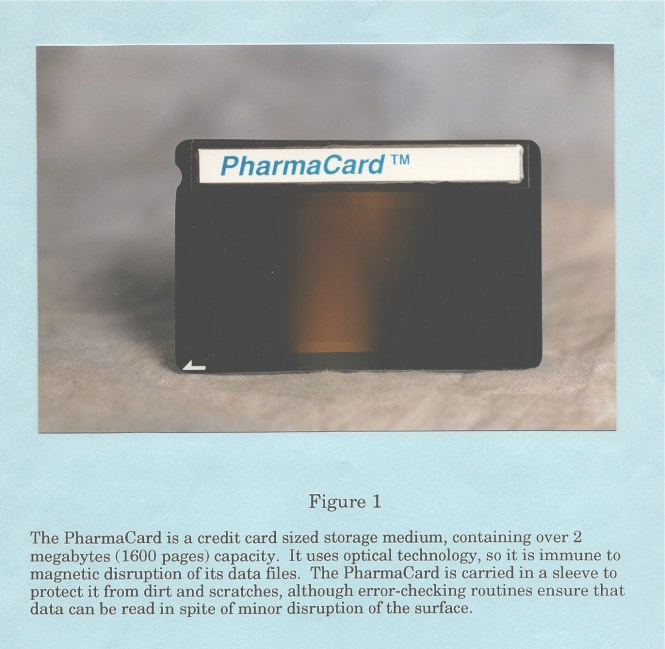
Research pharmacologist Dr. Edward Gallaher and I brainstormed over ideas and eventually came up with a computer program using  WORM (write-once-read-many) optical technology used in compact disc systems. much like a CD-R but without the spinning disc.  The credit-card sized disk could store up to two megabytes of data on an optical layer that could be written once and never changed. An optical card-reader interfaced with any IBM compatible PC.   The plan was to place card readers at pharmacies, medical offices and emergency rooms.  We called it Pharmacard.
Screen Shot 2015-05-26 at 6.33.49 PM

Pharmacard System Developed. ASTI Connections. Vol 4. Eugene, OR: Advanced Science and Technology Institute; 1992.

PHARMACARD3
Although computerized medical records existed in 1992 they were predominantly stand alone with many just replicating the paper record without word search capability.  Moreover these programs did not communicate with one another so no information portability existed between the entities involved.  Communication of information from pharmacy to doctors to emergency room was not an option.  The system was fragmented and the search for information long.
But drug mishaps were a real problem.  As with digoxin they could be fatal.  Multiple reports of drug induced morbidity and mortality were found in literature searches.  An obvious problem existed. . Many were drug interactions such as that with digitalis and erythromycin.  From my viewpoint the need for addressing the problems caused by inadequate and and incomplete records was not only self-evident but a priority.   Solutions however were few.  “Brown-bag” sessions in which patients bring in a paper bag containing all of their meds were held periodically.  Little booklets titled “patient medication records” were given to patients to update and record their new and current prescriptions.
PHARMACARD4In addition to an up to date medication list we decided to put in the bare but essential elements of the medical record that would be needed in an emergency; these consisted of demographics, emergency contacts, a basic problem list, allergies and a baseline EKG.
An available baseline EKG was decided based on its presence making it much easier to detect a problem by looking for differences.  A baseline EKG would conceivably facilitate the timing and accuracy of diagnosis.  In addition it would save money because without a comparison the default is admission.
We then applied for multiple research grants for funding to do a pilot study.  All were rejected and contained comments suggesting we pitch our wares to the computer people not the medical people-this is computer science not medical science.
We received very little interest at an AMA poster presentation in Washington D.C.  Few people would even read the poster with most taking a quick glance and redirecting straight ahead as if they were avoiding a street-corner pollster.   Those who did read it were either non-plussed, perplexed or cynical.
A research psychopharmacologist M.D.,PhD from France  asked permission to give me some advice.   He then told me it would not work.   He said the idea was great, it would work as intended and probably help prevent drug related problems.  But that did not matter because no one
gets it yet.”
   Aside from a handful of people intimately involved in the research most everyone else finds this useless as do most people at the  conference.  This means nothing to them.
PHARMACARD5 They don’t see the problem and they don’t see a need for a solution. Many believe it is the patient’s responsibility to keep track of their medications and that any problem associated with not providing their medication list up to date were self-inflicted.”  He said it will be a different story in five or ten years when the problem is acknowledged and accepted by the rank and file.
In 1999 the Institute of Medicine published To Err is Human: Building a Safer Health Care System placing  patient safety high on the nation’s health care agenda.  Medical errors, adverse drug reactions and interactions were deemed a big problem. Identifying ways to keep track of medications became a priority and multiple business ventures popped up and got their hats in the ring.    Suddenly everyone not only recognized the problem but imparted the sense they knew it all along.  Seven years had gone by and our project had then fallen by the wayside. In addition our optical platform was obsolete.
As with firefighter arson this illustrates the most crucial step in addressing a problem is admitting the problem exists.  Firefighter arson had been documented for over a century but not properly addressed.  The  extent of the problem was not publicly recognized until  a  Special Report: Firefighter Arson was done by the Department of Homeland Security, the United States Fire Administration and the National Fire Data Center in 2003.   The most crucial step was admitting the problem exists.  The second was defining the problem. The third was having zero tolerance for those engaged in the problem.  States that have taken this approach have found a marked reduction in firefighter arson.
PHARMACARD1The  problem of not recognizing  problems as problems can also be applied to individuals;  Bill Cosby comes to mind.  So too does FSPHP self-appointed drug-testing expert Dr. Gregory Skipper whose irresponsible introduction of junk-science drug testing into the marketplace through a loophole  has undoubtedly caused many more deaths than Dr. Harold Shipman who killed more than 250 patients in the U.K. by injecting them with morphine.
Skipper’s introduction of junk science drug and alcohol testing and use of cutoff points he pulls out of a hat and then moves upward as the problems are exposed is shameful.     The fact that he unleashed this on other doctors knowing full well what would happen in a zero tolerance program needs to be revealed.
My survey is revealing many suicides as a direct result of these tests, including those of medical students and residents.  And most of those who have died were not  even remotely addicts or alcoholics.  They were reported anonymously,  given one of these tests and asked to be evaluated at a “PHP-approved” assessment center  where a diagnosis was confirmed followed by  3-4 months of inpatient treatment.   I am finding out most of the doctors referred to PHPs do not have any problems but the PHPs and their affiliates are giving false diagnoses, false drug testing and using threats to control them and there is little they can do about it.    Skipper’s complete lack of empathy for his victims as he continues to put  coins in his purse is abhorrent.       Meanwhile the death  count continues to rise.Slide39Screen Shot 2015-03-12 at 11.17.53 PM