Three shells and a pea–ASAM, FSPHP, and LMD

IMG_9145

Three shells and a pea–ASAM, FSPHP, and LMD.

As home to some of the countries top ranked hospitals and most prestigious medical schools,  Massachusetts is an international healthcare hub with world-class teaching, research and clinical care. Two of the top three psychiatric hospitals in the United States as rated by U.S. News and World Report are found here in Massachusetts with McLean Hospital earning the top prize and Massachusetts General Hospital ranked number three. However, this medical mecca of learning and research is apparently unable to attract anyone with the competence and skill to assess a physician for substance abuse or disruptive behavior.

In Massachusetts if the State PHP feels a physician is in need of an assessment the evaluation must be done at “a facility experienced in the assessment and treatment of health care professionals.”  No exceptions. And apparently these esoteric skills are only found in Georgia, Arkansas, Alabama, Kansas, and a half dozen other far-away places.

With over 20 years experience with the Massachusetts PHP, Physicians Health Services, inc., Harvard Medical Schools Dr.’s John Knight and J. Wesley Boyd wrote an article in the Journal of Addiction Medicine last year entitled  “Ethical and Managerial Considerations Regarding State Physician Health Programs.”

One of the issues they discussed was the conflicts of interest between the state PHPs and the “PHP-approved” evaluation centers.  The conflicts-of-interest between state Physician Health Programs and these “PHP-approved” assessment and treatment centers  were also uncovered in the recent state Audit of the North Carolina PHP. What was not uncovered, however, was just how absolute these conflicts of interest are.   It is a smoke and mirrors closed system of false choice  An elaborate charade of verisimilitude. Carnival hucksters in medical smocks.

One comment in Knight and Boyd’s article that I was surprised got past editorial review was that the treatment centers may “consciously or otherwise” tailor diagnosis and recommendations to the PHP’s impression of that physician. “consciously” tailoring a diagnosis is fraud. It is political abuse of psychiatry. It is unethical and unconscionable.  It is, in fact, a crime.  Political abuse of psychiatry right here in the United States.

And if you cross-reference the  medical directors of the “PHP-preferred facilities”  with this  list of Like-Minded Docs  it is a perfect match.

Therefore when the PHP refers a physician for an evaluation and gives them a choice of an assessment facility there is no choice. It is three card monte. A shell game. Heads I win tails you lose.  Isn’t it about time this unethical and unconscionable rigged referral process be exposed.

IMG_9150 Unknown-3

Violations of Due Process by NCPHP

Have been speaking with MA State Auditor Suzanne Bump’s office regarding the corrupt MA PHP, PHS inc. and the MA BORM Physician Health and Compliance Unit (essentially one and the same). Expect a forthcoming state audit of this group which will mirror the NC audit. Unlike the NC audit (which was able to hide abuse), the MA Audit will reveal definite and indefensible abuse

rumikern's avatarCPR - The Center for Physician Rights

The state auditor (NCOSA) issued its report on its more than year long performance audit of NCPHP and found a pattern of systematic violations of due process in its conduct of physician evaluations under the rubric of “peer review.” Further, the auditor noted that there was “the appearance of multiple conflicts of interest” in its referrals to select out-of-state evaluation and treatment programs.

Here is the audit on the NCOSA website: NC Office of the State Auditor

However, of even greater concern was the finding that no entity charged with NCPHP’s legal oversight was actively monitoring its abuses. Both the NCMB (Medical Board) and the NCMS (Medical Society) were specifically charged with overseeing NCPHP and holding it accountable for compliance with appropriate protocol and with state and federal law.

View original post

The Medical Profession, Moral Entrepreneurship, Moral Panics, and Social Control

The Medical Profession, Moral Entrepreneurship, Moral Panics, and Social Control.

As a society governed by organizations, associations,  institutions and regulatory bodies, the medical profession is not immune to “moral panics” and “moral crusades.”

A threat to patient care or the values of the profession can be identified and amplified.   A buildup of public concern fueled by media attention ensues creating a need for governing bodies to act. Medical Professionalism and the Public Health has been assailed.

Unbeknownst to the general population and most members of the medical profession at large, certain groups have gained tremendous sway within organizational and regulatory medicine. Through  moral entrepreneurship they have gained authority and become  the primary definers of the governance of the medical profession and the social control of  doctors.  To benefit their own interests they have fostered and fueled “moral panics.” Exhorting authorities to fight these  threats by any means necessary  they have successfully made and enforced rules and  regulations and introduced new self-serving definitions and tools that neither help doctors nor protect the public.

The Medical Profession, Moral Entrepreneurship, Moral Panics and Social Control

IMG_9005The Medical Profession, Moral Entrepreneurship, and Social Control

Sociologist Stanley Cohen  used the term “”moral panic” to characterize the amplification of deviance by the media, the public, and agents of social control.1  Labeled as being outside the central core values of consensual society, the deviants in the designated group are perceived as posing a threat to both the values of society and society itself.   Belief in the seriousness of the situation justifies intolerance and unfair treatment of the accused.   The evidentiary standard is lowered.

Howard Becker describes the role of “moral entrepreneurs,” who crusade for making and enforcing rules that benefit their own interests by bringing them to the attention of the public and those in positions of power and authority under the guise of righting a society evil. 2

And according to cultural theorist Stuart Hall, the media obtain their information from the primary definers of social reality in authoritative positions and amplify the perceived threat to the existing social order. The authorities then act to eliminate the threat.3  The dominant ideas or ideologies are reproduced by relying on the opinions of the defining authority and then spread through the media. The communal good has been assailed.

As a society governed by organizations, associations,  institutions and regulatory bodies, the medical profession is not immune to “moral panics.”  A threat to patient care or the values of the profession can be identified and amplified.   A buildup of public concern fueled by media attention ensues creating a need for governing bodies to act. Medical Professionalism and the Public Health has been assailed.

Unbeknownst to the general public and most members of the medical profession at large, certain groups have gained tremendous sway within medical society. Through  moral entrepreneurship they have gained authority and become  the primary definers of the governance of the medical profession and the social control of  doctors.  To benefit their own interests they have fostered and fueled “moral panics” and “moral crusades. ” Exhorting authorities to fight these  threats by any means necessary  they have successfully made and enforced rules and  regulations and introduced new definitions and tools with no meaningful resistance or opposition.

The Inquisition did not have to convince  individual citizens or the general public of their beliefs to advance an agenda; just Ecclesiastical and Political Authority.  Similarly, the  “impaired physicians movement” did not have to convince individual doctors or the medical profession of their beliefs  to further a self-serving agenda; just  regulatory and administrative authority.

Addiction Medicine Monopoly, False Authority and Conflicts of Interest

The “impaired physicians movement” can be defined as a group of physicians with alcohol and substance abuse problems who, having found sobriety through 12-step spirituality, banded together to promote the ideology behind their personal  “recovery”  to other doctors and the medical community at large. In the 1980s the movement gained momentum and as their numbers grew  began calling themselves  specialists in “addiction medicine.”  The American Society of Addiction Medicine (ASAM)  is not a true specialty, but a Self-Designated-Practice-Specialty, which simply means that is what they are calling themselves.  It reflects neither knowledge nor expertise..  “Board certification” by the American Board of Addiction Medicine (ABAM) is not recognized by the American Board of Medical Specialties (ABMS).

ABAM certification requires only a medical degree, a valid license to practice medicine, and completion of residency training in ANY specialty.  Addiction Psychiatry, a subspecialty of psychiatry under the American Board of Neurology and Psychiatry  is the only  specialty recognized by the ABMS. and their specialty society is the American Academy of Addiction Psychiatry.

The ASAM is schooled in just one one uncompromising model of addiction with the majority attributing their very own sobriety to that model–the chronic relapsing “brain disease” with lifelong abstinence and 12-step spiritual recovery model.   As the “voice of addiction medicine,” the ASAM has nevertheless defined the dominant treatment paradigm in the United States.   ASAM doctors outnumber addiction psychiatrists by 4:1 and the movement is well funded.   Because addiction is defined as a “disease”, addicts must be “treated” (more often coercive than voluntary), and “cured” (defined as abstinent).  The billion dollar  assessment and treatment industry and the drug and alcohol testing industry  lucratively profits from this model which has grown to monopolize addiction treatment  in the United States.

The goal of the ABAM Foundation is to “gain recognition of Addiction Medicine as a medical specialty by the American Board of Medical Specialties (ABMS).”   A monopoly defined by self-appointed experts without recognized  specialty training will soon likely Robber baron their way to being accepted as  a true specialty.

Physician Health Programs, Regulatory Agencies, and Treatment Centers

Physician Health Programs (PHPs) meet with, assess, and monitor doctors who have been referred to them for substance use or other mental or behavioral health problems. Unless being monitored by one, PHP practices are unknown to most physicians and operate outside the scrutiny of the medical community.  Initially funded by State Medical Societies and staffed by volunteer physicians,  PHPs  served the dual function of helping sick doctors and protecting the public.

As the populations of ASAM physicians proliferated  in the 1980s, many  joined their state Physician Health Programs. PHP doctors who did not agree with the ASAM groupthink were gradually removed  and they  organized under the Federation of State Physician Health Programs (FSPHP).  Other ASAM physicians found employment at treatment centers as staff physicians and medical directors.

The FSPHP cultivated a relationship with the  Federation of State Medical Boards (FSMB) and the state PHPs formed alliances with their  state medical boards. Promoting themselves as offering “treatment” rather than”punishment” they offered an alternative to disciplinary action.  They then began promoting their successful outcomes  in rehabilitating “impaired physicians”,  and this history can be seen by examining the archives of the Journal of Medical Regulation and similar  publications.  In 1995 the   Washington  PHP claimed a success rate of  95.4%,   Tennessee  claimed 93% and Alabama 90%.

Part of this success was attributed  to the specialized  treatment centers for doctors directed by their ASAM colleagues such as  Ridgeview Institute in Atlanta created by G. Douglas Talbott.  Talbott, who helped organize and serve as past president of the ASAM claimed a 92.3 percent recovery rate. He also put forth a Medical Urban Legend–the proposition that doctors were a different species, separate from the rest of society, who needed special treatment three times longer than anyone else.  Amazingly, this dicto simpliciter argument that can, in fact, be refuted simply by pointing it out  was allowed to enter regulatory medicine unopposed.  Simply because, sadly, no one ever pointed out the logical fallacy. It is now entrenched.    Three months or more of treatment is  standard of care for our profession. They did this by getting medical boards and the FSMB to accept fantasy as fact by relying on board members tendency to accept expert evidence at face value.

Physicians are unique only insofar as the unique elements required of the profession to become and be a physician such as going to medical school and completing the required board examinations.  That’s it.    I implore anyone to put forth any sound argument based on science and evidence that justifies a thrice lengthy stay in medical professionals.  Not gonna happen.   Thought stopping memes and logical fallacy is the best they have to offer.  And, unfortunately this type of  rabbling gibberish cuts the mustard in the regulatory medicine venue.   A “low-bar” evidentiary standard is not the problem.  If you look at the documentary evidence from a medico-historical perspective there never was a bar.  The FSMB has essentially given the impaired physicians movement carte blanche authority and unrestrained managerial prerogative.  A bar never even existed.  It’s a laissez-faire Lord of the Flies free-for-all.    The logical fallacy of appeal to authority–illegitimate and irrational authority.  Bamboozled by smoke and mirrors.

A 1995 issue of the FSMB publication  The Federal Bulletin: The Journal of Medical Licensure and Discipline contains reports on eight  separate state  PHPs.   The “almost 90% success rate” was  applauded by the editor, who added  “cooperation and communication between the medical boards and the physician health programs must occur in an effort to protect the public while assisting impaired physicians in their recovery.”   And more recent reports suggest PHPs   reduce malpractice claims. They are now being promoted as a replicable model  to be used in other populations.

The problem is no one bothered to examine the methodology to discern the validity of these claims.  There has been no critical analysis or Cochrane type review of any of these studies which are invariably small, methodologically flawed, and biased.

The FSMB has accepted them as  expert authority and  their authoritative opinion as fact.  It  is this acceptance of faith without objective assessment that has allowed the ASAM and FSPH to advance their agenda. By  confusing ideological opinion  with professional knowledge, the FSMB and state Medical Boards have acted as willing gulls each step of the way. No counter-forces existed.  And they still don’t.   Junk science and unvalidated neuropsychological testing is used by these groups unconstrained and willfully.  There is no regulation, oversight, or accountability.  They are using polygraph testing (despite the AMA’s previous public policy statement deeming it junk) to both condemn “disruptive” surgeons and deem convicted pedophiles fit to return to work.  They have introduced junk-science in drug and alcohol testing and unvalidated “neuropsychological” testing to detect “character-defects” by getting regulatory agencies to accept the validity of these tests not by the Scientific Method or Evidence Based Research but by (to coin a term) “Regulatory Sanctification”

To paraphrase one FSPHP member,   “Who needs evidence-based medicine when the boards have already accepted these tests as valid?”  Who indeed?

The ideological bias and financial conflicts of interest between PHPs and the  treatment centers was also not recognized. It still isn’t.  The  spotlights are apparently all  on Big Pharma  in this regard.    Some sunlight needs to be exposed in the direction of the billion dollar drug and alcohol testing and assessment industry as well.

Doctors  were held at Ridgeview three times longer than the rest of the population (and at three times the cost)  under threat of loss of licensure.   Although there is no evidence base or plausible explanation why an entire profession would have a three-times  longer length of stay than the rest of the population this continues to be the reality. There is no choice.

in 2011 The ASAM issued a Public Policy Statement on coordination between PHPs, regulatory agencies, and treatment providers recommending  that  only “PHP approved” treatment centers be used in the assessment and treatment of doctors.  It specifically excludes non “PHP -recognized” facilities.  And what defines a “PHP approved” treatment center?    In addition to finding essentially no oversight by the state medical society and medical board, a recent audit of the  North Carolina PHP found financial conflicts of interest and no  documented criteria for selecting the out of state treatment centers they used.  The common denominator the audit missed was that the 19  “PHP-approved” centers were all ASAM facilities just like Ridgeview whose medical directors can be seen on this list.

The appeal to authority logical fallacy has enabled the FSPHP to become the expert authority on physician impairment through the eyes of the medical boards.  It has also allowed them to increase their scope.

The FSMB House of Delegates adopted an updated Policy on Physician Impairment at their 2011 annual meeting distinguishing “impairment” and “illness”  stating that Regulatory Agencies should recognize the PHP as their expert in all matters relating to licensed professionals with “potentially impairing illness.”

According to the FSPHP, physician illness and impairment exist on a continuum with illness typically predating impairment, often by many years.”

The policy extends PHP authority to cover physical illnesses affecting cognitive, motor, or perceptive skills, disruptive physician behavior, and “process addiction” (compulsive gambling, compulsive spending, video gaming, and “workaholism”). It also defines “relapse without use” as “behavior without chemical use that is suggestive of impending relapse.”

G. Douglas Talbott defines  “relapse without use”  as  “emotional behavioral abnormalities” that often precede relapse or “in A A language –stinking thinking.”  AA language has entered the Medical Profession and no one even blinked.  It will get worse.

The ASAM has  monopolized addiction treatment in the United States.   It has imposed  it on doctors through the FSPHP.  The FSPHP political apparatus exerts a monopoly of force. It selects who will be monitored and dictates every aspect of what that entails.  It is a, in fact, a  rigged game.

Inherent in this model is the importance of external control.  It gives them power to exert control over the individual regardless of whether they need to be treated.

By bamboozling regulatory medicine this was accomplished.    And the maintenance of this relationship is necessary as this  presentation  by an FSPHP physician  warns, “guard this relationship jealously.”

Moral Panics and Moral Crusades

By introducing and fueling moral panics the ASAM/FSPHP political apparatus has been able to expand in both scope and power.

The Medscape article “Drug Abuse Among Doctors:  Easy, Tempting, and Not Uncommon” published in the “Business of Medicine” section in January 2014 is characteristic example of the authoritative opinion, propaganda, and misinformation spun to maintain a pervasive climate of fear. Proof by anecdote.  Physicians are “5 times as likely as the general public to misuse prescription drugs” according to Lisa Merlo, PhD.  “Given the epidemic of prescription addiction sweeping the nation, that’s a grim statistic.”

Described as a “researcher at the University of Florida’s Center for Addiction Research and Education,” Merlo’s research involving 55 doctors being monitored by their state Physician Health Program published in the Journal of Addiction Medicine in October 2013 found “most physicians who abuse prescription drugs” do so to “relieve stress and physical or emotional pain.”  Nowhere is it mentioned on Medscape that Merlo is the Director of Research for the Florida state PHP Professionals Research Network.   Physician access to medications through prescriptions,  “networks of professional contacts, and proximity to hospital and clinic supplies” gives them “rare access to powerful, highly sought-after drugs” says Marvin D. Seppala, chief medical officer at Hazelden.  This access “sets them apart” and “not only foment a problem” but”perpetuate it” says Seppala.  “Access “becomes an addict’s top priority” and they “will do everything in their power to ensure it continues.”  

“They’re often described as the best workers in the hospital,” he says. “They’ll overwork to compensate for other ways in which they may be falling short, and to protect their supply. They’ll sign up for extra call and show up for rounds they don’t have to do.” Physicians are intelligent and skilled at hiding their addictions, he says. Few, no matter how desperate, seek help of their own accord.”  In reality this is absurd.  And if you look at any of the current “moral panics” that are being used to suggest random suspicion-less drug testing of all doctors or promoting the Physician Health Programs as the “New Paradigm” you will inevitably find a doctor, just like Marv Seppala who is on this list as  an author or interviewee.  It is a given.

The terms  “impaired physician” and  the “disruptive physician”  are used as labels of deviancy.  As deviants who allegedly threaten the very core of medicine (patient care) and  the business of medicine (profit)  they must be stopped at all costs.   Belief in the seriousness of the situation justifies intolerance and unfair treatment.  The evidentiary standard is lowered.  Aided by a  “conspiracy of silence” among doctors in which impaired colleagues are not reported  necessitates identification of them by any means necessary.   Increase the grand scale of the hunt.

In this way these front-groups have successfully acted as moral entrepreneurs to make and enforce rules and put forth new definitions and mandates that serve their own interests.     A retrospective non -blinded non-randomized cohort study with serious underlying methodological errors involving 904 physicians being monitored by PHPs is now being used to “set the standard for recovery.”

IMG_8365

Across the Country doctors are going to the media,  law enforcement, the AGO, and the ACLU only to be turned a deaf ear.   Many consider this a “parochial” issue best handled by the medical community. Doctors reporting crimes are turned back over to the very perpetrators of the crimes.   The Medical Societies and professional organizations contribute to the problem by willful ignorance.   Accusations are used to disregard the claims of the accused.   It is a system of institutional injustice that is driving many doctors to suicide.  Hopeless, helpless, and feeling entrapped many are taking this route.  And no one is talking about it.   This cannot be avoided any longer.

The next target is the “aging physician.”   And as they have done with the “impaired” and “disruptive” physician” the FSPHP and their affiliates are setting the stage for another “moral crusade.”

  1. Cohen S. Folk Devils and Moral Panics: The Creatio of the Mods and Rockers (New Edition). Oxford, U.K.: Martin Robertson; 1980.
  2. Becker H. Outsiders: Studies in the Sociology of Deviance. New York: Free Press; 1963.
  3. Hall SC, Critcher C, Jefferson T, Clark J, Roberts B. Policing the Crisis: Mugging, the State, and Law and Order. London: Macmillan; 1978.

images-4

State Mandated 12-step –Establishment Clause Violations Run Amok- (Anonymity and Moral Inventories Optional)

mllangan1's avatarDisrupted Physician

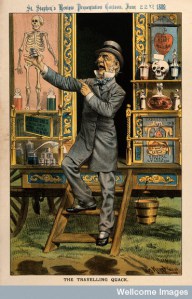
V0011377 A quack doctor selling remedies from his caravan; satirizing

“The surest way to work up a crusade in favor of some good cause is to promise people they will have a chance of maltreating someone. To be able to destroy with good conscience, to be able to behave badly and call your bad behavior ‘righteous indignation’—this is the height of psychological luxury, the most delicious of moral treats.” Aldous Huxley -Chrome Yellow 1921

A letter of agreement with the BORM, drafted at the behest of Physicians Health Service Inc., and signed by me 1/20/12 under threat of loss of my medical license specifically mandates participation “in a minimum of three 12-step meetings per week” and submit proof to PHS, “develop an “active 12-step sponsor relationship with someone who is not a healthcare professional.”

These requirements were made because I requested an independent evaluation at a non-biased  non-12-step assessment center not affiliated with the ASAM.    The choices PHS gave me were all…

View original post 5,087 more words

State Mandated 12-step –Establishment Clause Violations Run Amok- (Anonymity and Moral Inventories Optional)

V0011377 A quack doctor selling remedies from his caravan; satirizing

“The surest way to work up a crusade in favor of some good cause is to promise people they will have a chance of maltreating someone. To be able to destroy with good conscience, to be able to behave badly and call your bad behavior ‘righteous indignation’—this is the height of psychological luxury, the most delicious of moral treats.” Aldous Huxley -Chrome Yellow 1921

A letter of agreement with the BORM, drafted at the behest of Physicians Health Service Inc., and signed by me 1/20/12 under threat of loss of my medical license specifically mandates participation “in a minimum of three 12-step meetings per week” and submit proof to PHS, “develop an “active 12-step sponsor relationship with someone who is not a healthcare professional.”

These requirements were made because I requested an independent evaluation at a non-biased  non-12-step assessment center not affiliated with the ASAM.    The choices PHS gave me were all 12-step facilities with Medical Directors who can be seen on this list.   My request for an independent evaluation was justified as the MRO for PHS is on the same list.  The same MRO who allowed PHS to misrepresent the positive EtG tests and fabricate a confirmatory positive PEth.

The PHS monitoring contract states that positive laboratory reports will be reported to the Board “with the exception of those medications that have been properly prescribed for a legitimate medical purpose and of which PHS has been informed in advance or of which PHS has approved” and that positive drug results are reportable to the Board “unless PHS is provided with advance verification of such medications.”

PHS claimed that I had been told to discontinue medications used to control and treat lifelong asthma.   I had not.   I provided the Board with multiple documents contradicting PHS claims.

An August 24, 2009 from Dr. Luis Sanchez, M.D. to the Board states:

“Dr. Langan has informed PHS that he is being prescribed two asthma inhalers. By FDA mandate, the inhaler manufacturers changed to ethyl alcohol propellants in January of this year. Dr. Langan has provided documentation of this medication. Physician Health Services (PHS) will be working with Dr. Langan to determine whether there are alternative options for asthma treatment that do not utilize ethanol as a propellant. Meanwhile, PHS has advised him to continue to use this medication as needed and as directed by his treatment providers.”

After discussing alternative options with my PHS associate director, John Knight, M.D., it was decided to continue them as prescribed. This decision was based on the history and severity of my asthma and the good control and treatment these mediations provided. As a child and young adult I had multiple emergency room visits and was hospitalized several times for asthma, but the medications had prevented any serious asthma attacks for the previous 10 years.

A letter dated January 1, 2010 from Louis Sanchez acknowledges continued use of the asthma inhalers. He writes: “Dr. Langan has provided PHS documentation of this medication. PHS has concluded that there was no evidence of relapse at this time.”

The documentary evidence shows that PHS acknowledged the prescribed medications, considered me compliant, and advised I continue to use them.

A February 10 2010 letter to my Chief, Dr. Kenneth Minaker, M.D. acknowledges the relationship between the medication and the alcohol biomarker Etg and affirms compliance with my PHS contract:

Screen Shot 2014-10-14 at 12.20.14 PM

No EtG tests were done until June 20 and June 30, 2011. PHS reported these as “positive” by claiming I was told to discontinue my asthma medications. I provided the Board with multiple documents that contradict this claim and suggested that Dr. Knight be contacted to verify this was untrue.   I also requested written documentation to support PHS claim. The Board ignored the contradictory documentation, did not contact John Knight, and neither PHS nor the Board could provide any documentation to support the claim that I was told to discontinue the medication.  They still haven’t.

Reporting a positive test to the Board for a prescribed and acknowledged medication would be in violation of the PHS monitoring contract. Claiming the medications were discontinued allowed PHS to report these tests as true positives and also do a “confirmatory” test. The Etg was used as a stepping-stone to order a blood being used by Physician Health Programs to differentiate “incidental” exposure from drinking.

They were aware of the medications, aware they contained ethanol, and aware that they caused positive Etg levels but reported it anyway under the pretext that I was told to discontinue the medication.   This misrepresentation was then “confirmed” by fraud.

There is no known cutoff level for Etg to differentiate incidental exposure from drinking. It should be noted that the use of ethanol containing metered dose inhalers is not “incidental” exposure but “direct” exposure and reporting them as positive violates all established protocols and guidelines.  PHS then used forensic fraud for confirmation.

On July 1st, 2011, Dr. Gary Chinman of PHS informed me that I had positive EtG tests on June 20th, and June 30th, 2011. I was told to go to Quest Laboratories to obtain a confirmatory blood test.   On July 19th, 2011 I was informed that the test was positive at a markedly high level of 365. The cutoff level of PEth is 20 and a level of 365 suggests heavy sustained alcohol use. Common sense would have dictated this to be erroneous at this point based on my appearance, work performance, and all collateral information.

I immediately requested evaluations from my PCP and the Chief of Addiction Medicine at MGH. They both did full evaluations (including speaking with my supervisors and colleagues,  physical exams, and laboratory tests ) and wrote letters to the Board contradicting PHS claim. The Board was well aware that no other pretext existed to suggest alcohol use except for these tests. The Board ignored all outside information and continued to support PHS.

Suspecting the test was fabricated I requested the “litigation packet.” PHS initially refused. I persisted in obtaining the results and PHS finally agreed but threatened me with “unintended consequences.”   I received the “litigation packet” in December of 2011 and it revealed fraud. A fax dated July 19, 2011 from PHS to USDTL requested that my ID # (1310) and a chain-of-custody be added to an already positive specimen 19 days after it was collected.

This evidence of fraud was provided to the Board in December of 2011. This was followed by a letter from the Chief of Toxicology at MGH opining that the positive test was an intentional and purposeful act by PHS to misrepresent an invalid test as valid.11:5:12-Dr. Flood Letter–Ignored by PHS:USDTL:BORM

The test has since been invalidated as a result of a complaint filed with the College of American Pathologists (CAP), an accrediting agency for the labs.

To sum this up I knew that the test was fabricated at the time and  it was subsequently verified as fabricated ),  I simply wanted a fair and objective evaluation from an assessment facility with no conflicts of interest.  Marworth, Hazelden, or Bradford were the three choices given–all heavily indoctrinated ASAM facilities with close ties to the state Physician Health Programs.

Both PHS and the Board denied this request in violation of the Establishment Clause of the 1st Amendment.   The Board’s Complaint Committee found I was in violation of my Letter of Agreement because I did not immediately enter into one of the three programs offered.  On December 21st, 2011 the Board concurred that I was in violation of my LOA and chose to  “resolve the matter” by extending my contract by two years and “fortifying certain provisions” including

Screen Shot 2014-10-14 at 12.42.52 PM

BORM 12:22:2011

Interestingly, PHS had mandated thrice weekly 12-step meetings for a duration of three months.   The Board took it upon themselves to extend it from three months to 2-years–an ultra vires act outside the scope and power of the Board and an obvious Establishment Clause violation.     The Board also gave PHS carte blanche managerial prerogative to “submit proof of said participation” at the thrice weekly 12-step meetings.     PHS chose names and telephone numbers of fellow attendees at anonymous meetings as the burden of proof!    I informed the Board that obtaining unique identifiers such as names and telephone numbers to provide to a State substance abuse monitoring agency would be a tall order as “anonymous” is half its name.   They did not take this into consideration.  PHS also mandated under threat of my license that I could no longer use the asthma inhalers that had been controlling my asthma for the past decade.

Screen Shot 2014-10-14 at 12.49.13 PM

PHS Letter 12:6:11-phone numbers:claims lab will support test

PHS Letter March 2012 Requesting Signatures

But the requirement that I humiliate myself by attending meetings at which I don’t belong and try to convince anonymous attendees to breach their anonymity wasn’t enough.   I had to do it while wheezing.    The Board forbade me from any of my asthma MDIs and essentially all of the propellants were replaced with ethanol by Federal mandate to protect the Ozone.   Dr. Knight and I looked into alternatives previously and decided that due to the severity of my asthma and the control achieved by my current medications I would continue them as prescribed.  As cold and exercise were two major contributors to asthma attacks I had to stop going to the gym and I had 19 major asthma attacks during that winter.  My PCP documented the wheezing and shortness of breath at my checkups.

And to kick a wheezing fellow asking inappropriate requests at A.A. while he’s down, the  Board extended PHS requirement of thrice weekly mandated AA meetings from 3 months to 2 years on their own accord.   This is an inappropriate ultra vires act by the Board.  It is outside the scope of their authority and an obvious Establishment Clause violation.

PHS had fun with the phone numbers.  This is all documented in multiple e-mails such as these:Screen Shot 2014-10-14 at 1.31.49 PMScreen Shot 2014-10-14 at 1.29.20 PM Screen Shot 2014-10-14 at 1.27.34 PM

It soon became apparent that my attorney was doing nothing.   At a meeting with PHS I told them that getting names and phone numbers at 12-step meetings was inappropriate and that Dr. Chinman was asking personal questions.  My attorney turned to me and said “Well they have to ask questions. They need to make sure you’re not just paying somebody to say you were at a meeting?    It then dawned on me that he had insisted on blaming the positive PEth test on my asthma inhalers and never even contacted the labs.    He also refused to call Hazelden to verify that they had not made the request for phone numbers.   I was told that this is the case  with most PHPs.  They refer you to a few attorneys who they know well and give a lot of business who will not bite the hand that feeds them.    Another component of this rigged game.

On October 9th I received the following e-mail from my attorney:Screen Shot 2014-10-14 at 1.44.23 PM

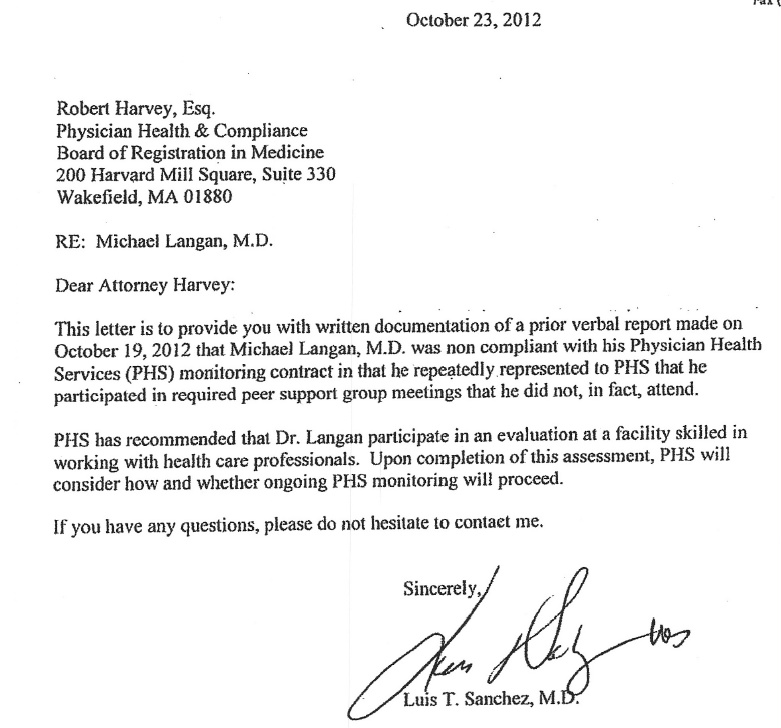
And on October 23, 2012 PHS formally reported my “noncompliance” with 12-step meetings to the Board

Screen Shot 2014-10-14 at 1.47.59 PM

It has now become clear why this occurred at this time.  Nevertheless the Board has outlined the decision making process from beginning to end right here in the February 6th, Board Order.

The modified Letter of Agreement specifically states that I must attend 3 “12-step” meetings per week and obtain a “sponsor.” No alternatives were offered and it is well established that mandated AA or 12-step by the State is in violation of the 1st Amendment.   The Board then suspended me for allegedly not complying with the 12-step requirement.   My suspension was, in fact, an Establishment Clause violation.

On April 8th, 2013, Attorney William Burgess of the Appignani Legal Center wrote a letter to PHS and The Board identifying the Establishment Clause violations and requested written response in how they would be remedied.  This can be seen here:Secular_substance_abuse_treatment_options_for_MA_doctors

Board attorney Barbara replied on April 19th, 2013 with “the physician who you named in your letter currently has an open matter with the Board and, therefore it would be inappropriate for the Board members to receive your letter.   Additionally, as you are not the attorney of record for the physician, I am unable to comment on the assertions you have made regarding the physician and his interaction with the Board and PHS.”  The letter can be seen here:  boardresponse5:1:13

This non-response is unacceptable.   The Establishment Clause violations have been pointed out to the Board. Whether or not I have an open matter with the Board is irrelevant. Who identifies the violation is irrelevant as the law is clear on this matter.

Screen Shot 2014-10-14 at 3.02.49 PM

The Proof PHS required was the name and phone number of a fellow attendee who they could call to verify my attendance.   PHS mandated thrice weekly 12-step meetings per week for 3 months then once per week. The Board then again violated the Establishment Clause by taking it upon themselves to lengthen my sentence. and extended it from 3 months to 2 years.

A “12-step” program is a set of guiding or “spiritual principles” outlining a course of action for recovery from addiction, compulsion, or other behavioral problems. Originally proposed by Alcoholics Anonymous (AA) as a method of recovery from alcoholism.1 The Twelve Steps were first published in the book Alcoholics Anonymous: The Story of How More than One Hundred Men Have Recovered from Alcoholism in 1939.2 The 12-step ideology has been adopted by other groups such as Narcotics Anonymous and Overeaters Anonymous and that, except for the identified problem source, are carbon copies of one another

Screen Shot 2014-10-12 at 12.37.01 AM

The proof of attendance at 12-step groups, as documented in the attached letters from PHS, mandated that I “provide PHS with the phone number of a consenting meeting participant” which is against the “suggested Alcoholics Anonymous (AA) policy regarding “cooperation with the courts.” The suggested AA policy is to sign “first name only to a card,” and even this “is not always accepted.”

According to Alcoholics Anonymous General Services3 “while most meetings will sign your court card, some will not. It is up to each individual group to decide. Since AA is not allied with the court system, AA is not required to do the courts work. We are not court employees.   If a meeting chairperson or group member offers to sign your court card they will probably just sign their first name or initials. We are personally anonymous,” and “regardless of an A.A. member’s vocation, reporting on the “progress” of another A.A. member is strictly outside the scope of what A.A. does.”

The act of obtaining phone numbers at anonymous meetings not only violates the rights of the person being forced to do it but the rights of the other attendees. The basic tenet of AA is that it is for people who desire to be there and the spiritual foundation of is anonymity. Anonymity, by definition, refers to an individual’s personal identity, or personally identifiable information, being unknown. Signing a first name to a card provides anonymity. Providing a first name and a telephone number most assuredly does not as it is a unique identifier, not unlike a social security number or driver’s license number, and can easily be used to uniquely identify that person. Consequently, trolling for phone numbers to be given to an unfamiliar non-governmental state affiliated agency from anonymous members of a categorically anonymous group that considers anonymity as the spiritual core of its existence, presents a tall order.

Nevertheless, despite being half of its name, the BORM accepted the statement from PHS that obtaining names and phone numbers at 12-step meetings was accepted without question and I was not allowed to challenge or question the decision before the BORM.

Difficult as it was, I was able to provide them with phone numbers despite PHS’ attempts to make it as difficult as possible as documented in the attached e-mails and letters that include my concern that this Sisyphean task was merely designed as a failsafe to deem me noncompliant with the BORM should the need arise. It was.

In addition to coercion PHS continued to engage in threats, intimidation, and “torture” (an act committed by a person acting under the color of law specifically intended to inflict severe physical pain or suffering upon another person within his custody or physical control).

On 11/8/2012 the BORM found I was in violation of this agreement and referred the case to the full Board for sanction based on alleged “noncompliance” with the ordered attendance.

The First Amendment states in the “Establishment Clause that “Congress shall make no law respecting an establishment of religion.”  Acts of direct coercion, threats backed by legal sanctions, are barred by the Establishment Clause.

Legally, Alcoholics Anonymous is established as a religious organization.  And so is Narcotics Anonymous.  This is well established and as far as United States courts are concerned AA and NA are, beyond a doubt, organizations that engage in religious activities and their meetings qualify as religious services.

Applying a standard three-part test to determine whether my constitutional rights have been violated

  1. Has the state acted?
  2. Was there coercion?
  3. Was the object of the coercion religious rather than secular?

As to point one the answer is clearly affirmative.  PHS’ recommendations to the BORM were that I do the following:

  • Participate in a minimum of (3) PHS approved 12 step meetings per week for the next 3 months including at least 1 physician meeting a week and document your participation with the signature of a consenting attendee and a phone number for the consenting attendee.  After 3 months you must attend at least 1 PHS approved support meeting a week and 1 physician meeting a month
  • Develop an active sponsor relationship and provide consent for this sponsor to confirm twice a year with PHS that he/she is your sponsor.

The Board wrote this up in the letter of agreement without offering any other options.

Coercion-point two—also is clearly present by force of law and threat of penalty.   The elements of coercion are 1. A forced choice,  2. Threat of sanction, 3. Coercive ijntent.

The BORM states if I attempt to negotiate or dispute PHS’ recommendation I will be “immediately suspended.”  Your money or your life.

Point three is now well established. (see notes below)

Mandating phone numbers as proof of attendance makes this particularly egregious as they inappropriately demanded I engage in a religious based program and violate the basic principles of the program (anonymity).

Moreover, the request for mandated 12-step attendance was not made out of “good faith” or beneficence. It was a retaliatory act designed to punish me because I questioned the results of a drug test that was done on July 1st, 2011 and reported as a confirmatory positive for alcohol use.

As a result of this test PHS requested an evaluation at a facility of their choosing. They were all -12-step facilities with medical directors they knew well. All ASAM/LMD and in 12-step recovery themselves

Because PHS had previously (2008) misrepresented the results of a drug test to justify sending me to an out of state facility for an evaluation where the facility fabricated neuropsychological testing to support “denial and cognitive impairment” resulting in forced inpatient rehabilitation I requested that the BORM allow an evaluation at an independent facility that did not have a referral relationship with PHS (and the inherent conflicts of interest that exist).4   The BORM would not consider the requests, said I had to go to one of the choices I was given, and added to more years to my contract because I had the audacity to request an alternative.

I also requested the laboratory (USDTL) “litigation packet.” Considered a legal document, this record is generated in any forensic (as opposed to clinical) laboratory -testing, and records the collection, shipping, handling, and testing of the sample. It is done to document that a drug test was done correctly on the person it was supposed to done on. It follows a specific protocol that involves strict chain of custody followed by MRO review.

PHS was resistant to my request for the “litigation packet,” but I eventually got it and, as Dr. Flood’s opinion letter shows, the test was fabricated. Chain of custody was nonexistent. The BORM refused to look at it. I filed a complaint with the College of American Pathologists (CAP) and an investigation was done which showed that the test was manipulated. Although the lab was sanctioned under threat of losing accreditation by CAP, as a non-governmental organization with no regulations and accountable to no one, PHS continued to support the validity of the test.

On December 4th, 2012 I got the following e-mail documenting that the laboratory issued an amended report mandated by CAP that showed the external chain of custody was not followed and thus making it an invalid test.

The amended report was issued on October 4th, 2012. I called Linda Bresnehan at PHS to ask for a copy of the amended report. She said she just got the report that day and issued a letter to the BORM December 11, 2012 stating that they just received the revision to the lab test but they “did not make a determination of relapse following the positive test,” they were not “aware of any action taken” by the BORM, and that they would continue to “disregard it.”

The BORM did not consider the logic that the very basis for my forced attendance at AA meetings and all of the other negative consequences thrown at me was this very test. Nor did they take into consideration the fact that the amended report was issued in October and the temporal relationship to them finding me out of compliance with AA meetings.

Instead, the BORM found me out of compliance with PHS which is essentially a lie (noncompliance) based upon a lie (saying that Hazelden recommended 3x per week AA meetings with phone numbers) based upon a lie (a fabricated test).

But the forensic fraud,  “color of law” abuse, Civil rights violations, harassment, intimidation, and abuse qualifying as criminal harassment  under 42 U.S.C. § 1983 -subject to a systematic scheme of harassment and intimidation   Personal humiliation, embarrassment and mental distress) and arguably a violation of the Bill of Rights under cruel and unusual punishment are irrelevant. So too is the arrogant over-the-top bizarrely inappropriate request for phone numbers. Even without these factors entering the picture the Establishment Clause violations are clear.    And the fact that they ignored the request to remedy a Civil rights violation is indefensibly unconscionable.    They acted with malice, willfulness, and callous and reckless indifference to the safety and rights of my family and me.  The “Right to be secure in one’s person” is an aspect of liberty protected by the due process clauses of both the Fifth and Fourteenth Amendments.  And “Liberty” is Constitutionally protected by both the Fifth and Fourteenth Amendments, and also a protectable deprivation of due process. The liberty interest is violated and actionable by any conduct of persons acting under color of law that “shocks the conscience” (Massachusetts Civil Rights Act is M.G.L. c. 12 § 11I).  

 Unknown-1 copy 2

Notes:

The First Amendment states in the “Establishment Clause that “Congress shall make no law respecting an establishment of religion.” Acts of direct coercion—threats backed by legal sanctions—are barred by the Establishment Clause.

Three federal courts have held that coerced participation in 12-step programs like AA and NA violates the First Amendment. In Kerr v. Ferry, 95 F.3d 472 (7th Cir 1996), the Seventh Circuit held that requiring an inmate to attend NA meetings or risk suffering adverse effects for parole eligibility violated the Establishment Clause. The Second Circuit reached a similar conclusion in Warner v. Orange County Department of Probation, 115 F.3d 1068 (2d Cir. 1997), striking a probation condition requiring attendance at AA meetings.

In 2007 the Ninth Circuit Court of Appeals held that a parole officer’s demand that a convicted drug offender attend Narcotics Anonymous violated the First Amendment rights of the offender who claimed to be a Buddhist (Inouye v. Kemna, 504 F.3d 705 (9th Cir. 2007)).

Moreover, the case ruled that “any coercing authority” can be held individually, civilly liable for the First Amendment constitutional rights violation that they perpetrate on people unwillingly and involuntarily forced to go to 12-step programs and the offender was free to sue the parole officer for damages, even though state officials are often immune form such suits.

In both the Warner and Inouye cases, the courts found the law sufficiently clearly established to abrogate the officer’s qualified immunity. Qualified immunity shields government officials from liability for civil damages “insofar as their conduct does not violate clearly established statutory or constitutional rights of which a reasonable person would have known. (Harlow v. Fitzgerald 4567 U.S.C. 1983)

Warner and Inouye were able to go forward with lawsuits against their officers for damages for violation of their constitutional rights under 42 U.S.C. 1983. (Civil action for deprivation of rights). Numerous federal and district courts and state supreme courts have reached the same conclusion.

What this means is that you can sue a judge, a prison warden, a parole officer, a “counselor, a medical board member, or anyone else in a position of authority who forces you to go to AA meetings.

In cases like this the courts found that the government had forced the person to attend AA or NA. In other cases, where state of local officials simply made participation in AA one option for substance abusers, courts have no found any Establishment Clause violation.

[29] “For the government to coerce someone to participate in religious activities strikes at the core of the Establishment Clause of the First Amendment, whatever else the Clause may bar.” Inouye v. Kemna, 504 F.3d 705, 712 (9th Cir. 2007). The Ninth Circuit articulated the following test in Inouye v. Kemna “with regard to determining whether [Plaintiff] was [subject to] governmental coercion of religious activity . . . : ‘first, has the state acted; second, does the action amount to coercion; and third, is the object of the coercion religious rather than secular?’” Id. at 713. “First, [Crofoot] acted in his official state capacity as a parole officer to order [Plaintiff into a 12-step program that contained religious components]. That the state did not run the program itself is ‘of no moment.’” Id. (quoting Kerr v. Farrey, 95 F.3d 472, 479 (7th Cir. 1996)). It is undisputed that Crofoot, Wilding, and Jallins were acting in their official state capacities when they required Plaintiff to participate in the 12-step drug treatment program as a condition of his parole, and subsequently removed and incarcerated him for not participating in the program.

[30] Further, the Parole Defendants’ “action was clearly coercive: [Plaintiff] could be imprisoned if he did not attend and he was, in fact, ultimately returned to prison in part because of his refusal to participate in the program.” Inouye, 504 F.3d at 713 (emphasis added). The Parole Defendants argue Plaintiff was returned to prison because he was “disruptive” in the program. This argument rings hollow in light of the undisputed facts showing Plaintiff was only “disruptive” in the program “‘in a congenial way’” and “was ‘sort of passive aggressive.’” (Partial Mot. SUF ¶¶ 12, 13.) It is also undisputed that Plaintiff communicated his objection to participation in the Empire program and that Crofoot told Plaintiff he “should continue to participate in the Empire Program or he would be returned to prison.” (Id. ¶ 10.) It is further undisputed that Crofoot and Wilding concluded that “the right thing to do” was to refer Plaintiff to the Board of Parole Hearings “on a parole violation for failing to participate in the BPH-ordered program.” (Id. ¶ 15.) It is also undisputed that Deputy Commissioner Jallins authorized Plaintiff to be returned to prison because of Plaintiff’s failure to participate in the program. (Id. ¶¶ 18-19, 24.)

[31] “The final element requires somewhat more discussion.” Kerr, 95 F.3d at 479. It is undisputed that “Empire used a 12-step program that included references to God and a ‘higher power.’” (Partial Mot. SUF ¶ 3.) Further, Plaintiff’s following averments in his declaration have not been controverted:

[32] Shortly after arriving at Empire, I discovered that Empire used a “12-step” recovery program based [on] the principles of Alcoholics Anonymous (“AA”) and Narcotics Anonymous (“NA”), which contains religious components. Among other features, the “12-step” method used by Empire made references to God, involved acknowledgment of a “higher power,” and included prayer. [¶] I am an atheist, and was one in 2007. The substantial religious components to the “12-step” program administered by Empire conflicted with my beliefs. Prior to my release on parole, I had notified correctional authorities of my Atheism, and requested placement in a treatment facility that did not contain religious components.

[33] (Hazle Decl. ¶¶ 2, 3.) The Parole Defendants do not dispute that the Empire’s 12-step program contained religious components. “As such, on this summary judgment record and given the lack of dispute between the parties in question, . . . the third prong of [Plaintiff’s] Establishment Clause test has been met as well.” Inouye, 504 F.3d at 713-14. Therefore, “the program runs afoul of the prohibition against the state’s favoring religion in general over non-religion,” because of the program’s use of a religious concept of a Higher Power through references to God and prayer. Kerr, 95 F.3d at 480. Accordingly, Plaintiff’s partial motion for summary judgment against the Parole Defendants is granted.

[34] B. Plaintiff and Westcare’s cross motions for summary judgment on Plaintiff’s Establishment Clause claim

It is beyond dispute that, at a minimum, the Constitution guarantees that government may not coerce anyone to support or participate in a religion or its exercise (Lee v Weisman 505 U.S)

Legally, Alcoholics Anonymous is established as a religious organization. And so is Narcotics Anonymous. This is well established and as far as United States courts are concerned AA and NA are, beyond a doubt, organizations that engage in religious activities and their meetings qualify as religious services.

Applying a standard three-part test to determine whether my constitutional rights have been violate

  1. Has the state acted?
  2. Was there coercion?
  3. Was the object of the coercion religious rather than secular?

As to point one the answer is clearly affirmative. PHS’ recommendations following my evaluation at Hazelden (See PHS letter dated 10/27/2011) include:

  • Participate in a minimum of (3) PHS approved 12 step meetings per week for the next 3 months including at least 1 physician meeting a week and document your participation with the signature of a consenting attendee and a phone number for the consenting attendee. After 3 months you must attend at least 1 PHS approved support meeting a week and 1 physician meeting a month
  • Develop an active sponsor relationship and provide consent for this sponsor to confirm twice a year with PHS that he/she is your sponsor.

Coercion-point two—also is clearly present by force of law and threat of penalty.   The elements of coercion are 1. A forced choice, 2. Threat of sanction, 3. Coercive intent.

Motion to Take Judicial Notice of Adjudicative Facts Pertaining to Violation of the Establishment Clause of the First Amendment

Motion to Take Judicial Notice of Adjudicative Facts

Motion to Take Judicial Notice of Law

BORM 11:8:2012 12:4:12-BORM Letter 12:21:11-BORM Board Order 12:22:11-BORM Violation LOA 12:27:2011-BORM LOA American Humanist Letter to BORM boardresponse5:1:13 BORM 12:22:2011 BORM Agreement Emergency Petition to Return to Practice.011013 letter re secular substance abuse treatment options for MA doctors (reply to PHS) v2-1 Liebert Letter to BORM 11:14:2011– Ltr JLH to Harvey.122812.01 Secular_substance_abuse_treatment_options_for_MA_doctors  EMAILSLIEBERT

Psychopathy and the Medical Profession

IMG_9598Psychopathy is present in all professions. In The Wisdom of Psychopaths: What Saints, Spies, and Serial Killers Can Teach Us About Success, Kevin Dutton provides a side-by-side list of professions with the highest (CEO tops the list) and lowest (care-aid) percentage of psychopaths.   Interestingly surgeons come in at #5 among the professions with the highest percentage of psychopathy while doctors  (in general) are listed among the lowest.

Although by no means a scientific study, Psycopaths, by their very nature, seek power and it would make sense that a psychopath among us might pick surgery over pediatrics or pathology as they are drawn to power, prestige, and control. Be this as it may the incidence of psycopathy or psychopathic traits in doctors of any specialty is low. Statistics indicate that no more than 1% of men in general exhibit psychopathic traits. In Women these characteristics are far less.

Due to irresponsible behavior and a tendency to ignore or violate social conventions and rules,  psychopaths frequently find themselves engaged in conduct involving the criminal justice system or involved in other disciplinary action. Juvenile delinquency, arrests, school suspensions and misconduct related issues are barriers that preclude professional careers for many and, with around 15% of the prison population estimated to be psychopathic, incarceration and recidivism are common final pathways. Because of this tendency it would be highly unlikely for most sociopaths to follow a standard professional career pathway involving academic rigor and normal professional and societal expectations,  because impulsive irresponsible actions commonly blocks it. This would predict a probably much lower prevalence of psycopathy in physicians compared to the general population.

That being said, such self imposed removal from a potential  career is the sole product of getting caught for misconduct and being held accountable for it.   Psychopaths possess several traits that make this difficult.    With a talent for “reading people” and identifying their weak spots and vulnerabilities they are able to get people to see what they want them to see.  Psychopaths often exude charm, confidence and charisma.  They can lie effortlessly and are very convincing..

The natural history of psychopathy involves risky behavior and the ability to get away with it or out of it. The consequences of this depend on if and when it occurs. It is entirely conceivable that some may live their entire lives undetected. With a need for stimulation and a proneness to boredom the psychopath is particularly prone to drug abuse and addiction and twice as likely as the general population to be diagnosed.

 Psycopathy involves a path of risky behavior as well as the potential for being held accountable for it. At any age the behavior that brings they psychopath to the attention of the criminal justice system is often drug or alcohol related. The natural history of the average psychopath reveals an overrepresentation in prison with a 15x greater risk in general. Any statistics on psycopathy in a population is based on psychometric evaluations retrospectively in specific populations. Being arrested or getting caught for something does not reveal the pathology or the correlation. You have to look for it.

And nothing is known of subpopulations of psychopaths and the impact of intelligence, education, profession and other factors and how they relate to outcomes and consequences over time. Egocentricity and a sense of entitlement drives they do not adapt to the environment but try to make the environment adapt to them. Without empathy and lacking remorse the goal is always self-serving and a question of what they can get out of it.

 Many judges, as an alternative to incarceration, have been requiring people arrested for drug and alcohol related offenses to attend AA meetings and provide proof of participation. As misguided as this is on other levels it is also dangerous. Given a choice between incarceration and attending AA the majority of any population, including those with psychopathic traits, would choose the latter. And as in any situation they would use it to see what they could get out of it. Masters of manipulation and impression management in a room full of potential victims. The reports of rape and theft coming out is no surprise. It is in all likelihood much worse.

And in reality psychopaths exist in every profession, including medicine.

What is the natural history and final common pathway of M.D. psychopaths?  Where do these shape-shifters end up?

Screen Shot 2014-11-08 at 11.10.42 PM

In his book Without Conscience, Dr. Robert Hare notes “If we can’t spot them, we are doomed to be their victims, both as individuals and as a society. ” Dr. Clive Boddy in Corporate Psychopaths observes that unethical leaders create unethical followers, which in turn create unethical companies and society suffers as a result.” And if you look at the FSPHP branch of the ASAM that is exactly what you will find.  less than 1/% of the population are psychopaths but they represent more that 10% of those in prisons.  What is the natural history of the physician psychopath? You do the math.

images-4

http://psychopathyinfo.wordpress.com/2012/03/22/characteristics-of-corporate-psychopaths-and-their-corporations/

A paranoid is someone who knows a little of what’s going on.

mllangan1's avatarDisrupted Physician

“A paranoid is someone who knows a little of what’s going on”
–William S. Burroughs
IMG_0330.JPG
In his 1969 novel The Wild Boys, William S. Burroughs writes “Under pretext of drug control suppressive police states have been set up throughout the Western world…. The police states maintain a democratic façade from behind which they denounce as criminals, perverts and drug addicts anyone who opposes the control machine.”

15 years earlier Dr. Ruth Fox formed the New York City Medical Society on Alcoholism. This organization subsequently became the American Medical Society on Alcoholism and eventually the American Society of Addiction Medicine (ASAM). The organizational goal of this group has always been to convince the medical establishment of the chronic relapsing brain disease model of alcoholism (and subsequently all addictions) and that 12-step spiritual recovery as defined by Bill Wilson and the Big Book as not only a valid medical treatment

View original post 1,361 more words