

 Accountability is necessary to prevent corruption and requires both the provision of information and justification for actions. What was done and why? Accountability also necessitates consequences-the ability of outside actors to punish and sanction those who commit the misconduct Without these constraints corruption is inevitable.

The drug and alcohol testing and treatment industry plan to use the medical profession as a urine collection agency to bypass procedural protections: The ASAM White Paper on Drug Testing and the “Future of American Drug Policy.”

Before the 2012 Drug and Alcohol Testing Industry Association (DATIA) annual conference, Dr. Robert Dupont delivered a speech entitled “Drug Testing and the Future of American Drug Policy.” He describes a “New Paradigm” for substance abuse treatment that enforces “zero tolerance for alcohol and drug use” enforced by monitoring with frequent random drug and alcohol tests in which any positive test is “met with swift, certain” consequences.” The paradigm is based on the current Physician Health Programs blueprint. Dupont states:
“…physician health programs , have set the standard for effective use of drug testing. These pioneering state programs provide services to health care professionals with substance use disorders. The programs are run by physicians, some of whom in recovery themselves. PHPs feature relatively brief but highly focused treatment followed by active lifelong participation in the 12-step fellowships of Alcoholics Anonymous and Narcotics Anonymous. The key to the success of the PHP system of care management is the enforcement of the standard of zero tolerance for any alcohol or other drug use by intensive long-term random testing for both alcohol and drugs with swift and certain consequences for even a single use of alcohol or any other drugs of abuse. PHPs use drug panels of 20 or more drugs. The PHPs commonly use EtG and EtS tests to detect recent alcohol use. Similar comprehensive programs have been developed for commercial pilots and attorneys. These innovative programs of care management produce unprecedented long-term, outcomes.”
Physician Health Programs use a doctor’s medical license as “leverage” in what they call “contingency management.” What this means is that a doctor who is being monitored by a PHP must comply with any and all demands of the PHP under threat of being reported to the state Medical Board and immediate suspension of licensure. Dupont wants to extend this model to other populations including our elderly, our pregnant mothers, college and high school students and schoolchildren.
The 2013 American Society of Addiction Medicine White Paper on Drug Testing describes the organizational structure of the “New Paradigm” and this includes utilizing the medical profession as a urine collection agency for their drug and alcohol testing and the loophole they plan to exploit is this: When a doctor-patient relationship exists drug and alcohol testing is rendered “clinical” rather than “forensic”so the consequences of a positive test can legitimately be called “treatment” rather than punishment. Because addiction is currently defined as a disease, addicts must be “treated” (which in the United States is more often coercive than voluntary), and “cured” (which is defined as remaining abstinent). When the disease concept is not strictly reserved for medical conditions but is expanded to any and all drug and alcohol use.
The proposed system bypasses the strict chain-of-custody and Medical Review Officer requirements designed to ensure accuracy and minimize false-positives. These strict protocols are used by essentially all employee assistance programs (EAPs) in workplace drug testing programs. Forensic drug testing is tightly regulated because the results of a positive test can be grave and far reaching and erroneous results are unacceptable.

THE ASAM PAPER DESCRIBES MANDATED DRUG-TESTING FOR PATIENTS IN A NUMBER OF SPECIALTIES INCLUDING ADOLESCENT MEDICINE, PSYCHIATRY, OBSTETRICS, AND GERIATRICS. CONTINGENCY MANAGEMENT WILL INVOLVE “THE POTENTIAL FOR LOSS OF CURRENT OR DESIRED EMPLOYMENT, OR THREATENED LOSS OF OR RESTRICTIONS ON A PROFESSIONAL OR COMMERCIAL LICENSE, OR LEGAL AND FORENSIC NECESSITY.”
“THIS WHITE PAPER ENCOURAGES WIDER AND “SMARTER” USE OF DRUG TESTING WITHIN THE PRACTICE OF MEDICINE AND, BEYOND THAT,BROADLY WITHIN AMERICAN SOCIETY. SMARTER DRUG TESTING MEANS INCREASED USE OF RANDOM TESTING* RATHER THAN THE MORE COMMON SCHEDULED TESTING,* AND IT MEANS TESTING NOT ONLY URINE BUT ALSO OTHER MATRICES SUCH AS BLOOD, ORAL FLUID (SALIVA), HAIR, NAILS, SWEAT AND BREATH WHEN THOSE MATRICES MATCH THE INTENDED ASSESSMENT PROCESS. IN ADDITION, SMARTER TESTING MEANS TESTING BASED UPON CLINICAL INDICATION FOR A BROAD AND ROTATING PANEL OF DRUGS RATHER THAN ONLY TESTING FOR THE TRADITIONAL FIVE-DRUG PANEL.”
Federal workplace drug testing is done in accordance with mandatory guidelines. This testing is regulated using FDA approved tests with established sensitivity, specificity and cutoff levels. FDA approval requires rigorous research and proven validity. The FDA requires valid scientific evidence (with both clinical and analytical validation).
The Federation of State Physician Health Programs (FSPHP), the group currently in managerial control of state physician health programs in 47-states, has introduced non-FDA drug testing via a loophole that removes all accountability. The EtG, EtS, and PEth tests were introduced as Laboratory Developed Tests (LDTs) with little to no evidence base through pathway developed for “clinical” tests of low market potential that would not otherwise be developed due to the prohibitive cost of the FDA approval process. An LDT does not even require testing in humans (“in vivo”) or even proof that the test is testing what it claims to be testing (validity) for. It is an honor system and without FDA oversight a lab can can claim anything they want about these tests with no accountability. They do not have to provide any proof of what they claim or justify what they claim. After partnering with labs to develop these tests, the FSPHP then convinced the Federation of State Medical Boards they were valid and accurate tests that were necessary to detect a bogus cadre of drunk and drugged doctors able to hide their impairment and who were protected by a “code of silence.” This bogus danger was then used to convince state Medical Boards to use these unvalidated tests on doctors in state physician health programs.
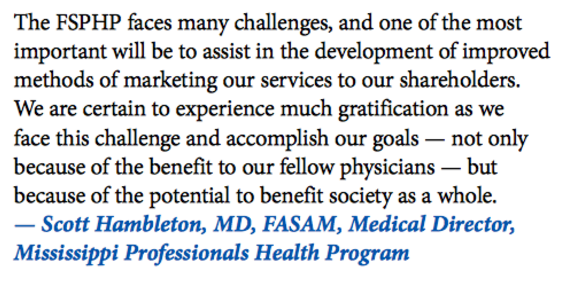
(Source: ASAM Physician Health News March 2015)ASAM Physician Health News March 2015)
The ASAM white paper contains the following quote minimizing the critical role of the MRO in drug testing. They feel clinical testing is good enough.
Unlike forensic drug testing where the test results must be able to meet rules of evidence in administrative, civil or criminal proceedings, clinical drug testing* is part of a patient examination performed by a clinician with whom the patient is in a therapeutic relationship. The testing is used for the purposes of diagnosis, treatment, and the promotion of long-term recovery. Clinical drug test results must meet the established standards of medical practice and benefit the therapeutic relationship, rather than meeting the formal legal requirements of forensic testing. Drug testing in medicine employs the same sound procedures, safeguards, and systems of information management that are used for all other health-related laboratory tests, tests on which life-and death medical decisions are commonly made.
Changing Public Policy and Regulatory Authority to Increase Power and avoid Accountability
The Federation of State Physician Health Programs has been able to construct this scaffold with no meaningful opposition and below the public radar. They have done this by removing accountability at multiple levels. By preventing access to information and erecting a system without oversight no consequences exist to deter misconduct and abuse. The same tactics and strategies will be used as they expand this to other populations.
The Federation of State Physician Health Programs trumpets the the 12-step chronic relapsing brain disease model of addiction as defined by A.A. because it supports the drug and alcohol assessment, testing and treatment industries goals of more and more testing and treatment. For example a 2011 FSMB Policy on Physician Impairment identifies, defines and essentially legitimizes “potential impairment” and “relapse without use.”
A PHP Should be empowered to conduct an intervention based on clinical reasons suggestive of potential impairment.  Unlike the Board which must build a case capable of withstanding
legal challenge, a PHP can quickly intervene based on reasonable concern."
“Empowered” to conduct an “Intervention” for reasons “suggestive” of “potential” impairment means a doctor can be pulled out of practice for anything. It essentially gives them carte blanche authority. Due process and fundamental freedoms of choice are removed.
in 2011 The ASAM issued a Public Policy Statement on coordination between PHPs, regulatory agencies, and treatment providers recommending that only “PHP approved” treatment centers be used in the assessment and treatment of doctors. A recent audit of the North Carolina PHP found financial conflicts of interest and no documented criteria for selecting the out of state treatment centers they used. The common denominator the audit missed was that the 19 “PHP-approved” centers were all ASAM facilities whose medical directors can be seen on this list.
The FSMB House of Delegates adopted an updated Policy on Physician Impairment at their 2011 annual meeting distinguishing “impairment” and “illness” stating that Regulatory Agencies should recognize the PHP as their expert in all matters relating to licensed professionals with “potentially impairing illness.”
According to the FSPHP, physician illness and impairment exist on a continuum with illness typically predating impairment, often by many years.”
The policy extends PHP authority to cover physical illnesses affecting cognitive, motor, or perceptive skills, disruptive physician behavior, and “process addiction” (compulsive gambling, compulsive spending, video gaming, and “workaholism”). It also defines “relapse without use” as “behavior without chemical use that is suggestive of impending relapse.”
G. Douglas Talbott defines “relapse without use” as “emotional behavioral abnormalities” that often precede relapse or “in A A language –stinking thinking.” AA language has entered the Medical Profession and no one seems to have even noticed.
The FSPHP political apparatus exerts a monopoly of force. It selects who will be monitored and dictates every aspect of what that entails. It is a, in fact, a rigged game.
The Need for Regulation, Oversight, and Accountability
Accountability is necessary to prevent corruption and requires both the provision of information and justification for actions. What was done and why? Accountability also necessitates consequences-the ability of outside actors to punish and sanction those who commit the misconduct. Without these constraints corruption is inevitable.
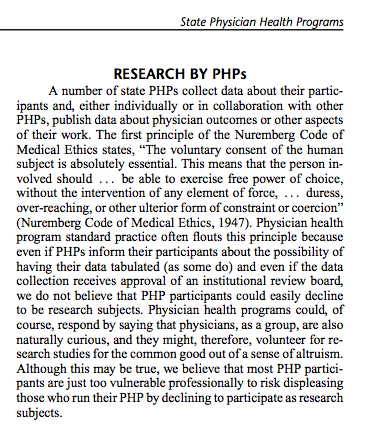
In 2012 Drs. John Knight and Wes Boyd recommended the medical community outside of PHPS provide oversight and demand accountability. In Ethical and Managerial Considerations Regarding State Physician Health Programs they noted the financial conflicts of interest between PHPs and their “approved centers, coercion and abuse and even possible violations of the Nuremberg Code of Medical Ethics yet their paper generated little interest in the medical community. The North Carolina PHP audit revealed financial conflicts-of-interest and no oversight by the state medical society or board and that abuse of doctors could occur undetected due to the complete absence of accountability. State Auditor Beth Woods told the British Medical Journal in a recently published article that the state program had holes in it “big enough to drive a truck through.”
In Ethical and Managerial Considerations Regarding State Physician Health Programs Knight and Boyd state: “Because PHP practices are unknown to most physicians before becoming a client of the PHP, many PHPs operate outside the scrutiny of the medical community at large. Physicians referred to PHPs are often compromised to some degree, have very little power, and are, therefore, not in a position to voice what might be legitimate objections to a PHP’s practices.” And when objections do occur many take the side of the PHP, complacent in their belief that these are just altruistic and competent doctors just helping sick colleagues and protecting the public and valid complaints are deemed nothing more than “bellyaching. In reality the ethical and criminal misconduct occurring in PHPs rivals that of Dr. Farid Fata, the Detroit Oncologist who intentionally misdiagnosed patients with cancer so he could make money off unnecessary chemotherapy treatment. Dr. Fata’s egregious betrayal of trust and unconscionably vile acts resulted in an appropriate response.
 The exact same misconduct is being perpetrated by PHPs but being overlooked, justified or otherwise ignored. Dr. Fata intentionally misdiagnosed patients with cancer who did not have cancer so he could give them chemotherapy to make money. PHPs are intentionally misdiagnosing substance abuse and behavioral disorders in physicians who do not have them in order to give them unneeded treatment and force them into monitoring contracts for profit and control.
This undermines the very integrity of the profession. It is particularly vile when the betrayal of trust involves doing the opposite of what was entrusted. Abuse of positions of power, trust and influence in the field of medicine need to be both prevented, recognized and addressed. Oversight, regulation and accountability are essential if this is going to be accomplished. There are no exceptions. Policies and procedures must be enforced in a consistent manner.
The medical boards, medical societies, and departments of health have given the state PHPs carte blanche control and absolute power. They refuse to even investigate accusations and they have convinced law enforcement that this is a parochial matter best handled by within the medical profession. As a result, valid complaints of crimes are not taken seriously. This refusal to investigate or even acknowledge valid and factual complaints of professional misconduct has not only prevented the exposure of wrongdoing and corruption but deepened it. The Federation of State Physician Health Programs and “Like-minded docs” must be recognized for what they are. Front-groups for the drug and alcohol assessment, testing and treatment industry. This is glaringly obvious and you don’t have to look that deep to figure it out. And these are the very same groups being proposed as advocacy bodies for addiction treatment and public policy change. It is not that hard to figure out what they will be advocating for –more diagnoses, more testing and more treatment.

The American philosopher Eric Hoffer noted:
“The only way to predict the future is to have power to shape the future. Those in possession of absolute power can not only prophesy and make their prophecies come true, but they can also lie and make their lies come true.”
The “PHP-blueprint” is built on the very foundation Hoffer describe and unless you want mandated randomized non-FDA approved drug and alcohol testing with “swift and certain” consequences at future visits with your doctor you will need to speak up.
This occurred in the medical profession rapidly and with little notice and that is exactly what will happen here.
“Every time we turn our heads the other way when we see the law flouted, when we tolerate what we know to be wrong, when we close our eyes and ears to the corrupt because we are too busy or too frightened, when we fail to speak up and speak out, we strike a blow against freedom and decency and justice.”
Share this:

The “PHP-Blueprint”–A Trojan Horse for Profit and Wider Social Control: Watching helplessly, as Cassandra did, while the soldiers emerge and wreak their predicted havoc.

In my February 2016 post The “PHP-Blueprint”–A Trojan Horse for Profit and Wider Social Control (copied below) I describe the planned expansion of a substance abuse management program currently being used on doctors to other people including the elderly, pregnant mothers, college students and kids. I suggest the following documents be read:
- Robert Dupont’s 2012 Keynote speech before the Drug and Alcohol Testing Industry Association.
- Robert Dupont’s address before the House Subcommittee on Oversight and Investigation Combatting the Opioid Epidemic
- 2014 Journal of the American Medical Association (JAMA) article entitled “Addiction Medicine: The Birth of a New Discipline”
- The ASAM White Paper on Drug Testing
- Why good addiction centers connect clients to AA or NA
Robert Dupont’s 2012 keynote speech before the Drug and Alcohol Testing Industry Association (DATIA) describes a “new paradigm” for addiction treatment he proposes be expanded to the workplace, the healthcare system, and schools. The ASAM White Paper on Drug Testing describes in great detail how they plan to introduce non-FDA approved laboratory developed tests (LDTs) into the healthcare system and require doctors to drug test all patients ranging from pediatrics to obstetrics to geriatrics. They wish to do away with the forensic protections currently used in workplace drug-testing (such as strict documented chain-of-custody and Medical Review Officer (MRO) evaluation) by using your doctor’s office as a drug and alcohol testing collection agency and I describe this in detail here: Utilizing the Medical Profession as a urine collection agency–The ASAM White Paper on Drug Testing.
Dupont’s address before the House Subcommittee lobbying for the “PHP model” as standard of care in opioid treatment illustrates the “policy entrepreneurship” and “bent science” this group has used to advance their agenda. Here Dupont makes the ludicrous claim that a survey of doctors being monitored by PHPs rating their experiences from “extremely hurtful” to “extremely helpful” found that “only 3% said it had been hurtful to any extent” with the remainder reporting their experience as helpful and “nearly 50% reporting ‘extremely helpful.'”
“When asked to rate which components of the PHP program were most valuable to them the highest rating went to participation in the 12-step fellowships, followed by their formal treatment experiences and their sustained random monitoring.”
Of course this does not comport with reality. It is just propaganda pushing the “PHP-blueprint” and an agenda of more and more testing and treatments. This is all based on a 2009 study called Setting the Standard for Recovery: Physicians’ Health Programs” and Dupont is the lead author on this paper. The conflicts-of-interest here are incredible.
It was recently proposed the same groups that developed and manage the substance abuse management programs being used on doctors act as organized bodies to advocate for all people with addiction and in recovery to pursue public policy changes for addiction treatment on a national level. This recommendation was made by the Editor-in-Chief of ASAM Weekly to fellow members of the American Society of Addiction Medicine (ASAM) and 250,000 addiction medicine professionals in a September 27, 2016 ASAM Weekly Editorial Comment and the author is on the list of “like-minded docs” and closely affiliated with the primary architects of this system. He is part of their inner circle and just another foot soldier in the Trojan Horse.
A significant problem is that the vast majority of people know little or nothing about Physician Health Programs (PHPs) and even fewer care. They need to before it is too late. Abbie Hoffman spoke of Dupont’s expertise in drug testing both scientifically and politically as representing “the greatest threat to civil liberties we seek to protect” and warned “know your enemy.” A warning that has apparently been ignored as he and the groups he represents will in all likelihood be elected as representative bodies advocating for addiction medicine at large and be given power to lobby for legal, regulatory and public health policy changes in addiction treatment. They will continue to push an agenda that benefits the drug and alcohol testing, assessment and treatment industry and all we can do is watch helplessly, as Cassandra did, while these soldiers emerge and wreak their predicted havoc.
Source: The “PHP-Blueprint”–A Trojan Horse for Profit and Wider Social Control
——————————————————————–
 “In the small world of drug testing, these four—Angarola, Bensinger, DuPont and Willette—are affectionately referred to as the Gang of Four. Dr. John Morgan explains, “They are the ones responsible for a good deal of drug testing’s success, and some of the fear that goes along with it. Remember these names. These men are among the most competent and knowledgeable about drug testing—scientifically and politically. They are well-informed: they have to be. Their livelihoods depend upon their credibility. Unfortunately their expertise represents the greatest threat to the civil liberties we seek to protect. Know your enemy.” 1
Steal This Urine Test – Fighting Drug Hysteria In America – By Abbie Hoffman with Jonathan Silvers. 1986
A recent Huffington Post article written by Maia Szalavitz, The Rehab Industry Needs to Clean Up Its Act Here’s How, describes the need to radically rethink and reform American addiction treatment.. The article quotes Dr. Mark Willenbring who states
“What we simply need is a nice bulldozer, so that we could level the entire industry and start from scratch.”
Agreed, but the chances of this are slim to none if the “PHP-blueprint” becomes the “New Paradigm.” To prevent this from happening it is critical to disprove the claims, recognize the threat, and address the matter directly and collectively. We need political and social activism in the same spirit as Abbie Hoffman whose words from three decades ago are aptly accurate. His prescient warnings remain unknown, forgotten, or irrelevant to us today but their accuracy is crystal clear. Few people know the enemy.
 On April 23, 2015 Dr. Robert Dupont, MD addressed the House Subcommittee on Oversight and Investigations Combatting the Opioid Abuse Epidemic and proposed widespread application of a “New Paradigm” for substance abuse management based on the nation’s physician health program (PHP) model of care.
This model is being brandished as “gold standard for addiction treatment” to the drug and alcohol rehabilitation community and general public. The medical literature contains numerous articles claiming the high success rate of these programs4,6,9,10and they are being promoted to set the “ standard for recovery” as a replicable model to be used for treating “other addicted populations.”11 In his speech before the House Subcommittee Dupont states critics call the expansion “utopian” but many would beg to differ. “Dystopian” would be more like it.
There has been an increasing scrutiny of these programs recently not yet covered by mainstream media. The link between the marked increase in physician suicide (which is much more than the oft quoted medical school class of 400 per year is directly related to the FSPHP takeover of PHPs). A recent Medscape article describes the coercion, control, secrecy and conflicts-of-interest between the PHPs and their “PHP-approved” assessment and treatment centers. The simple fact is the majority of doctors referred to these programs do not have a substance use disorder or psychiatric problem but are given one nevertheless. This removes their locus of control and puts the PHP in complete power. Their fate is in the hands of the PHP.
The assessment and treatment facilities used by PHPs do not take insurance and require payment up front. It is all out of pocket because if insurance was involved the fraud would have been discovered long ago. The PHPs have no accountability. There is no oversight by medical boards or medical societies and answerability and justification for actions are absent. And as we are hearing the rehabilitation industry itself is unregulated. So too are the junk-science lab tests used in PHP programs as these non-FDA lab tests and the corrupt labs that use them have no oversight form the FDA or any other agency able to hold them to account. It is a free for all.
Those ensnared in this web do know the enemy but can do nothing about it. I am hearing story after story of doctors seeking help from their medical societies, law enforcement, the media and the ACLU only to be turned away.
Their stories are remarkably similar An increasing number of complaints involving PHPs and the preferred assessment and treatment centers and contracted commercial labs are being reported. A recent lawsuit filed by a doctor against the North Carolina PHP and Medical Board reported onMedscape last week is a prototypical case. The scenario typically goes like this: An accusation is made against a doctor who has had no previous disciplinary history or concerns (alcohol on breath, throwing a surgical instrument) and referred to the state PHP; An assessment is recommended by the PHP at an out-of-state “PHP-approved” assessment and treatment center; the assessment confirms a psychiatric problem or substance use disorder and recommends typically three-months of inpatient treatment followed by a 5-year contract with the state PHP for monitoring. It is becoming clear that doctors who do not fit the diagnostic criteria for a disease are being diagnosed with a disease. There are also complaints of laboratory misconduct and forensic fraud.
It is important to recognize that State PHP programs require strict adherence to 12-step doctrine11 and limit assessments to not only ASAM facilities but to a specific constellation of 12-step assessment and treatment centers with medical directors who belong to a group called like-minded docs. It is in fact a “rigged game.”
In “Six lessons from state physician health programs to promote long-term recovery” Dupont and Dr. Greg Skipper attribute this success rate to the following factors:12
(1) Zero tolerance for any use of alcohol and other drugs;
(2) Thorough evaluation and patient-focused care;
(3) Prolonged, frequent random testing for both alcohol and other drugs;
(4) Effective use of leverage;
(5) Defining and managing relapses; and
(6) The goal of lifelong recovery rooted in the 12-Step fellowships.12
In truth the sole basis for these claims is a single retrospective cohort study of 904 physicians monitored by 16 state PHPs initially published in the British Medical Journal in 2008.2 In 2009 the same study was published in the Journal of Substance Abuse Treatment3 and deemed the “PHP-blueprint. Methodologically flawed and rife with conflicts-of-interest this study is the sole foundation of all of the claims. Of the 904 participants 102 were “lost to follow up” and of the remaining 802, 155 failed to complete the contract but despite the small numbers this study has been hashed and rehashed to brandish the claims of an 80% success rate physician including subsets of psychiatrists,4surgeons5 and anesthesiologists6 In his address to the House Subcommittee Dupont, who is a co-author on every one of these papers, claims similar success in a subgroup of opioid addicted doctors.
None of this has been subjected to normal scientific peer-review procedures and represents a serious departure from the normal standards of scientific inquiry
The same forces that have created and sustained the current monopoly of 12-step oriented treatment in America have grand plans through links forged though government, private agencies and the drug and alcohol testing assessment and treatment industry.
Through a combination of large-scale funding, rhetorical persuasion and moral panics they have gained both tremendous sway and power in the profession of medicine and the collateral damage they have caused is widespread and permanent. They are poised to do the same to others using the same methods and the procedural protections afforded to those currently being tested for substances of abuse in Federal Workplace Drug Testing programs will be removed without your consent or knowledge. I recently heard from someone that these groups are lobbying the Nuclear Regulatory Commission into accepting this model with some resistance.
As far-fetched as all of this sounds all one has to do is look. The greatest threat to the civil liberties we seek to protect is no longer a threat but a reality.
Examine the documents below and connect the dots to see the coming Trojan horse for systemic application of a flawed substance abuse management program with no evidence base.
Medicalization of 12-step will be accomplished when “addiction medicine” becomes recognized as a bona-fide medical specialty by the American Board of Medical Specialties.(ABMS) which is slated to occur within the next couple years. At that point this group will deem 12-step ideology as best practice “evidence-based” doctor recommended care. This will “sanctify” the ideology as medical “standard of care” and can then be imposed on anyone with impunity and immunity. Medicalization subverts the Establishment clause of the 1st Amendment and the propaganda supporting this has already begun. See the 12-step “facilitation” piece below giving the reasoning they will use. This is not facilitation but coercion.
The ASAM White Paper on Drug Testing promotes random testing of everyone using the Non-FDA approved tests of unknown validity currently used in state physician health programs. This will be implemented through the healthcare system by removing procedural protections currently in place under federal guidelines. This is sure to be a boon for anyone battening and fattening off the Drug and Alcohol Testing Industry Association or rehab racket gravy train but a burden and pain for the rest of us.
The conflicts of interest are unfathomable.
Dupont and fellow “Gang of Four” member Peter Bensinger (DEA chief, 1976–1981) run a corporate drug-testing business. Their employee-assistance company, Bensinger, DuPont & Associates is the sixth largest in the nation and managing drug testing for some 10 million Americans including Kraft Foods, the FAA and even the Justice Department. They sell drug-testing management programs. The “New Paradigm” is simply a ruse to get non-FDA approved testing into the wider workplace via loopholes and workarounds. His ties to the drug and alcohol testing and treatment industry are easy to find. Drug testing is a multi-billion-dollar-a-year industry. DATIA [Drug & Alcohol Testing Industry Association] represents more than 1,200 companies and employs a DC-based lobbying firm, Washington Policy. Many of the non-FDA approved tests they are using in the “PHP-blueprint” they in fact introduced to the market themselves with no evidence base. It is reprehensible.
And the people who will suffer most in the “New Paradigm” will be those who are already marginal in American society. That’s a given. I have heard from doctors who are gay or belong to a minority group who claim they were referred to a PHP due to discrimination but had no recourse.
Medicalization of behavior removes due process as the victimized are simply put in a labeled group. The perpetrators justify their actions through actuarial logic that safely enables them to deny and dismiss underlying prejudice from view by categorization of risk. Discrimination is justified and rationalized. Just read the documents below and connect the dots. If you do not like what you see then do something about it. Say something. Write something. Tweet something. Make a phone call. Just do something. \
The Emperor has no clothes and this needs to be exposed. Either defend what you read below or protest this New Inquisition. We need revolt and Revolution. The Federation Of State Physician Health Programs (FSPHP) regime is simply another front-group designed to force the medical profession in line for the profits of the rehab racket. The FSPHP is the enemy not state PHPs. They need to be put under “new management.” The bullies, thugs and profiteers need to be removed. This system needs to be reformed and repaired with transparency and accountability. To accomplish this the entire long running mess needs to be bulldozed and rebuilt from scratch. Advocacy and watch-dog groups need to be formed to protect those currently ensnared in this system.
- Robert Dupont’s 2012 Keynote speech before the Drug and Alcohol Testing Industry Association
- Robert Dupont’s address before the House Subcommittee on Oversight and Investigation Combatting the Opioid Epidemic
- 2014 Journal of the American Medical Association (JAMA) article entitled “Addiction Medicine: The Birth of a New Discipline”
- The ASAM White Paper on Drug Testing
- Why good addiction centers connect clients to AA or NA

- Hoffman A, Silvers J. Steal This Urine Test: Fighting Drug Hysteria in America. 1 ed: Penguin Books.
- DuPont RL, McLellan AT, Carr G, Gendel M, Skipper GE. How are addicted physicians treated? A national survey of Physician Health Programs. Journal of substance abuse treatment. Jul 2009;37(1):1-7.
- White WL, Dupont RL, Skipper GE. Physicians health programs: What counselors can learn from these remarkable programs. Counselor. 2007;8(2):42-47.
- Skipper GE, Campbell MD, Dupont RL. Anesthesiologists with substance use disorders: a 5-year outcome study from 16 state physician health programs. Anesthesia and analgesia. Sep 2009;109(3):891-896.
- Yellowlees PM, Campbell MD, Rose JS, et al. Psychiatrists With Substance Use Disorders: Positive Treatment Outcomes From Physician Health Programs. Psychiatric services. Oct 1 2014.
- DuPont RL, McLellan AT, White WL, Merlo LJ, Gold MS. Setting the standard for recovery: Physicians’ Health Programs. Journal of Medical Regulation. Mar 2010;95(4):10-25.
- Dupont RL, Skipper GE. Six lessons from state physician health programs to promote long-term recovery. Journal of psychoactive drugs. Jan-Mar 2012;44(1):72-78.
- McLellan AT, Skipper GS, Campbell M, DuPont RL. Five year outcomes in a cohort study of physicians treated for substance use disorders in the United States. Bmj. 2008;337:a2038.
- DuPont RL, McLellan AT, White WL, Merlo LJ, Gold MS. Setting the standard for recovery: Physicians’ Health Programs. Journal of substance abuse treatment. Mar 2009;36(2):159-171.
- Buhl A, Oreskovich MR, Meredith CW, Campbell MD, Dupont RL. Prognosis for the recovery of surgeons from chemical dependency: a 5-year outcome study. Archives of surgery. Nov 2011;146(11):1286-1291.
Share this:

The proposed advocacy for addicts provides an altruistic cover enabling the group to pursue legal, regulatory and healthcare public policy change on behalf of addiction treatment for self benefit.

ASAM Weekly is a publication of the American Society of Addiction Medicine (ASAM) circulated by E-mail to “more than 25,00 addiction professionals” every Tuesday. It provides timely news briefings of top stories related to addiction medicine. The current issue includes a National Survey on Drug Use and Health study correlating substance use with suicidal ideation; original research suggesting a strong link between alcohol use and”thwarted belonging” ( wanting and needing to be with others being socially isolated ) with both homicidal and suicidal ideation in a group under community corrections supervision by the criminal justice system; a study of privately billed services looking at the economic impact of the opioid epidemic on the healthcare system (Fair Health White Paper) which found a 1000% increase in opioid related treatment and service costs between 2011 and 2014; and an article written for the Huffington Post entitled “When ‘All or Nothing’ Means Life or Death” that questions the abstinence based model that currently monopolizes addiction treatment in the United States which the author notes “is not only harmful and killing people,” but also “defies much of what we know about addiction.”
In his weekly editorial Editor-in-Chief William Haning refers to prescription database finding that the number of opioid prescriptions written in Tennessee last year outnumbered the number of people in Tennessee. He appropriately notes this should “stun the readership” as it should. He notes several other articles this week “remind us that most of the public is not terribly interested in whether somebody has an addiction” or the socioeconomic impact of addiction. He states “the public really can’t be expected to care” is someone with a substance use disorder is using substance and may not even be “realistically expected to care very much” about those who recover.
“What they do and rightly care about,” Haning declares, “is the outcome of substance usage” and the public “is much more impressed by and will react to the consequences, ” As consequences he points to the two articles concerning suicidal and homicidal ideation and a report concerning sexual assault and violence from the University of Wisconsin . He goes on to state: “It causes an understandable lack of sympathy when a group of illnesses imparts injury to others.” He lists crime, trauma in the workplace, spread of infectious disease and impact of childhood development of the disordered family as additional outcomes or consequences.
Haning notes a dilemma for those in recovery–they want to advocate for others but do not want to draw attention to themselves as the attention is far different from a diabetic or parent of a child with muscular dystrophy pushing for increased research or approval of a new medication. He points out a national organization advocating for the treatment of the mentally ill exists (NAMI) that is comprised largely of those being treated but “no strong national equivalent exists for substance use disorder yet” with two “organized bodies” as exceptions: “physicians who have themselves entered recovery (IDAA), and another, smaller body of physicians in recovery who are engaged in the treatment of SUDs” These “organized bodies” have generally been focused on “ensuring identification of and care of their colleagues and patients” but have more recently become involved in the “pursuit of public policy changes.”


Propoganda, Truth and Credibility
In Propaganda: The Formation of Men’s Attitudes Jacques Ellul discusses the underlying assumptions and ideology that give rise to propaganda and the structures and belief systems needed for propaganda to flourish. Propagandists move with an “assortment of soothing and easily digestible notions.” He discusses how easy it is for most people to accept propaganda as the individual does not want information but only value judgments and preconceived positions. On the surface Haning’s proposal is rational and seems like a good idea. Who could argue with it?
It is important to recognize what Haning is referring to. IDAA is an acronym for International Doctors in Alcoholics Anonymous , an AA fellowship of more than 9500 doctors. The organized body focused on ensuring “identification” of “colleagues” are the state physician health (basically employee assistance programs for doctors). 47 of them are under the management of the Federation of State Physician Health Programs (FSPHP). The organized body focused on “care” of “patients is a group called Like Minded Docs (LMDs). Collectively these groups represent the physician health program model and it is being promoted as “gold standard addiction treatment” based on a 2009 study called the“PHP-blueprint” that reported remarkable success rates (80%). The high success rate is attributed primarily to close linkage with 12-step programs and the use of “residential and outpatient treatment programs that were selected for their excellence.”

Mechanics and Mentality
The “PHP-blueprint” is abstinence based and 12-step participation is mandatory. Random frequent drug and alcohol testing is used with zero-tolerance. A positive test results in an out-of-state “PHP-approved” assessment center and concepts such as “potentially impairing illness” and “relapse without use” are accepted. The core organizational structure includes the state PHP, commercial drug testing labs and a number of out-of-state “PHP-approved” assessment and treatment centers. The PHP’s have no regulation or oversight. The testing, assessments and treatment are out -of-pocket cash only.The assessment and treatment centers have very little oversight and because the commercial drug-testing labs use non-FDA approved laboratory developed tests (LDTs) they are not regulated. No agency exists to provide sanctions for faulty or even fraudulent testing. No internal or external avenues of complaint exist. It is essentially a closed system in which no outside opinion is acknowledged let alone addressed. Transparency and accountability are absent. Due process is absent. Every “PHP-approved” facility is represented by a Like-Minded Doc and many of the doctors involved in the drug-testing process are also on the list of LMDs. It is a rigged system and explained here. Choice in assessment and treatment is removed and the “PHP-approved” facilities engage in “diagnosis rigging” and are willing to label people with diagnoses when they do not in fact meet the diagnostic criteria for that diagnosis. Pervasive problems include:
–Labeling normal variations in behavior as pathological
–Failing to receive proper diagnosis and effective treatment in those who need it
–Forcing unneeded evaluations and treatments including forced committment
Pervasive and Serious Concerns
Physician Health Programs- More Harm Than Good? was the first article critical of PHPs. “Physician health programs under fire” was recently published in the British Medical Journal (BMJ). The lack of accountability and financial and ideological conflicts of interest are addressed. Complaints include coercion, threats, “diagnoses rigging,” lab fraud and false diagnoses to to support unneeded treatment. The physician health program model is a major factor in the current suicide epidemic in doctors.
Profit Motive and Plans for Expansion
In his Editorial Haning mentions a “national organization for advocacy of treatment of the mentally ill” called NAMI and this stands for the National Association of Mental Illness (NAMI). It is considered a pharmaceutically funded front-group founded by Abott Labs, Pfizer, Eli-Lilly and pharmaceutical manufacturers. They all market drugs for mental illness. Mother Jones reported $11+ million over 5 years from Big Pharma, and an Eli Lilly executive directed operations from their headquarters.. A U.S. Senate investigation revealed Big Pharma contributed $23 million in a just two years and until forced by the Senate Finance Committee to identify its corporate donors had refused to do so. The “Campaign to Stop the Stigma of Mental Illness” was started by NAMI and the group claims one out of five adults will suffer some form of mental illness in their lifetime. The system is designed to provide a seemingly altruistic agenda but is in actual fact driven and funded by groups who profit from labelling more people mentally ill. It is, in fact, the very same business model as what we see here but the primary profiteers are not Big Pharma but Big Rehab -the multi-billion dollar drug and alcohol testing, assessment and treatment industry.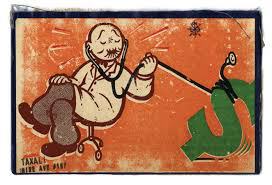
What is planned is explicitly spelled out in the ASAM White Paper on Drug Testing . This is a Trojan horse for expanding the “PHP-blueprint.” The business mode is similar to the razor or printer model. The razor or printer does not generate a profit, the razor and printer cartridge replacements do recurrently. PHPs are simply employee assistance programs (EAPs). Selling the PHP (i.e replacing an existing EAP) does not turn a profit, the non-FDA approved drug and alcohol testing does (and the referrals to the “approved” assessment and treatment centers. The New York Times reported that the size of the US drug-screening industry grew from $800 million in 2000 to $2 billion in 2013.
Infrastructure Already in Place
The drug and alcohol assessment, treatment and testing organizations are already present To replace an EAP with the PHP model it is only necessary to convince an employer or administrative agency in charge of professional licensure. If elected as public policy advocates for addiction treatment they will most assuredly be lobbying and working on state and federal laws and aligning themselves with licensing boards to remove due process and civil liberties by “medicalization”. This could impact anyone from our elderly, to our military, pregnant women, nursing mothers and school children. It is a testing and treatment Trojan Horse. They will be pushing public policy to coerce people into treatment who do not need treatment.
 Creating Bogus Risks of Danger
Linking patient harm to “impaired” doctors is one of the primary propaganda techniques used by the FSPHP to forward the assessment, testing and treatment agenda. Be creating fear in hospital administrators, medical boards and the public ( “The Junkie in the O.R.” ) This appeal to consequences (argumentum ad consequentiam) is suggested by Haning in the editorial. He states the public will react to consequences such as crime, trauma in the workplace, spread of infectious disease and “impact of childhood development of the disordered family “as potential consequences. The PHP system uses a medical license as “leverage” but any other license or benefit provided by the state could be used in the same manner. This is what is called “contingency management” and how this is done is discussed in the ASAM White Paper on Drug Testing.
FSPHP/FASAM/LMD
 The primary architects of this system can be found on a list of Fellows of the American Society of Addiction Medicine. The list can be seen here and includes G. Douglas Talbott, Robert Dupont, and Paul Earley whose contributions to the current paradigm I have detailed in previous posts. The list also includes Greg Skipper who introduced the first non-FDA approved laboratory developed test for alcohol and is currently promoting Soberlink -another junk science gadget that is prominently advertised as the top header in the current issue of ASAM Weekly.
The list of like-minded docs was taken down from the website several months ago. Below is a screenshot taken the week prior. On this list are Dupont, Earley, Skipper and the medical director’s of every single “PHP-approved” assessment and treatment center and it must be a small world after all because if you look at this list it has the name “Bill Haning” on it. You will also find him on the list of ASAM Fellows.



Share this:

Competent, Ethical and Fair Legal Representation for Doctors —A Possible New Niche area for Lawyers.
 Skilled negotiators and lawyers with administrative law experience would do well to consider representation for doctors before medical boards regarding “physician health” matters.It is not that esoteric, complicated or difficult. As with the rest of the population, most have just not critically analyzed the issues behind the curtain.
Source: Competent, Ethical and Fair Legal Representation for Doctors —A Possible New Niche area for Lawyers.
Share this:

Physician Health Programs (PHPs) are not above the law; They just think they are
 The essence of accountability is answerability which means having the obligation to answer questions regarding decisions and actions. This requires the transmission of information when it is requested. The accountable actor provides the information to the overseeing actors in a transparent manner.Accountability also requires explanation and justification for the information provided. What was done and why? Standards, rules, regulations, codes, laws and other benchmarks are then applied by the overseeing actor to determine if the information provided was appropriate or inappropriate.The availability and application of sanctions for illegal or inappropriate actions uncovered through answerability is also a necessary component of accountability. This is necessary to impose restraint on authority and power. Lack of enforcement of sanctions contribute to the creation of a culture of impunity.
Source: Physician Health Programs (PHPs) are not above the law; They just think they are
Share this:

Really in need of funding-Please donate to DisruptedPhysician.com

 Please donate to DisruptedPhysician.com if you can! Making some serious gains and really need funding at this point.
Please donate here.
https://www.gofundme.com/2ccpj29j
Source: Really in need of funding-Please donate to DisruptedPhysician.com
Share this:

ASAM Weekly Editorial recommends Physician Health Program (PHP) organizational groups provide addiction treatment advocacy on a national level to guide public policy: A RED FLAG if ever there was one.
ASAM Weekly is a publication of the American Society of Addiction Medicine (ASAM) circulated by E-mail to “more than 25,00 addiction professionals” every Tuesday. It provides timely news briefings of top stories related to addiction medicine. The current issue includes a National Survey on Drug Use and Health study correlating substance use with suicidal ideation; original research suggesting a strong link between alcohol use and”thwarted belonging” ( wanting and needing to be with others being socially isolated ) with both homicidal and suicidal ideation in a group under community corrections supervision by the criminal justice system; a study of privately billed services looking at the economic impact of the opioid epidemic on the healthcare system (Fair Health White Paper) which found a 1000% increase in opioid related treatment and service costs between 2011 and 2014; and an article written for the Huffington Post entitled “When ‘All or Nothing’ Means Life or Death” that questions the abstinence based model that currently monopolizes addiction treatment in the United States which the author notes “is not only harmful and killing people,” but also “defies much of what we know about addiction.”
In his weekly editorial Editor-in-Chief William Haning refers to prescription database finding that the number of opioid prescriptions written in Tennessee last year outnumbered the number of people in Tennessee. He appropriately notes this should “stun the readership” as it should. He notes several other articles this week “remind us that most of the public is not terribly interested in whether somebody has an addiction” or the socioeconomic impact of addiction. He states “the public really can’t be expected to care” is someone with a substance use disorder is using substance and may not even be “realistically expected to care very much” about those who recover.
“What they do and rightly care about,” Haning declares, “is the outcome of substance usage” and the public “is much more impressed by and will react to the consequences, ” As consequences he points to the two articles concerning suicidal and homicidal ideation and a report concerning sexual assault and violence from the University of Wisconsin . He goes on to state: “It causes an understandable lack of sympathy when a group of illnesses imparts injury to others.” He lists crime, trauma in the workplace, spread of infectious disease and impact of childhood development of the disordered family as additional outcomes or consequences.
Haning notes a dilemma for those in recovery–they want to advocate for others but do not want to draw attention to themselves as the attention is far different from a diabetic or parent of a child with muscular dystrophy pushing for increased research or approval of a new medication. He points out a national organization advocating for the treatment of the mentally ill exists (NAMI) that is comprised largely of those being treated but “no strong national equivalent exists for substance use disorder yet” with two “organized bodies” as exceptions: “physicians who have themselves entered recovery (IDAA), and another, smaller body of physicians in recovery who are engaged in the treatment of SUDs” These “organized bodies” have generally been focused on “ensuring identification of and care of their colleagues and patients” but have more recently become involved in the “pursuit of public policy changes.”
Propoganda, Truth and Credibility
In Propaganda: The Formation of Men’s Attitudes Jacques Ellul discusses the underlying assumptions and ideology that give rise to propaganda and the structures and belief systems needed for propaganda to flourish. Propagandists move with an “assortment of soothing and easily digestible notions.” He discusses how easy it is for most people to accept propaganda as the individual does not want information but only value judgments and preconceived positions. On the surface Haning’s proposal is rational and seems like a good idea. Who could argue with it?
It is important to recognize what Haning is referring to. IDAA is an acronym for International Doctors in Alcoholics Anonymous , an AA fellowship of more than 9500 doctors. The organized body focused on ensuring “identification” of “colleagues” are the state physician health (basically employee assistance programs for doctors). 47 of them are under the management of the Federation of State Physician Health Programs (FSPHP). The organized body focused on “care” of “patients is a group called Like Minded Docs (LMDs). Collectively these groups represent the physician health program model and it is being promoted as “gold standard addiction treatment” based on a 2009 study called the“PHP-blueprint” that reported remarkable success rates (80%). The high success rate is attributed primarily to close linkage with 12-step programs and the use of “residential and outpatient treatment programs that were selected for their excellence.”
Mechanics and Mentality
The “PHP-blueprint” is abstinence based and 12-step participation is mandatory. Random frequent drug and alcohol testing is used with zero-tolerance. A positive test results in an out-of-state “PHP-approved” assessment center and concepts such as “potentially impairing illness” and “relapse without use” are accepted. The core organizational structure includes the state PHP, commercial drug testing labs and a number of out-of-state “PHP-approved” assessment and treatment centers. The PHP’s have no regulation or oversight. The testing, assessments and treatment are out -of-pocket cash only.The assessment and treatment centers have very little oversight and because the commercial drug-testing labs use non-FDA approved laboratory developed tests (LDTs) they are not regulated. No agency exists to provide sanctions for faulty or even fraudulent testing. No internal or external avenues of complaint exist. It is essentially a closed system in which no outside opinion is acknowledged let alone addressed. Transparency and accountability are absent. Due process is absent. Every “PHP-approved” facility is represented by a Like-Minded Doc and many of the doctors involved in the drug-testing process are also on the list of LMDs. It is a rigged system and explained here. Choice in assessment and treatment is removed and the “PHP-approved” facilities engage in “diagnosis rigging” and are willing to label people with diagnoses when they do not in fact meet the diagnostic criteria for that diagnosis. Pervasive problems include:
–Labeling normal variations in behavior as pathological
–Failing to receive proper diagnosis and effective treatment in those who need it
–Forcing unneeded evaluations and treatments including forced committment
Pervasive and Serious Concerns
Physician Health Programs- More Harm Than Good? was the first article critical of PHPs. “Physician health programs under fire” was recently published in the British Medical Journal (BMJ). The lack of accountability and financial and ideological conflicts of interest are addressed. Complaints include coercion, threats, “diagnoses rigging,” lab fraud and false diagnoses to to support unneeded treatment. The physician health program model is a major factor in the current suicide epidemic in doctors.
Profit Motive and Plans for Expansion
In his Editorial Haning mentions a “national organization for advocacy of treatment of the mentally ill” called NAMI and this stands for the National Association of Mental Illness (NAMI). It is considered a pharmaceutically funded front-group founded by Abott Labs, Pfizer, Eli-Lilly and pharmaceutical manufacturers. They all market drugs for mental illness. Mother Jones reported $11+ million over 5 years from Big Pharma, and an Eli Lilly executive directed operations from their headquarters.. A U.S. Senate investigation revealed Big Pharma contributed $23 million in a just two years and until forced by the Senate Finance Committee to identify its corporate donors had refused to do so. The “Campaign to Stop the Stigma of Mental Illness” was started by NAMI and the group claims one out of five adults will suffer some form of mental illness in their lifetime. The system is designed to provide a seemingly altruistic agenda but is in actual fact driven and funded by groups who profit from labelling more people mentally ill. It is, in fact, the very same business model as what we see here but the primary profiteers are not Big Pharma but Big Rehab -the multi-billion dollar drug and alcohol testing, assessment and treatment industry.
What is planned is explicitly spelled out in the ASAM White Paper on Drug Testing . This is a Trojan horse for expanding the “PHP-blueprint.” The business mode is similar to the razor or printer model. The razor or printer does not generate a profit, the razor and printer cartridge replacements do recurrently. PHPs are simply employee assistance programs (EAPs). Selling the PHP (i.e replacing an existing EAP) does not turn a profit, the non-FDA approved drug and alcohol testing does (and the referrals to the “approved” assessment and treatment centers. The New York Times reported that the size of the US drug-screening industry grew from $800 million in 2000 to $2 billion in 2013.
Infrastructure Already in Place
The drug and alcohol assessment, treatment and testing organizations are already present To replace an EAP with the PHP model it is only necessary to convince an employer or administrative agency in charge of professional licensure. If elected as public policy advocates for addiction treatment they will most assuredly be lobbying and working on state and federal laws and aligning themselves with licensing boards to remove due process and civil liberties by “medicalization”. This could impact anyone from our elderly, to our military, pregnant women, nursing mothers and school children. It is a testing and treatment Trojan Horse. They will be pushing public policy to coerce people into treatment who do not need treatment.
Creating Bogus Risks of Danger
Linking patient harm to “impaired” doctors is one of the primary propaganda techniques used by the FSPHP to forward the assessment, testing and treatment agenda. Be creating fear in hospital administrators, medical boards and the public ( “The Junkie in the O.R.” ) This appeal to consequences (argumentum ad consequentiam) is suggested by Haning in the editorial. He states the public will react to consequences such as crime, trauma in the workplace, spread of infectious disease and “impact of childhood development of the disordered family “as potential consequences. The PHP system uses a medical license as “leverage” but any other license or benefit provided by the state could be used in the same manner. This is what is called “contingency management” and how this is done is discussed in the ASAM White Paper on Drug Testing.
FSPHP/FASAM/LMD
The primary architects of this system can be found on a list of Fellows of the American Society of Addiction Medicine. The list can be seen here and includes G. Douglas Talbott, Robert Dupont, and Paul Earley whose contributions to the current paradigm I have detailed in previous posts. The list also includes Greg Skipper who introduced the first non-FDA approved laboratory developed test for alcohol and is currently promoting Soberlink -another junk science gadget that is prominently advertised as the top header in the current issue of ASAM Weekly.
The list of like-minded docs was taken down from the website several months ago. Below is a screenshot taken the week prior. On this list are Dupont, Earley, Skipper and the medical director’s of every single “PHP-approved” assessment and treatment center and it must be a small world after all because if you look at this list it has the name “Bill Haning” on it. You will also find him on the list of ASAM Fellows.
Share this:

The Proposed Expansion of “physician health programs” (PHPs)and the urgent need for a critical analysis of irrational and illegitimate authority

Physician Health Programs (PHPs) claimed “gold standard” for addiction treatment. “80% success rate” being used to promote “new paradigm” to other populations.

1. National Physician Health Program Blueprint Study Publications List
2. Setting the Standard for Recovery: Physicians’ Health Programs
————————————————————————-
PHPs are essentially Employee Assistance Programs (EAPs) for doctors. The vast majority of people know little or nothing about Physician Health Programs (PHPs).
Physician Health Programs (PHPs) are being called the “gold-standard” for EAPs. Claims of unparalleled success are being used to promote PHPs to other populations as a “replicable model of recovery.”
Drs. Robert Dupont and Gregory Skipper are promoting PHPs as “A New Paradigm for Long-Term Recovery” claiming an 80% success rate in doctors.
An article entitled “What Might Have Saved Philip Seymour Hoffman,” claims PHPs “ought to be considered models for our citizenry” and the “best evidence-based addiction treatment system we have going.” The author repeats the 80%…
View original post 1,251 more words

 Urgently

