 A Federal class action lawsuit has been filed in the Eastern District of Michigan against the state PHP program alleging constitutional violations related to the forced medical treatment of health care professionals involved in the State’s “Professionals Health Program” (PHP) and the “callous and reckless termination of professional licenses without due process.” According to the complaint:
“The Health Professional Recovery Program (HPRP) was established by the Michigan Legislature as a confidential, non-disciplinary approach to support recovery from substance use or mental health disorders. The program was designed to encourage impaired health professionals to seek a recovery program before their impairment harms a patient or damages their careers through disciplinary action. Unfortunately, a once well-meaning program, HPRP, has turned into a highly punitive and involuntary program where health professionals are forced into extensive and unnecessary substance abuse/dependence treatment under the threat of the arbitrary application of pre-hearing deprivations (Summary Suspension) by LARA.filed in the the State of Michigan and a private contractor (Ulliance, Inc. of Troy, Michigan) engaged in a conspiracy to violate the civil rights of Michigan health professionals by involuntarily subjecting them to excessive and unnecessary treatment for substance abuse and suspending their licenses if they do not comply.”
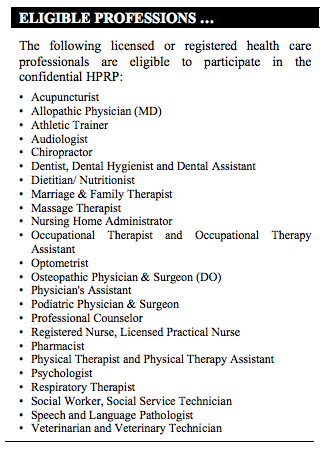
As is the case with most PHPs across the country taken over by the FSPHP the mechanics and mentality are the same. Referrals can be made anonymously by “colleagues, partners, hospital administrations, patients, family members, or the State” to the PHP for any health professional (from acupuncturist to veterinarian) exhibiting “potential signs of impairment”
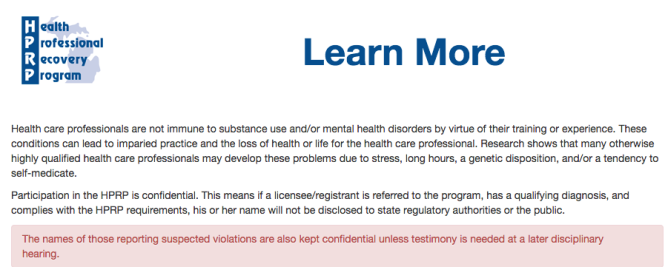
The HPRP website states the names of those reporting are kept confidential “unless testimony is needed at a later disciplinary hearing.”
 After initial intake with HPRP, the licensee is referred to a “qualified evaluator” and “If the evaluation indicates a substance use and/or mental health disorder that represent a possible impairment” the HPRP makes referrals for treatment services to an “approved provider.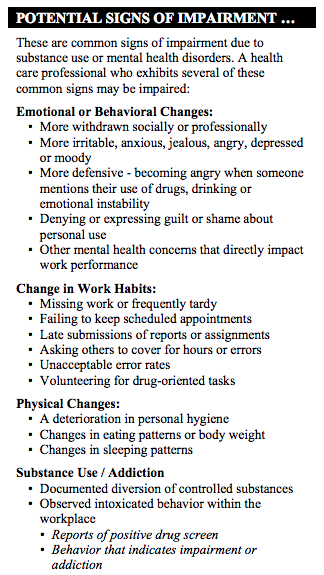
The “qualified evaluators” and “approved providers” are undoubtedly the same out-of-state facilities North Carolina state Auditor Beth Woods found her state program was referring to in her audit of the N.C. PHP under the undefinable justification they were “PHP-approved.”
As with North Carolina, the Michigan PHP will be unable to provide what quality indicators and quantitative measurements are being used to “qualify” and “approve these facilities. None exist as the common denominators in these “PHP-approved” and state mandated assessment and treatment centers are ideological and economic.
The medical directors of almost if not all of them can be seen on this list of “like-minded docs.” The conflicts-of-interest and intertwined relationships among this group is staggering.
The philosophy of Like-Minded Docs is the following:
“We believe that evidence from extensive, well-designed studies demonstrates the great benefits of Twelve-Step recovery modalities including Twelve Step Facilitation in promoting long-term recovery. Further, Twelve-Step modalities are compatible with other treatment strategies including medication-management. We believe that Addiction specialists need to facilitate a path for our patients toward the best possible state of wellness and recovery as they receive treatment for this chronic disease. We believe a well-rounded educational and clinical preparation for physicians choosing to practice addiction medicine or addiction psychiatry requires a comprehensive exposure to the psychosocial and spiritual modalities of treatment as well as the neurobiological and psychopharmacological modalities.”
This connection needs to be made by both North Carolina and Michigan as the state is mandating treatment not only to assessment and treatment centers with economic conflicts of interest but with ideological ones as well. Health care practitioners are being forced into evaluations exclusively at 12-step facilities and excluding non-12 step assessment and treatment centers. This is a clear violation of the Establishment Clause of the 1st Amendment.
The complaint goes on to state the HPRP:
“has expanded its role to include making treatment decisions in place of the opinions of qualified providers. Licensees are subjected to intake evaluations by a pre-selected cadre of providers who profit from the enrollment of HPRP members. This process culminates in a large number of health professionals receiving a “Monitoring Agreement” which is essentially a nonnegotiable contract for treatment selected by HPRP. While HPRP’s contract with the State requires that treatment be selected by an approved provider and that it be tailored in scope and length to meet the individual licensee’s needs, licensees generally receive the same across-the-board treatment mandates regardless of their diagnosis or condition. Further, treatment providers are not permitted to recommend the specific treatment rendered and HPRP has a policy that only HPRP can set the terms of the treatment required in the contract. Failure to “voluntarily” submit to unnecessary and costly HPRP treatment results in automatic summary suspension..”
“Facing the threat of summary suspension in the event of non-compliance, licensed health professionals are induced into a contract as a punitive tool of BHCS and are often required to refrain from working without prior approval, refrain from taking prescription drugs prescribed by treating physicians, and sign broad waivers allowing HPRP to disclose their private health information to employers, the State of Michigan, and/or treating physicians.”
“Every licensee in the State of Michigan who has received a summary suspension, as a result of HPRP non-compliance, has had their private health data transmitted to the BHCS for use during administrative proceedings. In short, the mandatory requirements of HPRP, coupled with the threat of summary suspension, make involvement in HPRP an involuntary program circumventing the due process rights of licensees referred to the program. The involuntary nature of HPRP policies and procedures as outlined above and the unanimous application of suspension procedures upon HPRP case closure are clear violations of Procedural Due Process under the Fourteenth Amendment.”
This is exactly the same system of institutional injustice seen at Ridgeview under G. Douglas Talbott. Multiple physician suicides were attributed to these same abuses–involuntary forced treatment under extortion of loss of licensure. It is time this elephant in the room be addressed in terms of the marked increased in suicide we are seeing now.
http://www.chapmanlawgroup.com/hprp-class-action/
Health Professionals File Class Action Against HPRP
Jurisdiction: U.S. District Court for the Eastern District of Michigan
Subject: Plaintiff’s filed a class action lawsuit on behalf of Michigan health care professionals, alleging constitutional violations related to the forced medical treatment of health care professionals involved in the State’s substance abuse monitoring program (HPRP) and the callous and reckless termination of professional licenses without due process by HPRP and the Bureau of Healthcare Services.
Three Michigan health professionals filed a federal class action for due process violations arising out of execution of a State substance abuse monitoring program known as the Health Professionals Recovery Program. According to the class action lawsuit filed today in the Eastern District of Michigan, the State of Michigan and a private contractor (Ulliance, Inc. of Troy, Michigan) engaged in a conspiracy to violate the civil rights of Michigan health professionals by involuntarily subjecting them to excessive and unnecessary treatment for substance abuse and suspending their licenses if they do not comply.
HPRP, intended as a voluntary treatment program by the legislature, has become a highly punitive and involuntary tool designed to circumvent due process, the complaint states. However, according to the complaint, Carole Engle, the Former Director of the Bureau of Healthcare Services, implemented a policy that any person who does not voluntarily submit to this unnecessary treatment would be immediately suspended without a hearing and prevented from practicing as a health professional. Carole Engle recently resigned her position after Governor Snyder refused to renew her contract with the State of Michigan. It is unclear whether her recent resignation is related to the recently filed class action.
The controversial treatment program has generated a significant amount of criticism in recent years from Michigan health professionals who have called for a class action in an effort to stop HPRP’s abuse of their broad sweeping power. For years, HPRP subjected nurses to three years of intense addiction treatment sometimes on the basis of an anonymous tip.
“We turned to the courts for fairness because HPRP’s mandate of unnecessary treatment has ruined countless lives. My life has been ripped apart by HPRP despite the fact that two evaluators determined that I do not need treatment. I am only one of hundreds who have had to choose between suspension of my license and tens of thousands of dollars worth of treatment that was unnecessary – I just couldn’t afford it, and now I can no longer practice as a nurse” said Carol Lucas, a registered nurse and a Plaintiff in the class action.
Chapman Law Group, a Michigan health care law firm, filed the complaint on behalf of three named Plaintiffs, each of whom fell victim to HPRP’s demand that they submit to unnecessary treatment or have their license suspended. The class includes Michigan health professionals who are or were participants in the Health Professionals Recovery Program during the period from January 1, 2011 to present.
The complaint and amended complaint can be seen below:
Michigan Case 2-15-cv-10337
Michigan Amended Complaint 2-15-cv-10337



 Disrupted Physician